
| The Thailand Long-Term Resident (LTR) Visa is a 10-year, multiple-entry visa introduced by Thailand’s Board of Investment (BOI) in 2022. Indian citizens can apply under four categories. The most relevant for working professionals is the Work-From-Thailand (WFT) Professional category, which requires a minimum income of USD 40,000 per year from an overseas employer. The visa costs THB 50,000 (approx. ₹1,12,000) in government fees and takes approximately 20 working days to process. Successful applicants receive a 10-year multiple-entry visa and a work permit allowing them to work for overseas employers from Thailand. |
| QUICK ANSWER: What are Thailand LTR Visa requirements for Indians? Indian citizens qualify for the Thailand LTR Visa (Work-From-Thailand Professional category) if they: 1. Earn a minimum of USD 40,000/year from an overseas employer or client 2. Hold valid health insurance with at least USD 50,000 coverage 3. Have 5+ years of work experience in their field 4. Provide an employment contract with a non-Thai company 5. Submit proof of income (bank statements, tax returns, salary slips) The visa is valid for 10 years, allows multiple entries, and does not require renewing every year. |
| IMPORTANT LEGAL DISCLAIMER This guide is for informational purposes only. Visa rules, fees, and eligibility requirements can change without notice. This is not legal or immigration advice. Always verify current requirements on the official Thailand BOI website (boi.go.th) or consult a licensed Thai immigration attorney before applying. Processing times and costs stated here reflect reported data as of early 2026 and may vary. |
Introduction
Thailand’s Long-Term Resident (LTR) Visa has become one of the most genuinely useful long-stay visa options available to Indian remote workers and digital nomads. And unlike many visa programs that look good on paper but fail in practice, this one has a track record of approvals for Indian applicants when the application is prepared correctly.
This guide is written specifically for Indian passport holders. That means Indian-specific income documentation requirements, how to handle income earned in INR or through platforms like Upwork and Toptal, and what the BOI actually looks for when reviewing Indian applications. It is not a generic LTR overview translated for an Indian audience audience built from the ground up for your situation.
If you are a software developer, IT consultant, designer, finance professional, or any remote professional earning at least USD 40,000 per year from a non-Thai employer, this visa is worth your serious attention.
Who Is the Thailand LTR Visa Designed For?
The Thailand Board of Investment (BOI) created the LTR Visa to attract four specific types of long-stay foreign residents:
| LTR Category | Who It is For | Min. Income Requirement |
| Wealthy Global Citizen | High-net-worth individuals with investment income | USD 80,000/year OR USD 1M in assets |
| Wealthy Pensioner | Retirees aged 50+ with pension or investment income | USD 40,000/year |
| Work-From-Thailand (WFT) | Remote workers employed by non-Thai companies | USD 40,000/year |
| Highly Skilled Professional | Specialists in S&T, healthcare, finance working in Thailand | USD 80,000/year (or USD 40K with specific credentials) |
For most Indian professionals especially those in IT, software development, consulting, fintech, or digital services the Work-From-Thailand (WFT) Professional category is the most relevant and accessible entry point.
Eligibility Requirements for Indian Citizens
Work-From-Thailand (WFT) Professional Category
To qualify under the WFT category, Indian citizens must meet all of the following:
| Requirement | Minimum Standard | India-Specific Notes |
| Annual income | USD 40,000/year (approximately ₹34.4 lakh) | Must be from a non-Thai employer. INR-based income requires USD conversion proof. |
| Employment type | Employed OR self-employed for overseas clients | Freelancers accepted if income proof is documented correctly (see below) |
| Work experience | 5 years in your professional field | Required — list in CV/resume. Indian work experience certificates are accepted. |
| Health insurance | USD 50,000 coverage minimum | International plans like Cigna Global, AXA, or BUPA required. Indian ECHS not accepted. |
| Passport validity | Valid passport | Indian passport must be valid. OCI card holders see section below. |
| Age | No minimum age stated | No upper age limit for WFT category |
India-Specific Income Proof: What BOI Actually Accepts
This is where most Indian applicants encounter problems and where most online guides fall short. The BOI has specific expectations for how income is documented. Here’s what works and what does not:
For salaried employees of overseas companies
- Last 3 months’ salary slips (in USD or original currency with conversion)
- Employment contract clearly stating overseas employer, designation, and salary
- Last 2 years’ Income Tax Returns from India (ITR-1 or ITR-2 showing foreign income, if applicable)
- Bank statements for last 3 months showing salary deposits
If your salary is paid in INR but you work for a foreign employer (common with Indian subsidiaries), you will need a letter from your employer stating that your role is for the parent/overseas entity and your income equivalent in USD.
For freelancers and self-employed professionals
This is the most complex scenario for Indian applicants. BOI does not have a separate “freelancer” income category your income simply needs to demonstrate USD 40,000/year from non-Thai sources. Acceptable documentation includes:
- Bank statements from the last 12 months showing consistent income (ideally USD 3,333+/month)
- CA-certified income certificate from a Chartered Accountant in India
- Income Tax Returns (ITR-4 for freelancers) for the last 2 years
- Contracts or agreements with overseas clients
- PayPal, Wise, Payoneer, or bank transfer records showing international remittances
- Upwork, Fiverr, Toptal or similar platform earnings statements if applicable
Important: The CA certificate should be on letterhead, stamped, and signed. It should state your annual income clearly and confirm it is from overseas sources. This document is critical \u2014 do not skip it.
Income in INR vs USD: Does it matter?
The BOI calculates the USD 40,000 threshold in US dollars. If you earn in INR, your bank statements will show INR amounts. This is acceptable, but your application should include a clear conversion note or letter explaining the USD-equivalent based on the exchange rate during the period in question.
Applicants who receive international transfers (USD, EUR, GBP) directly have a cleaner documentation trail and generally face fewer questions during the review process.
Documents Required for Indian Applicants
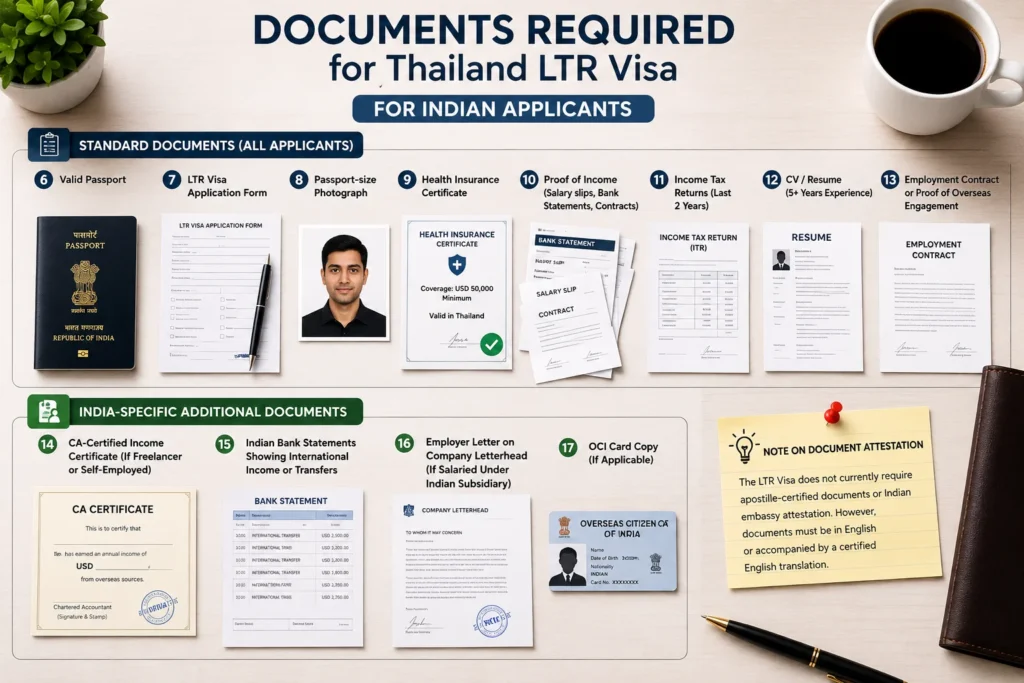
Standard documents (all applicants)
- Valid Indian passport (minimum 6 months validity recommended)
- Completed LTR Visa application form (available via BOI e-Service portal)
- Passport-sized photograph (4×6 cm, white background)
- Health insurance certificate (minimum USD 50,000 coverage, valid in Thailand)
- Proof of income (salary slips, bank statements, contracts)
- Income Tax Returns for last 2 years
- CV/Resume showing 5+ years of professional experience
- Employment contract or proof of overseas engagement
India-specific additional documents
- CA-certified income certificate (if freelancer or self-employed)
- Indian bank statements showing international income or transfers
- Employer letter on company letterhead (if salaried under Indian subsidiary)
- OCI card copy (if applicable see OCI section below)
Note on document attestation: Unlike some visa applications, the LTR Visa does not currently require apostille-certified documents or Indian embassy attestation. However, documents must be in English or accompanied by a certified English translation.
Step-by-Step Application Process
- Create account on BOI’s official e-Service portal (ltrvisat.boi.go.th)
- Complete the online application form and upload all required documents
- Pay the endorsement fee of THB 50,000 (approximately ₹1,12,000) online through the portal.
- BOI reviews the application may request additional documents
- Upon BOI approval, receive the LTR endorsement letter
- Apply for the actual LTR Visa stamp at the Royal Thai Embassy in India (New Delhi, Mumbai, Chennai, or Kolkata) OR at a Thai immigration office if already in Thailand on a valid visa
- Pay the visa fee of THB 10,000 (approximately ₹22,000) at the embassy or immigration office.
- Receive your 10-year LTR Visa sticker in your passport
You can apply entirely online from India through the BOI portal. You do not need to be physically in Thailand to begin the process. The visa stamp can be applied for at the Thai Embassy in India once the BOI endorsement is approved.
Processing Time and Cost Breakdown
| Fee Component | Amount (THB) | Amount (INR approx.) | Notes |
| BOI endorsement fee | THB 50,000 | ₹1,12,000 | Paid online via BOI portal. Non-refundable. |
| Visa stamp fee | THB 10,000 | ₹22,000 | Paid at Thai Embassy in India or Thai Immigration |
| Re-entry permit (if needed) | THB 3,800 | ₹8,500 | Only if exiting Thailand before 1-year check-in |
| TOTAL | THB 63,800 | ₹1,42,500 | One-time cost for 10-year visa validity |
Processing time: The BOI endorsement stage takes approximately 20 working days once all documents are submitted and verified. Processing times can extend to 30-35 working days during peak periods (typically January-March).
Important: The 10-year LTR Visa does not require annual renewal. However, LTR Visa holders must report their address to Thai Immigration every 90 days (standard requirement for all long-stay visa holders in Thailand) and must re-enter Thailand at least once every 12 months to maintain continuous residency.
Banking and Tax Implications for Indian LTR Visa Holders
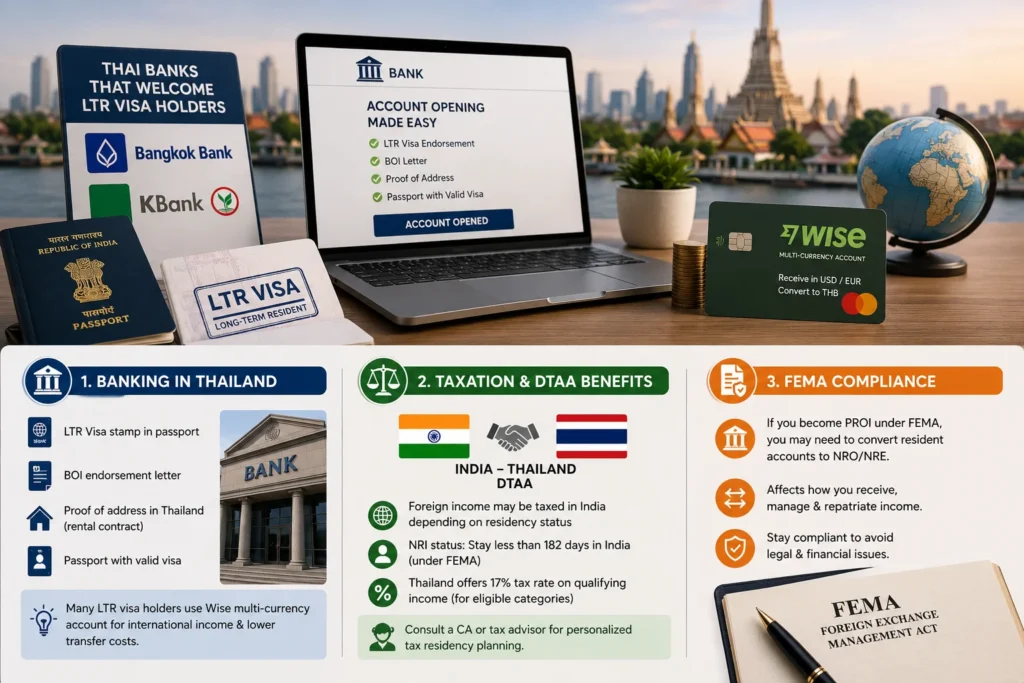
Opening a bank account in Thailand on LTR Visa
The LTR Visa includes a special endorsement that makes it significantly easier to open a bank account in Thailand compared to tourist visa holders. Bangkok Bank and Kasikorn Bank (KBank) both accept LTR Visa holders as customers. You will typically need:
- LTR Visa stamp in passport
- BOI endorsement letter
- Proof of address in Thailand (rental contract)
- Passport with valid visa
Many Indian LTR Visa holders also maintain a Wise multi-currency account for receiving international income in USD or EUR and converting to THB as needed this reduces reliance on Thai banking for international transfers.
India-Thailand Double Tax Avoidance Agreement (DTAA)
India and Thailand have a Double Taxation Avoidance Agreement (DTAA). For Indian citizens who become tax residents of Thailand (spending 180+ days/year in Thailand), this treaty determines how and where their income is taxed.
Key implications for Indian LTR Visa holders:
- Income earned from non-Thai sources (overseas employment, Indian clients) may still be subject to Indian tax depending on your residency status under Indian income tax law
- Becoming a non-resident Indian (NRI) status under FEMA requires spending less than 182 days in India in a financial year
- LTR Visa holders may benefit from Thailand’s special 17% personal income tax rate on qualifying income under the Highly Skilled Professionals category. However, applicants under the Work-From-Thailand (WFT) category may still be subject to standard Thai taxation on Thailand-sourced income.
This is a complex area. Consult a CA or international tax advisor before making decisions based on tax residency planning.
FEMA compliance note
Indian citizens planning to relocate long-term to Thailand on an LTR Visa should be aware of FEMA (Foreign Exchange Management Act) obligations. Specifically, if you become a Person Resident Outside India (PROI) under FEMA, you may be required to convert your resident bank accounts to NRO/NRE accounts. This affects how you receive and repatriate income. Consult your bank and a CA before relocating.
Common Mistakes Indian Applicants Make
| Mistake | Why It Causes Problems | What To Do Instead |
| Submitting salary slips in INR without USD conversion | BOI reviewers need to verify the USD 40,000 threshold clearly | Include a cover letter with exchange rate conversion and a bank statement showing international transfers |
| No CA certificate for freelancers | BOI has no other way to verify unstructured freelance income | Get a CA-certified income certificate on letterhead before applying |
| Using Indian health insurance | Most Indian health insurance plans do not meet the USD 50,000 international coverage requirement for the Thailand LTR Visa. | Get an international health insurance plan such as Safety Wing, Cigna Healthcare Global, or AXA International. |
| Underestimating processing time | Applicants book flights or terminate leases before BOI approval | Allow 30-40 working days. Do not make irreversible plans until the endorsement letter arrives |
| Applying under the wrong category | Highly Skilled category requires additional BOI-recognized credentials WFT is more accessible for most professionals | Start with WFT if you meet the USD 40,000 threshold upgrade later if eligible |
OCI Card Holders: Does It Change Anything?
If you hold both an Indian passport and an Overseas Citizen of India (OCI) card, the OCI card does not directly benefit you for the Thailand LTR Visa application. The LTR Visa is issued based on your nationality (Indian passport), not your OCI status.
However, OCI holders who are tax residents of another country may have a different income documentation trail \u2014 in which case, you should document income based on the country where you are currently residing and paying taxes.
LTR Visa vs Other Long-Stay Options for Indians
| Visa Type | Duration | Work Allowed | Min. Income | Difficulty for Indians |
| Thailand LTR Visa (WFT) | 10 years | Yes (overseas employer) | USD 40K/year | Medium |
| Thailand Tourist Visa | 60-90 days | No (legally) | None | Easy |
| Thailand SMART Visa (T) | 4 years | Yes (Thai companies) | USD 40K/year | Hard (endorsement needed) |
| Malaysia DE Rantau | 3-12 months | Yes (overseas only) | USD 24K/year | Easy-Medium |
| Georgia Remotely From | 12 months | Yes (overseas only) | USD 2K/month | Easy |
The Thailand LTR Visa offers the longest duration and most stable immigration status of any Southeast Asian digital nomad visa available to Indian citizens. Its main competitor for Indians is the Malaysia DE Rantau visa (lower income requirement, shorter stay) and the Georgia Remotely From programme (lower cost, shorter duration, easier to qualify).
Realistic Risks and Limitations
- Income threshold is in USD: Currency fluctuations affect whether your INR income clears the USD 40,000 threshold. A weak rupee year could make documentation complex.
- Freelancers face more scrutiny: BOI reviewers are more familiar with employment contracts than freelance portfolios. Prepare your documentation carefully.
- Health insurance is ongoing: You must maintain valid health insurance throughout your stay on the LTR Visa. If your insurance lapses, you could technically be in violation.
- 90-day reporting is mandatory: Many LTR Visa holders underestimate the administrative burden of 90-day address reporting to Thai Immigration.
- Indian banking complications: Becoming a long-term Thailand resident has FEMA and Indian tax residency implications that require active management.
- Not a path to Thai permanent residency: The LTR Visa does not currently have a pathway to Thai permanent residency. It is a renewable long-stay option, not a settlement route.
Frequently Asked Questions
Can Indian freelancers apply for the Thailand LTR Visa?
Yes. The Work-From-Thailand category accepts self-employed professionals and freelancers, provided they can document annual income of at least USD 40,000 from non-Thai clients or employers. A CA-certified income certificate, ITR filings, and bank statements showing consistent international income are the key documents for freelance applications.
Is USD 40,000 calculated gross or net?
The BOI looks at gross annual income. Your documents should reflect total annual earnings before deductions. If you are a freelancer, the figure on your CA certificate should represent total gross income from overseas sources.
Can I apply from India without going to Thailand first?
Yes. The BOI e-Service portal allows the endorsement application to be completed entirely online. Once the endorsement letter is issued, you can get the visa stamp at the Royal Thai Embassy in India. You do not need to be in Thailand to apply.
Does the LTR Visa allow me to hire Thai employees or start a Thai company?
No. The Work-From-Thailand Professional category allows you to work for your overseas employer only. It does not authorize you to engage in local Thai business activities, hire Thai staff, or operate a Thai business entity. If you want to do any of those things, you would need a Thai Business Visa or BOI-promoted entity status.
What happens if my income drops below USD 40,000/year after I have the visa?
The LTR Visa is issued for the full 10-year period based on eligibility at the time of application. There is no annual income verification requirement. However, if you apply for renewal after 10 years, you would need to meet the income threshold again at that point.
Is the Thailand LTR Visa compatible with NRI status in India?
Long-term Thailand residency can lead to NRI (Non-Resident Indian) status under Indian income tax law if you spend fewer than 182 days in India in a financial year. NRI status has implications for your Indian bank accounts, investments, and tax obligations. This is an area where professional advice from a CA is strongly recommended before making your move.
What Indian bank account do I need to receive income while on the LTR Visa?
If you become an NRI under FEMA, your Indian resident savings accounts should be converted to NRO (Non-Resident Ordinary) or NRE (Non-Resident External) accounts. These accounts have different rules for repatriation of funds. Your Indian bank can guide you through this transition.
Final Verdict: Is the Thailand LTR Visa Right for Indian Professionals?
| For Indian remote workers and digital nomads earning USD 40,000+ per year from overseas employment, the Thailand LTR Visa is one of the most straightforward and legitimate long-stay options available. It offers a 10-year stay, genuine work authorization for remote work, and access to Thailand\u2019s banking system all in a country with high quality of life, strong internet infrastructure, and a large expat community. The main barriers for Indian applicants are documentation complexity (especially for freelancers) and the upfront cost of THB 63,800. If you meet the income threshold and can prepare your documents correctly including the CA certificate and clear income conversion documentation the approval rate for well-prepared Indian applications is strong. This is not a visa for those testing the waters. It is for Indian professionals who have decided they want to base themselves in Thailand long-term and want to do it correctly and legally. |