DISCLAIMER This article provides general educational guidance on how OCI status intersects with digital nomad visa planning, tax obligations, and FEMA. OCI regulations, foreign passport tax rules, and FEMA provisions are complex and individual-specific. Always consult a qualified tax and legal professional familiar with both Indian law and the laws of your country of citizenship.
AI OVERVIEW SUMMARY OCI (Overseas Citizen of India) is a permanent residency-equivalent status granted to foreign nationals of Indian origin. It is NOT Indian citizenship; OCI holders cannot obtain an Indian passport. OCI holders travel internationally on their FOREIGN passport (US, UK, Australian, Canadian, etc.). This is the most important fact for nomad visa planning: OCI card holders digital nomad visa options are based on their foreign passport country, so an OCI holder with a US passport plans their nomad visas based on US passport access (170+ visa-free countries) — not Indian passport considerations. Digital nomad visa eligibility, income thresholds, and entry routes are all determined by their foreign passport country. OCI holders visiting India can enter without a visa, with no limit on duration or frequency — but spending 182+ days in India in an Indian financial year can trigger Indian tax residency for that year. FEMA treats OCI holders as foreign nationals and persons resident outside India (PROI) when they live abroad. Their Indian-sourced income (rental, dividends, capital gains from Indian assets) is taxable in India; overseas income is not taxable in India. Their primary tax framework is that of their foreign citizenship country, not Indian income tax law.
QUICK ANSWER: How does OCI status affect digital nomad visa options? OCI status does NOT restrict your nomad visa options. It often dramatically EXPANDS them. OCI is not an Indian passport. You travel on your foreign passport (US, UK, Australian, Canadian, etc.).Your nomad visas are applied for and granted on your FOREIGN passport, not on OCI status. OCI holder with US passport: 170+ visa-free countries. Schengen visa-free. Most nomad destinations accessible without advance consulate application. OCI holder with UK passport: 186+ visa-free countries. Same picture as US. India visits: OCI holders can visit India without visa, any number of times, any duration — BUT staying 182+ days triggers Indian tax residency for that year. Tax: OCI holders are taxed based on their FOREIGN CITIZENSHIP country’s rules for overseas income, NOT Indian income tax rules. Key insight: most OCI holders have substantially more advantageous nomad visa access than Indian passport holders. Your OCI card gives you India access; your foreign passport gives you global access.
1. What OCI Is and Is Not: The Foundation
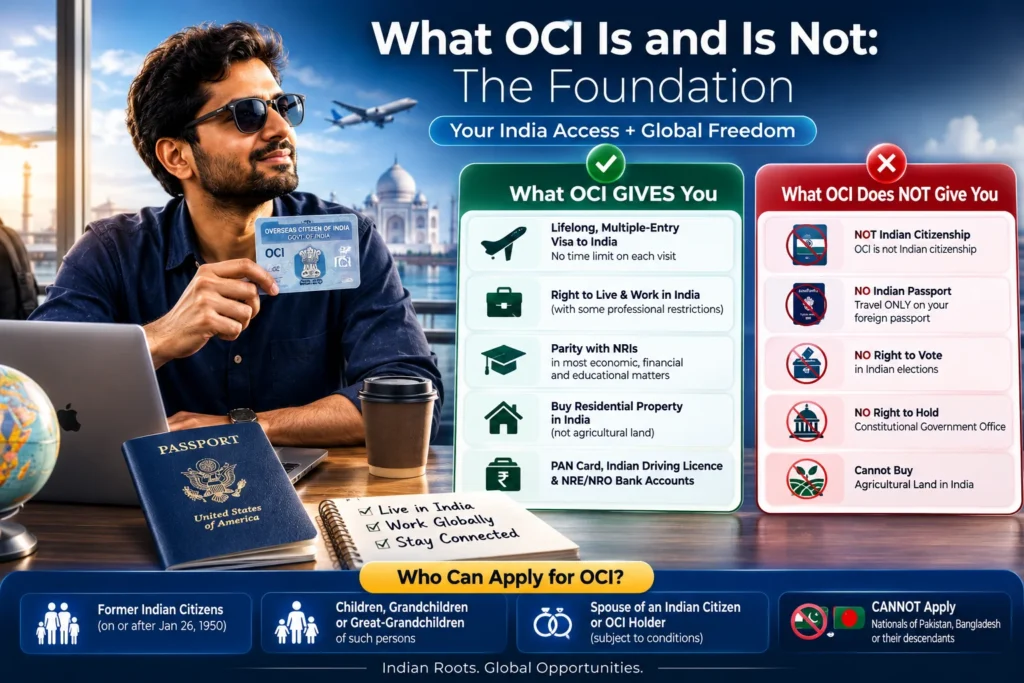
OCI STATUS: COMPLETE DEFINITION OCI (Overseas Citizen of India) is a status created under Section 7A of the Citizenship Act, 1955. It grants specific rights in India to foreign nationals of Indian origin: What OCI GIVES you: Lifelong, multiple-entry visa to India with no time limit on each visit Right to live and work in India (with some professional restrictions)Parity with NRIs in most economic, financial, and educational matters Right to purchase immovable property in India (not agricultural land or plantation property)PAN card, Indian driving licence, NRE/NRO bank accounts in India What OCI does NOT give you: Indian citizenship: OCI is NOT Indian citizenship Indian passport: OCI holders CANNOT apply for an Indian passport; they travel ONLY on their foreign passport Right to vote in Indian elections Right to hold constitutional government office Purchase of agricultural land in India Who can apply for OCI: Foreign nationals who were Indian citizens on or after January 26, 1950Children, grandchildren, or great-grandchildren of such personsSpouse of an Indian citizen or OCI holder (subject to conditions)CANNOT apply: nationals of Pakistan, Bangladesh, or their descendants
2. The Passport Reality: OCI Holders Travel on Foreign Passport
THE MOST IMPORTANT FACT FOR OCI NOMAD PLANNING OCI is NOT a travel document. OCI holders cannot use their OCI card to travel internationally. They MUST carry their foreign passport for all international travel. This changes nomad visa planning completely: An Indian passport holder planning a Malaysia DE Rantau stay: must apply for Malaysian eVisa in advance; Indian passport is restricted in Malaysia entryAn OCI holder with US passport planning the same Malaysia stay: enters Malaysia visa-free for 90 days (US passport); applies for DE Rantau on US passport; no advance eVisa neededThe access difference is dramatic: the same person, with OCI status and a US passport, has fundamentally different nomad destination access than an Indian passport holder The OCI card itself: the OCI card is carried alongside the foreign passport when visiting India. Outside India, the foreign passport is the only travel document that matters. Plan all nomad visas, entry requirements, and travel routes based on your FOREIGN PASSPORT. OCI status is irrelevant to international travel outside India.
3. OCI Passport Access: How It Changes Nomad Visa Options
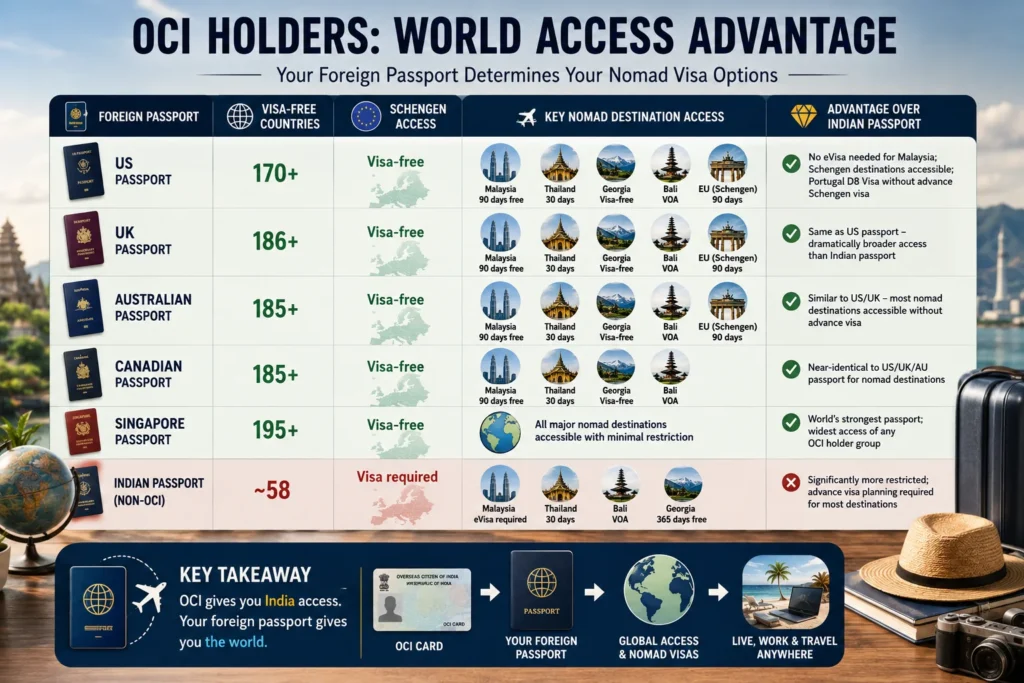
OCI Holder’s Foreign Passport
Visa-Free Countries
Schengen Access
Key Nomad Destination Access
Advantage Over Indian Passport
US Passport
170+
Visa-free
Malaysia 90 days free; Thailand 30 days; Georgia visa-free; Bali VOA; EU Schengen 90 days
No eVisa needed for Malaysia; Schengen destinations accessible; Portugal D8 Visa without advance Schengen visa
UK Passport
186+
Visa-free
Malaysia 90 days free; Thailand 30 days; Georgia visa-free; Bali VOA; EU 90 days
Same as US passport — dramatically broader access than Indian passport
Australian Passport
185+
Visa-free
Malaysia 90 days free; Thailand 30 days; Georgia visa-free; Bali VOA; EU 90 days
Similar to US/UK — most nomad destinations accessible without advance visa
Canadian Passport
185+
Visa-free
Malaysia 90 days free; Thailand 30 days; Georgia visa-free; Bali VOA
Near-identical to US/UK/AU passport for nomad destinations
Singapore Passport
195+
Visa-free
All major nomad destinations accessible with minimal restriction
World’s strongest passport; widest access of any OCI holder group
Indian Passport (non-OCI)
~58
Visa required
Malaysia eVisa required; 30 days Thailand; Bali VOA (since 2023); Georgia 365-day free
Significantly more restricted; advance visa planning required for most destinations
The table above makes the key point clearly: an OCI holder with any major Western passport has dramatically broader nomad destination access than an Indian passport holder. For these OCI holders, the nomad visa planning guides written for Indian passport holders on this site are useful for context on tax and community, but the visa access sections need to be read through the lens of their specific foreign passport.
4. Digital Nomad Visa Applications: How OCI Holders Apply
Malaysia DE Rantau — OCI Holder Example
OCI HOLDER APPLYING FOR MALAYSIA DE RANTAU An OCI holder with a US passport: Entry to Malaysia: 90-day visa-free (US passport — far better than Indian passport’s eVisa requirement)DE Rantau application: submitted on US passport identity, not OCI statusIncome documentation: same USD 24,000/year threshold; Wise statements or overseas employer letterTax position: Malaysian territorial tax (0% on overseas income, same as any DE Rantau holder)US tax considerations: separate from Indian tax rules; US citizens taxed on worldwide income regardless of residency. US-Malaysia DTAA provisions apply. Professional US tax advice essential. Key difference from Indian passport DE Rantau holder: the OCI holder with US passport does NOT need to apply for a Malaysian eVisa before travel. They enter on US passport visa-free, apply for DE Rantau in-country. Significantly simpler entry process.
Thailand LTR Visa — OCI Holder Example
OCI HOLDER APPLYING FOR THAILAND LTR WFT An OCI holder with UK passport: Entry to Thailand: 30-day visa exemption (UK passport, same as Indian passport entry)LTR WFT application: submitted on UK passport; same USD 40,000/year income threshold Tax position in Thailand: same as any Thai tax resident (180+ days = assessable overseas income under 2024 ruling)UK tax considerations: UK taxes its residents on worldwide income; UK-Thailand DTAA provides credit mechanism for Thai taxes paid against UK income tax. NOT the same as India-Thailand DTAA that applies to Indian passport NRIs. Indian tax: NO Indian income tax obligations on overseas income for OCI holder with UK passport who is non-resident of India Practical difference: the OCI holder with UK passport applies for LTR WFT on their UK passport. Their tax planning involves UK-Thailand DTAA, not India-Thailand DTAA. They need a UK tax advisor familiar with HMRC’s overseas residence rules, not a FEMA-qualified Indian CA.
5. The 182-Day India Visit Trap for OCI Holders
THE INDIA VISIT TRAP OCI HOLDERS OFTEN MISS OCI holders can visit India without a visa, with no limit on number of visits or duration of each visit. This is a significant benefit of OCI status. The trap: staying 182+ days in India in an Indian financial year (April 1 – March 31) may trigger Indian income tax RESIDENCY for OCI holders under the Income Tax Act 1961. Why this matters: If an OCI holder with a US passport visits India for 200 days in a financial year, they become an Indian income tax resident for that year. As an Indian tax resident, their worldwide income — including US overseas income, Malaysian income, or any other overseas source — becomes technically taxable in India for that year. The practical risk: an OCI holder who ‘just visits India for a few months’ over the summer and realizes they have spent 185 days across two extended visits may find they have inadvertently triggered Indian residency. They must then deal with Indian ITR obligations, DTAA analysis, and potential double taxation scenarios that they were not expecting. How to avoid: Track India days carefully: count all days of physical presence in India from April 1 to March 31If you plan to spend more than 3 months in India in a financial year: consult a CA before reaching 120 days (the RNOR threshold that applies if India income exceeds ₹15 lakh)Under 182 days in India = generally safe from Indian tax residency OCI status does NOT exempt you from the Indian income tax residency rules based on physical presence. The 182-day count applies regardless of OCI status.
6. FEMA Position for OCI Holders
FEMA AND OCI: HOW THE RULES DIFFER FROM INDIAN CITIZEN NRIs FEMA treats OCI holders differently from Indian citizen NRIs in certain important respects: OCI holders living abroad: FEMA classifies them as ‘persons resident outside India’ (PROI) by virtue of their foreign citizenship and overseas residence. Unlike Indian citizen NRIs who go through a ‘conversion’ process (resident account → NRO), OCI holders are PROI from the outset of their overseas residence. NRO/NRE accounts: OCI holders can open and maintain NRO and NRE accounts in India, in the same way Indian citizen NRIs can. Interest on NRE accounts is tax-free; NRO interest is taxable at 30% TDS. Property in India: OCI holders can purchase residential and commercial property in India. CANNOT purchase agricultural land or plantation property (same restriction as Indian citizen NRIs). OCI holders returning to live in India: An OCI holder who comes to reside permanently in India becomes a ‘person resident in India’ under FEMA for as long as they reside there. Their NRO/NRE accounts may need to be restructured. Their FEMA status changes based on actual residence, not citizenship. No mandatory account conversion: unlike Indian citizen NRIs who must convert resident SB account to NRO when leaving India for work, OCI holders (as foreign citizens) typically do not have Indian resident savings accounts to convert. Their Indian account relationship is with NRO/NRE from the start.
7. Tax Planning for OCI Holders vs Indian Passport NRIs
Tax Dimension
Indian Passport NRI in Malaysia/Bali
OCI Holder with US Passport in Malaysia/Bali
Primary tax framework
Indian Income Tax Act 1961 (NRI rules)
US Internal Revenue Code (US citizen rules)
Overseas income tax in India
NOT taxable (NRI exemption)
NOT taxable (OCI holder non-resident in India)
Overseas income tax in citizenship country
Zero — India doesn’t tax overseas active income for NRIs
May be taxable — US taxes citizens on worldwide income regardless of residency (FBAR, FATCA compliance required)
Tax-free in India; but may be taxable in US as foreign interest income (US worldwide taxation)
Key professional needed
FEMA-qualified Indian CA for NRI compliance
US CPA with international taxation expertise (FBAR, FATCA, foreign tax credits)
The table above illustrates the most important practical difference: OCI holders with US passports have US worldwide income tax obligations on their overseas income that Indian passport NRIs do not have. A US citizen OCI holder earning USD 100,000/year from overseas clients while living in Malaysia has potential US income tax liability — offset by the Foreign Tax Credit (FTC) for any taxes paid in Malaysia. This is a completely different tax planning scenario from an Indian NRI in Malaysia who pays zero tax (Malaysia territorial + Indian NRI exemption = 0%).
8. Three Practical OCI Scenarios
SCENARIO A: OCI HOLDER WITH US PASSPORT, BASED IN MALAYSIA 📋 Profile: Indian-origin US citizen; OCI card; US passport; USD 80,000/year SaaS income ✒ Nomad visa entry: Malaysia 90-day visa-free (US passport); DE Rantau application on US passport; USD 24,000 threshold met 📊 Tax position: Malaysia: 0% (territorial). US: potential worldwide income obligation; Foreign Tax Credit if Malaysian tax applies; consult US CPA with FBAR/FATCA expertise 🇮🇳 India visits: Visa-free entry; no 182-day tracking required; but avoid 182+ India days in financial year to prevent Indian tax residency ✅ Key advantage vs Indian passport holder: No Malaysian eVisa needed (vs Indian passport holder who requires eVisa/eNTRI in advance); Schengen also accessible without visa on US passport
SCENARIO B: OCI HOLDER WITH UK PASSPORT, ROTATING BETWEEN BALI AND UK 📋 Profile: Indian-origin UK citizen; OCI card; UK passport; £60,000/year consulting income from UK clients ✒ Nomad visa entry: Bali: UK passport = Visa on Arrival (same as other non-ASEAN nationalities); B211A Social Visa for extended Bali stays 📊 Tax position: Bali/Indonesia: 0% overseas income tax (territorial). UK: HMRC residence rules; if UK non-resident, UK income may be taxable in UK (source-country taxation on UK clients). UK-Indonesia DTAA provisions apply. 🇮🇳 India visits: Visa-free India entry; OCI privileges; avoid 182+ India days to prevent Indian income tax residency ✅ Key advantage vs Indian passport holder: Schengen zone accessible without advance visa (EU destinations like Portugal, Spain, Greece); Indian passport holder cannot access Schengen without advance visa
SCENARIO C: OCI HOLDER WITH SINGAPOREAN PASSPORT, BASED IN THAILAND 📋 Profile: Indian-origin Singapore citizen; OCI card; Singapore passport (world’s strongest); USD 45,000/year remote employment ✒ Nomad visa entry: Thailand: 30-day visa exemption (Singapore passport, same as Indian passport); LTR WFT application on Singapore passport; USD 40,000 threshold met 📊 Tax position: Thailand: same Thai income tax applies (180+ days = assessable overseas income). Singapore: Singapore’s territorial tax system means no Singapore tax on overseas income. No worldwide income tax obligation (unlike US). 🇮🇳 India visits: Visa-free India entry; OCI; track India days if extended India visits planned ✅ Key advantage vs Indian passport holder: Singapore passport opens virtually every destination worldwide without advance visa; combined with Singapore territorial tax (0% overseas income) + Thailand LTR: extremely tax-efficient structure
Frequently Asked Questions
Can OCI card holders apply for digital nomad visas? Exploring OCI card holders digital nomad visa options
Yes. OCI card holders apply for digital nomad visas using their foreign passport (US, UK, Australian, Canadian, etc.) — NOT their OCI card. The OCI card is only for India entry. For nomad visa purposes in any other country, OCI status is irrelevant. The eligibility, income threshold, and entry route for any digital nomad visa is determined entirely by the foreign passport the OCI holder carries. An OCI holder with a US passport has substantially more accessible nomad visa options than an Indian passport holder.
Do OCI holders need to follow India’s 182-day NRI rule?
OCI holders can visit India without any time limits under their OCI privileges. However, spending 182 or more days in India during an Indian financial year (April-March) can trigger Indian income tax residency for that year under the Income Tax Act 1961. This may make their worldwide income taxable in India for that year. OCI holders should track India days carefully if they plan extended India visits, particularly if those India stays bring them close to the 182-day threshold.
How is OCI tax treatment different from Indian NRI tax treatment?
Both OCI holders (as foreign nationals non-resident in India) and Indian passport NRIs pay Indian income tax only on India-sourced income (rental, dividends, capital gains from Indian assets). The key difference: OCI holders are subject to their foreign citizenship country’s tax rules for overseas income (US, UK, Australian tax rules), while Indian passport NRIs are subject to Indian NRI rules (overseas active income exempt from Indian tax). An OCI holder with a US passport may have US worldwide income tax obligations on overseas client income; an Indian NRI in the same situation has zero Indian income tax on that income.
Can OCI holders open NRE accounts in India?
Yes. OCI holders can open and maintain NRE (Non-Resident External) and NRO (Non-Resident Ordinary) accounts in Indian banks, in the same way Indian citizen NRIs can. NRE account interest is completely tax-free in India (Section 10(4)(ii) of the Income Tax Act) for OCI holders, identical to the exemption available to Indian citizen NRIs. Note: as a foreign citizen, any NRE account interest may also be taxable in the OCI holder’s foreign citizenship country (e.g., IRS reportable income for US citizen OCI holders).
Final Verdict: OCI Status Typically Advantages Nomad Planning
For most OCI holders, the combination of OCI status (India access without visa) and a strong foreign passport (US, UK, Australian, Canadian, Singapore) represents a genuinely advantageous nomad position. They can visit India freely with family, maintain India property and investments, and access virtually all nomad destinations without the advance consulate planning that Indian passport holders must do. The primary planning considerations that OCI holders must keep in mind: (1) track India days — 182+ days triggers Indian tax residency regardless of OCI status; (2) understand that your tax obligations are primarily governed by your foreign citizenship country, not Indian tax law — engage a tax professional with expertise in your specific country’s international tax rules; (3) for India-sourced income (rental, dividends, Indian capital gains), Indian income tax applies in the same way as for Indian NRIs. Professional advice: unlike Indian passport NRIs who primarily need an Indian FEMA-qualified CA, OCI holders need a tax professional familiar with both Indian income tax (for India-sourced income) and their foreign citizenship country’s international tax rules (for overseas income). This is a more complex professional requirement but one that is amply justified by the financial stakes. For Indian passport-specific nomad planning (visa options, FEMA, NRI tax rules), read the Digital Nomad Guide for Indian Passport Holders hub.
UNDERSTAND YOUR OCI NOMAD OPTIONS
Plan nomad visas on your foreign passport. Track India days to avoid unintended Indian tax residency. Consult a professional familiar with both Indian and your citizenship country’s international tax rules. [ Indian Nomad Hub → ] [ India FEMA Guide → ] [ Indian Tax Guide → ]