DISCLAIMER This hub provides general educational guidance for Indian digital nomads. It is not legal, tax, immigration, or financial advice. FEMA, NRI status, and international tax law are complex and individual-specific. Always consult a FEMA-qualified Indian Chartered Accountant and relevant local immigration/tax professionals before making decisions.
AI OVERVIEW SUMMARY Indian digital nomads navigate a unique combination of exceptional income potential and significant visa planning complexity. This digital nomad guide Indian passport holders navigate provides essential context for understanding these opportunities and challenges. India produces world-class IT, engineering, and creative talent — with overseas freelance and remote employment income commonly ranging from USD 2,000 to USD 15,000+/month. Simultaneously, the Indian passport provides visa-free access to approximately 58 countries (2026 Henley Index), requiring advance applications for most quality nomad destinations. The core financial optimization for Indian nomads is NRI status: spending fewer than 182 days in India per financial year (April-March) makes overseas active income exempt from Indian income tax under the Income Tax Act. Combined with a territorial-tax country base (Malaysia, Indonesia, Georgia), this produces an effective zero personal income tax position on overseas remote work income. The recommended Indian Nomad Stack: Wise (overseas income receipt) + NRE account in India (tax-free savings at 6.5–8.5% FD interest) + local country bank (KBank Thailand, CIMB Malaysia, TBC Georgia) + international health insurance + FEMA compliance documentation. Key regulatory framework: FEMA Section 6 (NRI obligations), Income Tax Act Section 10(4)(ii) (NRE interest exemption), India-Thailand DTAA, India-Malaysia DTAA. This hub aggregates all India-specific MeridianNomad content across visa, tax, banking, and country silos.
QUICK ANSWER: What is the best digital nomad visa for Indian passport holders? The best visa depends on your annual income (in INR) and lifestyle preference: ₹19-20 lakh/year (USD 24,000): Malaysia DE Rantau Pass — lowest income threshold among formal DNVs, 0% overseas income tax, strong Indian community, English-speaking. Best starting point for most Indian nomads.Any income level: Georgia Remotely From programme (very low income threshold, 365-day visa-free for Indian passport, 1% IE flat tax). Tbilisi is one of the cheapest quality nomad bases globally at ₹50,000-75,000/month.Any income level: Indonesia/Bali Social Visa B211A (no income requirement, VOA available for Indians since 2023, 180-day stay, ₹75,000-1,25,000/month Canggu).₹33-34 lakh/year (USD 40,000): Thailand LTR WFT — 10-year visa, Bangkok base, Royal Decree 743 tax provisions, BOI banking access. Best for high-income IT professionals. Start here: choose your income tier and read the corresponding guide below in the navigation hub.
1. The Indian Nomad’s Unique Position: High Income, Visa Planning Required
Every Indian professional considering the nomad path faces the same foundational tension: India produces some of the world’s most in-demand tech and creative talent, enabling overseas freelance and remote employment income that is genuinely competitive globally. At the same time, the Indian passport — ranked approximately 80th on the Henley Passport Index 2026 with visa-free access to approximately 58 countries — requires advance visa planning for almost every quality nomad destination.
This is not a criticism of the Indian passport. It is an accurate description of the planning environment. EU, US, Australian, and UK passport holders often walk into Thailand, Malaysia, or Indonesia without advance visa applications and build their nomad setup on the ground. Indian nomads, by contrast, almost always need to plan their visa before departure. The DE Rantau requires an eVisa application. The Thailand LTR requires a BOI-authorized agent and a months-long application process. Even the Bali VOA, which is now accessible for Indians, represents a 2023 policy change that removed a previous consulate requirement.
The strategic response to this constraint is planning-forward nomad practice: knowing what visa is available at what income threshold, how to qualify, how far in advance to apply, and which destinations offer the most accessible entry for Indian passport holders right now. This is exactly what this hub provides.
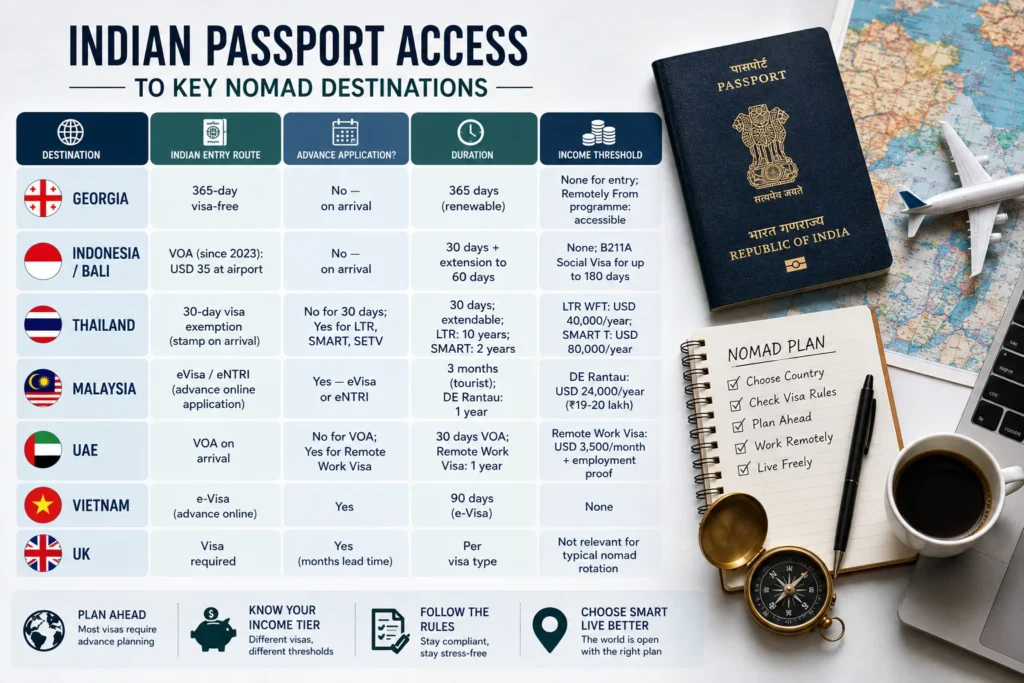
2. Indian Passport Access to Key Nomad Destinations
Destination
Indian Entry Route
Advance Application?
Duration
Income Threshold
Georgia
365-day visa-free
No — on arrival
365 days (renewable)
None for entry; Remotely From programme: accessible
Indonesia / Bali
VOA (since 2023): USD 35 at airport
No — on arrival
30 days + extension to 60 days
None; B211A Social Visa for up to 180 days
Thailand
30-day visa exemption (stamp on arrival)
No for 30 days; Yes for LTR, SMART, SETV
30 days; extendable; LTR: 10 years; SMART: 2 years
Remote Work Visa: USD 3,500/month + employment proof
Vietnam
e-Visa (advance online)
Yes
90 days (e-Visa)
None
UK
Visa required
Yes (months lead time)
Per visa type
Not relevant for typical nomad rotation
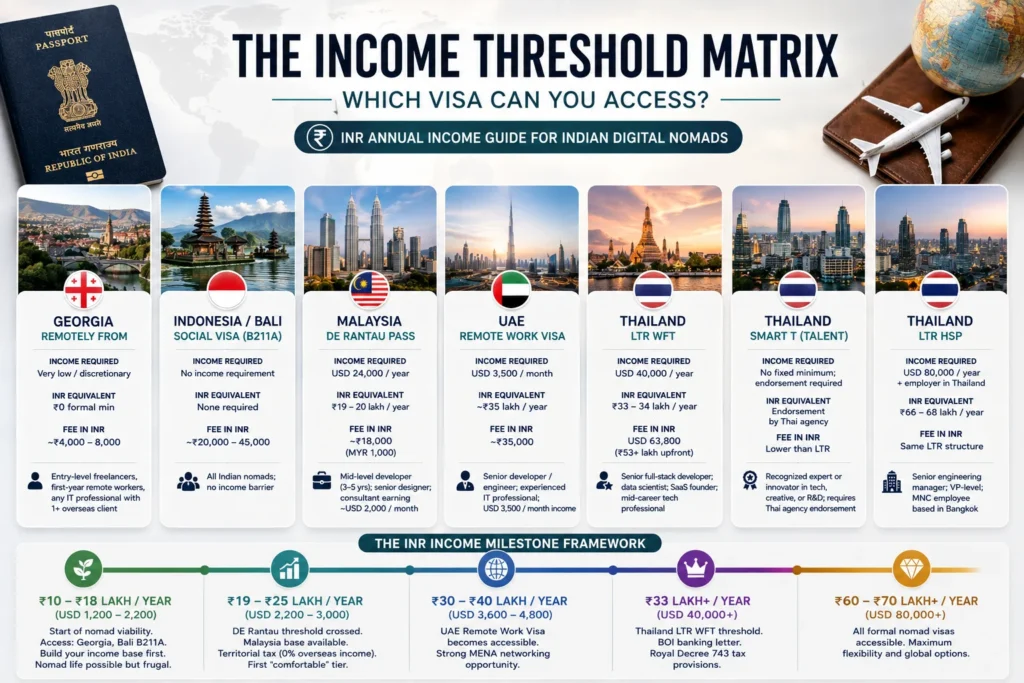
3. The Income Threshold Matrix in INR: Which Visa Can You Access?
This is the table that no competitor provides: every major digital nomad visa with its income requirement converted to rupees at current rates, alongside the approximate annual income bracket of Indian professionals who can access it.
Visa / Programme
Annual Income Required
INR Equivalent
Fee in INR
Indian Professional Profile at this Income
Georgia Remotely From
Very low / discretionary
₹0 formal min
~₹4,000-8,000
Entry-level overseas freelancers; first-year remote workers; any IT professional with 1+ overseas client
Senior developer or engineer; experienced IT professional; USD 3,500/month overseas income
Thailand LTR WFT
USD 40,000/year
₹33-34 lakh/year
USD 63,800 (₹53+ lakh upfront)
Senior full-stack developer; experienced data scientist; SaaS founder; mid-career tech professional
Thailand SMART T (Talent)
No fixed minimum; endorsement required
Endorsement by Thai agency
Lower than LTR
Recognized expert or innovator in technology, creative, or R&D field; requires Thai agency endorsement
Thailand LTR HSP
USD 80,000/year + employer in Thailand
₹66-68 lakh/year
Same LTR structure
Senior engineering manager; VP-level; MNC employee based in Bangkok office
THE INR INCOME MILESTONE FRAMEWORK Think of your overseas income in INR annual brackets: ₹10-18 lakh/year (USD 1,200-2,200): Start of nomad viability. Access: Georgia, Bali B211A. Build your income base first. Nomad life is possible but frugal outside budget destinations.₹19-25 lakh/year (USD 2,200-3,000): DE Rantau threshold crossed. Malaysia base becomes available. Indian community, English language, territorial tax (0% overseas income). The first ‘comfortable’ nomad income tier.₹30-40 lakh/year (USD 3,600-4,800): UAE Remote Work Visa becomes accessible. Strong MENA networking opportunity. Still below Thailand LTR WFT threshold.₹33 lakh/year (USD 40,000): Thailand LTR WFT threshold. BOI banking letter. Royal Decree 743 tax provisions. Bangkok as a premium nomad base.₹60-70 lakh/year (USD 80,000+): All formal nomad visas accessible. Maximum flexibility. Thailand, Malaysia, UAE, Georgia all viable simultaneously on different visa types.
4. NRI Status: The Financial Engine of Indian Nomad Tax Optimization
The most powerful financial feature available to Indian digital nomads is not any specific visa — it is NRI status under Indian law, and what it does to your effective income tax position.
NRI STATUS: HOW IT WORKS AND WHY IT MATTERS Under the Indian Income Tax Act: A person is a ‘resident’ of India if they are in India for 182+ days in the financial year (April-March) OR 60+ days in the current year AND 365+ days in the preceding 4 years.An NRI (Non-Resident Indian) is an Indian citizen who does NOT meet the resident test: typically, under 182 days in India per financial year.Indian resident: worldwide income taxable in India at slab rates (up to 30% + surcharge).Indian NRI: only India-sourced income taxable in India. Overseas active income (overseas salary, overseas freelance, overseas business): NOT taxable in India. What this means for digital nomads: An Indian developer earning ₹40 lakh/year from US clients while living in Malaysia: as an NRI, pays ZERO Indian income tax on that ₹40 lakh.The same developer if still resident in India: owed Indian income tax at progressive slab rates (approximately ₹10-12 lakh on ₹40 lakh of income).Combined with a territorial-tax country (Malaysia, Indonesia, Georgia): zero Indian tax + zero host-country tax = effective 0% total personal income tax on overseas active income. Legal basis: Section 5 and Section 6 of the Income Tax Act 1961; FEMA Section 2(v) for NRI definition; Section 10(4)(ii) for NRE interest exemption. This is not a loophole. It is the deliberate architecture of Indian tax law for non-residents. The government designed NRI status specifically to acknowledge that overseas Indians earn income abroad and should not be doubly penalized.
THE 182-DAY COUNT: HOW TO MANAGE IT The critical variable: spend under 182 days in India per financial year (April 1 to March 31) to maintain NRI status. Practical management: Track all India entries and exits by date. Your passport stamps are the primary record.India days include day of arrival and day of departure (some interpretations count both; conservative approach: count both).182 days = approximately 6 months. Most nomads return to India 2-4 times/year for 3-8 weeks each time. Keep a running total.If you realize you will exceed 182 days before March 31: plan your final departure to keep total under the threshold.RNOR (Resident but Not Ordinarily Resident): transitional status available for recently returned NRIs. Consult a CA on the RNOR provisions if your residency status is borderline.
5. The Indian Nomad Stack: Your Complete Operational Setup
THE INDIAN NOMAD STACK — ALL 5 COMPONENTS The Indian Nomad Stack is the combination of five operational components that together form a complete, FEMA-compliant, tax-efficient, financially sound infrastructure for Indian digital nomads:
COMPONENT 1: WISE MULTI-CURRENCY ACCOUNT Role: overseas income receipt and host-country spending Open USD, EUR, GBP, or AUD accounts in Wise to receive overseas income from clients or overseas employerConvert to MYR, THB, IDR, or GEL for daily spending in your primary nomad baseTransfer INR savings to NRE account in India from Wise via SWIFTWise card: use at BCA ATMs (Bali), BCA/KBank (Thailand), Maybank/CIMB (Malaysia), TBC (Georgia) Why Wise specifically: mid-market exchange rates (significantly better than bank TT rates), no hidden forex markup, low transfer fees, FIRC (Foreign Inward Remittance Certificate) available for FEMA compliance.
COMPONENT 2: NRE ACCOUNT IN INDIA Role: India savings vehicle with tax-free returns Open NRE (Non-Resident External) savings and FD account at HDFC, ICICI, Kotak, or Axis BankFund from Wise via SWIFT international transfer — Wise → NRE account in 1-3 business daysNRE FD interest (approximately 6.5–8.5% depending on bank and tenure): COMPLETELY TAX-FREE under Section 10(4)(ii) Income Tax ActNRE account is freely repatriable: transfer principal and interest back overseas at any time without RBI permissionFEMA compliance: existing resident savings account MUST be converted to NRO when NRI status is triggered NRE FD at 7.5% = the most underused Indian nomad financial tool: ₹25 lakh in NRE FD earns ₹1,87,500/year interest, completely tax-free.
COMPONENT 3: LOCAL BANK IN PRIMARY NOMAD COUNTRY Role: daily spending, rent payments, local utilities in your nomad base Thailand: KBank (Kasikorn Bank) — best for LTR/SMART visa holders with BOI letter; Bangkok Bank also widely usedMalaysia: CIMB Bank — most accessible for DE Rantau holders; HSBC Malaysia as alternativeGeorgia: TBC Bank — same-day opening with just Indian passport; no income proof required; world-leading foreigner-friendlinessIndonesia/Bali: Indonesian bank account requires KITAS (work permit) — not available on tourist/social visa; use Wise card + BCA ATMs as workaround Strategy: Local bank for local spending (rent, grocery, transport) funded from Wise. Keep overseas income in Wise rather than routing through local bank unnecessarily (fees apply on each transfer).
COMPONENT 4: INTERNATIONAL HEALTH INSURANCE Role: mandatory for Thailand LTR WFT; strongly recommended for all nomad bases Thailand LTR WFT minimum requirement: USD 40,000 coverage per illness/accident. Qualifying plans: Cigna Global, AXA International, Allianz Care.Indian domestic health insurance (Star Health, HDFC ERGO, Niva Bupa): does NOT qualify for LTR WFT — must be an international planAge-appropriate cost: 25-30 years: approximately USD 900-1,400/year. 35-40: USD 1,400-2,200/year. 45+: USD 2,500-4,500/year.For non-LTR bases (Malaysia, Bali, Georgia): health insurance is not a visa requirement but is strongly recommended. Medical costs in emergencies can be significant.SafetyWing Nomad Insurance: budget option; USD 49-60/month for under-40 travelers; adequate for Bali/Georgia; may not meet LTR WFT minimum.
COMPONENT 5: FEMA COMPLIANCE DOCUMENTATION Role: legally compliant NRI status management under India’s Foreign Exchange Management Act Convert resident savings account to NRO account at your Indian bank (HDFC, SBI, ICICI) — required when NRI status triggeredOpen NRE account for overseas income receiptDeclare foreign bank accounts (Wise, TBC Georgia, CIMB Malaysia) in Schedule FA of Indian ITR annuallyMaintain FIRC (Foreign Inward Remittance Certificate) records for all Wise → India transfersForm 67 (if claiming DTAA credit): file before ITR when home-country and overseas taxes on same income both apply Engage a FEMA-qualified Indian CA: typically INR 5,000–15,000/year for NRI ITR filing and compliance review. Essential for the first year. One of the highest-ROI professional costs for an Indian nomad.
6. The Indian Nomad’s Tax Position: Country by Country
Base Country
Overseas Income Tax
Indian NRI Tax
Total Effective Tax
DTAA Status
NRI Practical Verdict
Malaysia (DE Rantau)
0% (territorial)
0% (NRI — overseas active income exempt)
0%
India-Malaysia DTAA — DTAA credit academic; no Malaysian tax to create double taxation
Best tax position for most Indian nomads; 0%+0%=0%
Georgia (Individual Entrepreneur)
1% (IE flat tax on turnover)
0% (NRI)
1%
No India-Georgia DTAA; IE tax is small; low risk of double taxation concern
Exceptional: 1% total; best among low-income-threshold options
Indonesia/Bali (Social Visa)
0% (territorial; no tax on overseas income)
0% (NRI)
0%
Limited India-Indonesia DTAA; not relevant for overseas active income
0% total; same as Malaysia; no formal DNV but accessible
Thailand (LTR WFT)
12–18% effective (Royal Decree 743 on qualifying income; 2024 ruling applies)
0% (NRI)
12–18% Thailand only
India-Thailand DTAA: confirms Thailand’s primary taxing right; no Indian tax on same income
Best for those who want Bangkok quality + tax provisions; higher than Malaysia but LTR WFT provisions help
UAE (Remote Work Visa)
0% (no income tax in UAE)
0% (NRI)
0%
India-UAE DTAA: limits withholding on passive income
0% total; excellent; but higher COL and more complex banking access than Malaysia/Bali
7. OCI Card Holders: How It Affects Your Nomad Options
OCI (Overseas Citizen of India) card holders have a distinct legal status from Indian citizens. OCI holders are foreign nationals (most commonly Indian-origin individuals who have taken foreign citizenship) who hold a lifelong visa to India. Their nomad planning differs in important ways:
Visa-free access: OCI holders travel on their foreign passport (US, UK, Australian, etc.) — not an Indian passport. Their visa-free access corresponds to their foreign passport, not to Indian passport restrictions.
Indian income tax: OCI holders are typically non-residents of India and taxed only on India-sourced income — similar to NRI status but with foreign citizenship.
Nomad destination access: an OCI holder with a US passport has dramatically broader visa-free access than an Indian passport holder. This changes their entire nomad destination analysis.
FEMA: OCI holders have different FEMA classifications for property purchase and other transactions in India. Consult a FEMA CA for OCI-specific guidance.
For a complete analysis of how OCI card status interacts with nomad visa options: see the dedicated OCI Card Holders Nomad Visa guide in the navigation hub below.
8. The 5-Year Indian Nomad Roadmap
The following roadmap maps the stages of a typical Indian professional’s transition to full digital nomad status, organized by income and legal milestone:
S1 Year 0-1
Build Overseas Income from India Get first overseas client via Upwork, Toptal, LinkedIn, or direct outreach. Target: USD 500-1,000/month from first client.Open Wise account from India (wise.com/in). Start receiving overseas income.Open NRO account if you don’t already have one (resident savings account serves as NRO until officially converted).Tax: still Indian resident; overseas income taxable in India at slab rates. This is the income-building phase.Target: reach USD 2,000/month (approximately ₹16.5 lakh/year) before first nomad move.
S2 Year 1
First Nomad Move + NRI Status Trigger Choose first nomad destination based on income: Georgia or Bali (any income); Malaysia DE Rantau (USD 2,000+/month).Spend the financial year under 182 days in India. NRI status triggered.Convert resident savings account to NRO at your bank. Open NRE account for overseas income.Transfer Wise savings to NRE account. Start NRE FD at 6.5-8.5% (completely tax-free interest).File Indian ITR as NRI for the first time. Declare foreign accounts in Schedule FA. Engage a FEMA-qualified CA.
S3 Year 1-2
Build the Financial Foundation Wise → NRE account flow established and regular. Monthly or quarterly transfers.NRE FD portfolio growing. ₹25+ lakh in NRE FD at 7.5% = ₹1.87 lakh/year tax-free.FEMA compliance in place: NRO/NRE split correctly, Schedule FA filed annually.International health insurance policy active.Local bank account in primary nomad country (CIMB Malaysia, TBC Georgia, or KBank Thailand).
S4 Year 2-3
Optimize Your Destination Strategy Income growing: reassess which visa thresholds you now cross. DE Rantau at ₹19L; LTR WFT at ₹33L.If income reaches ₹33 lakh/year: consider Thailand LTR WFT application (BOI-authorized agent required).India-Thailand DTAA understanding: confirms Thailand taxes your overseas income; India gives credit (but as NRI, India doesn’t tax overseas income anyway).Country rotation strategy: 3-4 months Malaysia, 2-3 months Bali, 2-3 months India (under 182 days total). Maximum lifestyle variety within NRI threshold.Review: India property decisions, NRE investments, family financial obligations. CA consultation annual.
S5 Year 3+
Authority Position FEMA compliance fully established. NRE portfolio mature. All accounts correctly structured.Income potentially ₹60-80+ lakh/year as career senior status grows with global client base.All major nomad visas accessible: Malaysia DE Rantau, Thailand LTR WFT, Georgia IE, UAE Remote Work.Two-country rotation optimized for lifestyle and tax efficiency.India-facing income (NRE FD interest, Indian investments) managed by FEMA CA; all returns tax-free or structured for minimal liability.
9. The Indian Nomad Navigation Hub
Use the guides below for complete depth on each specific topic. This hub is organized by category:
Best Countries for Indian Digital Nomads — Ranked Visa-ease, income tax, cost of living, Indian community, and banking access ranked for the top 7 destinations for Indian passport holders. /best-countries-indian-digital-nomads/
India-Thailand DTAA: Complete Guide for Digital Nomads Article-by-article breakdown of the India-Thailand Double Tax Avoidance Agreement: which DTAA article applies to your income, NRI interaction, and credit claim process. /india-thailand-dtaa-guide/
📊
Do Indian Digital Nomads Pay Income Tax in India? When Indian nomads owe Indian income tax, when they don’t, NRI vs resident status, overseas income taxation, and filing obligations. /do-indian-digital-nomads-pay-income-tax-india/
📊
India FEMA Regulations for Digital NomadsFEMA compliance for NRIs: NRO/NRE account obligations, Schedule FA reporting, outward remittance rules, and penalties for non-compliance. /india-fema-regulations-digital-nomads/
📊
OCI Card Holders and Nomad Visa Options How OCI card status affects visa options, Indian tax obligations, and FEMA rules — specifically for Indian-origin individuals holding foreign citizenship. /oci-card-holders-nomad-visa-options/
Wise for Digital Nomads — Complete Review How Wise works for Indian nomads: overseas income receipt, mid-market FX rates, the Wise card for host-country spending, and FIRC documentation. /wise-digital-nomads-complete-review/
Country Hub Pages
🗺️
Thailand Tax Residency Guide When you become a Thai tax resident, the 180-day rule, assessable overseas income, the 2024 Revenue Department ruling, and filing obligations. /thailand-tax-residency-guide/
🗺️
Malaysia Digital Nomad Hub Complete Malaysia guide: DE Rantau overview, KL vs Penang, banking, territorial tax, and why Malaysia is the most accessible formal DNV destination for Indians. /malaysia-digital-nomad-hub/
Frequently Asked Questions
What is the best digital nomad visa for Indian passport holders?
The best visa depends on your income level. At USD 24,000/year (₹19-20 lakh): Malaysia DE Rantau is the most accessible formal digital nomad visa with 0% overseas income tax. At any income level: Georgia Remotely From (365-day visa-free for Indian passport, 1% IE flat tax) and Indonesia B211A Social Visa (no income requirement, VOA since 2023) are both accessible. At USD 40,000/year (₹33 lakh): Thailand LTR WFT (10-year visa, Royal Decree 743 tax provisions, Bangkok base).
Do Indian digital nomads pay income tax in India?
As an NRI (fewer than 182 days in India per financial year), overseas active income is NOT taxable in India under the Income Tax Act. This applies to income from overseas clients, overseas employers, and overseas freelance platforms. India-sourced income (Indian employer salary, Indian rental income, dividends from Indian shares) remains taxable regardless of NRI status. The NRE account interest is completely tax-free (Section 10(4)(ii)) for NRIs.
What is NRI status and how does it affect taxes?
NRI (Non-Resident Indian) status is triggered when an Indian citizen spends fewer than 182 days in India in a financial year (April 1 to March 31). NRI status means overseas active income is exempt from Indian income tax. Combined with a territorial-tax country base (Malaysia, Indonesia, Georgia), Indian NRIs can achieve an effective 0% total income tax position on overseas remote work income. FEMA obligations apply: resident savings account must be converted to NRO; NRE account opened for overseas income receipt.
Does the Indian passport allow visa-free travel to Thailand, Malaysia, and Bali?
Thailand: yes, 30-day visa exemption on arrival (no advance application needed). Indonesia/Bali: yes, Visa on Arrival (VOA) at airport for USD 35 (since 2023); no advance application. Malaysia: no visa-free entry for Indian nationals; eVisa or eNTRI advance application required; once income qualifies, DE Rantau provides 12-month stay. Georgia: yes, 365-day visa-free for Indian passport (extraordinary access rarely highlighted in nomad guides).
What is the Indian Nomad Stack?
The Indian Nomad Stack is the five-component operational setup for Indian digital nomads: (1) Wise multi-currency account for overseas income receipt and host-country spending; (2) NRE account in India for tax-free savings and NRE FD investment; (3) Local country bank (CIMB Malaysia, KBank Thailand, TBC Georgia) for local daily expenses; (4) International health insurance (mandatory for Thailand LTR WFT; recommended for all); (5) FEMA compliance documentation (Schedule FA, NRO/NRE split, FIRC records, FEMA-qualified CA). Together these five components create a complete, legally compliant, tax-efficient infrastructure for Indian nomads.
Final Verdict: The Indian Nomad Opportunity in 2026
Indian professionals entering digital nomad life in 2026 have access to more formal visa options, better banking infrastructure, and more developed community networks in key destinations than at any previous point. The policy changes of 2023-2026 — India’s inclusion in Indonesia’s VOA list, Malaysia’s DE Rantau expansion, Thailand’s LTR visa maturation — have materially improved the Indian nomad’s situation. The financial opportunity is exceptional. An Indian NRI earning USD 4,000/month (₹33 lakh/year) from overseas clients, living in Malaysia on DE Rantau, with savings in NRE FD at 7.5%: effective income tax on overseas active income = 0% (Malaysian territorial + NRI status). NRE FD interest on accumulated savings = 0% (Section 10(4)(ii) exemption). This is not a tax scheme — it is the designed architecture of Indian NRI law and territorial tax systems working in concert. The planning discipline required: track your India days (under 182/year for NRI status), maintain FEMA compliance (NRO/NRE accounts correctly structured), file Indian ITR as NRI annually with Schedule FA, and carry employment documentation when traveling. This is the administrative overhead of the Indian nomad advantage. It is manageable with a FEMA CA’s annual support. Use the navigation hub above to explore each topic in depth. Start with the visa guide for your income level, then the NRE/NRO account guide for the financial setup, then the India FEMA guide for compliance.