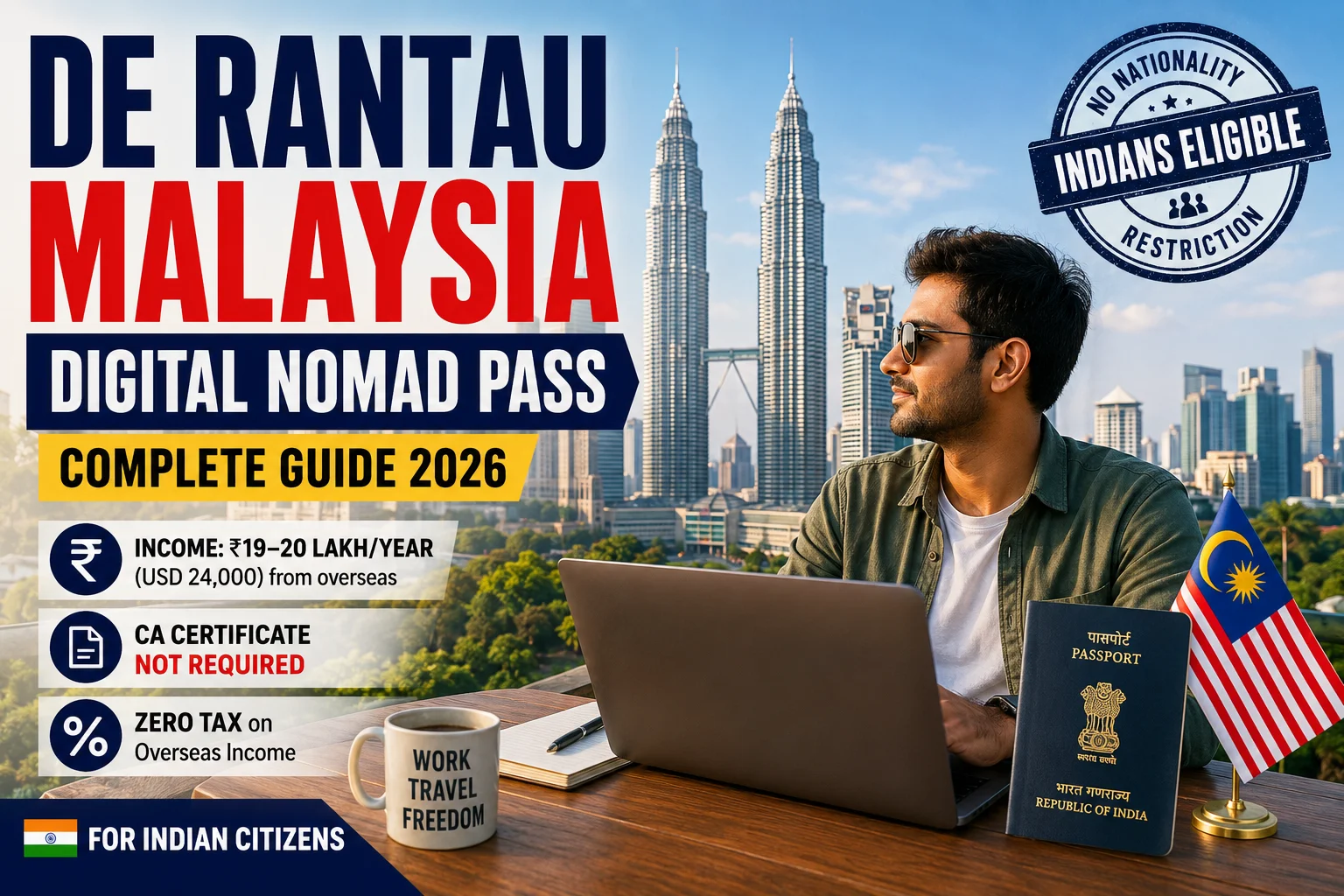
Indian nationals can apply for Malaysia’s DE Rantau Digital Nomad Pass with no nationality restriction. The income threshold for Indian applicants: USD 24,000/year = approximately ₹19–20 lakh/year from overseas clients or foreign employer. This is significantly more accessible than Thailand’s LTR WFT Visa (₹33–34 lakh/year). Key income proof for Indians: overseas bank statements (Wise transaction history preferred), overseas client contracts, or Upwork/platform annual earnings statements. An ICAI CA certificate is NOT required for DE Rantau — unlike Thailand’s LTR WFT Visa. Application fee: MYR 1,000 (≈ USD 220 / ₹18,000). The tax advantage is compelling for Indian NRIs: NRI status (fewer than 182 India days/financial year) means zero Indian income tax on overseas active income; Malaysia’s territorial tax system means zero Malaysian tax on overseas income. Combined effect: overseas professional income with zero personal income tax in either country. Indian community in Malaysia is one of the largest in Southeast Asia — Tamil, Gujarati, and Punjabi communities — with South Indian cuisine and temples extensively accessible in both KL and Penang.
QUICK ANSWER: Can Indian citizens apply for DE Rantau? Yes. Indian passport holders can apply for Malaysia’s DE Rantau Digital Nomad Pass with no nationality restriction. India-specific key facts: Income threshold: USD 24,000/year = approximately ₹19–20 lakh/year from overseas employers or overseas clients Application fee: MYR 1,000 (≈ USD 220 / approximately ₹18,000)CA certificate: NOT required. Unlike Thailand’s LTR WFT Visa, DE Rantau uses bank statements + contracts as income proof. Tax advantage: NRI status (< 182 India days) + Malaysia’s territorial tax system = zero income tax on overseas income in both India and Malaysia Indian community: 7% of Malaysia’s population is of Indian descent — Tamil, Gujarati, Punjabi communities in KL and Penang
DISCLAIMER Requirements can change. Always verify at derantau.mdec.my before applying. This guide reflects requirements as of June 2026. This is not legal, financial, or tax advice. Consult a FEMA-qualified CA for NRI and tax guidance specific to your situation.
Introduction: Why DE Rantau Makes Sense for Indian Digital Professionals
For Indian remote workers and freelancers earning USD 2,000+/month from overseas clients, Malaysia’s DE Rantau represents a unique combination that is difficult to find elsewhere in Asia: legal remote work authorization, zero Malaysian income tax on overseas earnings, access to one of the most established Indian diaspora communities in Southeast Asia, and an English-speaking environment that requires no linguistic adjustment.
The income threshold — USD 24,000/year, approximately ₹19–20 lakh/year — places DE Rantau within reach of mid-senior Indian software developers, digital marketers, consultants, and creative professionals earning above this level from overseas clients. At this income level, Thailand’s LTR WFT Visa (₹33–34 lakh/year minimum) is not accessible. DE Rantau is.
This guide is written specifically for Indian applicants: the income threshold in rupees, the exact documentation for each type of Indian income situation, the CA certificate confusion resolved, the NRI tax advantage explained, and the Indian community life you can expect in KL and Penang.
DE Rantau Eligibility for Indian Nationals
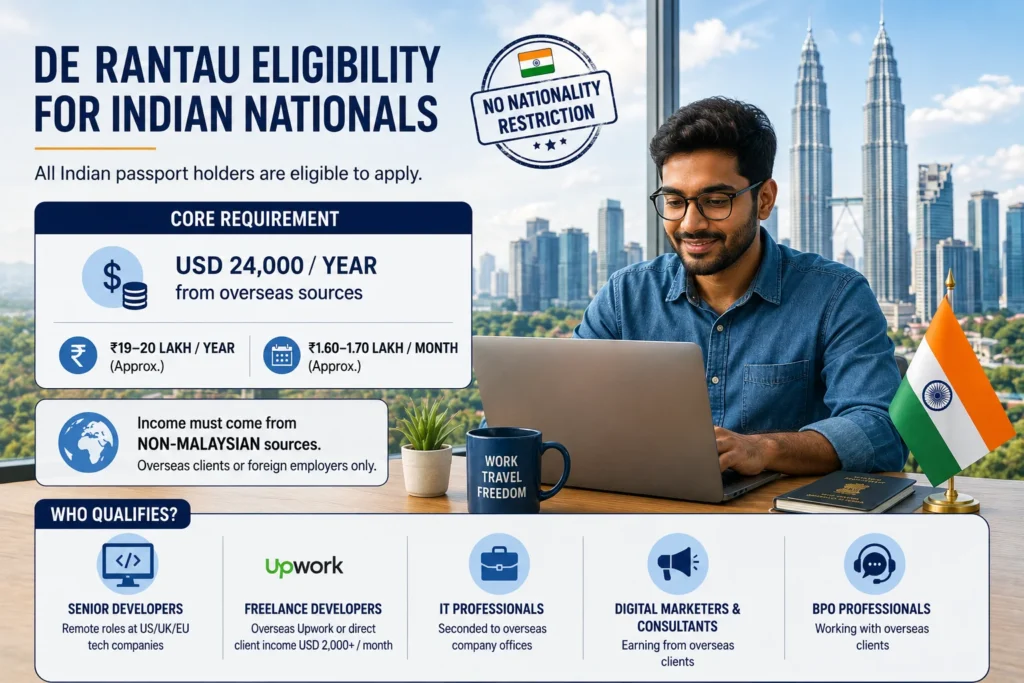
ELIGIBILITY SUMMARY FOR INDIAN PASSPORT HOLDERS No nationality restriction. All Indian passport holders are eligible to apply. The core requirement: USD 24,000/year from overseas sources In INR terms: approximately ₹19–20 lakh/year at current exchange ratesMonthly equivalent: approximately ₹1.60–1.70 lakh/month from overseas clientsIncome must come from NON-Malaysian sources. Indian clients working with overseas MNCs or direct overseas clients qualify. Income from Malaysian companies does NOT qualify. Who qualifies among Indian professionals: Senior software developers at US/UK/EU tech companies (remote position): easily qualifiesFreelance developers with overseas Upwork/direct client income at USD 2,000+/month: qualifiesIndian IT professionals seconded to overseas company offices: qualifies if paid by overseas entityDigital marketers, content creators, consultants earning from overseas clients: qualifies if income threshold metBPO professionals earning from overseas clients: qualifies if income from non-Malaysian source
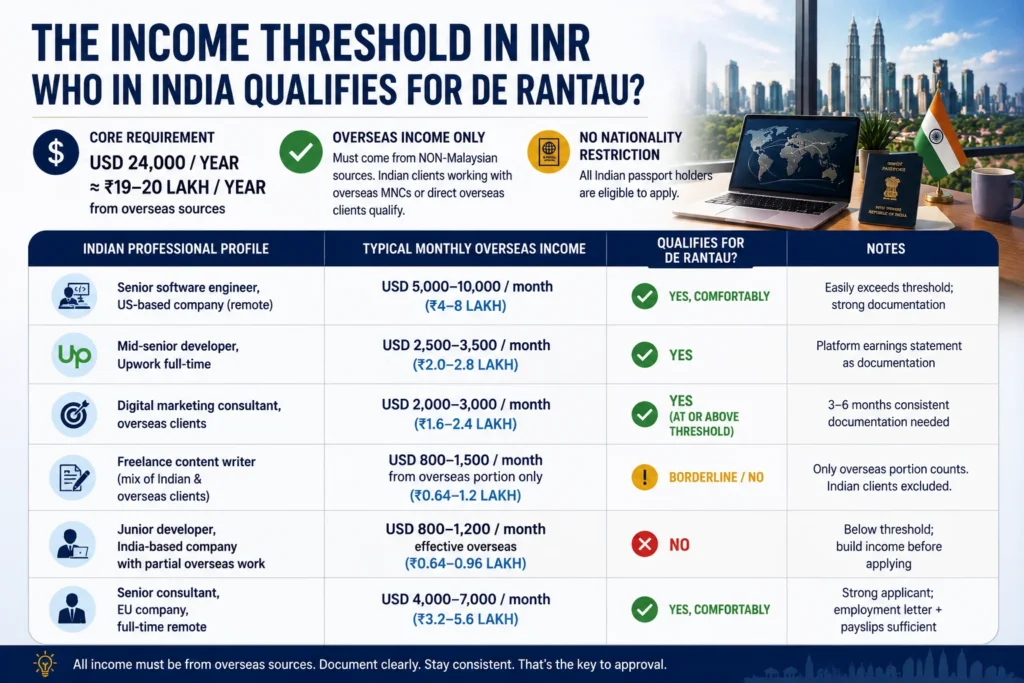
The Income Threshold in INR: Who in India Qualifies
Indian Professional Profile
Typical Monthly Overseas Income
Qualifies for DE Rantau?
Notes
Senior software engineer, US-based company (remote)
Digital marketing consultant, overseas clients (USD 2,000–3,000)
USD 2,000–3,000/month (₹1.6–2.4 lakh)
Yes (at or above threshold)
3–6 months consistent documentation needed
Freelance content writer (mix of Indian and overseas clients)
USD 800–1,500/month from overseas portion only
Borderline / No
Only overseas portion counts. Indian clients excluded.
Junior developer, India-based company with partial overseas work
USD 800–1,200/month effective overseas
No
Below threshold; build income before applying
Senior consultant, EU company, full-time remote
USD 4,000–7,000/month (₹3.2–5.6 lakh)
Yes, comfortably
Strong applicant; employment letter + payslips sufficient
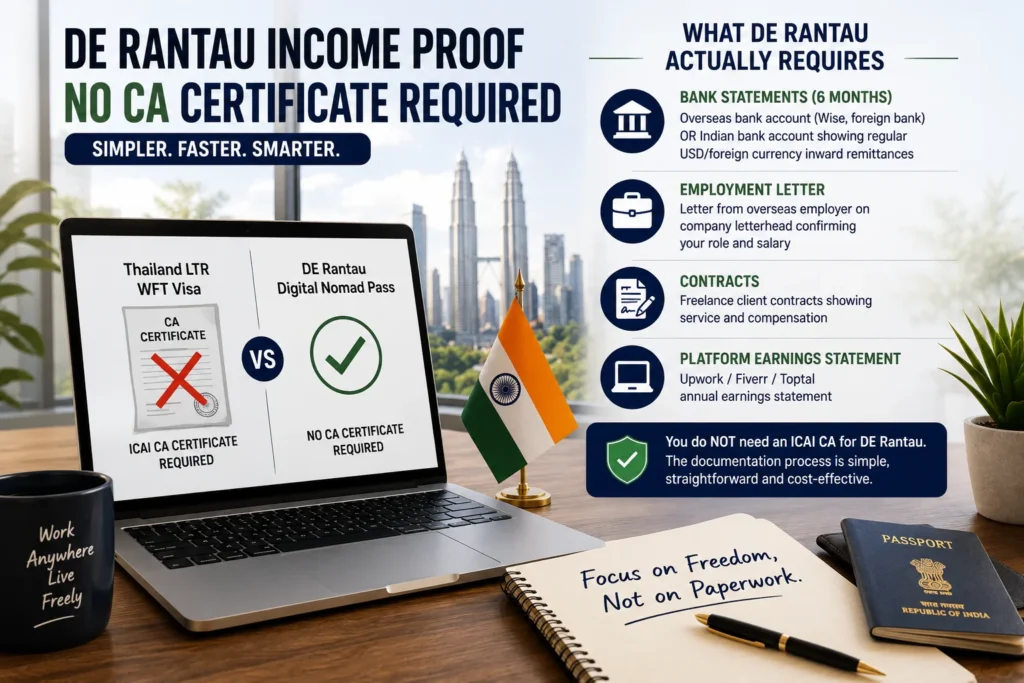
The CA Certificate Question: What DE Rantau Actually Requires
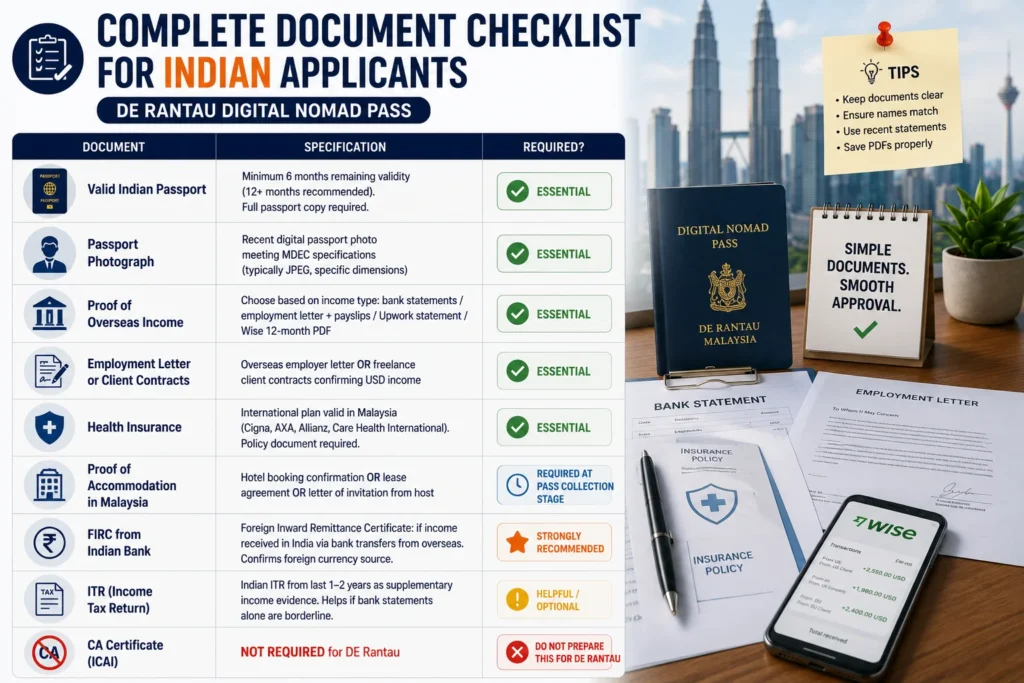
CRITICAL CLARIFICATION FOR INDIAN APPLICANTS Many Indian digital nomads who have researched Thailand’s LTR WFT Visa know it requires an ICAI CA certificate — a certificate from a Chartered Accountant registered with ICAI confirming overseas income. They assume DE Rantau has a similar requirement. DE Rantau does NOT require an ICAI CA certificate. DE Rantau income proof for Indian applicants is: Bank statements (6 months): Overseas bank account (Wise, foreign bank) OR Indian bank account showing regular USD/foreign currency inward remittances Employment letter: Letter from overseas employer on company letterhead confirming your role and salary Contracts: Freelance client contracts showing service and compensation Platform earnings statement: Upwork/Fiverr/Toptal annual earnings statement You do NOT need to engage an ICAI CA for DE Rantau. The documentation process is significantly simpler than Thailand LTR. Preparing a CA certificate for DE Rantau is a waste of time and money.
India-Specific Documentation Guide: By Income Type
Type 1: Salaried by an overseas employer (remote job)
DOCUMENTATION: SALARIED OVERSEAS EMPLOYEE Employment letter from overseas company (on company letterhead): must state your role, salary in USD/EUR, and company’s non-Malaysian registrationLast 6 months payslips from overseas employer showing monthly salaryBank account statements (6 months) showing salary deposits: use overseas account (Wise, US/UK bank) or Indian bank NRE account showing inward remittancesIf income routed through India: provide FIRC (Foreign Inward Remittance Certificate) from Indian bank confirming foreign currency receipt Tip: If paid in USD to an Indian savings account, bank statements alone may be sufficient — but FIRC confirmation strengthens the application.
Type 2: Freelancer with overseas clients (Upwork, direct, Toptal)
DOCUMENTATION: FREELANCER WITH OVERSEAS CLIENTS Wise transaction history (12-month PDF export): the most accepted and cleanest documentation for Indian freelancers. Shows USD receipts, conversion to INR, and source (client payments).Upwork annual earnings statement or Upwork payment history (12 months): official PDF showing total earnings by month Freelance client contracts (at least 2–3 contracts): signed agreements showing scope and compensation in USD Client invoices and payment confirmations: 6–12 months of invoices with corresponding payment receipts Indian bank account statements showing regular inward remittances: if income routed through India after Wise Tip: Wise transaction history is the single most useful document for Indian freelancers. Export 12 months as PDF and include this as your primary income documentation. MDEC reviewers are familiar with Wise as an income receipt tool.
Type 3: Platform earner (Upwork/Fiverr/Amazon/Google AdSense)
DOCUMENTATION: PLATFORM INCOME EARNER Platform earnings statement (12 months): Upwork, Fiverr, Toptal, Amazon Associates, Google AdSense — official annual or monthly earnings statementsPayoneer or Wise annual statement: if income routed through Payoneer or Wise before reaching your bankBank account statements (6 months) confirming the income receipt Important: Income from INDIAN platforms or INDIAN clients does NOT count toward the USD 24,000/year threshold. Only overseas (non-Malaysian, non-Indian) client income qualifies. If your Upwork profile earns from both Indian and overseas clients, document only the overseas client earnings.
Recent digital passport photo meeting MDEC specifications (typically JPEG, specific dimensions)
Essential
Proof of overseas income
Choose based on income type: bank statements / employment letter + payslips / Upwork statement / Wise 12-month PDF
Essential
Employment letter or client contracts
Overseas employer letter OR freelance client contracts confirming USD income
Essential
Health insurance
International plan valid in Malaysia (Cigna, AXA, Allianz, Care Health International). Policy document required.
Essential
Proof of accommodation in Malaysia
Hotel booking confirmation OR lease agreement OR letter of invitation from host
Required at pass collection stage
FIRC from Indian bank
Foreign Inward Remittance Certificate: if income received in India via bank transfers from overseas. Confirms foreign currency source.
Strongly recommended if using Indian bank statements
ITR (Income Tax Return)
Indian ITR from last 1–2 years as supplementary income evidence. Helps if bank statements alone are borderline.
Helpful / Optional
CA certificate (ICAI)
NOT REQUIRED for DE Rantau
Do NOT prepare this for DE Rantau
Entering Malaysia: Indian Passport Requirements
Indian passport holders do not have visa-free access to Malaysia. You need to arrange entry separately from the DE Rantau application:
Entry Method
Details
Best For
Malaysia eNTRI (Electronic Travel Registration)
15-day single entry. Apply online. Approximately USD 30 equivalent. Available to Indian passport holders.
Short initial visit to process DE Rantau stamp
Malaysian eVisa
Apply through Malaysia’s official e-visa portal. Typically 30-day single entry. Valid for tourism.
First entry to collect DE Rantau endorsement
Visit Pass (DE Rantau)
Once MDEC issues the approval letter, present at Malaysian Immigration. The immigration officer will endorse your DE Rantau pass valid up to 12 months.
MHC New Delhi, MHC Mumbai, MHC Chennai issue Malaysian visas. Present De Rantau approval letter for long-stay visa application.
For extended stays; may issue longer initial entry
PRACTICAL ENTRY SEQUENCE FOR INDIANS Apply for DE Rantau online (from India). Wait for MDEC approval letter.Apply for Malaysian eVisa or eNTRI for initial entry to Malaysia.Upon arrival at KLIA: proceed to Malaysian Immigration. Present: passport, DE Rantau approval letter, proof of accommodation.Immigration endorses your passport with DE Rantau Pass. Your 12-month authorization begins.Verify exact current entry requirements at the Malaysian High Commission website or derantau.mdec.my before travelling. Entry procedures can change.
Step-by-Step DE Rantau Application for Indian Citizens
STEP 1
Verify Your Income Eligibility Calculate your monthly overseas income from non-Malaysian, non-Indian clients or overseas employer. Must consistently reach USD 2,000/month (USD 24,000/year) equivalent. If using Wise: export 12-month transaction history and confirm the total. ⚡ Indian clients or Indian-based companies do not count. Only income from overseas (non-Indian, non-Malaysian) sources qualifies.
STEP 2
Gather Your Documentation Package Based on your income type (salaried / freelancer / platform), assemble the relevant documents from the checklist above. Ensure all bank statements and contracts clearly show USD or other foreign currency amounts — not INR only. ⚡ Name your document files clearly in English before uploading: passport_photocopy.pdf, wise_12month_statement.pdf, upwork_earnings_2025.pdf. MDEC reviewers process many applications; organized documentation speeds review.
STEP 3
Purchase Health Insurance Valid in Malaysia Buy an international health insurance plan with Malaysia coverage before applying. MDEC requires this. Options: Cigna Global, AXA International, Allianz Care, Care Health International Global Plan. ⚡ Niva Bupa, Star Health domestic Indian plans do NOT qualify. Must be an internationally valid plan with Malaysia coverage explicitly stated in the policy documents.
STEP 4
Create MDEC Account and Complete Application Go to derantau.mdec.my. Create an account with your email. Fill in the application form: personal details, income amount (in USD), income source (overseas employer / freelance), employment type. ⚡ In the income section: enter your total monthly income in USD. If you earn ₹1.80 lakh/month from an overseas US client, enter the USD equivalent at current rate, e.g., USD 2,150/month.
STEP 5
Upload Documents and Pay MYR 1,000 Upload all required documents. Pay the application fee of MYR 1,000 (approximately USD 220 / ₹18,000) using international Mastercard (Wise card, Revolut, or international credit card) or FPX if you have a Malaysian bank account. ⚡ Wise card works for the MYR 1,000 payment if your card supports international transactions. Alternatively, international Visa/Mastercard from HDFC, ICICI, or Axis Bank works.
STEP 6
Wait for MDEC Review (2–4 Weeks) MDEC states 5–7 working days but actual processing often takes 2–4 weeks for Indian applicants due to document review thoroughness. Check your MDEC portal and email daily. If MDEC requests additional information (AIR — Additional Information Request): respond within 48 hours. ⚡ If you receive an AIR requesting clarification on income source: provide a clear cover letter explaining your income structure. E.g., ‘I provide software development services to Company X, registered in the United States under EIN XXXXXXX. All income is remitted to my Wise account [account number] as shown in the attached statements.’
STEP 7
Receive Approval and Enter Malaysia Upon approval, download the MDEC approval letter. Arrange Malaysian entry (eVisa or eNTRI). At KLIA, present passport and DE Rantau approval letter to immigration for pass endorsement. Your 12-month DE Rantau pass begins. ⚡ Bring all original documents that were uploaded during application. Some immigration officers request originals for verification at the point of endorsement.
The India + Malaysia Tax Advantage for Indian Nomads
THE DOUBLE-ZERO TAX ADVANTAGE FOR INDIAN NRIs IN MALAYSIA Indian NRIs living in Malaysia on DE Rantau face a uniquely favorable tax position: India side: NRI status (fewer than 182 days in India per financial year April–March): India taxes only India-sourced income Overseas active income (from overseas clients/employer) earned by NRI: NOT taxable in India under the Income Tax Act India-Malaysia DTAA: Prevents formal double taxation on any income category Malaysia side: Malaysia’s territorial tax system: Only income sourced WITHIN Malaysia is taxable Overseas income (from overseas employer or overseas clients) is NOT taxable in Malaysia This applies regardless of whether you stay 90 or 365 days in Malaysia Combined effect: India: NRI pays zero Indian income tax on overseas active income Malaysia: Zero Malaysian income tax on overseas income (territorial system)Result: USD 24,000–80,000+ overseas income with zero personal income tax in either country Important caveats: This analysis applies to active overseas income (freelance services, overseas employment). Passive income types (dividends from Indian companies, Indian bank interest, Indian rental income) may still be taxed in India. Home country tax obligations for Indian-sourced income continue regardless of Malaysia residence. Consult a FEMA-qualified Indian CA and a Malaysian tax advisor for your specific situation before making tax decisions based on this framework.
Account structure for Indian NRIs in Malaysia
Account
Purpose
How to Access
Wise (overseas)
Primary income receipt from overseas clients. Convert to MYR for Malaysia spending or INR for India transfers.
Open online from India before departure. Immediate setup.
NRE account (Indian bank)
Receive overseas income repatriated to India. Tax-free interest in India for NRIs. Freely repatriable.
Convert Indian savings account to NRE upon NRI status. Available at HDFC, ICICI, SBI, Axis.
NRO account (Indian bank)
For India-sourced income (rental, dividends, Indian salary if any). Mixed fund account.
Convert resident account to NRO when applicable per FEMA.
CIMB Malaysia (attempt)
Daily MYR spending in Malaysia. Try to open after arrival with full documentation.
Branch visit with DE Rantau pass, MDEC letter, and income documentation.
Indian resident account
Convert to NRO when NRI status triggered. Do not maintain resident account as NRI.
Contact your Indian bank proactively when approaching NRI status.
Indian Community Life in Malaysia: What to Expect
Kuala Lumpur
INDIAN COMMUNITY IN KUALA LUMPUR Brickfields (Little India, KL): Malaysia’s most concentrated Indian community area, 5 minutes from KL Sentral. South Indian banana leaf restaurants, Indian textiles, Tamil newspapers, Hindu temples, Indian grocery stores. Sri Mahamariamman Temple at the entrance is over 100 years old. Major Indian festivals celebrated publicly: Thaipusam (Batu Caves, 35 minutes from KL — one of the world’s largest Hindu festivals), Deepavali (national holiday in Malaysia), Ponggal, Vaisakhi. Tamil language: Widely spoken in the Indian community. Tamil-language schools (SJKT), Tamil newspapers (Tamil Nesan), Tamil TV channels available. Hindi: Less dominant in Malaysian Indian community than in India — most Malaysian Indians are Tamil-speaking. English is the common language between Indian communities of different linguistic backgrounds. Gujarati community: Significant Gujarati business community in Klang Valley. Swaminarayan temple in Petaling Jaya. Punjabi community: Sikh gurdwaras in KL (Gurdwara Sahib Sentul, Gurdwara Sahib Petaling Jaya). Food: Nasi Kandar (open 24 hours; classic Mamak), banana leaf restaurants, Indian breads (roti canai is ubiquitous), biryani, thosai, idli. Indian food is woven into Malaysian cuisine culture.
Penang
George Town’s Little India: Queen Street area with Indian textile shops, flower garland vendors, temples, and South Indian restaurants
Sri Mahamariamman Temple (Penang): One of the oldest temples in Malaysia, George Town
Sri Thandayuthapani Temple: Annual Thaipusam procession in Penang — significant event
Indian food in Penang: Kapitan’s Curry (heritage Indian Muslim restaurant), Hameediyah Restaurant, numerous banana leaf places
Tamil community: Penang has a strong Tamil-speaking Indian community, particularly in Lebuh Pasar and surrounding areas
Frequently Asked Questions
Can Indian citizens apply for Malaysia DE Rantau?
Yes. Indian passport holders can apply for DE Rantau with no nationality restriction. The income threshold in Indian context is approximately ₹19–20 lakh/year (USD 24,000/year) from overseas clients or overseas employer. Application fee is MYR 1,000 (≈ USD 220 / ₹18,000).
What is the DE Rantau income requirement in Indian rupees?
USD 24,000/year = approximately ₹19–20 lakh/year at current exchange rates, or approximately ₹1.60–1.70 lakh/month. Only income from overseas (non-Indian, non-Malaysian) sources counts toward this threshold.
Do I need a CA certificate for DE Rantau as an Indian applicant?
No. Unlike Thailand’s LTR WFT Visa which requires an ICAI CA certificate to certify overseas income, DE Rantau uses bank statements, employment letters, freelance contracts, and platform earnings statements as income proof. Preparing a CA certificate for DE Rantau is not necessary and will not be requested by MDEC.
What is the tax situation for Indian NRIs on DE Rantau in Malaysia?
Favorable. Indian NRI status (fewer than 182 India days per financial year) means India taxes only India-sourced income — not overseas active income. Malaysia’s territorial tax system means overseas income is not taxable in Malaysia regardless of length of stay. Combined: overseas professional income with zero personal income tax in either country, subject to professional advice for your specific situation.
Do Indians need a visa to enter Malaysia for DE Rantau?
Yes. Indian passport holders need a Malaysian entry visa (eVisa, eNTRI, or visa from the Malaysian High Commission) for initial entry. Upon entry with your MDEC approval letter, Malaysian immigration endorses your DE Rantau pass in your passport. Check current Malaysian visa requirements for Indian passport holders at the Malaysian High Commission website before applying.
Is there a strong Indian community in KL and Penang?
Yes. Approximately 7% of Malaysia’s population is of Indian descent, primarily Tamil but also Gujarati, Punjabi, and other communities. KL’s Brickfields (Little India) is a major Indian commercial and cultural hub. Penang’s George Town has its own Little India area. Batu Caves Murugan Temple (35 minutes from KL) is one of the world’s largest Hindu temples. Indian food, Tamil language, temples, and Indian grocery stores are accessible in both cities.
Final Verdict: DE Rantau for Indian Professionals
For Indian digital professionals earning USD 2,000+/month from overseas clients, DE Rantau presents a combination that is difficult to match elsewhere in Asia: legal remote work authorization at a low income threshold, zero Malaysian income tax on overseas earnings, access to a large and established Indian community, English-speaking environment, and total first-year cost under USD 1,700. The tax story is particularly compelling for Indian nomads who are or will become NRIs. The combination of NRI status (no Indian tax on overseas active income) plus Malaysia’s territorial tax (no Malaysian tax on overseas income) creates an effective zero personal income tax position on overseas professional earnings. The documentation process is simpler than many Indian nomads expect: Wise transaction history + contracts + employment letter is sufficient for most Indian income types. The ICAI CA certificate is not needed. Practical recommendation: If your overseas income is USD 2,000–3,500/month and you are open to KL or Penang as a base, DE Rantau should be your first Southeast Asia evaluation. If your income is above USD 3,500/month, compare DE Rantau with Thailand’s LTR WFT Visa to determine which fits better based on city preference and banking needs. See the DE Rantau complete guide for the full application process, or the Malaysia vs Thailand for Indian nomads article for the direct comparison.