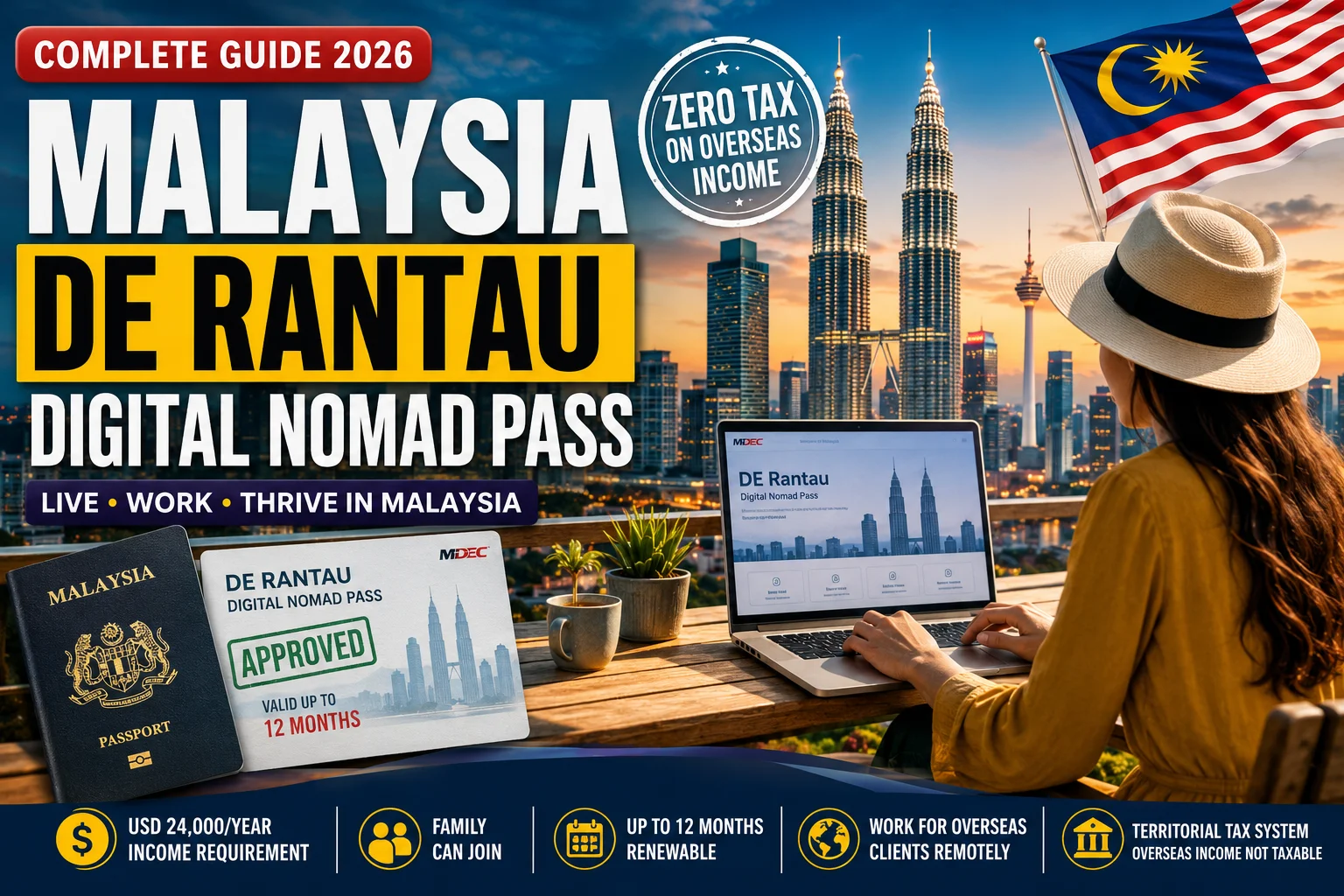
The DE Rantau Digital Nomad Pass Malaysia is a digital economy residency programme managed by MDEC (Malaysia Digital Economy Corporation) that allows remote workers and digital freelancers with overseas income to legally live and work remotely in Malaysia. Key facts: income requirement USD 24,000/year (approximately ₹20 lakh/year INR or PHP 1.3 million/year); application fee MYR 1,000 (approximately USD 220) for individuals, MYR 2,000 for families; pass duration up to 12 months (renewable); application processed online via the MDEC DE Rantau portal. The most important financial advantage: Malaysia uses a territorial tax system, which means overseas income is NOT taxable in Malaysia, even for individuals who qualify as Malaysian tax residents (182+ days). DE Rantau holders who earn income exclusively from overseas sources and spend extended periods in Malaysia effectively pay zero Malaysian income tax on their professional income. Banking note: most Malaysian banks require Employment Pass for smooth account opening; Wise + international card is the practical workaround for most DE Rantau holders. Primary nomad bases: Kuala Lumpur (Mont Kiara, Bangsar, KLCC area) and Penang (George Town).
QUICK ANSWER: What is Malaysia DE Rantau Digital Nomad Pass? The DE Rantau Digital Nomad Pass is Malaysia’s official remote work visa programme for digital professionals with overseas income. Key facts at a glance: Managed by: MDEC (Malaysia Digital Economy Corporation)Income requirement: USD 24,000/year (approximately ₹20 lakh/year or PHP 1.3 million/year)Application fee: MYR 1,000 individual (≈ USD 220); MYR 2,000 family Pass duration: Up to 12 months (renewable)Work authorization: Allows remote work for overseas employers/clients from Malaysia Tax advantage: Malaysia’s territorial tax system means overseas income is NOT taxable in Malaysia No nationality restriction: Open to all passport holders with qualifying overseas income
DISCLAIMER Requirements, fees, and processes are subject to change. Always verify current information at the official MDEC DE Rantau portal (derantau.mdec.my) before applying. This guide reflects requirements as of June 2026 and is not legal or immigration advice.
Introduction: Why DE Rantau Matters
Malaysia’s DE Rantau programme has quietly become one of the most accessible and financially efficient digital nomad visa frameworks in Asia. While Thailand’s LTR Visa gets most of the regional attention, DE Rantau offers something Thailand cannot: zero Malaysian income tax on overseas earnings, even for long-stay residents, due to Malaysia’s territorial tax system.
Combined with an income threshold (USD 24,000/year) that is accessible to a much broader range of digital professionals than Thailand’s USD 40,000/year LTR WFT requirement, and a total cost of approximately USD 220 vs Thailand’s USD 63,800 LTR Visa fee, DE Rantau represents exceptional value for eligible remote workers.
This guide covers every dimension: eligibility, documents, the application process, the tax advantage, cost of living in Kuala Lumpur and Penang, and the specific guidance for Indian and Filipino digital nomads that no other guide provides.
What Is DE Rantau? Programme Overview
DE RANTAU PROGRAMME FACTS Full name: DE Rantau Digital Nomad Pass Programme administrator: MDEC (Malaysia Digital Economy Corporation) Parent ministry: Ministry of Communications and Digital, Malaysia Launch year: 2022 Programme objective: Attract digital economy talent to Malaysia, support the Malaysia Digital hub agenda What DE Rantau provides: Legal authorization to reside in Malaysia and provide digital services for overseas employers or clients Multiple-entry pass valid for up to 12 months DE Rantau Nomad Pass endorsement in your passport Access to Malaysia’s Digital Hub ecosystem and co-working partnerships Dependent pass for qualifying family members (spouse + up to 2 children) What DE Rantau does NOT provide: Authorization to work for Malaysian employers (requires Employment Pass)Permanent residency or citizenship pathwayAutomatic Malaysian bank account (banking requires separate application)
DE Rantau Eligibility Requirements
Requirement
Specification
Notes
Overseas income
USD 24,000/year minimum (USD 2,000/month) from overseas employer or clients
₹20 lakh/year INR or PHP 1.3 million/year. Must be from a NON-Malaysian entity.
Nationality
Any nationality
No restriction. Indian, Filipino, UK, US, Pakistani, Nigerian all accepted.
Age
18 years minimum
No upper age limit stated.
Employment type
Employed by overseas company OR freelancer with overseas clients
Income must originate outside Malaysia. Cannot be Malaysian-sourced income.
Health insurance
Must have health insurance coverage valid in Malaysia
International plans (Cigna, AXA, Allianz) accepted. Local policies may also qualify.
Passport validity
Minimum 6 months remaining validity
Recommended: at least 12+ months remaining for 12-month pass.
Clean background
No criminal record or security concerns
Standard immigration requirement.
USD 24,000/YEAR IN INDIAN CONTEXT The DE Rantau income threshold of USD 24,000/year translates to: Approximately ₹19–20 lakh/year at current exchange ratesApproximately ₹1,65,000/monthCompare: Thailand LTR WFT requires USD 40,000/year (₹33–34 lakh/year) Acceptable income documentation for Indian applicants: Overseas client contracts and invoices (Upwork, direct clients, international employers)Bank statements showing regular international transfers (FIRC from Indian bank)Employment letter from overseas employer confirming salaryWise transaction history (12 months preferred)International payslips or employer payroll statements Note: CA certificate (ICAI) not required for DE Rantau. Unlike LTR WFT Visa, income documentation is simpler: bank statements + contracts are sufficient.
USD 24,000/YEAR IN PHILIPPINE CONTEXT The DE Rantau income threshold translates to: Approximately PHP 1.3–1.4 million/year at current exchange ratesApproximately PHP 108,000–120,000/monthAccessible to senior Filipino developers, consultants, and digital marketers earning above this level Acceptable income for Filipino applicants: Upwork or Fiverr earnings history (platform statement for 12 months)Direct overseas client contracts and invoicesOverseas employer letter with salary confirmationWise or Payoneer annual earnings statementsPhilippine BDO/BPI bank statements showing regular USD inward transfers BIR note: Filing BIR Form 1701 continues regardless of Malaysia stay. Malaysia’s territorial tax system means zero Malaysian tax on overseas income.
The Tax Advantage: Why Malaysia Is Unique
MALAYSIA’S TERRITORIAL TAX SYSTEM — THE KEY ADVANTAGE Malaysia uses a territorial tax system, which means only income derived from within Malaysia is subject to Malaysian income tax. What this means for DE Rantau holders: Overseas income (from foreign employers or overseas clients) is NOT assessable for Malaysian income taxThis applies regardless of how many days you spend in Malaysia per yearEven if you become a Malaysian tax resident (182+ days in Malaysia), overseas income remains non-taxableEffective Malaysian tax rate on overseas professional income: 0% Comparison with Thailand: Thailand (2024 ruling): If you spend 180+ days in Thailand AND bring overseas income into Thailand in the same year earned = assessable for Thai income tax (progressive rates 0–35%)Malaysia (territorial system): Spend 365 days in Malaysia, bring all overseas income into Malaysia = STILL not taxable in Malaysia This makes Malaysia one of the most tax-efficient nomad bases in the region for overseas income earners. DE Rantau’s combination of accessibility (USD 24,000/year), low fee (MYR 1,000), and zero overseas income tax is a compelling package. Important: Your home country tax obligations continue regardless of Malaysia’s zero tax on overseas income. India (NRI rules + DTAA) and Philippines (BIR) filing obligations are not eliminated by Malaysia’s territorial system.
DE Rantau Pass Fees and Costs
Fee Item
Amount
Notes
Individual application fee
MYR 1,000 (≈ USD 220 / ₹18,000 / PHP 12,500)
One-time fee for 12-month pass
Family application (spouse + up to 2 children)
MYR 2,000 (≈ USD 440)
Additional MYR 1,000 for family addition
Pass renewal (12-month extension)
MYR 1,000
Same fee for each renewal
Health insurance (mandatory)
USD 800–2,500/year depending on plan
International coverage required (Cigna, AXA, Allianz)
MDEC co-working access (optional)
Varies by partner space
Some co-working spaces offer DE Rantau discounts
TOTAL FIRST-YEAR COST ESTIMATE (INDIVIDUAL) DE Rantau pass fee: MYR 1,000 (≈ USD 220) Health insurance: USD 800–1,500 (international plan) Total first-year cost: Approximately USD 1,000–1,700 Compare with Thailand LTR WFT Visa: USD 63,800 (BOI application fee alone, 10-year pass) For 12-month stays: DE Rantau at approximately USD 1,000–1,700 total is among the most cost-effective digital nomad visa options in Asia.
For family applicants: marriage certificate (spouse) and birth certificates (children)
DOCUMENT PREPARATION TIPS Bank statements should show consistent income at or above USD 2,000/month over the statement period. One-off large transfers are less convincing than regular recurring income.Wise transaction history: Export as PDF from Wise account. Shows all transfers and confirms overseas income source and regularity.Freelance income: Provide at least 3 client contracts plus corresponding invoice and payment evidence. Platform earnings statements (Upwork) are strong evidence.All documents in non-English languages: certified English translation required.Document authenticity: MDEC may request apostille on key documents. Check current requirements at derantau.mdec.my before submitting.
Step-by-Step DE Rantau Application Process
STEP 1
Create Your MDEC Account Go to derantau.mdec.my and create an account using your email. Verify your email address. This is the portal where your entire application is submitted and tracked. ⚡ Use your primary email. This account will be your point of contact for all MDEC communications.
STEP 2
Complete the Online Application Form Fill in your personal details, employment/freelance information, income details (must show USD 2,000+/month), employment type, and primary Malaysia base (KL or Penang). ⚡ Income section: enter gross monthly income from overseas sources. Be precise and consistent with your supporting bank statements.
STEP 3
Upload Required Documents Upload all required documents in the specified formats (typically PDF, JPG). Document size limits apply. Ensure all documents are clear, complete, and legible. ⚡ Name your files clearly: passport_copy.pdf, bank_statement_jan_mar_2026.pdf, etc. MDEC reviewers process many applications; clear naming speeds review.
STEP 4
Pay the Application Fee Pay MYR 1,000 (individual) or MYR 2,000 (family) via the portal. Accepted payment methods include credit card, debit card, and FPX (Malaysian online banking). International cards (Visa, Mastercard) typically accepted. ⚡ Wise card, Revolut, or international Mastercard debit can be used for the MYR 1,000 payment. Check current payment options on the portal.
STEP 5
Wait for MDEC Review MDEC states 5–7 working days for review. Actual applicant experience: 2–4 weeks in many cases. MDEC may request additional documents (Additional Information Request — AIR) if documentation is incomplete. ⚡ Check your email and MDEC portal daily during this period. Respond to any AIR (Additional Information Request) promptly — delays in responding extend processing time.
STEP 6
Receive Approval Letter Upon approval, you receive an approval letter via email and downloadable from the portal. This letter is your authorization to proceed to immigration processing. ⚡ Print multiple copies of the approval letter. You may need it at multiple stages.
STEP 7
Process at Immigration / MDEC Centre Present your approval letter and passport at the designated MDEC processing centre or Malaysian immigration counter. Your passport receives the DE Rantau Nomad Pass endorsement stamp. ⚡ Bring all original documents including those uploaded during application. Processing at the centre is typically same-day or within 1–2 days.
STEP 8
Enter Malaysia and Activate Your Pass Travel to Malaysia (or if already in Malaysia, complete immigration processing locally). Your 12-month period begins from the date of endorsement. ⚡ Set a calendar reminder for 2 months before your pass expiry to begin renewal process. Allow adequate lead time for renewal.
Kuala Lumpur as Your DE Rantau Base
Best areas for digital nomads in KL
Area
Character
Monthly Rent (1BR)
Best For
Mont Kiara
International expat hub; family-friendly; malls, international schools
MYR 2,500–4,000
Families, expats wanting international community
Bangsar / Bangsar South
Young professional hub; good cafes and restaurants; tech company offices
MYR 2,000–3,500
Solo nomads and couples; co-working access
KLCC / Bukit Bintang
City centre; luxury options; tourist area; Petronas Towers vicinity
MYR 2,500–5,000+
Short stays, high-end preference
Petaling Jaya (PJ)
Suburban; lower cost; good connectivity via MRT
MYR 1,500–2,500
Cost-conscious, longer stays, quieter environment
Cost of living in Kuala Lumpur (DE Rantau holder, 2026)
Expense Category
Monthly Cost (MYR)
Monthly Cost (USD approx.)
Accommodation (1BR, Mont Kiara / Bangsar)
MYR 2,500–3,500
USD 550–775
Food (mix of hawker centres + restaurants)
MYR 600–1,200
USD 130–265
Transport (Grab, MRT, occasional taxi)
MYR 200–400
USD 44–88
Co-working space (full month)
MYR 400–800
USD 88–175
Health insurance (international plan)
MYR 350–700
USD 77–155
Internet (fibre at apartment, backup SIM)
MYR 100–200
USD 22–44
TOTAL ESTIMATED
MYR 4,150–6,000
USD 910–1,320
Penang: The DE Rantau Alternative Base
George Town, Penang offers a compelling alternative to Kuala Lumpur for DE Rantau holders: lower cost of living, UNESCO Heritage architecture, a world-renowned food scene, and a smaller but welcoming expat community. Many nomads cycle between Penang (2–3 months) and KL (rest of year).
Cost of living: approximately 20–30% lower than Kuala Lumpur for accommodation
1BR apartment in George Town: MYR 1,200–2,200/month
Co-working: Common Ground Penang, Colony, several boutique spaces in George Town
Connectivity: Penang International Airport with connections to Singapore, KL, Bangkok
Best for: Nomads wanting a slower pace, heritage environment, and reduced costs
Banking for DE Rantau Holders: The Practical Reality
Banking is the most consistently reported challenge for DE Rantau holders. Malaysian banks generally require a stronger status document than DE Rantau for smooth personal account opening:
Bank
DE Rantau Account Opening
Notes
CIMB
Possible but branch-dependent
CIMB has reported being more flexible for DE Rantau holders than some peers. Try CIMB Go Online or branch
Maybank
Difficult without Employment Pass
Primarily targets Malaysian citizens and Employment Pass holders
RHB
Branch-dependent
Some branches have opened accounts for DE Rantau holders with extensive documentation
Public Bank
Generally difficult
Reports suggest Employment Pass preferred
HSBC Malaysia
Possible (international bank)
HSBC’s international infrastructure may be more accommodating for foreign pass holders
THE PRACTICAL BANKING SOLUTION FOR DE RANTAU HOLDERS Primary recommended setup (same as Thailand): Wise multi-currency account: Receive overseas income in USD/EUR, convert to MYR for daily expenses, 2 free ATM withdrawals/month. Works immediately with no Malaysian bank required.Try CIMB or HSBC Malaysia for MYR account: Bring DE Rantau Pass endorsement, MDEC approval letter, passport, proof of address in Malaysia, and income documentation. Branch selection matters.Grab Financial / Boost e-wallet: Malaysian e-wallets work with international cards. Grab Pay linked to Visa/Mastercard works at most Malaysian merchants without a local bank account.International ATM card: Wise or Revolut card works at Malaysian ATMs. Malaysia ATMs generally charge MYR 12–20 per foreign card withdrawal.
India-Specific DE Rantau Guide
INDIAN NATIONALS: COMPLETE DE RANTAU FRAMEWORK Income documentation approach: Option 1 — Salaried: Employer letter from overseas company + last 6 months payslips + bank account showing salary depositsOption 2 — Freelancer: Last 12 months Wise transaction history + client contracts/invoices + ITR (Indian tax return) showing overseas incomeOption 3 — Platform earner (Upwork/Fiverr): Annual earnings statement from platform + Wise/bank statements showing transfers Indian FEMA and NRI implications: Spending fewer than 182 days in India per financial year = NRI status under FEMA. Same implications as for Thailand.Overseas income (earned from overseas sources) as NRI: not taxable in IndiaMalaysia’s territorial tax system: zero Malaysian tax on overseas incomePractical result for Indian NRIs on DE Rantau: India taxes only India-sourced income; Malaysia taxes zero overseas income. Effective double-zero tax on overseas active income. Indian community in Malaysia: Significant Indian Tamil and Indian Gujarati communities in KL and PenangIndian restaurants, grocery stores, temples: very accessible in both citiesHindi and Tamil widely understood; English the business language
FILIPINO NATIONALS: COMPLETE DE RANTAU FRAMEWORK Income documentation approach: Upwork/Fiverr/platform earners: Annual earnings statement from platform + Wise or bank statements confirming USD incomeSalaried overseas employee: Employer letter + payslips + BDO/BPI bank statements showing international salary depositsDirect freelancer: Overseas client contracts + 12 months invoices and payments + Wise statement Philippine BIR and tax obligations: BIR Form 1701 filing continues regardless of Malaysia stayMalaysia’s zero tax on overseas income does NOT affect BIR obligationsPhilippines-Malaysia DTAA: Provisions prevent formal double taxation on income taxed in both countries (though Malaysian overseas income tax is zero, so treaty mainly relevant for Malaysia-sourced income if any) Filipino community in Malaysia: Large Filipino community in Kuala Lumpur (estimated 50,000+)Active OFW community; many Filipino restaurants and social spacesEnglish widely used — Filipinos transition easilyAirAsia and Cebu Pacific: multiple daily flights KL–Manila and KL–Cebu
DE Rantau vs Thailand LTR Visa: The Decision Framework
Factor
DE Rantau (Malaysia)
LTR WFT Visa (Thailand)
Better For
Income requirement
USD 24,000/year
USD 40,000/year
DE Rantau — accessible to more professionals
Application fee
MYR 1,000 (≈ USD 220)
THB 3,500–10,000 (SMART) or USD 63,800 (LTR)
DE Rantau dramatically cheaper
Pass duration
12 months (renewable annually)
10 years (LTR)
LTR for long-term commitment; DE Rantau for flexibility
Tax on overseas income
0% (territorial tax)
Progressive rates 0–35% on same-year transfers
DE Rantau wins on overseas income tax
Total annual cost
~USD 1,000–1,700 (fee + insurance)
~USD 65,000+ Year 1, then lower
DE Rantau dramatically cheaper Year 1
Visa stability
Annual renewal required
10-year pass after approval
LTR more stable for long-term planning
City quality
KL and Penang: excellent
Bangkok: excellent
Personal preference; similar quality
Banking access
More difficult (Work Pass preferred by banks)
Easier (LTR BOI letter widely accepted)
Thailand LTR better for banking access
English usage
Excellent (official language)
Good (widely spoken in expat areas)
Malaysia slightly ahead on English
Cost of living
KL: slightly lower than Bangkok
Bangkok: competitive
Similar; personal spending patterns vary
THE RECOMMENDATION FRAMEWORK Choose DE Rantau if: Your overseas income is USD 24,000–40,000/year (below LTR WFT threshold)You want the lowest possible cost to obtain legal remote work authorization in Southeast AsiaTax efficiency on overseas income is a primary priority (0% vs Thailand’s 5–15% effective rate)You prefer annual flexibility over 10-year commitment Choose Thailand LTR WFT if: Your overseas income exceeds USD 40,000/yearYou plan Bangkok specifically as your primary long-term baseBanking access ease is important (LTR BOI letter is better accepted by Thai banks)You want a 10-year pass without annual renewal
Frequently Asked Questions
What is the DE Rantau Digital Nomad Pass Malaysia?
The DE Rantau Digital Nomad Pass is Malaysia’s official digital economy residence programme for remote workers and digital freelancers with overseas income. Managed by MDEC, it provides a 12-month pass (renewable) for USD 2,000+/month overseas income (USD 24,000/year minimum), at a cost of MYR 1,000 (≈ USD 220) per individual. Key benefit: Malaysia’s territorial tax system means overseas income is not taxable in Malaysia.
What is the income requirement for DE Rantau?
USD 24,000 per year, equivalent to USD 2,000 per month from overseas employers or clients. In Indian rupees: approximately ₹19–20 lakh/year. In Philippine pesos: approximately PHP 1.3 million/year. Income must come from non-Malaysian sources. Acceptable proof: bank statements, overseas employer letters, freelance contracts, platform earnings statements (Upwork, Fiverr).
Do DE Rantau holders pay Malaysian income tax?
No. Malaysia uses a territorial tax system: only income derived within Malaysia is subject to Malaysian income tax. Overseas income (from foreign employers or overseas clients) is not taxable in Malaysia regardless of how long you spend in the country. This applies even if you become a Malaysian tax resident (182+ days). Effective Malaysian income tax on overseas professional income: 0%.
How long does DE Rantau take to process?
MDEC states 5–7 working days. Actual applicant experience ranges from 2 to 4 weeks, particularly if MDEC issues an Additional Information Request (AIR) for supplementary documentation. Submit complete, high-quality documentation from the start to avoid delays.
Can Indian nationals apply for DE Rantau?
Yes. Indian passport holders can apply for DE Rantau with no nationality restriction. Income threshold in Indian context: approximately ₹19–20 lakh/year from overseas clients or employers. Income proof can include overseas client contracts, Wise transaction history, FIRC from Indian bank, or Upwork/Fiverr earnings statements. CA certificate (ICAI) is not required.
Can Filipino nationals apply for DE Rantau?
Yes. Filipino passport holders are eligible with no nationality restriction. Philippine-origin client income and platform income (Upwork, Fiverr) qualify as overseas income. BDO/BPI bank statements showing USD inward transfers, Wise transaction history, or Upwork annual earnings statements are accepted documentation. BIR obligations continue regardless of Malaysia stay.
Is DE Rantau better than Thailand LTR Visa?
For different situations: DE Rantau is better if your income is USD 24,000–40,000/year (below LTR threshold), if the dramatically lower cost (USD 220 vs USD 63,800+) matters, or if tax efficiency on overseas income is a priority (0% vs Thailand’s rate). Thailand LTR WFT is better for higher-income professionals (USD 40,000+) who want a 10-year pass and prioritize banking access ease. Many nomads use both: DE Rantau for Malaysia periods, Thailand Non-B or LTR for Thailand periods.
Final Verdict: Is DE Rantau the Right Choice for You?
The DE Rantau Digital Nomad Pass offers a combination rarely found in digital nomad visa programmes: low income threshold (USD 24,000/year), very low application cost (MYR 1,000 / USD 220), and zero Malaysian income tax on overseas earnings through Malaysia’s territorial tax system. For Indian and Filipino digital nomads earning USD 2,000–3,500/month from overseas clients who want a legally compliant Southeast Asia base with minimal tax complexity, DE Rantau deserves serious consideration alongside or instead of Thailand’s LTR Visa. The practical challenges are real: banking access in Malaysia requires more effort than in Thailand, and the annual renewal requirement means ongoing administrative attention. But neither challenge is significant compared to the financial advantages. The correct starting question: Does your overseas income consistently reach USD 2,000/month? If yes, DE Rantau is likely accessible. If your income is USD 2,000–3,000/month and cost efficiency matters: DE Rantau over Thailand LTR is the logical choice. Read the DE Rantau for Indian citizens guide or DE Rantau for Filipino citizens guide for the nationality-specific documentation and process details.