Thailand vs Malaysia Indian nomads: For Indian digital nomads comparing Thailand and Malaysia, the decision turns primarily on three factors: income threshold, tax treatment of overseas income, and the depth of the Indian community. Malaysia’s DE Rantau pass requires USD 24,000/year (₹19–20 lakh/year) versus Thailand’s LTR WFT at USD 40,000/year (₹33–34 lakh/year), making Malaysia the only accessible option for Indians earning ₹20–33 lakh/year from overseas. Tax: Malaysia’s territorial tax system means overseas income is not taxable in Malaysia; Thailand’s 2024 ruling makes same-year overseas income assessable for Thai tax residents at progressive rates. For an Indian NRI earning USD 40,000/year, Malaysia saves approximately ₹1.5–2 lakh/year in income tax. Indian community: Malaysia has 2.3+ million Indian-descent residents (7% of population), multi-generational Tamil, Gujarati, and Punjabi communities; Thailand has a primarily nomad/expat Indian community. Banking: Thailand LTR holders have better banking access (BOI letter widely accepted at KBank and Bangkok Bank). The rotation strategy — 4–5 months Malaysia + 3–4 months Thailand per year — is how experienced Indian nomads maximize both countries’ advantages.
QUICK ANSWER: Thailand or Malaysia for Indian digital nomads? The decision depends on three income-based criteria: If your overseas income is ₹19–33 lakh/year (USD 24,000–40,000): Only Malaysia qualifies (DE Rantau). Thailand’s LTR WFT requires ₹33–34 lakh minimum. If your income exceeds ₹33 lakh/year: Both qualify. Choose Malaysia for tax efficiency (0% on overseas income) or Thailand for Bangkok’s nomad ecosystem and 10-year visa stability. For most Indian nomads: Malaysia wins on tax, income threshold, Indian community depth, and cost-efficiency. Thailand wins on nomad community size, banking access for LTR holders, and Bangkok city energy. The best approach for many Indians: The rotation strategy — 5 months Malaysia (territorial tax advantage) + 4 months Thailand (nomad energy) + 3 months travel/India.
Introduction: The Two Best Southeast Asia Options for Indian Nomads
For Indian digital nomads choosing a Southeast Asian base, Thailand and Malaysia have emerged as the two most practical options. Both have formal remote work visa frameworks, excellent infrastructure, active expat communities, and good flight connectivity to India. Both are within a 3–5 hour flight of each other, making rotation between the two feasible.
The question is not which country is ‘better’ in the abstract — it’s which country fits your specific income level, tax priorities, lifestyle preferences, and community needs. This comparison answers that question with the specific INR income figures, tax calculations, and community context that most generic comparison articles skip.
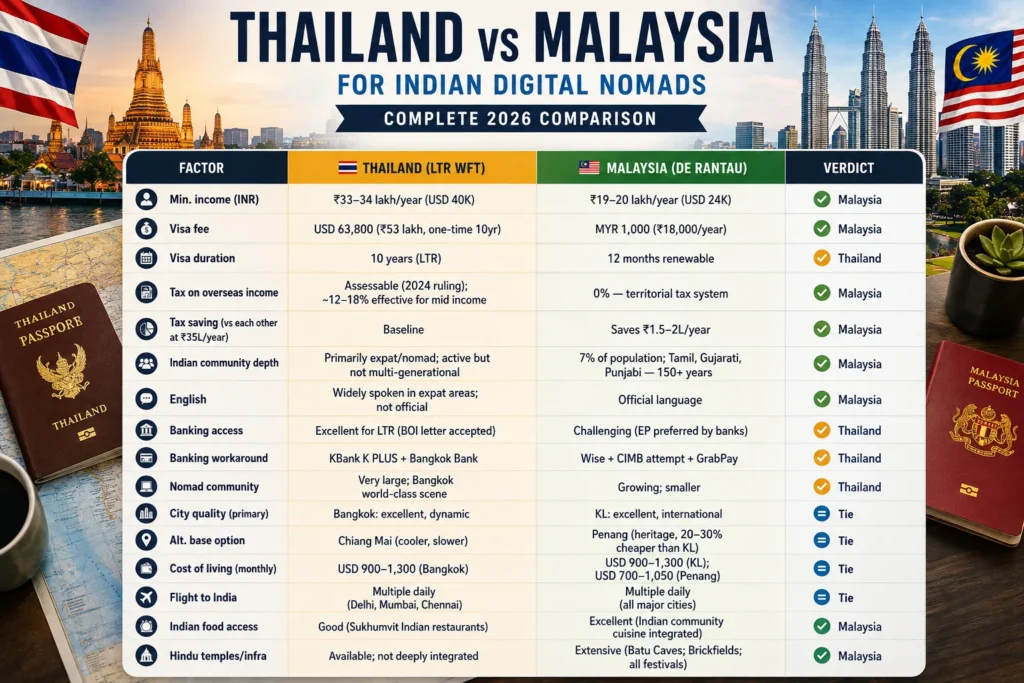
Master Comparison: Thailand vs Malaysia for Indian Nomads
Factor
🇹🇭 Thailand (LTR WFT)
🇲🇾 Malaysia (DE Rantau)
Verdict
Min. income (INR)
₹33–34 lakh/year (USD 40K)
₹19–20 lakh/year (USD 24K)
Malaysia ✓
Visa fee
USD 63,800 (₹53 lakh, one-time 10yr)
MYR 1,000 (₹18,000/year)
Malaysia ✓
Visa duration
10 years (LTR)
12 months renewable
Thailand ✓
Tax on overseas income
Assessable (2024 ruling); ~12–18% effective for mid income
Extensive (Batu Caves; Brickfields; all festivals)
Malaysia ✓
Deep Dive 1: Income Threshold in INR — The First Decision Filter
THE THRESHOLD QUESTION FOR INDIANS Before comparing any other factor, check which visas you actually qualify for: Thailand LTR WFT Visa income threshold: USD 40,000/year = approximately ₹33–34 lakh/year at current exchange ratesIf your overseas income is below this: Thailand LTR WFT is not accessible to youAlternative for lower income in Thailand: DTV (Destination Thailand Visa) — newer; shorter stay authorizations; check current requirements Malaysia DE Rantau income threshold: USD 24,000/year = approximately ₹19–20 lakh/yearAccessible to a much broader range of Indian remote professionals What this means in practice: Indian income ₹19–20 lakh/year: Only Malaysia DE Rantau qualifies. Thailand LTR not an option.Indian income ₹20–33 lakh/year: Only Malaysia qualifies. Thailand LTR not accessible.Indian income ₹33 lakh+/year: Both Thailand LTR and Malaysia DE Rantau qualify. Now you compare all other factors.Indian income ₹50 lakh+/year: Both qualify. Thailand SMART T may also qualify (sector-specific). Consider all options.
Deep Dive 2: Tax — The Most Financially Significant Difference
The tax difference between Thailand and Malaysia is the most financially significant comparison factor for Indian nomads planning long stays. It is also the factor most commonly misunderstood or omitted in competitor articles.
THAILAND TAX POSITION FOR INDIAN NOMADSThailand (180+ days): Thai tax resident status triggered. Per the 2024 Revenue Department ruling (Phor Ngor 161/2566): overseas income brought into Thailand in the same year it is earned is assessable for Thai tax residents. Estimated Thai tax at ₹35 lakh/year overseas income (approximately THB 1,400,000): After personal allowance (₹1,40,000 equiv.) + standard 50% deduction (₹1,40,000 cap): net assessable income approximately THB 1,240,000Thai tax on THB 1,240,000 at progressive rates: approximately THB 175,000 (≈ ₹1.40 lakh)India-Thailand DTAA credit: may reduce further if Indian advance tax has been paid. As NRI with no Indian tax on overseas income, DTAA credit may be zero. Effective outcome: Indian NRI in Thailand on LTR WFT, ₹35 lakh/year income, pays approximately ₹1.2–1.5 lakh/year in Thai income tax after deductions LTR WFT Royal Decree 743 rate cap: May reduce effective rate vs standard progressive. Exact application requires professional interpretation.
MALAYSIA TAX POSITION FOR INDIAN NOMADS Malaysia (any number of days): Malaysia’s territorial tax system means overseas income is NOT taxable in Malaysia, regardless of residency status. Estimated Malaysian tax at ₹35 lakh/year overseas income: ₹0 India + Malaysia NRI position: Indian NRI status (fewer than 182 India days): No Indian tax on overseas active incomeMalaysian territorial tax: Zero Malaysian income tax on overseas incomeCombined: ₹35 lakh/year overseas income with zero income tax in both India and Malaysia Annual tax saving of Malaysia vs Thailand at ₹35 lakh/year income: approximately ₹1.2–1.5 lakh/year At ₹50 lakh/year income: saving approximately ₹2–3 lakh/year. At ₹75 lakh/year: saving approximately ₹4–6 lakh/year. This tax difference compounds significantly over a 3–5 year stay. At ₹50 lakh/year income for 5 years: Malaysia saves approximately ₹10–15 lakh vs Thailand.
Deep Dive 3: Indian Community — Malaysia’s Structural Advantage
For Indian professionals considering a long-term Southeast Asia base, the quality of the Indian community affects daily life in ways that go far beyond weekend restaurant visits. It affects the availability of Indian food daily, religious infrastructure, Tamil/Hindi language access, festivals observed publicly, and the experience of being around people from a shared cultural context.
Community Factor
Thailand
Malaysia
Indian population
Primarily Bangkok expat/nomad community; estimated few thousand active Indian nomads
2.3+ million Indian-descent residents (7% of total population); multi-generational Tamil, Gujarati, Punjabi communities
Community depth
Expat community: primarily professionals and tourists. Active but transient.
Diaspora community: 150+ years in Malaysia. Permanent residents, business owners, professionals.
South Indian food
Sukhumvit area Indian restaurants; good but limited
Nasi kandar, banana leaf rice, roti canai, idli/dosai everywhere. Malaysian-Indian cuisine is part of national food culture.
Hindu temple access
A few temples in Bangkok; less integrated into city life
Batu Caves (Murugan temple, Thaipusam national event), Sri Mahamariamman (Brickfields), numerous state-level temples
Tamil language
Minimal (not an Indian linguistic community)
Widely spoken in Indian community. Tamil-medium schools (SJKT). Tamil TV and newspapers available.
Indian festivals (public)
Diwali observed by Indian expats; not public holiday
Deepavali is a national public holiday in Malaysia. Thaipusam at Batu Caves is one of world’s largest Hindu festivals.
Indian grocery stores
Good variety in Sukhumvit/Little India Bangkok
Extensive in Brickfields, Klang, Little India areas. South and North Indian ingredients widely available.
Gujarati/Punjabi community
Smaller community
Significant Gujarati business community (Petaling Jaya); Punjabi Sikh gurdwaras in KL
Deep Dive 4: Banking Access
Banking access is the one area where Thailand’s LTR Visa framework provides a clearer advantage:
Banking Factor
Thailand (LTR Holders)
Malaysia (DE Rantau Holders)
Primary account opening
BOI endorsement letter accepted at KBank and Bangkok Bank. Smooth process at foreigner-experienced branches.
Most banks prefer Employment Pass. CIMB is best option for DE Rantau holders but not guaranteed.
Best banking app
K PLUS (KBank) — widely regarded as best banking app in Thailand; English, PromptPay, QR payments
Wise account as primary income tool; Malaysian bank more difficult to use for international transfers
Daily payments
K PLUS PromptPay: works everywhere in Thailand
GrabPay + Touch ’n Go: works at most KL merchants; PromptPay equivalent
ATM access
Free at KBank/Bangkok Bank ATMs with own account
Foreign card fee MYR 12–20 per withdrawal; CIMB if account opened
Verdict
Clear advantage for LTR holders
Functional with Wise + GrabPay; less convenient than Thailand LTR banking
Deep Dive 5: Cost of Living
Monthly Expense
Bangkok
Kuala Lumpur
Penang
1BR apartment (expat area)
USD 500–750 (₹42,000–63,000)
USD 550–775 (₹46,000–65,000)
USD 265–490 (₹22,000–41,000)
Food (mix local + restaurant)
USD 130–265
USD 130–265
USD 110–220
Transport (Grab + transit)
USD 55–110
USD 55–110
USD 44–88
Co-working (full month)
USD 88–175
USD 88–175
USD 70–130
Health insurance
USD 77–155
USD 77–155
USD 77–155
Internet + mobile
USD 30–60
USD 30–60
USD 30‖55
TOTAL ESTIMATE
USD 880–1,515 (₹74,000–1,27,000)
USD 930–1,540 (₹78,000–1,29,000)
USD 596–1,138 (₹50,000–95,000)
COST CONTEXT FOR INDIAN NOMADS Bangkok and KL are broadly comparable in total monthly cost. Penang is materially cheaper than both — the most cost-efficient destination in the comparison at USD 596–1,138/month. The financial advantage of Malaysia over Thailand is primarily in the TAX dimension, not cost of living. Both cities are similarly priced for mid-range nomad lifestyles. However, Penang as a Malaysia base option adds a meaningful cost-of-living advantage on top of the tax benefit.
Deep Dive 6: Flight Connectivity to India
India Route
From Bangkok
From Kuala Lumpur
Delhi (DEL)
Multiple daily (AirAsia, IndiGo, Air India, Thai)
Multiple daily (AirAsia, IndiGo, Air India, Malaysia Airlines)
Mumbai (BOM)
Multiple daily
Multiple daily
Chennai (MAA)
Multiple daily (AirAsia direct)
Multiple daily (AirAsia direct)
Kolkata (CCU)
Multiple daily
Multiple daily
Hyderabad (HYD)
Multiple daily (AirAsia direct)
Multiple daily (AirAsia direct)
Bengaluru (BLR)
Multiple daily
Multiple daily (AirAsia direct)
Kochi (COK)
Direct (Air India, IndiGo)
Direct (AirAsia — strong route from KL)
Approximate one-way fare
USD 80–200 (₹6,700–16,700)
USD 60–180 (₹5,000–15,000)
Flight time to Delhi
5–6 hours
5–6 hours
Flight time to Chennai
3.5–4 hours
3–3.5 hours
Both countries have excellent India connectivity. If anything, Malaysia’s AirAsia base makes some routes marginally cheaper. From a connectivity perspective, this is a tie. For South Indians (Chennai, Hyderabad, Kochi connection), Malaysia’s KL might be marginally better via AirAsia direct.
The India-Specific Decision Framework
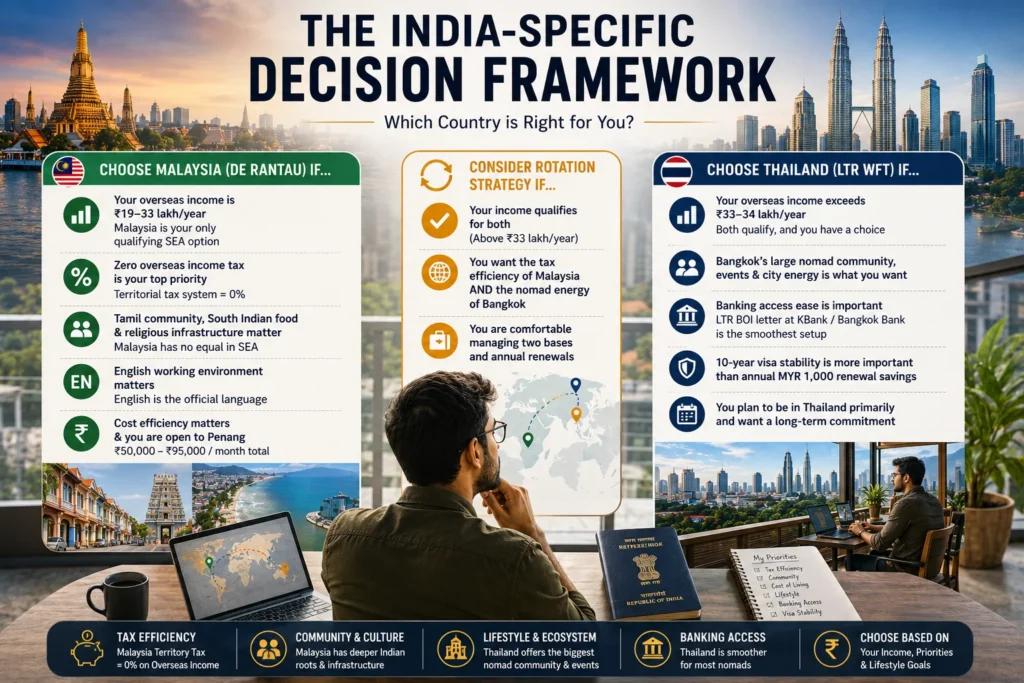
WHICH COUNTRY FOR YOUR SITUATION? Choose Malaysia (DE Rantau) if any of these apply: Your overseas income is ₹19–33 lakh/year: Malaysia is your only qualifying Southeast Asia option. Thailand LTR WFT is not accessible.Zero overseas income tax is your top financial priority: Malaysia’s territorial system gives you this. Thailand’s 2024 ruling means Thai tax applies on same-year overseas income.Tamil community, South Indian food, and religious infrastructure are important to your daily quality of life: Malaysia has no equal in Southeast Asia on these dimensions. English working environment matters: Malaysia is official-English. Thailand is English-functional but not official. Cost efficiency matters and you are open to Penang: At ₹50,000–95,000/month total, Penang is the most cost-efficient serious nomad base in Southeast Asia. Choose Thailand (LTR WFT) if all of these apply: Your overseas income exceeds ₹33–34 lakh/year: both qualify, and you have a choice Bangkok’s large nomad community, events, and city energy is what you specifically want Banking access ease is important: LTR BOI letter at KBank/Bangkok Bank is the smoothest foreign banking setup in Southeast Asia10-year visa stability is more important than annual MYR 1,000 renewal savings You plan to be in Thailand primarily and want a long-term commitment Consider the rotation strategy if: Your income qualifies for both (above ₹33 lakh/year)You want the tax efficiency of Malaysia AND the nomad energy of Bangkok You are comfortable managing two bases and annual renewals
The Rotation Strategy: Using Both Countries Together
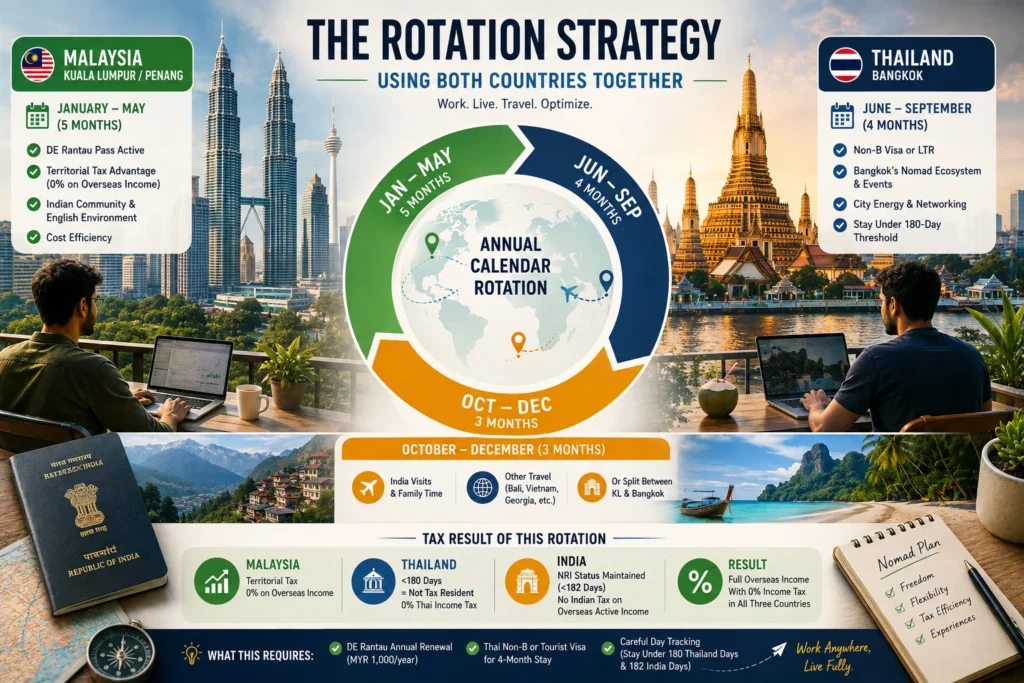
THE DUAL-COUNTRY STRATEGY FOR EXPERIENCED INDIAN NOMADS The most financially and experientially optimal setup for Indian nomads who qualify for both visas: Annual calendar rotation (example): January–May (5 months): Kuala Lumpur or Penang. DE Rantau pass active. Territorial tax advantage on all overseas income. Indian community depth, English environment, cost efficiency. June–September (4 months): Bangkok. Non-B visa or LTR if applicable. Bangkok’s nomad ecosystem, events, and city energy. Below Thailand 180-day threshold for the year. October–December (3 months): India visits, other travel (Bali, Vietnam, Georgia), or split between KL and Bangkok. Tax result of this rotation: Malaysia: Territorial tax — zero on overseas income regardless of days Thailand: 4 months = under 180 days = NOT Thai tax resident. Zero Thai income tax on overseas income. India: NRI status maintained (under 182 India days per financial year). No Indian tax on overseas active income.Result: Full overseas income with zero income tax in all three countries — the most tax-efficient Indian nomad structure in Asia What this requires: DE Rantau annual renewal (MYR 1,000/year). Thai Non-B or tourist visa for 4-month Bangkok stay. Careful day tracking to stay under 180 Thailand days and 182 India days. The rotation is the advanced play. Many Indian nomads start with one country, find their footing, and then optimise the split after 6–12 months of experience.
Frequently Asked Questions
Is Thailand or Malaysia better for Indian digital nomads?
For Indians earning under ₹33 lakh/year from overseas: Malaysia is the only qualifying option — Thailand’s LTR WFT requires ₹33–34 lakh minimum. For Indians earning above ₹33 lakh: Malaysia offers zero overseas income tax and a deeper Indian community; Thailand offers a larger nomad ecosystem and better banking access. Many experienced Indian nomads use both via a rotation strategy.
What is the income threshold for Thailand LTR vs Malaysia DE Rantau in rupees?
Thailand LTR WFT Visa: USD 40,000/year = approximately ₹33–34 lakh/year. Malaysia DE Rantau: USD 24,000/year = approximately ₹19–20 lakh/year. Indians earning between ₹20–33 lakh/year from overseas can only qualify for DE Rantau, not LTR WFT.
How much tax do Indians save by choosing Malaysia over Thailand?
At ₹35 lakh/year overseas income: approximately ₹1.2–1.5 lakh/year saved. At ₹50 lakh/year: approximately ₹2–3 lakh/year saved. At ₹75 lakh/year: approximately ₹4–6 lakh/year saved. Malaysia’s territorial tax means zero Malaysian tax on overseas income; Thailand’s 2024 ruling means same-year overseas income is assessable at progressive rates for Thai tax residents.
Is the Indian community stronger in Thailand or Malaysia?
Malaysia by far. Malaysia has approximately 2.3 million Indian-descent residents (7% of total population), predominantly Tamil but also Gujarati, Punjabi, and other communities, with 150+ years of history. Brickfields Little India, Batu Caves (Thaipusam), Tamil-language schools and media, and deep South Indian food culture throughout the country. Thailand has an active but primarily nomad/expat Indian community, not a multi-generational diaspora.
What is the rotation strategy for Indian nomads between Thailand and Malaysia?
5 months Malaysia (DE Rantau, territorial tax advantage, Indian community) + 4 months Thailand (Bangkok nomad ecosystem, under 180-day Thai tax threshold) + 3 months travel/India. This structure keeps Thailand days under 180 (no Thai tax residency), maintains NRI status (under 182 India days), and maximizes Malaysia’s territorial tax advantage on overseas income for the full year.
Final Verdict: The India-Specific Recommendation
For most Indian digital nomads choosing between Thailand and Malaysia, Malaysia is the superior single-country choice on the three factors that matter most: income threshold accessibility, tax efficiency on overseas income, and Indian community depth. The decisive scenario: an Indian nomad earning ₹25–35 lakh/year from overseas clients has Malaysia DE Rantau as their only qualifying Southeast Asia option, benefits from zero Malaysian income tax on that overseas income, and finds in KL and Penang one of the richest Indian diaspora communities in the world. The entire financial and lifestyle case points to Malaysia. Thailand’s moment: an Indian professional earning ₹50 lakh+/year who prioritizes Bangkok’s nomad scene, wants a 10-year visa, and values ease of banking access. At that income level, the ₹2–3 lakh/year tax saving from Malaysia is significant but not decisive relative to lifestyle preference. The expert move at any income level: the rotation strategy. Use Malaysia as the primary tax-efficient, community-rich base for 5 months; use Bangkok for the nomad ecosystem and energy for 4 months; spend the rest of the year traveling or in India. This structure delivers the best of both countries while maintaining both visa options and maximizing tax efficiency. See the DE Rantau complete guide for Malaysia application, the LTR Visa guide for Thailand, or the Malaysia vs Thailand comparison table above to match your specific income level to the right visa.