Malaysia digital nomaddestinations are among the most tax-efficient and accessible in Southeast Asia. The DE Rantau Digital Nomad Pass (USD 24,000/year income threshold, MYR 1,000/≈USD 220 fee) provides legal remote work authorization. Malaysia’s territorial tax system means overseas income — from foreign employers or overseas clients — is not taxable in Malaysia regardless of how long you stay. Two primary nomad bases: Kuala Lumpur (international city, Mont Kiara and Bangsar expat areas, strong infrastructure) and Penang (George Town UNESCO Heritage, lower costs, slower pace). English is an official language of Malaysia, making the transition straightforward for Indian and Filipino professionals. The Indian diaspora in Malaysia is substantial (approximately 7% of population), with strong Tamil and Gujarati communities particularly in KL and Penang. Large Filipino expat community in KL. Total monthly cost for a single digital nomad: approximately USD 900–1,300 in Kuala Lumpur; USD 700–1,050 in Penang — making Malaysia 15–25% cheaper than Bangkok for comparable lifestyle. Banking is more challenging than Thailand: most Malaysian banks prefer Employment Pass. Wise + international card is the practical solution for most DE Rantau holders.
QUICK ANSWER: Is Malaysia good for digital nomads? Yes — Malaysia is one of the most tax-efficient and accessible digital nomad bases in Asia. Key highlights: DE Rantau Nomad Pass: Legal visa at USD 24,000/year income threshold. MYR 1,000 (≈ USD 220) fee. 12 months renewable. Zero Malaysian tax on overseas income: Malaysia’s territorial tax system means overseas income is not taxable, even for long-stay residents. Two strong bases: Kuala Lumpur (international hub) and Penang (UNESCO heritage, lower costs)English official language: No language barrier for Indian and Filipino professionals Strong diaspora communities: Large Indian and Filipino communities in both cities Cost: USD 900–1,300/month (KL) or USD 700–1,050/month (Penang) for comfortable solo nomad life
Introduction: Why Malaysia Deserves More Attention
In most digital nomad conversations about Southeast Asia, Thailand gets the spotlight. Bangkok has the infrastructure, Chiang Mai has the community, and the Thailand LTR Visa has the 10-year marketing hook.
But Malaysia has a quieter story that is, for many nomads, the more compelling one. Its territorial tax system means overseas income is not taxable in Malaysia regardless of residency status — a structural financial advantage that Thailand cannot match under its 2024 Revenue Department ruling. Its DE Rantau pass is accessible at USD 24,000/year, a threshold that serves a much broader population than Thailand’s LTR WFT requirement. And English is an official language, removing the linguistic friction that makes daily life harder in countries where English is a secondary option.
Add Kuala Lumpur’s infrastructure (reliable internet, modern transport, international connectivity from KLIA), Penang’s combination of heritage character and lower costs, and one of the largest Indian and Filipino diaspora communities in Southeast Asia, and Malaysia becomes a genuinely strong candidate for digital nomads choosing a Southeast Asian base.
This hub is the complete Malaysia reference for MeridianNomad readers: everything from visa to tax to banking to daily life, with a navigation hub linking to the depth articles for each specific topic.
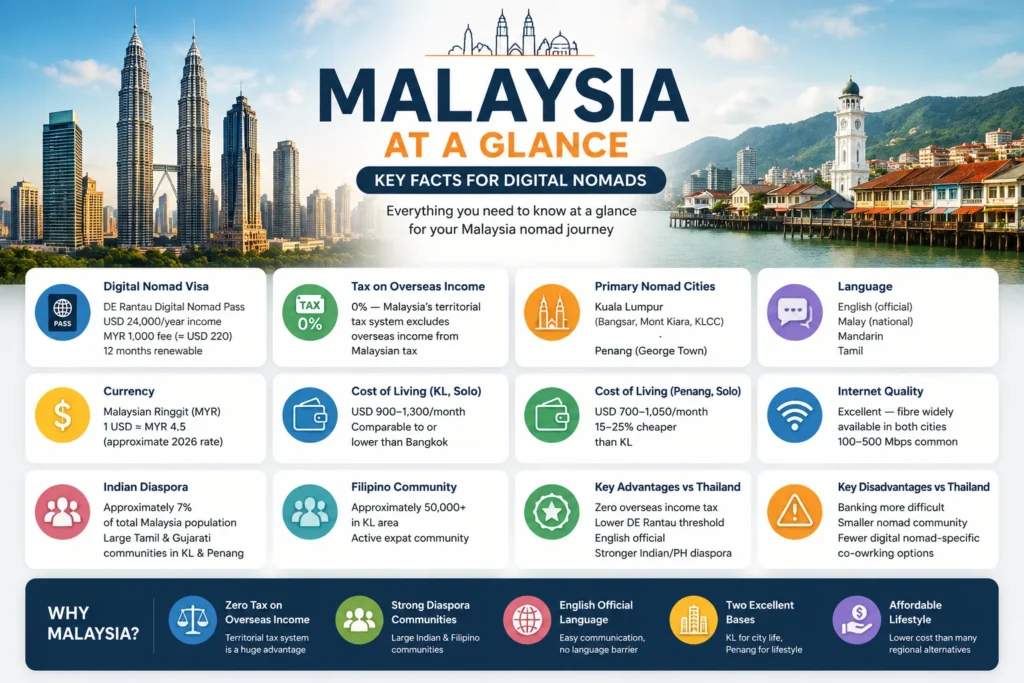
Malaysia at a Glance: Key Facts for Digital Nomads
Excellent — fibre widely available in both cities; 100–500 Mbps common
Indian diaspora
Approximately 7% of total Malaysia population; large Tamil and Gujarati communities in KL and Penang
Filipino community
Approximately 50,000+ in KL area; active expat community
Key advantages vs Thailand
Zero overseas income tax, lower DE Rantau threshold, English official, stronger Indian/PH diaspora
Key disadvantages vs Thailand
Banking more difficult, smaller nomad community overall, fewer digital nomad-specific co-working options
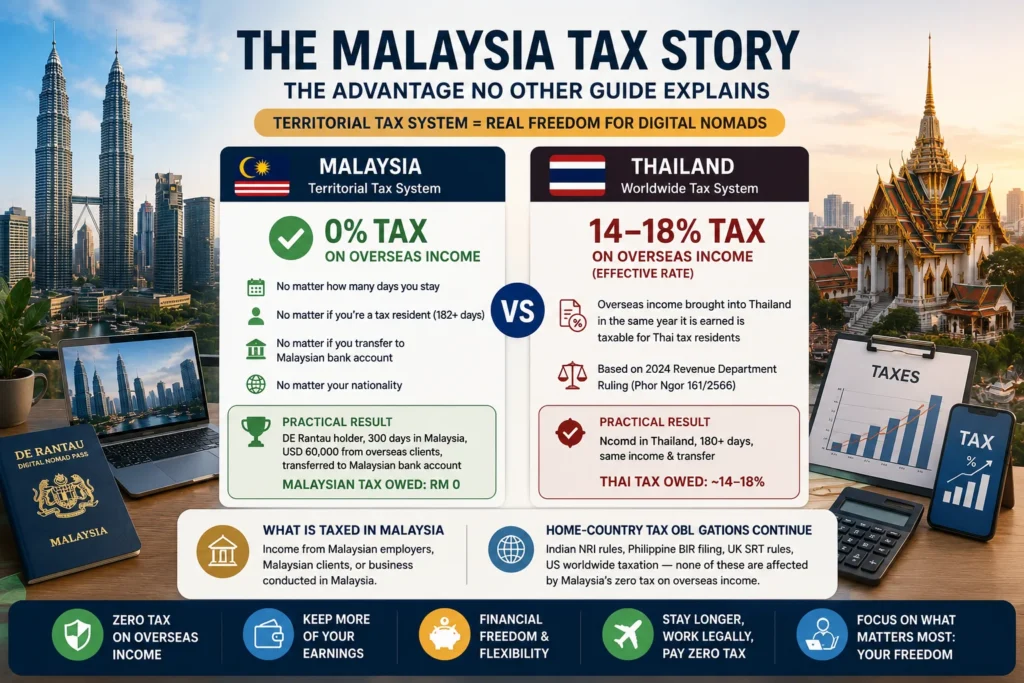
The Malaysia Tax Story: The Advantage No Other Guide Explains
MALAYSIA’S TERRITORIAL TAX SYSTEM — WHY IT MATTERS Malaysia taxes only income that is sourced within Malaysia. Income from overseas employers, overseas clients, or overseas business activities is NOT subject to Malaysian income tax, regardless of: How many days you spend in Malaysia per yearWhether you qualify as a Malaysian tax resident (182+ days)Whether you transfer overseas income into a Malaysian bank accountWhat your nationality is Practical result for DE Rantau holders: A DE Rantau holder spending 300 days in Malaysia, earning USD 60,000 from overseas clients, and transferring all earnings to a Malaysian bank account: owes ZERO Malaysian income tax on those overseas earningsThe same nomad in Thailand (180+ days, same-year overseas income transfer): potentially owes Thai income tax at progressive rates 0–35%, with effective rate approximately 14–18% after deductions Comparison with Thailand 2024 ruling: Thailand: overseas income brought into Thailand in the same year it is earned is assessable for Thai tax residents (Phor Ngor 161/2566)Malaysia: overseas income is simply outside the Malaysian tax base — no equivalent ruling, no year-of-transfer trap What IS taxed in Malaysia for nomads: Income from Malaysian employers, Malaysian clients, or business conducted in Malaysia. DE Rantau holders who only work for overseas clients have zero Malaysian income tax exposure. Home-country tax obligations continue: Indian NRI rules, Philippine BIR filing, UK SRT rules, US worldwide taxation — none of these are affected by Malaysia’s zero tax on overseas income. Consult your home-country tax advisor.
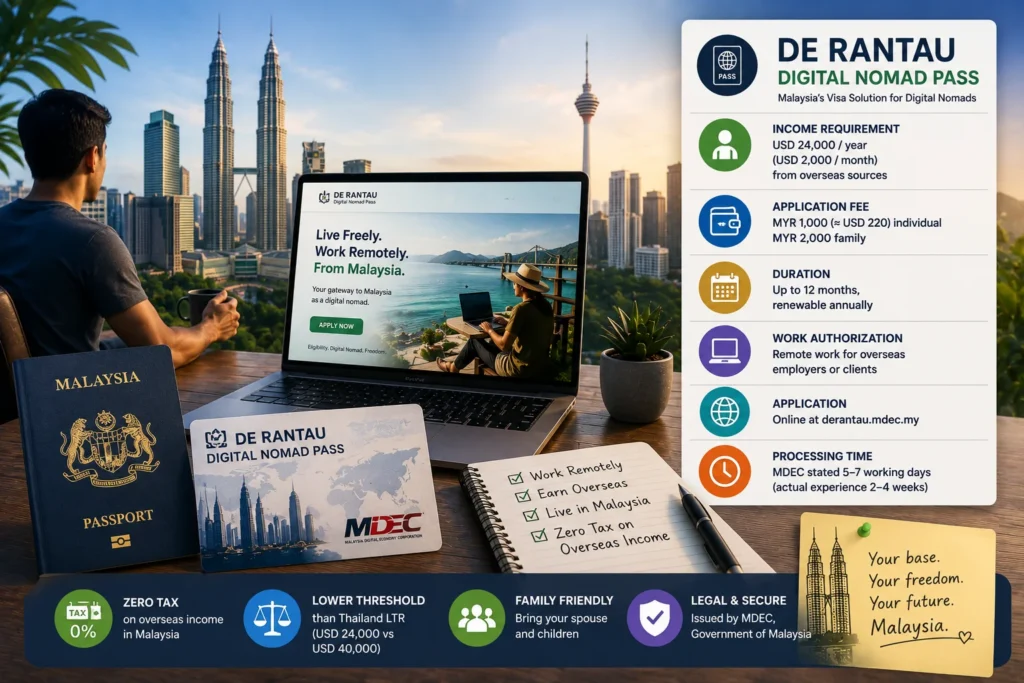
DE RANTAU KEY FACTS Full name: DE Rantau Digital Nomad Pass Administrator: MDEC (Malaysia Digital Economy Corporation) Income requirement: USD 24,000/year (USD 2,000/month) from overseas employers or clients Application fee: MYR 1,000 (≈ USD 220) individual; MYR 2,000 family Duration: Up to 12 months, renewable annually Work authorization: Remote work for overseas employers/clients from Malaysia Application: Online at derantau.mdec.my Processing: MDEC stated 5–7 working days; actual experience often 2–4 weeks In Indian context: USD 24,000/year = approximately ₹19–20 lakh/year — significantly lower than Thailand LTR WFT (USD 40,000/year) In Philippine context: USD 24,000/year = approximately PHP 1.3 million/year — accessible to mid-senior Filipino professionals
For the complete DE Rantau application guide including document requirements, step-by-step process, and income proof guidance: see the DE Rantau complete guide in the navigation hub below.
Kuala Lumpur as a Digital Nomad Base
Kuala Lumpur is Southeast Asia’s most internationally connected city after Singapore, with infrastructure that exceeds Bangkok in some categories (metro system, airport connectivity) while remaining significantly cheaper than Singapore. For digital nomads who want city-level convenience, high-speed connectivity, and proximity to both the Indian and Filipino expat communities, KL is the obvious choice.
Best nomad areas in Kuala Lumpur
Area
Character
Est. 1BR Rent
Best For
Mont Kiara
International expat hub; family-friendly; malls, international schools, Western amenities
MYR 2,500–4,000/month
Families, expats seeking international environment, longer stays
Bangsar / Bangsar South
Young professional, mixed expat and local; good cafes, tech company HQs nearby
MYR 2,000–3,500/month
Solo nomads and couples; co-working access; social scene
KLCC / Bukit Bintang
City centre landmark area; Petronas Towers; luxury dining and shopping
MYR 2,500–5,000+/month
Shorter stays; higher budget; convenience over community
Petaling Jaya (PJ)
Suburban; lower rent; good MRT connectivity; local character
MYR 1,400–2,500/month
Budget-conscious; longer stays; quieter pace
Cheras / Ampang Jaya
More local character; good Indian food access; lower cost
MYR 1,200–2,000/month
Indian community proximity; budget priority
Kuala Lumpur infrastructure for nomads
Internet: MyRepublic, Maxis, TIME fibre available in most condominiums. 100–500 Mbps plans: MYR 80–200/month
Mobile: Celcom, Maxis, Digi (now merged as CelcomDigi), U Mobile, Yes. Tourist SIM available at KLIA arrivals. Unlimited data plans from MYR 30–60/month.
Co-working: WeWork KL (KL Sentral, TRX), Common Ground (multiple locations), Colony, Mindspace, WORQ. Day passes MYR 50–80; monthly MYR 400–800.
Transport: LRT/MRT/Monorail covers central KL. Grab (ride-hailing) reliable and cheap. Klang Valley Integrated Transit (KVIT) good for most nomad areas.
Healthcare: KPJ Healthcare, Pantai Hospital, Gleneagles — private healthcare world-class; considerably cheaper than Singapore. Health insurance strongly recommended.
Penang: The Alternative Capital for Malaysia Nomads
George Town, Penang is the other side of the Malaysia nomad equation: a UNESCO World Heritage city with heritage shophouse architecture, a globally renowned street food scene, a more relaxed pace, and cost of living approximately 20–30% lower than Kuala Lumpur. Many experienced Malaysia nomads settle in Penang after testing KL.
George Town: what the nomad life looks like
Character: Heritage Southeast Asian city; Chinese shophouse architecture; multicultural Malay, Chinese, Indian, and Western community
Cost: 1BR apartment MYR 1,200–2,200/month in George Town proper; MYR 1,000–1,600 in nearby Butterworth or Jelutong
Internet: TIME fibre and Maxis widely available; 100+ Mbps in most apartments
Co-working: WORQ Penang, Common Ground Penang, Colony (check current locations), several boutique spaces in George Town
Food: Penang is widely considered Malaysia’s food capital — hawker centres, char koay teow, Hokkien mee, Indian banana leaf, nasi kandar
Transport: Penang is more walkable than KL in the heritage area; Grab reliable; Penang Bridge to mainland
Connectivity: Penang International Airport (PEN) — AirAsia to KL (45 min), Singapore, Bangkok, Bali, regional hubs
Penang vs Kuala Lumpur: the decision
Factor
Penang (George Town)
Kuala Lumpur
Monthly cost (solo)
USD 700–1,050
USD 900–1,300
Pace
Slower, more relaxed
Fast, city energy
International connectivity
Good (Penang Airport)
Excellent (KLIA — major hub)
Nomad community size
Smaller but tight-knit
Larger, more international
Indian community
Strong Tamil community (Penang Hill, Little India)
Very large Tamil and Gujarati community
Character
Heritage, artistic, food-focused
Modern international city
Best for
Long-stay, creative work, budget priority, community depth
Short stays, frequent travel, corporate vibe, networking
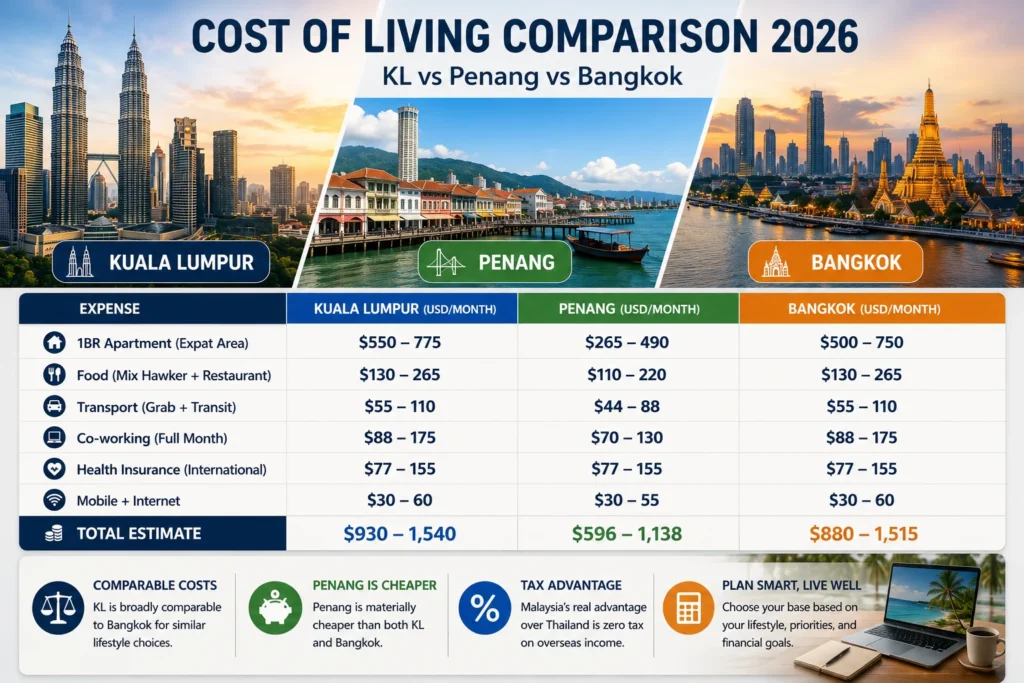
Cost of Living: KL vs Penang vs Bangkok (2026)
Expense
KL (USD/month)
Penang (USD/month)
Bangkok (USD/month)
1BR apartment (expat area)
USD 550–775
USD 265–490
USD 500–750
Food (mix hawker + restaurant)
USD 130–265
USD 110–220
USD 130–265
Transport (Grab + transit)
USD 55–110
USD 44–88
USD 55–110
Co-working (full month)
USD 88–175
USD 70–130
USD 88–175
Health insurance (international)
USD 77–155
USD 77–155
USD 77–155
Mobile + internet
USD 30–60
USD 30‖55
USD 30–60
TOTAL ESTIMATE
USD 930–1,540
USD 596–1,138
USD 880–1,515
COST CONTEXT Malaysia is broadly comparable to Bangkok in cost of living for similar lifestyle choices. Penang is materially cheaper than either KL or Bangkok for accommodation. The financial advantage of Malaysia over Thailand is primarily in the TAX dimension (zero Malaysian income tax on overseas income) rather than cost-of-living differences, which are modest.
Internet Quality and Digital Infrastructure
KL fibre speeds: 100–500 Mbps in most condominiums (TIME, MyRepublic, Maxis Fibre). Consistency excellent in well-served buildings.
Penang fibre: TIME and Maxis available in George Town; 100 Mbps standard in most apartments. Slightly slower than KL but adequate for video calls and remote work.
Mobile data: CelcomDigi and Maxis 4G coverage is excellent in both cities. 5G rolling out in KL. Unlimited mobile plans from MYR 30–60/month.
Power: 240V 50Hz (same as UK standard 3-pin plug). Reliable power supply in urban areas. Minor outages possible during heavy rainfall.
Co-working: Both KL and Penang have robust co-working ecosystems. WeWork, Common Ground, Colony are major players. MDEC DE Rantau partners offer discounts at some spaces.
Backup: Malaysian Maxis and CelcomDigi SIM cards are the ideal backup for apartment fibre outages. International roaming from Indian Airtel and Jio works in Malaysia.
Banking in Malaysia for Digital Nomads
Banking is the most consistent practical challenge for DE Rantau holders. Malaysian banks generally prefer Employment Pass holders for standard retail banking:
Bank
DE Rantau Account Opening
Notes
CIMB
Best chance among local banks; some flexibility
Try CIMB Go app or CIMB branch with full documentation package
Maybank
Difficult
Primarily targets Malaysians and Employment Pass holders
RHB
Branch-dependent
Some RHB branches have opened accounts with DE Rantau + additional docs
HSBC Malaysia
Better than most
HSBC’s international infrastructure more accommodating for pass holders
Public Bank
Generally difficult
Employment Pass strongly preferred
RECOMMENDED BANKING SETUP FOR DE RANTAU HOLDERS Primary setup (immediate, no Malaysian bank needed): Wise multi-currency account: Receive overseas income in USD/EUR. Convert to MYR at mid-market rate. Wise card works at Malaysian ATMs and merchants (Mastercard acceptance is universal in KL and Penang).International ATM withdrawals: Malaysian ATMs accept foreign cards. Fee varies by ATM (typically MYR 12–20 per foreign card withdrawal). Use Wise card for 2 free monthly ATM withdrawals.GrabPay / e-wallets: Link international Mastercard to GrabPay for seamless Malaysian payments. Works at most Malaysian merchants. Try for local account (after arrival): CIMB: Visit a CIMB branch with DE Rantau pass (passport with endorsement), MDEC approval letter, proof of Malaysian address, and 6 months of overseas income bank statements.HSBC Malaysia: International banking relationship may allow smoother account opening.
India-Specific Malaysia Digital Nomad Guide
INDIA × MALAYSIA: COMPLETE GUIDE Why Malaysia is particularly compelling for Indian nomads: Indian community: Approximately 7% of Malaysia’s 33 million population is of Indian descent — predominantly Tamil from southern India but also Punjabi, Gujarati, and Telugu communities. KL’s Brickfields (Little India), Penang’s Little India, and communities in Klang are among the most established Indian communities in Southeast Asia.Hindi and Tamil widely understood: Tamil is spoken by the majority of Malaysian Indians. Hindi understood in many Indian-community areas. Telugु-speaking community particularly in Seremban.Indian food: South Indian banana leaf, Nasi Kandar (Mamak food), roti canai, tandoori restaurants — Indian food culture is deeply embedded in Malaysian cuisine.Religious infrastructure: Hindu temples (Batu Caves is a major pilgrimage site), Sikh gurdwaras, mosques, and churches — full religious infrastructure for Indian professionals of all faiths. Financial framework for Indian nomads in Malaysia: NRI status (fewer than 182 India days): India-sourced income only taxed in India. Malaysia territorial tax: Overseas income (including India-origin overseas clients) NOT taxable in Malaysia. Zero Malaysian income tax exposure for overseas income. FEMA: Malaysian bank account is a foreign bank account under FEMA. Report in Schedule FA of Indian ITR as NRI. Inward remittances to India: Use Wise for INR transfers to NRE account. FIRC from Indian bank for FEMA compliance. DE Rantau income threshold in INR: USD 24,000/year = approximately ₹19–20 lakh/year. Much lower than Thailand LTR WFT (₹33–34 lakh/year). For the complete India-specific DE Rantau guide: see the DE Rantau for Indian citizens article in the navigation hub.
Philippines-Specific Malaysia Digital Nomad Guide
PHILIPPINES × MALAYSIA: COMPLETE GUIDE Why Malaysia resonates strongly with Filipino nomads: English as official language: English is an official working language of Malaysia. Filipinos experience very little language friction in daily life, workplace communication, and government dealings.Filipino community: Approximately 50,000+ Filipinos in the Klang Valley area. Active community organizations, Filipino restaurants, and social networks. AirAsia flies KL–Manila multiple times daily.Food culture overlap: Malaysian cuisine shares significant overlap with Filipino preferences through shared flavors, rice culture, and tropical ingredients. Filipino restaurants are accessible in KL.Flight connectivity: KL–Manila is one of ASEAN’s busiest routes. AirAsia, Cebu Pacific, Philippine Airlines, and Malaysia Airlines all operate the route. Under 3 hours; fares from MYR 100–300 one-way.Cultural familiarity: Both Malaysia and Philippines are ASEAN nations with shared Southeast Asian cultural contexts. Filipinos often describe Malaysia as one of the most accessible international adjustments they have made. Financial framework for Filipino nomads in Malaysia: BIR obligations continue regardless of Malaysia stay. BIR Form 1701 must reflect all income. Malaysia territorial tax: Zero Malaysian tax on overseas income — no Philippines-origin income Malaysian tax issue. Philippines-Malaysia DTAA: Prevents formal double taxation. Relevant primarily for Malaysia-sourced income (if any). Income threshold for Filipinos: USD 24,000/year = approximately PHP 1.3 million/year from overseas clients. Accessible to senior developers, BPO managers, digital marketers, consultants. For the complete Philippines-specific DE Rantau guide: see the DE Rantau for Filipino citizens article in the hub.
Malaysia vs Thailand for Digital Nomads
Factor
Malaysia
Thailand
Verdict
DE Rantau vs LTR income threshold
USD 24,000/year
USD 40,000/year (LTR WFT)
Malaysia more accessible
Visa fee
MYR 1,000 (≈ USD 220)
USD 63,800 (LTR)
Malaysia dramatically cheaper
Tax on overseas income
0% (territorial)
0–35% (progressive, on same-year transfers)
Malaysia wins
Visa duration
12 months renewable
10 years (LTR)
Thailand for long-term stability
Banking access
More difficult (EP preferred)
Easier (LTR BOI letter accepted)
Thailand easier
English
Official language
Widely spoken but not official
Malaysia slightly ahead
Indian community size
7% of total population, multi-generational
Large but primarily expat/nomad
Malaysia stronger diaspora
Filipino community
50,000+ in KL area
Growing expat community in Bangkok
Malaysia stronger diaspora
Nomad community size
Smaller, developing
Large, established
Thailand larger community
City quality (primary)
Kuala Lumpur: excellent
Bangkok: excellent
Personal preference
Alternative base
Penang (heritage, low cost)
Chiang Mai (cooler, mountain)
Personal preference
Flight hub
KLIA — strong ASEAN + SE Asia hub
BKK (Suvarnabhumi) — major hub
Comparable; Thailand slightly more global
THE DECISION FRAMEWORK Choose Malaysia if: Your income is USD 24,000–40,000/year (below LTR WFT threshold), zero overseas income tax is a priority, English environment matters, or Indian/Filipino community depth is important. Choose Thailand if: Your income exceeds USD 40,000/year, you want a 10-year pass, Bangkok’s city energy and nomad community is what you seek, or easier banking access is critical. Use both: Many nomads split time between Malaysia (for territorial tax advantage and community) and Thailand (for nomad ecosystem and city life). 90 days Malaysia + 90 days Thailand in a rotation keeps both options active.
Malaysia Quick-Start Guide for Digital Nomads
Confirm income eligibility: Verify you earn USD 2,000+/month (USD 24,000/year) consistently from overseas clients or employer. Gather 6 months of documentation.
Apply for DE Rantau Pass online: Create MDEC account at derantau.mdec.my. Complete form, upload documents, pay MYR 1,000. Allow 2–4 weeks for approval.
Arrange health insurance: Purchase international health plan valid in Malaysia (Cigna Global, AXA, Allianz). Required for DE Rantau.
Choose your base city: KL for international city experience and larger community; Penang for heritage environment and lower costs. Many nomads try Penang first then settle based on preference.
Open Wise account (if not already done): For international income receipt and MYR conversion. This is your primary financial tool before and after arrival.
Arrive and process passport endorsement at MDEC: Upon arrival in Malaysia with your approval letter, visit the MDEC centre for DE Rantau Pass endorsement in your passport.
Get a Malaysian SIM: Purchase CelcomDigi, Maxis, or U Mobile SIM at KLIA arrivals or any telco outlet. Unlimited data plans from MYR 30–60/month.
Open GrabPay or Touch ’n Go e-wallet: Link your international Mastercard (Wise card) for Malaysian daily payments. Essential for transport, food delivery, and most cashless transactions.
Try CIMB for Malaysian bank account: Visit a CIMB branch with full documentation. If successful, great. If not, Wise + GrabPay covers most daily banking needs.
Track your Malaysia days: If you approach 182 days, you qualify as a Malaysian tax resident — though overseas income remains non-taxable under territorial system. Stay aware for any home-country residency implications (FEMA for Indians, etc.).
Malaysia Digital Nomad Navigation Hub
Use these cluster articles for complete depth on each specific Malaysia topic:
📋
DE Rantau Digital Nomad Pass — Complete Guide Requirements, fees, application steps, income proof documentation, processing timeline, and banking workarounds. /malaysia-de-rantau-digital-nomad-pass-guide/
🇮🇳
DE Rantau for Indian Citizens India-specific DE Rantau guide: income documentation in INR, NRI implications, FIRC, FEMA compliance, Indian community in KL and Penang. /de-rantau-indian-citizens/
🇵🇭
DE Rantau for Filipino Citizens Philippines-specific DE Rantau guide: BIR obligations, income documentation, Filipino community in KL, AirAsia connectivity, and BDO/BPI remittance coordination. /de-rantau-filipino-citizens/
⚖️
Malaysia vs Thailand for Indian Nomads Complete comparison for Indian professionals: income thresholds in INR, tax treatment, visa fees, community, banking, and the rotation strategy. /thailand-vs-malaysia-indian-nomads/
🏦
CIMB Malaysia Account for Foreigners — How to Open Step-by-step guide to opening a CIMB account as a DE Rantau holder: branch selection, documents, what to say, and what to do if declined. /cimb-malaysia-foreigners-account-guide/
🇺🇸
Malaysia Tax Residency Rules for Digital Nomads Complete Malaysia tax framework: territorial tax explained, 182-day rule, what counts as Malaysian-sourced income, and home-country interaction. /malaysia-tax-residency-digital-nomads/
🏙
Cost of Living Kuala Lumpur for Digital Nomads Month-by-month cost breakdown: rent by area, food options and costs, transport, co-working, healthcare, and total monthly estimates. /cost-of-living-kuala-lumpur-digital-nomads/
Frequently Asked Questions
Is Malaysia a good country for digital nomads?
Yes. Malaysia combines legal remote work authorization (DE Rantau Pass, USD 24,000/year threshold), zero Malaysian tax on overseas income (territorial tax system), English as an official language, competitive cost of living (USD 900–1,300/month in KL), and strong Indian and Filipino diaspora communities. It is particularly well-suited for Indian and Filipino professionals who find Malaysia’s community, language environment, and tax structure compelling.
What is the Malaysia digital nomad visa?
Malaysia’s digital nomad visa is the DE Rantau Digital Nomad Pass, managed by MDEC (Malaysia Digital Economy Corporation). Requirements: USD 24,000/year minimum overseas income, application fee MYR 1,000 (≈ USD 220), valid for up to 12 months and renewable. Apply online at derantau.mdec.my.
Do digital nomads pay tax in Malaysia?
No, on overseas income. Malaysia uses a territorial tax system: only income sourced within Malaysia is taxable. Overseas income (from foreign employers or overseas clients) is not taxable in Malaysia regardless of how long you stay. Digital nomads on DE Rantau who earn exclusively from overseas sources pay zero Malaysian income tax.
Kuala Lumpur for: city infrastructure, international connectivity (KLIA), larger nomad community, corporate networking. Penang for: lower cost (approximately 20–30% cheaper than KL), heritage character, slower pace, world-renowned food culture. Many experienced Malaysia nomads prefer Penang for long-stays after testing KL. A practical approach: start in KL (1–2 months) then try Penang (1–2 months) and decide based on personal fit.
Can Indian nationals get DE Rantau Pass?
Yes, Indian passport holders can apply for DE Rantau with no nationality restrictions. Income threshold in Indian rupees: approximately ₹19–20 lakh/year from overseas clients. Income proof: overseas client contracts, Wise transaction history, FIRC from Indian bank, or Upwork/Fiverr earnings statements. Indian community in Malaysia (particularly Tamil community) is substantial.
Is Malaysia cheaper than Thailand for digital nomads?
Broadly comparable with slight Malaysia advantage, particularly in Penang. Kuala Lumpur and Bangkok are similar in total monthly cost for comparable lifestyle (USD 900–1,300 in both cities). Penang is meaningfully cheaper (USD 700–1,050). The more significant financial advantage of Malaysia over Thailand is the zero overseas income tax under Malaysia’s territorial system, rather than cost-of-living differences.
Final Verdict: Is Malaysia the Right Base for You?
Malaysia’s case for digital nomads is strong and underappreciated. The combination of DE Rantau’s low income threshold (USD 24,000/year), very low cost (MYR 1,000), territorial tax advantage (zero Malaysian tax on overseas income), English official language, and well-established Indian and Filipino communities creates a package that is, for many nomads, superior to Thailand on multiple dimensions. The tax argument, in particular, is compelling: a nomad earning USD 60,000/year from overseas clients, living in KL or Penang, faces zero Malaysian income tax on those earnings. The same nomad in Bangkok (180+ days, same-year transfers) faces approximately THB 310,000 (USD 8,600) in estimated Thai income tax. That annual difference funds a full year of additional travel, savings, or reinvestment. Where Thailand wins: the nomad community is larger and more established, banking is significantly easier for LTR Visa holders, and the 10-year LTR pass offers more long-term stability than DE Rantau’s annual renewal. For high-income professionals (USD 40,000+) who value those advantages, Thailand LTR remains a strong choice. The smart move for many nomads: use both. Malaysia as a primary tax-efficient base for the bulk of the year, Thailand for shorter stays to access Bangkok’s nomad ecosystem and city energy. Both countries within 2 hours of each other by plane; AirAsia connects KL and Bangkok multiple times daily. Start with the DE Rantau complete guide, then navigate to your nationality-specific article (India or Philippines) using the hub above.