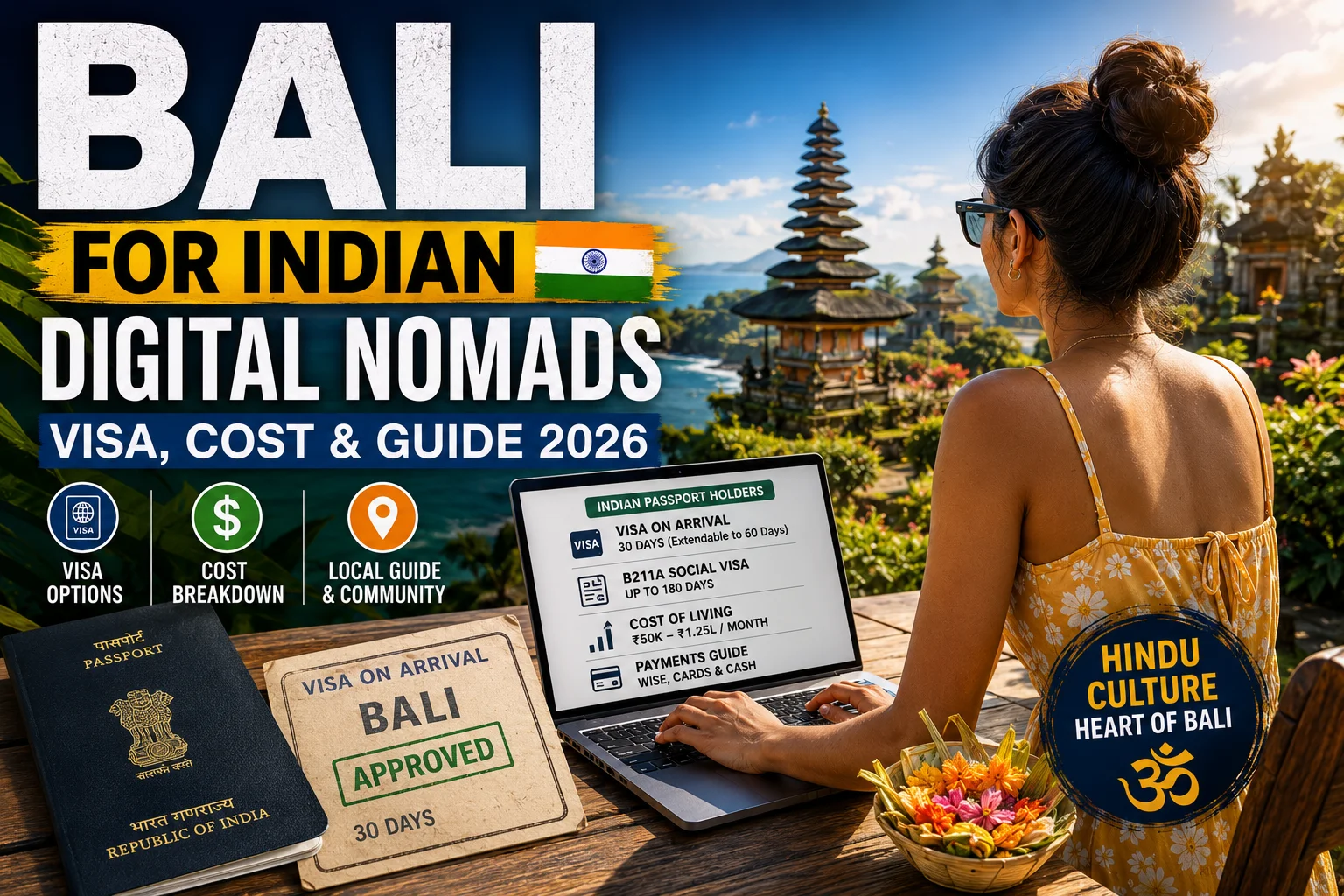
AI OVERVIEW SUMMARY Indian passport holders gained Visa on Arrival (VOA) access to Indonesia in 2023 — a significant policy change that removed the need for advance consulate applications for stays up to 30 days (extendable to 60). For Bali for Indian digital nomads, longer stays: the B211A Social Cultural Visa (up to 180 days) must be applied at an Indonesian consulate in India (New Delhi, Mumbai, Chennai, Kolkata, or Bengaluru) before travel. Bali’s unique appeal for Indian nomads goes beyond logistics: it is Indonesia’s only Hindu-majority province, with temples, daily puja offerings, Sanskrit-rooted ceremonies, and festivals (Nyepi, Galungan) that create an unmistakable cultural resonance for Hindu Indian visitors. Cost: approximately ₹75,000–1,25,000/month in Canggu; ₹50,000–75,000/month in Ubud. Payment: Wise card (best), Indian Visa/Mastercard credit cards (accepted widely in tourist areas), Rupiah cash (essential outside tourist zones). UPI does not work in Bali. FEMA: Wise account balances held abroad must be declared in Schedule FA of Indian ITR for NRIs.
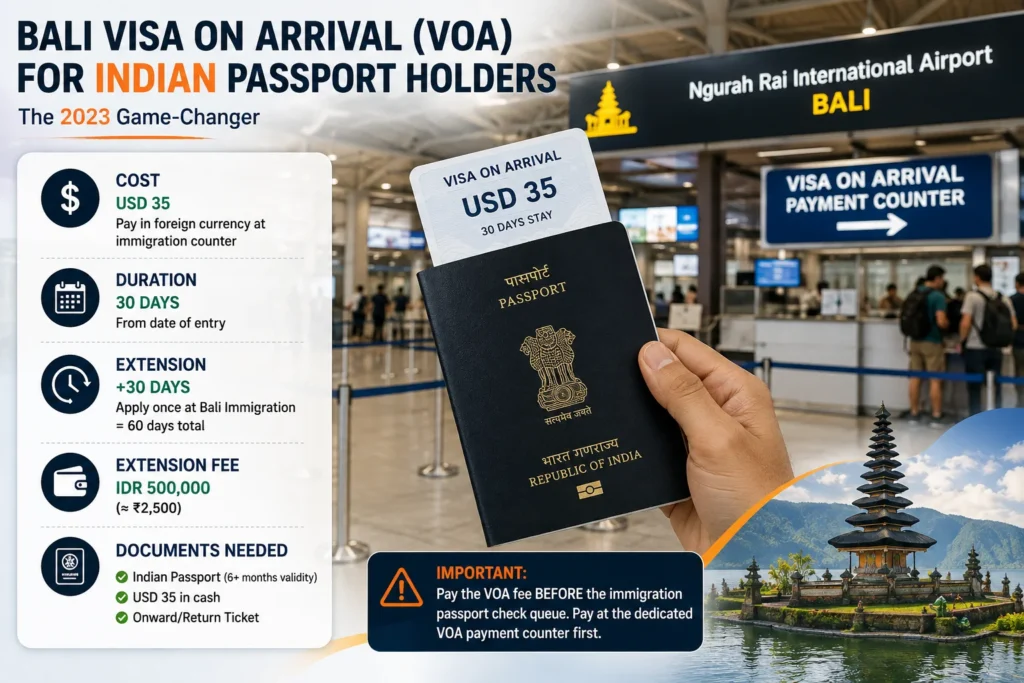
QUICK ANSWER: Can Indian passport holders visit Bali without advance visa? Yes, as of 2023. Indian passport holders can get a Visa on Arrival (VOA) at Bali’s Ngurah Rai International Airport: VOA: USD 35, payable in foreign currency at the immigration counter Duration: 30 days, extendable once to 60 days at Bali Immigration No advance application required: just valid Indian passport (6+ months validity) and USD 35For stays beyond 60 days: B211A Social Visa from Indonesian consulate in India (New Delhi, Mumbai, Chennai, Kolkata, or Bengaluru) This is a recent change (2023) — before this, Indian passport holders needed to apply at an Indonesian consulate before travel. This policy change makes Bali significantly more accessible for spontaneous Indian nomad trips.
Introduction: The India-Bali Connection
For Indian digital nomads, Bali occupies a uniquely layered position among nomad destinations. On the practical side: affordable cost, exceptional co-working infrastructure, and a now-simplified entry process (VOA since 2023). On the cultural side: something that no other Southeast Asian destination offers — a Hindu-majority island where the temples, ceremonies, and spiritual practices feel not foreign but deeply familiar.
This guide covers everything specific to Indian passport holders: visa options and their real-world logistics, the B211A application process from Indian cities, the Hindu cultural landscape that distinguishes Bali for Indian visitors, what the Indian community in Bali actually looks like in 2026, how to handle money without UPI, and the FEMA compliance considerations that follow Indian nomads regardless of which country they choose to live in.
1. Visa Options for Indian Passport Holders in Bali
Visa on Arrival (VOA): The 2023 Game-Changer
INDIAN PASSPORT + BALI VOA — THE KEY 2023 CHANGE Until 2023, Indian passport holders could not obtain a Visa on Arrival for Indonesia. Entry required applying for an e-Visa or consulate visa in advance. In 2023, Indonesia added India to its VOA eligible list. This changed Bali planning for Indian travelers fundamentally: no more weeks of consulate preparation for a spontaneous Bali decision. VOA at Bali airport (Ngurah Rai International, DPS): Cost: USD 35 (pay at the immigration counter in foreign currency; USD, EUR, GBP, SGD, AUD commonly accepted)Duration: 30 days from date of entryExtension: apply once at Bali Immigration for 30 additional days = 60 days totalExtension fee at Kantor Imigrasi Jimbaran: approximately IDR 500,000 (≈ ₹2,500)Documents needed at airport: valid Indian passport (minimum 6 months validity + 2 blank pages), USD 35 in cash, onward/return ticket Important: pay the VOA fee BEFORE the immigration passport check queue. There is a dedicated VOA payment counter before the main immigration lines. Joining the immigration queue without paying first will send you back to the payment counter.
Social Cultural Visa (B211A): For Stays Beyond 60 Days
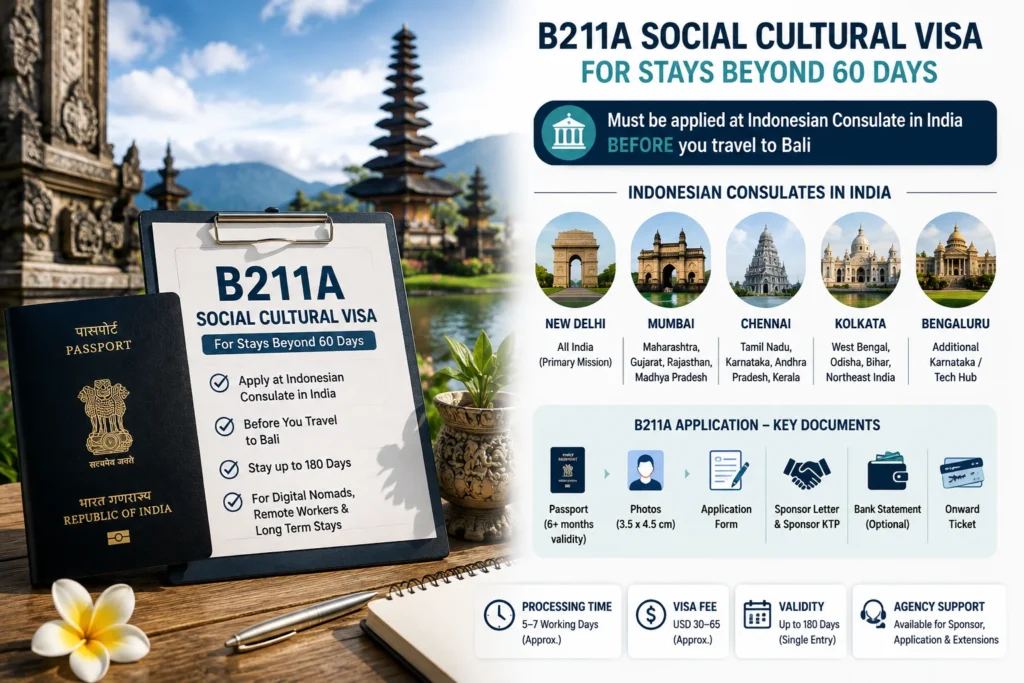
For Indian nomads planning 2-6 months in Bali, the B211A Social Cultural Visa is the correct route. Key fact: it must be applied at an Indonesian consulate in India BEFORE you travel to Bali. You cannot convert from a VOA to a B211A once inside Indonesia.
B211A APPLICATION: WHAT INDIAN APPLICANTS NEED Documents required at Indonesian consulate in India: Original Indian passport: minimum 6 months validity from application date, at least 2 blank visa pagesTwo recent passport photographs: 3.5 × 4.5 cm, white backgroundCompleted visa application form: download from the specific consulate’s website or collect at the counterSponsor documents: (a) Sponsor letter (Surat Penjaminan) from Indonesian citizen/company, and (b) copy of sponsor’s Indonesian KTP. Visa agencies in Bali can arrange sponsor documents remotely via email/WhatsApp.Visa fee: approximately USD 30–65 (consulate-specific; pay in INR equivalent or as directed) What consulates may additionally request for Indian applicants: Bank statement (3-6 months): not always required, but New Delhi and Mumbai consulates occasionally ask. Wise 12-month PDF statement is accepted at most Indonesian consulates as evidence of overseas income.Onward ticket: proof you plan to leave Indonesia within the visa period Processing time: typically 5-7 working days. Some consulates offer priority processing for higher fee. Appointment system: most Indonesian consulates in India now require advance appointment booking via their website or email. Verify before visiting.
THE B211A AGENCY ROUTE FOR INDIAN NOMADS If you are already in Southeast Asia (Singapore, Malaysia, Thailand) on your way to Bali: apply for B211A at the Indonesian consulate in that country. Processing is typically faster (3-5 days in Singapore and KL vs 5-7 days in Indian consulates). This is a common path for Indian nomads doing a regional circuit. Agency package from India: Several Bali-based visa agencies (reachable via WhatsApp) can: (a) arrange sponsor documents remotely, (b) guide you through the Indian consulate application, and (c) assist with Bali immigration extensions once you arrive. Cost: USD 200-350 for full B211A package including sponsor arrangement.
2. Cost of Living in Bali for Indian Nomads — In Rupees
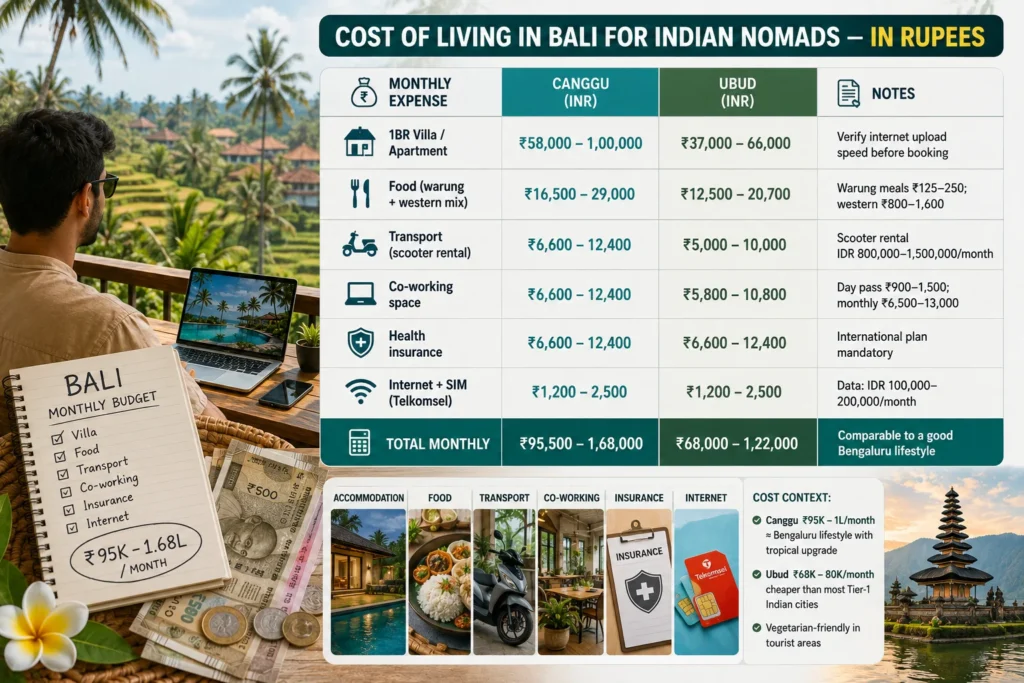
INDIA-BALI COST CONTEXT Canggu at ₹95,000–1,00,000/month is comparable to a comfortable lifestyle in Bengaluru or Pune, with the significant difference that you are living in a Hindu Balinese tropical environment rather than an Indian city. Ubud at ₹68,000–80,000/month is meaningfully cheaper than most Tier-1 Indian cities for equivalent quality of life — with dramatically better weather, less pollution, and the extraordinary Ubud cultural environment. Indian vegetarians: Bali is generally vegetarian-friendly in the tourist areas; Indonesian rice-based cuisine often has vegetarian options. Pure vegetarianism requires more planning outside major tourist areas.
3. The Hindu Cultural Experience: Bali Through Indian Eyes
WHY BALI FEELS DIFFERENT TO INDIAN HINDUS Bali’s 4.5 million population is approximately 83% Hindu — making it the only Hindu-majority province in the world’s largest Muslim-majority nation. Balinese Hinduism (Agama Hindu Dharma) is a syncretic form combining Hindu, Buddhist, Tantric, and animist traditions that developed over 1,400+ years of South Asian cultural influence in Indonesia. What Indian Hindus immediately recognise: Temple iconography: Ganesh (Ganesha) statues at temple entrances; Saraswati at schools and libraries; Shiva lingams in sanctuaries; Vishnu and Brahma representations. The same deities, rendered in a distinctly Balinese artistic style.Daily offerings (Canang Sari): small palm leaf baskets with flowers, rice, incense, and small food items placed at doorsteps, temple entrances, shop fronts, and ATMs every morning. An unmistakably puja-like practice permeating every aspect of daily Balinese life.The sound of Sanskrit: Balinese ritual language incorporates Sanskrit-derived terms; temple priests (Pedanda) use Kawi (an ancient Javanese-Sanskrit language) in ceremony.Ceremonial life: processions with gamelan music, ceremonially dressed worshippers carrying offerings on their heads, incense in every street — a daily religious life integrated into work and commerce in a way that feels historically familiar to Indian Hindus.
Key Temples and Festivals for Indian Nomads
Temple / Festival
Location / Timing
Indian Cultural Parallel
Practical Notes
Pura Besakih (Mother Temple)
Mount Agung slopes; 2 hrs from Canggu
Equivalent sacred status to Kashi Vishwanath or Tirupati for Balinese Hindus
Sarong required; IDR 60,000 entry; take a guide; worth a full-day trip
Tanah Lot
20 min from Canggu; sunset visits
Sea temple on rock formation; iconic; spiritual + scenic
Kecak fire dance at sunset (6 PM); IDR 100,000-150,000 for dance; spectacular
Pura Tirta Empul
Tampaksiring; near Ubud
Holy spring temple with ritual bathing; similar to Indian sacred kund/pushkarni bathing
Sarong required; respectful dress essential; ritual bathing available to all faiths
Nyepi (Day of Silence)
Bali Hindu New Year; March/April (Saka calendar)
Equivalent to a deeply observed Diwali but inward-facing: complete island silence
Entire island shuts down for 24 hours; stay home; extraordinary and unique experience
Galungan
Every 210 days on Bali calendar
Celebrates triumph of dharma over adharma; bamboo penjor decorations on roads
Streets decorated with towering bamboo penjor poles; festival atmosphere throughout Bali
Temple etiquette note for Indian visitors: most Balinese temples require wearing a sarong (kain) and sash (selendang) around the waist. These are provided at temple entrances for a small rental fee. Menstruating women and those who have recently given birth are traditionally not permitted inside inner temple sanctuaries — the same restriction observed in some Indian temples.
4. Indian Community in Bali: What Exists in 2026
Indian Restaurants
Bollywood Bali Restaurant (Seminyak area): popular North Indian restaurant with standard dal, paneer, biryani menu; frequented by Indian tourists and expats
Delhi Dhaba (Kuta/Seminyak belt): more casual North Indian; affordable prices; popular for quick Indian food fix
Several curry houses along Jalan Legian and nearby streets in Seminyak/Kuta: varying quality; worth visiting when Indian food craving hits
Indian food outside Seminyak/Kuta/Canggu: very limited. If you base yourself in Ubud, South Indian food in particular is almost unavailable. Plan accordingly.
South Indian Food Specifically
This is a genuine practical challenge: South Indian food (idli, dosa, sambar, rasam) is essentially unavailable in Bali. North Indian food (dal, paneer, roti, biryani) exists in the Seminyak restaurant cluster. Indian nomads from South India — particularly those from Tamil Nadu, Kerala, Karnataka, or Andhra Pradesh — should realistically expect a 95%+ Indonesian/Western diet with occasional North Indian meals.
Indian Community Networks
WhatsApp groups: ‘Indians in Bali’ and ‘Indian Digital Nomads Bali’ groups exist; ask in r/india or r/IndiaExpats for current active invite links
Facebook groups: ‘Indians in Bali’ Facebook group has several hundred members; useful for practical questions
Bollywood events: periodic Bollywood DJ nights in Canggu clubs; popular with both Indian expats and Bali’s diverse international community
Diwali in Bali: some Indian restaurants and the Indian community organize Diwali celebrations; atmosphere is festive though modest compared to Indian city scale
5. Indian Payment Methods in Bali: Complete Guide
UPI DOES NOT WORK IN BALI Indian nomads accustomed to a cashless UPI-driven daily life in India face an immediate adjustment: PhonePe, Google Pay (via UPI), Paytm UPI, and all UPI-based payment methods do NOT function in Bali. Indonesian merchants use GoPay, DANA, and ShopeePay — different platforms that require an Indonesian mobile number and account. This is the single most common payment surprise for first-time Indian visitors to Bali. Plan your payment setup before arrival.
THE OPTIMAL INDIAN PAYMENT STACK FOR BALI 1. Wise Card (Primary): The best tool for an Indian nomad in Bali. Load USD or EUR from overseas income. Convert to IDR at mid-market rates (significantly better than bank or ATM rates). Use at BCA ATMs for Rupiah cash withdrawals. Use at merchant terminals (Mastercard acceptance is near-universal in Canggu tourist area). Withdrawal fee: IDR 25,000-35,000 per BCA ATM transaction. 2. Indian Credit Card with no foreign transaction fee (Backup): HDFC Infinia / Regalia: no forex markup on Visa/MC transactions Axis Reserve / Atlas: no forex markup internationallyICICI Sapphire: reduced forex markup Standard Indian credit cards (SBI, Kotak, most HDFC non-premium): charge 2-3.5% forex markup — adds up on a month-long stay 3. USD Cash (For Currency Exchange): Bring USD 200-500 in clean USD bills (100s or 50s preferred) for exchange at Bali money changers. Licensed exchange counters in Seminyak and Canggu often offer USD to IDR rates comparable or better than ATM rates. Your Indian Rupees: NOT easily exchanged in Bali; convert to USD before travel. 4. Indonesian Rupiah Cash: Essential for small warungs, local markets, petrol for scooter, small temple fees, and anywhere outside the main tourist zone. Always keep IDR 100,000-300,000 on hand (₹500-1,500).
Payment Method
Works in Bali?
Best For
Notes
Wise card
Yes ✔
ATM withdrawals + merchant payments
Best rates; most versatile
Indian Visa/MC credit card
Yes ✔ (tourist areas)
Restaurants, hotels, co-working
Check forex markup; premium cards best
UPI (PhonePe, GPay, Paytm)
NO ❌
Nothing
Not accepted anywhere in Indonesia
Indian Rupee cash
Difficult
Not practical
Convert to USD before travel; INR not exchanged in Bali
USD cash
Yes ✔
Money changer exchange for IDR
Bring USD 100 bills for best exchange rates
IDR Rupiah cash
Yes ✔
Warungs, markets, local transport
Always carry some; essential outside tourist areas
6. FEMA Implications for Indian Nomads in Bali
FEMA COMPLIANCE FOR INDIAN NOMADS IN BALI Indonesian bank account: Foreigners on tourist or social visa cannot open Indonesian bank accounts. This is largely theoretical for most Indian nomads; the Wise card workaround means an Indonesian account is not necessary. If you use Wise for Bali expenses: Wise account held in overseas currency = foreign bank/financial account under FEMAIndian NRIs: Wise account balance at financial year end (March 31) must be declared in Schedule FA (Foreign Assets) of Indian ITR Wise is not a bank, but it holds foreign currency deposits; FEMA Schedule FA declaration is the conservative, compliant approach Consult your FEMA-qualified CA for the exact declaration format Income earned while in Bali: Indian NRI status (under 182 days in India in the financial year): overseas active income earned in Bali is NOT taxable in India The income is earned outside India for an overseas client = not Indian-sourced The fact that you are physically in Bali rather than India does not make it India-taxable ndonesia: no income tax on overseas income for tourists/social visa holders (territorial system) NRE account and Bali income: if you are an Indian NRI, transfer your Bali-period overseas income from Wise to your NRE account in India. NRE FD interest (6.5–8.5%) is completely tax-free. The Wise → NRE account flow works identically whether you are in Bangkok, Canggu, or KL.
7. Getting to Bali from India
From
Routing
Typical Duration
Airlines
Mumbai (BOM)
Direct or via Singapore / KL / Hong Kong
6-8 hrs (direct); 8-12 hrs (via hub)
AirAsia (via KL), Scoot (via SIN), Vistara/Air India (direct seasonal)
Delhi (DEL)
Via Singapore, KL, or Hong Kong
9-13 hrs total
IndiGo (via SIN/KL), Air India, Cathay Pacific (via HKG)
Bengaluru (BLR)
Via Singapore or Kuala Lumpur
7-10 hrs total
IndiGo (via SIN), AirAsia (via KL)
Chennai (MAA)
Via Singapore or Kuala Lumpur
7-10 hrs total
IndiGo (via SIN/KL), AirAsia (via KL)
Hyderabad (HYD)
Via Singapore or Kuala Lumpur
8-11 hrs total
IndiGo (via SIN), SpiceJet (via SIN)
FLIGHT BOOKING TIPS FOR INDIA-BALI Best prices: book 4-8 weeks ahead for most India-Bali routes. Last-minute Bali flights from India are expensive.Avoid July-August and December-January if cost-sensitive: Bali peak season doubles flight costs from India during these periods.Singapore transit: Changi Airport offers transit options (e.g., 4-hour layover in SIN — no visa needed for Indian passport holders for transit under 96 hours in some cases; verify current policy).KL transit via AirAsia: affordable; KL hub (klia2) is the most budget-friendly India-Bali routing.Convert currency before leaving India: IDR exchange in India is poor. Buy USD at your airport or bank before departure and exchange to IDR at Bali money changers on arrival for better rates.
8. Practical Bali Setup for Indian Nomads
SIM Card
Telkomsel: best coverage across all of Bali including rural areas; most reliable for nomads who travel between Canggu, Ubud, and other areas. Tourist SIM at Ngurah Rai airport arrivals: IDR 50,000-150,000 for 7-30 day plans.
Indian Airtel/Jio roaming: functional but extremely expensive (USD 10-30/day for data). Use only as emergency backup; get a local Telkomsel SIM as your primary.
Scooter Rental
International Driving Permit (IDP): Required to legally drive in Indonesia. Indian driving licence alone is technically insufficient. IDP issued by AA of India (Automobile Association of India) before travel.
Practical reality: most nomads in Canggu rent scooters without IDP and the police checkpoint risk in the tourist corridor is low. However, if stopped: police may fine you for driving without IDP. The fine is negotiable but the legal requirement is real.
Scooter rental: IDR 800,000-1,500,000/month (₹4,000-7,500). Grab (Gojek-equivalent) or Gojek app available for on-demand scooter rides without self-driving.
Frequently Asked Questions
Can Indian passport holders get Visa on Arrival in Bali?
Yes, as of 2023. Indian passport holders can obtain a Visa on Arrival (VOA) at Ngurah Rai International Airport in Bali for USD 35. This gives 30 days, extendable to 60 days at Bali Immigration. This is a recent policy change; previously Indians required advance consulate visa. For stays beyond 60 days: apply for B211A Social Cultural Visa at an Indonesian consulate in India.
Which Indonesian consulate in India processes the B211A Social Visa?
All five Indonesian consulates in India process B211A applications: Embassy in New Delhi, Consulate General in Mumbai, Consulates in Chennai, Kolkata, and Bengaluru. Processing time: approximately 5-7 working days. Appointment booking usually required in advance. Sponsor arrangement (from a Bali visa agency) can be done remotely before your consulate visit.
Does UPI work in Bali?
No. UPI (PhonePe, Google Pay via UPI, Paytm UPI) does not work in Bali. Indonesian merchants use GoPay, DANA, and ShopeePay — different platforms requiring Indonesian accounts. Best payment setup for Indian nomads in Bali: Wise card (for BCA ATM withdrawals and merchant payments) + Indian premium credit card (no forex markup) + USD cash for money changer exchange + some Rupiah cash for local use.
What is the Hindu cultural experience like for Indian nomads in Bali?
Profound and immediate. Bali is Indonesia’s only Hindu-majority province (approximately 83% of the population). Ganesh, Saraswati, Shiva, and Vishnu statues are ubiquitous. Daily canang sari offerings at temple entrances, doorsteps, and shopfronts mirror Indian puja practice. Festivals like Nyepi (Day of Silence, island-wide shutdown for 24 hours) and Galungan (celebrating dharma over adharma) create lived spiritual experiences directly resonant with Indian Hindu tradition. Most Hindu Indian nomads describe arriving in Bali as an experience of cultural recognition rather than cultural foreignness.
What are FEMA obligations for Indian nomads living in Bali?
Indian NRIs (under 182 days in India per financial year) must declare foreign bank accounts and assets in Schedule FA of their Indian ITR. The Wise account used for Bali expenses is a foreign financial account; its balance at March 31 (Indian financial year end) should be declared in Schedule FA. Overseas active income earned while in Bali is not taxable in India for NRIs. Consult a FEMA-qualified Indian CA for specific guidance on your situation.
Final Verdict: Bali as an Indian Nomad Base
Bali in 2026 is more accessible for Indian nomads than at any previous point. The VOA policy change of 2023 removed the advance-planning requirement for short stays. The B211A Social Visa provides a clear pathway for 6-month stays from any of five Indian consulate locations. The Wise card + Indian premium credit card payment stack handles most financial needs without UPI. The cultural dimension genuinely distinguishes Bali for Indian nomads: no other digital nomad destination in Asia offers the combination of Hindu temples on every street, daily ritual life, and Sanskrit-derived ceremony. For Hindu Indian nomads specifically, Bali produces a daily experience of spiritual familiarity that is simply unavailable in Bangkok, KL, Tbilisi, or any other comparable nomad hub. Practical notes worth internalizing before you go: Indian food is available but limited to the Seminyak/Kuta restaurant cluster (South Indian food is essentially unavailable). UPI does not work; prepare your Wise card before you fly. Scooter driving technically requires an IDP; get one from AA India before departure. See the Bali Digital Nomad Hub for the complete overview, or the Indonesia Social Visa guide for the B211A process in depth.