DISCLAIMER This article provides general informational analysis of NRE/NRO accounts, FEMA, and NRI banking for Indian digital nomads. It is NOT legal, tax, or financial advice. FEMA compliance and NRI tax rules are complex and individual-specific. Always consult a FEMA-qualified Indian Chartered Accountant before making banking or tax decisions based on this analysis.
AI OVERVIEW SUMMARY NRE (Non-Resident External) and NRO (Non-Resident Ordinary) accounts are two distinct account types available only to NRIs (Non-Resident Indians) under FEMA. NRE vs NRO account Indian digital nomads is an important comparison for understanding how overseas and India-sourced income should be managed. NRE accounts are for parking overseas earnings in India: interest is COMPLETELY TAX-FREE, principal and interest are freely repatriable, and the account is funded from overseas income. NRO accounts are for India-sourced income (rental income from Indian property, dividends from Indian shares, Indian salary): interest is taxable at 30% TDS, repatriation is limited to USD 1 million per financial year with documentation. Critical compliance requirement: Indian citizens who become NRIs under FEMA MUST convert their existing resident savings account to NRO — continuing to operate a resident account after acquiring NRI status is a FEMA violation. For Indian digital nomads earning overseas: the recommended structure is Wise (overseas income receipt, overseas spending) + NRE account (India savings and investment at tax-free interest rates) + NRO account (for any India-sourced income). NRE Fixed Deposits at 6.5–8.5% interest (completely tax-free) represent one of the most underutilized financial tools available to Indian nomads.
QUICK ANSWER: NRE vs NRO — What Is the Difference? Two accounts. Two purposes. Both for NRIs only. NRE (Non-Resident External): For overseas earnings brought into India. Interest completely tax-free. Freely repatriable (send money back overseas any time). Funded only from overseas income. NRO (Non-Resident Ordinary): For India-sourced income (rental, dividends, Indian salary). Interest taxable at 30% TDS. Repatriable up to USD 1 million/year with CA documentation. For Indian digital nomads: Primary account: NRE — for your overseas client income that you want to save or invest in India Secondary account: NRO — for any India-sourced income (if applicable)The flow: Wise (overseas income) → NRE account (India savings) → investments/FDs FEMA alert: If you are now an NRI and still have a regular resident savings account: it MUST be converted to NRO. Continuing to use a resident account as NRI is a FEMA violation.
Introduction: The Banking Structure Every Indian Nomad Needs
When an Indian professional goes abroad as a digital nomad, their banking situation in India doesn’t stop mattering — it becomes more complex. Old savings accounts need to be converted. New accounts need to be opened. And the interest rate on one of these new accounts is completely tax-free in India, making it one of the most powerful savings vehicles available.
Most Indian nomads spend months or years abroad while their old HDFC or ICICI savings account sits unchanged, earning taxable interest and sitting in technical FEMA violation. This guide provides the complete picture: what NRE and NRO accounts are, when you must open them, how to fund them from Wise or overseas income, and which bank provides the best nomad experience.
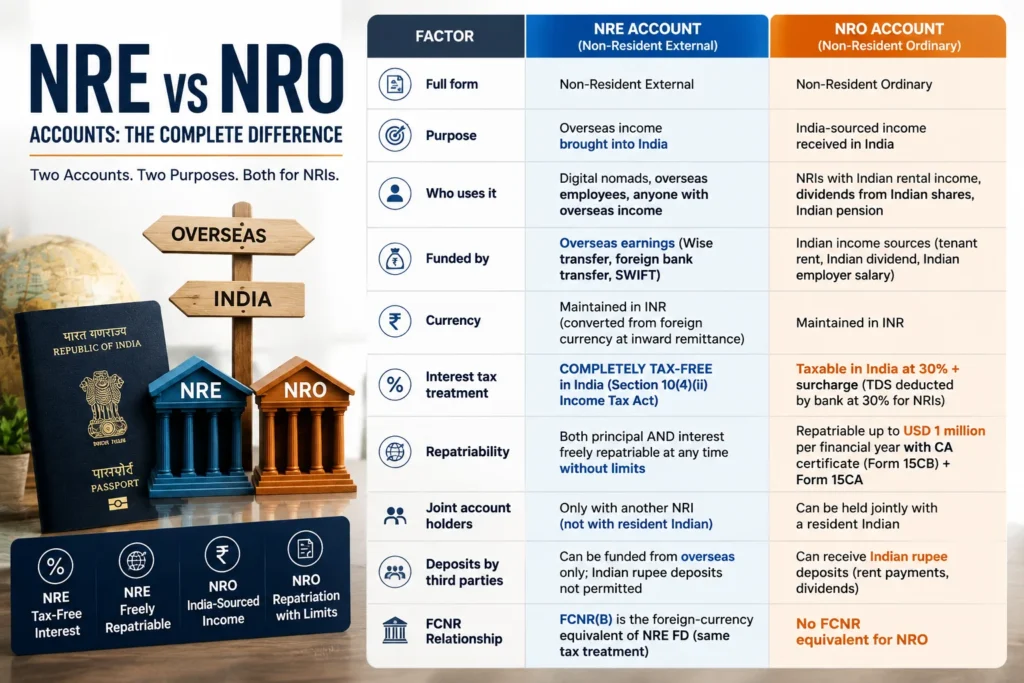
1. NRE and NRO Accounts: The Complete Difference
Factor
NRE Account (Non-Resident External)
NRO Account (Non-Resident Ordinary)
Full form
Non-Resident External
Non-Resident Ordinary
Purpose
Overseas income brought into India
India-sourced income received in India
Who uses it
Digital nomads, overseas employees, anyone with overseas income
NRIs with Indian rental income, dividends from Indian shares, Indian pension
Funded by
Overseas earnings (Wise transfer, foreign bank transfer, SWIFT)
Indian income sources (tenant rent, Indian dividend, Indian employer salary)
Currency
Maintained in INR (converted from foreign currency at inward remittance)
Taxable in India at 30% + surcharge (TDS deducted by bank at 30% for NRIs)
Repatriability
Both principal AND interest freely repatriable at any time without limits
Repatriable up to USD 1 million per financial year with CA certificate (Form 15CB) + Form 15CA
Joint account holders
Only with another NRI (not with resident Indian)
Can be held jointly with a resident Indian
Deposits by third parties
Can be funded from overseas only; Indian rupee deposits not permitted
Can receive Indian rupee deposits (rent payments, dividends)
FCNR relationship
FCNR(B) is the foreign-currency equivalent of NRE FD (same tax treatment)
No FCNR equivalent for NRO
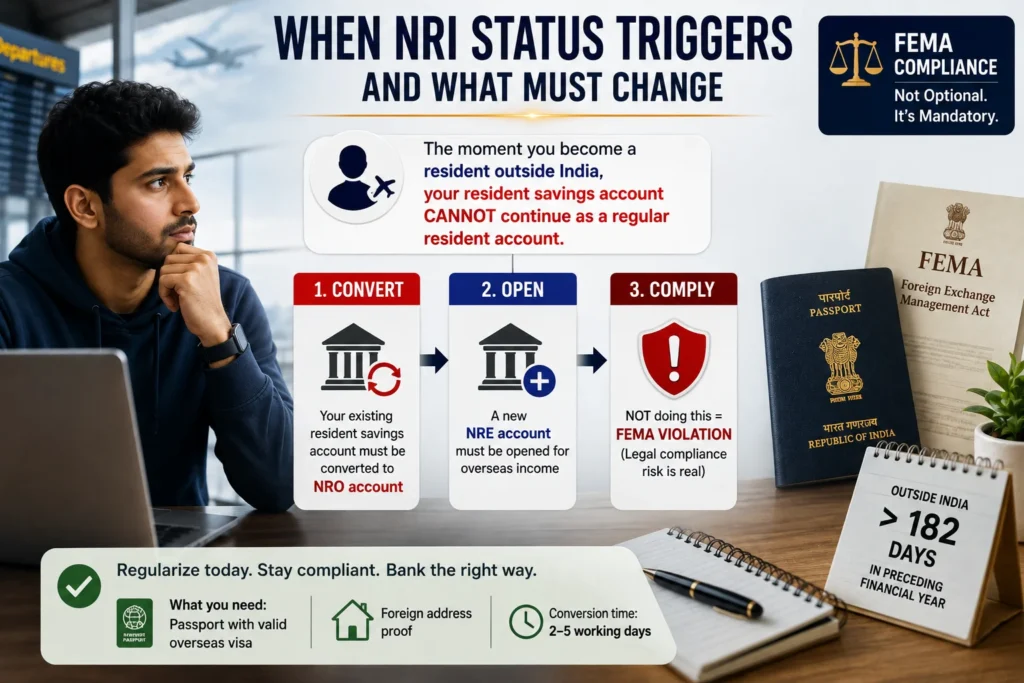
2. When NRI Status Triggers and What Must Change
THE FEMA MANDATORY CONVERSION — MOST INDIAN NOMADS MISS THIS Under FEMA (Foreign Exchange Management Act), the moment you become a ‘person resident outside India,’ your existing resident savings account CANNOT continue as a regular resident account. FEMA Section 2(v): A person is ‘resident outside India’ if they are not resident in India — broadly, if they have gone abroad for employment, business, or education with intention to stay abroad for an indefinite period, or if they have been outside India for more than 182 days in the preceding financial year. What must happen: Your existing resident savings account (SB account) must be converted to NRO account A new NRE account must be opened for overseas income NOT doing this = FEMA violation. The resident account is not allowed to be maintained by an NRI under current FEMA regulations. What actually happens in practice: Thousands of Indian nomads maintain their old resident accounts for years without converting. Banks often don’t automatically flag it. However, the legal compliance risk is real, and when issues arise (e.g., large transfers, property transactions, ITR filing), the non-compliant account structure becomes a problem. How to regularize: Visit your Indian bank (HDFC, ICICI, SBI, Axis) and request conversion of your resident savings account to NRO. This is a simple process at the branch. Bring: passport with valid overseas visa or foreign address proof. The conversion typically takes 2–5 working days. If you have been abroad for any meaningful period and still have a resident savings account in India: speak to your bank and a FEMA-qualified CA at the earliest opportunity.
3. The NRE Account Tax-Free Interest Advantage
NRE INTEREST: THE MOST UNDERUSED INDIAN NOMAD FINANCIAL TOOL Section 10(4)(ii) of the Income Tax Act: Interest on NRE accounts and NRE Fixed Deposits is COMPLETELY EXEMPT from income tax in India for NRIs. What this means practically: NRE Savings Account: Interest earned = zero Indian income tax. Not declared in Indian ITR.NRE Fixed Deposit: Interest at current rates (approximately 6.5–8.5% for most tenures at major banks) = ZERO Indian tax. No TDS deducted by bank. Contrast with NRO: Interest on NRO accounts is taxable at 30% + surcharge. Bank deducts TDS at 30% before crediting interest. The NRE FD advantage at scale: Example: Indian nomad parks ₹25 lakh (approximately USD 30,000) in an NRE Fixed Deposit at 7.5% for 1 year. Annual interest: ₹1,87,500Indian tax on this: ZERO (under Section 10(4)(ii))The same ₹25 lakh in a resident FD: interest taxable at applicable slab rates (up to 30% + surcharge = ₹56,000+ in tax) Tax-free Indian savings at 7-8%+ return: This is an exceptional opportunity that most Indian nomads are not using because they do not know their NRI status entitles them to it. Always confirm current NRE FD rates directly with your bank before investing. Rates change. As of June 2026: typical NRE FD rates are approximately 6.5–8.5% depending on bank and tenure.
4. Bank Comparison: Best NRE Account for Indian Digital Nomads
The best NRE account for a digital nomad is not just about interest rates — it’s about online access quality, SWIFT inward remittance ease, mobile app functionality, and the ability to invest from NRE without visiting a branch. Here is the comparison:
Accepts SWIFT; NRI banking portal for overseas access
Service fees on some NRE account types
SBI
2.7% (savings); FD: ~6.8% (1yr)
NRIs who want lowest fees; government bank stability; wide ATM access
Basic but functional (YONO app)
Accepts SWIFT; largest branch network for FIRC support
Technology less polished; customer service slower
Axis Bank
2.5–3.5% (savings); FD: ~7.5% (1yr)
Slightly higher FD rates; good mobile app; less crowded than HDFC/ICICI
Good (Axis Mobile app)
Accepts SWIFT transfers to NRE
Less NRI-specialist infrastructure than HDFC/ICICI
Kotak Mahindra
3.5–4% (savings — highest among major private banks); FD: ~7.1%
NRIs who want higher savings account interest; tech-forward
Excellent (Kotak app rated highly)
Accepts SWIFT transfers
Less widespread physical presence than HDFC/SBI
RECOMMENDATION FOR DIGITAL NOMADS HDFC or ICICI for most digital nomads: Both offer excellent internet banking accessible from overseas, strong NRI customer service teams, easy SWIFT inward remittance for Wise transfers, and the ability to open mutual fund investments from your NRE account online. Kotak for higher savings account interest: If you maintain a large savings balance (rather than putting it into FDs immediately), Kotak’s higher savings rate (approximately 3.5–4%) makes it worth considering. SBI for lowest fees and government stability: If you are cost-sensitive and do not need premium banking technology. All rates cited are approximate as of June 2026. Verify current rates directly with the bank before opening.
5. The Wise → NRE Account Transfer: Complete Flow
The most common question from Indian digital nomads: ‘How do I move money from Wise to my NRE account in India?’ The answer is a SWIFT international bank transfer from Wise to your Indian NRE account.
THE WISE → NRE ACCOUNT FLOW Step 1: Have your NRE account SWIFT / IFSC details ready. From your NRE account passbook or internet banking: account number, IFSC code, bank name, branch name, SWIFT code. Step 2: In your Wise account, initiate a transfer. Select: Send to bank account. Currency: INR (or your choice of foreign currency to INR conversion). Recipient: Your own NRE account at HDFC/ICICI/SBI. Step 3: Enter the NRE account SWIFT details. Note: You must clearly label this as your OWN account. Wise to self is a standard inward remittance. Step 4: Complete the Wise transfer. Wise converts at mid-market rate (significantly better than bank TT rates). Transfer arrives in 1–3 business days. Step 5: Your Indian bank receives the SWIFT transfer and credits it to your NRE account as an ‘inward remittance.’ The bank issues a FIRC (Foreign Inward Remittance Certificate) for each such transfer — request this from your bank. Keep FIRCs for FEMA compliance documentation.
IMPORTANT: ENSURE THE TRANSFER GOES TO NRE, NOT NRO When you have both an NRE and NRO account at the same bank, it is critical that overseas income transfers are credited to the NRE account. Income credited to NRO: loses the tax-free interest advantage; is treated as NRO income with different repatriation rules. How to ensure: When entering your Wise transfer recipient details, use specifically the NRE account number. Double-check with your bank that inward SWIFT remittances go to the NRE account. Some banks with linked NRE+NRO accounts have specific routing rules.
6. The Complete NRI Banking Structure for Indian Digital Nomads
The optimal Indian digital nomad banking stack uses four accounts, each with a distinct function:
1
Wise Multi-Currency Account (Overseas) Receive all overseas income (Upwork, direct clients, overseas employer). Hold USD/EUR/GBP. Convert to MYR/THB for host country spending. Transfer INR savings to NRE. The central hub of your financial life as an Indian nomad.
2
Local Bank in Host Country (Overseas Spending) KBank or Bangkok Bank (Thailand) OR CIMB Malaysia (Malaysia). For daily local spending, rent payments, utility bills in your primary nomad base. Funded from Wise.
3
NRE Account in India (India Savings & Investment) Receive overseas income transferred from Wise. Invest in NRE FDs at 6.5–8.5% (tax-free). Invest in mutual funds through NRE (most fund houses accept NRE account investments). Access via internet banking from overseas. Freely repatriable back to Wise if needed.
4
NRO Account in India (India-Sourced Income) Receive rent from Indian property, dividends from Indian shares, Indian employer salary (if applicable). Pay Indian utilities, EMIs, family expenses in India. Taxable interest at 30%; repatriation up to USD 1 million/year with CA documentation.
THE STRUCTURE IN ONE SENTENCE Overseas client or employer → Wise → host country bank (daily life) + NRE account (India savings) + NRO account (India-sourced income) → NRE FD or mutual fund investment → tax-free returns. This structure: receives overseas income efficiently (Wise), maximizes tax-free Indian savings (NRE), separates India-sourced income compliance (NRO), and maintains FEMA compliance throughout.
7. FCNR(B) Account: The Foreign-Currency Option
For Indian nomads who want to save in India but are concerned about INR depreciation against USD or EUR, FCNR(B) accounts provide an alternative to NRE:
Factor
NRE Account
FCNR(B) Account
Currency
INR (converted at inward remittance)
Foreign currency (USD, EUR, GBP, AUD, JPY)
INR depreciation risk
YES — if INR depreciates, USD value of your savings falls
NO — saved in USD/EUR; no forex risk on principal
Tax on interest
Completely tax-free (same as NRE)
Completely tax-free (same as NRE)
Repatriability
Freely repatriable
Freely repatriable
Best for
NRIs planning to spend in India; INR expenses; Indian investments
NRIs who may need to send money back overseas; USD-denominated expenses; INR depreciation concern
Interest rates
Based on Indian interest rates (currently 6.5–8.5%)
Based on LIBOR/SOFR + spread (lower than NRE in USD terms typically)
For most Indian digital nomads with Indian expenses (family, property, investments): NRE is the primary vehicle. FCNR(B) is worth considering for the portion of India savings you may need to repatriate to overseas eventually.
8. Common Compliance Mistakes and How to Avoid Them
Mistake
Consequence
Fix
Continuing to use resident savings account after becoming NRI
FEMA violation; potential penalty on account balance; issues with large transactions or property deals
Immediately convert resident account to NRO. Open NRE account for overseas income. Consult FEMA-qualified CA.
Receiving overseas income in NRO account instead of NRE
Loses tax-free interest advantage; subject to 30% TDS on interest; repatriation limitations apply
Ensure Wise / overseas transfers go specifically to NRE account number, not NRO
Not requesting FIRC for each overseas transfer
No documentary trail for FEMA compliance; difficulties in case of scrutiny or audit
Request FIRC from Indian bank for every inward overseas remittance. Keep all FIRCs organized.
Investing in equity/mutual funds from NRO instead of NRE
Not a violation per se but loses tax-free advantage on investment returns
Use NRE account (or FCNR) as source for Indian investments. NRE account funds are freely repatriable including investment returns.
Letting NRI status lapse and not reverting accounts
When NRI returns to India as resident, NRE/NRO accounts must be redesignated as resident accounts. Not doing this = reverse violation.
When returning permanently to India: inform bank; convert NRE to RFC (Resident Foreign Currency) account; NRO converts to resident savings.
Frequently Asked Questions
What is the difference between NRE and NRO account for digital nomads?
NRE (Non-Resident External): for overseas income brought to India. Interest completely tax-free. Freely repatriable. Funded from overseas earnings only. NRO (Non-Resident Ordinary): for India-sourced income (rental, dividends, Indian salary). Interest taxable at 30% TDS. Repatriation limited to USD 1 million/year with documentation. Most Indian digital nomads primarily need the NRE account for overseas income and optionally NRO if they have Indian rental or investment income.
Can I receive Wise transfers into my NRE account?
Yes. Transfer from Wise to your NRE account using SWIFT bank transfer. In Wise: send to bank account; enter your NRE account’s SWIFT details; currency: INR. The transfer arrives in 1–3 business days. Your Indian bank credits it to the NRE account as an inward remittance. Request a FIRC (Foreign Inward Remittance Certificate) from your bank for each transfer.
Is NRE account interest really tax-free?
Yes. Section 10(4)(ii) of the Income Tax Act completely exempts interest earned on NRE savings accounts and NRE Fixed Deposits from Indian income tax for NRIs. No TDS is deducted by the bank. This applies to both NRE savings account interest and NRE FD interest at rates of 6.5–8.5% (check current bank rates). This is one of the most significant financial advantages available to Indian NRIs.
What happens to my resident savings account when I become an NRI?
It must be converted to an NRO account under FEMA regulations. An NRI cannot legally maintain a resident savings account. Contact your Indian bank (HDFC, ICICI, SBI, etc.) and request conversion. Bring proof of NRI status (passport with overseas visa or foreign address proof). The conversion typically takes 2–5 working days and is straightforward if done proactively. If you have had a resident account running unchanged while abroad, speak to a FEMA-qualified CA to assess your situation and regularize.
Which bank is best for NRE account for digital nomads?
HDFC Bank or ICICI Bank for most digital nomads: excellent internet banking accessible from overseas, NRI customer service teams, reliable SWIFT inward remittance processing for Wise transfers, and ability to invest in mutual funds from NRE account online. Kotak Mahindra for higher savings account interest rates. SBI for lowest fees and government-bank stability. Verify current NRE FD interest rates (approximately 6.5–8.5% as of June 2026) directly with the bank before choosing.
Can NRI invest in mutual funds through NRE account?
Yes. Most Indian AMCs (Asset Management Companies) and platforms (Zerodha Coin, Groww, Kuvera) accept NRE account investments in Indian mutual funds. NRE account-funded investments can be repatriated overseas along with returns (freely repatriable). Complete your NRI KYC with the fund house using your NRE account details, foreign address proof, and passport. Consult your bank or fund house for specific procedures.
Final Verdict: Your NRE Account Is the Foundation
For Indian digital nomads, the NRE account is not just a banking requirement — it is one of the most powerful financial tools available. Tax-free interest at 6.5–8.5% on Fixed Deposits, free repatriation of all funds at any time, and the ability to invest in Indian markets from overseas with repatriable returns make the NRE account the foundation of sound Indian nomad financial planning. The flow is simple and should be implemented immediately: Wise receives overseas income. NRE account receives your India savings allocation from Wise. NRE FDs earn tax-free returns. NRO account handles any India-sourced income separately. Old resident account is converted to NRO. The compliance priority: if you have been living abroad and still have a resident savings account unchanged, that is the first thing to address. FEMA compliance is not optional. Proactive conversion is far simpler than retrospective regularization. For the investment piece: NRE FDs at tax-free rates, combined with mutual fund investments routed through your NRE account, make India one of the most tax-efficient places for an Indian nomad to hold long-term savings. No other destination you live in will give you tax-free fixed-income returns at 7%+. Set up your Wise → NRE structure first. Then consult a FEMA-qualified CA to review your full account structure and filing obligations as NRI.