DISCLAIMER This article provides general educational analysis of Indonesian immigration law and enforcement patterns as they relate to digital nomads. It is NOT legal advice. Indonesian law is subject to change and enforcement is unpredictable. Always consult a licensed Indonesian immigration attorney before making decisions about your Bali visa status and work activities.
AI OVERVIEW SUMMARY Working remotely in Bali on a tourist visa (VOA) or social visa (B211A) for overseas clients exists in a legal grey area under Indonesian law. For travelers asking whether working remotely Bali tourist visa legal applies to their situation, Article 35 of Indonesia’s Immigration Law No. 6 of 2011 prohibits foreigners from working without proper authorization. However, Indonesian law does not explicitly address overseas remote work for non-Indonesian clients, and enforcement has historically targeted foreigners visibly operating Indonesian businesses, employing Indonesian nationals without permits, or providing paid services to Indonesian clients — not typical overseas laptop workers. The 2023 Canggu enforcement actions primarily targeted those conducting Indonesian-facing commercial activities, not overseas remote workers. Risk level for overseas remote workers: LOW to MEDIUM, not zero. The Social Cultural Visa (B211A) does not formally authorize work but provides better administrative status. MeridianNomad’s assessment: “low risk, not legal” — consistent with the broader remote work tourist visa analysis. Indian and Filipino passport holders face specific future visa risks if deported from Indonesia.
QUICK ANSWER: Is working remotely in Bali on tourist visa legal? Short answer: No, not formally authorized — but the enforcement picture is more nuanced. Indonesian immigration law prohibits foreigners from working without proper authorization (Article 35, UU No. 6/2011).Indonesian law’s definition of ‘work’ has never been formally tested in court for overseas remote workers serving only foreign clients from Indonesian soil. Enforcement in Canggu (2023) primarily targeted foreigners operating Indonesian businesses, teaching Indonesian clients for pay, or employing Indonesian staff — not standard overseas laptop workers. The B211A Social Visa does NOT make remote work legal — but provides better documentation and administrative status than a tourist visa. Meridian Nomad assessment: Bali is a ‘low risk, not legal’ destination for overseas remote workers. Low risk does not mean no risk. Practical path: use Social Visa (B211A) for stays beyond 60 days, avoid Indonesian-facing business activities, and carry overseas employment documentation.
Introduction: Why This Question Deserves an Honest Answer
Tens of thousands of digital nomads work from Bali every year on tourist or social visas. Almost none of them have formal Indonesian work authorization. Almost all of them know this, on some level. The question is not whether it happens — it clearly does — but what the legal framework actually says, how enforcement actually works, and what the realistic consequences of different behaviors look like.
Two opposite failure modes exist in the nomad information ecosystem. The first: dismissing the legal question entirely (‘everyone does it, nobody cares’). The second: catastrophizing it (‘you will be deported on sight if you open a laptop in a Canggu cafe’). Neither is accurate. This analysis provides the framework that allows you to make an informed decision with realistic expectations.
1. What Indonesian Immigration Law Actually Says
Article 35 of Immigration Law No. 6 of 2011
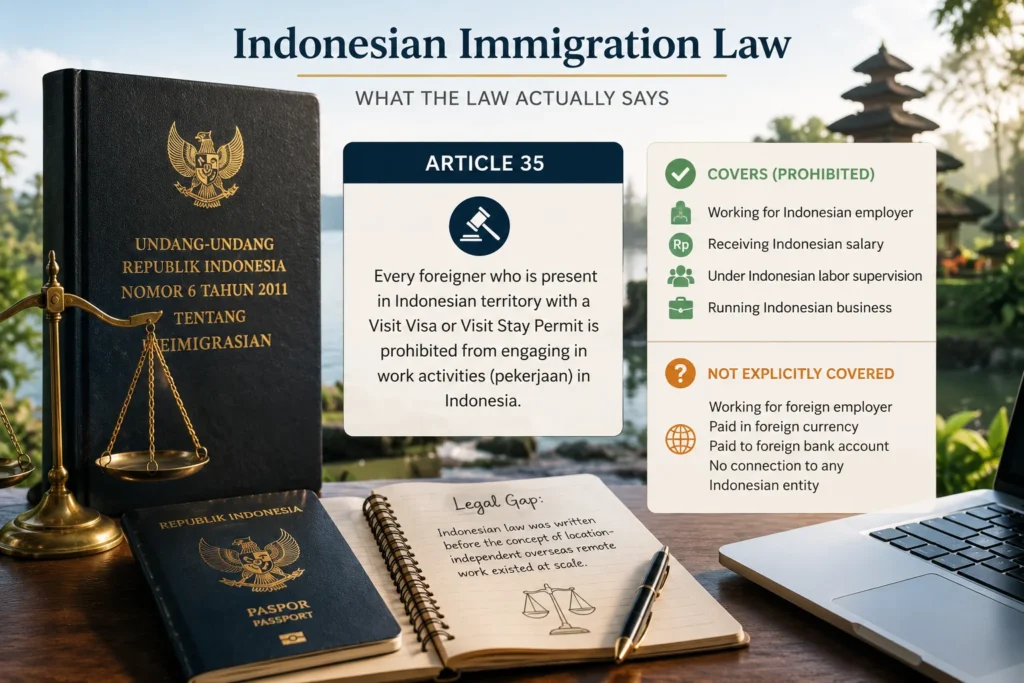
THE LAW: UU NO. 6 TAHUN 2011 TENTANG KEIMIGRASIAN Indonesia’s Immigration Law (Undang-Undang No. 6 Tahun 2011 tentang Keimigrasian) governs all aspects of foreigner entry, stay, and activities in Indonesia. The key provision: Article 35 prohibits foreigners who enter on a visit visa (visa kunjungan — the category that includes both tourist VOA and Social Cultural B211A) from engaging in employment or business activities. The relevant text (translated): “Every foreigner who is present in Indonesian territory with a Visit Visa or Visit Stay Permit is prohibited from engaging in work activities (pekerjaan) in Indonesia.” What ‘pekerjaan’ (work/employment) means in Indonesian law: Indonesian Labor Law (UU No. 13/2003 — Ketenagakerjaan) defines an employment relationship as one involving a person, an employer, wages, and instructionsThe traditional concept in Indonesian law: employment = a person working for an Indonesian employer, receiving Indonesian wages, under Indonesian labor supervisionWhat is NOT explicitly covered: a foreigner physically in Indonesia, working for a non-Indonesian employer via internet, receiving payment in foreign currency to a foreign bank account, with zero connection to any Indonesian entity
The legal gap is real: Indonesian law was written before the concept of location-independent overseas remote work existed at scale. The legislature intended to prevent foreigners from taking Indonesian jobs or operating Indonesian businesses without authorization — not to regulate a person in Canggu on a Zoom call with a US startup. Whether the law technically covers overseas remote work has never been formally adjudicated by an Indonesian court.
2. The Overseas Client Grey Area: Never Formally Resolved
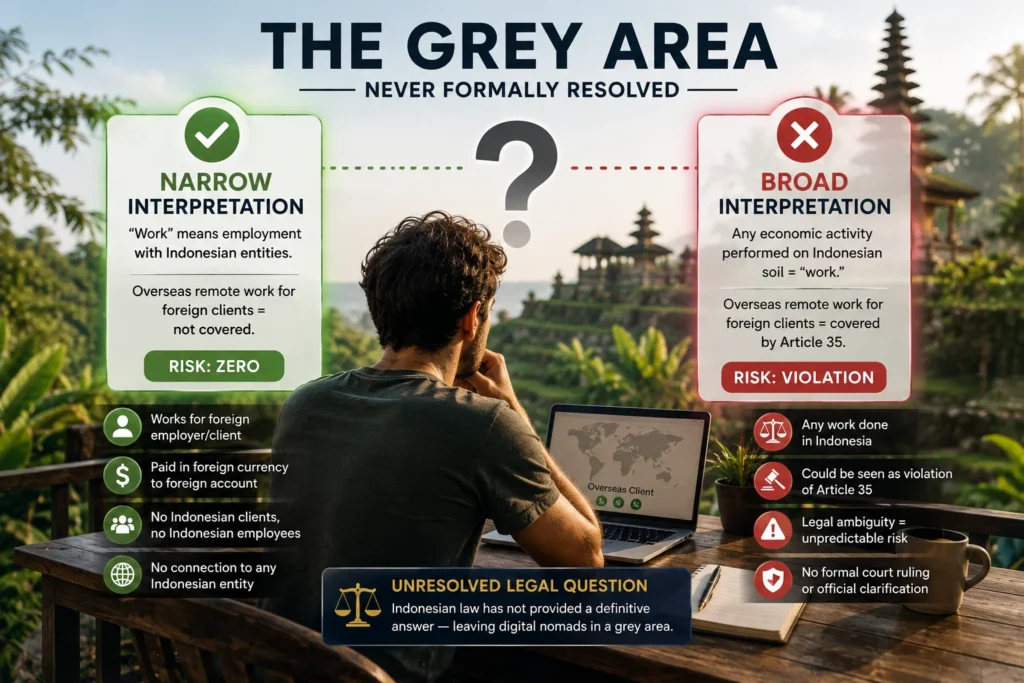
THE UNRESOLVED LEGAL QUESTION The central legal question: Does a foreigner who is physically in Indonesia, working via laptop for a non-Indonesian employer/client, receiving payment in foreign currency to an overseas account, with no Indonesian clients, no Indonesian employees, no Indonesian income, violate Article 35 of the Immigration Law? The honest answer: This has never been formally tested in an Indonesian court or adjudicated by Indonesian immigration authorities with a clear ruling. Two possible interpretations of Article 35: Narrow interpretation: ‘Work’ means employment-type relationships with Indonesian entities. Overseas remote work for foreign clients = not covered. Risk: zero under this reading. Broad interpretation: Any economic activity performed on Indonesian soil = ‘work.’ Overseas remote work for foreign clients = covered by Article 35. Risk: violation. Indonesian immigration enforcement has not publicly committed to either interpretation. In practice, enforcement actions have followed the narrow interpretation — targeting Indonesian-nexus activities, not overseas laptop work. This legal ambiguity is not unique to Indonesia. Thailand, Malaysia, and most Southeast Asian countries have the same unresolved question for overseas remote workers. Indonesia’s enforcement pattern has been broadly consistent with the ‘not the primary target’ approach seen across the region.
3. The 2023 Canggu Enforcement: What Actually Happened
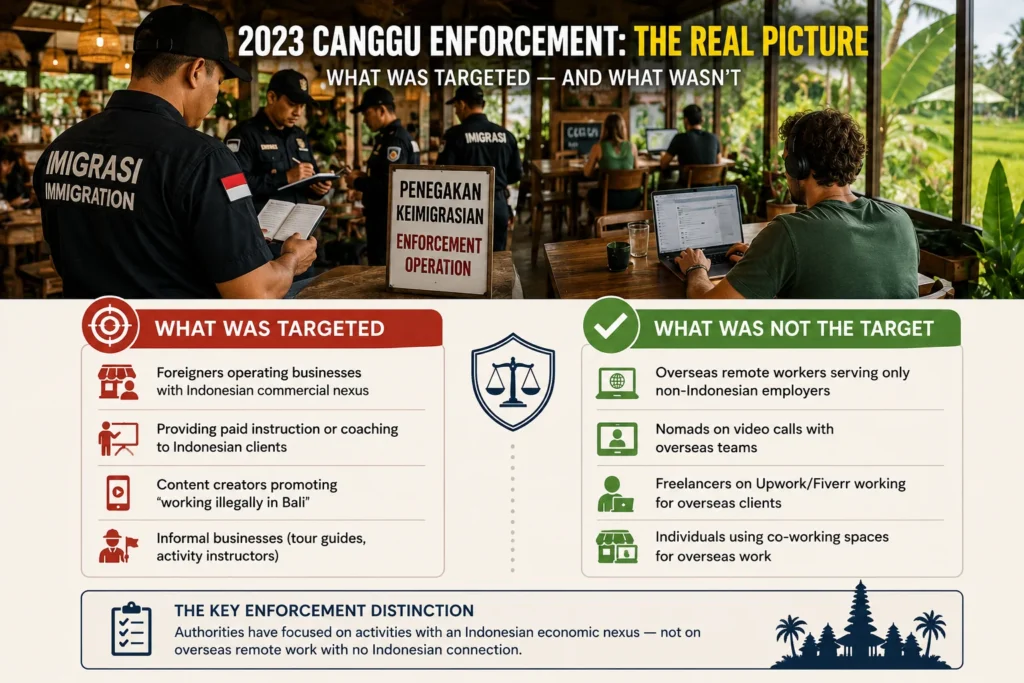
In February 2023, Bali immigration authorities, working with local police and government officials, conducted enforcement operations in Canggu targeting e-cafes and co-working areas. This became widely reported in the digital nomad community and generated significant alarm. Here is what the enforcement record shows:
What Was Targeted
Foreigners visibly operating businesses with Indonesian commercial nexus: managing staff, conducting sales to Indonesian clients, running Indonesian-registered operations without proper permits
Individuals providing paid instruction or coaching services directly to Indonesian nationals (in-person teaching, consultation with Indonesian clients for Indonesian-currency payment)
Social media content creators who had publicly promoted ‘working illegally in Bali’ in ways that drew official attention
Operators of informal businesses (tour guides, activity instructors) working with tourists for Indonesian rupiah payment without permits
What Was NOT the Primary Target
Standard overseas remote workers serving only non-Indonesian employers or clients via internet
Nomads on video calls with US, European, Australian, or other overseas teams
Freelancers on Upwork/Fiverr completing tasks for overseas clients from a Canggu laptop
Individuals using co-working spaces for overseas work
THE KEY ENFORCEMENT DISTINCTION FROM 2023 Immigration enforcement officers distinguish between: Indonesian economic nexus activity: working FOR Indonesian entities, earning FROM Indonesian clients, employing Indonesian nationals, operating businesses with Indonesian customers → this is what was targetedOverseas remote activity: working for foreign employers/clients with no Indonesian economic connection → this was not the stated focus of the 2023 actions This distinction is not a legal safe harbor — it is an observed enforcement pattern. The law is ambiguous; enforcement has been selective. Patterns can change.
4. Canggu vs Ubud: Different Risk Environments
Factor
Canggu
Ubud
Nomad community size
Very large; one of the world’s largest concentrations
Large but more established expat character
Commercial business by foreigners
High visibility; many foreigners appearing to operate Indonesian-facing businesses
Lower commercial density; slower pace; less visible business activity
2023 enforcement actions
Yes — Canggu was the focus of the 2023 operations
No comparable enforcement actions that year
Immigration officer attention
Higher — enforcement patrols occur more regularly
Lower — less visible enforcement presence
Social media visibility
Very high; Canggu nomad activities widely documented on Instagram/YouTube
Moderate; less social media focus on nomad work activities
Risk level for overseas remote workers
LOW to MEDIUM (higher in Canggu due to enforcement attention)
LOW (but not zero)
Recommended approach
Social Visa, co-working spaces, avoid Indonesian-facing activities
Same caution applies; less enforcement pressure
WHAT THIS MEANS IN PRACTICE Canggu is higher-visibility and has been the focus of recent enforcement. Ubud is lower-visibility. Neither is legally safe for overseas remote work on tourist visa — but the practical enforcement risk differs. Nomads choosing between areas for a long Bali stay, particularly those with sensitivity to enforcement risk, should factor this in: Ubud’s quieter environment reduces visibility-based risk, not legal risk.
5. The Social Visa (B211A) — Does It Make Remote Work Legal?
CLEARING UP A COMMON MISCONCEPTION Many nomad forums claim: ‘Get a Social Visa and you can legally work remotely in Bali.’ This is incorrect. The B211A Social Cultural Visa does NOT authorize work activities. The visa’s purpose is explicitly non-work: social interactions, cultural activities, language study, visiting family, attending courses. The prohibition on ‘work’ under Article 35 applies to Social Visa holders just as it applies to tourist visa holders. What the Social Visa DOES provide: Better administrative status: a registered sponsor, a documented stated purpose of stay, and a longer authorized duration Lower practical risk profile: Social Visa holders with a clear sponsor and documented legitimate stay purpose are less likely to be questioned than VOA-extension-chain tourists with no evident ties Documentation trail: sponsor letter, immigration records, and registered status provide context in case of any immigration encounter The practical risk reduction from B211A is real but not legal. A Social Visa holder working remotely for overseas clients is in a better administrative position than a tourist visa holder doing the same thing — but neither is formally authorized to work under Indonesian law. Use the Social Visa for the practical risk reduction and the longer stay, not because it makes remote work legal.
6. The “Low Risk, Not Legal” Framework
MeridianNomad consistently applies the same analytical framework across destinations: the distinction between ‘legal’ (formally permitted by law) and ‘low risk’ (enforcement is infrequent or targeted at behaviors different from the typical nomad’s profile). Bali falls into the ‘low risk, not legal’ category.
DE Rantau formally authorizes remote work for overseas clients
Thailand (LTR WFT)
✔ Legal
LTR WFT authorizes overseas remote work via BOI framework
Bali / Indonesia (Social Visa B211A)
⚠ Grey Area
Not formally authorized; enforcement targets Indonesian-nexus activity
Bali / Indonesia (Tourist VOA)
⚠ Grey Area
Same as B211A but with weaker administrative documentation
Thailand (Tourist Visa, no LTR)
⚠ Grey Area
Same overseas client grey area as Bali; enforcement historically lower
7. If You Are Stopped: Consequences and What to Do
Potential Consequences of Being Questioned or Detained
Scenario
Likely Outcome
Notes
Questioned at co-working space, working for overseas client via laptop
Warning, questioning, document check; likely release if documentation clear
Cooperate fully; present employment documents; do not argue legality on the spot
Found conducting Indonesian-facing business without permits
Detention, fine, deportation, potential blacklist
Most serious enforcement outcome; avoid this entirely
Overstayed visa while also working
Compounded violation: overstay + work; severe consequences
Never overstay; overstay compounds all other visa issues
Voluntarily disclosed to immigration officer
Generally better received than being caught; may result in administrative warning only
If you are uncertain about your status, proactive clarification is better than discovery
Documentation to Have Ready
Copy of employment contract or client agreement (shows overseas employer/client, overseas payment)
Bank statements showing income from overseas sources (not Indonesian clients)
B211A visa stamp and sponsor letter (if on Social Visa) — demonstrates registered legitimate stay
Passport with clear entry stamp showing legal admission
Your home country embassy’s emergency contact number: Indian Embassy Bali (KJRI Bali): +62-361-222-666; Philippine Consulate Bali (Honorary Consul): verify current number before trip
8. Indian and Filipino Passport Holders: Future Visa Implications
FOR INDIAN NATIONALS: FUTURE INDONESIA ACCESS If an Indian national is deported from Indonesia or placed on the Indonesian immigration blacklist: Future Bali VOA: may be denied at the airport. Immigration officers can check the blacklist database at entry. Future B211A Social Visa: Indonesian consulate in India may reject the application based on immigration history.E33G application: rejected. Indian passport and bilateral obligations: India and Indonesia do not have a bilateral treaty requiring notification to Indian authorities of immigration violations. However, Indonesian immigration records are kept and accessed at future entry attempts. Practical implication: A deportation from Indonesia affects your ability to return to Bali permanently or for a significant period. For Indian nomads who value Bali as a regular destination: the stakes of enforcement are meaningfully higher than the immediate inconvenience.
FOR FILIPINO NATIONALS: FUTURE INDONESIA ACCESS Filipino citizens currently enjoy ASEAN visa-free entry to Indonesia (30 days, no fee). An Indonesian deportation changes this: Future ASEAN visa-free entry: may be flagged at arrival; immigration can deny entry even under ASEAN arrangement if the traveler is on the blacklist.B211A Social Visa from Manila: Indonesian Embassy may reject applications from individuals with deportation history. BIR implications: A deportation from Indonesia is not reported to the BIR and does not directly affect Philippine tax obligations. However, it affects future Indonesia travel which may indirectly affect nomad income if Bali is a primary base. Philippine overseas worker context: digital nomads are not OFWs and deportation does not trigger OWWA or POEA records. But the Philippine Bureau of Immigration may note the deportation in outbound travel records for future reference.
9. Practical Risk Reduction Framework
WHAT TO DO TO MINIMIZE ENFORCEMENT RISK None of the following makes overseas remote work formally legal under Indonesian law. All of the following reduce your practical enforcement risk profile: Use a Social Visa (B211A) for stays beyond 60 days. Better administrative documentation than tourist VOA.Work from established co-working spaces (Dojo Bali, Outpost Canggu/Ubud). These environments are understood by immigration as overseas remote work environments. Less ambiguity than informal cafes.Do NOT provide paid services to Indonesian clients without proper authorization. This is the primary enforcement trigger — not overseas laptop work.Do NOT employ or instruct Indonesian nationals without proper permits. This creates Indonesian employer liability and is a primary enforcement target.Minimize social media content that depicts you ‘working in Indonesia without a work visa’ in ways that could draw official attention.Carry overseas employment documentation: employment contract or client agreements showing overseas payment in foreign currency.Know your embassy’s Bali contact before you go. Hope you never need it, but have it accessible. The honest summary: Bali remains one of the world’s most popular digital nomad destinations despite the absence of formal legal authorization for overseas remote work. The combination of low historical enforcement against overseas remote workers, selective enforcement against Indonesian-nexus activities, and practical steps above produces a meaningfully manageable risk profile — without making the activity legally authorized.
Frequently Asked Questions
Is working remotely Bali tourist visa legal?
Formally: no. Article 35 of Indonesia’s Immigration Law No. 6 of 2011 prohibits foreigners on visit visas (including tourist VOA and Social Cultural B211A) from engaging in work activities. However, the law’s application to overseas remote work for non-Indonesian clients has never been formally adjudicated, and enforcement has historically targeted Indonesian-nexus activities rather than standard overseas laptop workers. The practical risk for overseas remote workers is LOW to MEDIUM, not zero.
What happened in the 2023 Canggu enforcement actions?
Bali immigration conducted enforcement operations in Canggu in 2023 targeting foreigners conducting Indonesian-facing commercial activities: managing Indonesian staff, providing paid instruction to Indonesian clients, operating businesses with Indonesian customers without proper permits. The primary targets were foreigners with Indonesian economic nexus activities, not standard overseas remote workers serving foreign clients via laptop. However, the operations demonstrated that enforcement is real and can affect the nomad community.
Does the Social Visa B211A make remote work legal in Bali?
No. The B211A Social Cultural Visa does not authorize work activities. Article 35 of the Immigration Law applies equally to Social Visa holders. What B211A provides is better administrative status (registered sponsor, documented stay purpose) and a longer authorized stay — which reduces practical enforcement risk without creating formal legal authorization for overseas remote work.
Is Canggu riskier than Ubud for remote work enforcement?
In practice, yes. Canggu was the focus of the 2023 enforcement actions; Ubud has not seen comparable operations. Canggu’s higher density of foreign commercial activity and greater social media visibility make it a higher-enforcement-attention environment. Ubud’s quieter character and lower commercial density reduce visibility-based risk, though not legal risk.
What are the consequences if I am deported from Indonesia?
Deportation results in an Indonesian immigration blacklist record that can affect future entry. For Indian nationals: future VOA access at Bali airport and B211A applications at Indonesian consulates in India may be denied. For Filipino nationals: ASEAN visa-free entry may be flagged; future B211A applications may be rejected. A deportation from Indonesia is a meaningful consequence for anyone who plans to return to Bali regularly as a nomad destination.
Final Verdict: Informed Decision, Not Blind Optimism
Bali is in the ‘low risk, not legal’ category for overseas remote workers. This framing is specific: the risk is real and enforcement is unpredictable, even if it has historically been directed at different behaviors than the typical overseas laptop worker. The strongest practical steps: use a Social Visa for stays beyond 60 days; work from established co-working spaces; carry employment documentation; avoid any Indonesian-facing commercial activities without proper authorization. The honest alternative: if legal certainty for remote work is your priority, Malaysia’s DE Rantau Pass and Thailand’s LTR WFT Visa are the only regional options that formally authorize overseas remote work. Both are covered in depth on this site. Bali remains an extraordinary lifestyle destination — but it is not the destination for those who need formal legal clarity on their work status. See the Bali Digital Nomad Hub for the complete Bali setup guide, or the Indonesia Social Visa guide for the B211A application process.