
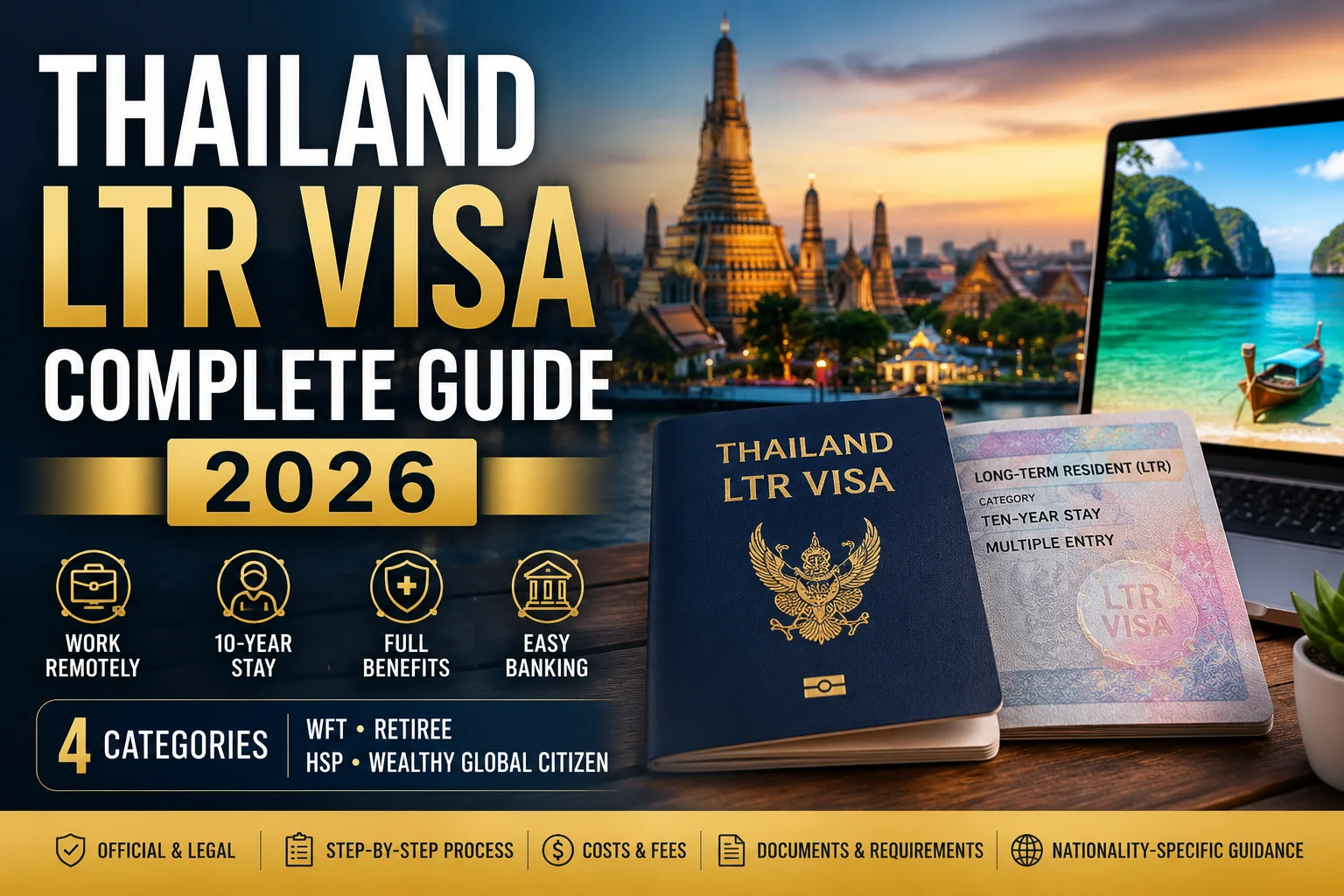
| Thailand’s Long-Term Resident (LTR) Visa is a 10-year, multiple-entry visa programme administered by the Thailand Board of Investment (BOI). It was launched in 2022 and has four categories: Work-From-Thailand (WFT) Professional (USD 40,000/year overseas income, most popular), Wealthy Pensioner (USD 40,000+/year passive income or USD 250,000 assets, age 50+), Highly Skilled Professional (USD 80,000 or USD 40,000+ with credentials, Thai employer in BOI sector), and Wealthy Global Citizen (USD 80,000+ income or USD 1 million in investments). All categories require valid international health insurance with USD 50,000+ Thailand coverage. The total application fee is THB 63,800 (BOI endorsement THB 50,000 + Embassy visa stamp THB 10,000 + re-entry permit if needed THB 3,800). BOI review takes 20 to 35 working days. LTR Visa holders receive explicit work authorization (WFT: overseas employers; HSP: Thai employer), 10 years of multiple-entry stay, preferential lane access at Suvarnabhumi Airport, and access to Thai banking without the restrictions tourist visa holders face. |
| QUICK ANSWER: What is the Thailand LTR Visa and how do you apply? The Thailand LTR Visa is a 10-year, multiple-entry long-stay visa for four groups: remote workers (WFT), retirees (Wealthy Pensioner), sector specialists (HSP), and high-net-worth individuals (Wealthy Global Citizen). To apply: (1) Determine your category, (2) Gather documents, (3) Submit via BOI portal (ltrvisat.boi.go.th), (4) Pay THB 50,000 endorsement fee, (5) Wait 20–35 working days, (6) Book Thai Embassy appointment, (7) Pay THB 10,000 visa stamp, (8) Travel and activate. Total first-year cost: approximately USD 2,400 to 3,200 (including health insurance). The LTR Visa eliminates visa runs, provides legal work authorization, and grants 10 years of legal stability. |
| LEGAL DISCLAIMER This guide is for informational purposes only and does not constitute legal, immigration, or tax advice. Thailand BOI requirements, visa fees, and policies change. Always verify current requirements at boi.go.th and consult a licensed Thai immigration attorney for your specific situation. |
Introduction: Why the Thailand LTR Visa Changed the Long-Stay Landscape
Before 2022, Thailand had no formal visa for remote workers. Professionals living and working in Bangkok on tourist visas operated in a legal gray area — technically unauthorized under the Aliens’ Work Act but rarely enforced. The recurring visa run was the standard rhythm of expat life: 30 days, a quick border crossing, 30 more days.
The LTR Visa changed this entirely. Launched by the Thailand Board of Investment in 2022 as part of Thailand’s economic development strategy, it provides the formal legal framework that a decade of nomads had been missing: explicit work authorization, 10-year multiple-entry stay, no visa runs, and full banking access. It is the most consequential change to Thailand’s long-stay visa landscape in the country’s modern history.
This guide is the complete reference for the Thailand LTR Visa in 2026. It covers all four categories in depth, the full application process, the complete documentation requirements by nationality, the banking and tax landscape, and links to every detailed cluster article for those who need to go deeper on any specific topic.
What Is the Thailand LTR Visa?
The Long-Term Resident (LTR) Visa is a special resident visa programme administered by the Thailand Board of Investment (BOI). It is separate from regular Thai immigration and operates under a unique two-stage endorsement and visa-stamping process.
| LTR VISA CORE SPECIFICATIONS Full name: Long-Term Resident Visa (Thailand) Administered by: Thailand Board of Investment (BOI) Validity: 10 years from issue date Entry type: Multiple entry Visa runs: Not required Renewal: Full reapplication at 10-year mark 90-day address report: Required throughout 10-year period Work authorization: Yes (category-dependent) Health insurance: USD 50,000+ international coverage required BOI application portal: ltrvisat.boi.go.th |
The 4 Thailand LTR Visa Categories: Quick Reference
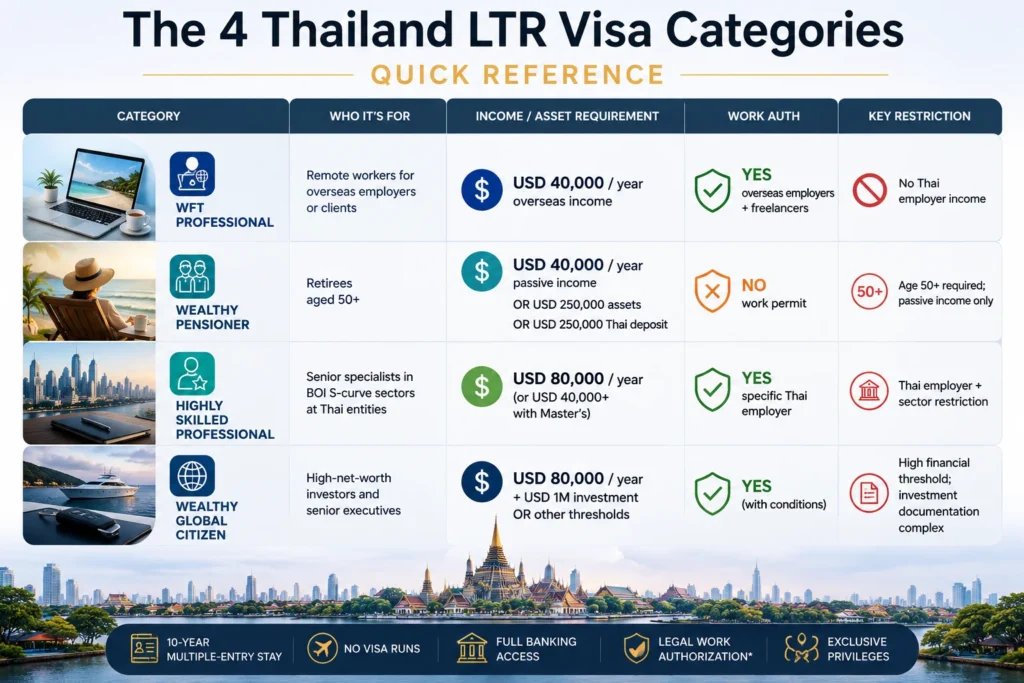
| Category | Who It’s For | Income / Asset Requirement | Work Auth | Key Restriction |
| WFT Professional | Remote workers for overseas employers or clients | USD 40,000/year overseas income | YES — overseas employers + freelancers | No Thai employer income |
| Wealthy Pensioner | Retirees aged 50+ | USD 40,000/year passive income OR USD 250,000 assets OR USD 250,000 Thai deposit | NO work permit | Age 50+ required; passive income only |
| Highly Skilled Professional | Senior specialists in BOI S-curve sectors at Thai entities | USD 80,000/year (or USD 40,000+ with Master’s) | YES — specific Thai employer | Thai employer + sector restriction |
| Wealthy Global Citizen | High-net-worth investors and senior executives | USD 80,000/year + USD 1M investment OR other thresholds | YES (with conditions) | High financial threshold; investment documentation complex |
Category 1: Work-From-Thailand (WFT) Professional — Complete Guide
The Work-From-Thailand (WFT) Professional category is the most popular LTR Visa category and the one most relevant to digital nomads, remote workers, and online business owners. It is specifically designed for people who earn their income from overseas employers or clients while living in Thailand.
WFT eligibility requirements
| Requirement | Standard | Notes |
| Annual income | USD 40,000 gross per year | From overseas non-Thai sources. All overseas client income combined counts. |
| Professional experience | 5 years minimum | In your relevant professional field. LinkedIn + CV documentation. |
| Health insurance | USD 50,000+ international coverage valid in Thailand | PhilHealth, UK NHS, US domestic plans do NOT qualify. Cigna Global, AXA International, Allianz Care accepted. |
| Income source | Overseas non-Thai employers or clients | Thai client income does NOT count toward threshold. Overseas clients from any country (including home country) qualify. |
| Employment type | Remote employee, freelancer, or online business owner | Multiple clients combined qualify. Single employer also qualifies. |
What WFT work authorization covers
- Remote work for one overseas employer
- Freelancing for multiple overseas clients simultaneously
- Running an online business serving overseas customers
- Independent consulting for overseas clients
| WFT DOES NOT COVER Work for Thai companies or Thai clients is NOT covered by the WFT work endorsement. If you want to work for a Thai employer, you need either the HSP category or a separate Thai work permit. Serving overseas clients through a Thai-registered entity requires specific legal structuring. |
Category 2: Wealthy Pensioner — Complete Guide
The Wealthy Pensioner category serves retirees aged 50 or older who want 10-year legal residence in Thailand without the annual renewal burden of the older Thai Retirement Visa (Non-O-A). It has three distinct qualification pathways.
Three Wealthy Pensioner qualification pathways
| PATHWAY 1: INCOME-ONLY Age 50+, passive income of USD 40,000+/year from pensions, dividends, rental income, or interest. No asset requirement. Simplest pathway. PATHWAY 2: COMBINED ASSETS + INCOME Age 50+, personal assets of USD 250,000+ AND passive income of USD 25,000+/year. For asset-rich, lower-income retirees. PATHWAY 3: THAI BANK DEPOSIT Age 50+, USD 250,000+ deposited in a Thai commercial bank or in Thai government bonds. Income requirement waived. |
What qualifies as Wealthy Pensioner income
- State and government pensions (US Social Security, UK State Pension, Indian EPF/EPS, Australian Age Pension)
- Private occupational pensions, SIPPs, 401k distributions, NPS annuity payments
- Life insurance annuities (LIC, AIA, fixed annuity contracts)
- Dividend income from investments
- Rental income from overseas property
- Bank interest and bond coupon payments
Employment income, consulting fees, and active business profits do NOT qualify. Wealthy Pensioner visa includes no work authorization.
Category 3: Highly Skilled Professional (HSP) — Complete Guide
The Highly Skilled Professional (HSP) category targets senior specialists working for Thai-registered entities in BOI’s S-curve target industries. It differs fundamentally from WFT: HSP requires a Thai employer, not overseas clients.
HSP dual income thresholds
| Threshold | Requirement | Who Qualifies |
| Standard | USD 80,000+/year from Thai entity employment | All qualified sector specialists regardless of credentials |
| Credential-based | USD 40,000+/year + Master’s degree or higher in relevant sector field | Senior specialists with qualifying academic credentials in BOI sectors |
BOI S-curve qualifying sectors for HSP
- Digital industry: Software engineering, AI/ML, fintech, cybersecurity, cloud platforms, data science
- Medical and healthcare technology: Medical devices, biomedical engineering, health informatics
- Smart electronics and robotics: IoT hardware, semiconductor design, industrial automation
- Next-generation automotive: EV technology, autonomous systems, battery engineering
- Agriculture and food technology: Precision farming, agritech, food safety systems
- Creative industry: Senior game development, animation, digital content production
| HSP VS WFT: THE CRITICAL DISTINCTION If you work FOR a Thai company in Thailand: you need HSP (or SMART Visa). If you work FROM Thailand for overseas employers or clients: you need WFT. Applying under the wrong category results in rejection. Identify your employment model first. |
Category 4: Wealthy Global Citizen (WGC) — Complete Guide
The Wealthy Global Citizen category is the LTR Visa’s premium tier, targeting high-net-worth individuals, senior executives, and major investors.
WGC qualification criteria
| Qualification Path | Requirement |
| Income + Investment (Path A) | USD 80,000+/year income AND USD 1,000,000+ invested in Thai bonds, Thai real estate, or Thai BOI-promoted entities |
| Reduced income with larger investment (Path B) | USD 40,000–80,000/year income AND USD 1,500,000+ in Thai government bonds or specific investments |
| Senior executive path | USD 80,000+/year income from senior executive role at publicly listed company or company with revenue USD 150M+ |
| WHO WEALTHY GLOBAL CITIZEN IS ACTUALLY FOR The WGC category serves a small, specific audience: global executives, institutional investors in Thailand, and high-net-worth individuals making substantial Thai market investments. Most digital nomads and remote workers are better served by WFT Professional. The financial thresholds and investment documentation complexity make WGC unsuitable as a general remote work visa. |
Master Decision Framework: Which LTR Category Are You?
| Your Situation | Category | Key Reason |
| Remote worker, overseas clients, USD 40K+/year | WFT Professional | Designed exactly for this. Most applicants. |
| Retiree, age 50+, USD 40K+/year passive income | Wealthy Pensioner (Path 1) | Pension / dividend income qualifies. No work auth needed. |
| Retiree, age 50+, USD 250K+ assets, USD 25K income | Wealthy Pensioner (Path 2) | Asset-based path for asset-rich lower-income retirees. |
| Retiree, age 50+, USD 250K to put in Thai bank | Wealthy Pensioner (Path 3) | Deposit path eliminates income requirement entirely. |
| Senior specialist at Thai tech company, S-curve sector | HSP | Thai employer in BOI sector. Not for overseas clients. |
| Senior specialist, Thai employer, Master’s degree, USD 40K+ | HSP (credential path) | Master’s degree + Thai employer + sector = USD 40K threshold. |
| High-net-worth investor or senior exec, USD 80K+, major Thai investment | Wealthy Global Citizen | Premium category for major investors. |
| Freelancer, multiple overseas clients, USD 40K+ combined | WFT Professional | Multiple overseas clients combined count. WFT explicitly covers freelancers. |
| Income below USD 40K/year, not qualifying for LTR | Consider Malaysia DE Rantau (USD 24K) or Georgia Remotely From (USD 2K/month) | Closest alternatives with legal remote work authorization below LTR threshold. |
Complete LTR Visa Application Process — 10 Steps
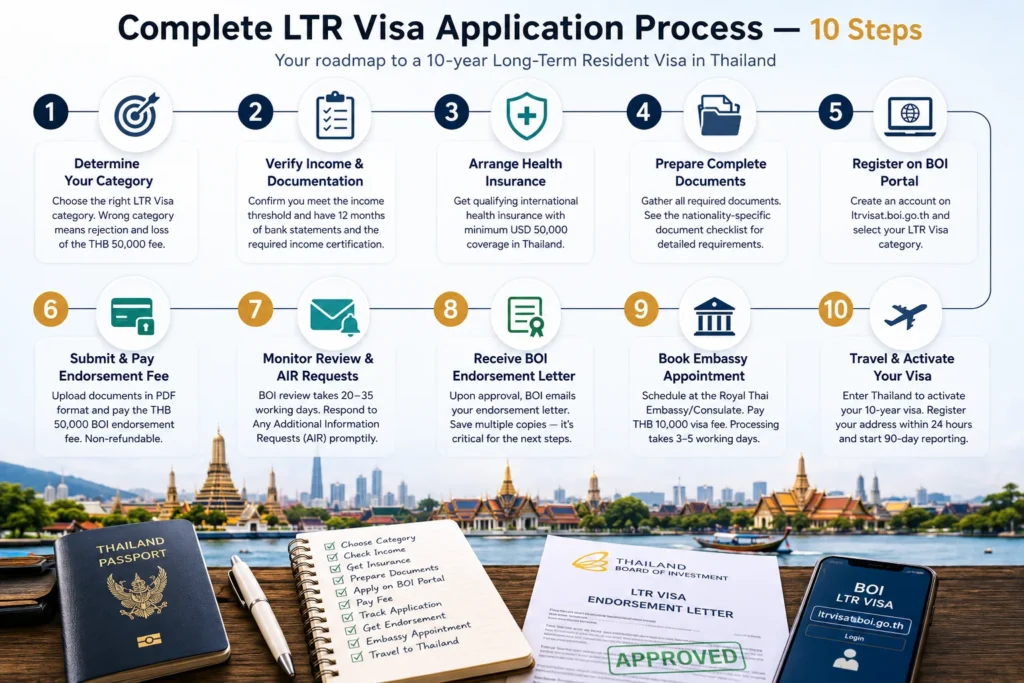
Step 1: Determine your LTR Visa category
Use the decision framework above. The wrong category means rejection and loss of the THB 50,000 non-refundable endorsement fee. Confirm your category before starting the application.
Step 2: Verify your income and documentation readiness
Check: Is your gross overseas income at or above the threshold? Do you have 12 months of bank statements? Can you obtain the required income certification (CA certificate for India, CPA letter for Philippines, W-2/1099 for US, SA100/SA302 for UK)?
Step 3: Arrange qualifying international health insurance
Purchase before applying. Accepted insurers: Cigna Global, AXA International, Allianz Care, Bupa Global. Required coverage: minimum USD 50,000 in Thailand. Home country plans (NHS, Medicare, PhilHealth) do not qualify. Get the formal insurance certificate from the insurer — not an app screenshot.
Step 4: Prepare the complete documentation package
See the Documents Required by Category and Nationality section below for the complete list.
Step 5: Register on the BOI e-Service portal
Go to boi.go.th Create an account with your email address. Select your LTR Visa category. The portal guides you through the required fields.
Step 6: Submit application and pay endorsement fee
Upload all documents in PDF format. Quality check: all documents must be readable, properly oriented, and in English or with certified translations. Pay the THB 50,000 BOI endorsement fee via the online payment system. This fee is non-refundable.
Step 7: Monitor BOI review and respond to AIR requests
BOI review takes 20 to 35 working days from complete submission. Monitor your registered email address daily. BOI may issue an Additional Information Request (AIR) if documents are incomplete, income proof is unclear, or insurance certificate doesn’t meet requirements. Respond to AIR within the specified deadline (usually 7 to 14 days).
Step 8: Receive BOI endorsement letter
Upon approval, BOI emails your LTR Visa endorsement letter. Download and save multiple copies. The endorsement letter is the critical document for your Embassy appointment and Thai banking.
Step 9: Book Royal Thai Embassy appointment
Schedule an appointment at the Royal Thai Embassy or Consulate in your home country. Bring: endorsement letter, passport, supporting documents, and application fee (THB 10,000 in local currency equivalent). Processing time: typically 3 to 5 working days at the Embassy.
Step 10: Travel to Thailand and activate your LTR Visa
Travel to Thailand. The LTR Visa’s 10-year validity begins from the date of first entry. Register your Thai address with your local district office (Ampur) within 24 hours of first stay at that address. Begin 90-day address reporting cycle from your first entry date.
Documents Required by Category and Nationality
Universal documents (all categories)
| Document | Specification |
| Passport | Valid for minimum 18 months remaining. All blank pages visible. |
| International health insurance certificate | USD 50,000+ coverage valid in Thailand. Formal certificate from insurer (not app or card). |
| Professional CV | Dates and roles clearly stated. 5+ years of professional experience. |
| Passport-size photographs | 2 recent photos, white background. |
WFT Professional — additional documents by nationality
| Nationality | Income Certification | Tax Documentation | Bank Statements |
| Indian | CA certificate (ICAI-registered, confirms overseas income) | ITR-4 (last 2 years), incometax.gov.in | 12 months showing international inward remittances |
| Filipino | CPA income certification (PRC-registered accountant) | BIR ITR Form 1701 (last 2 years), BIR Certificate of Registration | 12 months from BDO/BPI/Metrobank showing overseas credits |
| American | IRS Form 1040 + W-2 (employee) or 1099-NEC + Schedule C (freelancer) | Last 2 years federal returns | US bank statements (12 months) showing income deposits |
| British | SA302 or accountant letter (ICAEW/ACCA-registered) | SA100 Self Assessment return (last 2 years) | UK bank statements (12 months) |
| Australian | ATO Notice of Assessment + accountant letter (CPA Australia/CAANZ) | Individual Tax Return myTax (last 2 financial years) | ANZ/CBA/Westpac/NAB 12-month statements |
| Others | Professional accountant certification from recognized accounting body | Official tax returns for last 2 years | 12 months of bank statements |
Wealthy Pensioner — additional documents
- Pension statements: Official pension fund statements showing monthly/annual pension amounts
- Investment/dividend statements: Latest account statements from investment institutions
- Asset documentation (Path 2): Investment account certificates, property valuation (USD 250,000+)
- Thai bank deposit certificate (Path 3): Issued by Bangkok Bank or KBank confirming USD 250,000+ deposit
HSP — additional documents
- Employment contract from qualifying Thai entity
- Employer’s BOI promotion certificate (if BOI-promoted company)
- Academic credentials: Degree certificates + transcripts (for USD 40,000 credential pathway)
- Payslips: 12 months confirming salary at qualifying threshold
LTR Visa Processing Timeline: What to Expect
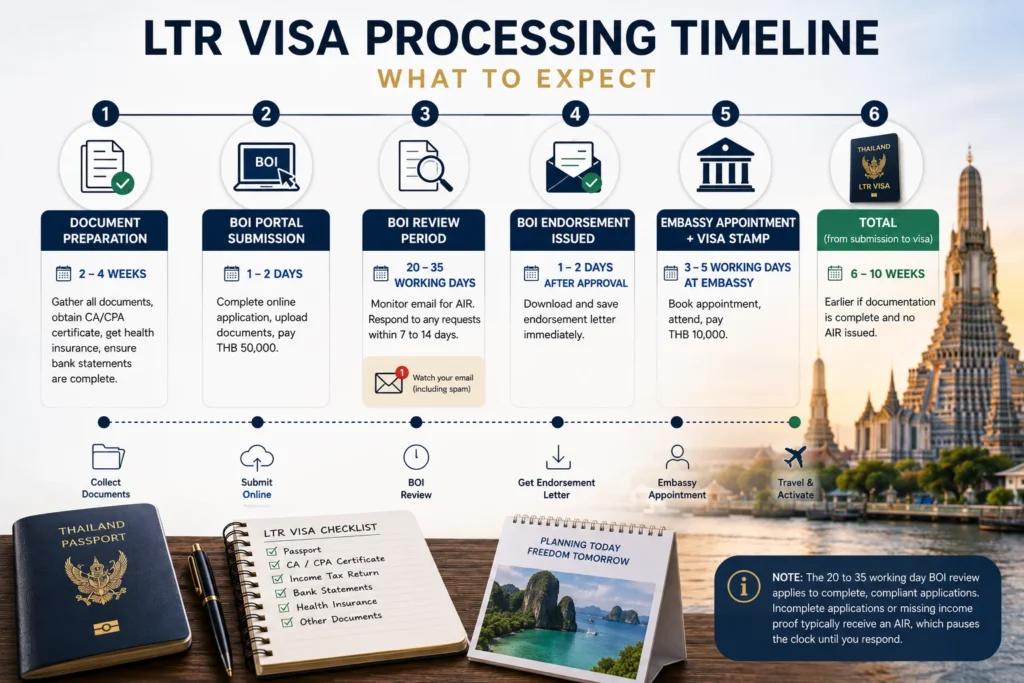
| Stage | Timeline | Key Action |
| Document preparation | 2 to 4 weeks | Gather all documents, obtain CA/CPA certificate, get health insurance, ensure bank statements are complete |
| BOI portal submission | 1 to 2 days | Complete online application, upload documents, pay THB 50,000 |
| BOI review period | 20 to 35 working days | Monitor email for AIR. Respond to any requests within 7 to 14 days. |
| BOI endorsement issued | 1 to 2 days after approval | Download and save endorsement letter immediately |
| Embassy appointment + visa stamp | 3 to 5 working days at Embassy | Book appointment, attend, pay THB 10,000 |
| TOTAL (from submission to visa) | 6 to 10 weeks when complete documentation submitted | Earlier if documentation is complete and no AIR issued |
Note: The 20 to 35 working day BOI review applies to complete, compliant applications. Applications with incomplete documents or missing income proof typically receive an AIR, which pauses the clock until you respond.
Complete LTR Visa Cost Breakdown
| Cost Item | Amount (USD approx.) | Amount (THB) | When Payable |
| BOI endorsement fee | USD 1,395 | THB 50,000 | At time of online application (non-refundable) |
| Visa stamp fee (Thai Embassy) | USD 280 | THB 10,000 | At Embassy appointment |
| Re-entry permit (if first entry via land border) | USD 106 | THB 3,800 | At Thai Immigration if needed |
| International health insurance (annual) | USD 800–1,800 | Varies | Before applying; renewed annually |
| Income certification (CA/CPA/accountant) | USD 50–300 | Varies by nationality | Before applying |
| Document translation (if applicable) | USD 30–200 | Varies | Before applying |
| TOTAL FIRST YEAR (visa fees only) | USD 1,675–1,700 | THB 60,000–63,800 | Split: BOI + Embassy |
| TOTAL FIRST YEAR (including health insurance) | USD 2,475–3,500 | Varies | Spread across application + insurance period |
LTR Visa Banking Access in Thailand
One of the most practical advantages of the LTR Visa over tourist visas is banking access. The BOI endorsement letter is accepted by major Thai banks for account opening.
What the LTR Visa endorsement enables
- Bangkok Bank: Savings account opening with BOI endorsement letter + passport. No other visa type required. Enables SWIFT transfers, PromptPay QR, ATM card.
- Kasikorn Bank (KBank): Same as Bangkok Bank. BOI letter accepted for account opening.
- KrungThai Bank, SCB, Bangkok Bank of Commerce: Also accept LTR Visa holders with BOI letter.
Recommended banking setup for LTR holders
- Primary Thai account: Bangkok Bank or KBank for local expenses, rent, utilities, PromptPay
- International income reception: Wise (USD, EUR, GBP virtual accounts) for overseas client payments
- Indian holders: NRE/NRO accounts in India (HDFC, ICICI, SBI) for India-linked obligations
- Filipino holders: BDO or BPI accounts maintained for Philippine obligations
Thai Tax Implications for LTR Visa Holders
Tax is the most misunderstood aspect of long-term Thailand residence. The LTR Visa does not change Thailand’s tax residency rules — they apply to all visa types equally.
The 180-day Thai tax residency rule
Any person who spends 180 or more days in Thailand in a calendar year becomes a Thai tax resident. As a Thai tax resident, assessable income is subject to Thai progressive income tax (0% to 35%).
2024 Revenue Department ruling (Phor Ngor 161/2566)
Thailand’s Revenue Department issued a ruling clarifying that foreign-sourced income brought into Thailand in the same calendar year it is earned is assessable income for Thai tax residents. Prior-year income transferred into Thailand is not affected. This ruling applies to all visa types including LTR Visa holders who are Thai tax residents.
Tax treaty protections
- India-Thailand DTAA: Framework for preventing double taxation on income earned in one country by residents of the other. Pension income, business profits, and employment income have specific provisions.
- Philippines-Thailand tax treaty: Similar double taxation avoidance framework for Filipino LTR holders.
- US-Thailand tax treaty: Limited in scope compared to US’s treaties with EU countries. US citizens’ worldwide income obligation remains.
- UK-Thailand DTA: Comprehensive treaty; UK non-residents generally exempt from UK tax on overseas earnings once Statutory Residence Test conditions for non-residency are met.
| TAX DISCLAIMER Thai tax for long-term residents is complex and highly individual. LTR Visa holders who spend 180+ days per year in Thailand should consult a Thai tax advisor and a home-country tax professional. Do not rely on online forum advice for tax planning. The 2024 Revenue Department ruling is actively evolving. |
Nationality-Specific Guidance: Indian Citizens
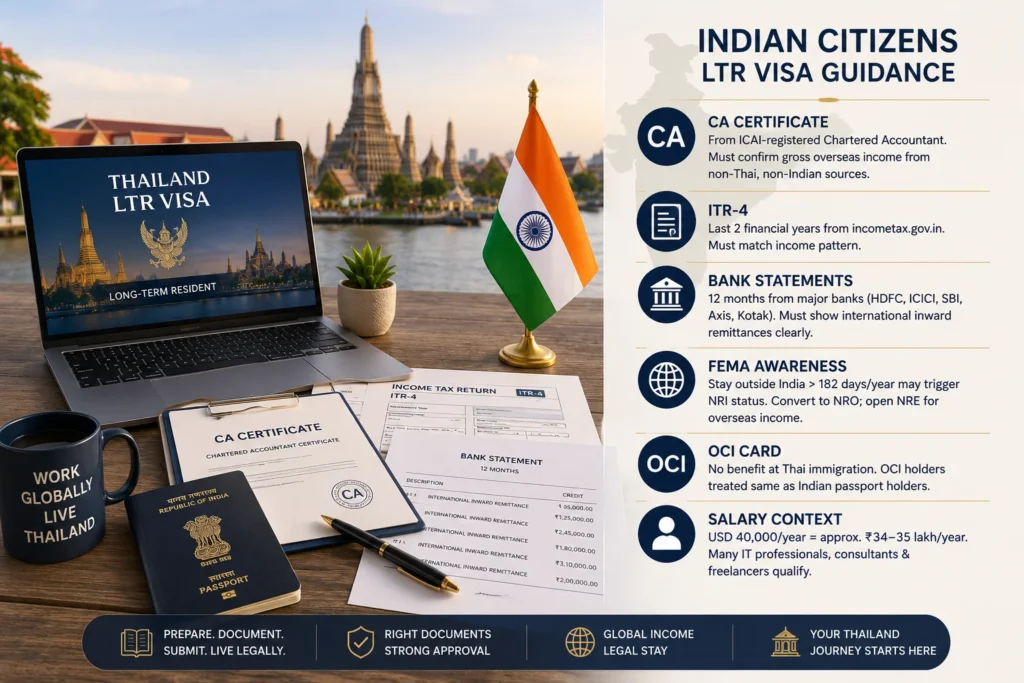
| INDIA-SPECIFIC LTR VISA GUIDANCE Indian nationals are among the most active LTR Visa applicants. Key India-specific requirements: CA Certificate: The single most important India-specific document. Must be from an ICAI-registered Chartered Accountant. Must explicitly confirm gross overseas income from non-Thai, non-Indian sources. Include ICAI membership number and firm stamp.ITR-4: Last 2 financial years from incometax.gov.in. Must show income pattern consistent with CA certificate.Bank statements: 12 months from HDFC, ICICI, SBI, Axis, or Kotak. Must show international inward remittances clearly.FEMA awareness: Spending fewer than 182 days in India per financial year can trigger NRI status. Convert resident savings to NRO; open NRE for overseas income repatriation.OCI card: No benefit at Thai immigration. OCI holders treated identically to Indian passport holders. Indian professional salary context: USD 40,000/year = approximately ₹34–35 lakh per year. Many senior IT professionals, consultants, and freelancers working for overseas clients meet this threshold. Detailed guides: Thailand LTR Visa for Indian Citizens → /thailand-ltr-visa-indian-citizens/ | How to Prove Freelance Income for LTR Visa → /prove-freelance-income-ltr-visa/ | LTR Visa Documents Checklist for Indians → /ltr-visa-documents-checklist-indians/ |
Nationality-Specific Guidance: Filipino Citizens
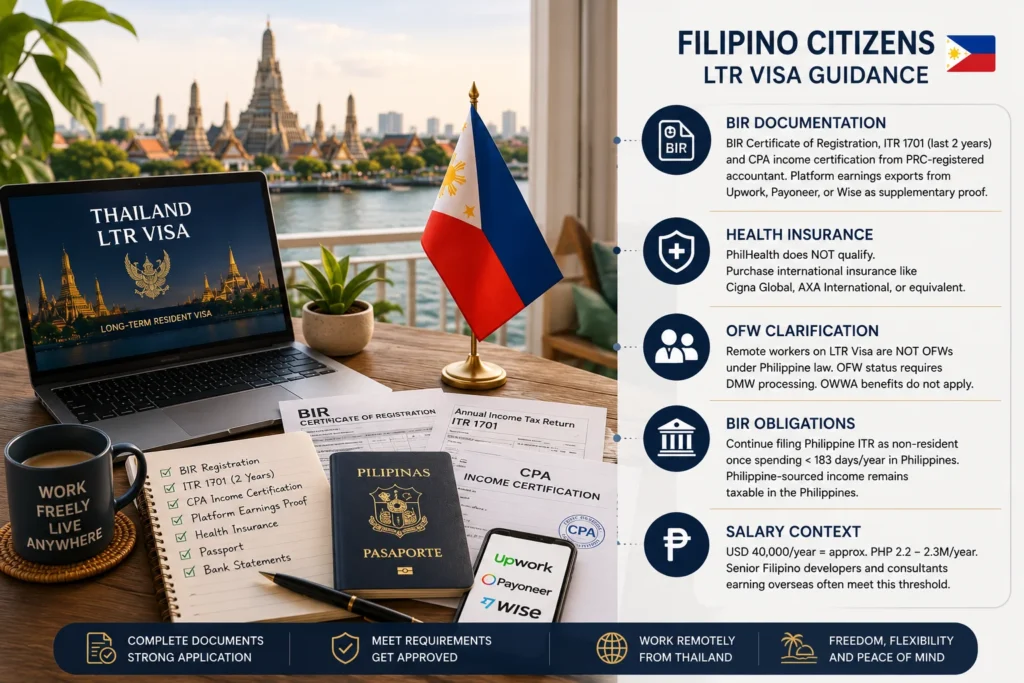
| PHILIPPINES-SPECIFIC LTR VISA GUIDANCE Filipino remote workers and professionals are the second largest applicant group from Asia after Indians. Key Philippines-specific requirements: BIR documentation: BIR Certificate of Registration + Annual ITR Form 1701 (last 2 years) + CPA income certification from PRC-registered accountant. Platform earnings exports from Upwork, Payoneer, or Wise as supplementary evidence. PhilHealth: Does NOT qualify as international health insurance for LTR Visa purposes. Must purchase Cigna Global, AXA International, or equivalent. OFW clarification: Remote workers on LTR Visa are NOT OFWs under Philippine law. OFW status requires DMW processing. OWWA benefits and protections do not apply. BIR obligations: Continue filing Philippine ITR as non-resident once spending fewer than 183 days per year in Philippines. Philippine-sourced income remains taxable in Philippines. Filipino salary context: USD 40,000/year = approximately PHP 2.2–2.3 million per year. Senior Filipino developers and consultants earning overseas often meet this threshold. Detailed guides: Thailand LTR Visa for Filipino Citizens → /thailand-ltr-visa-filipino-citizens/ | Thai Bank Account for Filipino Nationals → /thai-bank-account-filipino-nationals/ |
Common Mistakes and BOI Rejection Reasons
| Mistake / Rejection Reason | Consequence | Prevention |
| Applying under wrong category (Thai employer on WFT, overseas remote on HSP) | Rejection. THB 50,000 non-refundable. | Read decision framework. Confirm category before paying. |
| CA/CPA certificate not specifying overseas income source | AIR or rejection. BOI cannot verify overseas source. | CA certificate must explicitly state income is from overseas, non-Thai sources. |
| Health insurance certificate not meeting USD 50,000 Thailand coverage | AIR requesting replacement certificate. | Get the formal policy certificate, not a digital card or app screenshot. Verify USD 50,000+ Thailand coverage explicitly stated. |
| Bank statements not showing consistent overseas income pattern | AIR requesting clarification or additional months. | 12 months minimum. Highlight international credits. Ensure consistency with CA/CPA certificate amounts. |
| Missing document (passport copy, photos, CV) | AIR pausing review until submitted. | Use BOI’s checklist. Review entire application before submitting. |
| Documents in non-English language without certified translation | AIR requesting translations. | Translate all non-English documents before submission. Certified translations for academic credentials. |
| FEIE-reduced income figure submitted by US applicants | Income appears below threshold after FEIE deduction. | Submit gross income figures. Add cover note explaining FEIE adjustment. |
| Not starting application early enough | Current visa expires before LTR approval. Gap in legal status. | Start LTR application 3+ months before current visa expiry. |
After Approval: Your LTR Visa Ongoing Obligations
The LTR Visa’s 10-year validity comes with ongoing compliance obligations that are manageable but must be tracked:
| Obligation | Frequency | Process | Consequence of Missing |
| 90-day address report | Every 90 days | Thai Immigration (in person, online, or mail). TM.47 form. Free. | THB 2,000 fine per missed report |
| Health insurance renewal + BOI update | Annually | Renew insurance before expiry. Upload new certificate to BOI portal. | BOI non-compliance; potential status review |
| Income maintenance | Ongoing | No formal annual submission; maintain qualifying income | Affects 10-year renewal eligibility |
| Passport stamp transfer | When passport expires | Visit Thai Embassy with old + new passport. Fee THB 1,000–2,000. | Cannot travel on expired passport |
| Full 10-year renewal | At 10-year mark | Full BOI reapplication. Start 4 months before expiry. | Visa lapse if not completed before expiry |
Complete LTR Visa Article Navigation Hub
This master guide covers all LTR categories at overview level. Use the links below for complete depth on each specific topic:
LTR Visa nationality-specific guides
| 🇮🇳 | Thailand LTR Visa for Indian Citizens Full eligibility, CA certificate requirements, FEMA, ITR documentation, step-by-step for Indian applicants. /thailand-ltr-visa-indian-citizens/ |
| 🇵🇭 | Thailand LTR Visa for Filipino Citizens Full guide for Filipino passport holders with BIR documentation, PhilHealth clarification, and OFW misconception addressed. /thailand-ltr-visa-filipino-citizens/ |
| 🇺🇸 | Thailand LTR Visa for American Citizens IRS documentation (Form 1040, W-2, 1099), FEIE/FBAR/FATCA implications, and Royal Thai Consulate US locations. /thailand-ltr-visa-american-citizens/ |
| 🇬🇧 | Thailand LTR Visa for British Citizens HMRC SA100/SA302, Statutory Residence Test, National Insurance, UK-Thailand DTA overview. /thailand-ltr-visa-british-citizens/ |
| 🇦🇺 | Thailand LTR Visa for Australian Citizens ATO Notice of Assessment, superannuation, Medicare, AUD cost framing, direct flights. /thailand-ltr-visa-australian-citizens/ |
LTR Visa category deep-dives
| 💰 | LTR Visa Wealthy Pensioner Category All 3 pathways, qualifying income types, LTR vs Thai Retirement Visa comparison, Indian pension types. /ltr-visa-wealthy-pensioner-category/ |
| 🎓 | LTR Visa Highly Skilled Professional Category Dual income thresholds, BOI S-curve industries, Thai employer requirement, HSP vs WFT vs SMART Visa. /ltr-visa-highly-skilled-professional/ |
LTR Visa process guides
| 📋 | LTR Visa Documents Checklist for Indians Every document required with format specifications and common submission errors. /ltr-visa-documents-checklist-indians/ |
| ⏱ | LTR Visa Processing Time: Indian Applicants Stage-by-stage timeline, AIR handling, BOI follow-up strategy. /ltr-visa-processing-time-indian-applicants/ |
| ⚙️ | LTR Visa Renewal Process Step by Step Annual maintenance, passport expiry handling, health insurance updates, 10-year full renewal. /ltr-visa-renewal-process-guide/ |
| ⚠️ | LTR Visa Rejection Reasons Guide 12 documented rejection reasons, India-specific risk patterns, fixes for each. /ltr-visa-rejection-reasons/ |
| 💲 | How to Prove Freelance Income for LTR Visa CA certificate format, ITR-4 specifics, platform earnings documentation. /prove-freelance-income-ltr-visa/ |
Risks and Limitations
- Non-refundable endorsement fee: THB 50,000 is lost if rejected. Complete application preparation before submitting is the only protection.
- Thai tax residency at 180+ days: All categories face Thai tax obligations if spending 180+ days in Thailand. The 2024 Revenue Department ruling on foreign income is actively enforced.
- Income floor risk: If overseas income falls significantly below the USD 40,000 threshold and persists, it affects 10-year renewal eligibility.
- Employer dependency (HSP): HSP Visa is tied to the specific Thai employer. Changing employers requires visa reassessment.
- Health insurance cost escalation: Insurance premiums increase with age. Wealthy Pensioner holders in their 60s and 70s will face significantly higher annual insurance costs.
- No Thai-client work for WFT: WFT work endorsement covers overseas clients only. Any Thai-client or Thai-employer work requires separate work permit arrangements.
Frequently Asked Questions
What is the Thailand LTR Visa?
The Thailand Long-Term Resident (LTR) Visa is a 10-year, multiple-entry residence visa administered by the Thailand Board of Investment. It has four categories: Work-From-Thailand Professional (remote workers), Wealthy Pensioner (retirees), Highly Skilled Professional (sector specialists at Thai entities), and Wealthy Global Citizen (high-net-worth individuals). All require international health insurance (USD 50,000+ coverage). It was launched in 2022 and provides the legal work authorization and stable residence that tourist visas never offered.
How much income do you need for the Thailand LTR Visa?
Income requirements vary by category. Work-From-Thailand Professional: USD 40,000/year gross from overseas non-Thai sources. Wealthy Pensioner (income path): USD 40,000/year from passive sources (pensions, dividends, rental). Highly Skilled Professional: USD 80,000/year (standard) or USD 40,000/year with qualifying Master’s degree in a BOI sector. Wealthy Global Citizen: USD 80,000/year + USD 1 million in Thai investments (primary path).
How long does the LTR Visa application take?
The full process from document preparation to visa stamp takes 6 to 10 weeks: 2 to 4 weeks to prepare documents, 20 to 35 BOI working days for review, 3 to 5 days for Embassy stamping. Start at least 3 months before your current visa expires.
What documents do Indian and Filipino applicants need for LTR Visa?
Indian applicants need: CA certificate from ICAI-registered Chartered Accountant confirming overseas income, ITR-4 (last 2 years), 12 months of Indian bank statements showing international inward remittances, CV, and international health insurance certificate. Filipino applicants need: BIR ITR Form 1701 (last 2 years), BIR Certificate of Registration, CPA income certification from PRC-registered accountant, 12 months of Philippine bank statements, and international health insurance.
Can Indian and Filipino freelancers qualify for LTR Visa?
Yes. The WFT Professional category explicitly covers freelancers serving multiple overseas clients. Income from all overseas clients is combined for the USD 40,000/year threshold calculation. Indian freelancers need an ICAI CA certificate confirming the overseas source and total of their combined freelance income. Filipino freelancers need BIR documentation and CPA certification.
Does the LTR Visa allow working for Thai companies?
No, for WFT Professional category. The WFT work endorsement covers overseas employers and clients only. Working for Thai companies requires either the HSP category (which comes with a work permit for a specific Thai employer) or a separate Thai work permit arrangement. Applying for WFT when you intend to work for a Thai employer is a category mismatch that results in rejection.
What happens if I do not maintain the USD 40,000 income threshold during the 10-year period?
A temporary income dip does not automatically cancel the LTR Visa. BOI does not monitor income continuously. However, persistent non-qualification affects 10-year renewal eligibility. If BOI requests a compliance review, you must demonstrate current qualifying income. Maintain documentation and restore qualifying income before any BOI-initiated review.
Do LTR Visa holders pay Thai taxes?
LTR Visa holders who spend 180+ days per year in Thailand become Thai tax residents and are subject to Thai income tax on assessable income. The 2024 Revenue Department ruling (Phor Ngor 161/2566) clarified that foreign-sourced income brought into Thailand in the same year it is earned is assessable. Tax treaties (India-Thailand DTAA, Philippines-Thailand, US-Thailand, UK-Thailand) provide frameworks for avoiding double taxation. Consult a Thai tax advisor for individual planning.
Can I open a Thai bank account with an LTR Visa?
Yes. The BOI endorsement letter is accepted by Bangkok Bank and Kasikorn Bank (KBank) for savings account opening. LTR Visa holders can set up PromptPay, receive SWIFT transfers, and access full Thai banking functionality. This is significantly easier than opening a Thai bank account on a tourist visa, which most banks decline.
What is the difference between the LTR Visa and the Thailand Elite / Privilege Card?
The LTR Visa includes work authorization (overseas employers for WFT; Thai employer for HSP) and a BOI endorsement proving qualifying income or assets. The Thailand Elite/Privilege Card provides long-stay access (5 to 20 years) but NO work authorization. Elite Card holders who work remotely are in the same legal gray area as tourist visa holders. For remote workers, the LTR Visa is the legally superior option.
Where do I apply for the LTR Visa?
Applications are submitted online via the BOI e-Service portal at boi.go.th After BOI approval, the visa stamp is obtained at the Royal Thai Embassy or Consulate in your home country. There is no in-Thailand application option for the initial LTR Visa.
What if I don’t qualify for the LTR Visa yet?
If your income is below USD 40,000/year, Malaysia’s DE Rantau Digital Nomad Pass (USD 24,000/year threshold) and Georgia’s Remotely From programme (USD 2,000/month recommended) are the closest alternatives with legal remote work authorization. Continue building income and documentation toward the LTR threshold and apply when ready.
Final Verdict: Is the Thailand LTR Visa Right for You?
| The Thailand LTR Visa is the most important development in Thailand’s immigration history for long-term residents and remote workers. It converted a decade of legal ambiguity — tourist visas, endless border runs, unauthorized remote work — into a formal, stable, legally authorized 10-year residence framework. For remote workers earning USD 40,000+/year from overseas clients: the WFT Professional category is the correct answer. The THB 63,800 first-year cost is covered by the elimination of visa run costs within 2 to 3 years. The legal certainty is worth more than the money. For retirees aged 50+ with qualifying passive income or assets: the Wealthy Pensioner category provides a 10-year alternative to the annually renewable Thai Retirement Visa — at a higher upfront cost but dramatically lower ongoing administrative burden. For senior specialists at Thai companies in BOI sectors: the HSP category is the long-stay alternative to the SMART Visa, with 10 years versus 4 years at the same or slightly lower income threshold. Use the navigation hub above to go to the article most relevant to your situation. Every detail you need is one click away. |