
| A Thailand visa run guide explains that a Thailand visa run is the practice of leaving Thailand briefly to reset the permitted stay period on a tourist visa or visa-exempt entry. Common border crossing options include: Aranyaprathet/Poipet (Cambodia, approx. 3 to 4 hours from Bangkok, cheapest), Mae Sai/Tachileik (Myanmar, 3 to 4 hours from Chiang Mai), and Nong Khai/Vientiane (Laos, 6 hours from Bangkok). Air-based runs to Penang, Kuala Lumpur, or Singapore are more expensive but face less immigration scrutiny. Thai Immigration has discretion to grant shorter stays (15 days rather than 30) or deny entry to travelers with repetitive entry patterns, particularly at land border crossings. Visa runs are not a long-term solution for remote workers and digital nomads — Thailand’s LTR Visa (Work-From-Thailand Professional category) provides 10 years of legal stability and eliminates visa runs entirely for those meeting the USD 40,000/year income threshold. |
| QUICK ANSWER: What are the best border options for a Thailand visa run? The five most used Thailand visa run routes in 2026: Aranyaprathet → Poipet (Cambodia): Cheapest, 3–4 hours from Bangkok. USD 30 Cambodia tourist card. Most popular but highest scrutiny.Mae Sai → Tachileik (Myanmar): 3–4 hours from Chiang Mai. USD 10 Myanmar day pass. Good alternative to Poipet.Nong Khai → Vientiane (Laos): 6+ hours from Bangkok. Laos visa on arrival USD 30–42. Can combine with genuine Vientiane visit.Bangkok → Penang / Kuala Lumpur (Air): THB 2,000–4,000 return. Lowest immigration scrutiny of all options.Bangkok → Singapore (Air): THB 3,000‒6,000 return. Cleanest crossing; very low scrutiny. Important: Visa runs carry increasing immigration risk at land borders. If you are doing them monthly or more frequently, read the risk section before your next run. |
| DISCLAIMER Thai immigration policies and officer discretion can change. No visa run route is guaranteed to result in entry. This guide is for informational purposes only and is not legal advice. Border crossing requirements in Cambodia, Myanmar, and Laos change periodically — always verify current requirements before departing. MeridianNomad.com recommends long-stay visas as the legally stable alternative to repeated visa runs. |
Introduction: The Honest State of Thailand Visa Runs in 2026
Thailand visa runs have been part of the long-stay traveler experience for decades. They are efficient when they work and deeply inconvenient when they don’t. The basic premise has not changed: leave Thailand briefly, re-enter, and receive a new stamp granting another permitted stay period.
What has changed is the risk profile. Thai immigration has been tightening its approach to travelers with repeated tourist visa entries since the early 2020s. Land border crossings — particularly the Bangkok–Poipet route — see regular reports of travelers being questioned, granted shorter stays, or denied entry entirely based on their entry history. Air-based runs continue to be more reliable, but at higher cost.
This guide covers the five main Thailand visa run routes with honest cost, timing, and risk data. It also includes the section that most visa run guides skip: the point at which doing visa runs costs more — in money, time, and legal risk — than simply applying for the LTR Visa.
What Is a Thailand Visa Run?
A visa run is the act of leaving Thailand and immediately re-entering to reset the Thai immigration clock. When you enter Thailand on a tourist visa or visa-exempt basis, you receive a permitted stay stamp (typically 30 days for visa-exempt entry, 60 days for tourist visa). When that permitted stay nears expiry, a visa run extends your time in Thailand by exiting and re-entering.
Visa runs differ from ‘border runs’ in common usage: a visa run specifically involves re-entering Thailand to reset the immigration clock, while a border run might refer to crossing to get a new Thai visa stamp from a Thai Embassy in a neighboring country (e.g., getting a fresh Tourist Visa from the Thai Consulate in Penang).
Is the Thailand Visa Run Still Reliable in 2026?
The honest answer: it depends on your border choice and entry history.
| Scenario | Reliability in 2026 | Notes |
| Single visa run after an extended stay | High | First-time or occasional runners face little scrutiny |
| Monthly land border runs (Poipet) | Medium-Low | Officers aware of pattern; increased questioning; shorter stays possible |
| Quarterly air-based runs (KL, Singapore) | High | Air arrivals face lower scrutiny; less obvious visa run pattern |
| 6+ land border runs in 12 months | Low | Immigration history flags the pattern; entry may be denied or significantly shortened |
| Indian/Filipino frequent runner | Medium | Same rules apply; scrutiny based on entry frequency, not nationality |
The “visa run is dead” narrative circulating in nomad communities is an exaggeration — but the “visa run is completely safe and reliable” narrative is also outdated. The risk is real and grows with frequency. This guide presents each route with that risk context included.
Route 1: Bangkok → Aranyaprathet → Poipet (Cambodia)
The most popular, cheapest, and most scrutinized route
| Detail | Information |
| Distance from Bangkok | Approximately 250 km northeast of Bangkok |
| Travel time from Bangkok | 3 to 4 hours by minivan or bus from Mo Chit (Northern Bus Terminal) |
| Transport options | Minivans from Mo Chit: THB 250–400 one way. Direct to Aranyaprathet. Shared taxis also available. |
| Cambodia entry | Tourist on arrival: USD 30 for 30-day visa. E-Visa (pre-applied): USD 36. No photography at border. |
| Same-day return possible? | Yes — cross into Poipet, spend 30 minutes to 2 hours, return to Thai side |
| Total cost (return) | THB 600–900 transport + USD 30 Cambodia entry + THB 200 food/transport at border |
| Thai re-entry stamp | 30 days (visa-exempt); shorter stamps possible for frequent runners |
| Immigration scrutiny level | HIGH — officers are fully aware this is a visa run destination |
| Best for | First-time or occasional visa runners from Bangkok who want the cheapest option |
| POIPET PRACTICAL WARNINGS Arrive early: The Poipet border can be extremely crowded, especially on weekends. Aim to leave Bangkok by 6 AM for a smooth same-day return.Cambodian border agents: Known for fees — some claim a ‘processing fee’ of USD 1–5 beyond the official visa cost. You can refuse politely but it sometimes creates delays.Tell Thai immigration your purpose: ‘Tourism’ is the correct answer. Have your hotel address or hostel booking in Thailand ready if asked.Shorter stay risk: Frequent Poipet runners have reported receiving 15-day or 20-day stamps instead of 30 days. Budget airlines are more predictable. |
Route 2: Chiang Mai → Mae Sai → Tachileik (Myanmar)
Best land border option for northern Thailand residents
| Detail | Information |
| Distance from Chiang Mai | Approximately 250 km north of Chiang Mai |
| Travel time | 3 to 4 hours by bus from Chiang Mai Arcade Bus Terminal |
| Myanmar entry | Day pass: USD 10 (THB 350 approx). Grants access to Tachileik town only — cannot go further into Myanmar. |
| Same-day return possible? | Yes. Cross into Tachileik, browse the market, return same day. |
| Total cost (return) | THB 500–1,200 bus + USD 10 Myanmar day pass + meals |
| Thai re-entry stamp | 30 days (visa-exempt) |
| Immigration scrutiny level | MEDIUM — less crowded than Poipet; officers less accustomed to high-volume runners |
| Best for | People based in Chiang Mai or northern Thailand; lower scrutiny than Poipet |
Mae Sai is generally considered the more pleasant land border option for northern Thailand residents. The Myanmar day pass is cheaper than the Cambodian tourist visa. Tachileik has shops and restaurants for a comfortable few hours before returning. Less congested than Poipet on most weekdays.
Route 3: Nong Khai → Vientiane (Laos)
Best land option for those who want a genuine side trip
| Detail | Information |
| Distance from Bangkok | 620 km northeast of Bangkok |
| Travel time | 8 to 10 hours by overnight bus from Mo Chit, or 1-hour flight (AirAsia, Thai Lion) to Udon Thani then 1 hour to Nong Khai |
| Laos entry | Visa on arrival: USD 30–42 depending on nationality. e-Visa: USD 35. |
| Recommended stay | 2 to 3 nights in Vientiane for the combination to be worthwhile given the distance |
| Total cost (return) | THB 600–3,000 transport + USD 30–42 Laos visa + accommodation (USD 15–30/night) |
| Thai re-entry stamp | 30 days (visa-exempt) |
| Immigration scrutiny level | LOW-MEDIUM — crossing via Friendship Bridge is a recognized genuine tourist route |
| Best for | Those who want to combine the visa run with a genuine 2–3 day Vientiane visit |
Route 4: Bangkok → Penang / Kuala Lumpur (Air)
The low-scrutiny, high-comfort option with bonus: Thai Consulate access
| Detail | Information |
| Departure airport | Suvarnabhumi (BKK) or Don Mueang (DMK) |
| Airlines | AirAsia, Thai AirAsia, Malindo Air, Firefly (for Penang) |
| Return flight cost | THB 1,800–4,500 depending on advance booking and season |
| Recommended stay | 2 to 4 days in Penang or KL |
| Special advantage: Penang | Royal Thai Consulate General Penang issues Thai Tourist Visas. Can get a fresh 60-day Tourist Visa (TR) in Penang for the next Thailand entry instead of relying on 30-day visa-exempt. Fee: approx. USD 40. |
| Thai re-entry stamp | 30 days (visa-exempt at air entry) or 60 days (if getting TR from Thai Consulate Penang) |
| Immigration scrutiny level | LOW — international air arrival; officers routinely process genuine tourists from Malaysia |
| Best for | Those who want minimum scrutiny and can afford a slightly higher cost; those wanting a fresh 60-day visa from Penang Consulate |
Penang is the original ‘visa run with benefits’ destination: Georgetown is a genuinely worthwhile city, Thai food is excellent there, and the Thai Consulate General has a well-established process for issuing Thai Tourist Visas to those who want 60-day entries instead of 30-day visa-exempt stamps.
Route 5: Bangkok → Singapore (Air)
Premium option — lowest scrutiny, highest cost
| Detail | Information |
| Departure airport | Suvarnabhumi (BKK) |
| Airlines | Scoot, Jetstar Asia, SilkAir, Singapore Airlines |
| Return flight cost | THB 3,000–6,000 depending on season |
| Recommended stay | 2 to 3 days |
| Thai re-entry stamp | 30 days (visa-exempt at air entry) |
| Immigration scrutiny level | VERY LOW — Bangkok–Singapore is one of Southeast Asia’s busiest routes; arrivals are routine |
| Best for | Those who prioritize low scrutiny and don’t mind the higher cost; those who genuinely enjoy Singapore |
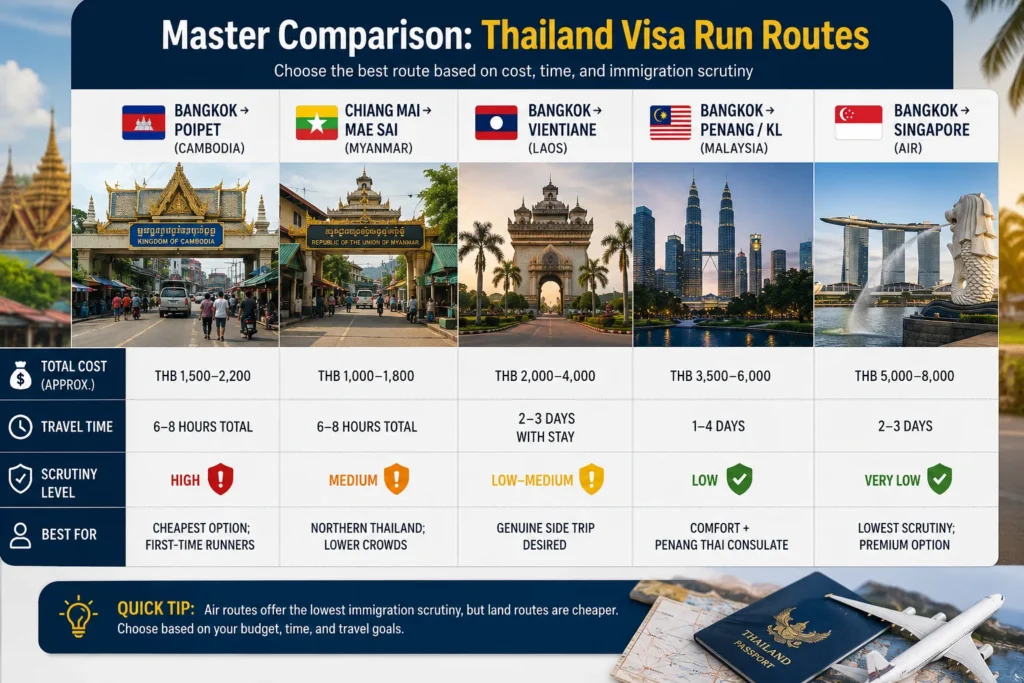
Master Comparison Table: All Thailand Visa Run Routes
| Route | From | Total Cost (approx.) | Travel Time | Scrutiny Level | Best For | |
| Bangkok → Poipet (Cambodia) | Bangkok | THB 1,500–2,200 | 6–8 hours total | HIGH | Cheapest option; first-time runners | |
| Chiang Mai → Mae Sai (Myanmar) | Chiang Mai | THB 1,000–1,800 | 6–8 hours total | MEDIUM | Northern Thailand; lower crowds | |
| Bangkok → Vientiane (Laos) | Bangkok | THB 2,000–4,000 | 2–3 days with stay | LOW-MEDIUM | Genuine side trip desired | |
| Bangkok → Penang/KL (Air) | Bangkok | THB 3,500–6,000 | 1–4 days | LOW | Comfort + Penang Thai Consulate | |
| Bangkok → Singapore (Air) | Bangkok | THB 5,000–8,000 | 2–3 days | VERY LOW | Lowest scrutiny; premium | |
What to Bring and What to Say at Thai Immigration
What to bring
- Passport (original — no photocopies accepted)
- Cash in USD for border entry fees (Cambodia, Myanmar, Laos) — THB also often accepted at land borders
- Hotel or accommodation booking confirmation in Thailand (printed or on phone — have the address ready)
- Return or onward ticket from Thailand if on a short stay (low-cost flight booking counts)
- Evidence of financial means if questioned: Wise app balance, bank app showing account, credit card
What to say at Thai immigration (land border re-entry)
Thai immigration officers may ask a few questions when you re-enter. The honest, practical answers:
| Immigration Question | Recommended Answer | Notes |
| Purpose of visit? | “Tourism” or “Holiday” | This is the correct answer for tourist visa / visa-exempt entry. Do not say “work” or “digital nomad.” |
| How long are you planning to stay? | State your planned stay honestly (“2 weeks” or “4 weeks”) | Do not say “As long as you’ll give me” or “30 days.” Be specific but genuine. |
| Where are you staying in Thailand? | Your hotel name and address, or the area (“Sukhumvit area in Bangkok”) | Have your accommodation booking or address ready on your phone. |
| Do you have proof of onward travel? | Return ticket, or explain your outbound travel plans | Budget airline booking back to your home country strengthens the case. |
| How many times have you entered Thailand this year? | Answer honestly | Do not guess or round down. Officer can see your passport stamps. |
| THE HONEST APPROACH IS THE CORRECT APPROACH Lying to Thai immigration officers is a worse outcome than being questioned honestly. If you have been in Thailand frequently, answer accurately. Officers respond better to honest, calm travelers than to evasive ones. The worst outcome from honest answers is a shorter-than-desired stay. The worst outcome from evasion is a ban. |
Cumulative Cost Analysis: Visa Runs vs LTR Visa Over 12 Months
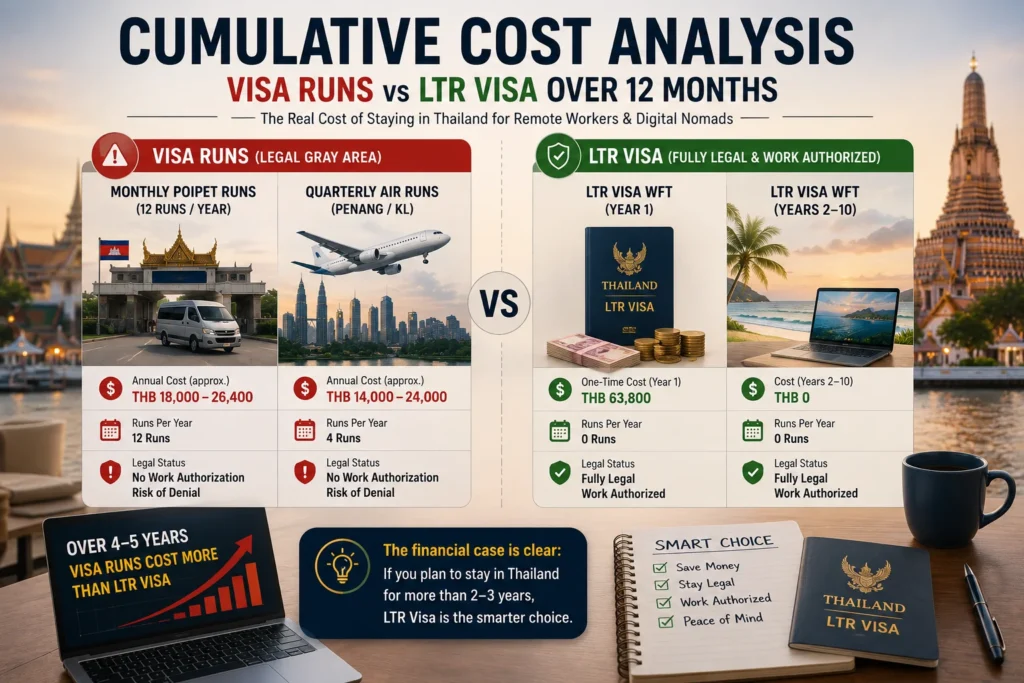
This is the calculation that most visa runners have never actually done. Here is the honest 12-month cost comparison:
| Scenario | Annual Cost (THB approx.) | Legal Status | Visa Runs/Year |
| Monthly Poipet runs (12 runs) | THB 18,000–26,400 in run costs | Legal gray area (no work auth) | 12 runs |
| Quarterly air runs to Penang (4 runs) | THB 14,000–24,000 in flight + stay costs | Legal gray area (no work auth) | 4 runs |
| LTR Visa WFT (one-time, year 1) | THB 63,800 in visa fees | Fully legal, work authorized | 0 runs |
| LTR Visa WFT (years 2–10) | THB 0 in visa fees (10-year duration) | Fully legal, work authorized | 0 runs |
If you are doing monthly land border runs: the cumulative annual cost (THB 18,000 to 26,400) is approaching half the LTR Visa’s one-time fee (THB 63,800). Over 4 to 5 years, you will have paid more than the LTR Visa fee in run costs alone — while still living in a legal gray area with no work authorization and full exposure to immigration denial risk.
The financial case for switching to LTR Visa is clear for any remote worker planning to stay in Thailand for more than 2 to 3 years.
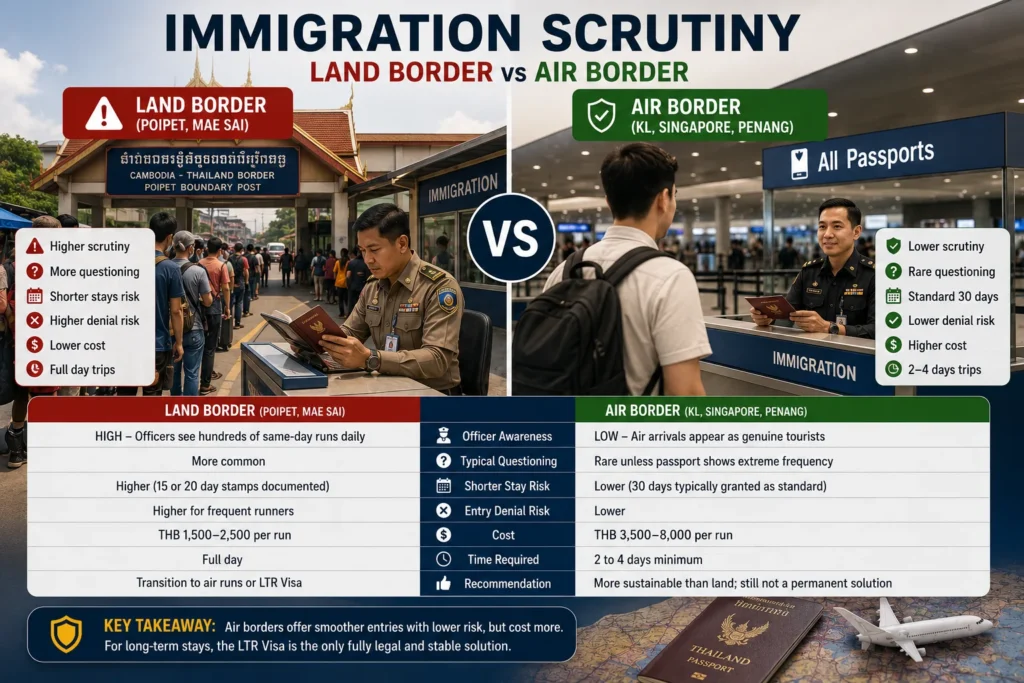
Immigration Scrutiny: Land Border vs Air Border — The Real Difference
| Factor | Land Border (Poipet, Mae Sai) | Air Border (KL, Singapore, Penang) |
| Officer awareness of visa run pattern | HIGH — officers see hundreds of same-day runs daily | LOW — air arrivals appear as genuine tourists |
| Typical questioning | More common | Rare unless passport shows extreme frequency |
| Shorter stay risk | Higher (15 or 20 day stamps documented) | Lower (30 days typically granted as standard) |
| Entry denial risk | Higher for frequent runners | Lower |
| Cost | THB 1,500–2,500 per run | THB 3,500–8,000 per run |
| Time required | Full day | 2 to 4 days minimum |
| Recommendation for frequent runners | Transition to air runs or LTR Visa | More sustainable than land; still not a permanent solution |
Nationality-Specific Notes: Indian and Filipino Passport Holders
| INDIA-SPECIFIC VISA RUN NOTES Indian citizens get 30 days visa-exempt entry to Thailand (air). A visa run resets this 30-day clock, giving another 30 days on re-entry.For 60-day stays: Indian passport holders can get a Thai Tourist Visa from the Thai Consulate in Penang (Malaysia) during an air visa run, converting the next entry to a 60-day tourist visa.Scrutiny: Indian travelers at Poipet face the same immigration scrutiny as any other nationality — it is based on entry pattern, not nationality.Transition point: Indian remote workers earning ₹34+ lakh/year from overseas clients should evaluate LTR Visa WFT as the long-term alternative to repeated visa runs. |
| PHILIPPINES-SPECIFIC VISA RUN NOTES Filipino citizens get 30 days visa-exempt entry to Thailand (air). Visa run resets the 30-day clock.Filipino passport holders can also get a Thai Tourist Visa from the Thai Consulate in Penang during an air visa run.Scrutiny: Same as other nationalities — based on entry frequency and pattern, not nationality.Transition point: Filipino remote workers earning PHP 2.2M+ per year from overseas clients (USD 40K threshold) should assess LTR Visa WFT as the legal alternative. |
Common Visa Run Mistakes
| Mistake | Consequence | Prevention |
| Doing monthly Poipet runs without monitoring entry history | Immigration pattern recognition leads to shorter stays or questioning | Switch to quarterly air runs or apply for LTR/DTV once income qualifies |
| Not having Thai accommodation address at immigration | Additional questioning; perceived as having no genuine tourist purpose | Always have hotel address or rental agreement address ready |
| Carrying remote work equipment visibly at land borders | Officer may question purpose of visit more aggressively | Pack laptop in checked bag or keep equipment low-profile at border |
| Forgetting that Cambodia visa fee is required (USD 30) every crossing | Arriving at Poipet without USD cash; unable to proceed | Always carry USD 30–50 cash for Cambodia entry fees |
| Not knowing the official total of previous Thai entries before crossing | Officer asks and you don’t know your own entry history | Check your passport entry stamps and count before each run |
Risks and Limitations of Thailand Visa Runs
- Entry denial: Thai Immigration can deny re-entry at their discretion. There is no formal appeal process at the border. A denial means returning to your departure point without entering Thailand.
- Shortened stays: Officers can grant stays shorter than the standard 30-day visa-exempt period. Frequent runners sometimes report 15-day stamps.
- Thai border ban risk: Repeated denials or repeated patterns of very brief overseas stays followed by immediate Thailand re-entry can result in informal flagging that affects future entries.
- No work authorization: Every visa run keeps you in a tourist visa legal gray area. Remote work for any employer or client while on tourist visa is technically unauthorized under the Aliens’ Work Act.
- Time and money accumulation: Monthly visa runs consume significant time and cost over a year — often exceeding the LTR Visa’s upfront cost over 2 to 3 years.
When to Stop Doing Visa Runs and Apply for the LTR Visa
Visa runs make sense in a narrow set of circumstances: you are genuinely testing whether Thailand is the right long-term base, you have not yet reached the LTR Visa income threshold, or you need a short-term bridge while your LTR application is in process.
Beyond these scenarios, visa runs impose costs that compound: the money spent on each run, the administrative burden of planning each exit, the legal uncertainty on each re-entry, and the accumulating immigration pattern that makes future entries harder.
| THE THREE SIGNALS THAT IT’S TIME TO STOP VISA RUNNING Signal 1: You have been doing monthly visa runs for 3+ months. The cumulative cost is approaching THB 6,000–9,000. You have spent significant time traveling for immigration compliance rather than living. Signal 2: You have been questioned at immigration, received a shorter-than-expected stay, or been asked why you keep entering and exiting. These are early warning signals. Signal 3: Your overseas income consistently exceeds USD 40,000 per year. You qualify for the LTR Visa today. Every month of continued visa runs is a month of paying for temporary legal uncertainty instead of permanent legal clarity. At any of these signals: read the Thailand LTR Visa Complete Guide and start your application. |
Frequently Asked Questions
What are the best border options for a Thailand visa run?
The five most practical Thailand visa run routes are: Aranyaprathet/Poipet (Cambodia, cheapest but highest scrutiny), Mae Sai/Tachileik (Myanmar, good for Chiang Mai), Nong Khai/Vientiane (Laos, best combined with genuine visit), Bangkok/Penang (air, allows Thai Consulate tourist visa pickup), and Bangkok/Singapore (air, lowest scrutiny). Air-based runs are more expensive but face significantly less immigration scrutiny than land border crossings.
How often can you do a visa run in Thailand?
There is no officially published maximum number of visa runs. In practice, Thai Immigration officers have discretion to question, shorten stays, or deny entry to travelers with repetitive entry patterns — particularly at land border crossings. Frequent Poipet runners (monthly) face the highest risk of shortened stays or additional questioning. Quarterly air-based runs face substantially lower scrutiny.
Can Indian and Filipino passport holders do Thailand visa runs?
Yes. Indian and Filipino citizens both receive 30-day visa-exempt entry to Thailand and can perform visa runs to reset this clock. Both nationalities can get a fresh 60-day Thai Tourist Visa from the Royal Thai Consulate General in Penang, Malaysia during an air-based visa run. The same immigration scrutiny rules apply to all nationalities — based on entry frequency, not nationality.
How much does a Thailand visa run cost?
Land border runs: THB 1,500 to 2,500 per run (transport + border fees). Air-based runs: THB 3,500 to 8,000+ per run (flights + short accommodation). Monthly land border runs cost approximately THB 18,000 to 30,000 per year — approaching half the LTR Visa’s one-time cost (THB 63,800) over time.
Is the Thailand visa run still working in 2026?
Visa runs continue to work in 2026, but with increasing scrutiny at land border crossings. Air-based runs remain more reliable. The risk of receiving a shorter stay (15 or 20 days instead of 30) or being questioned has increased at popular land border crossings like Poipet. For long-term Thailand residents, the LTR Visa provides legal certainty that visa runs cannot.
Final Verdict: Thailand Visa Runs in 2026
| Thailand visa runs are a practical short-term tool and a costly long-term habit. They work — most of the time — when done sensibly: not more often than quarterly, preferably via air, and with honest, prepared answers for Thai immigration. For digital nomads and remote workers who have been doing them monthly: the financial math, the legal gray area, and the accumulating immigration risk all point toward the same conclusion. The LTR Visa exists precisely because Thailand recognized that long-term visitors deserve legal stability, and remote workers deserve work authorization. Read this guide, do the visa run you need to do today, and then seriously calculate whether the LTR Visa is the smarter move for the next 10 years. Use the links below to compare Thailand’s long-stay visa options and start your LTR Visa research. |