
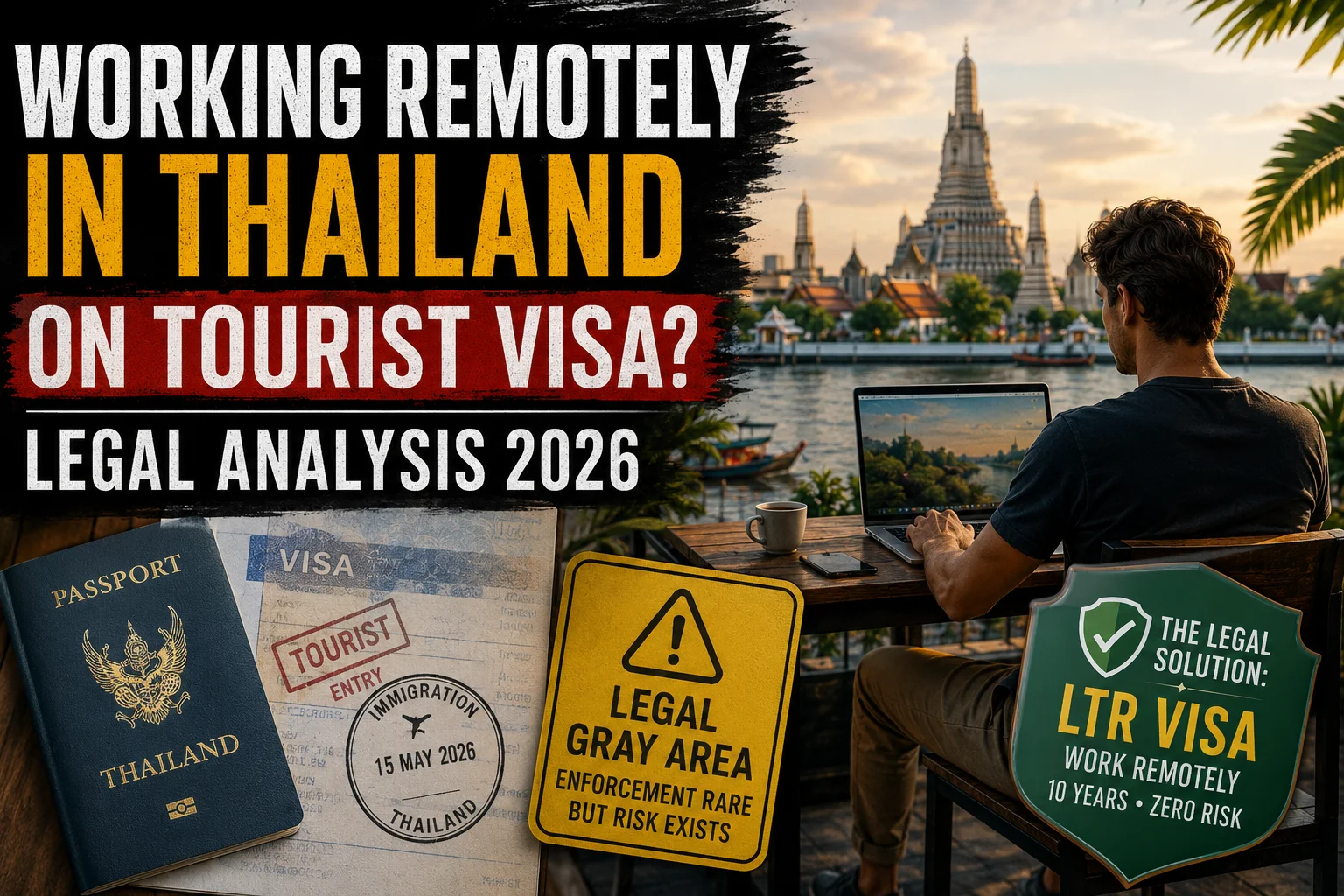
| Working remotely in Thailand on tourist visa legal issues exist in a genuine legal gray area under Thai law. The Aliens’ Work Act B.E. 2551 (2008) requires a work permit for any ‘work’ performed on Thai soil, but the legal definition of ‘work’ — whether it includes digital services provided to overseas clients without interaction with Thailand’s labor market — has not been definitively resolved by Thai courts or official BOI guidance. In practice, enforcement against remote workers serving overseas clients is rare and sporadic, with documented cases typically involving people working for Thai companies or in highly visible contexts. However, low enforcement probability is not the same as legal permission. The Thailand LTR Visa (Work-From-Thailand Professional category) is the formally authorized legal pathway for remote workers, providing a 10-year stay with an explicit work endorsement for overseas employment. |
| QUICK ANSWER: Is it legal to work remotely in Thailand on a tourist visa? Under a strict reading of Thai law, working remotely on a Thailand tourist visa is not authorized. The Aliens’ Work Act B.E. 2551 requires a work permit for any work performed on Thai territory, and tourist visas do not include work authorization. However, the legal position is genuinely debated among Thai immigration attorneys. Some legal professionals argue that digital work performed for overseas clients — with no economic interaction with Thailand’s labor market — may not constitute ‘work’ in the sense the law was designed to regulate. This view is not officially confirmed by Thai authorities. Bottom line: Working remotely on a Thailand tourist visa is legally uncertain, carries real but low enforcement risk, and has a clear legal solution: the Thailand LTR Visa (WFT category), which explicitly authorizes remote work for overseas employers. |
| CRITICAL LEGAL DISCLAIMER #1 This article is an informational legal analysis and does NOT constitute legal advice. MeridianNomad.com is not a law firm, and the authors of this article are not licensed attorneys. The legal analysis presented here reflects the state of Thai law and professional legal discourse as of 2026, but legal interpretations can change and individual circumstances vary. Do NOT make immigration, relocation, or visa decisions based solely on this article. If you have specific questions about your legal situation in Thailand, consult a licensed Thai immigration attorney. |
| CRITICAL LEGAL DISCLAIMER #2 — IMPORTANT This article does NOT encourage or recommend working in violation of Thai immigration or labor law. The presentation of the enforcement reality is provided for informational completeness — understanding how enforcement operates is relevant for legal awareness, not as a justification for non-compliance. The legal path forward is always the correct path. The Thailand LTR Visa is the proper solution for remote workers who want to live in Thailand legally. |
Introduction
There are few topics in the digital nomad community that generate more confusion, conflicting advice, and wishful thinking than the legal status of remote work on a Thailand tourist visa. You will find confident claims in every direction: “it’s completely fine,” “you will definitely be deported,” and everything in between.
Most of that discourse is built on partial information, outdated advice, or motivated reasoning. This analysis is built on a different foundation: the actual Thai statutes, documented enforcement history, and the genuine legal debate among practicing immigration attorneys in Thailand.
The goal is not to tell you what you want to hear. The goal is to give you the clearest available picture of the legal position, the enforcement reality, and the legitimate legal options that eliminate the uncertainty entirely.
The Thai Legal Framework: Two Relevant Laws
Working remotely in Thailand on a tourist visa involves two pieces of Thai legislation:
1. Thailand Immigration Act B.E. 2522 (1979)
This law governs visa categories and the conditions attached to each. A tourist visa (TR) — whether the standard 30-day visa-exempt entry or a formal tourist visa — is issued for the purpose of tourism. The act specifies that visa holders must comply with the conditions of their visa category.
The Immigration Act does not explicitly state that remote work is prohibited on a tourist visa. It establishes the visa framework and defers to the Aliens’ Work Act for work-related restrictions.
2. Thailand Aliens’ Work Act B.E. 2551 (2008)
This is the central statute. Section 6 of the Aliens’ Work Act states that a foreign national must not work without obtaining a work permit. ‘Work’ is defined in Section 4 as “engaging in work by exerting energy or using knowledge whether or not in consideration of wages or other benefits.”
The critical legal question is whether this broad definition covers digital work performed for overseas employers from Thai territory. The statute was written decades before remote work existed as a concept and does not explicitly address it.
| WHAT THE LAW SAYS vs. WHAT LEGAL PROFESSIONALS DEBATE The Law States: Any work performed on Thai soil requires a work permit. Tourist visas do not include a work permit. Therefore, any work performed on a tourist visa is technically a violation of the Aliens’ Work Act. The Legal Debate: Some Thai immigration attorneys argue that the intent of the Aliens’ Work Act is to protect Thailand’s domestic labor market. Digital work performed for overseas employers — where no Thai employee is displaced, no Thai contract is involved, and no Thai economic interaction occurs — may not constitute ‘work in Thailand’ in the sense the law regulates. This interpretation has not been confirmed by Thai courts. Important: Neither interpretation is officially endorsed by the Thai BOI, Thai Immigration, or the Thai Ministry of Labour. There is no official government clarification of the tourist visa remote work question. |
The Three Legal Positions on Remote Work in Thailand
Among Thai immigration practitioners and legal scholars, three distinct positions exist:
| Position | Argument | Who Holds It | Policy Implication |
| Strict Prohibition | Any work on Thai soil, including digital work for overseas employers, requires a work permit. Tourist visas explicitly do not permit work. | Conservative immigration attorneys; official government position when pressed | Get a work permit via LTR Visa, SMART Visa, or other authorized pathway |
| Gray Area / Unenforced | Remote work for overseas clients may not constitute ‘work in Thailand’ under the spirit of the Aliens’ Work Act, which targets labor market competition, not digital activity | Some progressive immigration practitioners; widely discussed in nomad communities | Legally uncertain — risk exists even if enforcement is rare |
| Source-of-Income Test | What matters is where the economic benefit flows. If income comes from outside Thailand and serves no Thai economic function, enforcement is unlikely | Informal view common in expat community; not a formal legal position | Pragmatic risk reduction, not legal compliance |
MeridianNomad does not endorse any of these positions as legal advice. The safest position — legally and practically — is to use a visa category that explicitly authorizes remote work.
The Enforcement Reality: What Actually Happens
Understanding enforcement reality is important for legal awareness — not as a justification for non-compliance, but because the gap between the legal text and enforcement practice is relevant to any honest analysis.
Documented enforcement patterns (2018–2026)
- Immigration raids at coworking spaces in Chiang Mai (2019) and Bangkok (2022 and 2023) resulted in questioning of digital workers. In most reported cases, individuals working for Thai companies or on Thai contracts were the target; remote workers serving overseas clients were largely not charged.
- Deportation cases involving remote work specifically — rather than overstays or other immigration violations — are rare in publicly documented records.
- Most border and immigration enforcement focuses on overstays, visa run patterns, and criminal activity rather than the employment nature of tourists’ digital activities.
- Social media posts explicitly showing work activities from Thailand (client meetings, work laptop setups, professional location sharing) have occasionally been used as evidence in immigration proceedings, particularly where the individual also had other immigration complications.
What typically triggers enforcement attention
- Working visibly for Thai companies or Thai clients from a Thai office
- Extended visa run patterns combined with visible work activity — suggests tourism is not the genuine purpose of the stay
- High public profile (influencers, journalists) who document their remote work activities in Thailand explicitly
- Reports from Thai immigration tiplines — in some cases filed by competitors, neighbors, or other parties
- Border immigration scrutiny for individuals with very frequent entry stamps
| WHAT DOES NOT TYPICALLY TRIGGER ENFORCEMENT Quietly working on a laptop in a private apartment or AirbnbStandard coworking space usage where work is for overseas clientsVideo calls with overseas colleaguesShort-stay tourists who also happen to answer work emails This pattern does NOT mean these activities are legal — it means enforcement is disproportionately directed at higher-visibility situations. |
Risk Spectrum: Legal Position and Enforcement Risk by Scenario
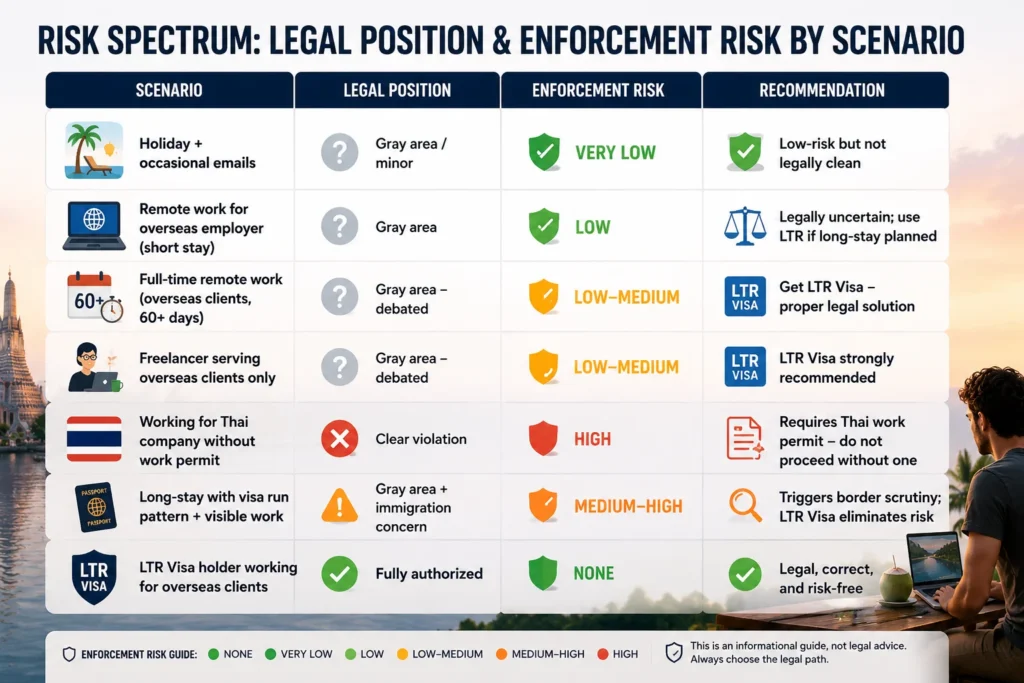
| Scenario | Legal Position | Enforcement Risk | Recommendation |
| Holiday + occasional emails | Gray area / minor | Very Low | Low-risk but not legally clean |
| Remote work for overseas employer (short stay) | Gray area | Low | Legally uncertain; use LTR if long-stay planned |
| Full-time remote work (overseas clients, 60+ days) | Gray area — debated | Low-Medium | Get LTR Visa — proper legal solution |
| Freelancer serving overseas clients only | Gray area — debated | Low-Medium | LTR Visa strongly recommended |
| Working for Thai company without work permit | Clear violation | High | Requires Thai work permit — do not proceed without one |
| Long-stay with visa run pattern + visible work | Gray area + immigration concern | Medium-High | Triggers border scrutiny; LTR Visa eliminates risk |
| LTR Visa holder working for overseas clients | Fully authorized | None | Legal, correct, and risk-free |
Factors That Increase Your Legal Risk
Even within the ‘low enforcement probability’ scenarios, certain behaviors and patterns increase the risk of immigration attention:
- Frequent visa runs (entering and exiting repeatedly): Thai Immigration becomes more attentive to individuals with many consecutive tourist entries, as it signals that tourism is not the genuine purpose of the stay
- Public documentation of work activity in Thailand: Posts, videos, or professional content explicitly showing you working in Thailand from a tourist visa position create a documented trail
- Working with Thai clients or receiving payments from Thai sources while on tourist visa: This is categorically more legally exposed than overseas-client-only remote work
- Carrying large amounts of work equipment (multiple monitors, office peripherals) that are atypical for a tourist: Can invite questions at immigration entry
- Registering a Thai business entity while on tourist visa: Immediately creates a legal obligation for a work permit
- Making Thai immigration officers aware that you are working while they are processing you at the border
What Happens If Caught Working Without Authorization
If Thai authorities determine that you have been working in Thailand without a work permit, the potential consequences are:
| Consequence | Description | Likelihood |
| Warning and release | First-time minor infraction may result in a warning. Rare for work permit violations. | Uncommon |
| Fine | Fines of up to THB 100,000 (approx. USD 2,800) under the Aliens’ Work Act for working without a work permit. | Possible |
| Deportation | Deportation from Thailand with a re-entry restriction. The restriction period depends on the severity of the violation. | Possible for significant violations |
| Re-entry ban | Short-term (1–5 years) or permanent ban from Thailand depending on circumstances. | Possible for serious or repeat violations |
| Criminal prosecution | In the most severe cases, criminal prosecution under the Aliens’ Work Act. Rare for remote workers; more common for work for Thai employers. | Rare |
In practice, documented enforcement cases against remote workers serving exclusively overseas clients with a tourist visa are uncommon. However, the existence of penalties is not theoretical — they are real legal risks that apply to the situation.
Tax Implications: The Less-Discussed Dimension
Most discussions of working remotely on a Thailand tourist visa focus on immigration law. The tax dimension is equally important and almost universally overlooked.
Thai income tax and the 180-day rule
Thailand taxes income based on physical presence. If you spend 180 or more days in Thailand in a calendar year, you become a Thai tax resident and your ‘assessable income’ — including foreign-sourced income brought into Thailand in the same tax year — may be subject to Thai income tax under the Revenue Department’s 2024 ruling (Phor Ngor 161/2566).
This means extended stays on tourist visas do not only create immigration risk — they can also create unexpected Thai tax obligations for foreign-sourced income.
Home country tax implications
If you become a Thai tax resident, your home country tax obligations may change. For Indian citizens: spending fewer than 182 days in India in a financial year can shift your Indian tax residency status. For Filipino citizens: similar principles apply under Philippine tax law. Both situations require active management and ideally professional tax advice.
| TAX DISCLAIMER Tax implications of extended stays in Thailand are complex and depend on nationality, tax treaties between your home country and Thailand, income source, and how your income is remitted. Consult a qualified tax advisor in both Thailand and your home country before planning a long-term stay. This is not tax advice. |
Nationality-Specific Considerations
Indian Citizens
| INDIA-SPECIFIC RISK FACTORS Indian passport holders on multiple-entry tourist visas with frequent visa run patterns receive heightened scrutiny at Thai land borders (particularly Poipet, Mae Sai, and Sadao) compared to some Western passport holdersOCI card holders have no special status under Thai immigration law — an OCI card does not grant any additional immigration permissions in ThailandIndia’s FEMA (Foreign Exchange Management Act) creates additional compliance obligations for Indians living abroad — extended presence in Thailand on a tourist visa has implications for Indian tax residency that deserve careful attentionIndian remote workers are among the most frequent applicants for the Thailand LTR Visa precisely because they have recognized the legal uncertainty of the tourist visa route and sought a proper solution |
Filipino Citizens
| PHILIPPINES-SPECIFIC RISK FACTORS Philippine passport holders face additional documentation burden when entering Thailand on tourist visas for extended stays — immigration officers may ask for proof of funds, onward travel, and hotel bookings more often than for some other nationalitiesThe OFW (Overseas Filipino Worker) classification has no bearing on Thai immigration law — a Filipino on a tourist visa working remotely is in the same legal position under Thai law as any other nationalityPhilippine BIR (Bureau of Internal Revenue) obligations do not pause when you are in Thailand — extended absence from the Philippines has implications for your Philippine tax residency status that require professional guidance |
The Legal Solution: Visa Options That Authorize Remote Work
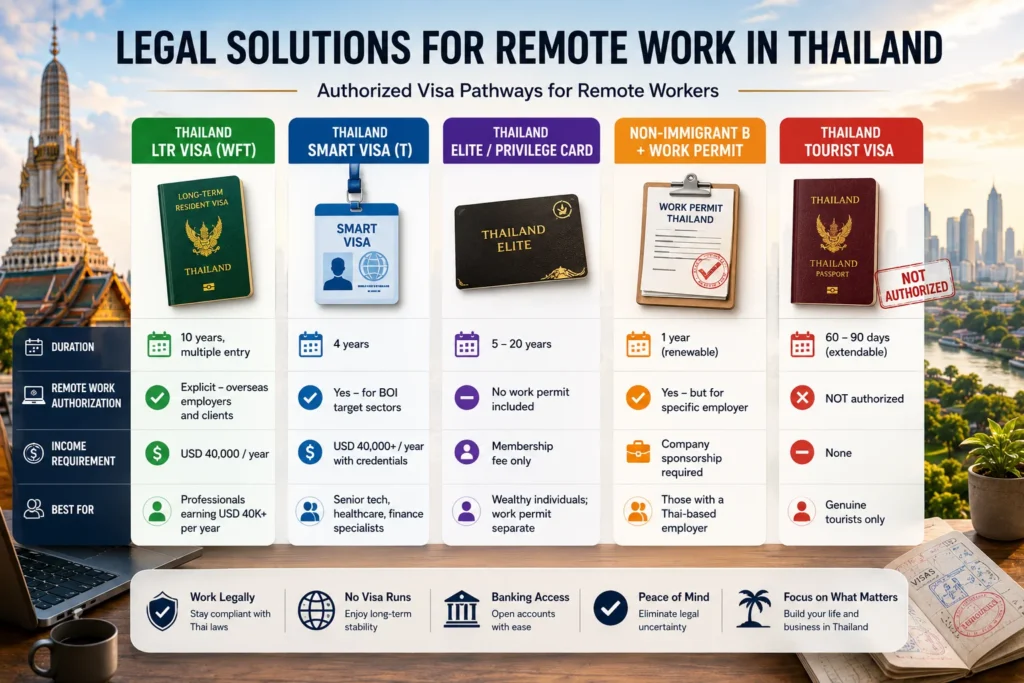
For remote workers who want to live in Thailand legally — without the legal uncertainty, the visa run requirements, or the immigration risk — there are proper pathways:
| Visa Option | Duration | Remote Work Authorization | Income Requirement | Best For |
| Thailand LTR Visa (WFT) | 10 years, multiple entry | Explicit — overseas employers and clients | USD 40,000/year | Professionals earning USD 40K+ per year |
| Thailand SMART Visa (T) | 4 years | Yes — for BOI target sectors | USD 40,000+/year with credentials | Senior tech, healthcare, finance specialists |
| Thailand Elite / Privilege Card | 5–20 years | No work permit included | Membership fee only | Wealthy individuals; work permit separate |
| Non-Immigrant B + Work Permit | 1 year (renewable) | Yes — but for specific employer | Company sponsorship required | Those with a Thai-based employer |
| Thailand Tourist Visa | 60–90 days (extendable) | NOT authorized | None | Genuine tourists only |
| THE CLEAR RECOMMENDATION For remote workers and digital nomads earning USD 40,000+ per year from overseas sources with 5+ years of professional experience, the Thailand LTR Visa (Work-From-Thailand Professional category) is the only visa option that provides: Explicit legal authorization for remote work for overseas clients10-year, multiple-entry stay without annual renewalsAccess to Thai banking systemFreedom from visa run requirementsComplete elimination of the legal uncertainty described in this article The LTR Visa exists specifically to give remote workers a legal home in Thailand. If you meet the eligibility requirements, using it is not just recommended — it is the straightforward answer to the legal problem this article describes. |
Tourist Visa vs. LTR Visa: The Decision Framework
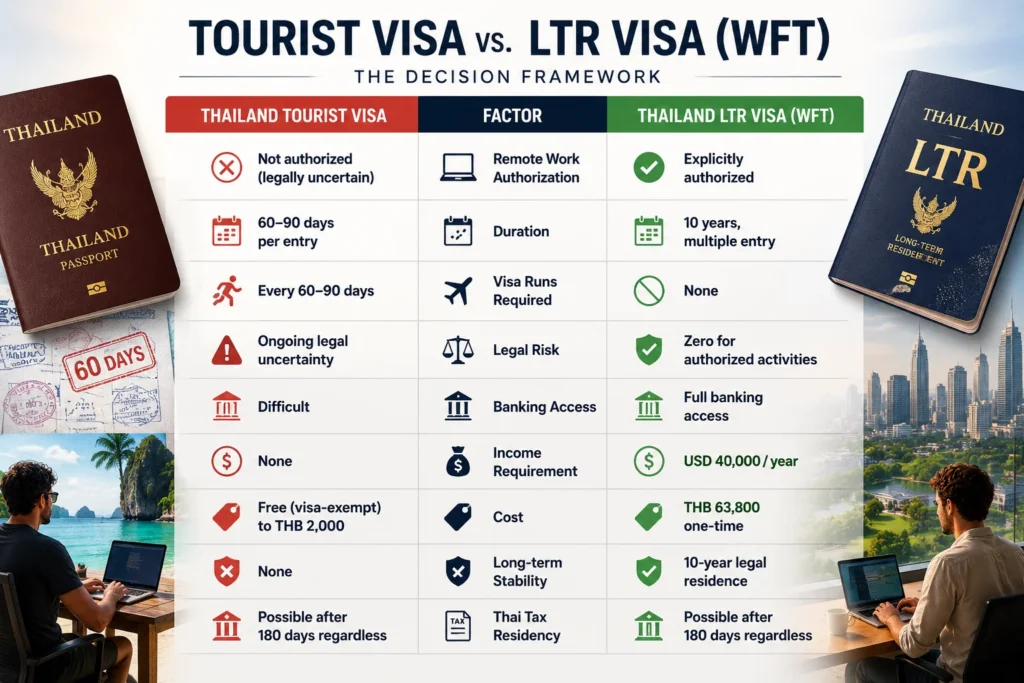
| Factor | Thailand Tourist Visa | Thailand LTR Visa (WFT) |
| Remote work authorization | Not authorized (legally uncertain) | Explicitly authorized |
| Duration | 60–90 days per entry | 10 years, multiple entry |
| Visa runs required | Every 60–90 days | None |
| Legal risk | Ongoing legal uncertainty | Zero for authorized activities |
| Banking access | Difficult | Full banking access |
| Income requirement | None | USD 40,000/year |
| Cost | Free (visa-exempt) to THB 2,000 | THB 63,800 one-time |
| Long-term stability | None | 10-year legal residence |
| Thai tax residency | Possible after 180 days regardless | Possible after 180 days regardless |
Practical Recommendations for Different Situations
If you are considering Thailand for a 1 to 4 week holiday while also doing some work
Occasional email checking and minor work tasks during a genuine holiday stay represent the lowest-risk scenario. The legal position is still uncertain, but enforcement against short-stay tourists in this context is not documented. This does not mean it is authorized — it means the practical risk is minimal. Plan your longer-term strategy properly.
If you are planning to live and work in Thailand for 3 to 12 months
At this level of intent and duration, the tourist visa is not the right tool — legally or practically. The visa run burden becomes significant, the legal uncertainty accumulates, and the immigration scrutiny risk rises with extended stay patterns. If you meet the LTR Visa requirements (USD 40,000/year income, 5+ years experience), apply. If you do not yet meet the requirements, consider Malaysia DE Rantau, Georgia Remotely From, or another visa that explicitly covers remote workers at a lower income threshold.
If you are already living in Thailand on tourist visas and thinking about regularizing your status
The LTR Visa can be applied for from Thailand if you are in the country on a valid visa. You do not need to return to your home country to apply. Start the BOI portal application and begin assembling your documents. Your prior tourist visa stays do not disqualify you from the LTR Visa — the BOI does not require an explanation of prior tourist visa use unless there are immigration violations involved.
Risks and Limitations of This Analysis
- This analysis is based on Thai law as of 2026. Thai legislation and enforcement practices can change. Always verify current legal positions with a Thai immigration attorney.
- Enforcement data comes from community reports and documented cases — not from official Thai Immigration statistics, which are not publicly published.
- The legal debate described here reflects the state of professional discourse among Thai immigration practitioners. It should not be interpreted as legal clearance for any activity.
- Individual circumstances — including prior Thai immigration history, nationality, profession, and visa history — can significantly affect both legal exposure and enforcement risk in ways this general analysis cannot capture.
Frequently Asked Questions
Is Working Remotely in Thailand on Tourist Visa Legal?
Under a strict reading of the Aliens’ Work Act B.E. 2551, no — any work performed on Thai territory without a work permit is a violation. However, many Thai immigration attorneys note that the statute was designed to protect Thailand’s domestic labor market, and digital work for overseas employers may not fall within its intended scope. This interpretation is not officially confirmed. The legally safe position is to hold a visa that explicitly authorizes remote work — such as the LTR Visa (WFT category).
Has anyone actually been deported for working remotely on a Thailand tourist visa?
Documented deportation cases specifically for remote work from overseas clients on a tourist visa are rare. Most documented enforcement cases involve working for Thai employers, extended overstays combined with visible work activity, or other compounding immigration issues. This does not mean there is no legal risk — it means enforcement has historically been targeted at higher-priority situations.
What is the Thailand LTR Visa and does it solve this problem?
The Thailand LTR Visa (Long-Term Resident Visa) was introduced in 2022 by the Thailand Board of Investment. The Work-From-Thailand (WFT) Professional category explicitly authorizes remote work for overseas employers and clients, requires no annual renewal, provides a 10-year multiple-entry stay, and eliminates the legal uncertainty described in this article entirely. It requires USD 40,000/year in overseas income and 5+ years of professional experience.
Can Thailand Immigration check if I am working while on tourist visa?
Thai Immigration does not routinely audit digital activity. However, social media posts, publicly visible work content, tip-offs, and visa run patterns can bring individuals to immigration attention. Extended visa run activity — where the pattern of entries and exits suggests Thailand is being used as a permanent base rather than a tourist destination — is the most common trigger for additional scrutiny.
Does working remotely on a tourist visa affect my home country tax obligations?
Potentially yes. If you spend 180 or more days in Thailand in a calendar year, you may become a Thai tax resident, which affects how your foreign-sourced income is taxed in Thailand. This is separate from any home country tax obligations — Indian and Filipino citizens face specific implications under their respective home-country tax frameworks for extended periods abroad. Consult a tax professional in both countries.
Final Verdict
| Working remotely on a Thailand tourist visa exists in a legal gray area that has not been officially resolved by Thai authorities. The law technically requires a work permit for any work on Thai soil. Enforcement against remote workers serving exclusively overseas clients is rare but documented and real. The honest answer is this: the tourist visa was not designed for remote workers, and using it as a long-term remote work base involves legal uncertainty that a proper visa eliminates. The LTR Visa (WFT category) is not the most accessible solution for everyone — the USD 40,000 income threshold excludes lower-earning nomads. But for those who qualify, it is the unambiguous legal answer to the question this article addresses. For those who do not yet qualify for the LTR Visa, options like Malaysia DE Rantau (USD 24,000/year threshold) and Georgia Remotely From (USD 2,000/month) provide proper legal authorization for remote work at lower income requirements. |