
Last Updated: May 2026 | Audience: Indian + Filipino freelancers (BOTH) | Priority: 9/10
| Thailand LTR Visa self-employed freelancers: Self-employed freelancers can apply for the Thailand LTR Visa under the Work-From-Thailand (WFT) Professional category. The minimum income requirement is USD 40,000 per year from non-Thai overseas clients or employers. BOI does not require a single employer — income from multiple overseas clients combined is acceptable. The key documentation difference for freelancers versus salaried employees is the requirement for a CA certificate (for Indian applicants), BIR registration documents (for Filipino applicants), platform earnings statements (Upwork, Payoneer, Wise), and 12 months of bank statements showing overseas income. The LTR Visa’s work permit covers remote work for overseas clients — it does not restrict freelancers to a single employer and does not authorize work for Thai-based companies. |
| QUICK ANSWER: Can self-employed freelancers get Thailand LTR Visa? Yes. Self-employed freelancers qualify for the Thailand LTR Visa Work-From-Thailand (WFT) Professional category if they meet all of the following: Earn at least USD 40,000 per year from non-Thai overseas clients (combined from all sources)Have 5+ years of professional experience in their fieldHold valid international health insurance with USD 50,000+ coverageCan document their income through bank statements, platform earnings reports, and a CA certificate or equivalentProvide client contracts or service agreements confirming overseas income sources Freelancers with multiple overseas clients, platform-based income (Upwork, Toptal), or project-based irregular income all qualify — provided the annual total meets the threshold and is properly documented. |
| IMPORTANT DISCLAIMER This article is for informational purposes only and does not constitute legal or immigration advice. BOI eligibility requirements can change. Always verify current requirements at boi.go.th before applying. Individual circumstances vary — consult a licensed Thai immigration consultant for advice on your specific situation. |
Introduction
The Thailand LTR Visa is widely discussed as a visa for employed professionals. What is far less well-known is that it is equally accessible to self-employed freelancers — provided the application is prepared correctly.
The Work-From-Thailand (WFT) category of the LTR Visa does not require a traditional employment contract with a single employer. It requires proof that you earn at least USD 40,000 per year from non-Thai sources. For a freelancer working with three overseas clients, that means documenting the combined income from all three. For an Upwork professional with consistent platform earnings, it means a formal Upwork annual statement plus bank records.
The challenge is not qualification — it is documentation. Freelancers have more complex income trails than salaried employees, and the BOI has specific expectations for how that income is presented. This guide covers exactly what those expectations are, how to meet them, and what the most common documentation mistakes look like so you can avoid them.
What ‘Self-Employed’ Means to the Thailand BOI
The Thailand BOI does not publish a separate category for ‘freelancers’ or ‘self-employed professionals.’ The LTR Visa categories are defined by income source and income type — not employment structure. The Work-From-Thailand (WFT) Professional category covers any professional who:
- Works remotely for an employer or clients based outside Thailand
- Earns at least USD 40,000 per year from these non-Thai sources
- Has 5+ years of professional experience in their field
- Holds qualifying health insurance
Under this framework, a software developer employed full-time by a US company and a software developer working as an independent contractor for three US clients are in the same category — both qualify under WFT. The BOI’s concern is the source and amount of income, not whether you have one employer or ten clients.
| THE ONE SCENARIO THAT DOES NOT QUALIFY A self-employed freelancer who works primarily for Thai-based companies or Thai clients does NOT qualify under the WFT category. The income must originate from outside Thailand. Working remotely in Thailand for Thai employers on a freelance basis is not the same as working remotely for overseas clients from Thailand. |
Which LTR Visa Category Applies to Self-Employed Freelancers
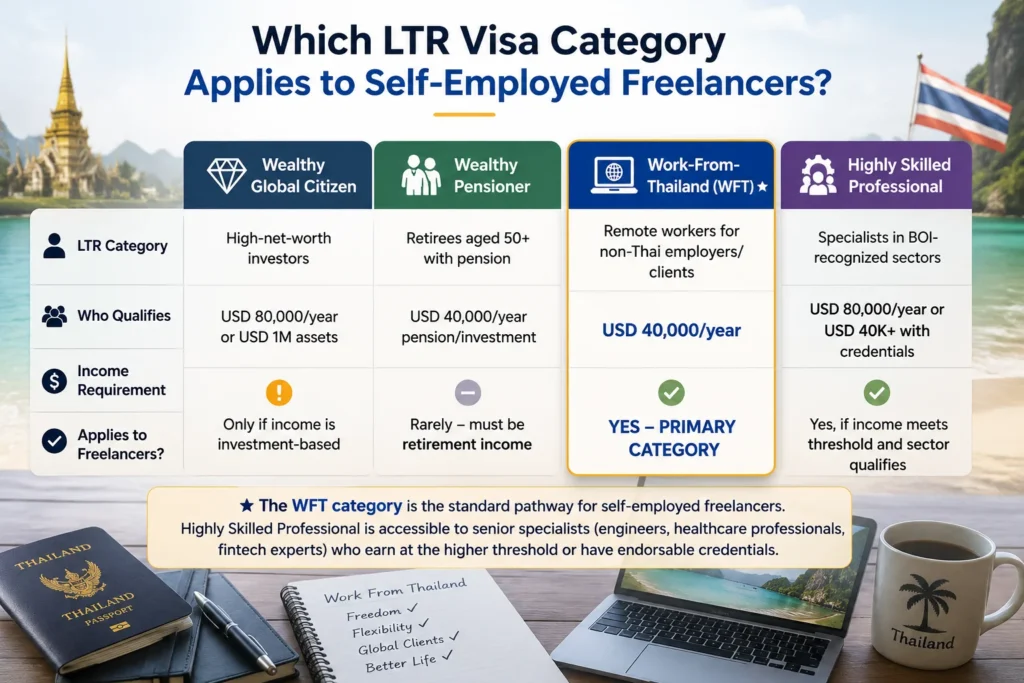
| LTR Category | Who Qualifies | Income Requirement | Applies to Freelancers? |
| Wealthy Global Citizen | High-net-worth investors | USD 80,000/year or USD 1M assets | Only if income is investment-based |
| Wealthy Pensioner | Retirees aged 50+ with pension | USD 40,000/year pension/investment | Rarely — must be retirement income |
| Work-From-Thailand (WFT) ★ | Remote workers for non-Thai employers/clients | USD 40,000/year | YES — PRIMARY CATEGORY |
| Highly Skilled Professional | Specialists in BOI-recognized sectors | USD 80,000/year or USD 40K+ with credentials | Yes, if income meets threshold and sector qualifies |
★ The WFT category is the standard pathway for self-employed freelancers. Highly Skilled Professional is accessible to senior specialists (engineers, healthcare professionals, fintech experts) who earn at the higher threshold or have endorsable credentials.
Eligibility Requirements for Self-Employed Freelancers
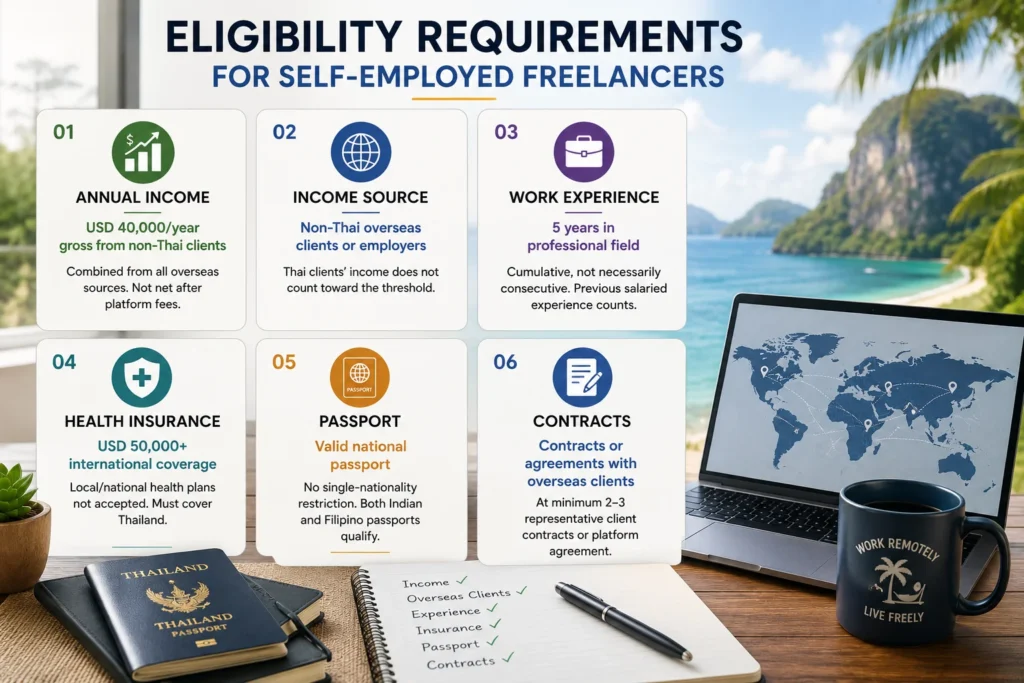
| Requirement | Standard for Freelancers | Key Notes |
| Annual income | USD 40,000/year gross from non-Thai clients | Combined from all overseas sources. Not net after platform fees. |
| Income source | Non-Thai overseas clients or employers | Thai clients’ income does not count toward the threshold |
| Work experience | 5 years in professional field | Cumulative, not necessarily consecutive. Previous salaried experience counts. |
| Health insurance | USD 50,000+ international coverage | Local/national health plans not accepted. Must cover Thailand. |
| Passport | Valid national passport | No single-nationality restriction. Both Indian and Filipino passports qualify. |
| Contracts | Contracts or agreements with overseas clients | At minimum 2–3 representative client contracts or platform agreement |
Types of Self-Employment the BOI Recognizes for LTR Visa
The following freelance and self-employment models all qualify under the WFT category, provided income originates from non-Thai overseas sources:
| Freelance Type | Income Documentation | Complexity |
| Platform-based (Upwork, Toptal, Fiverr) | Official platform earnings statement + bank statements | Low-Medium |
| Direct-contract freelancer (invoices) | Client contracts + invoice records + bank statements + CA/accountant cert | Medium |
| Mixed: platform + direct clients | All of the above combined | Medium-High |
| Online business owner (products/SaaS) | Revenue reports + business bank statements + accountant certification | High |
| Consultant with overseas retainers | Retainer agreements + bank statements + professional certification | Medium |
| Remote employee turned freelancer (recent transition) | Previous pay slips + current freelance documentation + CA cert for current period | Medium-High |
Income Proof: The Freelancer’s Documentation Roadmap
This is the section that separates successful freelance LTR applications from rejected ones. Here is what you need, organized by document type:
Core documents (all freelancers)
- Bank statements — 12 months showing international inward remittances. Highlight foreign currency credits. Include all accounts that receive overseas income.
- Platform earnings statements — Official annual exports from Upwork, Toptal, Payoneer, Wise, or PayPal. Not screenshots. Not dashboard summaries. Formal downloadable reports.
- Client contracts or service agreements — 3 to 5 representative agreements with overseas clients showing scope, fee, and client country.
- CA certificate or equivalent accountant certification — From an ICAI-registered CA (India) or a CPA (Philippines/international) confirming annual overseas income.
- Income Tax Returns (ITR) — Last 2 years. Shows government-recorded income history.
Supporting documents (strengthen the application)
- LinkedIn profile URL or portfolio site showing professional history
- Client testimonials or references from overseas clients (not a BOI requirement but adds credibility)
- Professional certifications relevant to your field (developers: AWS certs; designers: Adobe certifications; etc.)
- USD conversion note if income is received and declared in local currency
Handling Irregular Income: How BOI Assesses Project-Based Earnings
This is the question that worries most freelancers — and the answer is more reassuring than people expect.
BOI reviewers understand that freelance income is not a monthly salary. They look at total annual income, not monthly consistency. A freelancer who earned USD 3,000 in January, USD 8,000 in March, USD 1,500 in May, and higher amounts in the second half of the year — with an annual total of USD 45,000 — qualifies under the WFT threshold.
| HOW TO PRESENT IRREGULAR INCOME EFFECTIVELY Include a one-page cover note with your application explaining your income model: “I work on project-based contracts with overseas clients. Income varies by project delivery schedule. My gross annual income for the last 12 months totals USD [amount], as evidenced by the attached bank statements and CA certificate.”Your CA certificate should state the annual total, not a monthly average. This is the number BOI uses for the threshold assessment.If one year’s income is clearly above USD 40,000 and the previous year is slightly below, include a note from your CA explaining the trend and confirming your current earning capacity. |
Does the LTR Work Permit Restrict You to One Employer?
This is one of the most common misconceptions about the LTR Visa for freelancers — and it stops many from applying unnecessarily.
| WHAT THE LTR VISA WORK PERMIT ACTUALLY COVERS The LTR Visa includes a special endorsement that functions as a work permit for remote work with overseas employers or clients. It covers: Working remotely for one overseas employerWorking remotely for multiple overseas clients simultaneouslyPlatform-based freelancing for international clients (Upwork, Toptal, etc.)Running an online business serving overseas customers It does NOT authorize: Working for Thai-based companies (requires a separate Thai work permit)Providing services to Thai clients from Thai territoryOperating a physical business entity in Thailand Freelancing for multiple overseas clients is explicitly within scope of the LTR work endorsement. You do not need a new endorsement for each new client. |
Nationality-Specific Guidance: Indian Freelancers
| INDIA-SPECIFIC DOCUMENTATION REQUIREMENTS For Indian freelancers, the most critical additional document is the CA-certified income certificate. This is issued by an ICAI-registered Chartered Accountant and must: Confirm your annual gross income from overseas sources Include the CA’s ICAI membership number, stamp, and signature State income in USD equivalent (with INR conversion if income is in INR)Explicitly confirm that the income is from non-Indian, non-Thai overseas sources Additional India-specific documents: ITR-4 (Sugam) for most Indian freelancers — last 2 years, downloaded from incometax.gov.in ICAI CA certificate — this bridges the gap when ITR shows income as domestic business income Indian bank statements (HDFC, ICICI, SBI, Axis, Kotak) — 12 months showing international inward remittances Read the complete India-specific income proof guide on Meridian Nomad: How to Prove Freelance Income for LTR Visa (India) |
Nationality-Specific Guidance: Filipino Freelancers
| PHILIPPINES-SPECIFIC DOCUMENTATION REQUIREMENTS For Filipino freelancers, the documentation focuses on BIR registration, platform earnings, and international transfer records: BIR Certificate of Registration (COR) — confirms you are registered as self-employed with the Philippine tax authority Annual ITR (BIR Form 1701) for last 2 years — shows your declared income history Upwork/PayPal/Wise annual earnings exports — official platform statements showing overseas income Philippine bank statements (BDO, BPI, Metrobank, Union Bank) — 12 months showing international inward transfers Accountant-certified income summary — from a CPA confirming your annual overseas income Key note for Filipino freelancers: PhilHealth is NOT accepted as health insurance. You need an international plan (Cigna Global, AXA International, Safety Wing Remote Health) with USD 50,000+ coverage. Read the complete Filipino-specific LTR Visa guide: Thailand LTR Visa for Filipino Citizens |
Step-by-Step Application Process for Self-Employed Freelancers
- Confirm you meet the income threshold: Verify your gross annual income from all overseas sources totals USD 40,000+ for the most recent 12 months
- Gather income documentation: Collect bank statements (12 months), platform earnings statements, client contracts, and CA certificate or CPA certification
- Arrange health insurance: Purchase an international plan with USD 50,000+ Thailand coverage before applying
- Prepare your CV: Confirm 5+ years of professional experience is documented with dates, roles, and company/client names
- Create BOI portal account: Register at ltrvisat.boi.go.th and begin the online application
- Upload all documents: Complete the application form, upload all required PDFs (max 10 MB each), pay the BOI endorsement fee of THB 50,000
- Wait for BOI review: 20 to 35 working days. Monitor portal status and check email for any Additional Information Requests
- Receive endorsement letter: BOI emails the endorsement approval letter upon approval
- Book Thai Embassy appointment: Schedule visa stamping at the Royal Thai Embassy in your country
- Receive LTR Visa stamp: Attend appointment, submit documents, pay visa fee of THB 10,000. Collect passport with LTR Visa sticker within 3 to 5 working days.
- Travel to Thailand: Enter on your LTR Visa. Visa activates from first entry.
Cost Breakdown for Freelancer LTR Visa Applications
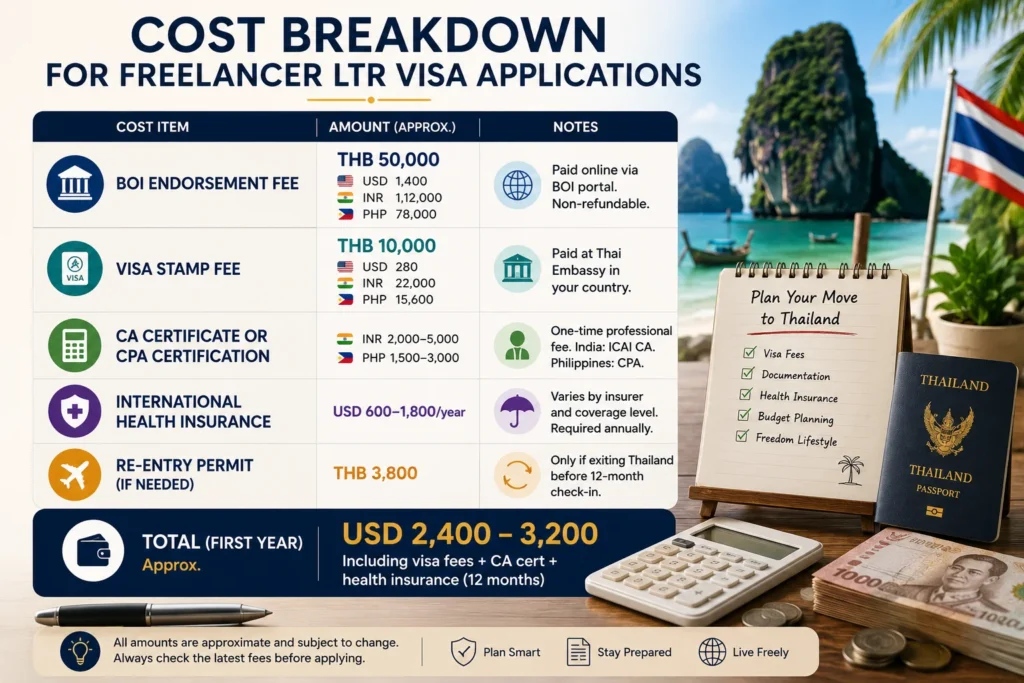
| Cost Item | Amount | Notes |
| BOI endorsement fee | THB 50,000 (approx. USD 1,400 / INR 1,12,000 / PHP 78,000) | Paid online via BOI portal. Non-refundable. |
| Visa stamp fee | THB 10,000 (approx. USD 280 / INR 22,000 / PHP 15,600) | Paid at Thai Embassy in your country |
| CA certificate or CPA certification | INR 2,000–5,000 / PHP 1,500–3,000 | One-time professional fee. India: ICAI CA. Philippines: CPA. |
| International health insurance | USD 600–1,800/year | Varies by insurer and coverage level. Required annually. |
| Re-entry permit (if needed) | THB 3,800 | Only if exiting Thailand before 12-month check-in |
| TOTAL (first year) | Approx. USD 2,400–3,200 | Including visa fees + CA cert + health insurance (12 months) |
Tax Implications for Self-Employed Freelancers on LTR Visa
Most people applying for the LTR Visa overlook the tax side — and for freelancers, this is particularly important.
Thai income tax on the LTR Visa
The WFT Professional LTR Visa does not automatically make you a Thai tax resident. Thai tax residency triggers when you spend 180 or more days in Thailand in a calendar year. If you do become a Thai tax resident, your income is assessed under Thai income tax rules — however, the 2024 Revenue Department ruling (Phor Ngor 161/2566) specifically addressed the taxation of foreign-sourced income brought into Thailand and clarified that pre-2024 income is not taxable. Consult a Thai tax advisor for your specific situation.
Home country tax obligations
Moving to Thailand on an LTR Visa does not automatically extinguish your home country tax obligations. For Indian freelancers, spending fewer than 182 days in India in a financial year can change your tax residency status from resident to non-resident — with implications for how your income is taxed and which accounts you must use. For Filipino freelancers, spending more than 180 days outside the Philippines in a tax year may affect your Philippine tax residency status.
| TAX DISCLAIMER Tax implications of relocating to Thailand as a self-employed freelancer are complex and depend on your nationality, home country tax treaties, income type, and time spent in each country. Always consult a qualified tax advisor in both your home country and Thailand before making relocation decisions based on tax considerations. |
Banking Setup for Self-Employed LTR Visa Holders
The LTR Visa significantly simplifies banking in Thailand compared to tourist or non-immigrant visa holders. Self-employed freelancers typically use the following setup:
- Thai bank account: Bangkok Bank or Kasikorn Bank (KBank) for local expenses (rent, utilities, daily spending). LTR Visa holders are accepted as customers with the endorsement letter.
- Wise multi-currency account: Receive USD, EUR, GBP from overseas clients in a dedicated international account. Convert to THB as needed for Thai expenses. Much lower fees than receiving international transfers directly into a Thai bank.
- Payoneer: Alternative to Wise for US-based platforms that pay through Payoneer. Also provides a USD virtual account useful for US dollar billing.
- Home country account: Keep your Indian (NRO/NRE) or Philippine bank account active for ongoing domestic obligations (tax payments, loan services, family remittances).
Freelancer vs. Employee Application: Key Differences
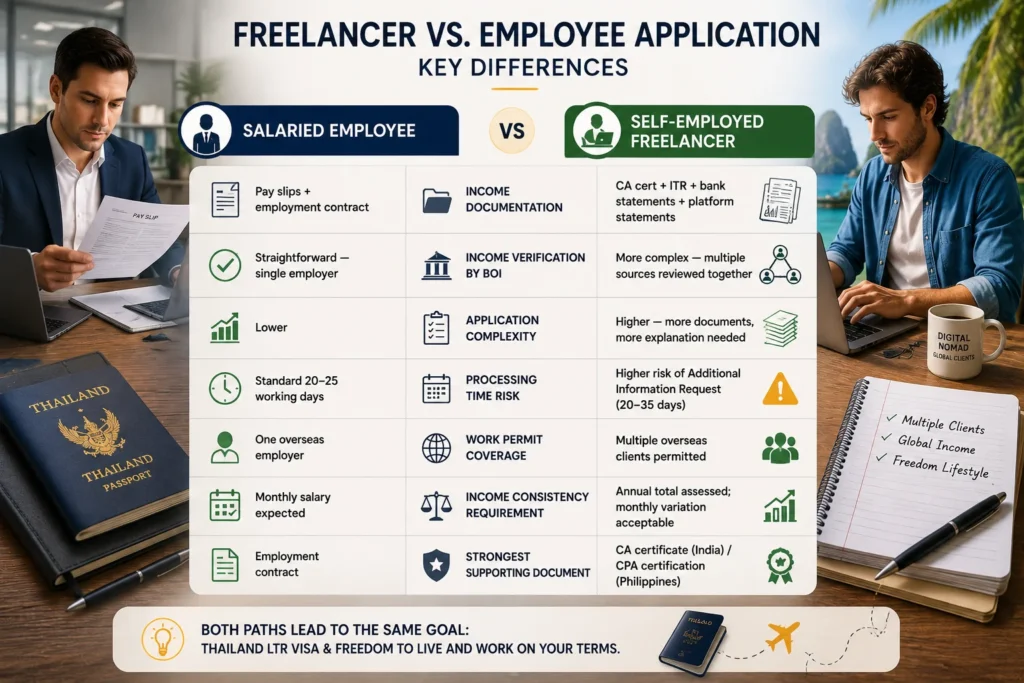
| Aspect | Salaried Employee | Self-Employed Freelancer |
| Income documentation | Pay slips + employment contract | CA cert + ITR + bank statements + platform statements |
| Income verification by BOI | Straightforward — single employer | More complex — multiple sources reviewed together |
| Application complexity | Lower | Higher — more documents, more explanation needed |
| Processing time risk | Standard 20–25 working days | Higher risk of Additional Information Request (20–35 days) |
| Work permit coverage | One overseas employer | Multiple overseas clients permitted |
| Income consistency requirement | Monthly salary expected | Annual total assessed; monthly variation acceptable |
| Strongest supporting document | Employment contract | CA certificate (India) / CPA certification (Philippines) |
Common Mistakes Self-Employed Applicants Make
| Mistake | Why It Causes Problems | What to Do Instead |
| Skipping the CA certificate or CPA certification | BOI has no standardized way to verify unstructured freelance income without professional certification | Always get a CA certificate (India) or CPA income certification (Philippines) before submitting |
| Submitting platform screenshots instead of formal exports | Screenshots are not official documents and do not satisfy BOI evidence standards | Export formal annual earnings statements from Upwork, Payoneer, or Wise as PDF |
| Not explaining irregular monthly income | BOI reviewers may flag inconsistent deposits as unclear or suspicious | Include a cover note explaining project-based income model and state the annual total clearly |
| Counting income from Thai clients in the threshold calculation | Only overseas non-Thai income counts toward USD 40,000 | Separate Thai-sourced income from overseas income clearly in your CA certificate and cover note |
| Applying before assembling complete documentation | Incomplete applications trigger AIR requests that add 10–20 working days | Prepare all documents fully before opening the BOI portal application |
| Using Indian CGHS / Filipino PhilHealth as the health insurance | Neither meets the USD 50,000 international coverage requirement | Purchase Cigna Global, AXA International, or SafetyWing Remote Health before applying |
Realistic Risks and Limitations
- Application complexity is higher for freelancers than for salaried employees: More documents, more explanation needed, higher likelihood of an Additional Information Request during review.
- Income fluctuation close to the threshold is risky: If your annual income is USD 41,000 in one year and USD 37,000 in another, the below-threshold year may require explanation. Ideally, your most recent 12 months comfortably exceed USD 40,000.
- Platform dependency risk: If a platform changes its payment terms or restricts your account, your income source disappears. BOI does not assess your future income stability — but you should.
- Health insurance is an ongoing requirement: You must maintain valid international health insurance throughout your stay. For self-employed professionals without employer-provided insurance, this is an annual recurring cost.
- Thai tax residency implications: Spending 180+ days in Thailand triggers Thai tax residency, which has income tax implications that are more complex for freelancers with multiple income sources than for salaried employees.
- No path to Thai permanent residency: The LTR Visa is a long-stay visa, not a residency or citizenship pathway regardless of how many years you hold it.
Frequently Asked Questions
Can freelancers with multiple overseas clients qualify for the Thailand LTR Visa?
Yes. The WFT Professional category does not require a single employer. Income from multiple overseas clients is combined to meet the USD 40,000 annual threshold. You will need documentation showing income from each source — bank statements covering all accounts, platform earnings statements for each platform used, and a CA certificate (India) or CPA income summary (Philippines) confirming the combined annual total.
What if my annual income is USD 40,000 some years but not others?
BOI typically reviews your most recent 12 months as the primary income assessment period. If the most recent 12 months clearly exceed USD 40,000, years where you earned slightly less are generally not disqualifying — particularly if you can explain the variance (e.g., a year transitioning between platforms or taking on a major project that shifted timing of payments). Your CA certificate or income summary should focus on the most recent 12-month period.
Does the LTR Visa work permit allow me to freelance for multiple clients?
Yes. The LTR Visa work endorsement covers remote work for overseas employers and clients — it is not restricted to a single employer. You can serve any number of overseas clients while based in Thailand on your LTR Visa. The restriction is on working for Thai-based entities, not on the number of overseas clients you serve.
Can I include income from my online business (products or SaaS) in the USD 40,000 calculation?
Yes, provided the income comes from overseas customers. Revenue from an online product, SaaS tool, or digital course with overseas buyers counts toward the threshold. You will need to document this through business bank statements, payment processor statements (Stripe, PayPal), and a professional income certification confirming the overseas source of the revenue.
I was previously salaried but recently went freelance. Can I still qualify?
Your 5-year professional experience requirement can be satisfied by your salaried work history — you do not need 5 years of freelance history specifically. What matters for the income threshold is your current income from overseas sources, typically the most recent 12 months. If you recently transitioned to freelancing but have strong recent income documentation, you can qualify. If your recent freelance income is not yet at USD 40,000 annually, wait until you have 12 months of qualifying income before applying.
Final Verdict: Is the LTR Visa Right for Self-Employed Freelancers?
| The Thailand LTR Visa is one of the few long-stay visa options globally that genuinely accommodates self-employed freelancers without penalizing them for not having a traditional employer. The WFT category’s income-based assessment, rather than employment-type assessment, means that a well-documented freelancer has the same access to this visa as a salaried professional. The documentation burden is higher for freelancers than for employees. The CA certificate or CPA income certification, in particular, is an extra step that most guides underemphasize. But it is a manageable step, not a barrier. If you are a self-employed freelancer earning USD 40,000+ per year from overseas clients, with 5+ years of professional experience and the ability to purchase international health insurance, the LTR Visa is a legal, stable, and long-term relocation pathway that is genuinely available to you. |