Last Updated: May 2026 | Audience: Indian + Filipino (BOTH) | Priority: 9/10
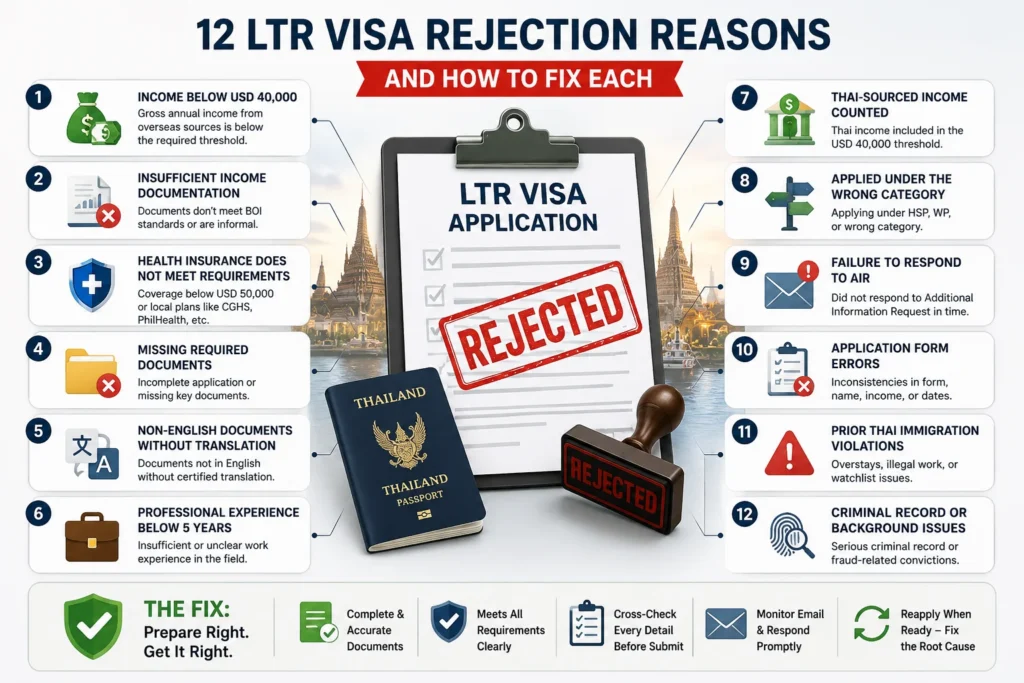
The Thailand LTR Visa is rejected for 12 documented reasons: income below the USD 40,000 threshold, insufficient documentation (missing CA certificate, screenshots instead of formal statements), health insurance that does not meet the USD 50,000 international coverage requirement, missing or incorrect application documents, non-English documents without translation, professional experience under 5 years, income from Thai sources incorrectly included in the threshold calculation, applying under the wrong LTR category, failure to respond to an Additional Information Request (AIR) within the allowed window, inconsistencies in the application form, prior Thai immigration violations, and criminal record issues. The BOI endorsement fee of THB 50,000 is non-refundable in the case of a formal rejection. Applicants can reapply after addressing the specific reasons for rejection — there is no mandatory waiting period between applications.
QUICK ANSWER: Why do people get rejected for Thailand LTR Visa? The most common LTR Visa rejection reasons are: Income below USD 40,000/year from overseas sourcesIncome documentation insufficient (missing CA certificate, screenshots submitted)Health insurance below USD 50,000 international coverageMissing, incorrect, or non-English documentsProfessional experience under 5 yearsIncome from Thai sources included in the threshold calculationAdditional Information Request (AIR) not responded to in timeApplying under the wrong LTR category Important: The THB 50,000 BOI endorsement fee is non-refundable if your application is formally rejected. Preparing a complete, correct application package before submitting is the only protection against this loss.
LEGAL DISCLAIMER The rejection reasons in this article are based on official BOI eligibility criteria, applicant community reports, and immigration practitioner guidance as of 2026. BOI does not publicly publish a formal rejection classification system. Individual application outcomes can vary based on factors not visible in public guidance. This article does not constitute legal or immigration advice. Consult a licensed Thai immigration consultant for advice on your specific situation. Always verify current requirements at boi.go.th before applying.
Introduction
The Thailand LTR Visa application costs THB 50,000 in endorsement fees before you know the outcome. That is approximately USD 1,400, INR 1,12,000, or PHP 78,000. If your application is rejected, that money does not come back.
This is not a reason to avoid applying — it is a reason to prepare correctly. The rejection rate for LTR Visa applications is not published by the BOI, but community reports consistently show that the vast majority of rejections are preventable: they come from documentation errors, income proof format issues, and health insurance non-compliance — not from applicants who fundamentally do not qualify.
This guide covers all 12 documented rejection reasons, the specific fix for each, and the nationality-specific risks that Indian and Filipino applicants face more frequently than others. Read it before you open the BOI portal.
The Critical Fee Question: Do You Lose THB 50,000 If Rejected?
WHAT HAPPENS TO THE FEE The BOI endorsement fee of THB 50,000 is explicitly stated as non-refundable. If the BOI formally rejects your application, you lose this fee in its entirety. However, there is an important distinction: Formal rejection: BOI reviews your application and declines it. Fee is lost.Administrative return: BOI returns your application before formal review begins because it is incomplete or missing key components. In some cases, the application may be resubmitted without an additional fee — but this is not guaranteed and depends on the stage at which the return occurs.AIR closure: If you fail to respond to an Additional Information Request within the allowed period, your application is typically closed rather than formally rejected. The fee implications in this scenario are unclear — do not let an AIR expire without responding. Bottom line: Treat the THB 50,000 as at risk from the moment you pay it. Submit only when your application is fully prepared and verified.
12 LTR Visa Rejection Reasons — With Specific Fixes
#1
Income Below the USD 40,000 Annual Threshold The most fundamental rejection reason: your documented gross income from non-Thai overseas sources does not reach USD 40,000/year. This includes situations where income is calculated net (after platform fees) rather than gross, or where some income sources were not documented and the visible total falls short. ✅ Fix: Calculate your gross annual income (before fees and deductions) from all overseas sources. Ensure your CA certificate or income certification reflects the gross total. If you are borderline, wait until you have a clear 12-month period above the threshold before applying.
#2
Insufficient Income Documentation Your income meets the threshold but the documentation does not satisfy BOI standards. Common examples: bank statement screenshots (not formal exports), self-written income statements, accountant letters without ICAI/CPA credentials, Upwork dashboard summaries rather than official earnings exports, or missing CA certificate for Indian freelancers. ✅ Fix: Use only formal, official documents: CA certificate from an ICAI-registered CA (India) or CPA income certification (Philippines/international), official platform earnings exports as PDF, and formal bank statements from your bank’s net banking portal. Review the complete documentation guide before submitting.
#3
Health Insurance Does Not Meet Requirements The most frequently overlooked rejection trigger. Indian applicants submitting CGHS, ECHS, or employer group health cards, and Filipino applicants submitting PhilHealth or local HMO documents, face near-certain rejection. Plans that technically state ‘international coverage’ but cap at below USD 50,000 also fail. ✅ Fix: Purchase a qualifying international health insurance plan before applying: Cigna Global, AXA International, BUPA Global, or SafetyWing Remote Health (not the travel plan). Confirm in writing that the plan covers Thailand and provides USD 50,000 minimum coverage. Submit the formal insurance certificate, not a policy summary or app screenshot.
#4
Missing Required Documents Applications with absent documents — no CV, no work experience certificates, no client contracts, or a missing ITR year — are either returned before formal review or rejected during review. BOI reviewers do not assume documents will be provided later; absent documents are treated as missing. ✅ Fix: Follow the complete documents checklist before opening the BOI portal. Prepare every document in full, convert to PDF, verify file size is under 10 MB, and confirm the document is in English (or translated) before uploading. Do not submit a partial application with plans to add more later.
#5
Non-English Documents Without Certified Translation Documents in Hindi, Tagalog, Urdu, or any non-English language submitted without a certified English translation cannot be assessed by BOI reviewers and typically trigger an AIR request or rejection. Common examples: Indian work experience certificates from government employers, Hindi-language birth certificates, or Tagalog-language employment records. ✅ Fix: Obtain certified English translations from a professional translation service for any document not in English. The translator must provide their name, signature, contact details, and a declaration of accuracy. Request English-language certificates directly from your employer’s HR department where possible.
#6
Professional Experience Below 5 Years The WFT category requires 5 years of professional experience in your field. Applicants who include only their freelance history (e.g., 3 years freelancing) without counting previous salaried employment, or who cannot document their experience period clearly, may fall short of this requirement. ✅ Fix: Your 5-year experience requirement can be satisfied by combining freelance history with previous salaried roles. Include a comprehensive CV with exact dates (month and year) for each role, plus work experience certificates from previous employers for the salaried periods. If you are genuinely under 5 years of relevant experience, wait before applying.
#7
Thai-Sourced Income Counted Toward the Threshold Applicants who work for both Thai and overseas clients sometimes include Thai-client income in their total when calculating the USD 40,000 threshold. Only income from non-Thai overseas sources qualifies. Mixing Thai and overseas income sources in your bank statements without clear separation creates a review problem even if the overseas-only total qualifies. ✅ Fix: In your CA certificate or income summary, explicitly state the overseas-sourced income separately from any Thai-sourced income. If you also have Thai-client income, note it clearly but do not include it in the qualifying threshold calculation. Your bank statements should ideally show separate account trails for overseas and Thai income.
#8
Applied Under the Wrong LTR Category Applying under the Highly Skilled Professional (HSP) category without the required endorsement from a BOI-recognized Thai company, or applying as a Wealthy Pensioner when under 50 years old, results in a category-mismatch rejection that is separate from income documentation issues. ✅ Fix: Confirm your correct category before applying. Most remote workers and freelancers qualify under the Work-From-Thailand (WFT) category — not HSP or Wealthy Pensioner. If you believe you qualify for HSP, confirm the endorsement requirement and the specific target sectors with a Thai immigration consultant before applying.
#9
Failure to Respond to an Additional Information Request (AIR) BOI may issue an AIR during the review period requesting supplementary documents or clarifications. If the applicant does not respond within the allowed timeframe (typically 15 to 30 days from the AIR issuance), the application is closed. This is treated as an application failure — the fee implications are unclear but recovery is difficult. ✅ Fix: Set an email alert for the BOI domain (@boi.go.th) and check your portal status every 3 to 5 working days during the review period. If you receive an AIR, respond as quickly as possible with all requested information in a single submission. Do not let an AIR deadline pass without response.
#10
Application Form Inconsistencies or Errors Name mismatches between the application form and passport, income figures that do not match the submitted documentation, incorrect dates of employment, or contradictory information in the application form versus the supporting documents create red flags during BOI review. ✅ Fix: Cross-check every field in the application form against your supporting documents before submitting. Your name must match your passport exactly. Income figures in the form must match your CA certificate and bank statements. Dates of employment must match your CV and work experience certificates.
#11
Prior Thai Immigration Violations A documented history of Thai visa overstays, previous deportation orders, working illegally in Thailand on a tourist visa (with documented evidence), or being placed on a watchlist by Thai Immigration creates a significant risk of BOI rejection regardless of the strength of your income documentation. ✅ Fix: If you have any prior Thai immigration violations, consult a licensed Thai immigration attorney before applying for the LTR Visa. Do not assume that a significant time gap since the violation has cleared the record. BOI has access to Thai Immigration databases.
#12
Criminal Record or Background Issues A serious criminal record — particularly convictions involving fraud, financial crimes, or offenses with penalties in Thailand — can result in BOI rejection. BOI conducts background checks as part of the review process. Minor traffic violations or civil matters are unlikely to be relevant, but significant criminal history is. ✅ Fix: If you have a criminal record of any kind, consult a Thai immigration attorney before applying. Do not attempt to conceal criminal history in the application — discovered concealment is grounds for permanent disqualification.
Nationality-Specific Rejection Risks
Indian Applicants: Higher-Risk Rejection Patterns
INDIA-SPECIFIC REJECTION RISKS Missing CA certificate: Indian freelancers who skip the CA certificate and rely on bank statements plus ITR alone face significant rejection risk — BOI cannot verify the overseas income origin without professional certificationITR mismatch: When ITR shows income as domestic business income but the application claims it is overseas-sourced, BOI may require clarification. Your CA certificate must bridge this gap explicitly.Bank statements showing only INR without clear international transfer labels: Include a cover note annotating international inward remittancesIndian health insurance submissions (CGHS, ECHS, employer group policies): Virtually guarantee rejection for insurance non-complianceWork experience certificates in Hindi or regional languages without translation: Trigger AIR requests and delay the reviewIncome calculated net of platform fees instead of gross: Falls below the USD 40,000 threshold calculation
PHILIPPINES-SPECIFIC REJECTION RISKS PhilHealth or local HMO submissions: Rejected for health insurance non-compliance. International plan required.Upwork/PayPal dashboard screenshots instead of formal exports: Not acceptable documentation. Must be official PDF exports.OFW documentation confusion: Submitting OWWA or DMW documents instead of standard income proof creates confusion in the application reviewIncome in PHP without USD conversion: Without a conversion note, BOI reviewers cannot verify the USD threshold is met from PHP-denominated bank statementsBIR ITR not filed or late filing: Missing BIR records weaken the income documentation package significantlyExpired Philippine passport: e-Passport with limited remaining validity may be flagged during Embassy visa stamping stage
Pre-Submission Prevention Checklist
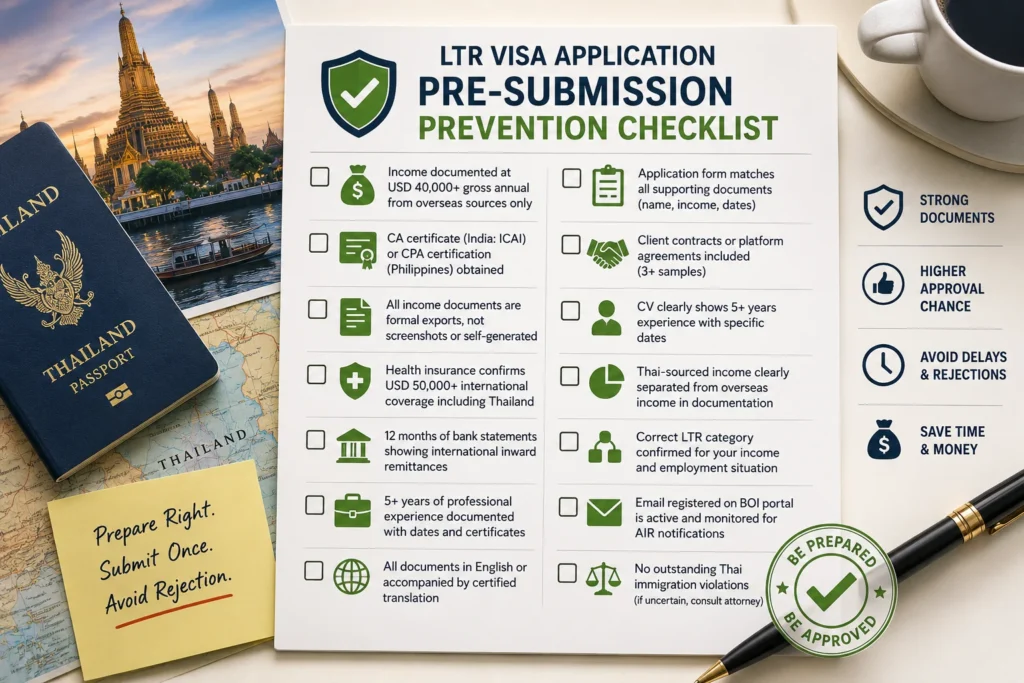
Run through every item below before paying the THB 50,000 fee and submitting:
☐
Income documented at USD 40,000+ gross annual from overseas sources only
☐
CA certificate (India: ICAI) or CPA certification (Philippines) obtained
☐
All income documents are formal exports, not screenshots or self-generated
☐
Health insurance confirms USD 50,000+ international coverage including Thailand
☐
12 months of bank statements showing international inward remittances
☐
5+ years of professional experience documented with dates and certificates
☐
All documents in English or accompanied by certified translation
☐
Application form matches all supporting documents (name, income, dates)
☐
Client contracts or platform agreements included (3+ samples)
☐
CV clearly shows 5+ years experience with specific dates
☐
Thai-sourced income clearly separated from overseas income in documentation
☐
Correct LTR category confirmed for your income and employment situation
☐
Email registered on BOI portal is active and monitored for AIR notifications
☐
No outstanding Thai immigration violations (if uncertain, consult attorney)
What to Do If Your LTR Visa Application Is Rejected
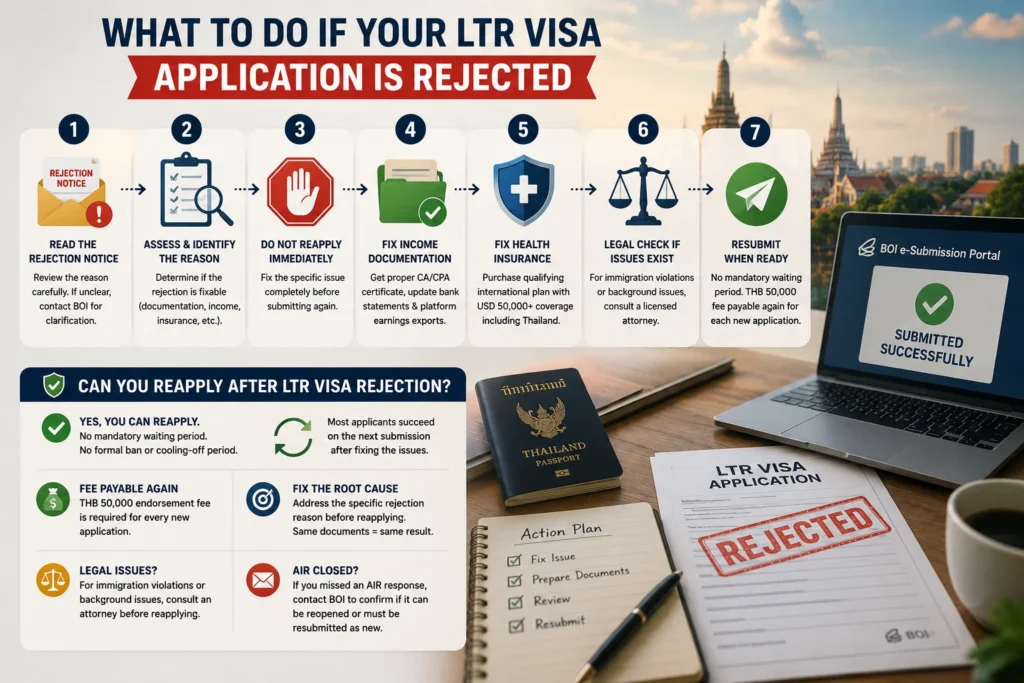
If your application is formally rejected by the BOI, follow these steps:
Read the rejection notice carefully: BOI’s rejection communication should indicate the basis for the decision. If the reason is unclear, contact BOI at ltr@boi.go.th referencing your application number to request clarification.
Assess whether the rejection is fixable: Most rejections are documentation-based and fully fixable. Confirm whether the rejection was due to income documentation, health insurance, missing documents, or another addressable reason.
Do not reapply immediately: Address the specific rejection reason completely before resubmitting. A second application with the same documentation will produce the same result.
For income documentation rejections: Obtain the correct CA certificate or CPA income certification, update your bank statements and platform earnings exports, and prepare a comprehensive income package before resubmitting.
For health insurance rejections: Purchase a qualifying international health insurance plan and obtain the formal certificate showing USD 50,000+ Thailand coverage.
For Thai immigration violation rejections: Consult a licensed Thai immigration attorney before reapplying. Do not attempt to reapply without professional guidance.
Resubmit when ready: There is no mandatory waiting period between LTR Visa applications. However, the THB 50,000 endorsement fee is payable again on every new application.
Can You Reapply After LTR Visa Rejection?
REAPPLICATION RULES Yes, you can reapply after rejection. The Thailand BOI does not impose a mandatory waiting period between LTR Visa applications. There is no formal ‘ban’ or cooling-off period after a standard documentation-based rejection. However: The THB 50,000 endorsement fee is payable again on every new application You must address the specific rejection reason before reapplying — resubmitting the same package will produce the same result If your rejection involved immigration violations or background issues, consult a Thai immigration attorney before reapplying For AIR-related closures (failure to respond in time), contact BOI to clarify whether your application can be reopened or must be resubmitted as new In practice, most applicants who are rejected for documentation reasons successfully obtain the LTR Visa on their second submission after properly preparing their income documentation package.
Frequently Asked Questions
Is the THB 50,000 BOI fee refunded if my LTR Visa application is rejected?
No. The THB 50,000 BOI endorsement fee is explicitly non-refundable. Whether your application is formally rejected or returned for incompleteness, the fee is not refunded. This is the most significant financial risk of an LTR Visa application. The only protection is to submit a complete, well-prepared application on the first attempt.
How will I know why my LTR Visa was rejected?
BOI sends a rejection notification to your registered email address. The notification should state the basis for the rejection. If the reason is not clear from the notification, contact BOI directly at ltr@boi.go.th with your application reference number and request a specific explanation. In practice, BOI’s rejection communications vary in detail — some are specific, others are general.
Can a past Thai tourist visa overstay affect my LTR Visa application?
Yes, potentially. A documented overstay on a previous Thai tourist visa is a Thai immigration violation and is visible in Thai Immigration records. Whether it results in LTR Visa rejection depends on the severity and recency of the overstay. Minor, resolved overstays from many years ago may be treated differently from recent significant overstays. Consult a Thai immigration attorney if you have any prior overstay history before applying.
What is the LTR Visa rejection rate?
The Thailand BOI does not publicly publish LTR Visa rejection or approval rates. Based on community reports from applicant forums (Thailand Tourism, LTR Visa Facebook groups), the vast majority of rejections are documentation-based and occur because applicants submit incomplete or non-compliant documentation — not because they fundamentally do not qualify. Well-prepared applications have a significantly higher approval rate.
If I receive an Additional Information Request, does it mean I will be rejected?
No. An AIR is a request for more information or clarification — not a rejection. Most applicants who receive an AIR and respond promptly and completely are approved. An AIR becomes a problem only if you fail to respond within the allowed timeframe, in which case the application may be closed. Treat every AIR as urgent and respond as quickly as possible with a complete, organized response.
Can my LTR Visa be rejected at the Thai Embassy visa stamping stage?
The Thai Embassy visa stamping stage is separate from the BOI endorsement stage. The Embassy applies the visa sticker to your passport based on the BOI endorsement letter. Embassy-level rejections at this stage are rare and typically involve passport validity issues or a late-emerging immigration flag. The primary rejection risk is at the BOI review stage, not the Embassy stamping stage.
Final Verdict: How to Protect Your THB 50,000 Application
The Thailand LTR Visa rejection is almost always preventable. The 12 reasons in this guide cover every documented rejection trigger. Read them, prepare against each one, and run the pre-submission checklist before paying the application fee. The three rejections that account for the majority of failed applications are: income documentation issues (missing CA certificate or wrong document formats), health insurance non-compliance (Indian CGHS or Filipino PhilHealth submitted), and missing documents. All three are completely avoidable. Spend 2 to 3 weeks preparing your application correctly. It is significantly cheaper than losing THB 50,000 on a rejected application and paying again to resubmit.