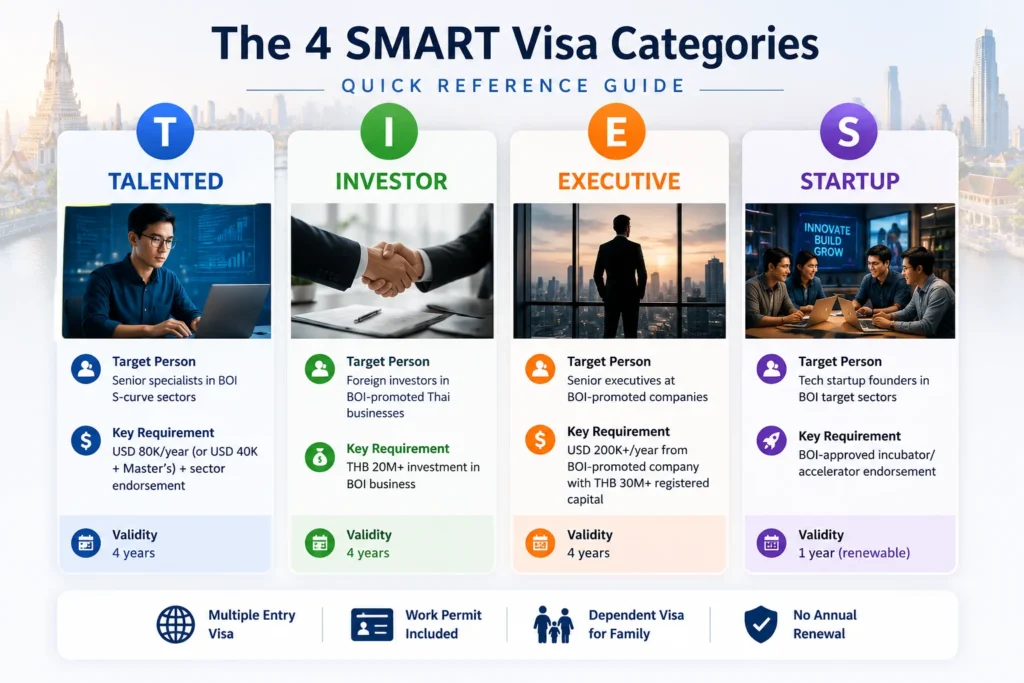
Thailand’s SMART Visa (Smart and Merit-based) is a BOI-administered visa programme with four categories designed to attract specific talent and investment profiles. Category T (Talented): Senior specialists in BOI S-curve industries earning USD 80,000+/year or USD 40,000+/year with Master’s degree credentials, requiring endorsement from NIA, depa, or NSTDA. Category I (Investor): Foreign nationals investing THB 20 million or more in BOI-promoted Thai businesses. Category E (Executive): Senior executives at BOI-promoted companies earning USD 200,000+/year. Category S (Startup): Entrepreneurs with BOI-approved incubator endorsement operating in target sectors, 1-year renewable. All SMART Visa categories provide 4-year validity (1 year for Startup), multiple entry, and work permits for the qualifying Thai entity. The SMART Visa requires a two-stage endorsement (sector agency + BOI) before visa issuance. It differs from the LTR Visa in duration (4 vs 10 years) and endorsement structure. Application fee: approximately THB 3,500 to 10,000 depending on category.
QUICK ANSWER: What is Thailand SMART Visa and who qualifies? The Thailand SMART Visa is a 4-year, multiple-entry visa for four groups: (T) Talented professionals in BOI sectors earning USD 80K+ or USD 40K+ with credentials, (I) Investors with THB 20M+ in Thai BOI businesses, (E) Senior executives at BOI-promoted companies earning USD 200K+, (S) Startups with BOI incubator endorsement. All categories require BOI endorsement through a two-stage process: sector agency endorsement first (NIA, depa, NSTDA), then BOI application. Work permits included for qualifying Thai employers. Dependents covered under SMART Dependent Visa. The SMART Visa serves professionals working for Thai-connected entities. For remote workers with overseas clients, the LTR WFT Visa is the correct alternative.
DISCLAIMER This guide reflects SMART Visa requirements as of June 2026. BOI can update categories, income thresholds, and endorsement requirements. Always verify at boi.go.th and depa.or.th/nia.or.th before applying. This is not legal advice.
Introduction: Why the SMART Visa Exists
Thailand’s SMART Visa was launched in 2018 by the Thailand Board of Investment — four years before the LTR Visa — as part of Thailand 4.0, the national strategy to develop the country into an innovation-driven economy. The core idea: attract the world’s best talent, investors, and entrepreneurs in Thailand’s strategically important industries by giving them long-stay visas with real work permits and no annual renewal burden.
The SMART Visa targets a more specific audience than the LTR Visa. Where LTR WFT is designed for any remote professional earning USD 40,000+ from overseas, SMART is designed for senior specialists, investors, executives, and startup founders who are actively working — or investing — within Thailand’s BOI-promoted economic ecosystem.
Understanding what the SMART Visa covers — and what it does not — is the starting point for every professional evaluating it. This guide covers all four categories in full, the endorsement process that most applicants find the most complex stage, and the critical comparison with the LTR Visa’s HSP category for senior specialists weighing their options.
What Is the Thailand SMART Visa?
SMART VISA CORE SPECIFICATIONS Full name: SMART Visa — Smart and Merit-Based Visa (Thailand) Administered by: Thailand Board of Investment (BOI) Validity: 4 years (Categories T, I, E) | 1 year extendable (Category S) Entry type: Multiple entry Annual renewal within period: Not required 90-day address report: Required Work permit: YES — for qualifying Thai employer in target sector Dependents: SMART Dependent Visa for spouse and children Endorsement required: YES — two-stage (sector agency + BOI) Application fee: Approximately THB 3,500 to 10,000 (varies by category) BOI portal: ltrvisat.boi.go.th
USD 200K+/year from BOI-promoted company with THB 30M+ registered capital
4 years
SMART S
Startup
Tech startup founders in BOI target sectors
BOI-approved incubator/accelerator endorsement
1 year (renewable)
SMART Visa Category T (Talented): Full Deep Dive
SMART T is the most commonly applied-for category and the one most relevant to senior technology, healthcare, engineering, and creative professionals working in Thailand.
SMART T dual income thresholds
Threshold Type
Annual Income
Additional Requirement
Standard threshold
USD 80,000+/year from Thai employer in target sector
No credentials required beyond professional experience
Credential-based threshold
USD 40,000+/year from Thai employer
Master’s degree or higher in a field relevant to BOI S-curve sector in which you work
SMART T endorsing bodies by sector
Sector
Primary Endorsing Body
Example Roles
Digital industry (software, AI, fintech, cybersecurity)
depa (Digital Economy Promotion Agency)
Software engineers, data scientists, fintech developers, cloud architects
Technology innovation and R&D
NIA (National Innovation Agency)
Tech innovators, R&D leads, product architects with innovation outputs
Science, biotech, advanced materials
NSTDA (National Science and Technology Development Agency)
Research scientists, biotech engineers, materials specialists
Medical devices, healthcare technology
Thai FDA or NHSO
Medical device engineers, health informatics specialists
Agriculture technology, food tech
NSTDA or relevant ministry
AgriTech specialists, food technology engineers
SMART T eligibility requirements
Employment: Must work for a qualifying Thai-registered entity or government organization in a BOI S-curve sector
Income: USD 80,000/year (standard) or USD 40,000/year with qualifying Master’s degree in relevant field
Experience: Professional experience in the qualifying sector
Endorsement: Sector agency (depa/NIA/NSTDA) endorsement letter required before BOI application
Health insurance: USD 50,000+ international coverage valid in Thailand
SMART Visa Category I (Investor): Full Deep Dive
SMART I serves foreign nationals who invest in BOI-promoted Thai businesses. It is the least commonly known SMART Visa category but provides one of the most stable long-stay pathways for foreign investors in Thailand’s private sector.
SMART I eligibility requirements
Requirement
Standard
Investment amount
At least THB 20 million (approximately USD 556,000) invested in one or more of: Thai stocks traded on the Stock Exchange of Thailand (SET), BOI-promoted entities, government bonds, real property
Documentation
Investment certificates, BOI promotion certificate of the invested company, bank records confirming investment
Thai company requirement
Investment must be in BOI-promoted company or eligible Thai investment category
No age requirement
No minimum age
Health insurance
USD 50,000+ international coverage valid in Thailand
SMART I does not require active employment. It is a pure investor visa. Holders receive 4-year multiple-entry stay and can conduct investment-related activities within Thailand.
SMART Visa Category E (Executive): Full Deep Dive
SMART E targets the most senior executive tier: C-suite and senior management at BOI-promoted companies with substantial registered capital. It sets the highest income threshold of all SMART categories.
SMART E eligibility requirements
Requirement
Standard
Annual income
At least USD 200,000/year from the qualifying employer
Employer type
BOI-promoted company with registered capital of at least THB 30 million (approximately USD 835,000)
Role
Senior executive: CEO, COO, CFO, CTO, Country Manager, or equivalent senior management
Employment contract
Formal employment contract from the qualifying BOI-promoted company
Health insurance
USD 50,000+ international coverage valid in Thailand
SMART E applicants represent the highest earners in the SMART Visa ecosystem. The USD 200,000/year income threshold combined with the BOI-promoted employer requirement makes this a narrow but high-value category. Most applicants are regional headquarters executives, country managers, or C-suite leaders of multinational companies with Thai BOI promotion status.
SMART Visa Category S (Startup): Full Deep Dive
SMART S is Thailand’s startup visa — the most dynamic and least documented of the four categories. It serves tech entrepreneurs and founders who are building companies in BOI target sectors within Thailand’s startup ecosystem.
SMART S eligibility requirements
Requirement
Standard
Startup type
Technology or innovation startup operating in BOI S-curve target sectors
Endorsement
Endorsement from a BOI-approved incubator, accelerator, or university (key qualifying institutions: DTAC Accelerate, AIS The StartUp, Techsauce, NIA-affiliated incubators, NSTDA Business Incubation Centre)
Stage
Operating or incorporated startup with active business activity in Thailand
Health insurance
USD 50,000+ international coverage valid in Thailand
Visa duration
1 year (renewable; requires demonstrated progress for renewal)
SMART S renewal conditions
Unlike SMART T, I, and E (4-year validity), SMART S is issued for 1 year and must be renewed annually. Renewal requires demonstrating startup progress: raising funding, growing the team, reaching product milestones, or securing customers. The specific metrics are assessed by the endorsing incubator and BOI.
SMART S VS THAILAND STARTUP ECOSYSTEM Bangkok’s startup ecosystem has grown significantly since 2018. BOI-approved incubators include university-affiliated programs (KMITL, CU), corporate accelerators (DTAC, AIS, SCB), and government-backed programs (NIA, NSTDA). The SMART S category is best accessed through establishing a relationship with one of these programs before applying for the visa. Startup founders considering Thailand should contact NIA (nia.or.th) or BOI’s startup team directly to identify the most appropriate incubator for their sector and stage before starting the SMART S application.
Master Decision Framework: Which SMART Visa Category Are You?
Your Profile
Category
Key Reason
Senior tech specialist at Thai company, USD 80K+/year in BOI sector
SMART T (standard)
Talented professional in target sector. Endorsement via depa/NIA.
Senior tech specialist at Thai company, USD 40K+/year + Master’s in relevant field
SMART T (credential)
Credential pathway reduces income threshold for qualified specialists.
Foreign investor with THB 20M+ in Thai BOI business or SET stocks
SMART I
Investor pathway. No employment required.
Senior executive (C-suite/country manager) at BOI-promoted company, USD 200K+/year
SMART E
Executive tier. Highest income threshold of all SMART categories.
Tech startup founder with BOI incubator endorsement in S-curve sector
SMART S
Startup pathway. 1-year renewable.
Remote worker with overseas clients, not at Thai entity
NOT SMART VISA — LTR WFT
SMART requires Thai-connected entity. LTR WFT is for overseas clients.
Senior specialist considering 10-year stability over 4-year SMART
LTR HSP
Same Thai employer requirement as SMART T; 10-year vs 4-year duration.
The SMART Visa Endorsement Process: Stage-by-Stage
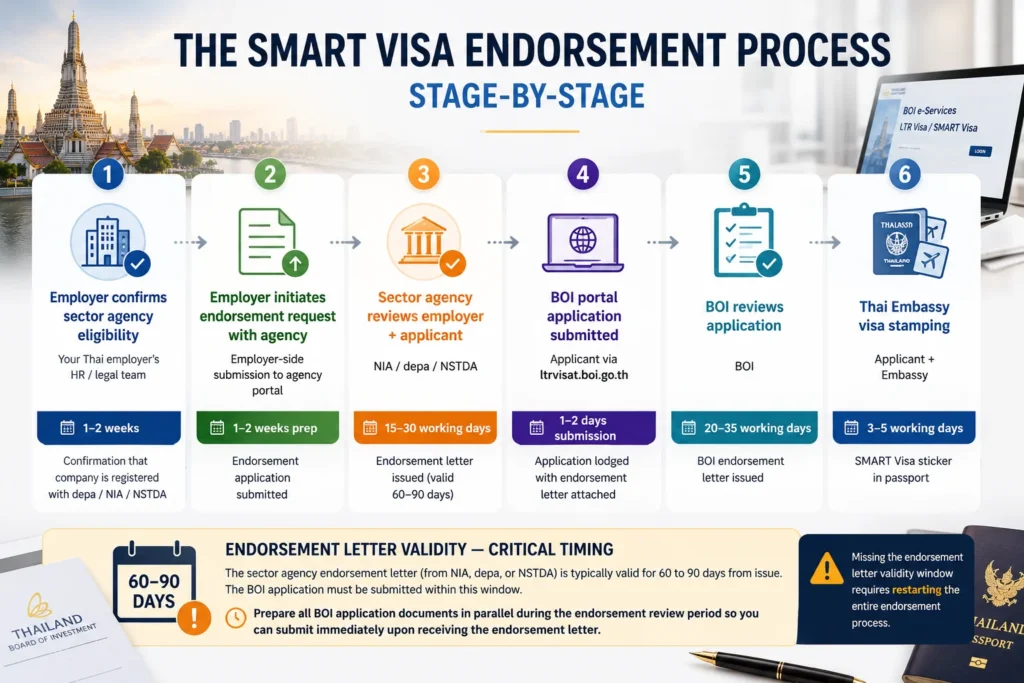
The SMART Visa’s endorsement requirement is its defining operational complexity. Unlike the LTR Visa (which goes directly through BOI), SMART Visa requires sector agency endorsement first. Here is the complete flow:
Stage
Who Acts
Timeline
Output
Employer confirms sector agency eligibility
Your Thai employer’s HR/legal team
1–2 weeks
Confirmation that company is registered with depa/NIA/NSTDA
Employer initiates endorsement request with agency
Employer-side submission to agency portal
1–2 weeks prep
Endorsement application submitted
Sector agency reviews employer + applicant
NIA / depa / NSTDA
15–30 working days
Endorsement letter issued (valid 60–90 days)
BOI portal application submitted
Applicant via ltrvisat.boi.go.th
1–2 days submission
Application lodged with endorsement letter attached
BOI reviews application
BOI
20–35 working days
BOI endorsement letter issued
Thai Embassy visa stamping
Applicant + Embassy
3–5 working days
SMART Visa sticker in passport
ENDORSEMENT LETTER VALIDITY — CRITICAL TIMING The sector agency endorsement letter (from NIA, depa, or NSTDA) is typically valid for 60 to 90 days from issue. The BOI application must be submitted within this window. Prepare all BOI application documents in parallel during the endorsement review period so you can submit immediately upon receiving the endorsement letter. Missing the endorsement letter validity window requires restarting the entire endorsement process.
Endorsing Bodies: Choosing the Right Agency
Agency
Sector Focus
Contact / Portal
Best For
depa (Digital Economy Promotion Agency)
Software, digital platforms, fintech, AI/ML, cybersecurity, cloud, e-commerce
Companies with active BOI promotion; may streamline endorsement
Complete SMART Visa Application Process — 8 Steps
Step 1: Identify your SMART Visa category and endorsing body
Use the decision framework above. Confirm your income level, employer type, and sector. Identify whether depa, NIA, or NSTDA is the appropriate endorsing body for your sector.
Step 2: Employer confirms agency relationship
Ask your Thai employer’s HR or legal team: Is our company registered with the relevant endorsing agency? Does our company have an existing relationship with depa/NIA/NSTDA for SMART Visa endorsements? This is the most common bottleneck for first-time applicants.
Step 3: Prepare documentation package
See documents section below. For SMART T: CV, academic credentials (for USD 40K pathway), employment contract, payslips, health insurance certificate. For SMART I: investment documentation. For SMART E: executive contract, BOI promotion certificate. For SMART S: incubator endorsement and startup documentation.
Step 4: Employer initiates endorsement request
Employer submits endorsement application to the sector agency with your credentials and employment details. This is employer-side. Give your documents to HR for inclusion in their submission.
Step 5: Sector agency review (15 to 30 working days)
Agency reviews both employer credentials and applicant qualifications. Respond promptly to any additional information requests from the agency. Upon approval, the agency issues an endorsement letter.
Step 6: Submit BOI application immediately
As soon as you receive the endorsement letter, submit the full SMART Visa application at ltrvisat.boi.go.th. Include the endorsement letter and all standard documents. Pay the BOI application fee.
Step 7: BOI review (20 to 35 working days)
BOI reviews the application and endorsement. Monitor email for any Additional Information Requests. Respond within the specified deadline.
Step 8: Thai Embassy visa stamping
Book appointment at Royal Thai Embassy in your home country with the BOI endorsement letter. Pay the visa stamp fee. Receive SMART Visa sticker. Travel to Thailand and activate.
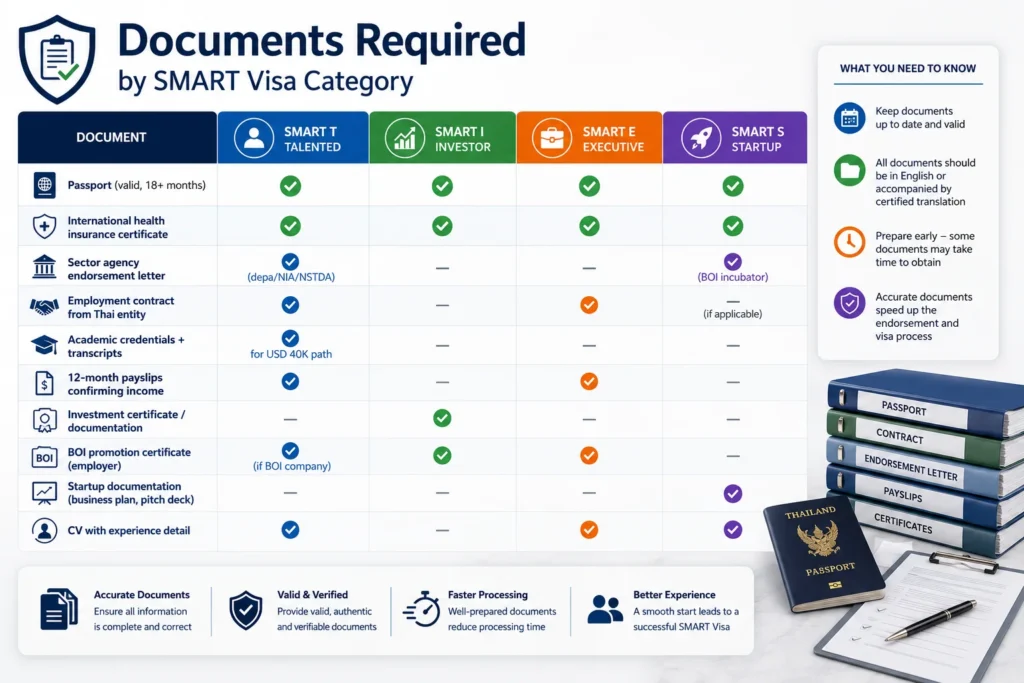
Documents Required by SMART Visa Category
Document
SMART T
SMART I
SMART E
SMART S
Passport (valid, 18+ months)
✅
✅
✅
✅
International health insurance certificate
✅
✅
✅
✅
Sector agency endorsement letter
✅ (depa/NIA/NSTDA)
—
—
✅ (BOI incubator)
Employment contract from Thai entity
✅
—
✅
— (if applicable)
Academic credentials + transcripts
✅ for USD 40K path
—
—
—
12-month payslips confirming income
✅
—
✅
—
Investment certificate / documentation
—
✅
—
—
BOI promotion certificate (employer)
✅ (if BOI company)
✅
✅
—
Startup documentation (business plan, pitch deck)
—
—
—
✅
CV with experience detail
✅
—
✅
✅
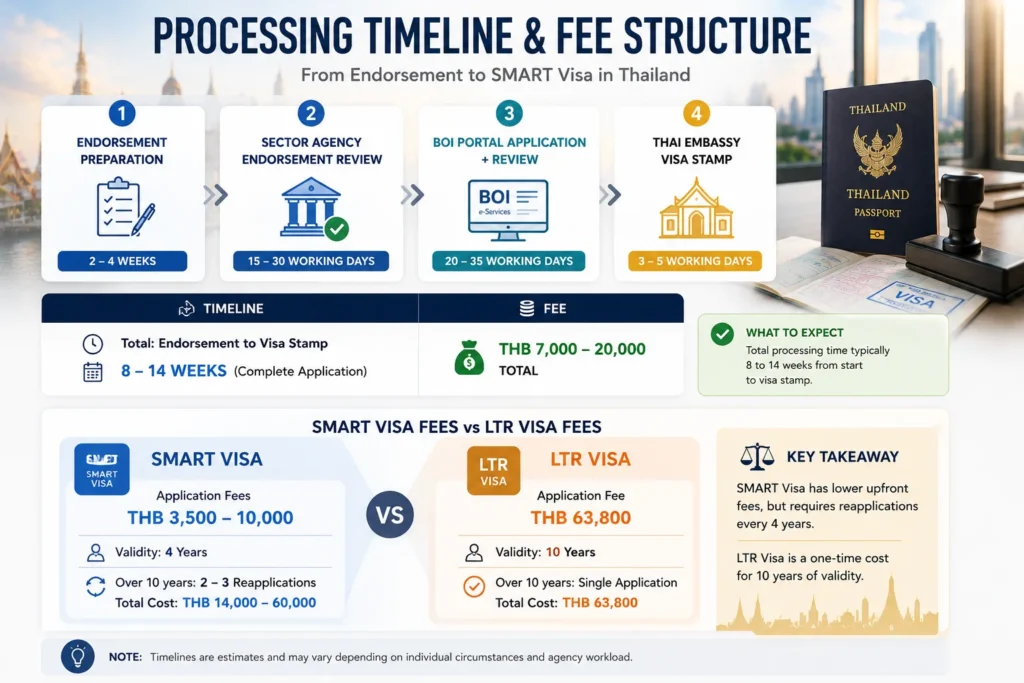
Processing Timeline and Fee Structure
Stage
Timeline
Fee
Endorsement preparation
2 to 4 weeks
None (preparation cost only)
Sector agency endorsement review
15 to 30 working days
None (agency review is free)
BOI portal application + review
20 to 35 working days
THB 3,500 to 10,000 (category-dependent)
Thai Embassy visa stamp
3 to 5 working days
THB 3,500 to 10,000 (visa fee)
Total: endorsement to visa stamp
8 to 14 weeks (complete application)
THB 7,000 to 20,000 total
SMART VISA FEES VS LTR VISA FEES SMART Visa application fees (THB 3,500 to 10,000) are significantly lower than LTR Visa fees (THB 63,800). However, SMART Visa is valid for only 4 years versus LTR’s 10 years. Over 10 years, SMART Visa requires 2 to 3 reapplications (total cost THB 14,000 to 60,000) compared to LTR’s single one-time cost. See the SMART vs LTR Visa comparison article for the complete 10-year cost analysis.
SMART Visa Work Authorization: What It Covers
Category
Work Permit Coverage
What You Can Do
What You CANNOT Do
SMART T
Work permit for specific Thai employer in qualifying sector
Work for endorsed Thai entity in S-curve sector
Work for Thai entities outside your endorsed employer; work for overseas clients (use LTR WFT for that)
Executive duties at the specific BOI-promoted company
Work for any other employer
SMART S
Startup activities at endorsed company
Operate endorsed startup business
Work for other employers
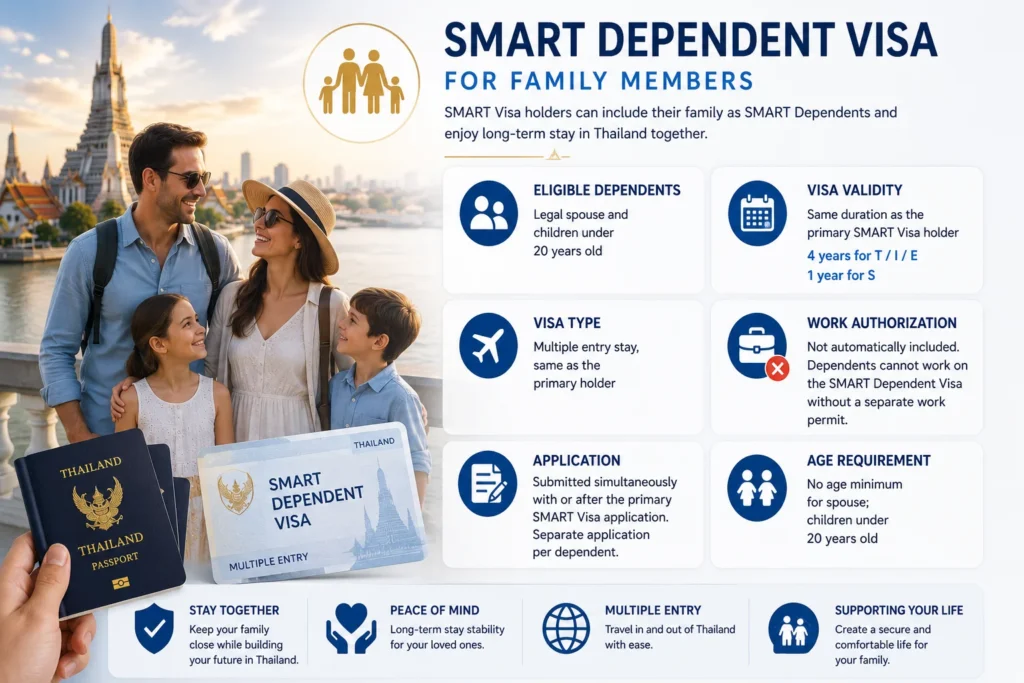
SMART Dependent Visa for Family Members
SMART Visa holders can include their family as SMART Dependents. Key provisions:
Eligible dependents: Legal spouse and children under 20 years old
SMART Dependent Visa validity: Same duration as the primary SMART Visa holder (4 years for T/I/E; 1 year for S)
Dependent visa type: Multiple entry stay, same as primary holder
Work authorization for dependents: Not automatically included. Dependents cannot work on the SMART Dependent Visa without a separate work permit.
Application: Submitted simultaneously with or after the primary SMART Visa application. Separate application per dependent.
Age requirement: No age minimum for spouse; children under 20
Nationality-Specific Guidance: Indians and Filipinos
INDIA-SPECIFIC SMART VISA NOTESIndian IT professionals at Thai tech companies are prime SMART T candidates. Key India-specific context: Salary context: USD 80,000/year = approx. INR 67 lakh/year. USD 40,000/year (credential path) = approx. INR 34 lakh/year. Senior Indian developers at major Thai banks (KBank, SCB digital teams) or BOI-promoted tech companies typically earn in the USD 40,000–70,000 range — making the credential-based USD 40,000 threshold the most relevant pathway.Indian credentials: IIT/NIT M.Tech or M.Sc. degrees in Computer Science, Engineering, or Biotechnology are strong credential-path qualifiers. MBBS + MD qualifies for healthcare sector SMART T.Indian IT companies: Infosys Thailand, Wipro Bangkok, TCS Thailand have BOI-promoted Thai subsidiaries. Employees at these entities may be eligible for SMART T through depa or NIA.Documentation: No CA certificate needed for SMART T (unlike LTR Visa). Employment contract and payslips from Thai employer are the primary income proof.
PHILIPPINES-SPECIFIC SMART VISA NOTES Filipino software developers and tech professionals are among the most active SMART T applicants from Southeast Asia. Key Philippines-specific context: Salary context: USD 80,000/year = approx. PHP 4.5–4.7 million/year. USD 40,000/year (credential path) = approx. PHP 2.2–2.3 million/year. Senior Filipino developers at Thai banks or tech companies at 120,000–180,000 THB/month typically fall in the credential pathway range.Filipino credentials: BS Computer Science + Master’s (MSCS/MIT) from UP, DLSU, Ateneo qualifies for digital sector SMART T credential pathway.depa is the primary endorsing body for Filipino software developers in Bangkok’s fintech, banking, and digital sector companies.No BIR documentation needed for SMART T: Thai employer contract and payslips are sufficient income proof. BIR documents are relevant only for LTR WFT applications.
SMART T vs LTR HSP: The Senior Specialist Decision
For professionals at Thai companies in BOI sectors, the most important decision is between SMART T and the LTR Visa’s Highly Skilled Professional (HSP) category. Both serve the same audience with different structures:
Long-term Bangkok career; administrative simplicity; maximum stability
Practical recommendation: If you are committed to a long Bangkok career in a BOI sector, LTR HSP offers 10-year stability with lower long-term cost. If you prefer lower initial fees or are uncertain about a 10-year commitment, SMART T is the appropriate stepping stone.
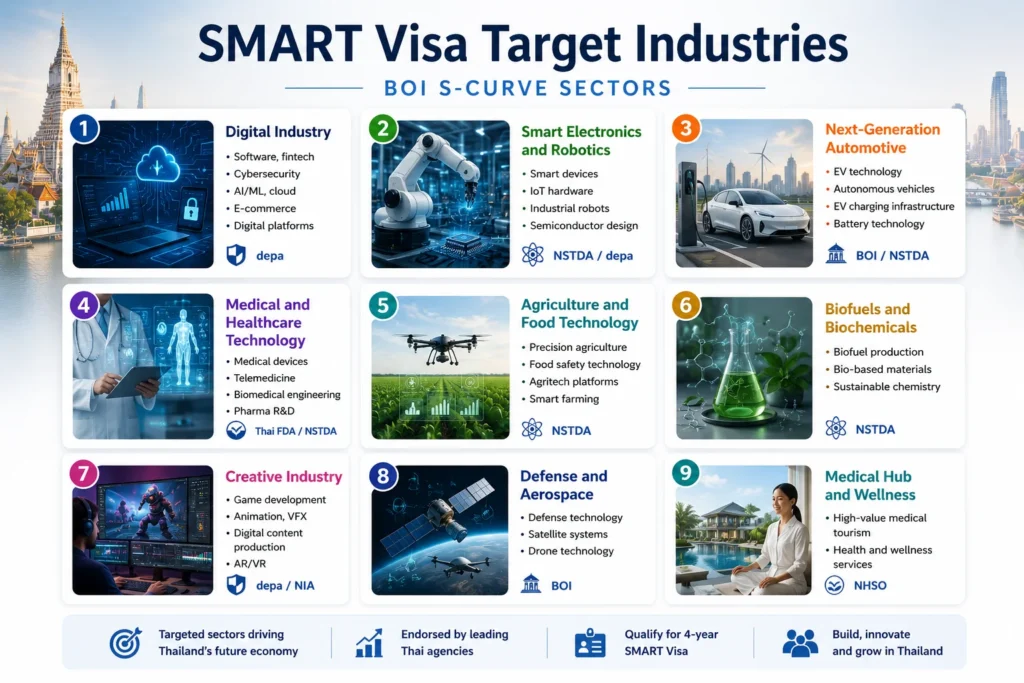
SMART Visa Target Industries: BOI S-Curve Sectors
S-Curve Sector
Sub-Industries
Primary Endorsing Body
Digital Industry
Software, fintech, cybersecurity, AI/ML, cloud, e-commerce, digital platforms
High-value medical tourism, health and wellness services
NHSO
SMART Visa Article Navigation Hub
This master guide covers all SMART Visa categories at overview level. Use the links below for complete depth on specific topics:
🖥️
SMART Visa for Filipino Software DevelopersComplete guide for Filipino developers: depa endorsement, PHP salary thresholds, qualifying credentials, SMART vs LTR decision. /thailand-smart-visa-filipino-software-developers/
⚙️
SMART Visa Endorsement Process — Step by Step Complete HowTo guide: which agency endorses which sector, employer role vs applicant role, endorsement letter validity, rejection handling. /thailand-smart-visa-endorsement-process/
⚖️
SMART Visa vs LTR Visa — Complete Comparison Full three-way comparison (SMART T vs LTR WFT vs LTR HSP) with 15-factor table, 10-year cost analysis, and career transition scenarios. /thailand-smart-visa-vs-ltr-visa/
🌏
Thailand Digital Nomad Visa Guide All Thailand visa options compared — SMART, LTR WFT, LTR HSP, Elite Card, tourist visa. Master decision framework. /thailand-digital-nomad-visa-guide/
📋
Thailand LTR Visa Complete Guide Master LTR Visa pillar: all 4 categories, full application process, nationality-specific documentation, banking and tax. /thailand-ltr-visa-complete-guide/
Common SMART Visa Mistakes and Rejection Reasons
Mistake
Consequence
Prevention
Applying to wrong endorsing agency for your sector
Agency redirects or rejects; 3–6 weeks delay
Map sector to correct agency before starting. Software = depa. Research/science = NSTDA. Innovation = NIA.
Not confirming employer’s agency relationship before starting
Weeks of delay if employer has no existing relationship
Ask HR: ‘Is our company registered with depa/NIA?’ before beginning any documentation.
BOI application submitted after endorsement letter expiry
Entire endorsement process must restart
Submit BOI application within 30 days of receiving endorsement letter. Do not use full 60–90-day validity as buffer.
Income below threshold without qualifying credentials
Rejection on income grounds
Confirm: USD 80K (standard) or USD 40K + Master’s in relevant field (credential path). Do not estimate.
Not including all dependents in initial application
Additional applications required later
List all dependents at time of primary application to process SMART Dependent Visas simultaneously.
SMART S startup applying without established incubator relationship
No qualifying endorsement available; application blocked
Establish incubator/accelerator relationship before applying for SMART S. Contact NIA or BOI startup team first.
Risks and Limitations
4-year renewal burden: Unlike LTR Visa’s 10-year stability, SMART Visa holders must reapply every 4 years with full endorsement and BOI process. Career transitions between renewals add complexity.
Thai employer dependency: SMART Visa is tied to the specific Thai employer. Changing employers requires visa reassessment. If the company loses BOI status, the visa situation requires immediate attention.
Endorsement process uncertainty: The sector agency endorsement is not guaranteed. If the agency determines the employer or applicant does not meet their criteria, the visa process stops.
Startup visa (SMART S) renewal risk: SMART S requires demonstrated progress at each annual renewal. Startups that fail to grow or lose incubator support may not qualify for renewal.
SMART E income threshold: USD 200,000/year is the highest threshold in the Thailand long-stay visa ecosystem. A restructuring that reduces executive compensation could affect renewal eligibility.
Frequently Asked Questions
What is Thailand SMART Visa and who qualifies?
The Thailand SMART Visa is a BOI-administered 4-year visa (1-year for Startup) with four categories: T (Talented professionals in BOI sectors, USD 80K standard or USD 40K with credentials), I (Investors with THB 20M+), E (Senior executives at BOI companies earning USD 200K+), and S (Tech startups with BOI incubator endorsement). All categories require a two-stage endorsement process: sector agency (NIA, depa, NSTDA) first, then BOI.
What is the difference between SMART Visa and LTR Visa Thailand?
SMART Visa requires a Thai-connected entity (Thai employer or Thai investment) and has a two-stage endorsement process. It is valid for 4 years. LTR WFT Professional is for remote workers with overseas employers/clients, goes directly through BOI without sector agency endorsement, and is valid for 10 years. For specialists at Thai companies in BOI sectors, LTR HSP is the 10-year alternative to SMART T. See the complete comparison: Thailand SMART Visa vs LTR Visa.
How does the SMART Visa endorsement process work?
The SMART Visa requires pre-BOI endorsement from a sector agency. Your Thai employer initiates the endorsement request with depa (digital sector), NIA (innovation/tech), or NSTDA (research/science). The agency reviews both employer and applicant credentials in 15 to 30 working days. Upon approval, an endorsement letter (valid 60 to 90 days) is issued. Submit the BOI application immediately using this letter. Total process: 8 to 14 weeks.
Can Indian and Filipino professionals get Thailand SMART Visa?
Yes. Both Indian and Filipino professionals working at qualifying Thai entities in BOI sectors can apply for SMART T. Indian salary context: USD 80K = approx. INR 67 lakh; USD 40K credential path = approx. INR 34 lakh. Filipino salary context: USD 80K = approx. PHP 4.5M; USD 40K = approx. PHP 2.2M. depa endorsement is the standard pathway for Indian and Filipino software developers and tech professionals.
What is SMART Visa Category S for startups?
SMART S is Thailand’s startup visa, valid for 1 year (annually renewable) for tech founders operating in BOI S-curve sectors with endorsement from a BOI-approved incubator or accelerator. Renewal requires demonstrated startup progress. Apply through NIA, NSTDA-affiliated incubators, or BOI-approved accelerators such as DTAC Accelerate, AIS The StartUp, or university incubators.
Is SMART Visa or LTR Visa better for senior specialists at Thai tech companies?
It depends on your time horizon and tolerance for reapplication. SMART T: lower upfront cost (THB 3,500 to 10,000), 4-year term, requires endorsement every cycle. LTR HSP: higher upfront cost (THB 63,800), 10-year term, one endorsement for a decade. For professionals committed to a long Bangkok career: LTR HSP offers better value and administrative simplicity over 10 years.
Final Verdict: Is Thailand SMART Visa Right for You?
The Thailand SMART Visa fills an important gap: it provides a formal, legally authorized long-stay option for senior specialists, investors, executives, and startup founders who are actively contributing to Thailand’s BOI-promoted economic sectors — not remote workers, not retirees, but people who are doing real work within Thailand’s economic ecosystem. The SMART T category is the workhorse of the programme and is genuinely accessible to mid-to-senior Thai-employed specialists who meet the credential-based USD 40,000 threshold. The endorsement process adds administrative complexity, but for professionals whose Thai employer already has a depa or NIA relationship, it is manageable. The SMART I and SMART E categories serve a narrow but important audience: investors and top-tier executives who want legal long-stay status tied to their business contributions in Thailand. SMART S for startups is an underutilized option that has real value for the right audience: tech founders who want a legitimate Thai residency tied to their startup activities rather than a tourist visa. Use the navigation hub above to go to the most relevant detailed guide for your category. The SMART Visa endorsement process guide is the most important next read for anyone planning to apply.