NOTE ON PRICES AND EXCHANGE RATES All prices are approximate as of mid-2026. Exchange rate used: 1 USD ≈ IDR 16,000 | 1 INR ≈ IDR 193 | 1 PHP ≈ IDR 280. Bali prices change seasonally and year on year — verify accommodation prices directly before booking. High season (July-August, December-January) prices can be 40-100% higher than rates shown.
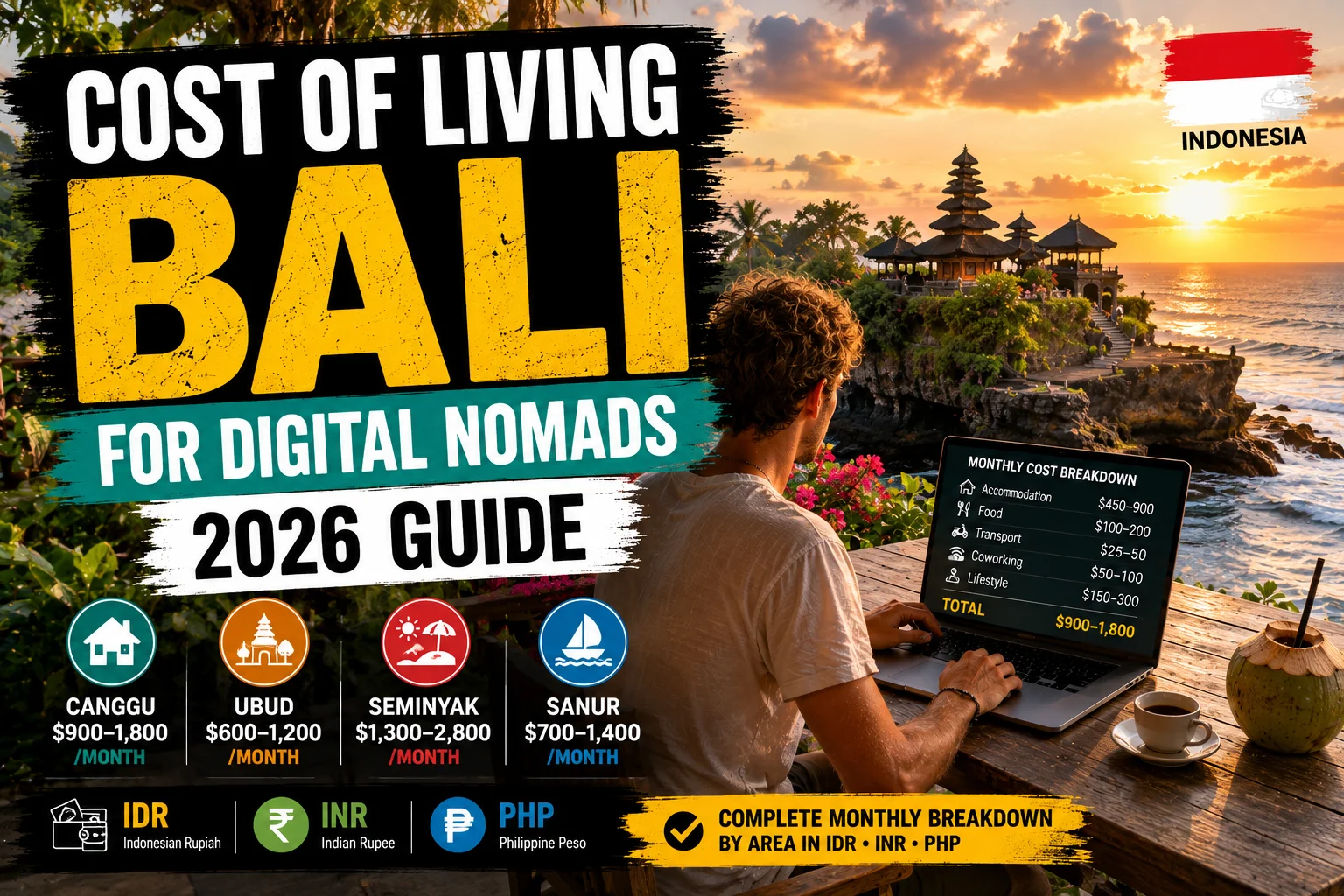
AI OVERVIEW SUMMARY Bali’s cost of living in 2026 varies significantly by area and lifestyle choices, making cost of living Bali digital nomads an important consideration when planning a realistic monthly budget. Canggu (main digital nomad hub) runs USD 900-1,800/month for a comfortable setup: villa rental IDR 4-8 million, food IDR 3-5 million, transport IDR 1 million, co-working IDR 1.5-3 million. Ubud is 25-35% cheaper at USD 600-1,200/month but has less nomad infrastructure. Seminyak is 30-50% more expensive than Canggu. The single biggest cost decision: Airbnb vs direct landlord rental (30-40% cheaper direct); find direct rentals via Facebook group ‘Bali Villas and Rooms for Rent.’ The ‘Bali trap’: eating every meal at tourist-zone western restaurants can push food costs to IDR 8-14 million/month — elimination Bali’s cost advantage entirely. Solution: 70% warung meals (IDR 20,000-50,000/meal) keeps food under IDR 3.5 million/month. High season (July-August, December-January) adds 40-100% to accommodation. Best value: sign a 3-month direct villa contract in March-May at off-season rates.
QUICK ANSWER: How much does it cost to live in Bali as a digital nomad? Canggu (comfortable mid-range): IDR 18,000,000-28,000,000/month ≈ USD 1,125-1,750 | ₹1,08,000-1,68,000 | PHP 63,000-98,000Ubud (budget-to-mid): IDR 11,000,000-18,000,000/month ≈ USD 687-1,125 | ₹66,000-1,08,000 | PHP 38,000-63,000Seminyak (upscale): IDR 25,000,000-45,000,000/month ≈ USD 1,562-2,812 | ₹1,50,000-2,70,000 | PHP 87,000-1,57,500Sanur (quiet/residential): IDR 14,000,000-22,000,000/month ≈ USD 875-1,375 | ₹84,000-1,32,000 | PHP 49,000-77,000 Key variable: accommodation method (Airbnb vs direct = 30-40% cost difference) and food choices (warung vs western = 3-5× cost difference).
Introduction: The Bali Budget Question Has a Specific Answer
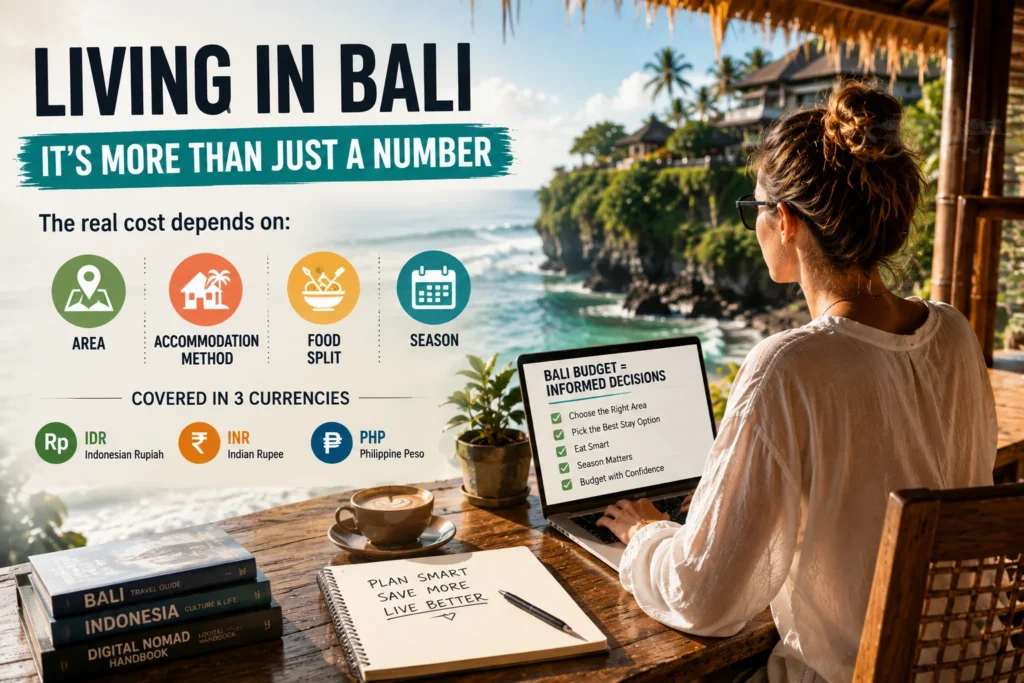
“How much does Bali cost?” is the most googled question about living in Bali, and the most commonly answered with vague ranges that don’t help actual planning. The honest answer requires specifying: which area, which accommodation method, which food split, and which season. This guide provides that specificity, with all major costs expressed in Indonesian Rupiah, Indian Rupee, and Philippine Peso — the currencies that matter most to MeridianNomad’s audience.
1. Area-by-Area Cost Profile
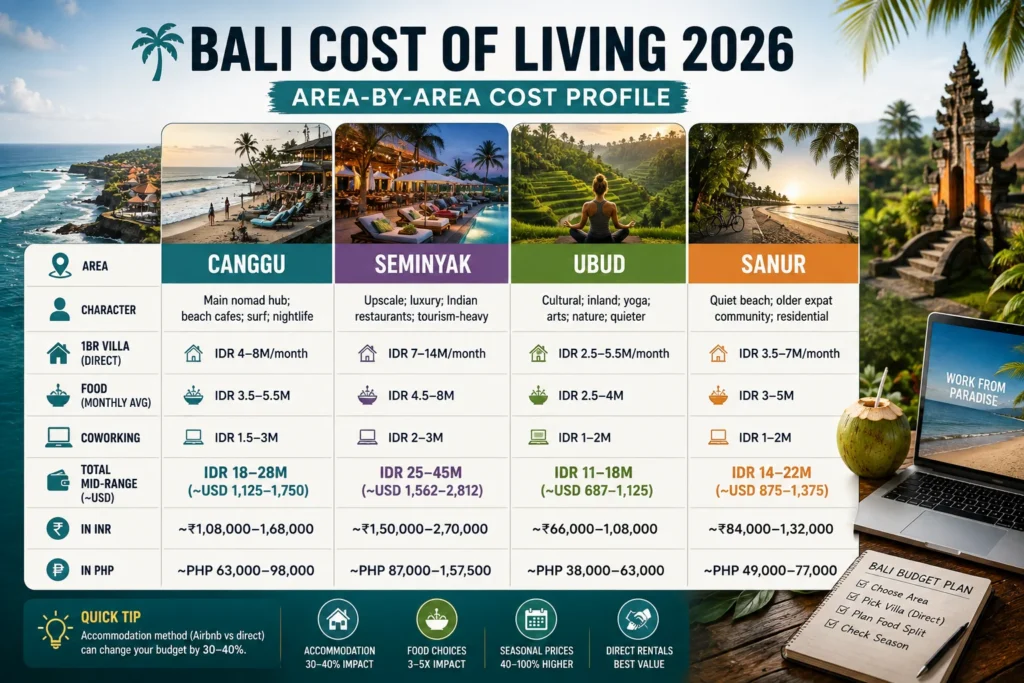
Area
Character
1BR Villa (Direct)
Food (Monthly avg)
Coworking
Total Mid-Range
In INR
In PHP
Canggu
Main nomad hub; beach cafes; surf; nightlife
IDR 4-8M/month
IDR 3.5-5.5M
IDR 1.5-3M
IDR 18-28M (~USD 1,125-1,750)
~₹1,08,000-1,68,000
~PHP 63,000-98,000
Seminyak
Upscale; luxury; Indian restaurants; tourism-heavy
IDR 7-14M/month
IDR 4.5-8M
IDR 2-3M
IDR 25-45M (~USD 1,562-2,812)
~₹1,50,000-2,70,000
~PHP 87,000-1,57,500
Ubud
Cultural; inland; yoga; arts; nature; quieter
IDR 2.5-5.5M/month
IDR 2.5-4M
IDR 1-2M
IDR 11-18M (~USD 687-1,125)
~₹66,000-1,08,000
~PHP 38,000-63,000
Sanur
Quiet beach; older expat community; residential
IDR 3.5-7M/month
IDR 3-5M
IDR 1-2M
IDR 14-22M (~USD 875-1,375)
~₹84,000-1,32,000
~PHP 49,000-77,000
2. Canggu: The Digital Nomad Hub — Three Budget Tiers
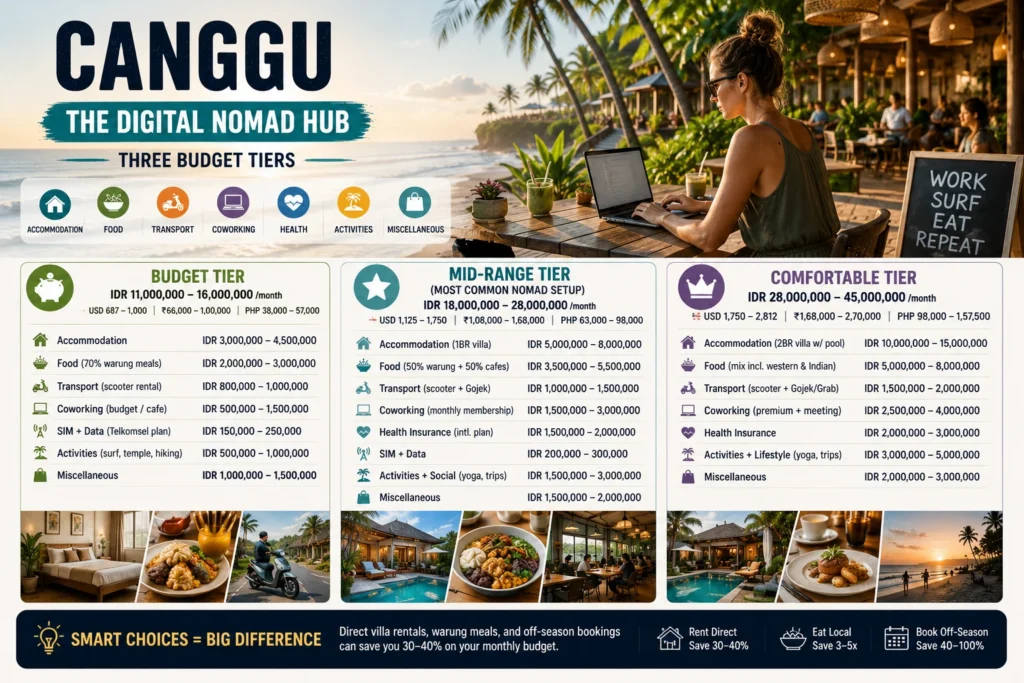
Canggu is where most digital nomads base themselves in Bali. Batu Bolong, Berawa, and Echo Beach are its three sub-areas, each with slightly different character. Here is what realistic monthly budgets look like across three tiers:
COMFORTABLE TIER — CANGGUIDR 28,000,000–45,000,000/month | USD USD 1,750–2,812 | 🇮🇳 ₹1,68,000–2,70,000 | 🇵🇭 PHP 98,000–1,57,500Accommodation: Premium 2BR villa with pool (direct): IDR 10,000,000-15,000,000 Food: Mix including western dining + Indian restaurants: IDR 5,000,000-8,000,000 Transport: Scooter + regular Gojek/Grab: IDR 1,500,000-2,000,000 Coworking: Premium membership + meeting rooms: IDR 2,500,000-4,000,000 Health insurance: IDR 2,000,000-3,000,000 Activities + lifestyle: Regular yoga, surf lessons, day trips: IDR 3,000,000-5,000,000 Miscellaneous: IDR 2,000,000-3,000,000
3. Accommodation: Airbnb vs Direct Landlord — The 30-40% Difference
THE SINGLE HIGHEST-IMPACT MONEY DECISION IN BALI Airbnb in Bali adds: platform service fee (14-16% of nightly rate) + cleaning fees + host markup for tourist pricing. A villa listed on Airbnb for USD 80/night = IDR 38,400,000/month. The same villa rented directly from the owner for 1+ month: typically IDR 5,000,000-7,000,000/month. That is a 35-45% cost difference — on your largest expense category. How to find direct villa rentals in Bali: Facebook group ‘Bali Villas and Rooms for Rent’: most active rental group in Bali; post what you want (area, bedrooms, budget, move-in date); landlords and agents respond within hoursDigital Nomads Bali Facebook group: community recommendations; nomads leaving post their villa available for the next personWalk the streets in your target area: Canggu’s Batu Bolong and Berawa have hand-painted ‘For Rent’ signs on villas and warungs; knock on the door or ask at the nearest warung for the owner’s numberNomad WhatsApp groups: ask for referrals from community members who just ended their leaseHipflat.com and Rumah.com: Indonesian property platforms with some direct listings What direct rental contracts look like: typically verbal agreement or simple written contract; 1-month deposit; month-to-month; minimum 1 month. Landlords prefer monthly payment in IDR cash or via Indonesian bank transfer.
Co-living costs more per square metre than direct villa rental. The premium buys: zero setup friction (no hunting for furniture, WiFi routers, or cleaning arrangements), instant community access, and flexible stay lengths. For a first-month Bali arrival or a nomad who values community over budget: co-living makes sense. For a 3-month+ Bali stay on a budget: direct villa wins decisively on cost.
4. Food Costs: The Most Variable Budget Line
Food Type
Cost (IDR)
In INR
In PHP
Notes
Warung meal (nasi/mie goreng)
IDR 20,000-35,000
₹104-181
PHP 56-99
Most affordable; filling; available everywhere in Canggu and Ubud
THE BALI TRAP: HOW TOURIST-ZONE EATING DESTROYS YOUR BUDGET This is the single most common reason Bali costs more than nomads expected: eating every meal at Canggu’s Instagram-worthy western cafes. The math: 3 western cafe meals/day × average IDR 150,000/meal × 30 days = IDR 13,500,000/month on food alone. That’s USD 844/month just for food — more than Ubud’s entire monthly budget. The solution: 70% warung meals: breakfast and lunch from warungs (IDR 20,000-40,000 each) + one western dinner 3-4×/week = IDR 2,500,000-3,500,000/month on food Morning market fruit: Bali’s pasar (traditional market) sells extraordinary tropical fruit at IDR 10,000-25,000/kg. Dragon fruit, mangosteen, rambutan, salak — make your own breakfast from market fruit and skip the IDR 75,000 smoothie bowlSelf-cooking 3-4 meals/week: Pepito supermarket and Bintang supermarket in Canggu have good quality ingredients at non-tourist prices 70% warung + 20% western + 10% self-cook = total food budget IDR 2,500,000-4,000,000/month. This is the sustainable Bali food budget.
5. Seasonal Price Variation: When to Arrive for Best Value
Season
Months
Accommodation Premium
Crowd Level
Weather
Best For
Peak high season
July-August + December-January
+40-100% above base rates
Very high; fully booked
Dry; excellent
Avoid if budget-sensitive; book 2+ months ahead if visiting
Shoulder season
February-March + September-November
+10-25% above base
Moderate
Mixed; Oct-Nov rainy afternoons
Reasonable prices; manageable crowds; best compromise
Low season (value)
April-June
Base rates; 15-30% below peak
Low
Dry (April-June excellent)
Best time for budget nomads; lowest villa prices; best 3-month contract negotiation
THE TIMING STRATEGY FOR BUDGET NOMADS Arrive in April or May. Sign a 3-month direct villa contract at off-season rates. Your 3-month lock-in price will often be lower than what the same villa charges per night in July. By the time high season arrives (July), you are already locked into your pre-agreed monthly rate. October-November rain pattern: afternoon showers are common but mornings are typically sunny. For most nomads who work mornings and explore afternoons, this is workable. The dramatic reduction in accommodation prices (15-30% below peak) and tourist crowds makes October-November genuinely pleasant for nomads who don’t need beach weather all day.
6. Currency and Payment in Bali: IDR Management
MANAGING IDR AS AN INDIAN OR FILIPINO NOMAD Indonesian Rupiah (IDR) cash is essential for Bali daily life. Here is the optimal currency strategy: For Indian nomads (INR): INR is NOT exchangeable in Bali. Do not bring rupees to Bali expecting to exchange them. Convert INR to USD before traveling via your Indian bank or forex service. Bring USD 100 bills (preferred by Bali money changers for best rates). USD 50 bills also accepted; USD 20 and below attract worse rates. Licensed money changers in Seminyak and Canggu: USD to IDR rates are typically competitive; better than most ATM rates. Use PT Dirgahayu or similarly licensed counters (avoid street money changers).Wise card: use at BCA ATMs for IDR cash withdrawals when you need emergency cash or have not yet exchanged USD. BCA ATM fee: approximately IDR 25,000-35,000 per withdrawal. Withdraw larger amounts to reduce per-withdrawal cost. For Filipino nomads (PHP): PHP can sometimes be exchanged in Bali but at poor rates. USD is significantly better. Bring USD or use Wise card at BCA ATMs. Payoneer card: also works at BCA ATMs for IDR cash if PHP earning via Fiverr/Upwork. ATM strategy for both: BCA (Bank Central Asia): most reliable for foreign cards; widest ATM network in Bali tourist areas Mandiri and BNI ATMs: also work for most Wise/foreign cards ALWAYS decline dynamic currency conversion (DCC) when the ATM asks if you want to be charged in your home currency. Always choose IDR. DCC rates are exploitative. Cashless in Bali: GoPay and OVO (Indonesian e-wallets) handle most QR payments at warungs and shops — but these require an Indonesian phone number and account, making them inaccessible to most visiting nomads. Wise/foreign card at tourist-area merchants is viable; cash is essential for warungs, markets, and local transactions.
NOTE FOR INDIAN NOMADS: INR TO BALI COST CONTEXT To put Bali’s costs in Indian rupee context: Budget Canggu (IDR 11-16M) = ₹66,000-97,000/month: cheaper than a comfortable Bengaluru or Pune lifestyle, with Bali’s tropical environment and nomad communityMid-range Canggu (IDR 18-28M) = ₹1,08,000-1,68,000/month: comparable to a good Gurgaon/Bandra lifestyle, but in a sea-view villa in BaliUbud budget (IDR 11-15M) = ₹66,000-90,000/month: meaningfully cheaper than most Tier-1 Indian cities for equivalent comfort level NRE account and Bali: transfer overseas income via Wise to NRE account in India for savings; withdraw via Wise card from BCA ATMs for Bali daily spending. This Wise → NRE + Wise card combo is the optimal financial setup for Indian nomads in Bali.
NOTE FOR FILIPINO NOMADS: PHP TO BALI COST CONTEXT Bali costs in Philippine peso context: Budget Canggu (IDR 11-16M) = PHP 38,000-57,000/month: significantly cheaper than Metro Manila (BGC, Makati) for equivalent quality of life; comparable to provincial Philippine city living but in BaliMid-range Canggu (IDR 18-28M) = PHP 63,000-98,000/month: achievable on USD 1,200-1,500/month overseas income; good value for Canggu lifestyleUbud (IDR 11-15M) = PHP 38,000-53,000/month: cheaper than most Metro Manila rentals for equivalent quality; yoga, nature, Balinese cultural experience included
Frequently Asked Questions
How much does it cost to live in Bali as a digital nomad?
In Canggu (main nomad hub): USD 1,125-1,750/month (IDR 18-28 million) for a comfortable mid-range lifestyle including 1BR private villa, mixed warung and western meals, scooter rental, coworking, and health insurance. In INR: approximately ₹1,08,000-1,68,000/month. In PHP: approximately PHP 63,000-98,000/month. Ubud is 25-35% cheaper. Seminyak is 30-50% more expensive.
Is Bali cheaper than Bangkok or Kuala Lumpur?
It depends on lifestyle choices. With warung-focused eating (70%+ meals at local Indonesian restaurants) and direct villa rental: Bali’s Ubud and mid-Canggu are cheaper than Bangkok and KL equivalents. With tourist-zone western restaurant eating and Airbnb accommodation: Bali can match or exceed Bangkok and KL costs. The gap between best-practice and worst-practice Bali budgeting is larger than in Bangkok or KL, making lifestyle discipline more important.
How do I find cheap accommodation in Bali without Airbnb?
Join the Facebook group ‘Bali Villas and Rooms for Rent’ and post your requirements (area, budget, dates, room type). Direct landlord rentals are 30-40% cheaper than equivalent Airbnb listings. Also: walk your target area looking for ‘For Rent’ signs, ask at local warungs for owner contacts, and connect via Digital Nomads Bali Facebook group where departing nomads post their villas for sublet at below-market rates.
When is the cheapest time to live in Bali?
April through June is the best value period: off-season accommodation rates, low tourist crowds, and excellent dry weather. Signing a 3-month contract in April at off-season rates locks you in below the July-August peak pricing. October and November also offer below-peak rates with afternoon rain showers that do not significantly affect nomad productivity. Avoid July-August and December-January if budget-sensitive: accommodation prices increase 40-100%.
Final Verdict: Bali Rewards the Prepared Nomad
Bali’s cost-of-living reputation as a ‘cheap destination’ is accurate for nomads who make the right choices: direct villa over Airbnb, warung-forward eating, arrival during shoulder season, and IDR cash management via money changers and Wise card. It is inaccurate for nomads who arrive without a plan, stay on Airbnb for the first month, eat at Instagram-worthy western cafes three times a day, and do not lock in a direct rental before high season hits. These nomads end up spending Bangkok prices without Bangkok’s infrastructure. The single highest-impact decision: accommodation. Get off Airbnb as fast as possible. Join the Facebook groups, spend two to three days in a short-term booking while hunting for direct monthly deals, and sign a month-to-month villa contract within the first week. Every month on Airbnb pricing versus direct pricing costs you approximately IDR 2,000,000-4,000,000 (USD 125-250). See the Bali Digital Nomad Hub for the complete Bali overview, or the Bali Banking Guide for how to manage IDR and overseas income in Bali.
PLAN YOUR BALI BUDGET
Choose your area, calculate your accommodation tier, and use the 70% warung rule for food. Arrive in April-June for best value. Set up Wise before you fly. [ Bali Digital Nomad Hub → ] [ Bali Banking Guide → ] [ Bali for Indian Citizens → ] [ Wise Review → ]