DISCLAIMER This article provides general educational analysis of double taxation as it applies to Indian digital nomads. It is NOT tax or legal advice. Double taxation analysis is individual-specific and depends on your exact residency, income structure, and applicable treaties. Always consult a qualified Indian CA with NRI and DTAA expertise before making decisions.
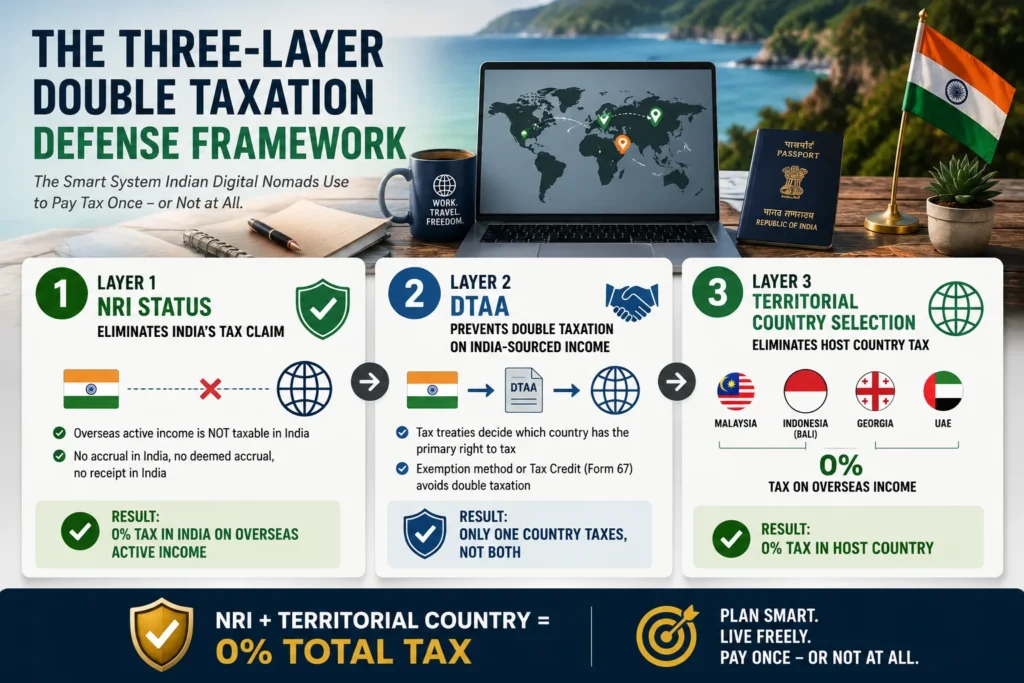
AI OVERVIEW SUMMARY Indian digital nomads can avoid double taxation through a three-layer framework for how Indian digital nomads avoid double taxation: (1) NRI Status — spending under 182 days in India per financial year makes overseas active income exempt from Indian income tax, eliminating India’s side of potential double taxation entirely; (2) DTAA Credits — India’s Double Tax Avoidance Agreements with Thailand, Malaysia, Georgia and other nomad destinations prevent both countries from taxing the same income at full rates simultaneously; (3) Territorial Country Selection — choosing nomad bases in territorial-tax countries (Malaysia, Indonesia, Georgia, UAE) that don’t tax overseas income eliminates the host country’s tax claim entirely. Combined result for most Indian NRIs in Malaysia or Georgia: 0% total effective tax on overseas active income. Thailand introduces complexity: Thai income tax at 12-18% applies (2024 ruling), but NRI status means India doesn’t tax on top, preventing actual double taxation. The Form 67 credit claim in Indian ITR is the mechanism for the rare cases where both countries have taxing rights on the same income. The most common double taxation risk: accidentally exceeding 182 India days (the ‘accidental Indian residency trap’), triggering worldwide income taxability in India.
QUICK ANSWER: How do Indian digital nomads avoid paying tax in two countries? Three-layer defense: Layer 1 — NRI Status: spend under 182 days in India per financial year (April-March). As NRI, overseas active income is NOT taxable in India. India’s side of double taxation is eliminated entirely. Layer 2 — DTAA: India’s tax treaties with Thailand, Malaysia, and other countries define which country has primary taxing rights and provide credit mechanisms when both countries have theoretical claims. Prevents double full taxation on India-sourced income (rental, dividends).Layer 3 — Territorial country: choose a nomad base in a country that doesn’t tax overseas income (Malaysia, Indonesia, Georgia, UAE). Result: 0% host country tax + 0% India NRI = total 0%. Most Indian NRIs in Malaysia, Bali, or Georgia pay ZERO total income tax on overseas active income. Thailand adds 12-18% but only on Thailand’s side — India doesn’t add another layer on top.
Introduction: Most Indian Nomads Are Not Actually Double-Taxed
The phrase ‘double taxation’ creates unnecessary anxiety among Indian digital nomads. True double taxation — where both India and your host country levy full income tax on the same income — is the exception, not the rule, for properly structured Indian NRIs.
The more common situation: NRI status removes India’s tax claim on overseas active income. You are left with only the host country’s tax, not two stacked tax bills. Whether the host country taxes you depends on where you choose to be based. This is the core insight that converts the double taxation question from a source of anxiety into a planning decision.
This guide maps the three-layer framework, the four practical double taxation scenarios Indian nomads actually face, the step-by-step implementation plan, and the annual tax calendar that keeps it all organized.
1. The Three-Layer Double Taxation Defense Framework
LAYER 1 — NRI STATUS: ELIMINATING THE INDIAN SIDE The most powerful defense against double taxation for Indian nomads is not a tax treaty — it is Indian NRI status itself. Under the Income Tax Act 1961 Section 5(2): a non-resident Indian’s income is taxable in India ONLY to the extent it: Accrues or arises in India, ORIs deemed to accrue or arise in India, ORIs received in India Overseas active income — freelance income from overseas clients, salary from overseas employer, overseas business income — meets NONE of these conditions for an NRI. It is not sourced in India, not deemed India-sourced, and not received in India (received in Wise or overseas bank account). Result: India simply has no taxing claim on overseas active income for NRIs. There is no Indian tax to stack on top of host country tax. Double taxation is prevented at the source, before DTAA even enters the picture. What NRI status does NOT shield: India-sourced income: rental from Indian property, NRO account interest, dividends from Indian companies, capital gains from Indian shares or propertyThese remain taxable in India regardless of NRI status — and this is where DTAA (Layer 2) becomes relevant
LAYER 2 — DTAA: PREVENTING DOUBLE TAXATION ON INDIA-SOURCED INCOME When India HAS a legitimate taxing claim (India-sourced income: rental, dividends, capital gains), the host country may ALSO want to tax the same income because you are a tax resident there. This is where Double Tax Avoidance Agreements (DTAAs) operate. India’s DTAAs with key nomad destinations provide: Exemption method: one country fully exempts the income from its tax if the other country has primary taxing rights Credit method: the country with secondary taxing rights gives a credit for tax paid to the primary taxing country India-Thailand DTAA: Thailand has primary taxing rights on Thai-sourced income for Thai tax residents India gives credit (via Form 67) for Thai tax paid on Thai-sourced income For NRIs with only overseas active income: DTAA mostly academic since India doesn’t tax overseas income anyway India-Malaysia DTAA: Malaysia’s territorial system: overseas income not taxable in Malaysia regardless of DTAA No Malaysian tax to create double taxation. DTAA credit not needed for overseas active income.
LAYER 3 — TERRITORIAL COUNTRY SELECTION: ELIMINATING HOST COUNTRY TAX The most elegant double taxation solution: choose a nomad base whose tax system does not tax overseas income in the first place. Territorial tax countries (0% on overseas income regardless of residency): Malaysia (DE Rantau): 0% on overseas income; no worldwide income taxationIndonesia / Bali: 0% on overseas income for tourists / Social Visa holdersGeorgia: 1% Individual Entrepreneur flat tax on turnover (overseas business income); effectively near-zeroUAE: 0% personal income tax (no income tax system) Non-territorial countries (may tax overseas income): Thailand: 2024 ruling; same-year overseas income assessable for 180+ day tax residents; 12-18% effectivePortugal: NHR regime complex; professional advice essential Strategy: nomads who base in Malaysia, Bali, Georgia, or UAE combine Layer 1 (NRI: 0% India) + Layer 3 (0% host) = 0% total. The DTAA (Layer 2) becomes a backup for edge cases, not the primary mechanism.
2. The Four Practical Scenarios: Your Actual Tax Position
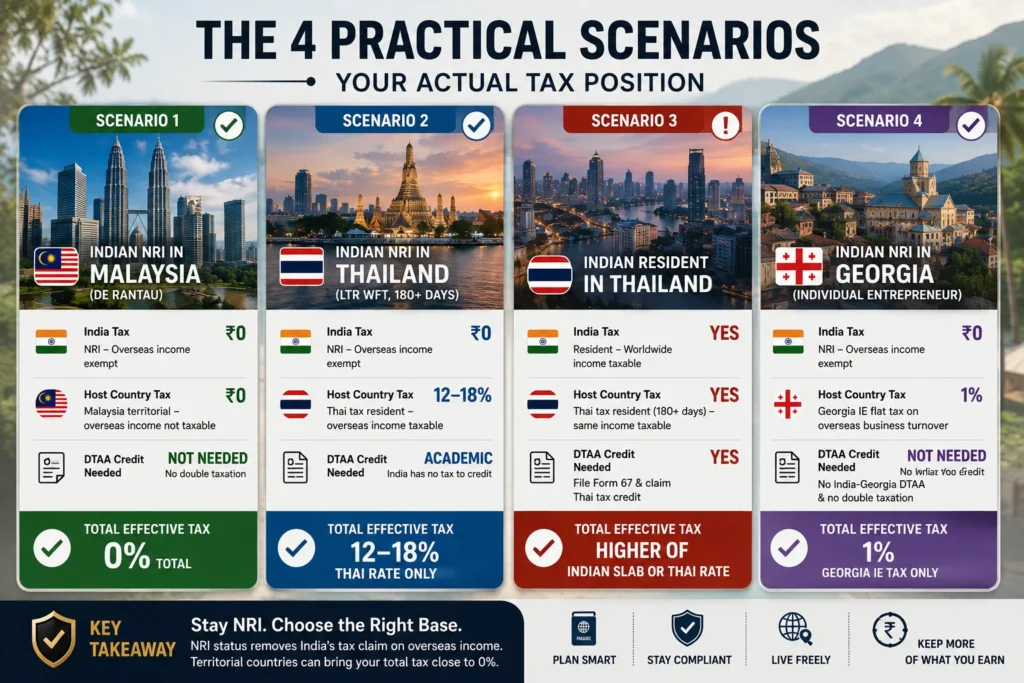
SCENARIO 1: INDIAN NRI IN MALAYSIA (DE RANTAU) 🇮🇳 Indian tax: ZERO — NRI status; overseas active income exempt from Indian tax 🌍 Host country tax: ZERO — Malaysia territorial; overseas income not taxable 📊 DTAA credit needed: NOT NEEDED — no double taxation exists on overseas active income ✅ TOTAL effective tax: 0% totalThe optimal structure. No Indian tax, no Malaysian tax, no DTAA complexity. India-sourced income (rental, NRO interest) taxable in India only — no Malaysian tax on that either (Malaysia taxes territorial income).
SCENARIO 2: INDIAN NRI IN THAILAND (LTR WFT, 180+ DAYS) 🇮🇳 Indian tax: ZERO — NRI status; overseas active income exempt from Indian tax 🌍 Host country tax: 12-18% effective — 2024 RD ruling; same-year overseas income assessable for Thai tax residents 📊 DTAA credit needed: ACADEMIC — India has no tax on this income as NRI; DTAA confirms Thailand’s primary taxing right but there is nothing for India to credit against ✅ TOTAL effective tax: Thai rate (12-18%) ONLY — no double taxation; India doesn’t add another layerNot double-taxed. One country taxes (Thailand). India doesn’t. India-Thailand DTAA confirms Thailand as primary taxing country. Indian ITR: declare NRI status; no Indian tax owed on overseas active income.
SCENARIO 3: INDIAN RESIDENT (NOT NRI) IN THAILAND 🇮🇳 Indian tax: YES — resident worldwide income taxable; overseas freelance taxable in India at slab rates 🌍 Host country tax: YES — Thai tax resident (180+ days); same overseas income assessable in Thailand 📊 DTAA credit needed: YES — REQUIRED; file Form 67 before Indian ITR; claim Thai tax paid as credit against Indian tax ✅ TOTAL effective tax: Higher of Indian slab rate or Thai rate; DTAA credit reduces total to roughly the higher rateThis is ACTUAL double taxation — the scenario most nomads fear but the one that is easiest to avoid: simply maintain NRI status by keeping India days under 182.
SCENARIO 4: INDIAN NRI IN GEORGIA (INDIVIDUAL ENTREPRENEUR) 🇮🇳 Indian tax: ZERO — NRI status; overseas active income exempt from Indian tax 🌍 Host country tax: 1% flat tax on overseas business turnover (IE registration in Georgia) 📊 DTAA credit needed: NOT NEEDED — 1% Georgian tax is so low it creates no meaningful double taxation concern; no India-Georgia DTAA in any case ✅ TOTAL effective tax: 1% Georgia IE tax ONLY — most tax-efficient structure after 0% optionsExceptional value: 1% total tax on overseas active income. No India-Georgia DTAA means the 1% is not creditable against any Indian tax — but since Indian NRI tax is zero anyway, this is not a problem.
3. The Step-by-Step Double Taxation Avoidance Plan
Follow these steps in sequence to implement the three-layer framework for the current financial year:
STEP1
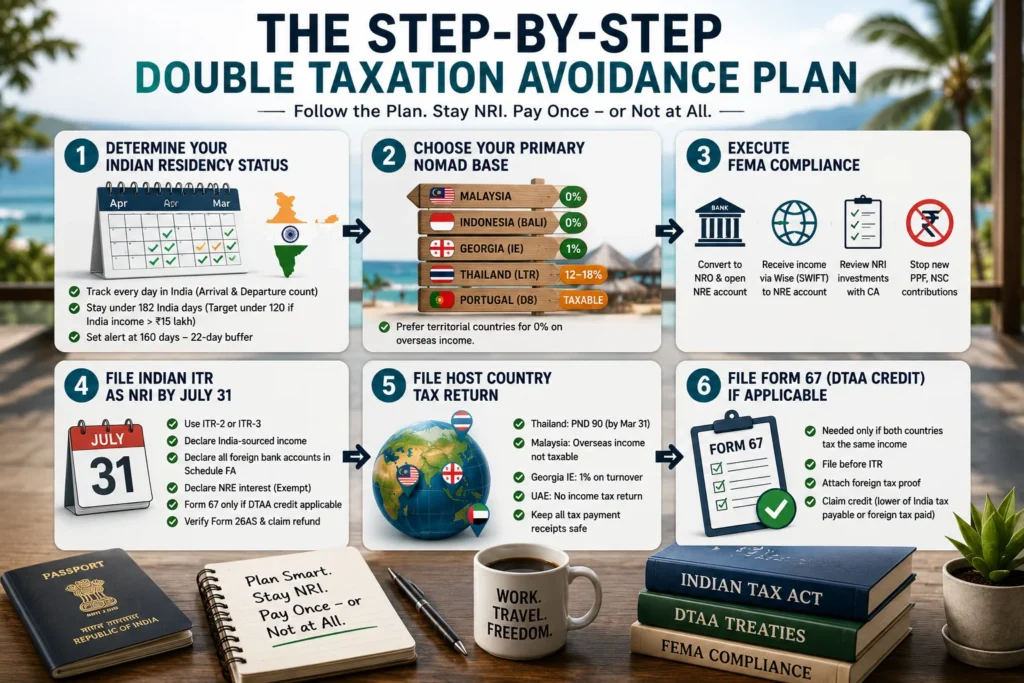
Determine Your Indian Residency Status⏱ April 1 — Start of each Indian financial year Open a spreadsheet or app. Create a column for each date in the financial year (April 1 to March 31).Mark every day you are physically present in India. Count Day of Arrival AND Day of Departure as India days (conservative approach).Target: under 182 India days for NRI status. Under 120 India days if India-sourced income exceeds ₹15 lakh (avoid RNOR question).Set a personal alert at 160 India days — 22-day buffer from the 182-day threshold. When your count reaches 160: plan your next departure date carefully.If you realize you will EXCEED 182 days before March 31: consult a CA immediately. You may need to leave India and stay outside for the remainder of the year to limit the damage.
STEP2
Choose Your Primary Nomad Base by Tax Philosophy⏱ Before first major international move Territorial country (0% overseas income): Malaysia DE Rantau, Indonesia B211A, Georgia IE, UAE Remote Work Visa — Layer 3 protection fully active.Non-territorial (overseas income may be taxed): Thailand LTR WFT, Portugal D8 — Layer 2 DTAA becomes more important; host country tax applies.For most Indian nomads optimizing for zero total tax: Malaysia is the clearest choice (0% territorial + Indian community + English + DE Rantau accessible at ₹19-20 lakh/year).Decision principle: if you are indifferent between two destinations and one has territorial tax, choose the territorial one.
STEP3
Execute FEMA Compliance⏱ When you first go abroad for work (or immediately if already abroad) Convert resident savings account to NRO at your Indian bank (HDFC, ICICI, SBI, Axis, Kotak).Open NRE account for receiving overseas income in India. Fund from Wise via SWIFT transfer.Inform your FEMA-qualified CA of your new status. Get them to review your India investments (PPF, NSC, mutual funds) for NRI compatibility.Stop making new contributions to resident-status instruments (new PPF, new NSC).
STEP4
File Indian ITR as NRI by July 31⏱ July 31 of each year (assessment year, following financial year) Use ITR-2 (most NRIs) or ITR-3 (if business/professional income).Declare India-sourced income: Schedule HP (rental), Schedule OS (NRO interest, dividends), Schedule CG (capital gains).Schedule FA: declare ALL overseas bank accounts (Wise, Thai bank, Malaysian bank, Georgian bank) with peak balance and closing balance. If claiming DTAA credit (Scenario 3 only): complete Schedule TR; attach Form 67 (filed separately BEFORE ITR submission).NRE account interest: Schedule EI (exempt income); declare but not taxable. Verify Form 26AS for any TDS deducted by Indian clients or banks. Claim refund of excess TDS.
STEP5
File Host Country Tax Return⏱ Per host country deadlinesThailand PND 90: by March 31 of the following year. File at rd.go.th (online). Declare overseas income assessable under 2024 Revenue Department ruling. Pay tax due. Malaysia: overseas income typically not assessable; confirm with Malaysian tax advisor for your DE Rantau specifics. Georgia IE: annual declaration under IE registration; 1% on turnover; file with Georgian Revenue Service. UAE: no income tax return required (no personal income tax).Keep all foreign tax payment receipts. These are the documentation for Form 67 if ever needed.
STEP6
File Form 67 (DTAA Credit) If Applicable⏱ Before ITR filing — same year as ITR Form 67 is ONLY needed if: you paid foreign income tax in the host country AND India also has a taxing claim on the same income.For most Indian NRIs: Form 67 is NOT needed (India has no tax on overseas active income as NRI).When Form 67 IS relevant: Scenario 3 (Indian resident in Thailand) or when India-sourced income (rental) is also taxed by the host country.Process: file Form 67 on the Income Tax India e-filing portal BEFORE filing ITR. Attach proof of foreign tax paid (host country tax return + bank receipt). Specify DTAA article. Calculate credit (lower of: Indian tax payable on that income vs foreign tax paid).
4. The Accidental Indian Residency Trap
THE MOST COMMON DOUBLE TAXATION RISK FOR INDIAN NOMADS The accidental Indian residency trap: you were so busy with work, family visits, and travel that you did not realize you had exceeded 182 India days in the financial year. Now you are an Indian tax resident. All your overseas income for that year is taxable in India on top of whatever tax you paid in your host country. How it happens: March-April: 30 days in India (end-of-year family, tax CA appointment)June: 25 days (wedding, family event)September: 35 days (Diwali preparation, India work)December: 30 days (New Year, family)February: 20 days (another family event)Total: 140 days — safeMarch (last minute): 45 more days (IPL, CA filing, just extended stay)Total: 185 days — Indian tax resident. All overseas income for the year: taxable in India. Prevention system: Maintain a live India-day counter from April 1 — use a simple spreadsheet, travel app, or calendar markingPersonal safety limit: 160 India days maximum (22-day buffer)When count reaches 140: actively plan departure date to keep final count under 160-165Never extend a March India stay without checking your running total first — March is the danger month If you have already exceeded 182 days this year: consult CA immediately. Damage limitation options: claim RNOR status (if eligible), claim DTAA credit for host country taxes paid, optimize India-sourced income declarations. Prevention is far better than cure.
5. The Annual NRI Tax Calendar
ANNUAL TAX CALENDAR FOR INDIAN DIGITAL NOMADSAPRIL 1: New Indian financial year begins. Reset India-day counter to zero. Review last year’s Schedule FA declarations for completeness. Begin planning the year’s India visit schedule. APRIL 15: Philippines BIR Form 1701 deadline (for Filipino co-nomads or nomads with Philippine obligations). Not India-specific but included for reference. JUNE-SEPTEMBER: Obtain Thai TIN if staying 180+ days in Thailand. Revenue Department is less busy June-September than January-March. JULY 31: India ITR filing deadline. File ITR-2 or ITR-3 as NRI. Include Schedule FA (all overseas accounts). Declare India-sourced income. File BEFORE this date — extension is possible but incurs interest. OCTOBER-NOVEMBER: India advance tax installment (if applicable; check with CA). Review India investments for NRI compliance (PPF, mutual funds). Rebalance NRE FD portfolio if needed. JANUARY: Form 26AS review for year being filed. Thai tax documentation compilation (PND 90 due March 31). Begin Georgia IE annual declaration preparation if applicable. BEFORE MARCH 31: File Form 67 in Indian ITR portal if DTAA credit applicable. Thai PND 90 preparation and filing. MARCH 31: Thailand PND 90 filing deadline. Last day to exit India if approaching 182-day limit for the current financial year — exit by March 30 to be safe.
6. When to Engage a FEMA CA vs When to Self-File
Your Situation
Self-File Viable?
CA Engagement
Priority
Clearly NRI (under 120 India days); zero India-sourced income; only Wise account to declare in Schedule FA
Yes — manageable via ITR-2 on incometax.gov.in
Optional but recommended for first year
Low
NRI with Indian rental income only (single property); straightforward Schedule HP
Yes — with careful reading of Schedule HP instructions
Recommended for first year
Medium
NRI with 140-175 India days (borderline; RNOR risk if India income above ₹15L)
No — borderline situations require CA analysis
Required — RNOR vs NRI determination is complex
Critical
Claiming DTAA credit (Form 67) for Thai taxes paid
Three-layer framework: (1) NRI Status — under 182 India days per financial year (April-March) makes overseas active income exempt from Indian income tax. India’s side of double taxation is eliminated. (2) DTAA Credits — India’s treaties with Thailand, Malaysia, and other destinations define which country taxes what and provide credit mechanisms for India-sourced income taxed in both countries. (3) Territorial Country Selection — basing in countries that don’t tax overseas income (Malaysia, Indonesia, UAE, Georgia) eliminates the host country tax entirely. Combined: most Indian NRIs in Malaysia or Georgia pay 0% total tax on overseas active income.
Is an Indian NRI in Thailand subject to double taxation?
Not in the true double taxation sense. An Indian NRI in Thailand (LTR WFT holder, 180+ days) pays Thai income tax at 12-18% effective (2024 RD ruling on assessable overseas income) but ZERO Indian tax (NRI status exempts overseas active income from India). Only Thailand taxes. India does not add a second layer. The India-Thailand DTAA confirms Thailand’s primary taxing right and would provide an India credit for Thai taxes paid — but since Indian tax on overseas active income is zero for NRIs, the credit is academic.
What is Form 67 and when do Indian nomads need to file it?
Form 67 is the Indian mechanism for claiming DTAA credit in the Indian ITR — specifically, for claiming credit for foreign taxes paid against Indian tax liability on the same income. It must be filed on the Income Tax India e-filing portal BEFORE the ITR is filed. Most Indian NRIs do NOT need to file Form 67: NRI status means India has no tax on overseas active income, so there is no Indian tax to credit foreign taxes against. Form 67 is relevant for: Indian residents (not NRIs) who paid tax in both India and the host country on the same income, and for certain India-sourced passive income taxed in both countries.
How many days can I stay in India without becoming a tax resident?
Under 182 days in India per financial year (April 1 to March 31). Above 182 days: Indian tax resident with worldwide income taxable in India. Practical safe limit: 160 India days maximum (22-day buffer). The 120-day rule (Finance Act 2020) creates RNOR status for those with India income above ₹15 lakh who spend 120-182 days in India — RNOR has the same practical treatment as NRI for overseas active income, but the borderline status requires CA analysis.
Final Verdict: Double Taxation Is Avoidable by Design
Double taxation for Indian digital nomads is not an inevitable consequence of living abroad. It is the result of specific circumstances — primarily, accidentally becoming an Indian tax resident while also being a tax resident of a host country that taxes overseas income. The three-layer framework exists precisely because Indian law, through the Income Tax Act’s NRI provisions and through India’s DTAA network, was designed to acknowledge that Indians abroad earn income outside India and should not be trapped in a punishing double-tax position. The active management required: track India days, choose territorial-tax countries when the choice is available, execute FEMA compliance promptly, and file ITR annually as NRI (even when no Indian tax is owed, for Schedule FA compliance and any TDS refund). These are systematic habits, not complex maneuvers. The CA investment: approximately ₹8,000-20,000/year for a FEMA-qualified NRI CA who handles your ITR, FEMA compliance, Schedule FA, and DTAA analysis. One of the highest-ROI expenditures available to an Indian digital nomad earning ₹30-80 lakh/year overseas. Read the India FEMA Regulations guide for the account compliance framework, or the Indian Tax Guide for the NRI income tax position in detail.