
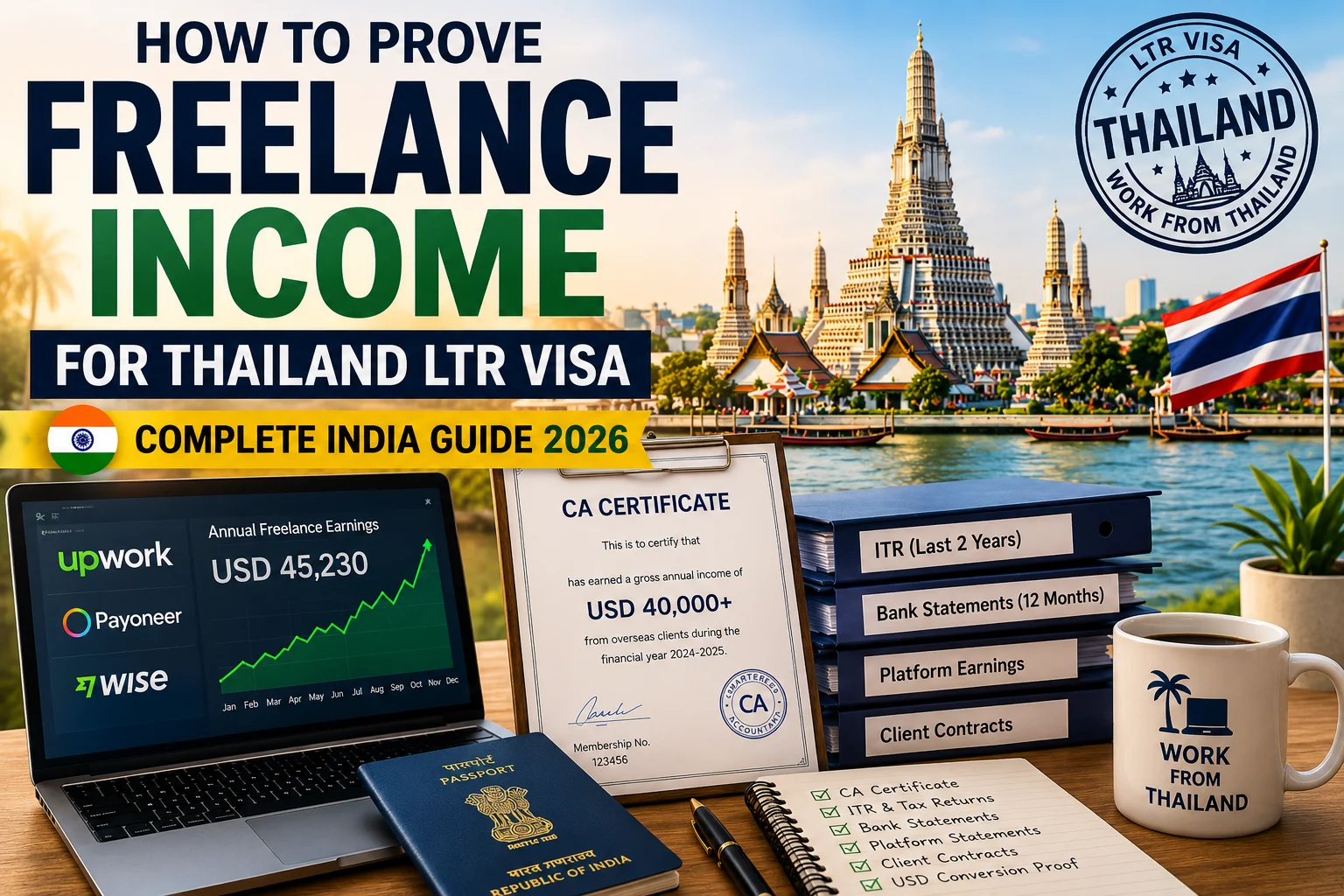
| Indian freelancers applying for the Thailand LTR Visa (Work-From-Thailand Professional category) Indian freelancers applying for the Thailand LTR Visa (Work-From-Thailand Professional category) must prove freelance income for LTR Visa requirements by showing a minimum annual income of USD 40,000 from non-Thai sources. Acceptable proof includes a CA-certified income certificate, Income Tax Returns (ITR-4), 12 months of bank statements showing international income, platform earnings statements (Upwork, Payoneer, Wise), and client contracts. A CA certificate from a practicing Chartered Accountant is the most important document for Indian freelancers. Self-generated income statements, screenshots, and informal payment records are not accepted by the Thailand BOI. |
| QUICK ANSWER: What documents prove freelance income for Thailand LTR Visa? For Indian freelancers, the Thailand BOI requires the following income proof documents: CA-certified income certificate (on CA letterhead, stamped and signed)Income Tax Return (ITR) for last 2 years — ITR-4 for most freelancers Bank statements for last 12 months showing international income deposits Platform earnings statements: Upwork, Toptal, Payoneer, or Wise annual reportsClient contracts or service agreements with overseas clients USD-to-INR conversion documentation if income is deposited in INR The CA certificate is non-negotiable for self-employed Indian applicants. Without it, BOI reviewers have no standardized way to verify your income. Do not submit an application without this document. |
| IMPORTANT DISCLAIMER This guide covers general income documentation requirements for the Thailand LTR Visa based on publicly available BOI guidance and applicant experience reports. Requirements can change without notice. Always verify current requirements on the official BOI website (boi.go.th) before preparing your application. This is not legal or financial advice. Consult a licensed Thai immigration consultant or your CA for specific guidance on your situation. |
Introduction
The income proof requirement is where most Indian freelancer applications for the Thailand LTR Visa either succeed or fall apart. It’s not that the income threshold is unreachable — USD 40,000 per year is achievable for many experienced Indian professionals. The problem is that freelancers don’t have salary slips. Their income comes from Upwork, Wise, PayPal, and direct bank transfers. Their ITR may declare income in ways that don’t clearly show “overseas” income. And many have never heard of a CA certificate for visa purposes.
This guide solves that. It walks you through every document you need, how to prepare each one specifically as an Indian freelancer, and what BOI reviewers are actually looking for when they assess your application.
Who This Guide Is For
This guide is specifically for Indian freelancers and self-employed professionals applying for the Thailand LTR Visa Work-From-Thailand (WFT) Professional category. It covers:
- IT and software freelancers (developers, designers, QA testers)
- Digital marketing, content, and SEO consultants
- Finance, accounting, and business consultants with overseas clients
- Remote work professionals employed by Indian companies but working for foreign clients
- Upwork, Toptal, Fiverr, or direct-contract freelancers earning in USD or other foreign currencies
- Professionals with a mix of Indian domestic clients and overseas clients
What the Thailand BOI Actually Looks for in Income Proof
Before preparing documents, understand the reviewer’s perspective. The BOI is trying to answer three questions:
| BOI Question | What They Need to See | Why It Matters |
| Does this person earn USD 40,000+/year? | Documented gross annual income from all overseas sources | The income threshold is a hard filter — below it, the application is declined |
| Is the income from non-Thai sources? | Proof that income originates from outside Thailand | LTR WFT requires overseas employment — Thai-sourced income does not count |
| Is the income consistent and verifiable? | Regular bank deposits, platform statements, official tax documents | One-time large payments are viewed differently from regular income patterns |
With that context, here is your step-by-step document preparation process.
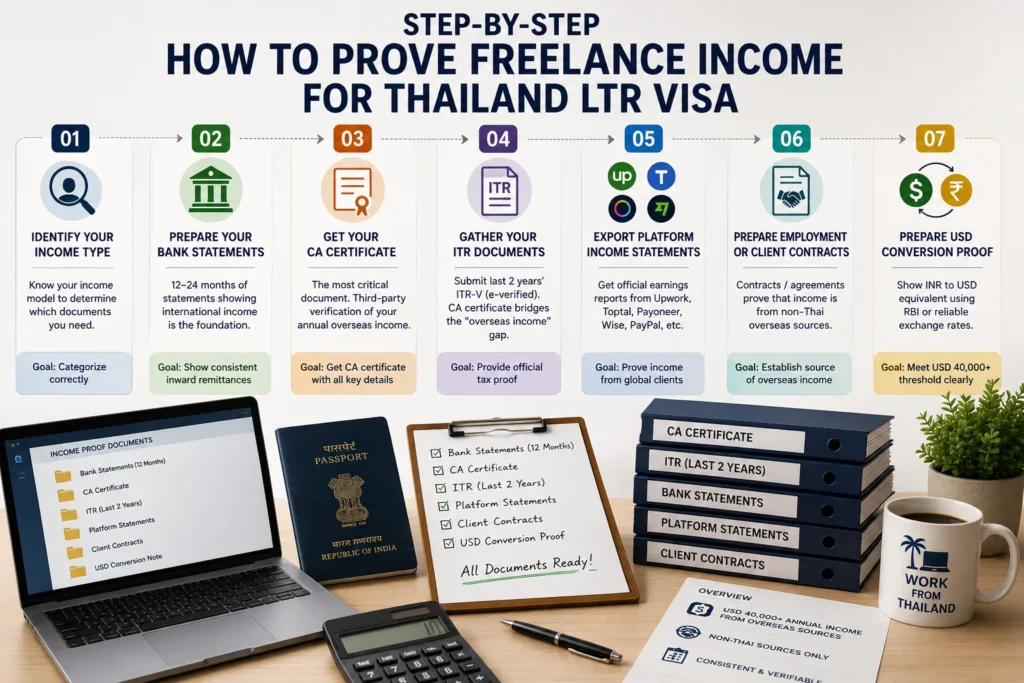
Step-by-Step: How to Prove Freelance Income for Thailand LTR Visa
Step 1: Identify Your Income Type
Start by categorizing your income. This determines which specific documents you need:
| Income Type | Primary Documents Needed | Complexity |
| Salaried (overseas company, USD salary) | Pay slips + Employment contract + Bank statements | Low |
| Freelancer via platforms (Upwork, Toptal) | Platform earnings statement + Bank statements + CA certificate | Medium |
| Direct-contract freelancer (invoices) | Client contracts + Invoice records + Bank statements + CA certificate + ITR | Medium-High |
| Mixed: Indian clients + some overseas | All of the above + CA letter separating overseas vs domestic income | High |
| Consultant with overseas retainer | Retainer agreement + Bank statements + CA certificate + ITR | Medium |
Step 2: Prepare Your Bank Statements
Bank statements are the baseline evidence of your income. Here is what BOI reviewers expect:
- Duration: Minimum 12 months of statements. Some successful applicants submit 24 months for stronger evidence.
- Account type: Savings account or current account in your name. Joint accounts are acceptable if you are listed as the primary holder.
- NRE/NRO accounts: If you already have these, include them — they often show international income more clearly than domestic savings accounts.
- What to highlight: International inward remittances clearly labeled as foreign currency deposits. Highlight or annotate these in your application cover note.
- Bank: SBI, HDFC, ICICI, Axis, Kotak, and major private banks are all familiar to BOI reviewers. No preference stated.
| IMPORTANT NOTE ON INCOME PATTERN BOI reviewers understand that freelance income is project-based and will not look exactly like a salary. Irregular monthly amounts are acceptable. What matters is that the total over 12 months clearly exceeds USD 40,000 equivalent and that the source of deposits is traceable to international clients. Add a brief cover note in your application if your income pattern is irregular, explaining the project-based nature of your work. |
Step 3: Get Your CA Certificate (Most Critical Step)
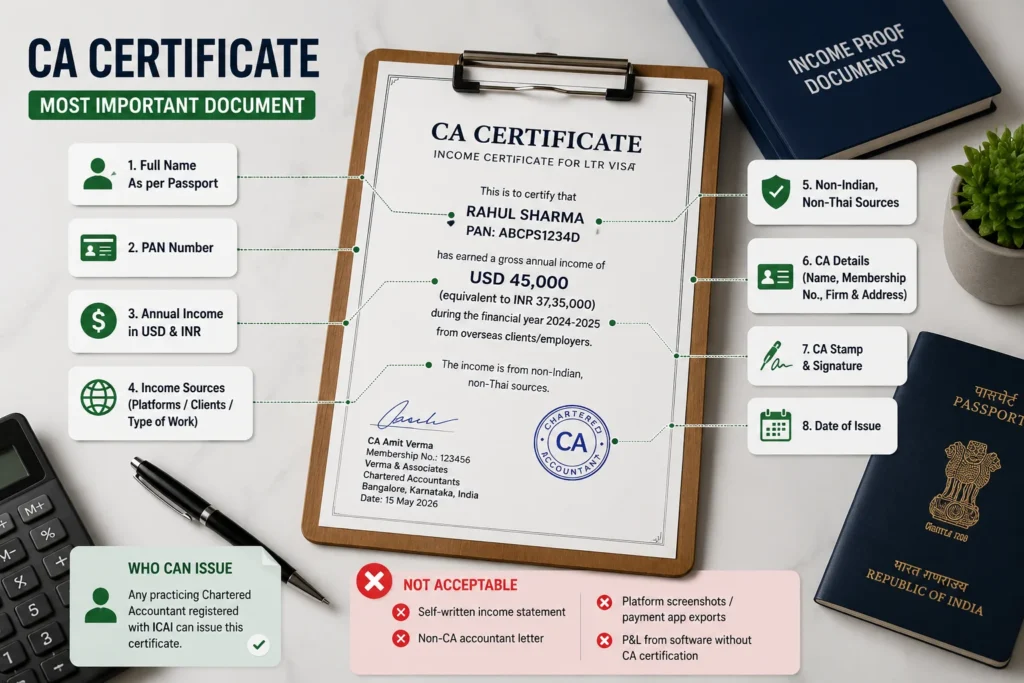
For Indian freelancers, the CA certificate is the single most important document in your LTR Visa income proof package. BOI uses it as a standardized, third-party verification of your income.
What the CA certificate must contain:
- Your full name as it appears on your passport
- Your PAN number
- A clear statement of your annual income: “This is to certify that [Name], PAN [XXXX], has earned a gross annual income of USD [amount] (equivalent to INR [amount]) during the financial year [YYYY-YYYY] from overseas clients/employers.”
- Breakdown of income sources if possible (platform name, client country, or type of work)
- Statement that the income is from non-Indian, non-Thai sources
- CA’s name, membership number (ICAI membership), firm name, and office address
- CA firm stamp and signature
- Date of issue
Who can issue this certificate:
Any practicing Chartered Accountant registered with the Institute of Chartered Accountants of India (ICAI) can issue this certificate. It does not need to be a ‘big firm’ — your personal CA or a local CA office is perfectly acceptable.
| WARNING: What will NOT work as a CA certificate The following are NOT acceptable substitutes for a proper CA certificate: A self-written income statement (even if accurate)A letter from your accountant who is not a qualified CA (ICAI member)Platform screenshots or payment app exports without a CA signatureA profit and loss statement generated from accounting software without CA certification |
Step 4: Gather Your ITR Documents
Income Tax Returns serve as the government-verified record of your declared income. Here is which form applies to you:
| ITR Form | Who Should Use It | LTR Visa Relevance |
| ITR-1 (Sahaj) | Salaried individuals, one house property, other income up to ₹50L | Relevant for salaried overseas employees only |
| ITR-2 | Individuals with capital gains or foreign income not from business | Relevant if your overseas freelance income is not ‘business income’ under IT Act |
| ITR-3 | Individuals with income from business or profession (partnership etc.) | Less common for solo freelancers |
| ITR-4 (Sugam) | Presumptive income from business/profession — most common for freelancers | MOST COMMON for Indian freelancers. Covers Schedule 44ADA (professionals) |
| THE HIDDEN ITR PROBLEM — MOST PEOPLE DON’T REALIZE THIS Many Indian freelancers declare their overseas income as domestic business income in their ITR — meaning the ITR shows INR amounts with no visible indication that the income was from foreign sources. This is legally fine for Indian tax purposes, but it creates a mismatch in your LTR Visa application where BOI expects to see “overseas income” documentation. Solution: Your CA certificate must explicitly bridge this gap by stating that your income, although declared in INR in your ITR, originated from overseas clients. The CA takes professional responsibility for this statement. This is exactly why the CA certificate is non-negotiable. |
What to submit from your ITR:
- Acknowledgment copy (ITR-V) for last 2 financial years
- Download from the Income Tax India portal (incometax.gov.in) — must show e-verification status
- If income is significantly higher in one year, include a brief note in your application cover letter
Step 5: Export Platform Income Statements
If you earn through freelance platforms, official earnings statements strengthen your application significantly. Here is how to get them:
| Platform | How to Export Statement | What to Include |
| Upwork | Reports → Transaction History → Export as CSV or PDF. Also use: My Stats → Lifetime Earnings PDF | Annual earnings summary + individual transaction history |
| Toptal | Contact Toptal finance team for annual income statement | Official statement showing total annual billings |
| Payoneer | Reports → Annual Summary or Transaction History export | Inbound payment history from overseas clients |
| Wise | Account → Statements → Select date range → PDF export | 12-month statement showing all inbound international transfers |
| PayPal | Activity → All Transactions → Download as CSV → Convert to PDF | Filtered to show received payments only |
| Direct bank (SWIFT/Wire) | Bank statement highlights international inward remittances — already covered in Step 2 | Label or annotate foreign currency transactions in cover note |
Step 6: Prepare Employment or Client Contracts
Contracts establish that your income is from non-Thai overseas sources. Here is what BOI looks for:
- For employment: A contract clearly stating the employer is a non-Thai entity, your designation, and your salary or compensation
- For freelance retainers: A service agreement or retainer contract with the client’s overseas company name, project scope, and agreed fee
- For project-based work: At least 3 to 5 representative contracts from the past 12 to 24 months that show the typical value and nature of your work
Note: If you have confidentiality agreements (NDAs) that prevent sharing contract details, you can redact sensitive client information while keeping the commercial terms (fee, duration, nature of service) visible. Include a note in your application explaining the redaction.
Step 7: Prepare USD Conversion Documentation
If your income is received in INR (even if from overseas clients), you need to demonstrate the USD equivalent clearly.
- Include a simple cover note: “During the financial year YYYY-YYYY, I received total gross income of INR [amount]. Based on the average USD-INR exchange rate of [rate] for the period, this is equivalent to approximately USD [amount].”
- Use the RBI reference rate or a publicly available source (XE.com, Bloomberg) for the conversion rate
- Your CA can include this conversion statement in their certificate for additional credibility
Documents BOI Will NOT Accept — Important Warning
| REJECTED INCOME DOCUMENTS — DO NOT SUBMIT THESE Submitting these documents will either weaken your application or cause outright rejection: Self-typed or self-generated income statements (even on your own letterhead)Screenshots from Upwork, PayPal, or banking apps (not formal exports)An income summary from a non-CA accountant or bookkeeperCash income documentation without any banking trail (BOI requires verifiable deposit records)P&L statements from Zoho, QuickBooks, or Tally without CA certificationITR alone without a CA certificate (ITR does not on its own prove overseas income) |
Special Cases: How to Handle Them
Case 1: Irregular or project-based income
If your monthly income varies significantly (e.g., ₹1.5 lakh in January, ₹7 lakh in March due to project delivery), include a one-page cover note explaining your work model. State that your income is project-based, describe the type of projects you handle, and confirm that your annual total consistently exceeds the USD 40,000 threshold. Your CA certificate should reflect the annual total, not monthly averages.
Case 2: Mixed income — Indian and overseas clients
If your income is a mix of Indian domestic clients and overseas clients, your CA certificate must clearly separate the two. BOI is interested only in the overseas portion. Ensure the overseas portion alone meets or exceeds USD 40,000/year. If both combined meet the threshold but the overseas-only portion falls short, your application is weaker — focus on building overseas client documentation.
Case 3: First-year freelancer (less than 12 months of income history)
If you have been freelancing for less than 12 months, your application is significantly harder to approve. Options:
- Submit whatever months of history you have, plus a strong CA certificate projecting annualized income
- Consider waiting until you have 12 months of consistent overseas income before applying
- If you previously had salaried overseas employment, include those pay slips to demonstrate the 5-year work experience requirement even if your freelance history is short
Case 4: Income not yet declared in ITR (current financial year)
If your most recent full financial year ITR has not yet been filed (which is common if applying early in the calendar year), submit the most recent available ITR plus your CA certificate covering the more recent period. BOI reviewers understand that Indian ITR filing timelines may mean the latest year is not yet available.
Complete Income Proof Checklist by Income Type
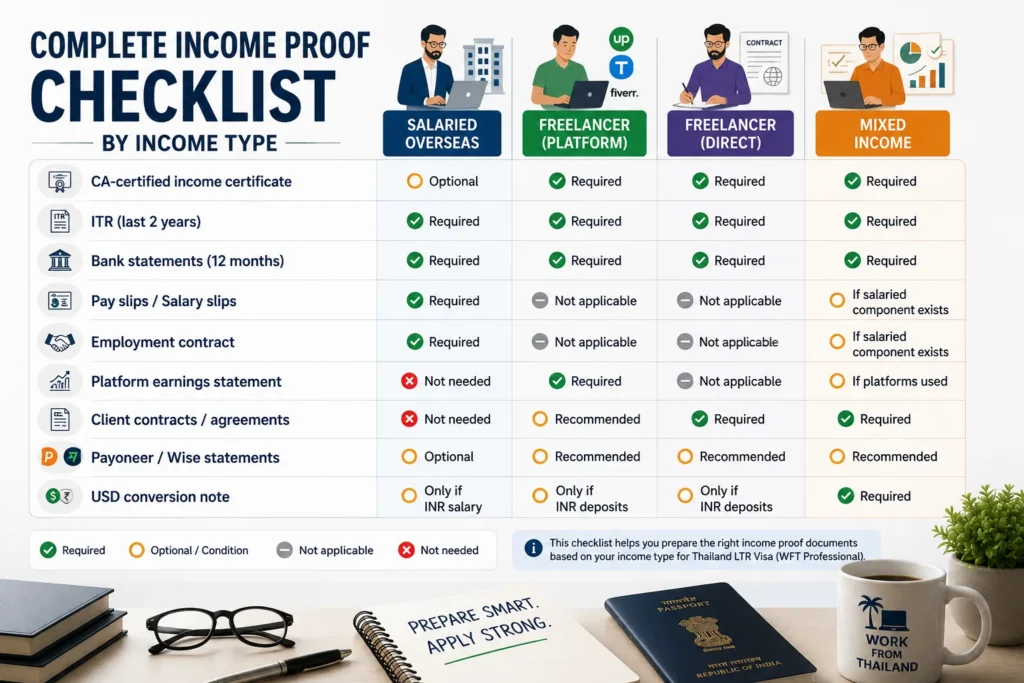
| Document | Salaried Overseas | Freelancer (Platform) | Freelancer (Direct) | Mixed Income |
| CA-certified income certificate | Optional | Required ✅ | Required ✅ | Required ✅ |
| ITR (last 2 years) | Required ✅ | Required ✅ | Required ✅ | Required ✅ |
| Bank statements (12 months) | Required ✅ | Required ✅ | Required ✅ | Required ✅ |
| Pay slips / Salary slips | Required ✅ | Not applicable | Not applicable | If salaried component exists |
| Employment contract | Required ✅ | Not applicable | Not applicable | If salaried component exists |
| Platform earnings statement | Not needed | Required ✅ | Not applicable | If platforms used |
| Client contracts / agreements | Not needed | Recommended | Required ✅ | Required ✅ |
| Payoneer / Wise statements | Optional | Recommended | Recommended | Recommended |
| USD conversion note | Only if INR salary | Only if INR deposits | Only if INR deposits | Required ✅ |
Frequently Asked Questions
Does my CA need to be from a specific city or firm?
No. Any practicing Chartered Accountant registered with the Institute of Chartered Accountants of India (ICAI) can issue the certificate. Your personal CA, a local CA office, or a CA found through the ICAI member directory are all acceptable. What matters is their ICAI membership number and professional stamp on the certificate.
My ITR shows my income as ‘business income in India’ even though it came from overseas clients. Is this a problem?
This is the most common concern for Indian freelancers. Your ITR declaration style for Indian tax purposes does not need to match your LTR Visa income proof. The CA certificate bridges this gap by explicitly confirming that your income, while declared domestically in your ITR, originated from overseas client sources. This is a standard situation and your CA can easily handle it.
Does the income need to be in USD or can it be in INR?
The income can be received and declared in INR. The BOI threshold is USD 40,000, so you need to demonstrate the INR equivalent at the applicable exchange rate. A cover note or CA certificate with this conversion is sufficient.
Can I use only Upwork statements without ITR?
Upwork statements alone are not sufficient. They serve as supporting evidence alongside, not instead of, the CA certificate and ITR. BOI requires a combination of official tax documentation and third-party income certification — platform statements alone do not satisfy both requirements.
What if my income was higher in one year and lower in another?
Submit both years’ ITR and CA certificate. If one year clearly meets the USD 40,000 threshold, that is generally sufficient. If both years are borderline, include a CA letter explaining the income trend and confirming your current earning capacity. Consistency is preferred but not mandatory if at least one recent year clearly qualifies.
Is a single-page CA certificate sufficient or does it need to be detailed?
A clear, professionally presented one-page CA certificate is sufficient if it covers all the required elements: your name, PAN, annual income amount, income source description (overseas clients/employers), CA membership details, stamp, and signature. Detail is helpful but length is not the determining factor.
Final Thoughts on Income Proof for Indian Freelancers
| The income proof requirement for the Thailand LTR Visa is genuinely manageable for Indian freelancers — but only if you prepare it correctly. The most common mistake is underestimating the CA certificate requirement or assuming that bank statements and platform screenshots are sufficient. Get your CA certificate first. Then compile your ITR documents, export your platform statements formally, and prepare a clean 12-month bank statement package. Add a brief USD conversion note if needed, and include representative client contracts. A well-prepared income proof package takes one to two weeks to assemble properly. The cost of a CA certificate (typically ₹2,000 to ₹5,000) is negligible compared to the THB 50,000 application fee and the value of a 10-year Thai visa. Do it right the first time. |