DISCLAIMER This article provides general educational analysis of FEMA regulations as they apply to Indian digital nomads. It is NOT legal advice. FEMA compliance is complex and individual-specific. Always consult a qualified Indian Chartered Accountant with FEMA expertise or an authorized FEMA consultant before making compliance decisions. FEMA regulations are subject to change via RBI notifications.
AI OVERVIEW SUMMARY The Foreign Exchange Management Act (FEMA), 1999 governs all foreign exchange transactions of Indian persons. India FEMA regulations digital nomads are particularly important because, for digital nomads, FEMA has a different NRI definition than the Income Tax Act: Section 2(v) defines a ‘person resident outside India’ based on PURPOSE of departure (employment or business abroad), not merely day count. A digital nomad who leaves India to pursue overseas work becomes a FEMA non-resident from the date of departure. Three mandatory actions follow immediately: (1) convert resident savings account to NRO, (2) open NRE account for overseas income, (3) stop resident-status financial activities. Key misconception: receiving overseas income is NOT an LRS (Liberalised Remittance Scheme) transaction — LRS is for Indian residents remitting money OUT of India. Receiving overseas income into an NRE account is a current account transaction, freely permitted under FEMA. Capital account transactions (overseas property purchase, overseas investments) may require RBI approval. FIRC (Foreign Inward Remittance Certificate) must be requested from the NRE bank for each significant overseas income receipt. Overseas bank accounts (Wise, Thai, Malaysian, Georgian banks) must be declared in Schedule FA of the annual ITR under the Black Money Act. FEMA violations carry administrative penalties up to 3× the amount involved; serious undisclosed foreign asset cases are handled by the Enforcement Directorate (ED).
QUICK ANSWER: What FEMA rules apply to Indian digital nomads? FEMA makes you a ‘person resident outside India’ (PROI) from the date you leave India for work — not after 182 days. FEMA NRI = intent-based, not day-count-based.3 mandatory actions: (1) convert resident SB account to NRO, (2) open NRE for overseas income, (3) stop resident-status financial activities.Receiving overseas income ≠ LRS. LRS is for residents remitting OUT of India. Overseas income to NRE account = current account transaction = freely allowed.All overseas bank accounts (Wise, KBank, CIMB, TBC) must be declared in Schedule FA of Indian ITR annually.FIRC from NRE bank = essential compliance document for every overseas income transfer. Engage a FEMA-qualified CA. Annual FEMA compliance review is the highest-ROI professional cost for Indian digital nomads.
Introduction: Why FEMA Matters Differently from Income Tax
Most Indian digital nomads know about the 182-day rule for NRI status under the Income Tax Act. Fewer know that FEMA — the Foreign Exchange Management Act, 1999 — has its own, different NRI definition, and that FEMA compliance obligations begin much earlier than the Income Tax Act triggers.
FEMA is the law that governs every foreign exchange transaction an Indian person makes: receiving overseas income, holding overseas bank accounts, making overseas investments, remitting money from India, and maintaining foreign assets. While income tax determines how much tax you owe, FEMA determines whether the foreign exchange transactions themselves are legally structured. You can be perfectly tax-compliant as an NRI while simultaneously being in FEMA violation because you haven’t converted your accounts. This guide covers both frameworks as they interact with the Indian digital nomad lifecycle.
1. FEMA Section 2(v): The NRI Definition That Most Nomads Miss
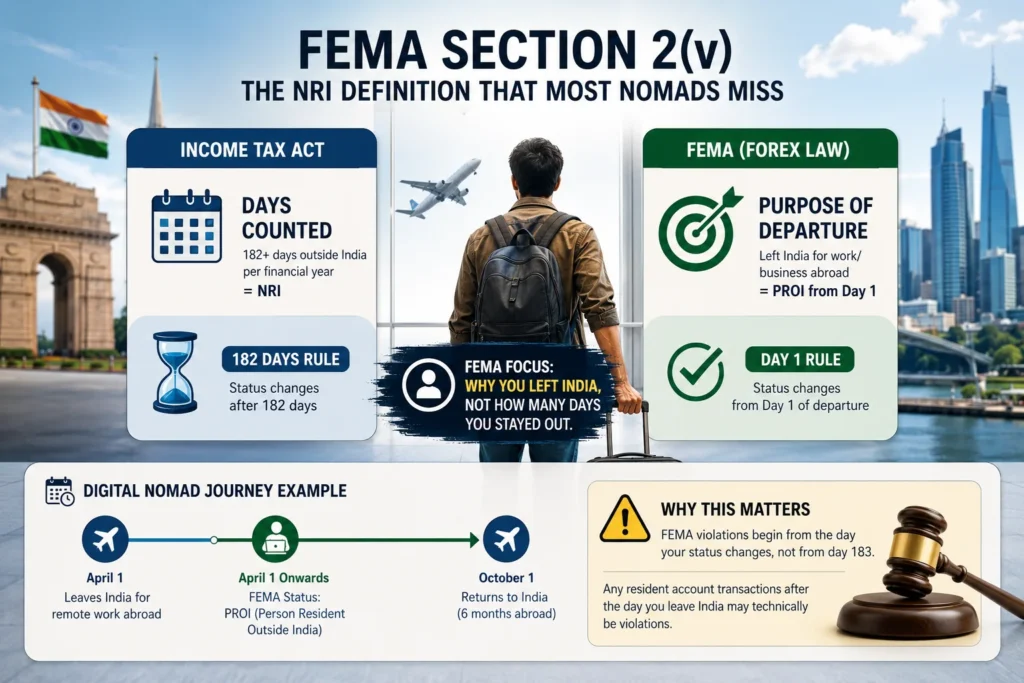
FEMA SECTION 2(V) — PERSON RESIDENT IN INDIA — PLAIN LANGUAGE The Foreign Exchange Management Act, 1999 defines a ‘person resident in India’ in Section 2(v) as: “A person residing in India for more than 182 days during the preceding financial year, but does not include: (a) a person who has gone out of India or who stays outside India in either case for or on taking up employment outside India, or for carrying on outside India a business or vocation outside India, or for any other purpose in such circumstances as would indicate his intention to stay outside India for an uncertain period.” Plain language translation: A person is NOT a FEMA resident if they have LEFT India for employment or business abroad — regardless of how many days they have been outside. The critical difference from Income Tax Act: Income Tax Act: NRI status is based on DAYS COUNTED (182+ days outside India per financial year = NRI)FEMA: PROI (Person Resident Outside India) status is based on PURPOSE OF DEPARTURE (left India for work/business abroad = PROI from Day 1 of departure) What this means for digital nomads: The day you leave India to pursue overseas freelancing or remote employment, you become a PROI under FEMA. You are not required to wait until 182 days have passed. Your FEMA obligations begin immediately. Why this matters: FEMA violations begin from the day your status changes, not from day 183. An Indian freelancer who left India in April, spends 6 months overseas, and returns in October has been a FEMA PROI from April — not from October. Any resident account transactions after April may technically be violations.
2. Three Mandatory FEMA Actions When You Become a PROI
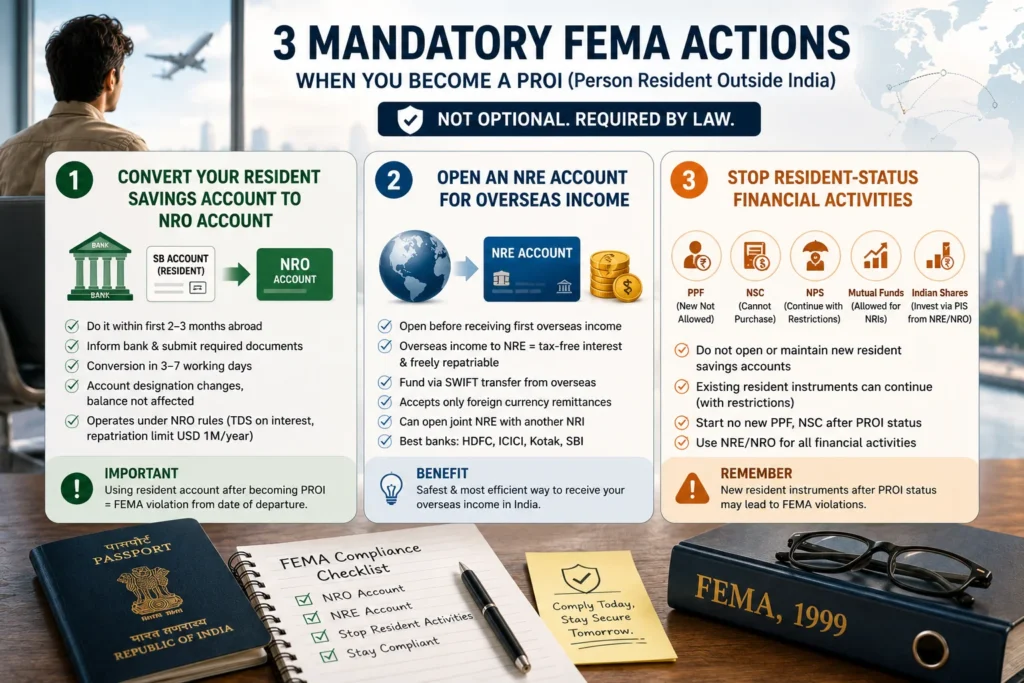
Three specific actions are required by FEMA when an Indian citizen becomes a person resident outside India. These are not optional; they are mandatory regulatory requirements.
ACT 1
Convert Your Resident Savings Account to NRO Account⏱ When: As soon as you become PROI — ideally before departing India or within first 2-3 months abroad Visit your Indian bank branch (HDFC, ICICI, SBI, Axis, Kotak) and inform them of your NRI statusRequest conversion of your resident savings account (SB account) to Non-Resident Ordinary (NRO) accountDocuments required: passport with overseas visa, work contract or overseas address proof, completed bank conversion formTimeline: banks typically process the conversion within 3-7 working daysWhat changes: the account designation changes; existing balance is not affected; the account now operates under NRO rules (30% TDS on interest, repatriation limits of USD 1 million/year) ⚠ Continuing to use a resident savings account after becoming PROI = FEMA violation. Even if you were unaware, the technical violation exists from your departure date. If you have maintained a resident account after going abroad: approach your bank proactively to convert. Voluntary compliance is treated more favorably than non-compliance discovered on audit.
ACT 2
Open an NRE Account for Overseas Income⏱ When: Simultaneously with NRO conversion — before receiving first overseas income transfer to India Open a Non-Resident External (NRE) savings account at your Indian bank (HDFC, ICICI, SBI, Kotak)NRE account is the correct vehicle for overseas income transferred to India: interest is completely tax-free (Section 10(4)(ii) Income Tax Act); funds are freely repatriableFund from overseas: SWIFT transfer from Wise to NRE account; or direct wire transfer from overseas employer/client to NRE accountNRE account cannot receive Indian rupee deposits (only foreign currency remittances)Can open joint NRE account with another NRI (not with resident Indian)Best banks for nomads: HDFC (best internet banking), ICICI (best NRI service team), Kotak (highest savings rate at approximately 3.5-4%)
ACT 3
Stop Resident-Status Financial Activities⏱ When: From the date of PROI status — applies to any new financial activities PPF (Public Provident Fund): NRIs cannot open NEW PPF accounts. Existing PPF accounts can be continued on a non-repatriable basis until maturity but cannot be extended beyond 15 years after maturityNSC (National Savings Certificate): NRIs cannot purchase NSC after becoming PROINPS (National Pension System): NRIs can continue existing NPS accounts but contributions and withdrawals have NRI-specific restrictionsEquity mutual funds: NRIs CAN invest in Indian equity mutual funds from NRE/NRO accounts; most fund houses accept NRI investmentsIndian shares: NRIs can invest in Indian equity through the Portfolio Investment Scheme (PIS) from NRE or NRO accountResident-status Savings Accounts: do not open or maintain any new savings accounts in the resident (SB) category ⚠ If you hold PPF, NSC, or other resident-status instruments before becoming PROI: you may continue them as an NRI with restrictions. Do not start NEW ones after PROI status. Consult a FEMA CA for existing instrument management.
3. The LRS Misconception: Receiving Overseas Income Is NOT LRS
THE MOST COMMON FEMA MISUNDERSTANDING AMONG INDIAN NOMADS Misconception: “I need to use the RBI’s Liberalised Remittance Scheme (LRS) to receive my overseas client income.” Reality: This is completely incorrect. LRS has nothing to do with receiving overseas income. What LRS actually is: LRS (Liberalised Remittance Scheme) is an RBI scheme that allows RESIDENT INDIANS (people living in India) to remit up to USD 250,000 per financial year OUTSIDE India for specific permitted purposes: overseas education, travel, overseas investment, overseas property purchase, gift to relatives abroad, maintenance of family members abroad. LRS applies to: A person LIVING IN INDIA who wants to SEND money to their overseas bank account A person LIVING IN INDIA who wants to invest in overseas stocks or buy overseas property A person LIVING IN INDIA sending money to a child studying abroad LRS does NOT apply to: An NRI receiving overseas income into their NRE account in India An NRI transferring money from their Wise account to their NRE account A digital nomad transferring Upwork earnings from overseas to India The correct FEMA classification for receiving overseas income: CURRENT ACCOUNT TRANSACTION. Under FEMA, current account transactions are generally freely permitted for NRIs without RBI approval. Receiving overseas income is a current account transaction — permitted, documented (via FIRC), and not subject to LRS limits. If you are an NRI receiving overseas client income into your NRE account: you do not need LRS. You do not have a USD 250,000 limit. Receive your income, get your FIRC, and maintain your records.
4. Capital Account vs Current Account: Why the Distinction Matters
FEMA divides all foreign exchange transactions into two categories. Understanding which category your transaction falls in determines whether it is freely permitted or requires RBI approval.
Transaction Type
Category
FEMA Treatment
Examples Relevant to Digital Nomads
Receiving overseas income into NRE account
Current Account
Freely permitted — no RBI approval needed
Upwork earnings, overseas client payment, overseas employer salary transferred to India
Holding overseas bank accounts (Wise, TBC Georgia, KBank)
Capital Account (overseas asset)
Permitted for NRIs — but must be declared in Schedule FA
Foreign bank accounts; must report in annual ITR Schedule FA
Buying overseas real estate (Bali villa, Bangkok condo)
Capital Account
Requires RBI approval under FEMA (Overseas Direct Investment / FDI rules)
Purchasing property abroad; not a current account transaction
Investing in overseas stocks (US ETFs, overseas company shares)
Capital Account
NRIs can invest in overseas stocks within specified FEMA provisions; complex rules apply
Investing in US S&P 500 ETFs, overseas startup equity; consult FEMA CA
Opening overseas bank account as NRI
Capital Account (but permitted)
NRIs permitted to hold overseas bank accounts freely; declaration in Schedule FA required
TBC Georgia, CIMB Malaysia, Wise — all permissible to hold; declare in Schedule FA
Sending money from NRE account back to overseas bank
Repatriation
Freely permitted — NRE funds are fully repatriable
Sending NRE savings back to Wise or overseas bank for investment or use
THE OVERSEAS PROPERTY QUESTION: DO YOU NEED RBI PERMISSION? A commonly asked question from Indian digital nomads who have been living in Bali, KL, or Bangkok for a few years: “Can I buy a property in my nomad base country?” Under FEMA: purchasing immovable property outside India is a capital account transaction that generally requires RBI approval under the Foreign Exchange Management (Acquisition and Transfer of Immovable Property outside India) Regulations. As an NRI, you can purchase overseas property from: Funds held in NRE/FCNR accounts (repatriable basis) or NRO accounts (non-repatriable basis) under specific conditionsFunds earned and held overseas (without routing through India) The regulations are complex and depend on the nature of the purchase (residential vs commercial), the source of funds, and the country involved. Some countries have their own restrictions on foreign property ownership (Indonesia, for example, has significant restrictions on foreigners owning freehold property). Consult a FEMA-specialized CA before any overseas property transaction.
5. FIRC: The Compliance Document Every Indian Nomad Must Collect
FIRC — FOREIGN INWARD REMITTANCE CERTIFICATE — COMPLETE GUIDE A FIRC (Foreign Inward Remittance Certificate) is a document issued by an authorized Indian bank certifying that a specific foreign exchange remittance was received into an Indian bank account. It is one of the most important compliance documents for Indian digital nomads. Why FIRC matters: FEMA compliance proof: confirms that overseas income was legitimately received as an inward remittance from an overseas sourceIncome Tax documentation: primary evidence of overseas income for ITR filing; supports the source of funds in case of any income tax inquiryGST compliance for service exporters: if you are registered for GST and providing IT/professional services to overseas clients, FIRCs serve as proof of export of services (eligible for LUT/bond or IGST refund claims)Bank audit trail: most Indian banks require FIRCs as part of NRE account compliance documentation How to request FIRC from your Indian bank: After each overseas income transfer is credited to your NRE account: note the transaction date, amount received, and remitting bank detailsRequest FIRC in writing to your bank: “Please issue FIRC for inward remittance of [amount] received on [date] from [Wise/overseas bank] to NRE account [account number].”Most banks offer FIRC via net banking portal (HDFC NetBanking, ICICI iMobile). Some require branch visit or email request.Fee: typically ₹100-500 per FIRC. Some banks provide free FIRCs for NRE account holders.Keep all FIRCs organized: soft copy (PDF) and physical copy. Maintain for at least 7 years (standard Indian income tax record-keeping period). FIRC for Wise → NRE transfers: when you transfer from Wise to your NRE account via SWIFT, the NRE bank issues a FIRC for the inward remittance. The FIRC shows: amount in INR, original foreign currency amount, remitting bank (Wise’s partner bank), date of credit, and your NRE account details.
6. Overseas Bank Accounts: Schedule FA Declaration
ALL OVERSEAS ACCOUNTS MUST BE DECLARED IN SCHEDULE FA Every Indian NRI with overseas bank accounts is required to declare them in Schedule FA (Foreign Assets) of the Indian ITR. This requirement comes from the Black Money (Undisclosed Foreign Income and Assets) and Imposition of Tax Act, 2015 — not just FEMA. Accounts that must be declared: Wise multi-currency account (held in foreign currency outside India)KBank or Bangkok Bank account in Thailand CIMB or Maybank account in Malaysia TBC Bank or Bank of Georgia account in Georgia Any other foreign bank, investment, or financial account What to declare in Schedule FA: Country where account is held Name and address of the foreign bank/financial institution Account number Account opening date Peak balance during the year (highest balance at any point during the financial year)Closing balance as of March 31Interest income or other income received from the account Penalty for non-declaration: Black Money Act, 2015: penalty of ₹10 lakh per undisclosed foreign asset This penalty is separate from any income tax implications The penalty applies even if no income was earned from the foreign account Filing: complete Schedule FA in your annual ITR (ITR-2 or ITR-3 for NRIs). The declaration is part of the standard ITR; no separate filing required.
7. The FEMA Penalty Framework: Understanding Proportionality
FEMA VIOLATION CONSEQUENCES — TIERED FRAMEWORK FEMA violations are not all equal. The penalty framework is tiered by severity: Tier 1 — Administrative Compounding (RBI): Minor/technical violations: delayed account conversion, procedural non-compliance, delayed FIRC documentation RBI may ‘compound’ (settle administratively) these violations Penalty: up to 3× the amount involved; or ₹2 lakh where amount cannot be quantified Typically dealt with proactively by the nomad through their bank/CA; not criminal proceedings Tier 2 — Adjudication (Enforcement Directorate): More serious FEMA violations referred to the Enforcement Directorate (ED) for formal adjudication ED conducts investigation and issues adjudication order Penalty: up to 3× the amount involved for contraventions of FEMA Asset attachment possible if ED believes proceeds of violation remain Tier 3 — Serious/Criminal (ED prosecution + Black Money Act): Deliberate, large-scale concealment of overseas assets Black Money Act violations: penalty ₹10 lakh per undisclosed foreign asset + 60-90% additional tax on undisclosed income Criminal prosecution in cases of willful evasion Context for digital nomads: Maintaining a resident account for a few months after going abroad = Tier 1 technical violation. Approach bank, convert, notify CA. Compounding possible.Failing to declare Wise account in Schedule FA for 3 years = Tier 3 risk (Black Money Act). More serious.Receiving overseas income into NRE account and getting FIRCs = compliant. No FEMA violation. The correct approach: proactive voluntary compliance. Discover a violation early, disclose to CA, approach bank/RBI for compounding. Self-disclosure is always treated more favorably than discovery on audit.
8. Complete FEMA Compliance Checklist for Indian Digital Nomads
FEMA COMPLIANCE CHECKLIST — COMPLETE FOR INDIAN NOMADS Account structure: ☐ Resident savings account CONVERTED to NRO account at Indian bank☐ NRE account OPENED for overseas income receipt☐ No new PPF accounts opened after PROI status☐ No new NSC purchases after PROI status☐ No resident-category savings or fixed deposits Overseas income management: ☐ All overseas income received into NRE account (via Wise SWIFT or direct)☐ FIRC requested from NRE bank for EVERY significant inward remittance☐ FIRCs maintained for minimum 7 years☐ Wise transaction history (PDF) exported and saved annually Annual ITR compliance: ☐ ITR filed annually (ITR-2 or ITR-3) even if India income below taxable threshold (to claim any TDS refund and for Schedule FA compliance)☐ Schedule FA completed: all overseas bank accounts declared (Wise, Thai bank, Malaysian bank, Georgian bank)☐ Schedule TR completed: any DTAA credits claimed with foreign tax payment proof attached☐ Form 26AS reviewed for any TDS deducted by Indian clients or banks Professional support: ☐ FEMA-qualified CA engaged for annual compliance review☐ Any capital account transactions (overseas property, overseas investment) reviewed by FEMA CA before proceeding☐ FEMA CA briefed on all overseas accounts and transactions annually
9. The FEMA-Income Tax Interface: Keeping It All Aligned
FEMA compliance and income tax compliance are distinct but interconnected. The same NRI status determination and the same overseas income affect both frameworks. Understanding how they interact prevents the most common compliance failure — being compliant with one while inadvertently violating the other.
Scenario
FEMA Position
Income Tax Position
Joint Compliance Required
NRI receiving Wise income into NRE account
Current account transaction — permitted; get FIRC
Not taxable in India (NRI overseas active income exempt)
File ITR as NRI; declare NRE account in Schedule FA; keep FIRC as income proof
NRI holding ₹50 lakh in NRE FD
NRE account is correct vehicle for NRI savings; FEMA-compliant
No additional compliance beyond NRE account maintenance and FIRC records
NRI receiving rental income from Indian flat
India-sourced income — NRO account for rental receipts; tenant TDS under Section 195
Taxable in India at slab rates after 30% standard deduction
NRO account for rental receipts; ITR filing with Schedule HP; TDS reconciliation
NRI with Wise account (not declared in Schedule FA)
FEMA: Wise is a foreign financial account; declarable in Schedule FA
Black Money Act violation: ₹10 lakh penalty per undisclosed foreign asset; also income tax investigation risk
Immediate disclosure in next ITR Schedule FA; consult CA for any penalty exposure
NRI buying Bali villa with NRE funds
Capital account transaction — requires FEMA/RBI compliance before proceeding
Overseas property must be declared in Schedule FA (asset value)
CA consultation mandatory before transaction; both FEMA and Income Tax implications
Frequently Asked Questions
What India FEMA regulations digital nomads Apply to Those Living Abroad?
FEMA Section 2(v) classifies an Indian who leaves for employment or business abroad as a ‘person resident outside India’ (PROI) from the date of departure — not after 182 days. Three mandatory actions follow: (1) convert resident savings account to NRO account, (2) open NRE account for overseas income, (3) stop resident-status financial activities (new PPF, NSC). All overseas bank accounts (Wise, KBank, CIMB, TBC) must be declared in Schedule FA of the annual ITR. FIRC must be requested from the NRE bank for each overseas income transfer.
How is FEMA’s NRI definition different from the Income Tax Act?
Income Tax Act: NRI status based on DAY COUNT — under 182 days in India per financial year. FEMA: PROI (Person Resident Outside India) status based on PURPOSE OF DEPARTURE — leaving India for employment or business abroad makes you PROI from Day 1, regardless of days counted. A digital nomad who left India in April for overseas work is a FEMA PROI from April, even though the Income Tax Act may not classify them as NRI until they complete under-182-days in the full financial year.
Is receiving overseas income an LRS (Liberalised Remittance Scheme) transaction?
No. LRS is a scheme allowing Indian RESIDENTS to remit money FROM India TO overseas (up to USD 250,000/year for permitted purposes). Receiving overseas income into an NRE account in India is a CURRENT ACCOUNT TRANSACTION — not an LRS transaction. NRIs are not subject to LRS limits when receiving overseas income. There is no USD 250,000 cap on overseas income received by NRIs. The LRS scheme and receiving overseas income are completely separate FEMA provisions.
FIRC (Foreign Inward Remittance Certificate) is a document issued by an Indian bank certifying that a foreign currency remittance was received into an Indian bank account. Digital nomads need FIRCs for: (1) FEMA compliance proof that overseas income was legitimately received, (2) Income tax documentation supporting the source of funds, (3) GST compliance for professional service exporters. Request FIRC from your NRE bank for each overseas income transfer via net banking or branch request. Keep all FIRCs for minimum 7 years.
Do I need to declare my Wise account in India’s income tax return?
Yes. The Wise multi-currency account is a foreign bank/financial account held outside India. Under the Black Money (Undisclosed Foreign Income and Assets) and Imposition of Tax Act, 2015, all foreign bank accounts must be declared in Schedule FA of the annual Indian ITR — regardless of whether the account earned income. Non-declaration carries a penalty of ₹10 lakh per undisclosed foreign asset. Declare Wise account, TBC Georgia, CIMB Malaysia, KBank Thailand, and any other overseas account in Schedule FA every year.
What happens if I maintained a resident account after going abroad?
Continuing to operate a resident savings account after becoming a PROI under FEMA is technically a FEMA violation. The appropriate response: approach your bank proactively to convert the account to NRO, and inform your FEMA-qualified CA. Technical violations of this nature are typically handled through RBI compounding (administrative settlement) rather than criminal proceedings, particularly when voluntarily disclosed. Proactive self-disclosure is always treated more favorably than violations discovered during audit.
Final Verdict: FEMA Is Manageable With Proactive Compliance
FEMA compliance for Indian digital nomads is not complicated — it is sequential and documentation-based. Convert your accounts, receive overseas income into NRE, collect FIRCs, declare overseas accounts in Schedule FA, and engage a FEMA-qualified CA for your annual ITR. This covers 95% of FEMA obligations for a typical Indian freelancer or remote employee. The most important mental model shift: FEMA compliance begins from the day you leave India for work — not from day 183. Most FEMA problems among Indian nomads come from a 6-12 month delay in converting accounts, driven by the incorrect belief that the 182-day Income Tax rule also applies to FEMA. It does not. The two things that create the highest FEMA/Black Money Act risk: (1) maintaining undisclosed overseas bank accounts without Schedule FA declaration, and (2) capital account transactions (overseas property, overseas investments) without proper FEMA authorization. Both are avoidable with a FEMA CA’s guidance. Annual FEMA compliance cost: a FEMA-qualified CA for NRI ITR filing with Schedule FA, FIRC review, and compliance advisory typically costs ₹8,000-20,000/year. This is one of the highest-ROI professional expenses available to Indian digital nomads. Read the NRE vs NRO Account guide for the banking structure, or the Indian Tax Guide for the complete tax position that works alongside FEMA compliance.
ENSURE FEMA COMPLIANCE
Start with the NRE/NRO account setup. Engage a FEMA-qualified CA. Declare all overseas accounts in Schedule FA annually. Collect FIRCs for every overseas income transfer. [ NRE vs NRO Account Guide → ] [ Indian Tax Guide → ] [ India-Thailand DTAA → ] [ Indian Nomad Hub → ]