
| The ‘Remotely from Georgia’ programme is a Georgian government initiative launched in 2020 by the Georgian National Tourism Administration (GNTA) to attract international remote workers to live and work from Georgia. It is not a visa — it is a registration platform that provides benefits such as coworking discounts, healthcare deals, and community access for registered remote workers. Georgia offers visa-free entry for up to 365 days to citizens of many countries, including Filipino nationals. Indian citizens may access Georgia visa-free if they hold a valid US, UK, or Schengen visa; otherwise, a Georgian e-visa is available for approximately USD 20 to 50. Georgia’s key appeal is its very low cost of living (USD 800 to 1,500/month in Tbilisi), fast internet, easy banking (TBC Bank and Bank of Georgia are accessible to foreigners within days of arrival), and a flat 20% income tax that does not apply to foreign-sourced income for non-tax-resident visitors. |
| QUICK ANSWER: What is the Remotely from Georgia programme for digital nomads? The ‘Remotely from Georgia’ programme is a Georgian government initiative that allows remote workers from around the world to live and work legally in Georgia by leveraging its existing visa-free access (up to 365 days for most nationalities). Key facts: Launched: 2020 by the Georgian National Tourism Administration (GNTA)Website: remotelyfromgeorgia.com Type: Benefits registration programme (not a separate visa)Key benefit: Access to coworking discounts, healthcare deals, and digital nomad community Entry: Visa-free for most nationalities (including Filipinos); Indian citizens need a valid US/UK/Schengen visa or Georgian e-visa Cost: Registration is free; living costs in Tbilisi start at approximately USD 800–1,500/month Georgia is one of the most accessible and affordable digital nomad destinations in the world, with excellent internet infrastructure and a welcoming foreigner community. |
| DISCLAIMER Georgia’s visa policy, programme benefits, and tax regulations can change. The information in this guide reflects the situation as of May 2026. Always verify current entry requirements from the Georgian Ministry of Foreign Affairs (mfa.gov.ge) and programme status at remotelyfromgeorgia.com before traveling. This is not legal or tax advice. |
Introduction
When Georgian authorities launched the ‘Remotely from Georgia’ programme in 2020 during the global pandemic, they were solving a straightforward problem: encourage skilled remote workers to move to Georgia, spend their foreign income locally, and contribute to the Georgian economy — without creating a complex new visa category.
The approach worked. Georgia rapidly became one of the top digital nomad destinations in the world, particularly for remote workers from Eastern Europe, Russia, and increasingly South Asia. The combination of near-zero entry barriers (visa-free for most nationalities), extremely low cost of living, fast internet, and easy banking made Georgia one of the most practical bases for remote work that exists anywhere.
For Indian and Filipino remote workers looking for an affordable, legally straightforward place to work from, Georgia deserves serious attention. This guide covers everything you need to know, including the specifics that matter most for South Asian passport holders.
What Is the Remotely from Georgia Programme?
| PROGRAMME OVERVIEW Official name: Remotely from Georgia (დისტანციურად საქართველოდან) Launched: May 2020 Issuing authority: Georgian National Tourism Administration (GNTA) under the Georgian government Website: remotelyfromgeorgia.com Purpose: Attract international remote workers to Georgia; stimulate the local economy through foreign spending What it is: A registration and benefits platform — NOT a separate visa type What it gives you: Discounts at partner coworking spaces, hotels, healthcare providers, and SIM card operators; access to the programme’s digital nomad community What it does not give you: A visa, a work permit, or any immigration status beyond what Georgia already provides through its standard entry policy |
The most important clarification this guide makes: registering on remotelyfromgeorgia.com does not issue you a visa. Georgia’s standard visa-free policy already allows most nationalities to stay up to 365 days per year. The programme is simply a way to formalize your status as a remote worker, access partner discounts, and join the digital nomad community in Georgia.
Programme vs. Visa: The Critical Distinction
| Aspect | Remotely from Georgia Programme | Georgia Standard Visa-Free Entry |
| What it is | A registration platform with benefits | An immigration policy granting entry without a visa |
| Issued by | Georgian National Tourism Administration (GNTA) | Georgian Ministry of Internal Affairs |
| Required for entry? | No — registration is optional | Depends on your nationality |
| Duration of stay | Does not extend your permitted stay | Governs how long you can legally stay in Georgia |
| Benefits | Coworking discounts, healthcare deals, community | None beyond the right to stay |
| Cost | Free to register | Free for visa-free nationalities; USD 20–50 for e-visa |
Practical implication: Filipino nationals who enter Georgia visa-free for 365 days are already living and working remotely in Georgia legally without registering for the programme. Registering simply adds the benefit layer on top. Indian nationals who need a Georgian e-visa should get the e-visa first — the programme registration is separate and optional.
Eligibility Requirements for the Programme
The programme’s formal requirements are minimal:
| Requirement | What Is Needed |
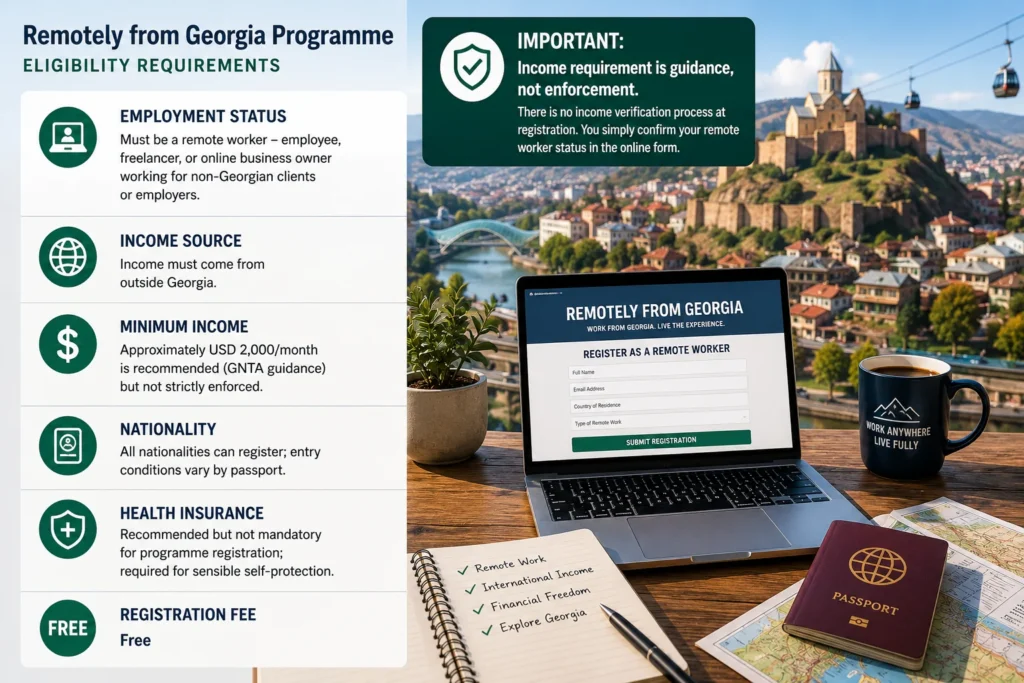
| Employment status | Must be a remote worker — employee, freelancer, or online business owner working for non-Georgian clients or employers |
| Income source | Income must come from outside Georgia (you are not working for Georgian companies) |
| Minimum income | Approximately USD 2,000/month is recommended (GNTA guidance) but not strictly enforced at registration |
| Nationality | All nationalities can register; entry conditions vary by passport (see nationality section) |
| Health insurance | Recommended but not mandatory for programme registration; required for sensible self-protection |
| Registration fee | Free |
| IMPORTANT: INCOME REQUIREMENT IS GUIDANCE, NOT ENFORCEMENT The USD 2,000/month income suggestion from GNTA is a recommendation to ensure participants can sustainably support themselves in Georgia. It is not verified at programme registration. You fill in an online form confirming your remote worker status; there is no income verification process. This makes the Remotely from Georgia programme one of the most accessible remote work programmes globally. |
How to Register with the Remotely from Georgia Programme
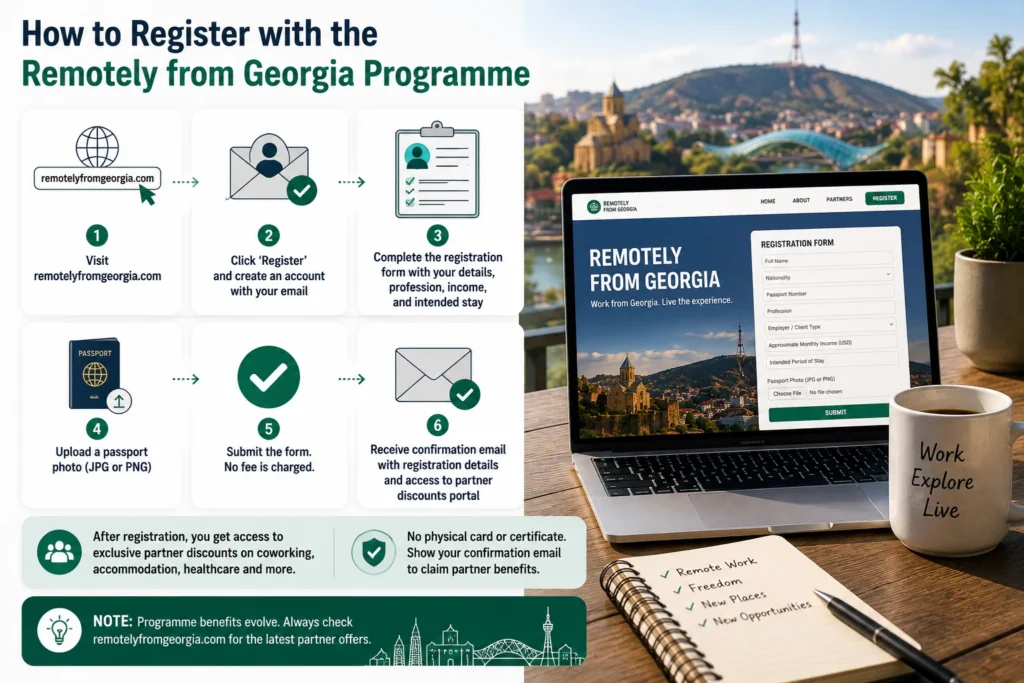
The registration process is entirely online and takes approximately 15 minutes:
- Visit remotelyfromgeorgia.com
- Click ‘Register’ and create an account with your email address
- Complete the registration form: full name, nationality, passport number, profession, employer or client type (employee/freelancer/business), approximate monthly income, and intended period of stay in Georgia
- Upload a passport photo (JPG or PNG format)
- Submit the form. No fee is charged.
- Receive a confirmation email with your programme registration details and access to the partner discounts portal
After registration, you receive login access to the partner deals section of the website. The programme does not issue a physical card or certificate — you present your programme registration confirmation email when claiming discounts at partner locations.
Note: As of 2026, the programme’s active management level has evolved since its 2020 launch. Verify that partner benefits are current by checking the programme website before relying on specific discount listings.
Entry to Georgia: Visa Policy by Nationality
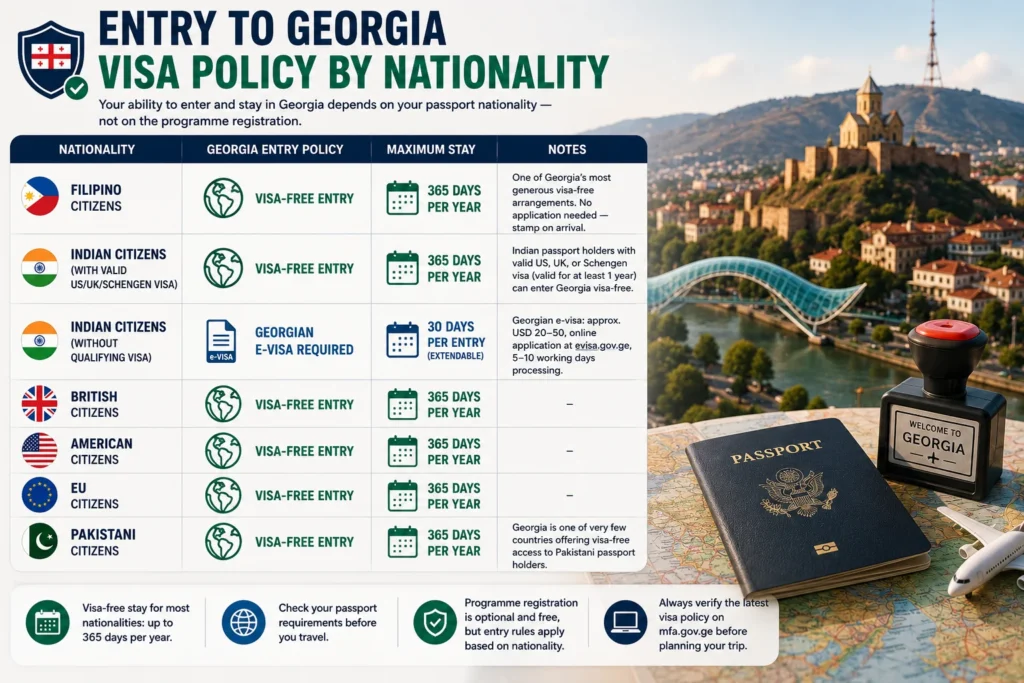
Your ability to enter and stay in Georgia depends on your passport nationality — not on the programme registration. Here is what you need to know:
| Nationality | Georgia Entry Policy | Maximum Stay | Notes |
| Filipino citizens | Visa-free entry | 365 days per year | One of Georgia’s most generous visa-free arrangements. No application needed — stamp on arrival. |
| Indian citizens (with valid US/UK/Schengen visa) | Visa-free entry | 365 days per year | Indian passport holders with valid US, UK, or Schengen visa (valid for at least 1 year) can enter Georgia visa-free. |
| Indian citizens (without qualifying visa) | Georgian e-visa required | 30 days per entry (extendable) | Georgian e-visa: approx. USD 20–50, online application at evisa.gov.ge, 5–10 working days processing. |
| British citizens | Visa-free | 365 days | |
| American citizens | Visa-free | 365 days | |
| EU citizens | Visa-free | 365 days | |
| Pakistani citizens | Visa-free | 365 days | Georgia is one of very few countries offering visa-free access to Pakistani passport holders |
Nationality-Specific Guidance: Indian Citizens
| INDIA-SPECIFIC GEORGIA ENTRY GUIDE For Indian citizens, Georgia entry works as follows: If you hold a valid US visa, UK visa, or Schengen visa with at least 12 months remaining validity: you can enter Georgia visa-free and stay up to 365 days per year. If you do NOT hold any of these visas: apply for a Georgian e-visa at evisa.gov.ge before traveling. The e-visa costs approximately USD 20 to 50, is processed in 5 to 10 working days, and grants a single 30-day entry that can be extended in Georgia. For longer stays as an Indian citizen without a qualifying third-country visa: enter on an e-visa, then extend or exit and re-enter (a short trip to nearby countries like Armenia, Azerbaijan, or Turkey is common for a re-entry).Indian passport holders registering for the Remotely from Georgia programme: registration is separate from visa issuance. Get your visa sorted first, then register for the programme. See our companion article: Georgia visa-free access for Indian citizens — for the complete entry guide with current conditions. |
Nationality-Specific Guidance: Filipino Citizens
| PHILIPPINES-SPECIFIC GEORGIA ENTRY GUIDE Filipino citizens have one of the simplest Georgia entry situations of all South and Southeast Asian nationalities: Visa-free entry for up to 365 days per year with a Philippine passportNo application, no fee, no prior approval needed — simply book your flight and enter Georgia at Tbilisi International AirportStamp on arrival valid for 365 days from the entry dateAfter 365 days, exit Georgia for at least 1 day and re-enter for another 365-day permitted stayRegistering for the Remotely from Georgia programme is optional but recommended for the coworking and healthcare discounts Filipino remote workers have arguably the most frictionless path to Georgia of any nationality: no visa, no income verification, straightforward entry process. |
Cost Breakdown: What Does It Cost to Join the Programme?
The programme itself is free to register. The costs involved are entirely related to your Georgia stay:
| Cost Item | Amount (GEL) | Amount (USD approx.) | Notes |
| Programme registration | Free | Free | No fee at remotelyfromgeorgia.com |
| Georgian e-visa (if required) | GEL 55–80 | USD 20–50 | Indian citizens without qualifying visa; not required for Filipinos |
| SIM card (Magti, Geocell, Beeline) | GEL 10–15 | USD 4–6 | Programme may offer discounted SIM packages |
| Airport transfer to Tbilisi centre | GEL 30–50 | USD 11–19 | Bolt or taxi from Tbilisi International Airport (TBS) |
| Monthly coworking space membership | GEL 100–350 | USD 37–130 | Programme partner discounts reduce these rates by 20–40% |
| Monthly accommodation (1-bedroom, Tbilisi centre) | GEL 600–1,600 | USD 220–590 | Prices vary significantly by neighbourhood |
| Monthly food (restaurants + groceries) | GEL 400–800 | USD 150–295 | Georgia is notably affordable for food |
| Health insurance (international plan) | USD 50–100/month | USD 50–100 | Recommended; programme may offer Georgian health insurance discounts |
Note: GEL/USD conversion as of May 2026. Verify current rates before budgeting.
Cost of Living in Tbilisi for Remote Workers
Tbilisi is consistently cited as one of the most affordable digital nomad capitals in the world. Here is a realistic monthly budget:
| Expense Category | Budget Level (GEL/month) | Comfortable Level (GEL/month) |
| Accommodation (1-bedroom apartment) | GEL 600–1,000 | GEL 1,100–1,600 |
| Food (restaurants 3–4x/week + groceries) | GEL 350–500 | GEL 600–900 |
| Coworking or internet cafe | GEL 100–200 | GEL 250–400 |
| Transport (Tbilisi metro + occasional taxis) | GEL 50–100 | GEL 100–200 |
| Utilities (included in most rentals) | GEL 0–80 | GEL 0–80 |
| Entertainment and going out | GEL 100–200 | GEL 200–400 |
| TOTAL monthly estimate | GEL 1,200–2,080 (approx. USD 440–765) | GEL 2,250–3,580 (approx. USD 830–1,320) |
For comparison: the USD 800 to 1,500 monthly budget that gets you a comfortable digital nomad life in Tbilisi would cover only basic accommodation in Bangkok or Bali, without the coworking and dining quality.
Banking in Georgia: TBC Bank and Bank of Georgia
One of Georgia’s most overlooked advantages for digital nomads is its banking accessibility. Unlike Thailand, where opening a bank account as a foreign national is visa-dependent and branch-inconsistent, Georgian banks serve foreign nationals with minimal bureaucracy.
TBC Bank (recommended)
TBC Bank is Georgia’s second-largest bank and the most popular among digital nomads and expats. Account opening for foreign nationals:
- Visit any TBC Bank branch with your passport and your Georgian entry stamp
- Request a personal account opening (most staff speak reasonable English)
- Receive a debit card (instant issuance or 1–3 business days)
- Set up TBC Bank’s app for full mobile banking (excellent interface, English support)
- No minimum deposit typically required for basic savings account
- IBAN account issued for international transfers (SWIFT and SEPA)
Bank of Georgia (BOG)
The other major option. Similar process and accessibility. Bank of Georgia has a strong mobile app and a large ATM network. Both TBC and BOG are well-regarded for foreign nationals.
| GEORGIAN BANKING VS. THAI BANKING FOR NOMADS Georgian banking is significantly easier for foreign nationals than Thai banking. While Thai banks require specific visa types and often reject tourist visa holders, Georgian banks typically require only a valid passport and a Georgian entry stamp. There is no visa-type filter for account opening. This is one of Georgia’s most practical advantages for digital nomads who have struggled with Thai banking requirements. |
Tax Implications for Remote Workers in Georgia
Georgia’s tax environment is one of its strongest attractions for international remote workers. Understanding how it works for digital nomads:
Georgian tax residency
You become a Georgian tax resident if you spend more than 183 days in Georgia in a calendar year AND your income is considered Georgian-sourced. For remote workers earning from non-Georgian clients and employers, income is considered foreign-sourced even if you are physically in Georgia.
Flat 20% income tax
Georgia has a flat 20% personal income tax rate. However, foreign-sourced income — income from clients and employers outside Georgia — is not subject to Georgian income tax for remote workers who have not established formal Georgian residency or a Georgian business entity. Most digital nomads in Georgia fall into this category.
Georgian Virtual Zone (for IT companies)
For those who want to formalize their Georgia base with a Georgian company, the Georgian Virtual Zone is a registration available to IT companies. Virtual Zone entities pay 0% income tax on foreign-sourced revenue and 5% dividend tax when distributing profits. This is used by some highly motivated digital nomads to formalize their Georgian tax status. It requires setting up a Georgian LLC, which involves approximately USD 100 to 300 in registration costs.
| HOME COUNTRY TAX OBLIGATIONS CONTINUE Living in Georgia does not automatically eliminate your home country tax obligations. Indian nationals who spend fewer than 182 days in India in a financial year may qualify for NRI status, with different tax implications. Filipino nationals have similar considerations under Philippine tax law. Always consult a tax professional in your home country before making long-term plans based on Georgian tax efficiency. |
Programme Benefits: What You Actually Get
Registering at remotelyfromgeorgia.com provides access to the programme’s partner network. Benefits as of the most recent programme update:
- Discounted coworking memberships at partner coworking spaces in Tbilisi (20 to 40% discounts at spaces such as Impact Hub Tbilisi, Fabrika, and others)
- Healthcare discounts at partner Georgian healthcare providers and pharmacies
- Discounted or free SIM cards from participating Georgian telecom operators (Magti, Geocell)
- Hotel and accommodation deals at partner properties
- Access to a community of registered remote workers in Georgia
- Official Georgian government recognition of your remote worker status (useful for communicating your purpose of stay)
Practical note: The programme’s partner list and specific discounts should be verified at remotelyfromgeorgia.com at the time of your registration, as partner relationships evolve. The core value of the programme is the entry policy (which exists independently) and the community access — not the discount catalogue alone.
Georgia vs. Thailand vs. Malaysia: Comparison for Digital Nomads
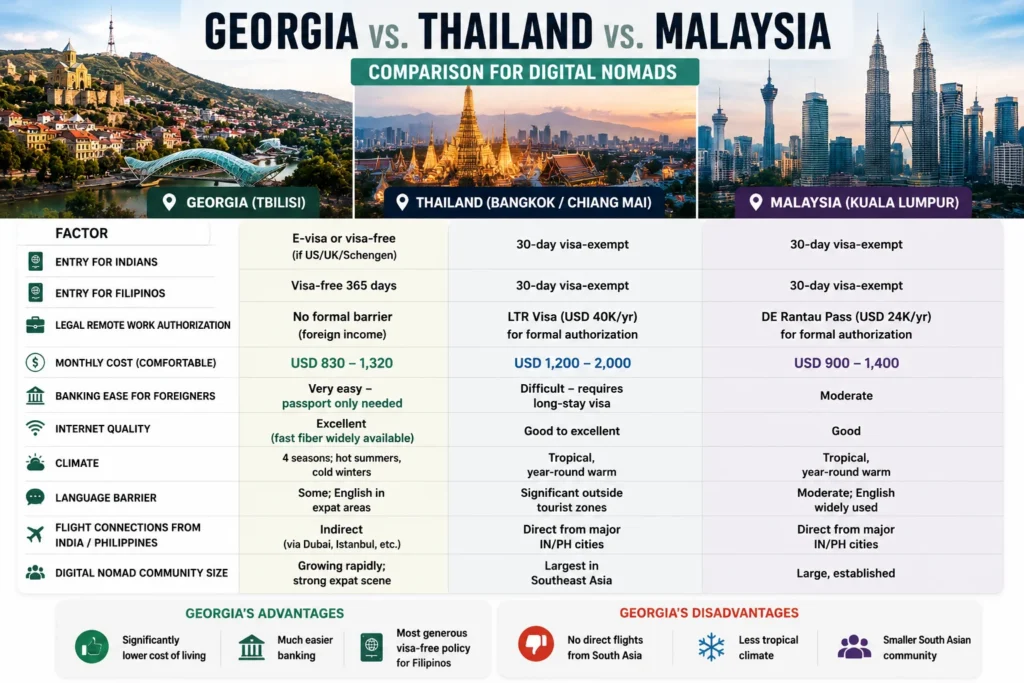
| Factor | Georgia (Tbilisi) | Thailand (Bangkok/Chiang Mai) | Malaysia (Kuala Lumpur) |
| Entry for Indians | E-visa or visa-free (if US/UK/Schengen) | 30-day visa-exempt | 30-day visa-exempt |
| Entry for Filipinos | Visa-free 365 days | 30-day visa-exempt | 30-day visa-exempt |
| Legal remote work authorization | No formal barrier (foreign income) | LTR Visa (USD 40K/yr) for formal authorization | DE Rantau Pass (USD 24K/yr) for formal authorization |
| Monthly cost (comfortable) | USD 830–1,320 | USD 1,200–2,000 | USD 900–1,400 |
| Banking ease for foreigners | Very easy — passport only needed | Difficult — requires long-stay visa | Moderate |
| Internet quality | Excellent (fast fiber widely available) | Good to excellent | Good |
| Climate | 4 seasons; hot summers, cold winters | Tropical, year-round warm | Tropical, year-round warm |
| Language barrier | Some; English in expat areas | Significant outside tourist zones | Moderate; English widely used |
| Flight connections from India/Philippines | Indirect (via Dubai, Istanbul, etc.) | Direct from major IN/PH cities | Direct from major IN/PH cities |
| Digital nomad community size | Growing rapidly; strong expat scene | Largest in Southeast Asia | Large, established |
Georgia’s clear advantages over Thailand and Malaysia: significantly lower cost of living, much easier banking for foreigners, and the most generous visa-free policy for Filipino nationals in the region. Its disadvantages are the lack of direct flights from South Asia, the less tropical climate, and a smaller existing South Asian community compared to Thailand.
Realistic Risks and Limitations
- Indirect flight connections: Getting to Georgia from India or the Philippines requires at least one connection (typically via Dubai, Istanbul, Doha, or Almaty). Travel times are 8 to 14+ hours. This is the most practical barrier for South Asian digital nomads considering Georgia.
- Language: While English is used in Tbilisi’s expat and coworking zones, Georgian is the national language and daily life outside tourist areas involves a significant language barrier.
- Programme evolution: The Remotely from Georgia programme has evolved since its 2020 launch. Some benefits that were prominent early on have changed. Always check the current programme status before making plans based on specific listed discounts.
- Climate: Georgia has four seasons. If you prefer year-round warmth, Georgia’s winters (November to March) in Tbilisi can be cold. Batumi on the Black Sea coast has a milder climate.
- Political and security awareness: Georgia’s geopolitical position (bordered by Russia, Armenia, Azerbaijan, Turkey) and domestic political situation should be monitored. Check your government’s travel advisories before planning a long stay.
- Indian e-visa dependency for some: Indian nationals without a qualifying third-country visa face the e-visa requirement, which adds a step compared to Filipino nationals’ visa-free access.
Common Mistakes Remote Workers Make
| Mistake | Consequence | What to Do Instead |
| Treating programme registration as a visa | Arriving in Georgia without the required entry visa (for Indian nationals without qualifying third-country visa) | Get your Georgian e-visa sorted before booking flights if you need one; registration is separate |
| Relying on outdated programme partner discounts | Arriving and finding listed discounts are no longer active | Check remotelyfromgeorgia.com for current partner status before basing plans on specific discounts |
| Ignoring home country tax obligations | Unexpected tax exposure in India or Philippines | Consult a CA (India) or CPA (Philippines) about your tax situation before planning a long Georgia stay |
| Not registering for TBC Bank within the first week | Missing the simplest, lowest-friction banking setup available to digital nomads anywhere in the world | Visit a TBC Bank branch within your first few days in Tbilisi |
| Underestimating flight inconvenience from South Asia | Long, expensive multi-stop journeys | Route via Dubai (Emirates/flydubai), Istanbul (Turkish/Pegasus), or Doha (Qatar) for the most convenient connections |
Frequently Asked Questions
What is the Remotely from Georgia programme?
The Remotely from Georgia programme is a Georgian government initiative launched in 2020 by the Georgian National Tourism Administration to attract international remote workers to Georgia. It is a free registration platform at remotelyfromgeorgia.com that provides access to partner discounts (coworking, healthcare, SIM cards) and digital nomad community access. It is not a visa — entry to Georgia is governed by Georgia’s standard visa-free policy, which already allows most nationalities to stay up to 365 days per year.
Do Indian citizens need a visa for Georgia?
It depends. Indian citizens who hold a valid US visa, UK visa, or Schengen visa (with at least 12 months remaining) can enter Georgia visa-free for up to 365 days per year. Indian citizens who do not hold any of these visas must obtain a Georgian e-visa at evisa.gov.ge before traveling. The e-visa costs approximately USD 20 to 50 and is processed in 5 to 10 working days. See our companion article: Georgia visa-free access for Indian citizens for full current details.
Do Filipino citizens need a visa for Georgia?
No. Filipino citizens can enter Georgia visa-free for up to 365 days per year with a Philippine passport. No application, fee, or prior approval is needed. Simply book a flight and present your Philippine passport at Tbilisi International Airport on arrival.
How much does it cost to live in Georgia as a digital nomad?
Monthly costs in Tbilisi range from approximately USD 440 to 765 for a budget-conscious remote worker to USD 830 to 1,320 for a comfortable lifestyle with a private apartment and regular coworking. Tbilisi is significantly cheaper than Bangkok, Bali, or Dubai while offering comparable internet quality and a growing digital nomad community.
Is Georgia a tax-friendly country for remote workers?
Generally yes. Foreign-sourced income — income from clients and employers outside Georgia — is not subject to Georgian income tax for remote workers who have not established formal Georgian tax residency or a Georgian business. Georgia’s flat 20% personal income tax applies to Georgian-sourced income. However, your home country tax obligations (India, Philippines) continue regardless of your location. Consult a tax professional for your specific situation.
How easy is it to open a bank account in Georgia as a foreigner?
Very easy compared to most countries. TBC Bank and Bank of Georgia both accept foreign nationals for account opening with passport and Georgian entry stamp only — no specific visa type required. The process takes approximately 30 to 60 minutes at the branch. This simplicity is one of Georgia’s most significant practical advantages for digital nomads who have struggled with Thai or Malaysian banking requirements.
Final Verdict: Is the Remotely from Georgia Programme Worth It?
| The Remotely from Georgia programme is not a complex programme — it is a straightforward registration that formalizes your status as a remote worker and unlocks a set of discounts. The real value is not the programme itself but the country it facilitates: Georgia’s low cost of living, easy banking, excellent internet, and generous visa-free policy for most nationalities. For Filipino remote workers, Georgia is one of the most accessible and affordable digital nomad destinations in the world: no visa required, bank account opened within days, USD 800 to 1,200/month comfortable living budget. The only real barrier is the flight connection from Southeast Asia. For Indian remote workers, Georgia is accessible with a valid US/Schengen/UK visa or an easily obtained e-visa. The lower barrier compared to Thailand’s LTR Visa income requirement (Georgia asks for USD 2,000/month vs. Thailand’s USD 40,000/year) makes Georgia a realistic option for Indian professionals at more modest income levels. Georgia is not the most well-known digital nomad destination in Southeast Asian circles — but it might be the most underrated one. |