
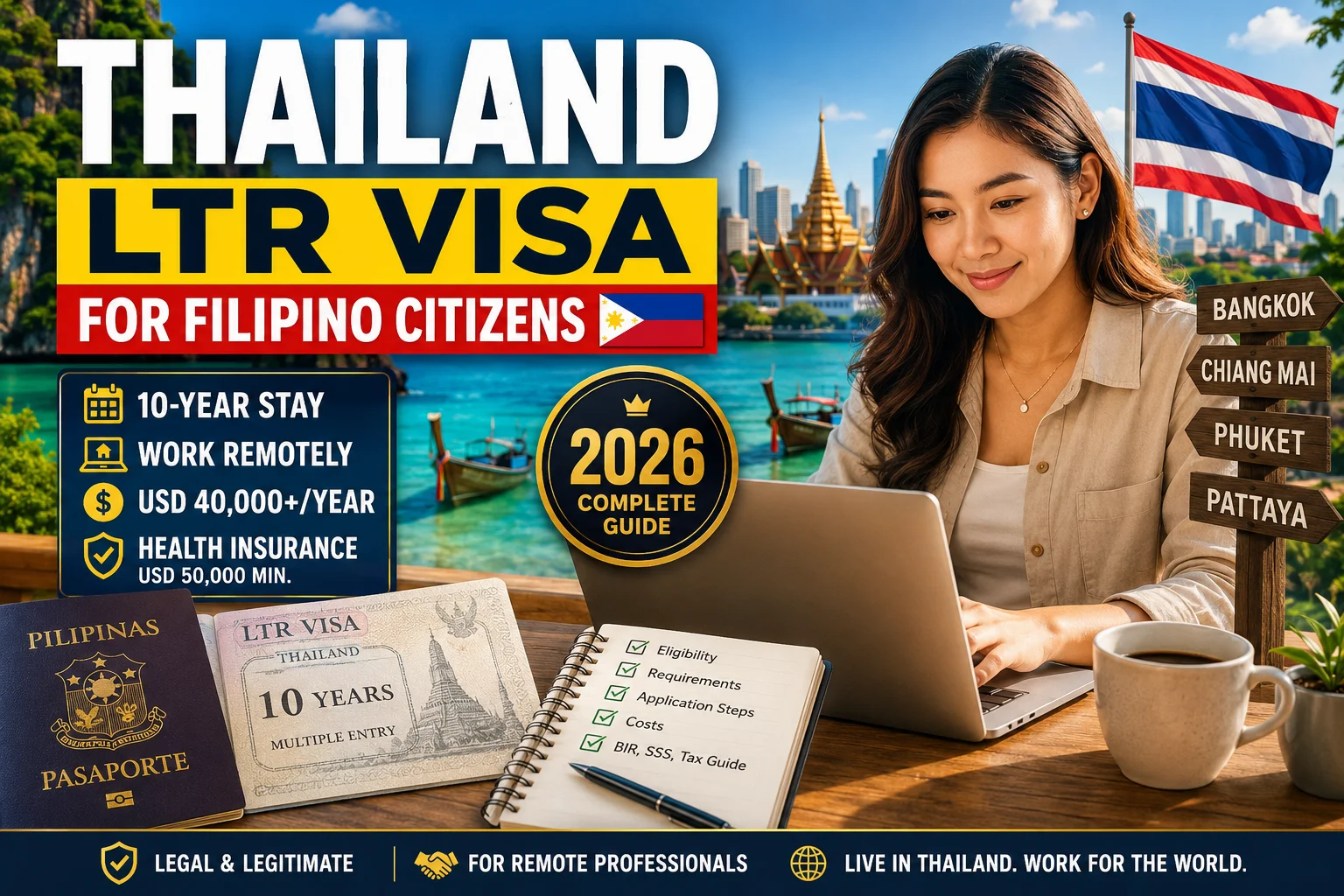
| The Thailand LTR Visa for Filipino Citizens is a 10-year, multiple-entry visa issued by Thailand’s Board of Investment (BOI). Filipino citizens can apply under four categories, with the Work-From-Thailand (WFT) Professional category being the most accessible for remote workers and freelancers. The minimum income requirement is USD 40,000 per year (approximately PHP 2.3 million annually at current exchange rates) from a non-Thai employer. Government fees total THB 63,800 (approximately PHP 99,000), and processing takes around 20 working days after complete document submission. The Thailand LTR Visa for Filipino Citizens is different from OFW status — it is a personal long-stay visa, not an employment deployment, and has no conflict with existing BIR or SSS obligations provided those are properly maintained. |
| QUICK ANSWER: Can Filipino citizens apply for Thailand LTR Visa? Yes. Filipino citizens can apply for the Thailand LTR Visa under the Work-From-Thailand Professional category if they meet all of the following: Earn at least USD 40,000/year (approx. PHP 2.3 million) from a non-Thai employer or overseas clients Have 5+ years of professional work experience Hold valid health insurance with USD 50,000 minimum international coverage Provide an employment contract or documented freelance income proof Hold a valid Philippine passport The visa grants a 10-year, multiple-entry stay in Thailand with a work permit for remote overseas employment. It is legal, legitimate, and well-suited to Filipino IT professionals, BPO managers, designers, developers, and online business owners. |
| IMPORTANT LEGAL DISCLAIMER This article is for informational purposes only and does not constitute legal, immigration, tax, or financial advice. Visa rules, fees, and eligibility requirements can change without notice. Verify all current requirements on the official Thailand BOI website (boi.go.th) and consult a licensed Thai immigration attorney or Philippine-based international tax advisor before making any relocation or visa decisions. BIR, SSS, PhilHealth, and Pag-IBIG obligations mentioned here reflect general guidance only — individual situations may differ. |
Introduction
For Filipino remote workers and digital nomads, Thailand is consistently one of the most popular long-stay destinations in Southeast Asia. The climate, cost of living, food, community, and Internet infrastructure make it a natural fit. And now, with the Thailand LTR Visa, there is a genuinely legal and stable visa pathway to stay for up to 10 years — without visa runs, tourist visa renewals, or immigration uncertainty.
But Filipino applicants have very specific questions that most generic LTR Visa guides simply do not answer. What happens to your BIR obligations when you’re living in Thailand? Does the LTR Visa affect your OFW status? Can Upwork income or PayPal receipts count as income proof for BOI? What about your SSS contributions?
This guide addresses all of those questions — specifically for Filipino citizens. Not a generic rewrite, but a guide built for your actual situation.
Thailand LTR Visa: Four Categories Overview
The BOI issues the LTR Visa under four distinct categories. For most Filipino professionals, the Work-From-Thailand (WFT) category is the clearest entry point:
| LTR Category | Who It’s For | Min. Income Requirement |
| Wealthy Global Citizen | High-net-worth investors | USD 80,000/year OR USD 1M in assets |
| Wealthy Pensioner | Retirees aged 50+ with pension income | USD 40,000/year |
| Work-From-Thailand (WFT) ★ | Remote workers for non-Thai employers | USD 40,000/year |
| Highly Skilled Professional | Specialists in BOI-recognized sectors | USD 80,000/year (or USD 40K with credentials) |
★ Most relevant for Filipino remote workers, developers, BPO professionals, designers, and online business owners working for overseas companies or clients.
Eligibility Requirements for Filipino Citizens
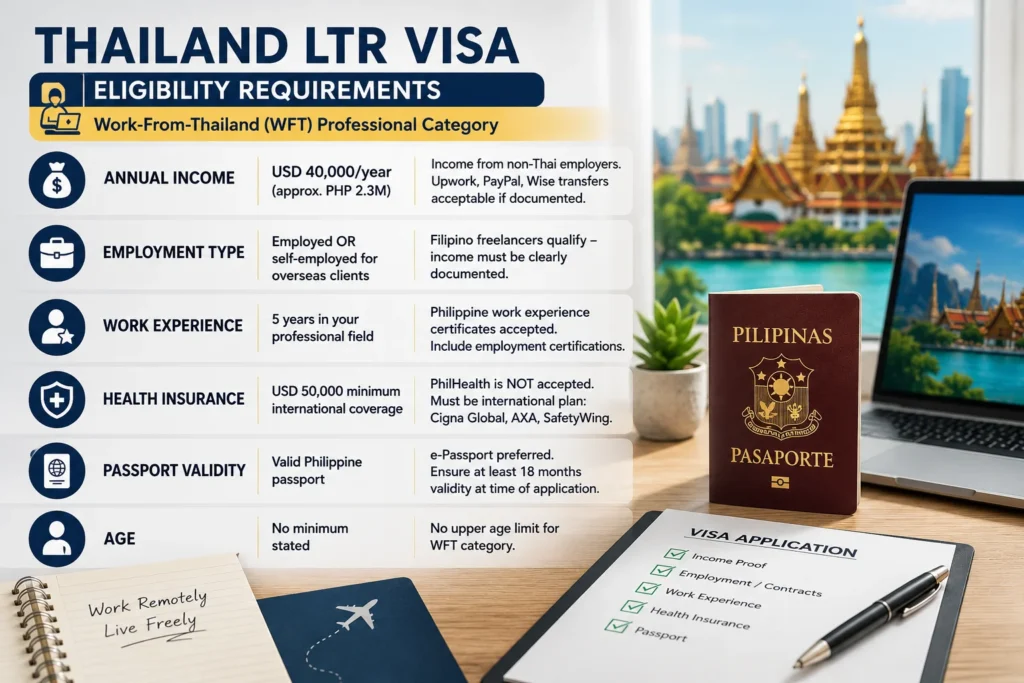
Work-From-Thailand (WFT) Professional Category
| Requirement | Minimum Standard | Philippine-Specific Notes |
| Annual income | USD 40,000/year (approx. PHP 2.3M) | Income from non-Thai employers. Upwork, PayPal, Wise transfers are acceptable if documented correctly. |
| Employment type | Employed OR self-employed for overseas clients | Filipino freelancers qualify — but income must be clearly documented (see income proof section) |
| Work experience | 5 years in your professional field | Philippine work experience certificates accepted. Include employment certifications from Philippine employers. |
| Health insurance | USD 50,000 minimum international coverage | PhilHealth is NOT accepted. Must be international plan: Cigna Global, AXA, SafetyWing. |
| Passport validity | Valid Philippine passport | e-Passport preferred. Ensure at least 18 months validity at time of application. |
| Age | No minimum stated | No upper age limit for WFT category |
Philippine-Specific Income Proof: What BOI Accepts
This is the section that matters most for Filipino applicants. The BOI needs to verify USD 40,000/year in income from non-Thai sources. Here’s what works for common Filipino income setups:
For salaried employees of overseas companies
- Last 3 months’ pay slips (in USD or original currency)
- Employment contract clearly stating the company is non-Thai, your role, and salary in USD or foreign currency
- BIR Form 2316 or ITR for last 2 years (shows your Philippine income history)
- Philippine bank statements showing international salary deposits
If your salary is processed through a Philippine bank in PHP but from an overseas employer, include a certificate from your employer confirming the overseas entity paying your salary.
For freelancers (most common Filipino remote worker scenario)
Many Filipino remote workers operate as freelancers through platforms like Upwork, Fiverr, Toptal, or direct contracts. BOI accepts freelance income documentation — but it must be presented clearly:
- Upwork, Fiverr, or Toptal annual earnings statements (downloadable from the platform)
- PayPal transaction history showing 12 months of international income (export as PDF)
- Wise, Payoneer, or direct USD bank transfer records for 12 months
- Philippine bank statements (BDO, BPI, Metrobank, UnionBank) showing consistent inward remittances
- Client contracts or service agreements with overseas clients
- BIR-registered income documentation — Certificate of Registration + Annual ITR
- An accountant-certified income summary letter (optional but strengthens the application)
Important: BOI is looking for consistent, documentable income from non-Thai sources. Inconsistent months are acceptable if your annual total clearly exceeds USD 40,000 and you can explain the pattern (e.g., project-based work).
Income in PHP: Does it qualify?
If you earn entirely in PHP but from overseas clients who pay via GCash international transfers, PayPal, or remittance channels, your income can still qualify. You will need to show:
- Proof that the income originates from a non-Thai, non-Philippine source
- A 12-month average that demonstrates the USD 40,000/year equivalent
- Bank statements clearly showing inward international transfers
The safest documentation trail involves USD or multi-currency accounts (Wise, Payoneer) that show the currency origin of payments.
Documents Required for Filipino Applicants
Standard documents (all applicants)
- Valid Philippine passport (e-Passport preferred, 18+ months validity recommended)
- Completed LTR Visa application form via BOI e-Service portal
- Passport-sized photograph (4×6 cm, white background)
- Health insurance certificate (minimum USD 50,000 international coverage)
- Proof of income (pay slips, platform earnings statements, bank statements)
- BIR ITR for last 2 years (BIR Form 1700 or 1701)
- CV/Resume showing 5+ years of professional work experience
- Employment contract or proof of overseas client engagements
Philippine-specific additional documents
- Upwork/PayPal/Wise earnings export (for freelancers)
- Philippine bank statements showing international income (12 months)
- BIR Certificate of Registration (COR) if registered as self-employed
- Accountant-certified income summary (recommended for freelancers)
- PhilHealth / SSS / Pag-IBIG IDs (proof of Philippine social contributions record — informational, not required by BOI)
Note on document language: All documents must be in English or include a certified English translation. Philippine government documents (BIR forms, PSA-issued documents) do not normally require translation as they are in English.
Step-by-Step Application Process from the Philippines
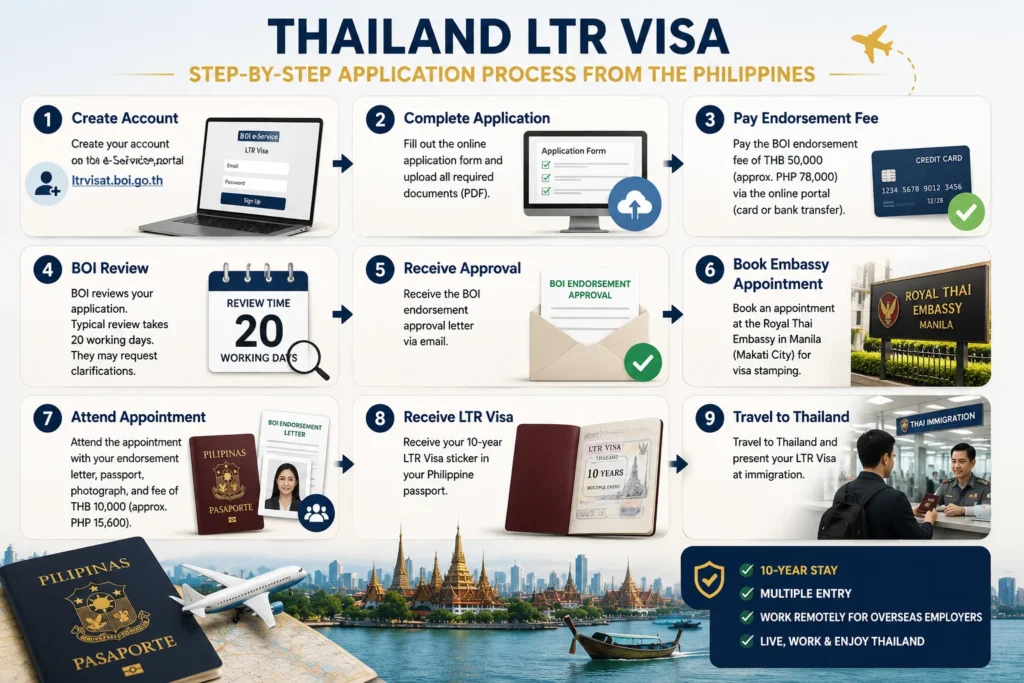
- Create your account on the BOI e-Service portal at ltrvisat.boi.go.th
- Complete the online application form and upload all required documents in PDF format
- Pay the BOI endorsement fee of THB 50,000 (approx. PHP 78,000) via the online portal using international card or bank transfer
- BOI reviews your application — typical review takes 20 working days; they may request clarifications
- Receive the BOI endorsement approval letter via email
- Book an appointment at the Royal Thai Embassy in Manila (Makati City) for visa stamping
- Attend the appointment with your endorsement letter, passport, photograph, and fee of THB 10,000 (approx. PHP 15,600)
- Receive your 10-year LTR Visa sticker in your Philippine passport
- Travel to Thailand and present your LTR Visa at immigration
| THAI EMBASSY IN MANILA — KEY DETAILS Royal Thai Embassy Manila Address: 107 Rada Street, Legaspi Village, Makati City, Metro Manila Appointment system: Available via the Thai Embassy Manila official website Bring: Endorsement letter, passport, photo, fee in cash or as specified Note: Check the Embassy’s current appointment availability and requirements before attending, as procedures may be updated. |
Processing Time and Cost Breakdown
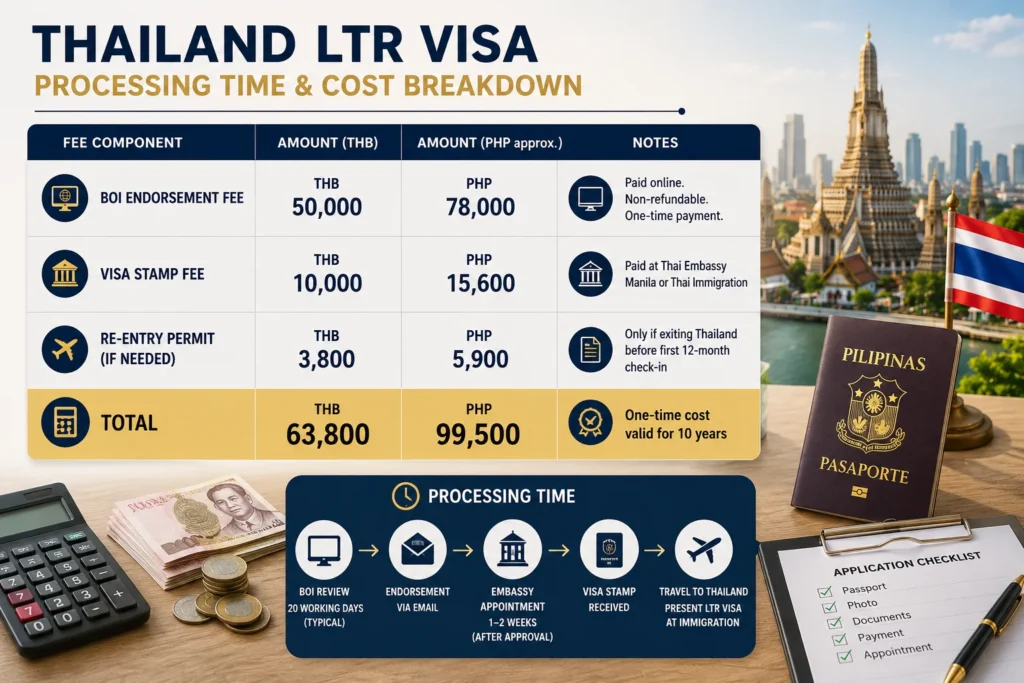
| Fee Component | Amount (THB) | Amount (PHP approx.) | Notes |
| BOI endorsement fee | THB 50,000 | PHP 78,000 | Paid online. Non-refundable. One-time payment. |
| Visa stamp fee | THB 10,000 | PHP 15,600 | Paid at Thai Embassy Manila or Thai Immigration |
| Re-entry permit (if needed) | THB 3,800 | PHP 5,900 | Only if exiting Thailand before first 12-month check-in |
| TOTAL | THB 63,800 | PHP 99,500 | One-time cost valid for 10 years |
Processing time: BOI endorsement typically takes 20 working days from complete document submission. Peak periods (January to March) may extend this to 30 to 35 working days. The Embassy visa stamping appointment can usually be scheduled within 1 to 2 weeks of receiving the endorsement letter.
Total timeline from application start to departure: approximately 5 to 8 weeks when everything goes smoothly.
OFW vs Digital Nomad: An Important Distinction for Filipinos
This is the question most Filipino applicants ask first — and almost no guide answers it clearly.
| WHAT IS AN OFW? An Overseas Filipino Worker (OFW) is a Filipino citizen who is deployed abroad under a formal employment contract processed through the Department of Migrant Workers (DMW, formerly POEA). OFWs are registered with DMW, covered by the Overseas Workers Welfare Administration (OWWA), and are typically employed by foreign companies for specific job contracts. |
| WHAT IS A DIGITAL NOMAD / LTR VISA HOLDER? A digital nomad on a Thailand LTR Visa is a Filipino professional who chooses to live in Thailand while working remotely for an overseas employer or freelance clients. You are not deployed by POEA/DMW, not under an OFW employment contract, and not covered by OWWA. You are simply a Filipino citizen living abroad on a legal long-stay visa — similar to how Filipino emigrants in the US or Canada live abroad. |
| Aspect | OFW | Digital Nomad (LTR Visa) |
| Deployment process | Via POEA/DMW with employment contract | Self-arranged via BOI visa application |
| OWWA coverage | Yes — mandatory | No — not applicable |
| Philippine income tax exemption | OFW income is tax-exempt in PH | Depends on BIR residency status (see below) |
| Health benefits | OWWA medical benefits apply | Personal international insurance required |
| SSS contributions | Voluntary if abroad | Voluntary — same as any Filipino abroad |
| Return obligation | End of contract deployment | None — stay as long as visa allows |
Bottom line: Getting an LTR Visa does not make you an OFW and does not conflict with OFW obligations if you have any. They are completely separate legal frameworks. The LTR Visa is a Thai immigration document; OFW status is a Philippine labor classification.
BIR, SSS, PhilHealth, and Pag-IBIG While Living in Thailand
BIR (Bureau of Internal Revenue) obligations
This is the section most Filipino remote workers are most concerned about — and rightfully so.
Under Philippine tax law, Filipino citizens are taxed on their worldwide income if they are considered tax residents of the Philippines. The general rule: if you spend more than 180 days in the Philippines in a taxable year, you remain a Philippine tax resident and your overseas income is subject to Philippine income tax.
If you are living in Thailand on an LTR Visa and spending the majority of the year there (less than 180 days in the Philippines), you may qualify as a non-resident Filipino citizen for Philippine tax purposes. This is complex territory — consult a BIR-registered CPA or international tax consultant before making any changes to your BIR filing status.
Practical note: Many Filipino remote workers continue filing their Philippine ITR as usual while abroad, especially if their income is already being taxed at source or if they are registered as self-employed under BIR. This is a conservative and common approach.
SSS, PhilHealth, and Pag-IBIG while abroad
| Contribution | Status When Abroad | Recommended Action |
| SSS | Voluntary — you can continue paying or pause | Continue paying voluntary contributions to preserve benefit entitlements (disability, retirement, death) |
| PhilHealth | Can continue as voluntary member abroad | Consider continuing if you plan to return to the Philippines and use PhilHealth benefits later |
| Pag-IBIG | Voluntary for Filipinos abroad | Optional — continue if you have an active Pag-IBIG loan or plan to apply for one |
Note: None of these Philippine government contributions are required by the Thai BOI for LTR Visa issuance or maintenance. They are purely personal financial decisions with long-term implications for Philippine benefits.
Banking and Tax Implications for Filipino LTR Visa Holders
Opening a Thai bank account
The LTR Visa significantly simplifies the process of opening a bank account in Thailand. Banks such as Bangkok Bank and Kasikorn Bank (KBank) accept LTR Visa holders as customers with the following:
- LTR Visa stamp in Philippine passport
- BOI endorsement letter
- Proof of address in Thailand (rental contract)
Filipino LTR Visa holders commonly use Wise multi-currency accounts to receive USD or EUR income from overseas clients and convert to THB as needed. This reduces reliance on local bank infrastructure for international transfers.
Philippine bank accounts while abroad
Keeping your Philippine bank account active (BDO, BPI, Metrobank, UnionBank) while living in Thailand is generally straightforward. You will not be required to change your account type unless you formally update your residency status with your bank.
If you become a non-resident Filipino under FEMA-equivalent Philippine banking rules, your bank may require you to convert to a non-resident account. In practice, many Filipinos living abroad for extended periods simply maintain their existing accounts without issues — but check with your bank for their specific policy.
Philippines-Thailand tax treaty
The Philippines and Thailand have a Double Taxation Agreement (DTA). For Filipinos who become tax residents of Thailand (spending 180+ days/year in Thailand), the DTA determines how income is taxed in each country. Given the complexity of this area, professional advice from a Philippine CPA or international tax consultant is strongly recommended.
Common Mistakes Filipino Applicants Make
| Mistake | Why It Causes Problems | What To Do Instead |
| Submitting Upwork screenshots instead of formal statements | BOI reviewers need official documents, not app screenshots | Export official Upwork lifetime earnings or annual statement as PDF |
| Using PhilHealth or HMO as health insurance proof | PhilHealth and local HMOs do not meet the USD 50,000 international coverage threshold | Get an international plan before applying — SafetyWing, Cigna Global, or AXA International |
| Applying with an expired or soon-expiring passport | Thai Embassy may reject if passport validity is too short | Renew your Philippine passport to at least 18+ months validity before applying |
| Not converting PHP income to USD equivalent clearly | BOI cannot assess if you meet the USD 40,000 threshold from PHP-only bank statements | Include a cover note with USD-PHP conversion and show international transfer origins |
| Assuming the LTR Visa replaces SSS/BIR obligations | It does not — these are separate Philippine government obligations | Continue managing your Philippine tax and contribution obligations independently |
| Booking flights before receiving endorsement letter | BOI process takes 20-35 working days; irreversible travel plans cause stress | Wait for the official BOI endorsement before booking flights or ending Philippine lease |
LTR Visa vs Other Long-Stay Options for Filipinos
| Visa Type | Duration | Work Allowed | Min. Income | Difficulty for Filipinos |
| Thailand LTR Visa (WFT) | 10 years | Yes (overseas employer) | USD 40K/year | Medium |
| Thailand Tourist Visa | 60-90 days | No (legally) | None | Easy |
| Thailand SMART Visa | 4 years | Yes (Thai companies) | USD 40K+ | Hard |
| Malaysia DE Rantau | 3-12 months | Yes (overseas only) | USD 24K/year | Easy-Medium |
| Georgia Remotely From | 12 months | Yes (overseas only) | USD 2K/month | Easy |
| UAE Remote Work Visa | 1 year (renewable) | Yes (overseas only) | USD 3.5K/month | Medium |
For Filipino professionals earning USD 40,000+ annually, the Thailand LTR Visa offers the best combination of duration, legal clarity, and quality of life. The Malaysia DE Rantau is a lower-barrier alternative for those below the USD 40,000 threshold. Georgia’s Remotely From programme is excellent for those wanting a fast, low-cost digital nomad base in Europe.
Realistic Risks and Limitations
- PHP-USD exchange rate volatility: If the PHP weakens significantly against the USD, your income in PHP may fall below the USD 40,000 threshold in dollar terms. Keep income documentation in USD where possible.
- Upwork/PayPal income documentation requires careful preparation: Platform-based income is accepted but requires formal earnings statements, not screenshots. Export these before applying.
- Health insurance must be maintained: The LTR Visa implicitly requires your insurance to remain active. A lapsed policy could create complications at Thai Immigration.
- 90-day address reporting: All LTR Visa holders must report their address to Thai Immigration every 90 days — in person, online, or via a representative. This is an ongoing administrative requirement.
- Philippine tax obligations do not automatically change: Living in Thailand does not automatically make you a Philippine non-resident for tax purposes. Active management of your BIR filing status is required.
- No path to Thai permanent residency: The LTR Visa is a long-stay visa, not a residency or citizenship pathway. You remain a Filipino citizen on a Thai long-stay visa.
Frequently Asked Questions
Can Filipino freelancers apply for the Thailand LTR Visa?
Yes. Filipino freelancers qualify under the Work-From-Thailand category provided they can document USD 40,000 per year in gross income from non-Thai clients. Upwork annual statements, PayPal transaction exports, Wise transfer records, and Philippine bank statements showing international income are all acceptable. A formal accountant-certified income summary strengthens the application significantly.
Will getting a Thailand LTR Visa affect my OFW status?
No. The Thailand LTR Visa is a Thai immigration document and has no effect on OFW status. OFW classification is issued by the Philippine Department of Migrant Workers (DMW) based on your deployment contract. If you are not currently an active OFW deployed through POEA/DMW, there is no OFW status to protect. If you are between OFW deployments and simply working remotely, the LTR Visa does not interfere.
Do I need to continue paying BIR taxes while living in Thailand?
This depends on your Philippine tax residency status. If you spend more than 180 days in the Philippines during a tax year, you remain a Philippine tax resident and your worldwide income is taxable in the Philippines. If you are spending the majority of your time in Thailand, you may qualify for non-resident status — but this requires formal assessment and ideally a BIR consultation or registered tax advisor’s guidance. Many Filipinos abroad continue filing their ITR as self-employed to stay compliant.
Does PhilHealth coverage apply in Thailand?
No. PhilHealth coverage applies in Philippine-accredited health facilities. While you are in Thailand, PhilHealth does not cover your medical expenses. This is why the LTR Visa requires USD 50,000 in international health insurance — to ensure you have genuine medical coverage while abroad. You may continue paying voluntary PhilHealth contributions to preserve your membership for when you return to the Philippines.
Can I apply from the Philippines without visiting Thailand first?
Yes. The entire BOI endorsement application process is conducted online via the BOI e-Service portal. You do not need to be in Thailand to apply. Once the BOI endorsement is approved, you present it at the Royal Thai Embassy in Manila for the actual visa stamp. You can then travel to Thailand on your newly issued LTR Visa.
Is USD 40,000 income calculated in gross or net?
Gross income. Your documentation should reflect total annual earnings before deductions. For freelancers, this means total billings to overseas clients, not take-home after platform fees. If Upwork charges 20% in fees, your gross contract value (before deductions) is what counts toward the threshold.
What happens to my Pag-IBIG housing loan if I move to Thailand?
Your Pag-IBIG housing loan obligations do not change due to your physical location. You remain responsible for monthly loan amortizations regardless of where you live. Many Filipino LTR Visa holders in Thailand continue servicing their Pag-IBIG loans through online banking or auto-debit arrangements set up before leaving.
Final Verdict: Is the Thailand LTR Visa Right for Filipino Professionals?
| For Filipino remote workers, developers, designers, BPO professionals, and online entrepreneurs earning at least USD 40,000 per year from non-Thai employers or overseas clients, the Thailand LTR Visa is one of the most legal, stable, and quality-of-life-positive long-stay options available. The documentation requirements are more involved for Filipino freelancers than for salaried employees — platform earnings statements, BIR records, and income conversions require preparation. But for well-prepared applicants, the approval track record is strong. The OFW concern is real but resolved simply: the LTR Visa is a separate, personal visa category. It does not interfere with Philippine labor law, DMW classifications, or OWWA programs. BIR and SSS obligations continue independently and require active management. This is the right visa for Filipino professionals who have built a sustainable overseas income stream and want to base themselves in Thailand legally, long-term, without the chaos of annual tourist visa renewals. |