AI OVERVIEW SUMMARY Filipino digital nomads living in Bangkok face tax obligations in two countries — but the Philippines Thailand tax treaty digital nomads framework explains how the Philippines-Thailand tax treaty prevents paying full tax rates in both. The core principle: two filing obligations, not two full tax bills on the same income. For Thai tax residents (180+ days in Thailand), Thai income tax applies on assessable overseas income at progressive rates. The Philippines-Thailand treaty credit mechanism then allows crediting Thai income tax paid against any Philippine tax obligation on the same income. The BIR Form 1701 (Annual Income Tax Return) must be filed by April 15 regardless of Thailand stay. Crucially, the Philippines classifies taxpayers by residency status: Resident Citizens (worldwide income taxable) vs Non-Resident Citizens (only Philippine-sourced income taxable). Filipino digital nomads who establish continuous absence from the Philippines for one year or more may qualify as non-resident citizens — making only their Philippine-sourced income taxable in the Philippines. OFW status is distinct: OFW income is exempt from Philippine income tax, but most Filipino digital nomads in Thailand are NOT OFWs and should not rely on OFW income exemption rules. SSS, PhilHealth, and Pag-IBIG voluntary overseas contributions can continue regardless of Thai residency.
QUICK ANSWER: Do Filipino digital nomads pay tax in both Thailand and Philippines? Potentially yes — but NOT full rates in both on the same income. Here is how it works: If Thai tax resident (180+ days): Thai income tax on overseas assessable income. Progressive rates 0–35%.If Philippine resident citizen: BIR taxes worldwide income. Treaty credit for Thai tax paid reduces Philippine tax on same income. If Philippine non-resident citizen: BIR taxes only Philippine-sourced income. Overseas income NOT taxed in Philippines regardless of Thai tax position. Filing obligations: Thai PND 90 (March 31) + Philippine BIR 1701 (April 15) — regardless of tax status. Key: Your Philippine residency status (resident citizen vs non-resident citizen) is the most important variable. Two filings, not two full bills. Always consult a Philippine CPA to determine your BIR status.
Introduction: The Tax Reality Filipino Nomads in Bangkok Face
The Philippines-Thailand tax treaty creates a framework that many Filipino digital nomads in Bangkok are unaware of — or aware of only in abstract terms. The result is two common and opposite mistakes: some Filipinos assume the treaty eliminates all Philippine tax obligations, while others assume they owe full income tax in both countries simultaneously. Both are wrong.
The treaty’s actual function is more nuanced: it allocates taxing rights between the Philippines and Thailand, provides a credit mechanism to prevent full double taxation, and resolves dual-residency disputes. What you actually owe depends on two variables: how long you stay in Thailand (Thai tax residency) and how the BIR classifies you in the Philippines (resident citizen vs non-resident citizen). Understanding both is the starting point for sound tax planning as a Filipino nomad in Bangkok.
This guide covers the treaty article by article in terms relevant to freelancers and remote employees, the critical distinction between OFW tax rules and non-resident citizen tax rules, the BIR filing obligations that never stop, and the dual-filing calendar that coordinates your Thai and Philippine filings correctly.
1. The Philippines-Thailand Tax Treaty: Foundation
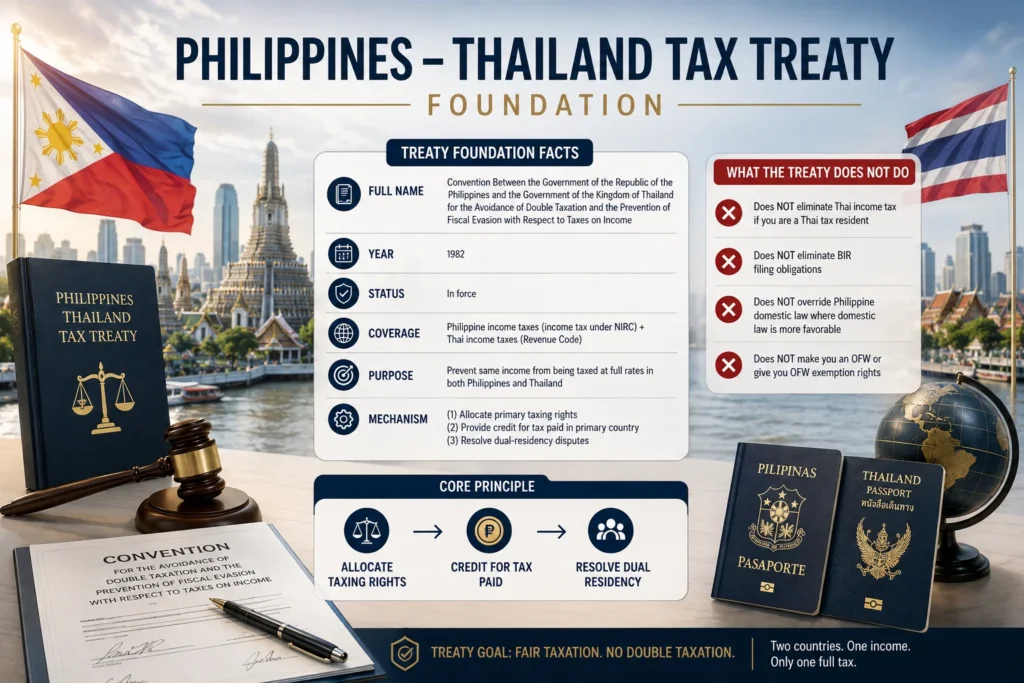
TREATY FOUNDATION FACTS Full name: Convention Between the Government of the Republic of the Philippines and the Government of the Kingdom of Thailand for the Avoidance of Double Taxation and the Prevention of Fiscal Evasion with Respect to Taxes on Income Year: 1982 Status: In force Coverage: Philippine income taxes (income tax under NIRC) + Thai income taxes (Revenue Code) Purpose: Prevent same income from being taxed at full rates in both Philippines and Thailand Mechanism: (1) Allocate primary taxing rights; (2) Provide credit for tax paid in primary country; (3) Resolve dual-residency disputes What the treaty does NOT do: Does NOT eliminate Thai income tax if you are a Thai tax resident Does NOT eliminate BIR filing obligations Does NOT override Philippine domestic law where domestic law is more favorable Does NOT make you an OFW or give you OFW exemption rights
2. Treaty Articles: What Each Means for Filipino Nomads
Article 4 — Residence: Who Owes Tax Where
ARTICLE 4 — RESIDENCE DETERMINATION Philippine residency for treaty purposes: A Philippine citizen who is a resident of the Philippines (has permanent home, centre of vital interests in Philippines). Thai residency for treaty purposes: A person who is a Thai tax resident under Revenue Code Section 41 (180+ days in Thailand per calendar year). Tie-breaker (Article 4(2)) if resident in both countries: Step 1: Permanent home — if only in one country, that country winsStep 2: Centre of vital interests — stronger personal and economic tiesStep 3: Habitual abode — where you regularly liveStep 4: Nationality — Philippine citizenship wins if both habitual abodeStep 5: Mutual agreement procedure between tax authorities Practical result: A Filipino spending 180+ days in Bangkok who has established daily life in Thailand (rental lease, Thai bank, no permanent home in Philippines) is likely a Thai treaty resident. This determines which articles apply to their income.
Article 7 — Business Profits (Freelancers)
Business profits are taxable only in the residence country unless a permanent establishment (PE) exists in the other country. For most Filipino digital nomads in Bangkok working from cafes or co-working spaces: no PE exists. Thai tax residency (not Article 7) is the primary determinant of Thai tax on freelance income.
Article 14 — Independent Personal Services (Freelancers / Consultants)
ARTICLE 14 — THE FREELANCER’S ARTICLE What it says: Income from independent personal services (professional activities, consulting, freelance work) is taxable in the residence country UNLESS the person has a ‘fixed base’ regularly available in the other country. Fixed base: Similar to PE for business profits. A dedicated rented office or workspace may qualify; shared co-working on day passes generally does not. For Filipino freelancers in Bangkok: Thai tax resident (180+ days): Thailand has primary taxing right under Article 4 residence determination. Article 14 does not add separate taxing rights beyond what Thai domestic law already creates.Philippines (as non-resident citizen): Taxes only Philippine-sourced income. Overseas freelance income earned in Bangkok: not Philippine-taxable.Philippines (as resident citizen): Taxes worldwide income. Treaty credit for Thai taxes paid reduces Philippine tax on same income.
Article 15 — Dependent Personal Services (Remote Employees)
ARTICLE 15 — EMPLOYMENT INCOME What it says: Employment income is generally taxable in the country where the work is performed. For Filipino remote employees working from Bangkok for an overseas employer (US, EU, Singapore, etc.): Work physically performed in Thailand: Thailand has primary taxing right under Article 15Thai tax resident (180+ days): Thai income tax on assessable overseas employment income The Article 15(2) exception: Employment income taxed ONLY in residence country if: Employee stays in Thailand for fewer than 183 days in the tax year ANDRemuneration paid by employer NOT registered in Thailand ANDIncome is not borne by a Thai PE of the employer For Filipino LTR WFT holders in Bangkok for 200+ days: Exception does not apply. Thailand taxes employment income. Philippines: credit for Thai tax paid if resident citizen; zero tax on overseas income if non-resident citizen.
BPI/BDO savings interest; Philippine time deposits
Art. 12
Royalties / software IP fees
15%
Thailand credits Philippine withholding
Filipino developers licensing software to Philippine clients
3. The Critical Philippine Residency Status Question
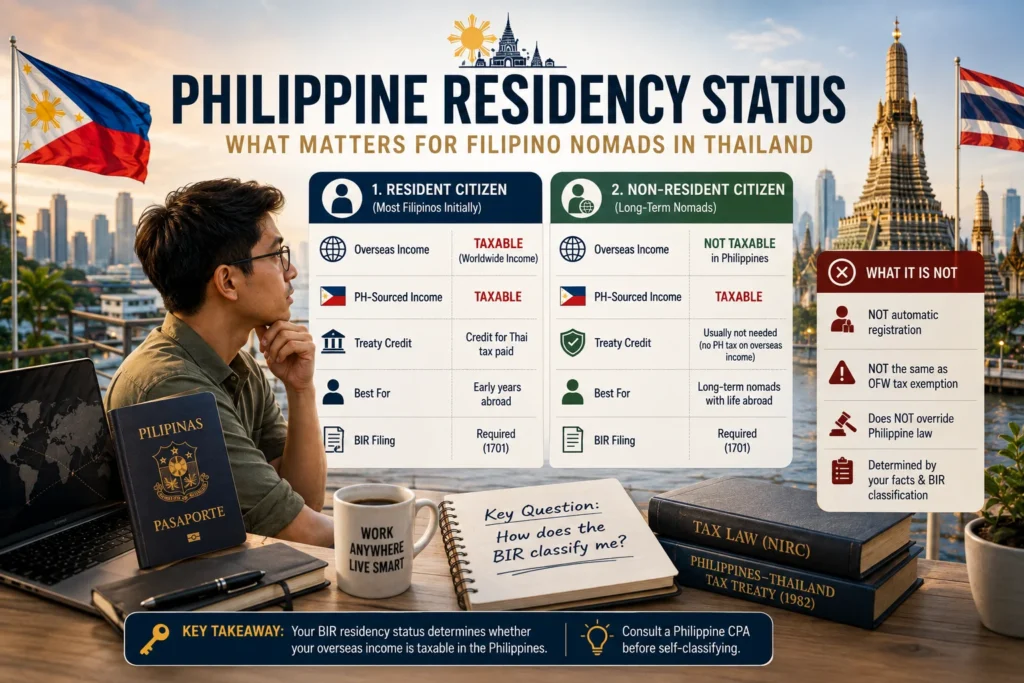
The most important variable for Filipino nomads in Thailand is not the Philippines-Thailand treaty itself — it is how the BIR classifies them under Philippine domestic law. This determines whether overseas income is Philippine-taxable at all.
BIR Residency Classification
Who Qualifies
Philippine Tax on Overseas Income
Philippine Tax on PH-Sourced Income
Relevance to Bangkok Nomads
Resident Citizen
Philippine citizen with permanent home in PH; returns regularly
YES — worldwide income taxable
YES
Most Filipinos in early years abroad; treaty credit for Thai tax paid prevents double taxation
Non-Resident Citizen
Philippine citizen who has established residence outside Philippines for at least 1 year continuously; or OFW
NO — overseas income NOT taxable in Philippines
YES
Long-term Filipino nomads who have clearly relocated abroad; most favorable tax position
Resident Alien
Non-Philippine citizen residing in Philippines
Not applicable
YES
Not applicable for Filipino nomads
Non-Resident Alien Not Engaged in Trade or Business (NRANETB)
Non-Philippine citizen briefly visiting
Not applicable
25% flat rate
Not applicable
THE NON-RESIDENT CITIZEN STATUS: THE MOST IMPORTANT CONCEPT FOR FILIPINO NOMADS Section 22(E) of the Philippine National Internal Revenue Code (NIRC) defines a non-resident citizen as: A citizen of the Philippines who establishes to the satisfaction of the Commissioner of Internal Revenue the fact of his physical presence abroad with a definite intention to reside therein; ORA citizen of the Philippines who leaves the Philippines during the taxable year to reside abroad, either as an immigrant or for employment on a permanent basis; ORA citizen of the Philippines who works and derives income from abroad and whose employment thereat requires him to be physically present abroad most of the time during the taxable year; ORA citizen who has been previously considered as non-resident citizen and who arrives in the Philippines at any time during the taxable year to reside permanently in the Philippines Key practical point: A Filipino digital nomad who has been abroad continuously for a significant period (commonly interpreted as at least 1 year) and has established life abroad (rental lease, overseas income, overseas bank account) may qualify as a non-resident citizen. This makes their overseas income NOT taxable in the Philippines. Who determines this: The BIR classifies you based on your facts. There is no automatic registration. Your ITR 1701 form has a classification box. Consult a Philippine CPA with overseas Filipino expertise before self-classifying. If you qualify as non-resident citizen: Your overseas income from Bangkok clients or overseas employer is NOT taxable in the Philippines. Only Philippine-sourced income (dividends from PSE stocks, Philippine bank interest, income from Philippine clients) is taxable. The treaty credit becomes less relevant because there is no Philippine tax on overseas income to credit against.
4. OFW vs Digital Nomad: Why This Distinction Matters for BIR
THIS IS NOT OFW STATUS — DO NOT APPLY OFW TAX RULES TO DIGITAL NOMADS OFW (Overseas Filipino Worker) income is exempt from Philippine income tax under Section 23(C) of the NIRC. This exemption is specific to OFWs — it does NOT automatically apply to all Filipinos working abroad. What makes someone an OFW for BIR purposes: POEA-processed worker deployed abroad under a specific employment contract OWWA member actively covered during the period of overseas employment OEC (Overseas Employment Certificate) holder What makes someone a digital nomad (NOT an OFW) for BIR purposes: Self-employed freelancer or independent contractor working remotely for overseas clients Remote employee of an overseas company whose employment was not arranged through POEADE Rantau holder in Malaysia, LTR Visa holder in Thailand, or similar digital nomad visa holder Why this matters: If you incorrectly treat yourself as OFW for tax purposes when you are actually a digital nomad remote worker, you are applying the wrong exemption. The correct analysis for digital nomads is the non-resident citizen classification, not OFW exemption. Bottom line: Most Filipino digital nomads in Bangkok are non-resident citizens (potentially), not OFWs. The tax exemption path is through non-resident citizen classification, not OFW status.
5. “Two Filings, Not Two Full Bills”: How the Treaty Credit Works
The core concept every Filipino nomad in Bangkok must understand: having two filing obligations does not mean paying two full tax bills on the same income.
HOW THE PHILIPPINES-THAILAND TREATY CREDIT WORKS Scenario: Filipino resident citizen in Bangkok (Thai tax resident, 180+ days), earning PHP 2 million/year from an overseas US employer. Step 1: Thai income tax: Thai tax on assessable overseas income brought into Thailand: approximately THB 175,000–200,000 (≈ PHP 220,000–250,000) depending on deductions and exchange rate Step 2: Philippine income tax (as resident citizen): Worldwide income taxable in Philippines. PHP 2 million income: approximately PHP 272,500 Philippine income tax (after standard deductions under graduated rates) Step 3: Treaty credit application: Article 23 of the Philippines-Thailand treaty: Philippines allows credit for Thai income tax paid on the same incomePhilippine BIR Form 1701: Schedule of Foreign Tax Credit (use Thai PND 90 acknowledgement as evidence)Thai tax paid (≈ PHP 225,000) credited against Philippine tax (≈ PHP 272,500)Philippine tax after credit: ≈ PHP 47,500 (the excess not covered by Thai tax credit) Total tax paid on same income: Thai tax (≈ PHP 225,000) + Philippine excess (≈ PHP 47,500) = ≈ PHP 272,500 Without the treaty: Thai tax + full Philippine tax = PHP 225,000 + PHP 272,500 = PHP 497,500 on the same income Treaty saves: approximately PHP 225,000 on this example income. Two filings, not two full bills.
6. Worked Example: Carlos — Filipino Developer in Bangkok
CASE STUDY: CARLOS — FILIPINO DEVELOPER IN BANGKOK Profile: Senior Filipino software developer, employed remotely by a Singapore tech company. Annual income: USD 36,000/year (≈ PHP 2,000,000/year). Lives in Bangkok from January to August (240 days).Step 1 — Thai tax residency: 240 days in Thailand in 2026 calendar year = Thai tax resident.Step 2 — Thai assessable income: USD 36,000 transferred to his Bangkok Bank account in 2026. Assessable under 2024 ruling. THB ≈ 1,440,000 gross.Step 3 — Thai income tax: After THB 60,000 personal allowance + THB 100,000 50% employment deduction: net assessable THB 1,280,000. Thai tax: approximately THB 155,000 (≈ PHP 195,000).Step 4 — BIR classification: Carlos has been living abroad for less than 1 year (started January 2026). BIR classifies him as resident citizen. Worldwide income taxable.Step 5 — Philippine income tax: PHP 2,000,000 income; after personal exemptions and deductions: approximately PHP 272,500 Philippine income tax at graduated rates.Step 6 — Treaty credit: Carlos files PND 90 in Thailand by March 31, 2027. Gets PND 90 acknowledgement. Files BIR 1701 by April 15, 2027. Claims foreign tax credit for Thai taxes paid (approx. PHP 195,000) in Schedule of Foreign Tax Credit.Step 7 — Philippine tax after credit: PHP 272,500 − PHP 195,000 (Thai credit) = approximately PHP 77,500 additional Philippine income tax. ✔ Carlos pays: Thai income tax (≈ PHP 195,000) + Philippine excess after credit (≈ PHP 77,500). Total: approximately PHP 272,500. Without treaty: would have paid PHP 467,500. Treaty credit saves: PHP 195,000.
CARLOS IN YEAR 2: HOW NON-RESIDENT CITIZEN STATUS CHANGES THE PICTURE If Carlos continues living in Bangkok through 2027 (establishing more than 1 year continuous absence), his BIR classification may change to non-resident citizen. As non-resident citizen in Year 2: Thai income tax: approximately PHP 195,000 (same — Thai tax residency unchanged)Philippine income tax: ZERO on overseas income (non-resident citizen = only Philippine-sourced income taxable)Total tax on overseas employment income: ≈ PHP 195,000 (Thai only) The difference between Year 1 (resident citizen) and Year 2 (non-resident citizen): approximately PHP 77,500 less in total annual tax. This is the financial case for clearly establishing non-resident citizen status. Consult a Philippine CPA about when and how to properly establish this classification.
7. The Dual-Filing Calendar: Coordinating Thailand and Philippines
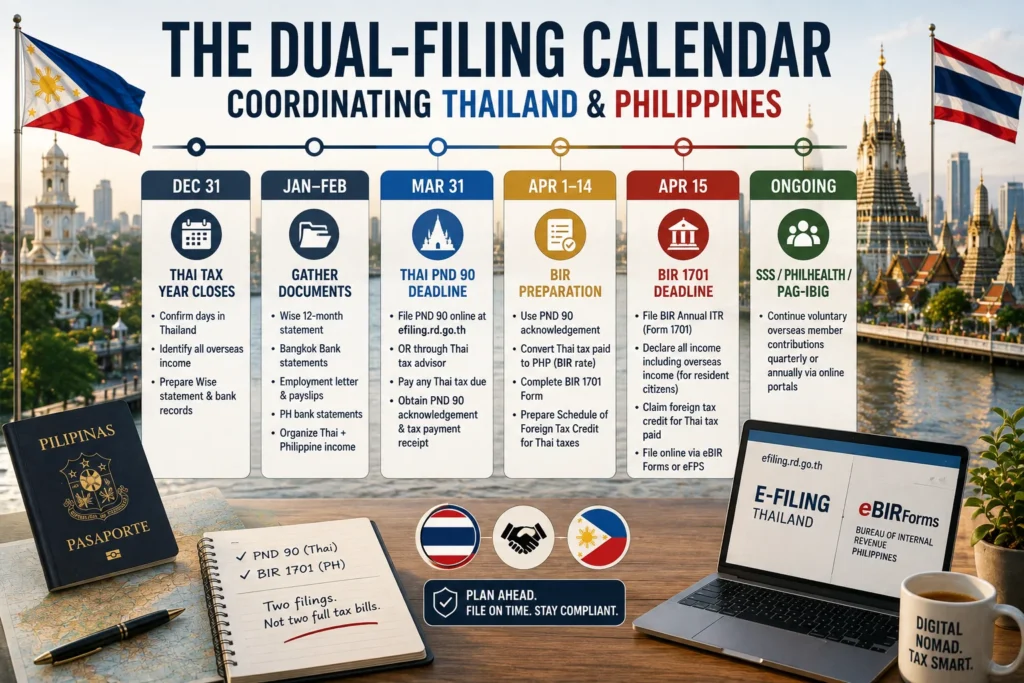
Date / Deadline
Obligation
Action Required
Dec 31
Thai tax year closes
Confirm total days in Thailand for the year. Identify all overseas income received in Thailand in the same year. Prepare Wise statement and bank records.
Jan-Feb
Gather documents
Compile: Wise 12-month statement, Bangkok Bank statements, employment letter, payslips, Philippine bank statements (for PH-sourced income). Organize Thai + Philippine income separately.
File PND 90 online at efiling.rd.go.th OR through Thai tax advisor. Pay any Thai tax due. Obtain PND 90 acknowledgement and tax payment receipt — critical for BIR credit claim.
Apr 1-14
BIR preparation
Use PND 90 acknowledgement to document Thai tax paid. Convert Thai tax paid to PHP at BIR reference rate. Complete BIR 1701 Form with Schedule of Foreign Tax Credit for Thai taxes.
Apr 15
BIR 1701 DEADLINE
File BIR Annual ITR (Form 1701). Declare all income including overseas income (for resident citizens). Claim foreign tax credit for Thai income tax paid. File online via eBIR Forms or eFPS.
Ongoing
SSS / PhilHealth / Pag-IBIG
Continue voluntary overseas member contributions to SSS, PhilHealth, and Pag-IBIG quarterly or annually via online portals.
8. SSS, PhilHealth, and Pag-IBIG: What Continues in Bangkok
The Philippines-Thailand tax treaty only covers income taxes. Social contribution obligations (SSS, PhilHealth, Pag-IBIG) are governed by separate Philippine laws and are not affected by the treaty.
Contribution
Can Continue Voluntarily?
Why It Matters
Online Portal
SSS
Yes — as Overseas Voluntary Member
Maintains pension entitlement, disability benefits, sickness benefits on return to Philippines
9. Practical Planning Scenarios for Filipino Nomads in Bangkok
Scenario A: Under 180 days in Thailand per calendar year
Thai tax residency: Not triggered. No Thai income tax on overseas income. Philippines (if resident citizen): BIR taxes worldwide income. But no Thai tax to credit against, so no foreign tax credit opportunity. Philippines (if non-resident citizen): BIR taxes only Philippine-sourced income. Overseas income not taxable. Best strategy at this day count: Stay under 180 days in Thailand. If Philippine non-resident citizen: near-zero total income tax on overseas income.
Scenario B: 180+ days in Thailand, Philippine resident citizen
Thai tax: Yes. Progressive rates on assessable overseas income. Philippines: Worldwide income taxable. Treaty credit for Thai taxes paid reduces Philippine tax. Action: File PND 90 (March 31) → file BIR 1701 with foreign tax credit (April 15).Planning note: If this is Year 1-2 abroad, assess whether non-resident citizen status will apply in Year 3+.
Scenario C: 180+ days in Thailand, Philippine non-resident citizen
Thai tax: Yes. Progressive rates on assessable overseas income.Philippines: ZERO on overseas income. Only Philippine-sourced income (dividends, bank interest) taxable.Treaty credit: Not needed for overseas active income (no Philippine tax to offset). Still relevant for Philippine-sourced passive income.Action: File PND 90 (March 31) → file BIR 1701 declaring only Philippine-sourced income (April 15). No foreign tax credit claim needed for overseas income.This is the most tax-efficient Thai-base structure for Filipino digital nomads.
Frequently Asked Questions
Philippines Thailand tax treaty digital nomads: Do You Pay Tax in Both Thailand and the Philippines?
Potentially in both countries, but not full rates on the same income. If you are a Thai tax resident (180+ days) and a Philippine resident citizen, Thai income tax applies on assessable overseas income. The Philippines-Thailand treaty credit mechanism allows crediting Thai tax paid against Philippine income tax on the same income, preventing double full taxation. If you are a Philippine non-resident citizen, overseas income is not taxable in the Philippines at all — only Thai income tax applies.
Is a Filipino digital nomad in Bangkok an OFW for BIR purposes?
No. OFW (Overseas Filipino Worker) status requires POEA-processed deployment, OWWA membership, and an OEC (Overseas Employment Certificate). Filipino digital nomads on LTR Visa, DE Rantau, or tourist visa in Thailand are not OFWs. The applicable BIR classification is either resident citizen (worldwide income taxable) or non-resident citizen (overseas income not taxable). Do not apply OFW income exemption rules to digital nomad income.
What is Philippine non-resident citizen status and how do I qualify?
Section 22(E) of the Philippine NIRC defines non-resident citizens as Filipinos who establish residence abroad continuously for at least one year, or those working abroad whose employment requires physical presence outside the Philippines for most of the taxable year. As a non-resident citizen, only Philippine-sourced income (dividends from Philippine companies, Philippine bank interest, Philippine rental income) is taxable in the Philippines. Overseas income is not taxable. Consult a Philippine CPA to confirm when and how your BIR status changes.
What is the BIR filing deadline when I live in Bangkok?
BIR Form 1701 (Annual Income Tax Return) must be filed by April 15 of the year following the taxable year, regardless of where you live. Living in Thailand does not extend or waive this deadline. File online via eBIR Forms or eFPS. If claiming foreign tax credit for Thai income taxes paid, have your Thai PND 90 acknowledgement ready before April 15.
How do I claim the Philippines-Thailand treaty credit in my BIR return?
In BIR Form 1701: go to the Schedule of Foreign Tax Credit. Enter Thailand as the source country, enter the gross income earned in Thailand, and enter the Thai income tax paid (from PND 90 acknowledgement, converted to PHP at BIR reference rate). The foreign tax credit reduces your Philippine income tax on the same income. File your Thai PND 90 first (March 31 deadline), then file your BIR 1701 with the credit (April 15 deadline).
Do SSS, PhilHealth, and Pag-IBIG obligations continue when living in Bangkok?
Yes. These social contribution obligations are not affected by the Philippines-Thailand tax treaty or by your Thai tax residency status. You can continue as voluntary overseas members of SSS (my.sss.gov.ph), PhilHealth (philhealth.gov.ph), and Pag-IBIG (pagibigfund.gov.ph). Continuing contributions maintains pension entitlement, healthcare coverage, and housing loan eligibility for your eventual return to the Philippines.
Final Verdict: Your Philippines-Thailand Tax Framework
The Philippines-Thailand tax treaty does exactly what it is designed to do: prevent full double taxation. Two filing obligations, not two full tax bills on the same income. For Filipino nomads planning their Bangkok base: the most important tax planning variable is your BIR residency classification. Establishing non-resident citizen status — typically after continuous absence from the Philippines exceeding one year — reduces your Philippine tax obligation to Philippine-sourced income only. Combined with Thailand’s tax position (which is determined by your Thailand day count), this gives you clarity on exactly what you owe and where. The practical sequence: (1) Know your Thai day count and whether you are a Thai tax resident. (2) Know your BIR classification (resident citizen or non-resident citizen). (3) File PND 90 in Thailand by March 31. (4) File BIR 1701 in Philippines by April 15, claiming treaty credit if applicable. (5) Continue SSS, PhilHealth, Pag-IBIG voluntary contributions. Professional advice is essential for the first year. A Philippine CPA with overseas Filipino expertise + a Thai tax advisor who works with expats is the right advisory team for a Filipino nomad establishing a Bangkok base. Read the Thailand Tax Residency Guide for the complete Thai tax framework, or the Thailand LTR Visa for Filipinos guide for the legal visa that formalizes your Bangkok stay.