
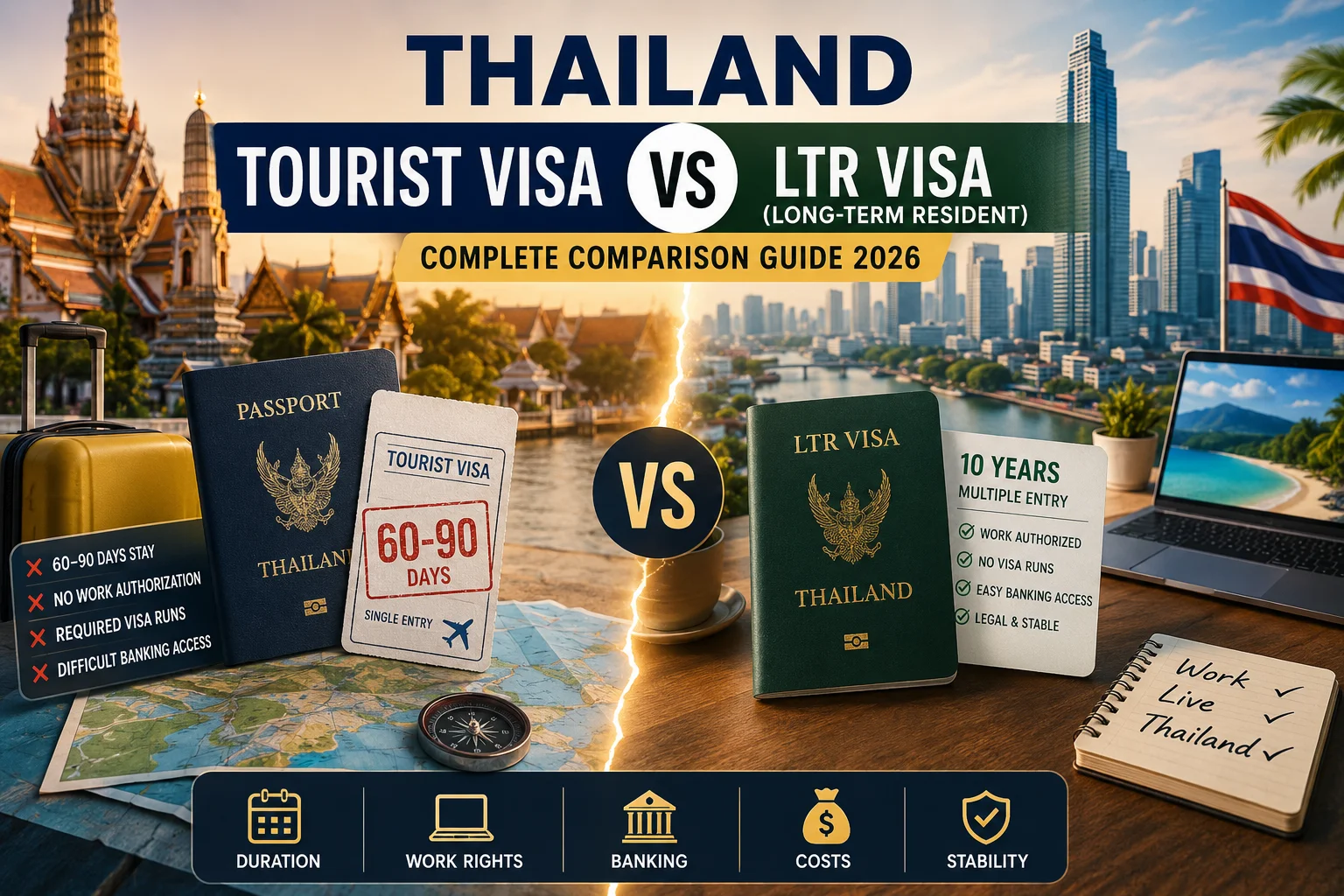
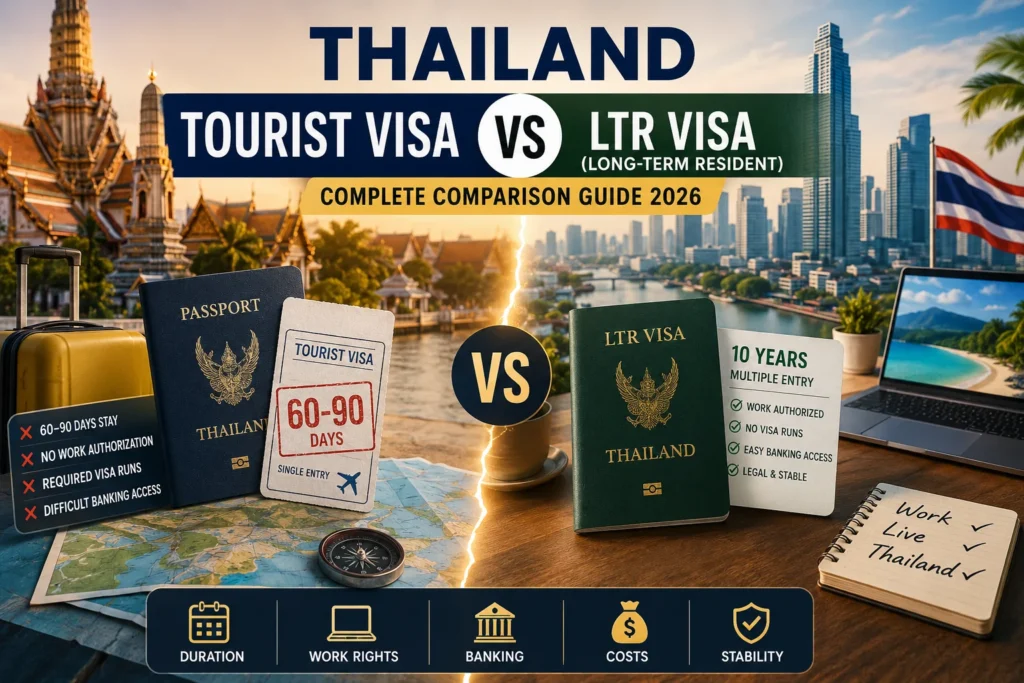
| The Thailand tourist visa vs LTR Visa comparison highlights two visa categories designed for completely different purposes. A tourist visa provides 60 to 90 days per entry with no work authorization and requires regular renewal or border runs. The LTR Visa provides 10 years of multiple-entry stay with an explicit work permit for overseas employment and full banking access. The upfront cost of the LTR Visa is THB 63,800 (approx. USD 1,780) but eliminates visa run costs and uncertainty for 10 years. The tourist visa requires no upfront cost but costs THB 1,900 per extension plus significant transport for border runs when extensions are exhausted. The LTR Visa requires USD 40,000/year in overseas income and 5+ years of professional experience; the tourist visa has no income requirement. For digital nomads and remote workers planning to stay in Thailand for more than a few months, the LTR Visa is categorically the stronger option if eligibility is met. |
| QUICK ANSWER: What is the difference between Thailand tourist visa and LTR Visa? The key differences between Thailand tourist visa and LTR Visa are: Duration: Tourist visa = 60–90 days per entry; LTR Visa = 10 years, multiple entry Work authorization: Tourist visa = not authorized; LTR Visa = explicitly authorized for overseas employers Cost: Tourist visa = THB 1,900 extension fee per stay; LTR Visa = THB 63,800 one-timeIn come requirement: Tourist visa = none; LTR Visa = USD 40,000/year from overseas Banking access: Tourist visa = very difficult; LTR Visa = easy with endorsement letter Visa runs: Tourist visa = required every 60–90 days; LTR Visa = none for 10 years Bottom line: For genuine tourists, the tourist visa is appropriate. For remote workers and digital nomads planning long-term Thailand residency, the LTR Visa is the legally correct and practically superior option. |
| DISCLAIMER Visa fees, eligibility requirements, and policies can change. Always verify current requirements at boi.go.th (LTR Visa) and immigration.go.th (tourist visa) before making any decisions. This is not legal or immigration advice. |
Introduction
If you are spending significant time in Thailand — or planning to — the choice between staying on tourist visas and applying for the LTR Visa is one of the most consequential decisions you will make about your Thailand lifestyle.
Most people start on tourist visas. It is the default: no income requirements, no application process, low cost. But for anyone who is genuinely building a life or remote career in Thailand, the tourist visa creates a pattern of instability: recurring border runs, legal ambiguity around remote work, difficulty opening bank accounts, and the ever-present uncertainty of whether Thai Immigration will start questioning your pattern of entries.
This comparison covers every dimension that matters: duration, work authorization, cost (including the real total cost of the tourist visa route), banking, tax implications, and the clear decision framework for who should choose which.
Quick Definitions: What Each Visa Actually Is
| Visa Type | What It Is | Issued By | Purpose |
| Thailand Tourist Visa (TR) | A short-stay visa for tourism. Also covers visa-exempt entry (30-day stamp on arrival for many nationalities including Indians and Filipinos). | Thai Embassies worldwide OR automatic on arrival (visa-exempt) | Tourism, short visits, family visits |
| Thailand LTR Visa — WFT Category | A 10-year, multiple-entry long-stay visa with work permit for remote work for overseas employers. Introduced by the Thailand BOI in 2022. | Thailand Board of Investment (BOI) | Long-term legal residence for remote professionals |
Master Comparison Table: 15 Key Factors
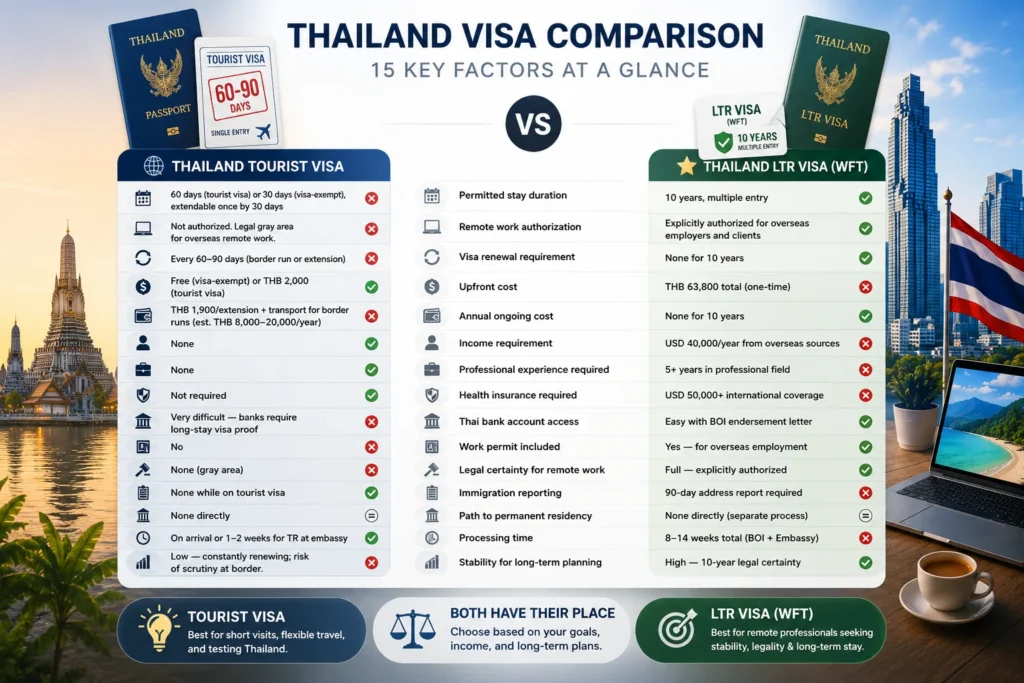
| Factor | 🌏 Thailand Tourist Visa | ⭐ Thailand LTR Visa (WFT) | Better for |
| Permitted stay duration | 60 days (tourist visa) or 30 days (visa-exempt), extendable once by 30 days | 10 years, multiple entry | LTR |
| Remote work authorization | Not authorized. Legal gray area for overseas remote work. | Explicitly authorized for overseas employers and clients | LTR |
| Visa renewal requirement | Every 60–90 days (border run or extension) | None for 10 years | LTR |
| Upfront cost | Free (visa-exempt) or THB 2,000 (tourist visa) | THB 63,800 total (one-time) | Tourist (short term) |
| Annual ongoing cost | THB 1,900/extension + transport for border runs (est. THB 8,000–20,000/year) | None for 10 years | LTR (long term) |
| Income requirement | None | USD 40,000/year from overseas sources | Tourist (no barrier) |
| Professional experience required | None | 5+ years in professional field | Tourist (no barrier) |
| Health insurance required | Not required | USD 50,000+ international coverage | Tourist (lower cost) |
| Thai bank account access | Very difficult — banks require long-stay visa proof | Easy with BOI endorsement letter | LTR |
| Work permit included | No | Yes — for overseas employment | LTR |
| Legal certainty for remote work | None (gray area) | Full — explicitly authorized | LTR |
| Immigration reporting | None while on tourist visa | 90-day address report required | Tourist |
| Path to permanent residency | None directly | None directly (separate process) | Equal |
| Processing time | On arrival or 1–2 weeks for TR at embassy | 8–14 weeks total (BOI + Embassy) | Tourist (faster) |
| Stability for long-term planning | Low — constantly renewing; risk of scrutiny at border | High — 10-year legal certainty | LTR |
Deep Dive: Duration and Stability
The duration difference between the tourist visa and LTR Visa is not merely a number — it represents fundamentally different quality of life experiences.
On a tourist visa, your permitted stay expires every 60 to 90 days. Each expiry forces you to either extend your stay at an immigration office (one-time only, THB 1,900 fee) or leave Thailand entirely for a border run. For a 12-month year, that means approximately 4 to 6 border crossing events, each requiring half a day to a full day of travel time and associated transport costs.
The LTR Visa, once issued, requires no annual renewal for 10 years. You enter and exit Thailand freely on the same visa for a decade. The only ongoing administrative requirement is the 90-day address report to Thai Immigration — which can be done in person, online, or by mail, and takes 15 to 30 minutes.
| THE REAL COST OF THE TOURIST VISA ROUTE OVER 1 YEAR Most cost comparisons show the LTR Visa at THB 63,800 vs. tourist visa at zero. This is misleading. Here is the realistic 12-month cost comparison for someone based in Thailand: Tourist visa route (12 months): • 4 tourist extensions at THB 1,900 each = THB 7,600 • 2–4 border run trips (bus/train to Malaysia or Cambodia border) = THB 4,000–12,000 • Accommodation near border (1 night each border run) = THB 2,000–6,000 • Time cost: 8–16 half-days per year at immigration or border crossings • TOTAL: THB 13,600–25,600 per year + significant time costLTR Visa (10-year span): • One-time cost: THB 63,800 • Annual health insurance: approx. THB 21,600–65,000 (required by LTR but a genuine health benefit) • Zero border run costs, zero extension fees for 10 years Break-even point without insurance: 2.5 to 5 years of tourist visa costs equal the LTR Visa one-time fee. |
Deep Dive: Work Authorization — The Most Important Difference
This is the dimension that matters most for remote workers and digital nomads, and the one most comparison articles gloss over.
| Activity | Thailand Tourist Visa | Thailand LTR Visa (WFT) |
| Working remotely for overseas employer (employee) | Not authorized — legal gray area | Explicitly authorized — work permit included |
| Freelancing for multiple overseas clients | Not authorized — legal gray area | Explicitly authorized |
| Working for Thai company or Thai clients | Not authorized (requires work permit) | Not authorized (requires separate Thai work permit) |
| Attending video calls and business meetings | Generally considered okay; enforcement rare | Clearly authorized as part of remote work |
| Running an online business serving overseas customers | Not authorized | Authorized (overseas revenue source) |
| 90-day address reporting | Not required | Required (straightforward process) |
The practical difference: on a tourist visa, every day of remote work is technically unauthorized and carries a non-zero legal risk. On an LTR Visa, every day of remote work for overseas clients is explicitly covered. For someone who depends on remote work income, this legal clarity has real value that cannot be measured only in financial terms.
Deep Dive: Banking and Financial Access
This difference affects daily quality of life in Thailand far more than most comparison articles acknowledge.
Tourist visa holders
Opening a bank account in Thailand on a tourist visa is notoriously difficult. Thai banks typically require proof of long-term legal residence, a work permit or Non-Immigrant visa, and often a letter from an employer or embassy. Tourist visa holders are routinely turned away by Bangkok Bank, Kasikorn Bank, and Krungthai Bank when attempting to open standard savings accounts.
The workarounds — Wise, Payoneer, international transfers — work for receiving income but create daily friction for local expenses (rent, utilities, regular payments) that require a Thai bank account.
LTR Visa holders
The LTR Visa includes a BOI endorsement letter that explicitly facilitates bank account opening at Thai banks. Bangkok Bank and Kasikorn Bank (KBank) both accept LTR Visa holders as customers with the endorsement letter, passport, and rental contract.
A functional Thai bank account means: direct THB payments without conversion fees, local debit card usage, smooth rental payment setups, and the ability to participate fully in Thailand’s financial infrastructure.
Deep Dive: Tax Residency — Where Both Visas Are Equal
One important fact that most comparison articles miss: Thai tax residency is triggered by physical presence, not visa type. Spending 180 or more days in Thailand in a calendar year makes you a Thai tax resident regardless of whether you are on a tourist visa or an LTR Visa.
| IMPORTANT: TAX APPLIES EQUALLY TO BOTH VISA TYPES The 180-day rule that triggers Thai tax residency applies identically to tourist visa holders and LTR Visa holders. Long-term tourists who spend most of the year in Thailand via tourist visa runs face the same potential Thai tax exposure as LTR Visa holders. The LTR Visa does not automatically create or eliminate tax obligations compared to tourist visa long-stays. Tax implications depend on nationality, income source, and the India-Thailand or Philippines-Thailand tax treaties. Both visa types require active tax planning if you are spending 180+ days/year in Thailand. Consult a tax advisor regardless of which visa you hold. |
Deep Dive: Eligibility Requirements
| Requirement | Thailand Tourist Visa | Thailand LTR Visa (WFT Category) |
| Annual income | None | Minimum USD 40,000/year gross from overseas sources |
| Professional experience | None | 5+ years in your professional field |
| Health insurance | Not required | USD 50,000+ international coverage valid in Thailand |
| Documents | Valid passport + photo | Passport + CA certificate/income proof + ITR + contracts + health insurance + CV |
| Application process | On arrival or tourist visa application at Thai Embassy | Online application via BOI portal + Thai Embassy visa stamping |
| Criminal record / background | Not checked for most nationalities | Background check conducted by BOI |
| Thai immigration history | Not assessed for tourist entry | Prior immigration violations can affect BOI assessment |
Decision Framework: Who Should Choose Which Visa
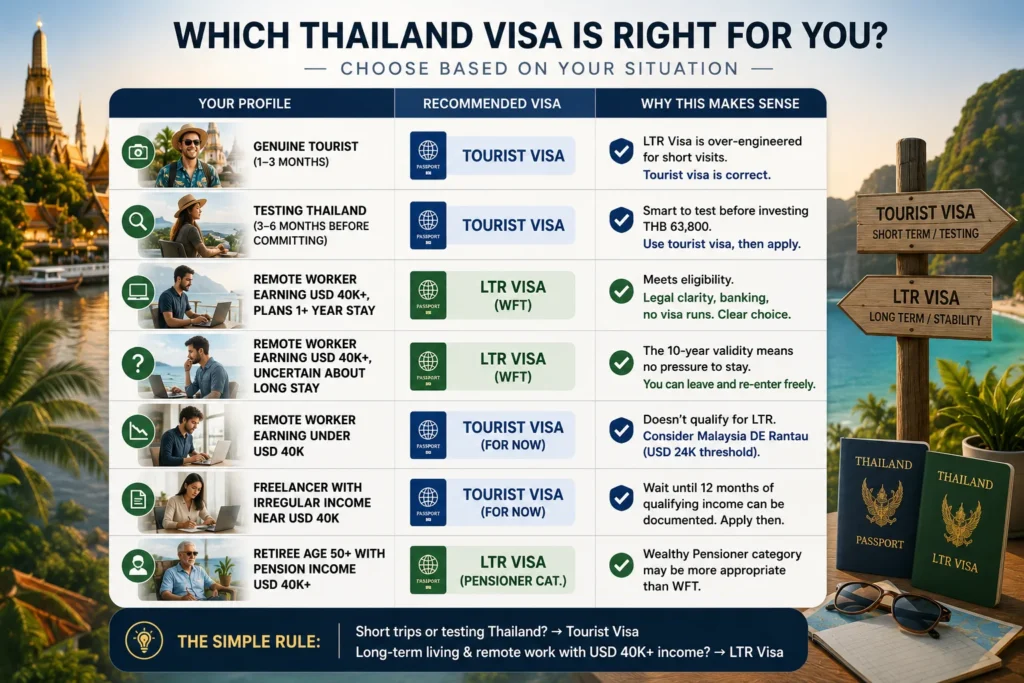
Use this framework to determine which visa is right for your situation:
| Your Profile | Recommended Visa | Reason |
| Genuine tourist (1–3 months) | Tourist Visa | LTR Visa is over-engineered for short visits. Tourist visa is correct. |
| Testing Thailand for 3–6 months before committing | Tourist Visa | Smart to test before investing THB 63,800. Use tourist visa, then apply. |
| Remote worker earning USD 40K+, plans 1+ year stay | LTR Visa | Meets eligibility. Legal clarity, banking, no visa runs. Clear choice. |
| Remote worker earning USD 40K+, uncertain about long stay | LTR Visa | The 10-year validity means no pressure to stay. You can leave and re-enter freely. |
| Remote worker earning under USD 40K | Tourist Visa (for now) | Doesn’t qualify for LTR. Consider Malaysia DE Rantau (USD 24K threshold). |
| Freelancer with irregular income near USD 40K | Tourist Visa (for now) | Wait until 12 months of qualifying income can be documented. Apply then. |
| Retiree age 50+ with pension income USD 40K+ | LTR Visa (Pensioner cat.) | Wealthy Pensioner category may be more appropriate than WFT. |
Nationality-Specific Guidance
Indian Citizens
| INDIA-SPECIFIC COMPARISON NOTES Tourist visa: Indian citizens receive 30 days visa-exempt on arrival (air entry), extendable once by 30 days = 60 days maximum per entry. Multiple re-entries via border runs create an entry pattern that Thai Immigration may start scrutinizing after many consecutive stamps. LTR Visa: Indian citizens are among the most active applicants for the LTR Visa (WFT category). The USD 40,000 threshold translates to approximately ₹34.4 lakh/year at current rates — achievable for senior Indian IT professionals and consultants. Indian-specific advantage of LTR Visa: Eliminates the need to explain frequent Thailand entries to Thai Immigration, which becomes relevant for Indians with many back-to-back tourist entry stamps. FEMA implications: The LTR Visa does not change Indian FEMA obligations. Long-term Thailand residence on either visa type requires active NRO/NRE account management. |
Filipino Citizens
| PHILIPPINES-SPECIFIC COMPARISON NOTES Tourist visa: Filipino citizens receive 30 days visa-exempt on arrival, extendable by 30 days = 60 days maximum per entry. Border runs to Malaysia (Kelantan crossing) are commonly used by Filipino nomads in Thailand. LTR Visa: The WFT category is accessible to Filipinos earning USD 40,000+ from overseas clients. Upwork developers, BPO managers, and online business owners in the Philippines community are the most common applicants. Philippines-specific consideration: PhilHealth is not accepted as qualifying health insurance for the LTR Visa. An international plan (SafetyWing Remote Health, Cigna Global) must be purchased separately. Malaysian alternative: For Filipino remote workers earning below USD 40K, Malaysia DE Rantau (USD 24K threshold, 1-year stay) is geographically accessible from Southern Thailand and provides legal remote work authorization. |
The Gap Scenario: What If You Don’t Yet Qualify for the LTR Visa?
If you want the LTR Visa but currently earn below USD 40,000/year, you have four options:
- Continue on tourist visas while building your income to the qualifying threshold. Document your income carefully as it grows — you will need 12 months of qualifying income when you apply.
- Apply for Malaysia DE Rantau (USD 24,000/year threshold) as a stepping stone. It provides legal remote work authorization in Southeast Asia while you build toward LTR eligibility.
- Apply for Georgia Remotely From programme (USD 2,000/month threshold). Easy to qualify; provides a European digital nomad base while you build income.
- Apply for Thailand Tourist Visa and manage the visa run situation as cost-effectively as possible until your income reaches the LTR threshold.
| THE INCOME TRAJECTORY STRATEGY If you are currently earning USD 25,000 to 35,000/year and growing, do not apply for the LTR Visa prematurely with inadequate documentation. Wait until you have 12 full months clearly above USD 40,000, then apply with a strong income package. A properly documented application at USD 42,000 is far stronger than a borderline application at USD 40,000. |
Common Mistakes in Choosing Between the Two
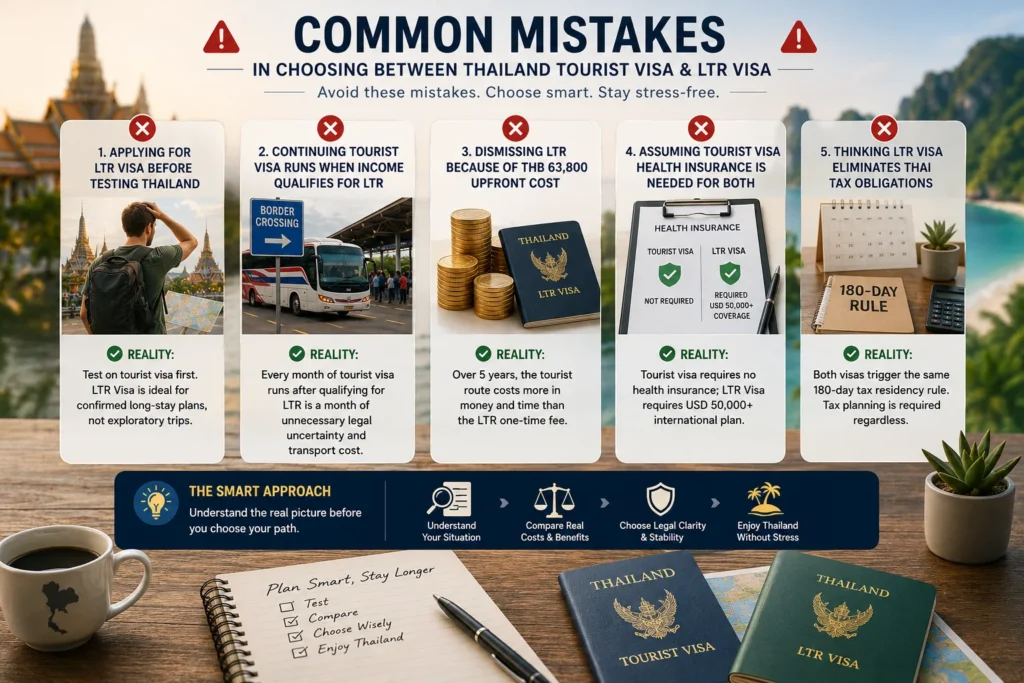
| Mistake | Who Makes It | Reality |
| Applying for LTR Visa before testing Thailand | Travelers new to Thailand | Test on tourist visa first. LTR Visa is ideal for confirmed long-stay plans, not exploratory trips. |
| Continuing tourist visa runs when income clearly qualifies for LTR | Remote workers above USD 40K | Every month of tourist visa runs after qualifying for LTR is a month of unnecessary legal uncertainty and transport cost |
| Dismissing LTR because of the THB 63,800 upfront cost without calculating tourist visa route total cost | Cost-focused applicants | Over 5 years, the tourist route costs more in money and time than the LTR one-time fee |
| Assuming tourist visa health insurance is needed for both | First-time researchers | Tourist visa requires no health insurance; LTR Visa requires USD 50,000+ international plan |
| Thinking LTR Visa eliminates Thai tax obligations | Tax-conscious applicants | Both visas trigger the same 180-day tax residency rule. Tax planning is required regardless. |
Risks and Limitations of Each Option
Tourist Visa risks
- Legal uncertainty for remote work — not authorized, enforcement is low but real
- Border run immigration scrutiny increasing for long-term visitors with many consecutive entries
- Difficulty accessing Thai banking system for daily financial life
- No stability: cannot sign 12-month lease confidently when visa expires every 60-90 days
- Accumulating entry stamps eventually trigger questions at Thai Immigration
LTR Visa risks and limitations
- THB 63,800 upfront cost is lost if you decide to leave Thailand after 1 to 2 years
- Health insurance ongoing cost adds approximately USD 600 to 1,800/year
- Documentation complexity is higher — particularly for Indian and Filipino freelancers
- Processing takes 8 to 14 weeks — cannot be obtained quickly for imminent plans
- No path to Thai permanent residency directly from LTR Visa
Frequently Asked Questions
What is the difference between Thailand tourist visa vs LTR Visa?
The Thailand tourist visa allows stays of 60 to 90 days per entry and does not authorize remote work. The Thailand LTR Visa (Long-Term Resident Visa, Work-From-Thailand category) provides a 10-year, multiple-entry stay with an explicit work permit for overseas employers. The LTR Visa requires USD 40,000/year in overseas income and 5+ years of professional experience; the tourist visa has no income requirements.
Is the Thailand LTR Visa worth it compared to a tourist visa?
For remote workers and digital nomads earning USD 40,000+ annually from overseas, the LTR Visa is generally worth it after a stay of 2 to 3 years. The break-even point is when the accumulated tourist visa run costs (extensions, transport, accommodation, time) equal the THB 63,800 LTR Visa fee. Beyond break-even, the LTR Visa provides 10 years of legal certainty, banking access, and no border runs — at zero ongoing visa cost.
Can I work remotely on a Thailand tourist visa?
Legally, no. The Thailand Aliens’ Work Act requires a work permit for any work performed on Thai soil, and tourist visas do not include a work permit. In practice, enforcement against remote workers serving exclusively overseas clients is rare but documented. The LTR Visa (WFT category) is the proper legal solution, providing an explicit work endorsement for overseas employment.
Do Thai tax rules apply differently to tourist visa vs. LTR Visa holders?
No. Thai tax residency is triggered by physical presence: spending 180 or more days in Thailand in a calendar year makes you a Thai tax resident regardless of visa type. Tourist visa holders on extended stays and LTR Visa holders face identical Thai tax residency exposure based on days spent in Thailand.
Can Indian and Filipino citizens get the Thailand LTR Visa?
Yes. Both Indian and Filipino citizens can apply for the Thailand LTR Visa under the Work-From-Thailand Professional category if they earn at least USD 40,000 per year from non-Thai overseas sources, have 5+ years of professional experience, and hold valid international health insurance with USD 50,000+ coverage. Indian and Filipino applicants follow the standard BOI online application process.
Final Verdict: Tourist Visa vs. LTR Visa
| The Thailand tourist visa and Thailand LTR Visa serve different people at different stages of their Thailand journey. The tourist visa is the right starting point for anyone testing Thailand or visiting short-term. It becomes the wrong tool when someone starts using it as a long-term residence strategy. For remote workers earning USD 40,000+ from overseas sources with plans to spend significant time in Thailand, the LTR Visa is not just the better option — it is the correct option. It provides legal certainty for remote work, removes visa run requirements, enables banking access, and eliminates immigration uncertainty for 10 years. The THB 63,800 upfront cost is significant but becomes marginal over a 5 to 10 year horizon when compared to the total cost and time invested in tourist visa maintenance. If you qualify for the LTR Visa and you plan to be in Thailand for more than 6 months per year, the analysis consistently points in one direction. |