The Thailand SMART Visa endorsement process is a mandatory pre-application stage that all SMART Visa applicants must complete before submitting to the BOI. The endorsement is issued by a recognized Thai government agency depending on the applicant’s sector: NIA (National Innovation Agency) for technology innovators, depa (Digital Economy Promotion Agency) for digital industry professionals, NSTDA (National Science and Technology Development Agency) for research scientists, and others for specialist sectors. The employer typically initiates the Thailand SMART Visa endorsement process with the relevant agency, submitting the applicant’s credentials and employment details. Review takes 15 to 30 working days per agency. Upon approval, the endorsing body issues an endorsement letter with a validity period of 60 to 90 days. The BOI application must be submitted within this window. An endorsement can be rejected if the employer or applicant does not meet the agency’s criteria — in which case the application cannot proceed until the rejection is addressed.
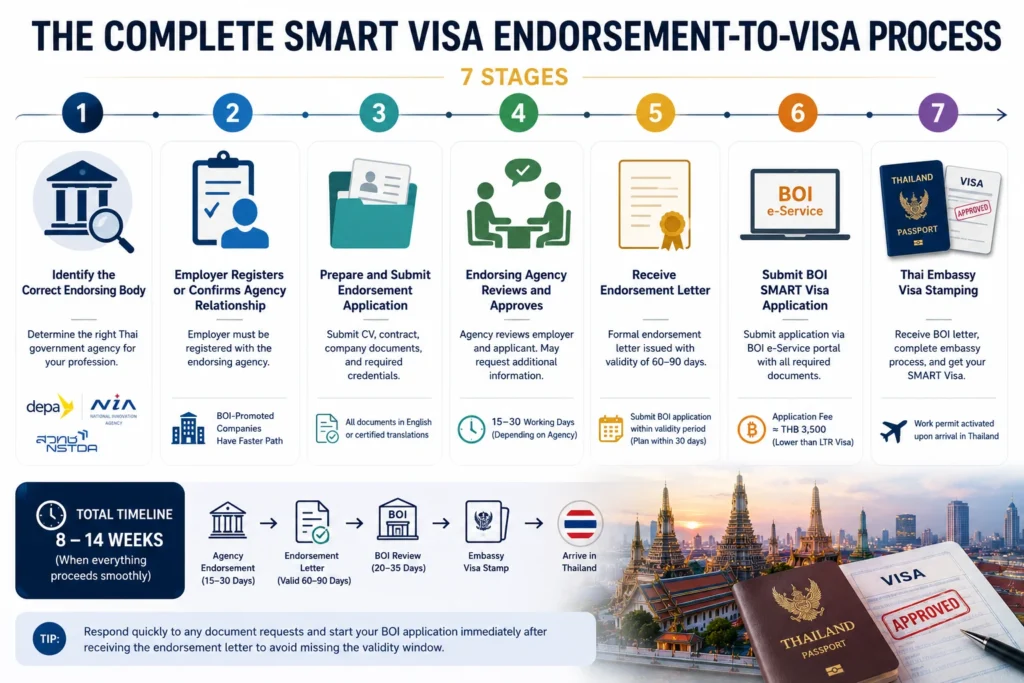
QUICK ANSWER: How does the Thailand SMART Visa endorsement process work? The SMART Visa endorsement process works in 7 stages: Identify the correct endorsing body for your sector (NIA, depa, NSTDA, or other)Employer (or applicant directly) submits endorsement request to the endorsing body with required credentialsEndorsing body reviews employer eligibility and applicant qualifications (15–30 working days)Endorsement letter issued upon approval (valid for 60–90 days)Submit BOI SMART Visa application via ltrvisat.boi.go.th within the endorsement letter’s validity periodBOI review and BOI endorsement letter issued (20–35 working days)Thai Embassy visa stamping — SMART Visa sticker placed in passport Total timeline from endorsement request to visa in passport: approximately 8 to 14 weeks when everything proceeds smoothly.
DISCLAIMER Endorsing body processes, timelines, and requirements can change. Always verify current requirements directly with NIA (nia.or.th), depa (depa.or.th), NSTDA (nstda.or.th), or BOI (boi.go.th) before initiating the endorsement process. This guide is for informational purposes only and is not legal advice.
Introduction: Why the Endorsement Step Stops Most Applications
The Thailand SMART Visa is one of the most appealing long-stay visa options for senior tech professionals, researchers, and innovators working in Thailand. But it has a unique requirement that the LTR Visa does not: before you can even submit your application to the BOI, you must first obtain a formal endorsement from a recognized Thai government agency.
This endorsement requirement is the step that most SMART Visa guides either gloss over or describe vaguely. In practice, it is the step that most delays — and sometimes stops entirely — SMART Visa applications. The endorsement process involves a separate government agency, a separate review period, and a separate approval letter. Understanding it fully before you start is the difference between an 8-week application and a 6-month one.
This guide covers the complete endorsement process stage by stage, including which agency to approach for which sector, what the employer’s role is (often misunderstood), how long each agency takes, and what happens if the endorsement is declined.
What Is SMART Visa Endorsement and Why Is It Required?
Thailand’s SMART Visa is not processed solely by the BOI. Before BOI issues its own endorsement, it requires that a sector-specific national agency has independently verified that:
The applicant’s skills and credentials meet the standards expected for a highly skilled professional in the target sector
The employer is a recognized entity operating in a BOI-targeted S-curve industry
The proposed employment role aligns with Thailand’s strategic development needs
This two-stage endorsement — sector agency first, then BOI — is what distinguishes the SMART Visa from the LTR Visa, which goes directly through BOI without a sector agency step. The two-stage process adds complexity but also adds credibility: SMART Visa holders have been vetted by Thailand’s own development agencies.
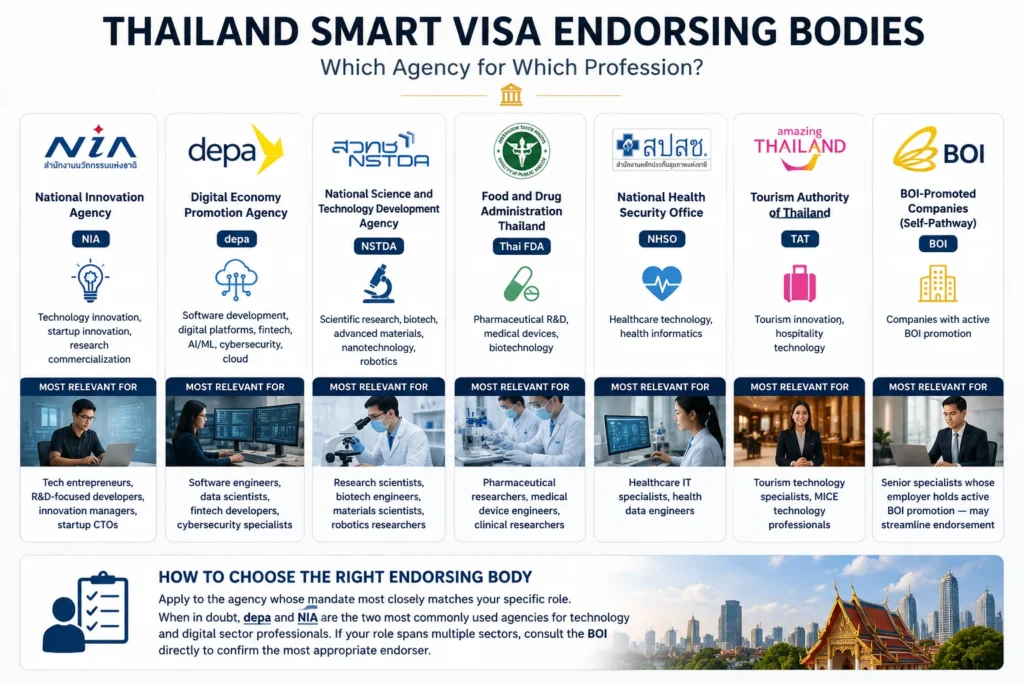
The Complete Endorsing Bodies: Which Agency for Which Profession
Endorsing Body
Abbreviation
Primary Sector Focus
Most Relevant For
National Innovation Agency
NIA
Technology innovation, startup innovation, research commercialization
Senior specialists whose employer holds active BOI promotion — may streamline endorsement
HOW TO CHOOSE THE RIGHT ENDORSING BODY Apply to the agency whose mandate most closely matches your specific role. A data scientist at a Thai bank’s AI team: depa. A researcher developing new biosensor materials at a Thai university: NSTDA. A tech entrepreneur building an innovation platform: NIA. When in doubt, depa and NIA are the two most commonly used agencies for technology and digital sector professionals. If your role genuinely spans multiple sectors (e.g., a biotech data scientist), consult the BOI directly to confirm which agency is the most appropriate endorser for your specific combination.
Who Does What: Employer Role vs. Applicant Role
This is the most widely misunderstood aspect of the SMART Visa endorsement process. Most professionals assume they need to apply to the endorsing agency themselves. In many cases, the employer initiates or leads the endorsement process.
Responsibility
Typically Employer (Thai company)
Typically Applicant
Registering as an endorsable employer with the agency
YES — most agencies require the employer to register first
Not typically — employer handles
Submitting the endorsement application online
YES at NIA and depa — employer-side portal submission
Can self-apply at some agencies if employer is unable
Providing company credentials (BOI status, sector documentation)
YES — employer must provide
Not available to applicant directly
Providing applicant’s academic credentials and CV
Passes to agency along with employer submission
YES — applicant provides documents to employer/HR
Following up with endorsing agency on review status
Employer HR typically tracks status
Can follow up directly if needed
Receiving and forwarding endorsement letter
YES — typically issued to employer address
Request copy for BOI application
PRACTICAL ACTION ITEM If you are employed by a Thai company and want to apply for SMART Visa, your first action is not to contact NIA or depa directly. Your first action is to inform your HR or legal team and ask: Is our company registered with NIA/depa/NSTDA as an endorsing employer?Can you initiate the SMART Visa endorsement process for me?How long has this typically taken for previous employees? If your employer is unfamiliar with the process, consider forwarding this guide to your HR team or requesting that the company consult a Thai immigration attorney to initiate the process.
The Complete SMART Visa Endorsement-to-Visa Process: 7 Stages
STEP 1
Identify the Correct Endorsing Body Determine which Thai government agency endorses your professional category. Use the table above: software/fintech/AI/digital = depa; biotech/research = NSTDA; innovation/startup tech = NIA. Confirm with your employer that they can engage with that agency. ⚡ When in doubt between depa and NIA, choose depa for digital/software roles and NIA for innovation/R&D roles. Applying to the wrong agency causes delays.
STEP 2
Employer Registers or Confirms Agency Relationship Your Thai employer must either already be registered with the endorsing agency or complete registration. Most major Thai tech companies, BOI-promoted firms, and large banks have existing relationships with depa or NIA. Startups or smaller companies may need to register first, which adds 1 to 2 weeks. ⚡ Ask HR explicitly: ‘Is our company already registered with depa/NIA?’ Companies with BOI promotion status often have a faster path.
STEP 3
Prepare and Submit Endorsement Application Employer submits the endorsement application to the agency’s portal or via email, including: applicant’s CV and credentials, employment contract showing salary and role, company documentation (BOI promotion certificate or registration), and any sector-specific documentation required by the agency. ⚡ Ensure all documents are in English or have certified English translations. Credentials from India (apostille) or Philippines (DFA-authenticated) should be authenticated before submission.
STEP 4
Endorsing Agency Reviews and Approves The agency reviews both the employer’s credentials and the applicant’s qualifications. Some agencies conduct site visits or request additional information. Review period: NIA and depa typically 15 to 25 working days; NSTDA 20 to 30 working days. The agency may request additional documents during this period — respond quickly. ⚡ If the agency requests additional documents, respond within 3 to 5 business days. Delays in response significantly extend total processing time.
STEP 5
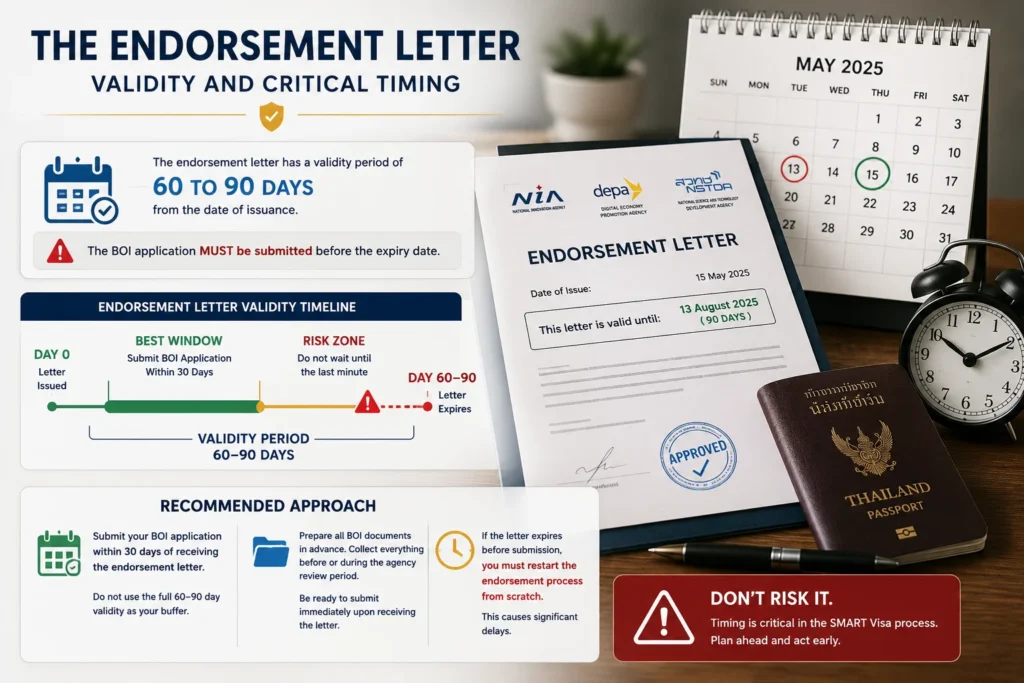
Receive Endorsement Letter The endorsing agency issues a formal endorsement letter upon approval. This letter is addressed to the applicant and/or employer and states: the applicant’s name and passport number, the endorsing agency’s confirmation, and the letter’s validity period (typically 60 to 90 days from the issue date). Start your BOI application immediately upon receiving this letter. ⚡ Note the exact validity expiry date of the endorsement letter. The BOI application must be submitted before this date. Do not delay — plan BOI submission for within 30 days of receiving the endorsement letter.
STEP 6
Submit BOI SMART Visa Application Using the endorsement letter, register on the BOI e-Service portal (ltrvisat.boi.go.th) and complete the SMART Visa application. Upload all required documents including the endorsement letter, passport, employment contract, health insurance certificate, and other standard documents. Pay the BOI application fee. BOI review: 20 to 35 working days. ⚡ The BOI SMART Visa application fee is significantly lower than the LTR Visa (approximately THB 3,500 vs THB 50,000).
STEP 7
Thai Embassy Visa Stamping After BOI approves, receive the BOI endorsement letter. Book an appointment at the Royal Thai Embassy or Consulate in your home country. Submit documents, pay the visa stamp fee, and receive your SMART Visa stamp. Upon arrival in Thailand, your work permit for the qualifying Thai employer is activated. ⚡ Schedule the Embassy appointment as soon as you receive the BOI letter. High-demand periods (before Thai holidays, end of year) have longer appointment wait times.
Agency-Specific Endorsement Detail
NIA (National Innovation Agency)
Application portal: NIA’s Smart Visa section at nia.or.th or through the NIA’s Smart Visa contact team
Typical timeline: 20 to 25 working days for initial review
NIA focus: Emphasizes the innovation dimension of the applicant’s work. Purely operational software roles may receive more scrutiny; roles with R&D, product development, or technology creation components are stronger candidates
Best for: CTOs, Principal Engineers, technology architects with product development or innovation responsibilities
depa (Digital Economy Promotion Agency)
Application portal: depa.or.th Smart Visa section or through BOI portal coordination
Key documents: CV highlighting digital/software skills, portfolio of digital work, employment contract at Thai digital sector company, academic credentials in relevant digital field
Best for: Software engineers, data scientists, platform developers, digital product managers, cybersecurity specialists at Thai digital sector companies
NSTDA (National Science and Technology Development Agency)
Application portal: NSTDA’s Science Visa coordination unit at nstda.or.th
Key documents: Academic research credentials (Master’s/PhD preferred), list of publications or research outputs, employer research organization documentation
Typical timeline: 25 to 35 working days (longest of the three primary agencies)
NSTDA focus: Research credentials and scientific contribution. Publication record and formal research institution employment are important
Best for: Research scientists, biotech researchers, materials engineers, applied scientists at Thai research institutions, university-affiliated researchers
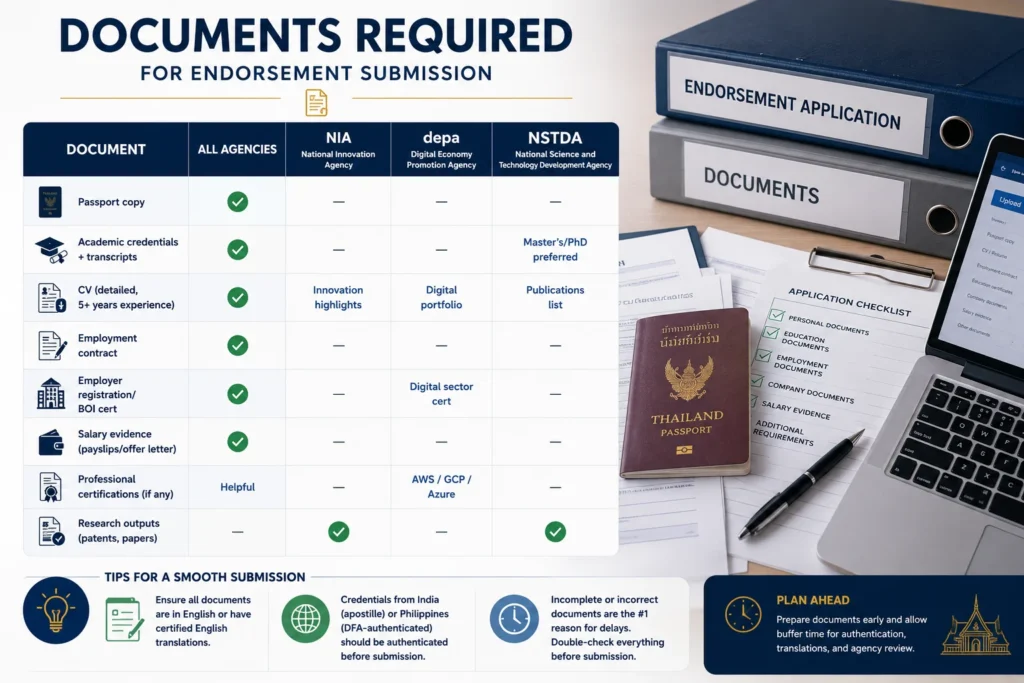
Documents Required for Endorsement Submission
Document
All Agencies
NIA Specific
depa Specific
NSTDA Specific
Passport copy
✅
—
—
—
Academic credentials + transcripts
✅
—
—
Master’s/PhD preferred
CV (detailed, 5+ years experience)
✅
Innovation highlights
Digital portfolio
Publications list
Employment contract
✅
—
—
—
Employer registration/BOI cert
✅
—
Digital sector cert
—
Salary evidence (payslips/offer letter)
✅
—
—
—
Professional certifications (if any)
Helpful
—
AWS/GCP/Azure
—
Research outputs (patents, papers)
—
✅
—
✅
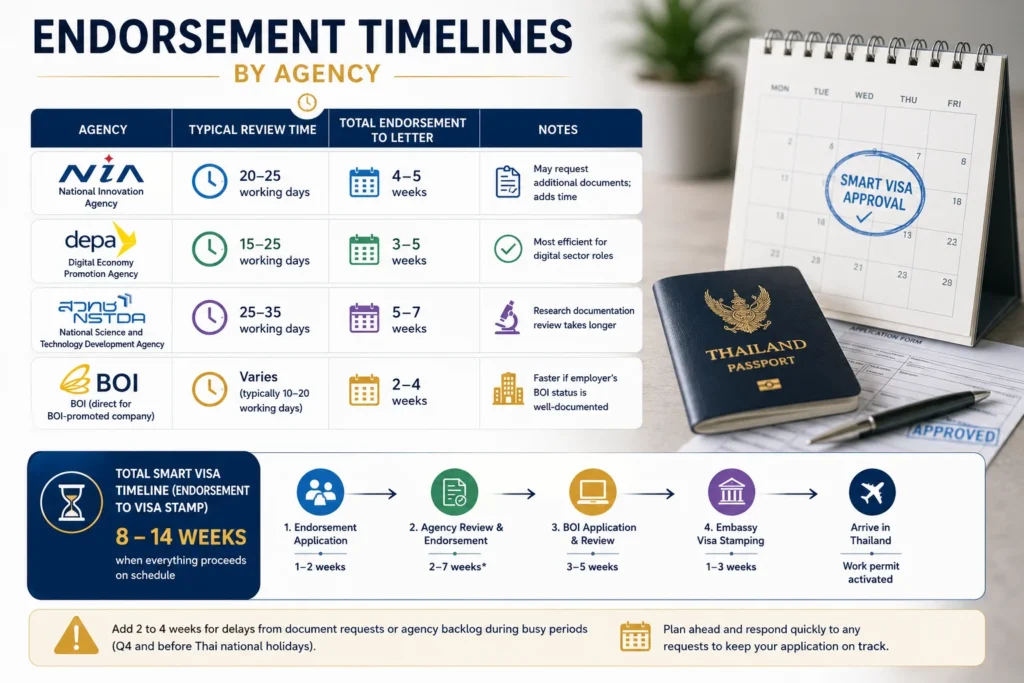
Endorsement Timelines by Agency
Agency
Typical Review Time
Total Endorsement-to-Letter
Notes
NIA
20–25 working days
4–5 weeks
May request additional documents; adds time
depa
15–25 working days
3–5 weeks
Most efficient for digital sector roles
NSTDA
25–35 working days
5–7 weeks
Research documentation review takes longer
BOI (direct for BOI-promoted company)
Varies
2–4 weeks
Faster if employer’s BOI status is well-documented
Total SMART Visa timeline (endorsement to visa stamp): approximately 8 to 14 weeks when everything proceeds on schedule. Add 2 to 4 weeks for delays from document requests or agency backlog during busy periods (Q4 and before Thai national holidays).
The Endorsement Letter: Validity and Critical Timing
ENDORSEMENT LETTER EXPIRY — DO NOT MISS THIS The endorsement letter issued by NIA, depa, or NSTDA has a validity period — typically 60 to 90 days from the date of issuance. The BOI application MUST be submitted before this date expires. If the endorsement letter expires before you submit the BOI application, you must restart the endorsement process from scratch. This is one of the most costly delays in the SMART Visa process. Recommended approach: Submit your BOI application within 30 days of receiving the endorsement letter — well within the validity windowDo not use the full 60 to 90-day validity period as your planning bufferIf you anticipate a delay in gathering BOI documents, collect everything before or during the endorsement review period so you are ready to submit immediately upon receiving the letter
What Happens If Your SMART Visa Endorsement Is Rejected?
Endorsement rejection does occur — more commonly than applicants expect. The most common grounds:
Employer does not qualify as a recognized entity in the relevant sector (not BOI-promoted, not registered with the endorsing agency, not in a target S-curve industry)
Applicant’s credentials do not meet the agency’s expectations for the sector (degree not sufficiently relevant, experience too general)
Salary below the applicable SMART Visa income threshold
Documentation incomplete or not meeting agency’s format requirements
Role does not align with S-curve sector priorities at the level of seniority expected
If your endorsement is rejected:
Request the specific rejection reason from the agency in writing
Determine whether the rejection is addressable (e.g., incomplete documentation) or structural (e.g., employer does not qualify)
If documentation-based: address the specific gap and resubmit. Most agencies allow resubmission.
If employer qualification is the issue: assess whether the employer can obtain BOI promotion or agency registration. This takes time but is addressable.
If salary is the issue: either negotiate a salary increase or assess the credential-based USD 40,000 pathway if you have qualifying academic credentials.
If the role fundamentally does not qualify: consider whether the LTR HSP category (which goes directly through BOI without sector agency endorsement) is a better pathway for your situation.
Nationality-Specific Notes for Indian and Filipino Applicants
INDIA-SPECIFIC ENDORSEMENT NOTES Academic credentials from Indian universities (IIT, IIM, AIIMS, NIT, or any NAAC-accredited institution) should be apostille-authenticated before submission to NIA, depa, or NSTDAUse Ministry of External Affairs (MEA) apostille service in India — available at designated government offices or via authorized agenciesDocuments in Hindi or regional languages: obtain certified English translations before submissionICAI CA certificate (for income proof) is relevant at the BOI stage, not the endorsing agency stage
PHILIPPINES-SPECIFIC ENDORSEMENT NOTES Philippine university credentials (UP, DLSU, Ateneo, UST, Mapua, etc.) should be authenticated by the DFA (Department of Foreign Affairs) with apostille before submissionTOR (Transcript of Records) from Philippine university: obtain certified copy from Registrar, then DFA apostilleDocuments in Filipino: obtain certified English translationsPRC board certification (for Electronics Engineers) is additional supporting evidence for depa submissions in hardware/IoT roles
Common Mistakes in the SMART Visa Endorsement Process
Mistake
Consequence
Prevention
Applying to the wrong endorsing agency
Wrong agency rejects or redirects application; weeks of delay
Map your sector to the correct agency before starting. Software = depa; Research/science = NSTDA; Innovation = NIA.
Assuming you apply to endorsing agency directly without employer involvement
Many agencies require employer-side submission; direct applicant submissions are rejected or deprioritized
Inform your Thai employer’s HR first. Most endorsements are employer-initiated.
Waiting to gather BOI documents until after endorsement is received
Endorsement letter expires before BOI documents are ready; must restart endorsement
Prepare all BOI application documents in parallel with the endorsement process.
Not specifying endorsement letter validity period
Attempting BOI submission after endorsement letter has expired
Note the exact expiry date of the endorsement letter and set a 30-day target for BOI submission.
Submitting unauthenticated credentials
Agency requests authentication; adds 2 to 4 weeks
Get apostille/DFA authentication on all academic credentials before starting endorsement.
Frequently Asked Questions
How does the Thailand SMART Visa endorsement process work?
The SMART Visa endorsement process involves 7 stages: identifying the correct endorsing body (NIA, depa, or NSTDA based on your sector), the employer submitting the endorsement application with credentials, agency review (15 to 35 working days), endorsement letter issued (valid 60 to 90 days), BOI application submitted with the endorsement letter, BOI review (20 to 35 working days), and Thai Embassy visa stamping. Total typical timeline: 8 to 14 weeks.
Which agency endorses SMART Visa for software developers?
depa (Digital Economy Promotion Agency of Thailand) is the primary endorsing body for software developers and digital industry professionals. This includes software engineers, fintech developers, AI/ML practitioners, cloud architects, cybersecurity specialists, and digital platform developers. NIA (National Innovation Agency) is more relevant for innovation-focused or entrepreneurship-focused tech roles.
Does my employer apply for SMART Visa endorsement, or do I apply directly?
In most cases, the Thai employer initiates the endorsement process by submitting an application to the endorsing agency on the applicant’s behalf. This is because most agencies require confirmation of the employer’s eligibility (BOI status, sector registration) alongside the applicant’s credentials. Inform your HR team and ask them to initiate the endorsement request as your first action.
How long is the SMART Visa endorsement letter valid?
Endorsement letters from NIA, depa, and NSTDA are typically valid for 60 to 90 days from the date of issuance. The BOI SMART Visa application must be submitted within this validity period. If the endorsement letter expires before the BOI application is submitted, the entire endorsement process must be restarted. Submit your BOI application within 30 days of receiving the endorsement letter to maintain a comfortable buffer.
What happens if my SMART Visa endorsement is rejected?
If the endorsing agency rejects your endorsement, request the specific reason in writing. Most rejections are addressable: incomplete documentation (resubmit with corrections), employer qualification issues (employer pursues BOI registration), or salary below threshold (negotiate raise or use credential-based threshold). If the rejection is structural (role does not qualify), consider the LTR HSP category, which goes directly through BOI without sector agency endorsement.
Final Verdict: Navigating the SMART Visa Endorsement Process
The SMART Visa endorsement process is the most complex and least documented step in Thailand’s most targeted long-stay visa for sector specialists. Most delays and failed applications trace back to the endorsement stage: wrong agency, employer not engaged, documents not authenticated, or endorsement letter expired. Managing this process well comes down to three things: start with your employer’s HR team, not with the endorsing agency directly; prepare all BOI application documents in parallel during the endorsement review period; and treat the endorsement letter expiry date as a hard deadline. For professionals who find the two-stage endorsement process too complex for their current employer situation, the LTR Visa Highly Skilled Professional category offers a comparable pathway directly through BOI without a sector agency endorsement step — worth comparing before committing to the SMART Visa route. Read the complete SMART Visa guide for a full comparison of SMART Visa categories and requirements, or the LTR HSP guide to compare both pathways.