AFFILIATE DISCLOSURE + DISCLAIMER This article contains affiliate links to Wise and Payoneer. MeridianNomad may receive a commission if you open an account using our links, at no cost to you. All fee information is sourced from official pricing pages. This article provides general informational guidance. It is not legal, financial, or tax advice. Thai financial regulations and tax rules change. Always consult a licensed Thai tax advisor or attorney for advice specific to your situation.
Receiving USD or EUR income in Thailand is legal and straightforward for foreign nationals on appropriate visas (LTR, SMART, Non-B, Non-O). If you’re researching receiving USD and EUR income in Thailand legally, the Bank of Thailand (BOT) permits foreign currency receipts with documentation requirements triggered only above USD 50,000 per transaction. The most cost-effective method for most nomads is receiving income via a Wise multi-currency account (USD/EUR local account details), converting to THB within Wise, and transferring THB to a Thai bank account (KBank or Bangkok Bank). This Wise-first approach costs approximately 0.5–1.0% in fees versus 2–4% total effective cost for direct SWIFT to a Thai bank. The 2024 Thai Revenue Department ruling (Phor Ngor 161/2566) established that overseas income brought into Thailand in the same calendar year it is earned is assessable income for Thai tax residents (those spending 180+ days in Thailand). Indian nationals need to maintain FIRC documentation for foreign remittances. Filipino nationals have ongoing BIR obligations regardless of where income is received. The optimal setup: Wise (receive overseas income + convert) + KBank or Bangkok Bank (daily Thai spending).
QUICK ANSWER: How do you legally receive USD and EUR income in Thailand? Legally receiving USD or EUR income in Thailand involves: Choosing a compliant receipt method: Wise multi-currency account (recommended), direct SWIFT to Thai bank, Payoneer, or PayPalBOT compliance: Foreign currency receipts below USD 50,000 per transaction require no special declaration; above USD 50,000, banks request purpose documentationTax awareness: Income brought into Thailand in the same year earned may be assessable for Thai tax residents (180+ days/year) under the 2024 Revenue Dept. rulingDocumentation: Keep records of all international transfers (bank statements, Wise history, FIRC for Indians) Recommended setup: Wise receives overseas USD/EUR at mid-market rate → converts to THB → transfers to KBank for daily Thai spending. Total cost: 0.5–1.0% vs 2–4% for direct Thai bank SWIFT.
Introduction
Every digital nomad in Thailand has the same practical question when they arrive: how do I actually get my money? A client in New York pays in USD. A company in Germany pays in EUR. You are in Bangkok. What happens between their payment and your KBank account?
The question has both a legal dimension (is it permitted?) and a practical one (what is the cheapest, fastest method?). Most guides answer only one of these. This guide covers both: the Bank of Thailand’s regulatory framework, the 2024 Revenue Department ruling that changed the tax landscape, and a method-by-method comparison with actual costs so you can set up the most compliant and cost-effective income receipt system for your situation.
The Legal Framework: What Thai Law Says About Foreign Income Receipt
For foreign nationals in Thailand on appropriate visas, receiving overseas income is legal. There is no law that prohibits a foreigner from having money sent to them from overseas clients or employers. The legal considerations cluster around three distinct areas:
Foreign exchange regulation: How foreign currency arriving in Thailand must be handled under Bank of Thailand rules (covered in the next section).
Tax liability: Whether the income is assessable under Thai tax law based on your residency status and when the income is brought into Thailand (covered in the 2024 Revenue Dept. ruling section).
These three areas are legally distinct. Having a compliant income receipt method (BOT) does not automatically resolve work authorization, and being tax compliant does not automatically resolve BOT documentation requirements. This guide covers all three.
Bank of Thailand (BOT) Regulations on Foreign Currency
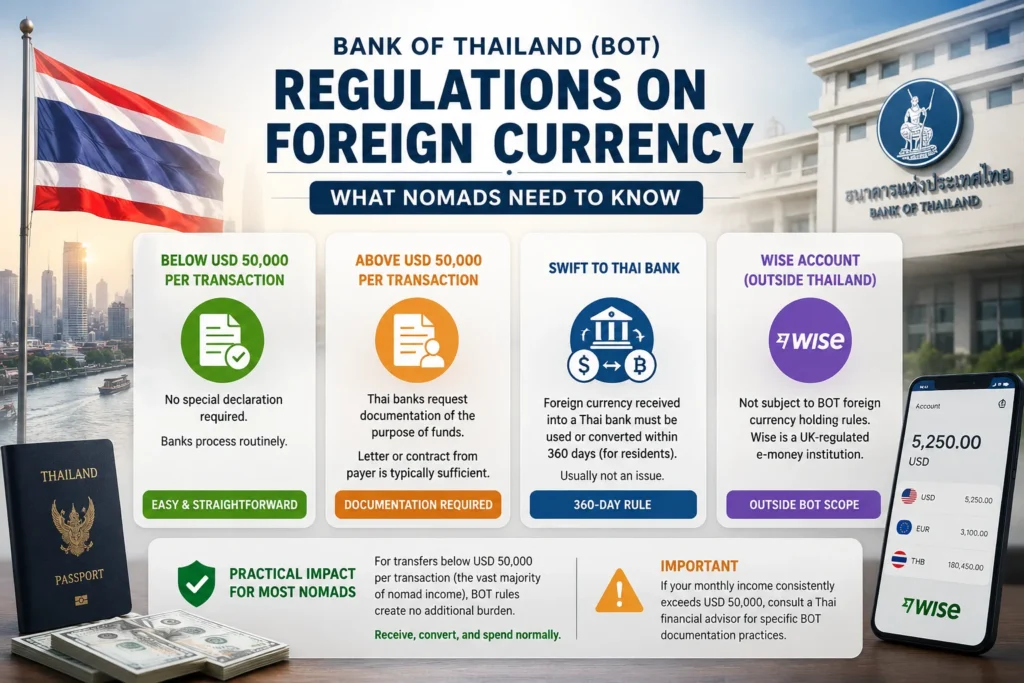
BOT FOREIGN EXCHANGE RULES: WHAT NOMADS NEED TO KNOW The Bank of Thailand regulates foreign exchange flows under the Exchange Control Act. Key rules for nomads receiving overseas income: Incoming foreign currency (USD/EUR receipts): Amounts below USD 50,000 per transaction: No special declaration required. Banks process routinely.Amounts above USD 50,000 per transaction: Thai banks are required to request documentation of the purpose of funds. For legitimate overseas income (salary, freelance fees, business revenue), a letter or contract from the payer is typically sufficient.Foreign currency received into a Thai bank (SWIFT): Must be used or converted within 360 days (for residents). In practice, this is rarely an issue as most transfers are converted to THB within days or weeks.Foreign currency held in Wise (outside Thailand): Not subject to BOT foreign currency holding requirements. Wise is a UK-regulated e-money institution, not a Thai bank. Funds in Wise USD are not ‘foreign currency held in Thailand’ in the BOT sense. Practical impact for most nomads: For transfers below USD 50,000 per transaction (the vast majority of nomad income), BOT rules create no additional burden. Simply receive, convert, and spend normally. Important: If your monthly income consistently exceeds USD 50,000, consult a Thai financial advisor for specific BOT documentation practices.
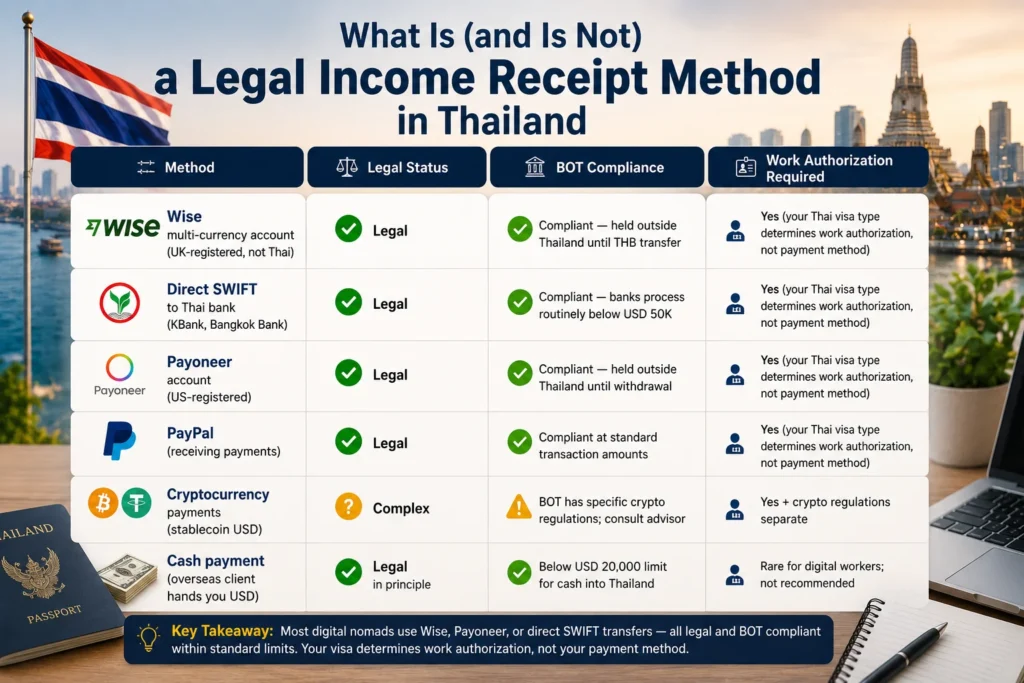
What Is (and Is Not) a Legal Income Receipt Method in Thailand
Method
Legal Status
BOT Compliance
Work Authorization Required
Wise multi-currency account (UK-registered, not Thai)
✅ Legal
✅ Compliant — held outside Thailand until THB transfer
Yes (your Thai visa type determines work authorization, not payment method)
Direct SWIFT to Thai bank (KBank, Bangkok Bank)
✅ Legal
✅ Compliant — banks process routinely below USD 50K
Yes (visa determines authorization)
Payoneer account (US-registered)
✅ Legal
✅ Compliant — held outside Thailand until withdrawal
Yes (visa determines authorization)
PayPal (receiving payments)
✅ Legal
✅ Compliant at standard transaction amounts
Yes (visa determines authorization)
Cryptocurrency payments (stablecoin USD)
❓ Complex
⚠ BOT has specific crypto regulations; consult advisor
Yes + crypto regulations separate
Cash payment (overseas client hands you USD)
✅ Legal in principle
✓ Below USD 20,000 limit for cash into Thailand
Rare for digital workers; not recommended
Method 1: Wise Multi-Currency Account (Recommended for Most Nomads)
WISE — HOW IT WORKS FOR THAILAND INCOME RECEIPT Step 1: Open Wise account (free, online, 15 minutes). Get your USD routing number + account number and EUR IBAN. Step 2: Share Wise USD/EUR account details with overseas clients. They pay a domestic transfer (no international fee for them). Step 3: Income arrives in your Wise USD or EUR balance. Wise holds it until you act. Step 4: Convert USD or EUR to THB in Wise at mid-market rate + transparent fee (0.5–1.0%). Step 5: Transfer THB to your KBank or Bangkok Bank account. Arrives in 1–3 business days. Fee structure: 0.5–1.0% of amount converted (mid-market rate — no markup)USD 2,000 income to KBank THB: approximately USD 10–20 in Wise feesSpeed: Income in Wise within 1–2 business days; THB in Thai bank within 1–3 additional daysBOT status: Wise is a UK e-money institution. Funds held in Wise are not ‘in Thailand’ from a BOT perspective until the THB transfer to your Thai bankDocumentation: Wise transaction history serves as transfer documentation for all purposes
When Wise is the best method
You have multiple overseas clients who pay in USD or EUR
You want mid-market rate currency conversion with no hidden markup
You also transfer money home to India or Philippines regularly (Wise handles this at low cost)
You are not yet able to open a Thai bank account (tourist visa holders can still use Wise card for daily purchases)
Method 2: Direct SWIFT to Thai Bank
Receiving income directly via SWIFT wire transfer to your KBank or Bangkok Bank account is the ‘traditional’ method. It works, but it is the most expensive option for most transfers.
Cost Component
Amount
Notes
Incoming SWIFT fee (Thai bank)
THB 200–500 per transfer
Charged by KBank or Bangkok Bank on receipt of international wire
Correspondent bank fee (deducted)
USD 5–15
Deducted from transfer amount at intermediary bank; varies
Exchange rate markup (if converting to THB)
1.5–3.0% above mid-market
Hidden in the THB rate Thai bank gives you vs the real mid-market rate
Total cost on USD 1,000 SWIFT transfer
USD 26–50 effective
vs Wise: USD 5–10 for same amount
When SWIFT to Thai bank makes sense
Your overseas employer already uses SWIFT and you cannot change the payment method
You receive very large transfers (USD 10,000+) where the fixed fee is a smaller percentage
Your employer pays all SWIFT fees so your effective cost is zero
Method 3: Payoneer
Payoneer is an alternative to Wise specifically useful for marketplace income (Upwork, Fiverr, Airbnb, Amazon, and 1,000+ platforms that offer direct Payoneer payout). For Thailand-based nomads, Payoneer functions as an income collection point rather than a daily banking tool.
Payoneer gives you a USD payment service (routing + account number) and EUR IBAN, similar to Wise
Direct integration with Upwork, Fiverr, Amazon FBA, Google AdSense as a payout method
Transfer to Thai bank: Payoneer supports transfers to KBank and Bangkok Bank via local payment networks
Fee for Payoneer’s own transfers: typically 1.5–3.0% — higher than Wise’s 0.5–1.0%
Recommended approach for marketplace income: Use Payoneer as collection point from platforms. Then transfer to Wise for better conversion rates, or transfer directly to Thai bank if the amount is large enough to absorb Payoneer’s fees.
Method 4: PayPal (and Why It Is Usually Not Optimal)
PayPal works for receiving payments but has significant disadvantages for nomads:
High conversion fees: PayPal charges 3–5% for currency conversion — much higher than Wise (0.5–1.0%)
Withdrawal to Thai bank: Fees apply when withdrawing PayPal balance to a local bank account
Account freezes: PayPal has a history of account restrictions for accounts showing unusual international activity, which nomad usage patterns can trigger
Best use case: Receiving occasional small payments from clients who only use PayPal. For regular income management, use Wise or direct SWIFT.
Master Method Comparison Table: Fee, Speed, and Compliance
Method
Total Fee on USD 1,000
Speed to THB in Thai Bank
BOT Compliance
Best For
Wise → KBank (recommended)
~USD 8–12 (0.8–1.2%)
2–5 business days total
✅ Full compliance
Most nomads; multi-client; home remittances
Direct SWIFT → KBank/BBL
~USD 26–50 (2.6–5%)
2–4 business days
✅ Full compliance
Large single transfers; employer-mandated SWIFT
Payoneer → Thai bank
~USD 15–30 (1.5–3%)
2–6 business days
✅ Full compliance
Upwork/Fiverr/marketplace income
PayPal → Thai bank
~USD 35–60 (3.5–6%)
3–5 business days
✅ Full compliance
Occasional small payments only
Wise → Wise card (no Thai bank)
Card conversion fee ~0.4%
Instant for card payments
✅ Full compliance
Short-stay; no Thai bank yet opened
The 2024 Revenue Department Ruling: What It Means for Your Income Receipt
IMPORTANT: PHOR NGOR 161/2566 — 2024 RULING ON FOREIGN INCOME In 2024, Thailand’s Revenue Department issued Ruling Phor Ngor 161/2566, which clarified the tax treatment of overseas income for Thai tax residents: If you spend 180 or more days in Thailand in a calendar year: you are a Thai tax resident and your overseas income may be assessableIncome brought into Thailand IN THE SAME YEAR IT WAS EARNED is assessable income for Thai tax purposesIncome earned in a prior year and transferred into Thailand in a later year: NOT assessable under this ruling (prior-year income timing exception) What this means for income receipt method: If you receive USD income in Wise and convert to THB in the SAME year: assessableIf you receive USD income in Wise and only transfer to Thailand in a LATER year: not assessable under current rulingMost nomads will not use prior-year deferral; awareness of the timing element is important for those doing significant tax planning Double taxation relief: India-Thailand DTAA and Philippines-Thailand tax treaty provide frameworks to avoid paying tax twice on the same income. The treaties do not eliminate Thai tax liability for Thai residents, but they provide credits or exemptions for taxes paid in the other country. This is not tax advice. Consult a qualified Thai tax advisor for your specific situation. See the Thailand Tax Residency Guide for the complete tax residency and liability analysis.
Documentation You Should Keep for Every International Transfer
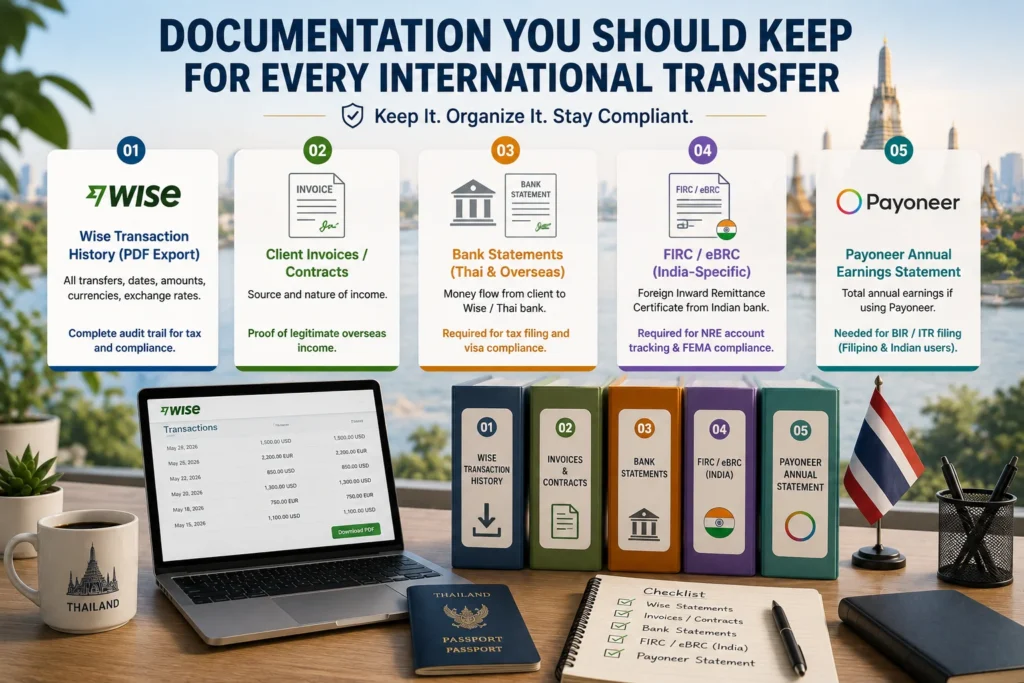
Maintaining proper records of international income receipt is important for several reasons: Thai tax filing, home country tax filing, visa compliance documentation, and banking compliance on large transfers.
Document
What It Shows
Why You Need It
Wise transaction history (PDF export)
All transfers, dates, amounts, currencies, exchange rates
Complete audit trail for Thai and home-country tax purposes; BOT documentation if ever requested
Client invoices / contracts
Source and nature of income
Demonstrates legitimate overseas income for Thai bank documentation if requested
Bank statements (Thai and overseas)
Money flow from client to Wise/Thai bank
Tax filing in Thailand and home country; visa compliance
FIRC / eBRC (India-specific)
Foreign Inward Remittance Certificate from Indian bank
Required for Indian NRE account income tracking; FEMA compliance
Payoneer annual earnings statement
Total annual earnings if using Payoneer
BIR or ITR filing for Filipinos; Indian ITR for Indian users
Indian Nationals: Receiving USD/EUR While in Thailand
INDIA-SPECIFIC INCOME RECEIPT GUIDE For Indian nationals living in Thailand and receiving overseas USD/EUR income, the income flows interact with both Thai and Indian financial regulations: Primary setup (recommended): Wise receives USD from overseas clientsConvert portion to THB in Wise → transfer to KBank for Thai daily lifeConvert portion to INR in Wise → transfer to Indian NRE bank account (HDFC, ICICI, SBI) for India obligations FIRC (Foreign Inward Remittance Certificate): When you transfer money from Wise to your Indian NRE/NRO account, your Indian bank issues a FIRC (or eBRC for exporters). Keep these for Indian ITR filing.Wise transfers to India generate FIRC from the receiving Indian bank. Request these regularly. NRI status and FEMA: Indian nationals spending less than 182 days in India per financial year qualify as NRIs under FEMAAs an NRI, foreign income (your overseas USD/EUR) is generally not taxable in India (only India-sourced income is taxed for NRIs)Thai income taxes paid on Thai-assessable income may be eligible for credit under the India-Thailand DTAAMaintain your NRE account for foreign income repatriation to India. NRE principal and interest are tax-free in India. India ITR filing: File as NRI. Report NRE balance and foreign assets in Schedule FA. Overseas income received by NRI is generally not taxable in India.
Filipino Nationals: Receiving USD/EUR While in Thailand
PHILIPPINES-SPECIFIC INCOME RECEIPT GUIDE For Filipino nationals in Thailand receiving overseas USD/EUR income: Primary setup (recommended): Wise receives USD from overseas clients using Wise USD local account details Convert portion to THB → KBank for Thai daily spending Convert portion to PHP → BDO/BPI/Union Bank for Philippine obligations and family remittances BIR obligations: Filipino nationals generally have BIR filing obligations regardless of where they live or where they receive income Income received via Wise, Payoneer, or direct SWIFT is still reportable income for Philippine BIR purposes BIR Form 1701 (Annual Income Tax Return) should reflect overseas income from all sources Whether Philippine income tax applies depends on your BIR residency status. Filipinos who have established clear non-resident status may have reduced Philippine tax obligations. Consult a Philippine CPA. Philippines-Thailand tax treaty: Provides frameworks to prevent double taxation. Thai tax paid on Thai-assessable income may be credited against Philippine tax liability on the same income. Platform earnings (Upwork, Fiverr): Use Payoneer or Wise for these. Keep platform annual earnings statements for BIR.Regular Wise statement exports: Serve as documentation for BIR and as proof of income source.
The Recommended Setup: Wise + KBank for Thailand-Based Nomads
COMPLETE INCOME RECEIPT SETUP Account 1: Wise (free, open online at wise.com) Receive: USD from US clients via routing + account number; EUR from EU clients via IBAN Convert: USD or EUR to THB at mid-market rate in Wise (0.5–1.0% fee)Send THB to KBank: Wise → KBank transfer (standard bank transfer, 1–3 days)Send to India (if applicable): Wise USD → INR to NRE account (same fee tier)Send to Philippines (if applicable): Wise USD → PHP to BDO/BPI (same fee tier) Account 2: KBank or Bangkok Bank (open in person with non-tourist visa) Receive: THB from Wise transfers Spend: Daily Thai life — Prompt Pay, utilities, rent, ATM App: K PLUS for all daily banking operations Documentation practice: Export Wise transaction history monthly (PDF). Save in a dedicated finance folder. Keep all client invoices and contracts that justify the source of income. For Indians: request FIRC from Indian bank every time you remit to NRE account. Open your Wise account first (online). Then open KBank in person. Your international income infrastructure will be complete and fully optimized in under 24 hours.
Common Mistakes When Receiving Foreign Income in Thailand
Mistake
Risk
Prevention
Using PayPal as primary income platform for large amounts
3–5% conversion fees; account freeze risk; inefficient for large amounts
Use Wise for primary income receipt; PayPal only for occasional small client payments
Receiving USD SWIFT directly to Thai bank without accounting for all fees
Hidden costs from SWIFT fees + exchange rate markup make total cost 2–4%; often surprises recipients
Calculate total effective cost including markup. Compare Wise vs SWIFT before committing to payment method with clients.
Not keeping transfer documentation
No audit trail for Thai or home-country tax; difficulty proving income source if ever requested
Spending 180+ days in Thailand without awareness of 2024 Revenue Dept. ruling on assessable foreign income
Read the Thailand tax residency guide. Know your day count. Plan transfers with tax timing awareness if income is substantial.
Using a tourist visa without work authorization for overseas client income
Technically unauthorized work in Thailand; legal gray area
Obtain appropriate visa (LTR WFT for USD 40K+ income; DE Rantau for Malaysia alternative)
Frequently Asked Questions
How do you legally receive USD and EUR income in Thailand?
The most compliant and cost-effective method is using a Wise multi-currency account to receive USD or EUR via local account details, converting to THB at mid-market rate in Wise, and transferring THB to your Thai bank (KBank or Bangkok Bank). This is fully compliant with Bank of Thailand regulations for amounts under USD 50,000 per transaction and costs 0.5–1.0% vs 2–4% for direct SWIFT to Thai bank.
Is it legal to receive overseas income in Thailand on an LTR Visa?
Yes. The LTR Visa (Work-From-Thailand Professional category) explicitly recognizes overseas income from non-Thai employers as the qualifying and authorized income source. LTR WFT holders can receive USD/EUR income via any method (Wise, SWIFT, Payoneer) without additional authorization beyond the visa itself.
What are the Bank of Thailand rules on receiving foreign currency?
For transfers below USD 50,000 per transaction: no special declaration required. Thai banks process routinely. For transfers above USD 50,000: Thai banks request documentation of the purpose of funds. For legitimate overseas income (salary, freelance fees, business revenue), a contract or letter from the payer is typically sufficient. Foreign currency held in Wise (a UK-regulated entity outside Thailand) is not subject to BOT foreign currency holding requirements until transferred to a Thai bank.
Does the 2024 Revenue Department ruling affect how I receive overseas income in Thailand?
The 2024 ruling (Phor Ngor 161/2566) affects when overseas income is taxable for Thai tax residents (180+ days/year in Thailand), not the method of receipt. Income brought into Thailand in the same calendar year it is earned is assessable. This affects tax planning and timing decisions, not the choice of Wise vs SWIFT vs Payoneer. Consult a Thai tax advisor for personal tax planning.
Which is cheaper: receiving USD via Wise or direct SWIFT to KBank?
Wise is significantly cheaper. Direct SWIFT to KBank involves: incoming SWIFT fee (THB 200–500), correspondent bank fee (USD 5–15), and exchange rate markup (1.5–3%). Total: USD 26–50 per USD 1,000. Wise: 0.5–1.0% transparent fee. Total: USD 5–10 per USD 1,000. Wise saves approximately USD 20–40 per USD 1,000 transferred.
Final Verdict: Setting Up Legal USD/EUR Income Receipt in Thailand
Receiving USD or EUR income in Thailand is straightforward, legal, and inexpensive when done correctly. The Bank of Thailand has no restrictions on foreign currency inflows at amounts below USD 50,000 per transaction, which covers the overwhelming majority of nomad income scenarios. The method choice matters financially. Wise as the primary income receipt account, with THB conversion and transfer to KBank for daily spending, is the most cost-effective setup for most nomads — saving USD 20–40 per USD 1,000 transferred compared to direct SWIFT. The 2024 Revenue Department ruling adds a tax planning dimension for those spending 180+ days in Thailand. Understanding when overseas income becomes assessable is separate from choosing how to receive it, but both decisions benefit from a coherent approach. The setup is: Wise account (free, open now) + Thai bank account (KBank, in person). Your international income infrastructure is ready in under 24 hours.