
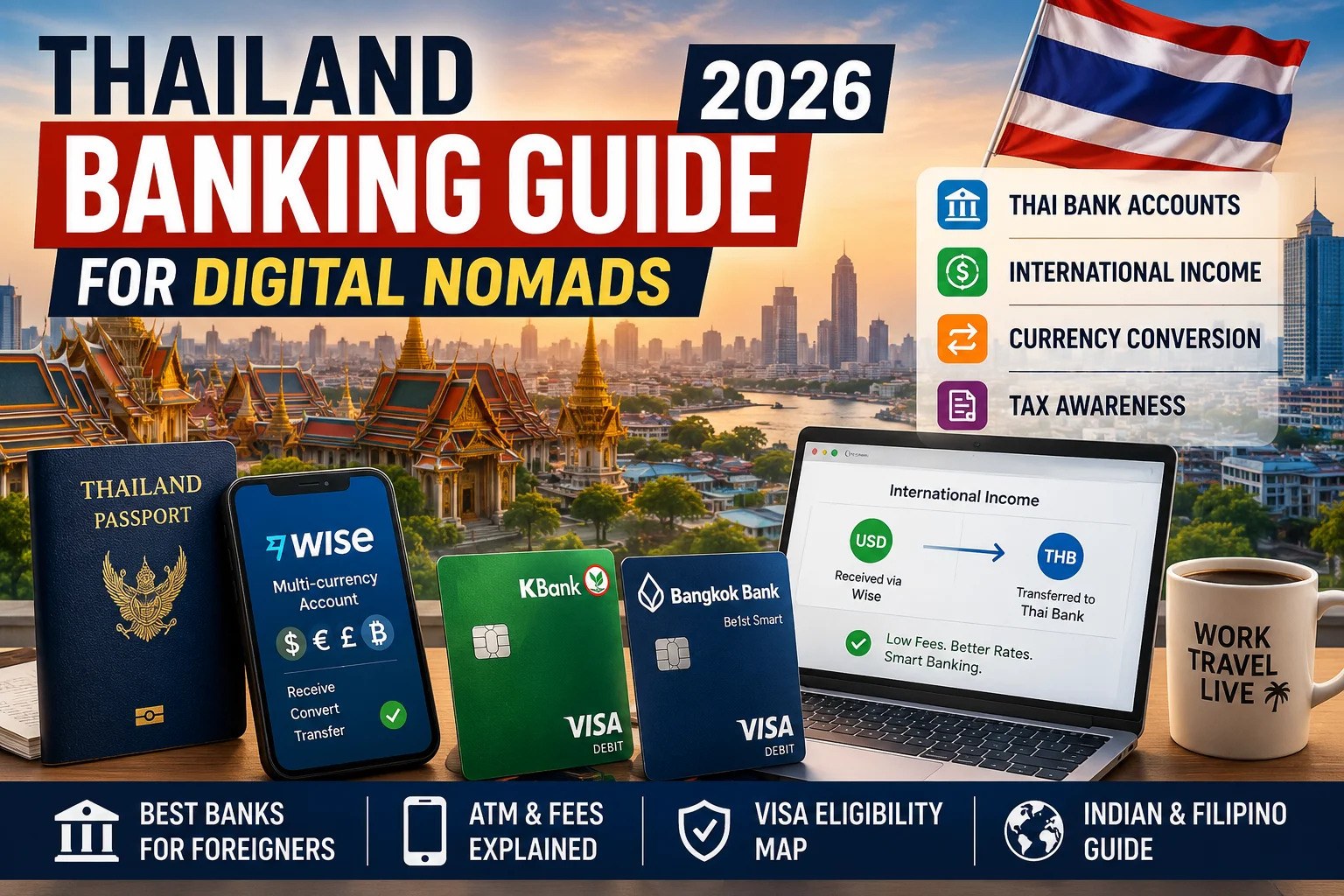
| Setting up banking in Thailand as a digital nomad requires a two-account architecture: an international account (Wise is the recommended option) for receiving overseas income and managing currency conversion, and a Thai local bank account (KBank or Bangkok Bank) for daily Thai life, PromptPay, rent, and utilities. This Thailand banking digital nomads guide explains the most practical setup. Foreign nationals can open Thai bank accounts in person with a valid non-tourist visa (LTR, SMART, Non-B, Non-O, Education). Tourist visa holders face significant friction. The best Thai bank accounts for foreigners are Bangkok Bank (ideal for SWIFT-heavy income and LTR Visa holders with BOI letter) and KBank (ideal for digital-first nomads who prioritize the K PLUS app). International income (USD, EUR, GBP) is best received via Wise at mid-market rate, converted to THB, and transferred to a Thai bank account. Direct SWIFT to Thai bank costs 2–4% in fees; Wise costs 0.5–1.0%. Thai ATMs charge THB 220 per foreign card withdrawal; DCC should always be declined. The 2024 Revenue Department ruling establishes that overseas income brought into Thailand in the same year it is earned is assessable for Thai tax residents (180+ days/year). Indian nationals need FIRC documentation and NRE/NRO account management; Filipino nationals have continuing BIR obligations. |
| QUICK ANSWER: What is the best banking setup for digital nomads in Thailand? The recommended Thailand banking setup for digital nomads: Wise multi-currency account (free, open online): Receive USD/EUR from overseas clients via local account details. Convert to THB at mid-market rate. Transfer THB to Thai bank.Thai local bank account (open in person): KBank for best mobile app (K PLUS); Bangkok Bank for SWIFT income + LTR Visa holders. Both are free to maintain.Result: Wise handles international income at 0.5–1.0% cost; Thai bank handles all daily THB spending, PromptPay, and local payments. Tax note: Spending 180+ days in Thailand makes you a Thai tax resident. The 2024 Revenue Dept. ruling means overseas income brought into Thailand in the same year may be assessable. |
| AFFILIATE DISCLOSURE + DISCLAIMER This article contains affiliate links to Wise. MeridianNomad may receive commission if you open an account using our links. All fee figures are from official sources. This is not financial or tax advice. |
Introduction: Why Banking Is the #1 Practical Challenge for Thailand-Based Nomads
Ask any long-stay nomad in Bangkok what caught them off guard most, and banking comes up more often than visa processes. Visas have clear rules. Banking in Thailand, for foreigners, operates in a space where written policy, branch discretion, and visa type all interact in ways that are difficult to predict without good information.
The practical challenges: Which banks will actually open accounts for foreigners? What visa do you need? How do you receive USD or EUR income without losing 3% to bank exchange rate markups? How do you pay rent when your Thai landlord only accepts PromptPay? What happens to your tax obligations when you bank in Thailand?
This guide addresses all of it. It is the complete Thailand banking reference for digital nomads — covering the two-account architecture that works for most nomads, the visa-banking eligibility map, international income receipt methods with actual fee data, the Thai ATM fee landscape, and the nationality-specific guidance for Indian and Filipino readers that no generic guide provides.
The Thailand Banking Landscape: What Foreigners Need to Know
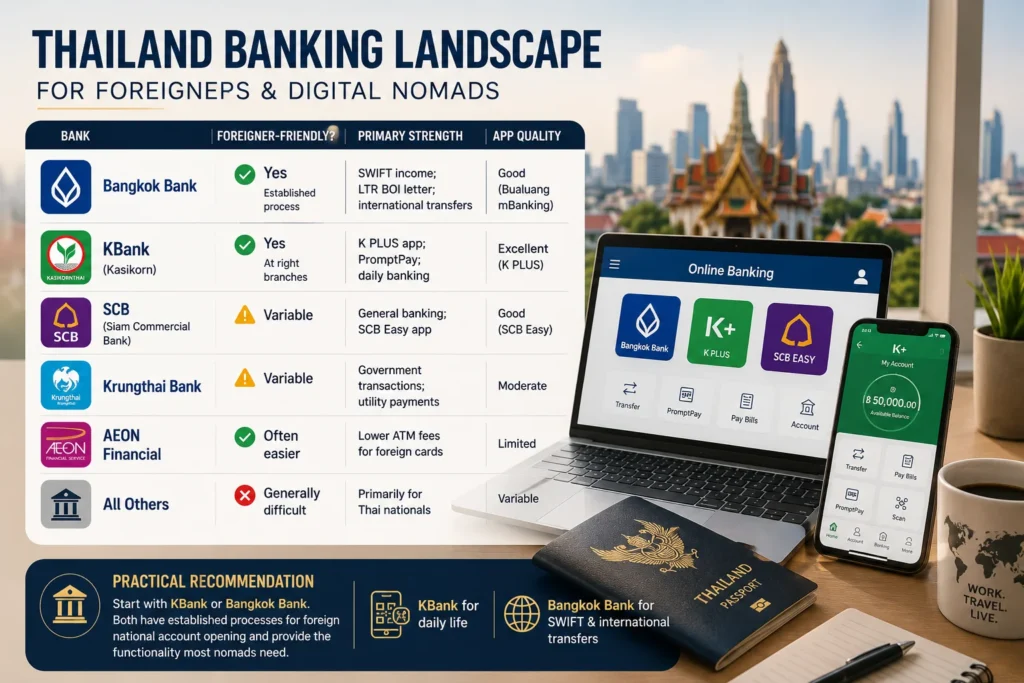
Thailand has over 15 commercial banks. For foreign nationals and digital nomads, the relevant landscape narrows considerably:
| Bank | Foreigner-Friendly? | Primary Strength | App Quality |
| Bangkok Bank | ✅ Yes — established process | SWIFT income; LTR BOI letter; international transfers | Good (Bualuang mBanking) |
| KBank (Kasikorn) | ✅ Yes — at right branches | K PLUS app; PromptPay; daily banking | Excellent (K PLUS) |
| SCB (Siam Commercial Bank) | ⚠ Variable | General banking; SCB Easy app | Good |
| Krungthai Bank | ⚠ Variable | Government transactions; utility payments | Moderate |
| AEON Financial | ✅ Often easier | Lower ATM fees for foreign cards | Limited |
| All others | ❌ Generally difficult | Primarily for Thai nationals | Variable |
Practical recommendation: Start with KBank or Bangkok Bank. Both have established processes for foreign national account opening and provide the functionality most nomads need. Many long-stay Thailand residents open both: KBank for daily life, Bangkok Bank for SWIFT and larger international transfers.
Can Foreigners Open Thai Bank Accounts? The Visa-Banking Eligibility Map
The single most important variable in Thai bank account opening is your visa type. Here is the honest eligibility map:
| Visa Type | Thai Bank Account Eligibility | Ease | Additional Note |
| LTR Visa (Long-Term Resident) | ✅ Yes — BOI endorsement letter accepted | Very Easy | BOI letter specifically accepted at KBank and Bangkok Bank. Best banking access. |
| SMART Visa | ✅ Yes — BOI endorsement letter accepted | Very Easy | Same as LTR; BOI letter is the key document. |
| Non-Immigrant B (Work) | ✅ Yes | Easy | Employer letter + work permit helps. Standard process. |
| Non-Immigrant O (Family/Retirement) | ✅ Yes | Easy–Moderate | May need additional supporting documents. Branch-dependent. |
| Education Visa (Non-O-ED) | ✅ Usually | Moderate | School enrollment letter required as supporting document. |
| Destination Thailand Visa (DTV) | ✅ Likely | Moderate | Relatively new; BOI connection may help. Branch-dependent. |
| Tourist Visa (TR / METV) | ⚠ Difficult | Hard | Most branches decline. Some in expat areas may accept with extensive docs. |
| Visa-exempt entry (30 days) | ❌ Generally No | Very Hard | Not recommended. Almost universally declined. |
| IF YOU’RE ON TOURIST VISA Tourist visa holders who need Thai banking access have two practical options before obtaining a non-tourist visa: Wise card: Open Wise online (no Thai visa needed). Use for card payments at Thai merchants and 2 free ATM withdrawals per month. No Prompt Pay. Wait until you have a non-tourist visa: Most nomads planning to stay in Thailand 90+ days should obtain an appropriate visa (Non-B, LTR, Non-O). Banking access follows immediately with the right visa. |
Bangkok Bank for Foreigners: What You Need to Know
Why Bangkok Bank is recommended for SWIFT-heavy income
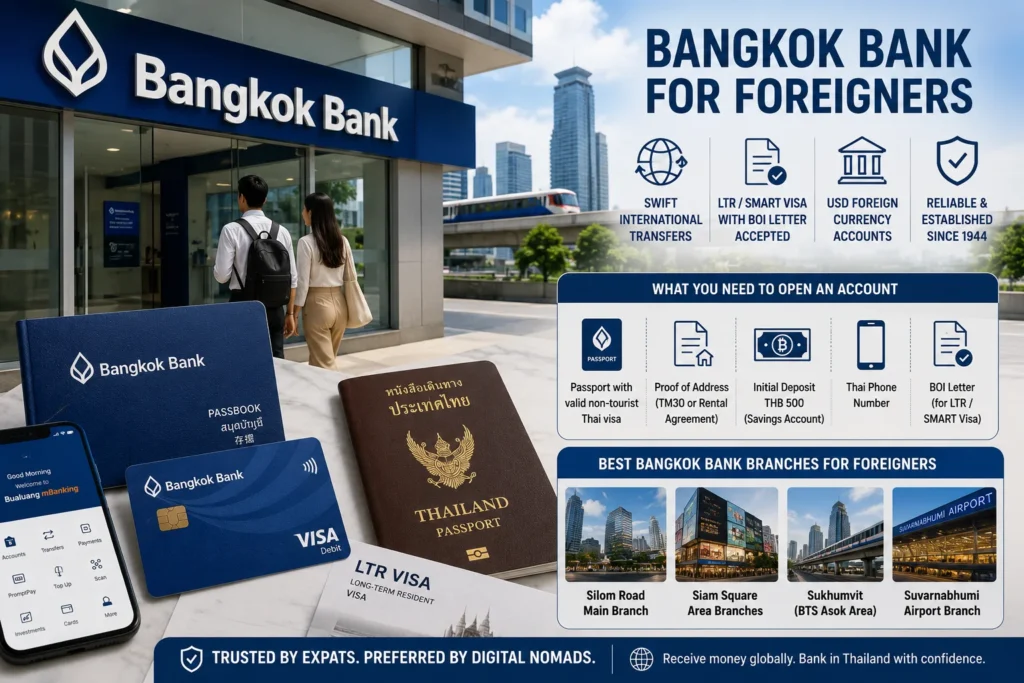
- Bangkok Bank has a long-established relationship with international SWIFT transfers and is one of Thailand’s largest correspondent banks
- The BOI endorsement letter (for LTR and SMART Visa holders) is well-known to Bangkok Bank staff, creating a smooth account opening process
- Bangkok Bank’s SWIFT infrastructure is reliable for receiving international USD/EUR transfers from overseas employers and clients
- USD Foreign Currency Account: Bangkok Bank offers USD-denominated accounts for foreigners, useful for holding USD without converting to THB
Bangkok Bank account opening requirements
- Original passport with valid non-tourist Thai visa
- TM30 (residence notification) or rental agreement as proof of Thai address
- Initial deposit: THB 500 minimum for savings account; THB 100 for Basic Banking Account
- Thai phone number for account setup
- For LTR/SMART Visa holders: BOI endorsement letter alongside passport
Best Bangkok Bank branches for foreigners
- Silom Road main branch — historically international banking hub
- Siam Square area branches
- Sukhumvit branches (BTS Asok area)
- Suvarnabhumi Airport branch — open for international arrivals
For the complete Bangkok Bank for foreigners guide, including step-by-step account opening, documents by nationality, and SWIFT setup: see the Bangkok Bank Indian nationals guide and the Thai bank account Filipino nationals guide in the navigation hub below.
KBank (Kasikorn Bank) for Foreigners: The Digital Nomad’s Bank
Why KBank leads on the digital banking experience
- K PLUS app: Widely regarded as the best banking app in Thailand. English language. PromptPay, bill payment, QR payments, inter-bank transfers, currency exchange, and investment features.
- KBank has 10,000+ ATMs (many inside 7-Eleven convenience stores) — one of the densest ATM networks in Thailand
- PromptPay QR payment integration in K PLUS is essential for daily Thai life
- BOI endorsement letter accepted for LTR and SMART Visa holders
KBank account opening requirements
- Original passport with valid non-tourist Thai visa
- TM30 or rental agreement as proof of address
- Initial deposit: THB 1,000 to THB 2,000
- Thai phone number (SIM card essential for K PLUS setup)
- For LTR/SMART holders: BOI endorsement letter
Best KBank branches for foreigners
- Siam Paragon (first floor) — experienced with foreigner applications
- Central World — large branch; frequent foreigner account openings
- Terminal 21 Asok — Sukhumvit expat area; foreigner-friendly
- EmQuartier — Sukhumvit, upscale, experienced staff
- Chiang Mai: Nimman Road area and Central Festival
Complete step-by-step guide including the TM30 requirement, which button to press, and what to say: see the KBank for Foreigners guide in the navigation hub.
KBank vs Bangkok Bank: Which Should You Open?
| Factor | KBank | Bangkok Bank | Recommendation |
| Mobile app | K PLUS — best app in Thailand | Bualuang mBanking — functional | KBank for app quality |
| SWIFT incoming transfers | Good | Excellent — longer track record | Bangkok Bank for heavy SWIFT use |
| LTR/SMART Visa BOI letter | ✅ Accepted | ✅ Accepted | Both |
| PromptPay / daily Thai spending | ✅ Excellent via K PLUS | ✅ Available | KBank |
| ATM network | 10,000+ ATMs (incl. 7-Elevens) | 10,000+ ATMs | Tie |
| USD Foreign Currency Account | Limited for personal | ✅ Available | Bangkok Bank for USD holding |
| Tourist visa opening | ⚠ Difficult | ⚠ Difficult | Both require non-tourist visa |
| Our recommendation | Primary account for daily life | Primary for SWIFT income receipt | Open both for long-stay |
| THE HONEST RECOMMENDATION Long-stay Thailand residents (6+ months): open both KBank and Bangkok Bank. Use KBank (K PLUS) for daily Thai spending, PromptPay, and local life. Use Bangkok Bank for receiving international SWIFT transfers and for higher-volume international banking. Both accounts are free to maintain. For shorter stays or those just starting: open KBank first (better app). Add Bangkok Bank later if your SWIFT volume justifies it. |
Receiving International Income in Thailand: Method Comparison
How you receive your USD, EUR, or GBP income determines 2–4% of your annual earnings in banking fees. Here is the complete comparison:
| Method | How It Works | Total Cost on USD 1,000 | Speed | Best For |
| Wise (recommended) | Client pays Wise USD account → convert in Wise → transfer THB to KBank/BBL | USD 5–10 (0.5–1.0%) | 2–5 business days | Most nomads; multiple clients; home remittances |
| Direct SWIFT to Bangkok Bank | Client sends SWIFT wire to Thai bank directly | USD 26–50 (2.6–5%) | 2–4 business days | Employer-mandated SWIFT; large single transfers |
| Payoneer | Marketplace payout → Payoneer → Thai bank | USD 15–30 (1.5–3%) | 2–6 business days | Upwork/Fiverr/marketplace income |
| PayPal | Client pays PayPal → withdraw to Thai bank | USD 35–60 (3.5–6%) | 3–5 business days | Emergency/occasional only |
| THE WISE INCOME RECEIPT SETUP Step 1: Open Wise account free at wise.com. Get USD routing + account number, EUR IBAN. Step 2: Share USD account details with overseas clients. They send a domestic US transfer (free for them). Step 3: Income arrives in Wise USD balance. Convert to THB at mid-market rate (0.5–1.0% fee). Step 4: Transfer THB to your KBank or Bangkok Bank account. Arrives 1–3 business days. Annual saving vs direct SWIFT: On USD 30,000/year income, Wise saves approximately USD 600–1,200 compared to Thai bank SWIFT. |
Currency Conversion in Thailand: Getting the Best Rate
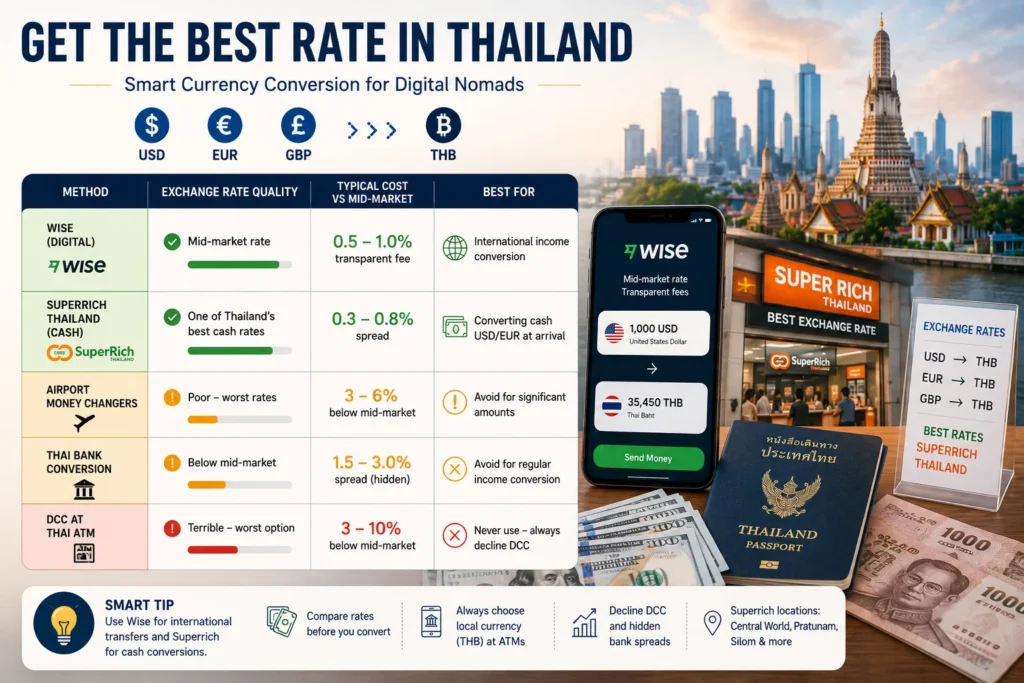
When converting USD, EUR, or GBP to THB, you have several options with significantly different costs:
| Method | Exchange Rate Quality | Typical Cost vs Mid-Market | Best For |
| Wise (digital) | Mid-market rate | 0.5–1.0% transparent fee | International income conversion |
| Superrich Thailand (cash) | One of Thailand’s best cash rates | 0.3–0.8% spread | Converting cash USD/EUR at arrival |
| Airport money changers | Poor — worst rates | 3–6% below mid-market | Avoid for significant amounts |
| Thai bank conversion | Below mid-market | 1.5–3.0% spread (hidden) | Avoid for regular income conversion |
| DCC at Thai ATM | Terrible — worst option | 3–10% below mid-market | Never use; always decline DCC |
Superrich Thailand: For cash conversions
Superrich is a Thai money changer chain (orange and green logo versions — different companies) known for significantly better cash exchange rates than airports or hotels. If you need to convert physical USD or EUR banknotes to THB, Superrich locations in Bangkok offer rates typically 0.5–1.5% better than Thai banks and 3–5% better than airport money changers. Main locations: Central World (Rajdamri), Pratunam, and Silom.
ATM Fees in Thailand: The Complete Picture
| THAI ATM FEE SUMMARY Standard foreign card ATM fee: THB 220 per withdrawal at all major Thai bank ATMs (Bangkok Bank, KBank, SCB, Krungthai, etc.) This fee is in addition to your home bank’s foreign transaction fee (typically 1–3.5%). DCC (Dynamic Currency Conversion): Thai ATMs offer to convert to your home currency at a poor rate. ALWAYS decline. Always press ‘Continue in Thai Baht’ or ‘Decline.’ Best cards for Thai ATMs: Wise card: 2 free withdrawals per month (up to plan limit), then 1.75% + flat fee; no FX markupCharles Schwab (US): Refunds the THB 220 fee; unlimited free withdrawalsRevolut (UK/EU): Free within monthly allowanceIndian debit cards (HDFC/SBI): THB 220 + 3.0–3.5% FX fee = ~9% total cost. Emergency only.Philippine debit cards (BDO/BPI): THB 220 + 2.5–3.5% FX fee = ~8.5% total cost. Emergency only. Cost optimization: Withdraw THB 20,000 at once vs four THB 5,000 withdrawals. Same THB 220 fee but 1.1% effective cost vs 4.4%. |
Thailand Banking and Tax: What Every Nomad Needs to Know
Banking decisions and tax obligations are linked in Thailand. Understanding the connection prevents costly surprises.
The 180-day Thai tax residency rule
Any person spending 180 or more days in Thailand in a calendar year is a Thai tax resident. Thai tax residents may be liable for Thai income tax on assessable income, regardless of visa type or work authorization.
The 2024 Revenue Department ruling (Phor Ngor 161/2566)
In 2024, Thailand’s Revenue Department clarified that overseas income brought into Thailand in the same calendar year it is earned is assessable income for Thai tax residents. This directly affects nomads who:
- Receive USD/EUR from overseas clients
- Convert to THB via Wise or SWIFT
- Transfer to a Thai bank account for spending
- Spend 180+ days in Thailand in that calendar year
Prior year income transferred into Thailand is generally not assessable under the current ruling. Income earned in one year but transferred only in the following year falls outside the ruling’s scope.
| WHAT THIS MEANS FOR BANKING SETUP The method of receiving income (Wise vs SWIFT) does not affect tax liability — both are compliant methods. The tax ruling is about WHEN income is brought into Thailand, not HOW. Banking setup decisions should be made primarily based on cost efficiency. Tax planning decisions should be made separately with a qualified Thai tax advisor. See the Thailand Tax Residency Guide for the complete tax analysis. |
Double taxation treaty protection
- India-Thailand DTAA: Framework to prevent double taxation on income earned in one country by residents of the other
- Philippines-Thailand tax treaty: Similar double taxation avoidance framework
- Both treaties provide tax credit mechanisms, meaning tax paid in one country is credited against liability in the other
Banking for LTR Visa Holders: Full Advantages
The Thailand LTR Visa (Long-Term Resident) provides the most comprehensive banking access available to foreign nationals in Thailand:
- BOI endorsement letter accepted at both Bangkok Bank and KBank for account opening
- Full savings account access, debit card, SWIFT incoming, PromptPay
- KBank K PLUS app fully functional
- No additional documentation beyond passport + BOI letter for most branches
- USD Foreign Currency Account available at Bangkok Bank for LTR holders
- The LTR WFT category’s overseas income is explicitly recognized as legitimate — no work authorization ambiguity
For complete LTR Visa information including all four categories, eligibility, and application: see the Thailand LTR Visa Complete Guide.
India-Specific Banking Guide for Thailand Nomads
| COMPLETE INDIA BANKING GUIDE For Indian nationals building a banking system for Thailand-based remote work: Three-account system: Wise account: Receive USD/EUR from overseas clients. Primary international income tool.KBank or Bangkok Bank Thailand: Daily Thai spending, PromptPay, rent, utilities.Indian NRE/NRO account (HDFC, ICICI, SBI): For India-side financial obligations, NRE for foreign income repatriation. Income flow: Overseas client → Wise USD → (a) Convert to THB → KBank for Thailand life, (b) Convert to INR → NRE account for India obligations. FIRC (Foreign Inward Remittance Certificate): When you transfer from Wise to Indian NRE/NRO account, your Indian bank issues FIRC. Keep all FIRCs.Required for Indian tax filing (ITR-NRI) — evidence of foreign income source. FEMA compliance: Spending fewer than 182 days in India per financial year triggers NRI status under FEMA.Convert resident savings account to NRO when applicable. Open NRE for foreign income.Thai bank account is a foreign bank account under FEMA — report in Schedule FA of Indian ITR. ATM cards: Use Wise card as primary cash card in Thailand. Indian debit cards: emergency use only (THB 220 + 3.5% FX fee = ~9.5% effective cost). For the complete Bangkok Bank for Indian nationals setup guide: see the cluster article in the hub below. |
Philippines-Specific Banking Guide for Thailand Nomads
| COMPLETE PHILIPPINES BANKING GUIDE For Filipino nationals building a banking system for Thailand-based remote work: Three-account system: Wise account: Receive USD from overseas clients (Upwork, direct clients, international employers).KBank or Bangkok Bank Thailand: Daily Thai life, PromptPay, rent, bills.Philippine bank (BDO, BPI, UnionBank): For Philippine obligations, family support, BIR-linked transactions. Income flow: Overseas client → Wise USD → (a) Convert to THB → KBank for Thailand, (b) Convert to PHP → BDO/BPI for Philippines. BIR obligations: Filipino nationals generally maintain BIR filing obligations regardless of residence location.BIR Form 1701 (Annual ITR) should reflect all income sources regardless of receipt method.Consult a Philippine CPA for specific non-resident filing obligations based on your situation. Payoneer for marketplace income: If using Upwork or Fiverr, Payoneer as payout method works, then transfer to Wise or directly to Philippine bank for remittance. ATM cards: Wise card as primary cash card in Thailand. Philippine debit cards (BDO, BPI): emergency only (THB 220 + 3% FX fee = ~8.5% effective cost). For the Thai bank account for Filipino nationals setup guide: see the cluster article in the hub below. |
The Recommended Thailand Banking Setup: Step by Step
Here is the complete recommended setup for a Thailand-based digital nomad, from day one:
Phase 1: Before or immediately upon arrival
- Open Wise account online (15 minutes, free at wise.com). Get USD routing + account number and EUR IBAN. Share with clients immediately.
- Get a Thai SIM card at the airport (AIS, DTAC, or TrueMove). Essential for Thai bank account setup.
- Use Wise card for any card purchases and up to 2 free ATM withdrawals while your Thai bank account is being set up.
Phase 2: First week with non-tourist visa
- Get your TM30 (residence notification) from your landlord or hotel. Essential for Thai bank account opening.
- Visit KBank at Siam Paragon, Central World, or Terminal 21 Asok. Open savings account with passport + visa + TM30 + SIM + THB 1,000–2,000 deposit.
- Download K PLUS app. Set up PromptPay linked to your Thai phone number.
Phase 3: First month
- Set up Wise → KBank THB transfer workflow. Test with a small transfer (THB 2,000–3,000).
- Share Wise USD account details with all overseas clients for future payments.
- Consider opening Bangkok Bank account if you expect large SWIFT income or want USD foreign currency account.
Phase 4: Ongoing
- Export Wise transaction history monthly (PDF). Keep for tax documentation.
- If spending 180+ days in Thailand: consult Thai tax advisor about assessable income implications.
- If Indian: initiate NRI account status change at Indian bank when applicable. Keep FIRC for all NRE remittances.
- If Filipino: maintain BIR filing obligations. Keep Wise statements as income documentation.
Complete Thailand Banking Article Navigation Hub
This pillar covers all Thailand banking topics at overview level. Use the articles below for complete depth on each specific topic:
Thai bank account guides
| 🏦 | KBank (Kasikorn) for Foreigners — How to Open Complete step-by-step guide: visa requirements, TM30, best branches in Bangkok and Chiang Mai, K PLUS setup, KBank vs Bangkok Bank comparison. /kbank-kasikorn-foreigners-how-to-open/ |
| 🇮🇳 | Bangkok Bank Account for Indian Nationals India-specific guide to opening Bangkok Bank: FIRC, NRE/NRO, SWIFT setup, FEMA compliance, and recommended Indian community branches. /bangkok-bank-account-indian-nationals/ |
| 🇵🇭 | Thai Bank Account for Filipino Nationals Philippines-specific guide to opening a Thai bank account: BDO/BPI integration, BIR considerations, Payoneer connection, and PromptPay setup. /thai-bank-account-filipino-nationals/ |
International income and currency
| 💸 | Wise for Digital Nomads — Complete Review 2026 Full Wise review: fee structure, USD/EUR account details, Wise card ATM policy, Wise vs Payoneer, India/Philippines-specific corridors. /wise-digital-nomads-complete-review/ |
| ⚖️ | Wise vs Thai Local Bank — Which Is Better? Honest comparison with 12-use-case table, 12-month cost analysis, PromptPay explained, and the definitive ‘use both’ recommendation. /wise-vs-thai-local-bank-comparison/ |
| 📥 | Receiving USD and EUR Income in Thailand Legally BOT regulations, method-by-method comparison, 2024 Revenue Dept. ruling, FIRC documentation, and India/Philippines income setup. /receiving-usd-eur-income-thailand-legally/ |
ATM and fees
| 🏧 | ATM Fees and Foreign Cards in Thailand — Guide THB 220 fee explained, DCC trap (always decline), best cards for Thailand, Indian/Filipino card total cost calculations. /atm-fees-foreign-cards-thailand/ |
Common Thailand Banking Mistakes Nomads Make
| Mistake | Financial Impact | Prevention |
| Accepting DCC at Thai ATMs | 3–10% premium on every withdrawal | Always decline DCC. Always press ‘Continue in Thai Baht.’ |
| Using Indian or Philippine debit card as primary cash card | ~9% effective cost per ATM withdrawal (THB 220 + FX fee + spread) | Use Wise card as primary. Home country cards: emergency only. |
| Receiving international income directly via Thai bank SWIFT | 2–4% in fees vs 0.5–1.0% via Wise | Set up Wise account. Route overseas income through Wise first. |
| Opening account at wrong branch without calling ahead | Rejection and wasted trip | Call branch the day before. Ask about foreigner accounts and your visa type. |
| Not getting TM30 before visiting the bank | Branch requests document; second trip required | Get TM30 from landlord or hotel before the bank visit. |
| Ignoring Thai tax residency when spending 180+ days | Unexpected Thai tax assessment on overseas income | Count your days. Consult Thai tax advisor when approaching 180. |
| Not keeping Wise transaction history | No documentation for Thai or home-country tax filing | Export Wise PDF monthly. Organize in annual finance folders. |
Frequently Asked Questions
What is the best banking setup for digital nomads in Thailand?
The optimal setup is two accounts: Wise (receive international income at mid-market rate, convert to THB) + Thai bank account (KBank for daily life; Bangkok Bank for SWIFT-heavy income). Open both: Wise online for free, KBank in person at a foreigner-friendly branch. This two-account system costs approximately 0.5–1.0% on international income vs 2–4% for Thai-bank-only solutions.
Which Thai bank is best for digital nomads?
KBank for most nomads: the K PLUS app is the best banking app in Thailand (English, PromptPay, QR payments). Bangkok Bank for those with heavy SWIFT income or who want a USD foreign currency account. Many long-stay Thailand residents open both.
Can I open a Thai bank account as a digital nomad?
Yes, if you have a valid non-tourist visa. LTR Visa, SMART Visa, Non-Immigrant B, and Non-Immigrant O holders can open accounts at KBank and Bangkok Bank with passport + visa + TM30 (address proof) + initial deposit. Tourist visa holders and visa-exempt entrants face significant rejection risk at most branches.
Do I pay tax in Thailand if I receive overseas income?
If you spend 180+ days in Thailand in a calendar year, you are a Thai tax resident and your overseas income brought into Thailand in the same year it was earned may be assessable under the 2024 Revenue Department ruling (Phor Ngor 161/2566). Prior-year income transferred later is generally not assessable. Consult a Thai tax advisor for your specific situation. See the Thailand Tax Residency Guide for complete analysis.
How do Indian nationals set up banking in Thailand?
Three-account system: Wise (receive USD/EUR overseas income), KBank or Bangkok Bank Thailand (daily THB spending), Indian NRE/NRO account (India-side obligations and foreign income repatriation). When Wise transfers to NRE account, Indian bank issues FIRC. Maintain NRI status under FEMA if spending fewer than 182 days in India. Report Thai bank account in Schedule FA of Indian ITR.
How do Filipino nationals set up banking in Thailand?
Three-account system: Wise (receive USD from overseas clients), KBank or Bangkok Bank Thailand (daily THB), Philippine bank BDO/BPI (Philippine obligations and remittances). Wise → KBank for Thailand life; Wise → BDO/BPI for Philippine needs. BIR filing obligations continue regardless of residence location.
What are ATM fees in Thailand for foreign cards?
THB 220 flat fee per withdrawal at all major Thai bank ATMs. This is in addition to your home bank’s foreign transaction fee (typically 1–3.5%). Always decline DCC (Dynamic Currency Conversion) — always press ‘Continue in Thai Baht’. Use Wise card for 2 free monthly withdrawals at mid-market rate. Withdraw larger amounts (THB 20,000 at once vs THB 5,000 four times) to minimize the per-transaction fee impact.
What is the cheapest way to convert USD to THB in Thailand?
Wise: mid-market rate + 0.5–1.0% transparent fee. Best for digital income conversion. Superrich Thailand (orange or green logo): best for cash USD/EUR banknote conversion. Both significantly better than Thai bank exchange rate (1.5–3.0% markup) or airport money changers (3–6% below mid-market).
Final Verdict: Building Your Thailand Banking Infrastructure
| Thailand banking for digital nomads is not complicated once you understand the architecture: international income tools (Wise) + local banking (KBank or Bangkok Bank) + home-country account for home obligations. The financial case for getting this setup right is clear. On USD 2,500/month overseas income, using Wise for international income reception instead of Thai bank SWIFT saves approximately USD 720–984 per year. That’s real money that requires zero sacrifice in convenience. The practical steps are straightforward: open Wise online today, get a Thai SIM at the airport, get TM30 from your landlord, visit KBank at Siam Paragon or Terminal 21. Your complete Thailand banking infrastructure will be operational within your first week. Tax awareness is the dimension most nomads underestimate. Spending 180+ days in Thailand creates Thai tax residency, and the 2024 Revenue Department ruling means that banking setup has tax implications worth understanding before day 180. Use the navigation hub above to go deeper on any specific topic. Every banking cluster article is one click away. |