DISCLAIMER This article provides general informational guidance for Filipino passport holders planning a Bali stay. Visa policies change. Verify current entry requirements at the Indonesian Embassy in Manila (kemlu.go.id/manila) and at imi.imigrasi.go.id before booking travel. This is not immigration, tax, or legal advice.
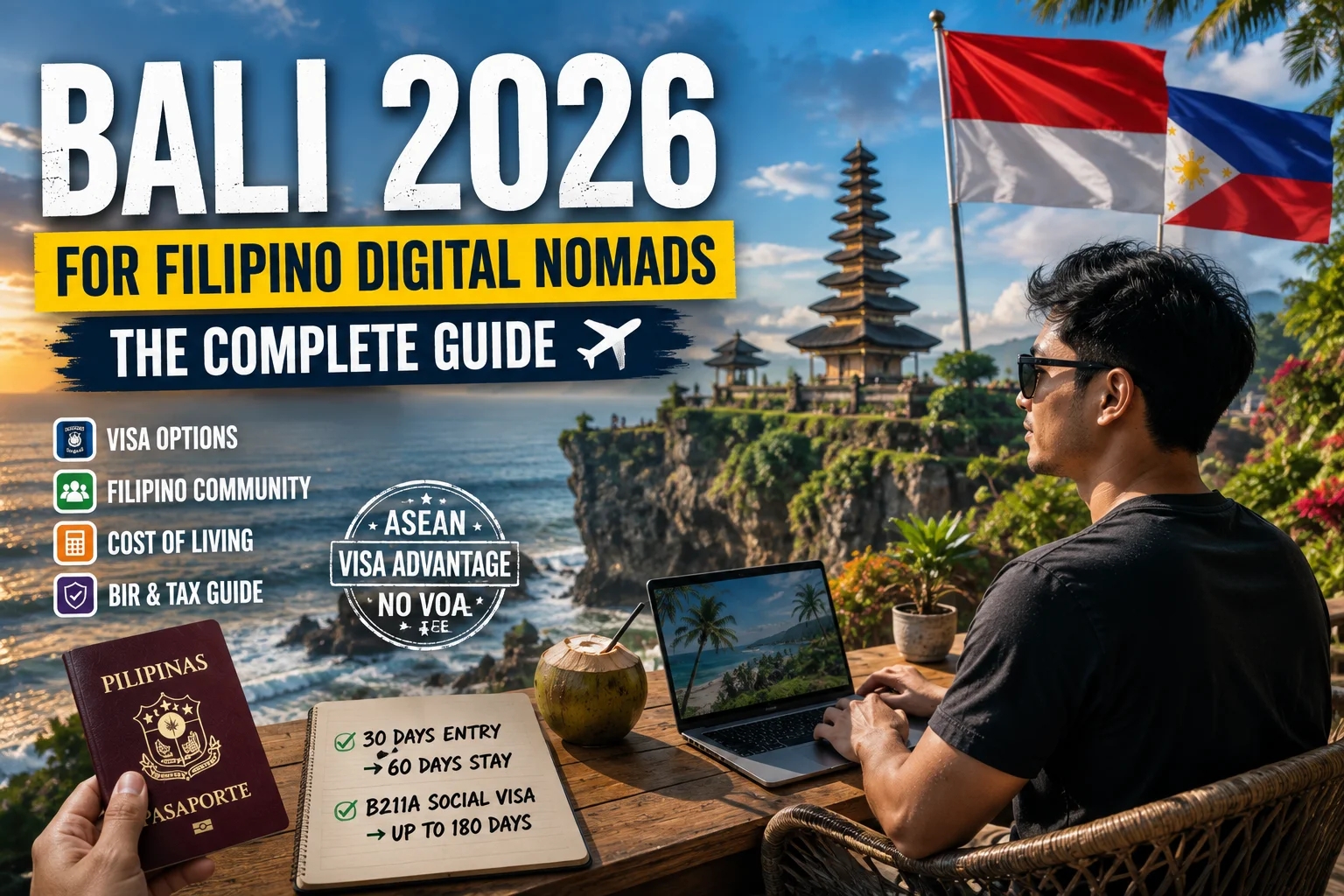
AI OVERVIEW SUMMARY Filipino citizens, as ASEAN passport holders, can enter Indonesia (including Bali) for up to 30 days without paying the Visa on Arrival fee that other nationalities pay — a meaningful practical advantage. For Bali for Filipino digital nomads, this can be extended once at Bali Immigration for 30 additional days (60 days total). For stays of 2-6 months: the B211A Social Cultural Visa (up to 180 days) can be applied at the Indonesian Embassy in Manila, Indonesian Consulate in Davao, or — most conveniently for Filipinos already in Malaysia on DE Rantau — at the Indonesian Consulate General in Kuala Lumpur. Bali’s Filipino community is significant: thousands of Filipinos work in the island’s hospitality and wellness industries, and a growing digital nomad segment has emerged in Canggu. The Philippines-Indonesia DTAA framework is limited; overseas remote work income earned in Bali is not Indonesian-taxable, but BIR Form 1701 filing remains mandatory for all Filipinos regardless of Bali stay. SSS, PhilHealth, and Pag-IBIG voluntary overseas contributions continue unchanged. Cebu Pacific operates Manila-Bali routes (under 4 hours), making Bali one of the closest quality nomad destinations from the Philippines.
QUICK ANSWER: Do Filipinos need a visa to visit Bali? Filipino passport holders enter Bali under ASEAN reciprocal arrangements: Standard entry: 30 days, accessible at Ngurah Rai Airport without advance consulate application ASEAN advantage: Filipino passport holders are not required to pay the USD 35 Visa on Arrival fee that non-ASEAN nationalities pay — saving USD 35 on each entry Extension: apply at Bali Immigration for 30 additional days = 60 days total. Extension fee: approximately IDR 500,000.For stays up to 6 months: B211A Social Cultural Visa from Indonesian Embassy Manila, Consulate Davao, or Indonesian Consulate in KL Key advantage: ASEAN membership makes the Philippines-Bali entry one of the most friction-free nomad entries in Southeast Asia. No advance visa, no USD 35 fee, no consulate appointment for initial 30-day stay.
Introduction: Why Bali Makes Strategic Sense for Filipino Nomads
For Filipino digital nomads, Bali offers a combination of advantages that few other destinations match simultaneously: under-4-hour direct flights from Manila, ASEAN-privileged entry with no advance visa needed, a large Filipino community already embedded in the island’s economy, a cost of living achievable on mid-range freelance income, and the distinctive cultural warmth of Balinese life that resonates immediately with Filipino sensibility.
Bali is also the Philippines’ nearest quality digital nomad destination. Closer than Kuala Lumpur, comparable in flight time to Bangkok. For Filipino nomads who want Southeast Asian tropical living without a long-haul flight, Bali is the most accessible option. This guide provides the complete picture: entry mechanics, the B211A Social Visa process from Philippines or Malaysia, the Filipino community reality in 2026, BIR and social contribution obligations, and the practical daily setup.
1. Entry for Filipino Passport Holders: ASEAN Advantage Explained
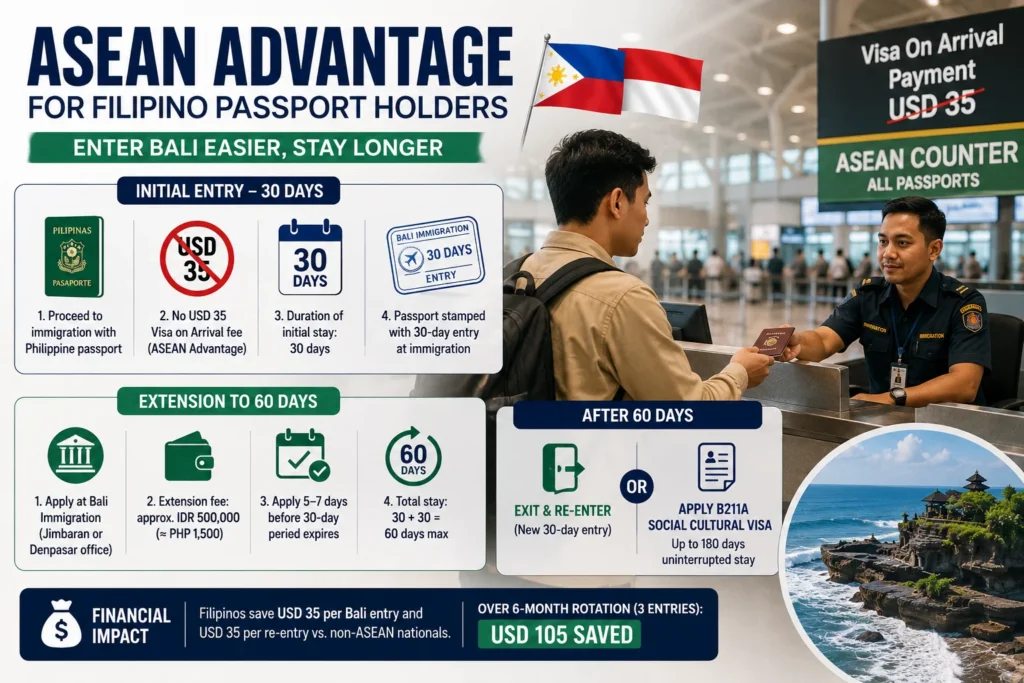
ASEAN PASSPORT ADVANTAGE — HOW IT WORKS FOR FILIPINOS The Philippines and Indonesia are both ASEAN member states. Under ASEAN reciprocal mobility arrangements, Filipino citizens enter Indonesia without going through the same Visa on Arrival (VOA) payment process as non-ASEAN nationalities. At Ngurah Rai International Airport (DPS), Bali: Proceed directly to the immigration counter with your Philippine passport No USD 35 VOA fee required (unlike Indian nationals and most Western nationals who pay USD 35 for VOA)Duration of initial stay: 30 days (same as VOA for other nationalities)Your passport is stamped with a 30-day entry at the immigration counter Extension to 60 days: Apply at Kantor Imigrasi Kelas I Khusus TPI Ngurah Rai (Jimbaran office) or Denpasar immigration Extension fee: approximately IDR 500,000 (≈ PHP 1,500)Apply at least 5-7 days before the 30-day period expires Total stay on initial ASEAN entry: 30 + 30 = 60 days maximum After 60 days: must exit Bali and re-enter (new 30-day entry) OR apply for B211A Social Cultural Visa for up to 180 days uninterrupted. Financial impact: compared to Indian nationals, Filipinos save USD 35 per Bali entry and USD 35 per re-entry. Over a 6-month Bali rotation requiring 3 entries: USD 105 saved. Modest but meaningful.
2. B211A Social Cultural Visa for Filipinos: Up to 180 Days
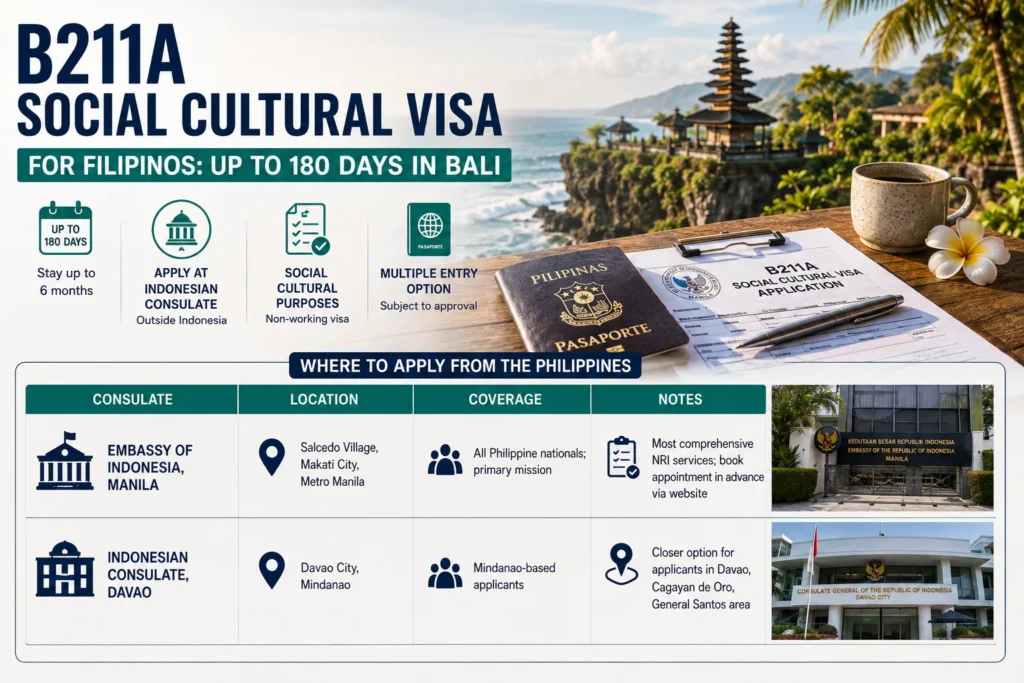
For Filipino nomads planning 2-6 months in Bali, the B211A Social Cultural Visa is the correct route. Like all nationalities, Filipinos must apply for B211A at an Indonesian consulate OUTSIDE Indonesia before traveling to Bali.
Option A: Apply from Philippines
Consulate
Location
Coverage
Notes
Embassy of Indonesia, Manila
Salcedo Village, Makati City, Metro Manila
All Philippine nationals; primary mission
Most comprehensive NRI services; book appointment in advance via website
Indonesian Consulate, Davao
Davao City, Mindanao
Mindanao-based applicants
Closer option for applicants in Davao, Cagayan de Oro, General Santos area
Option B: Apply from Kuala Lumpur (The DE Rantau Rotation Path)
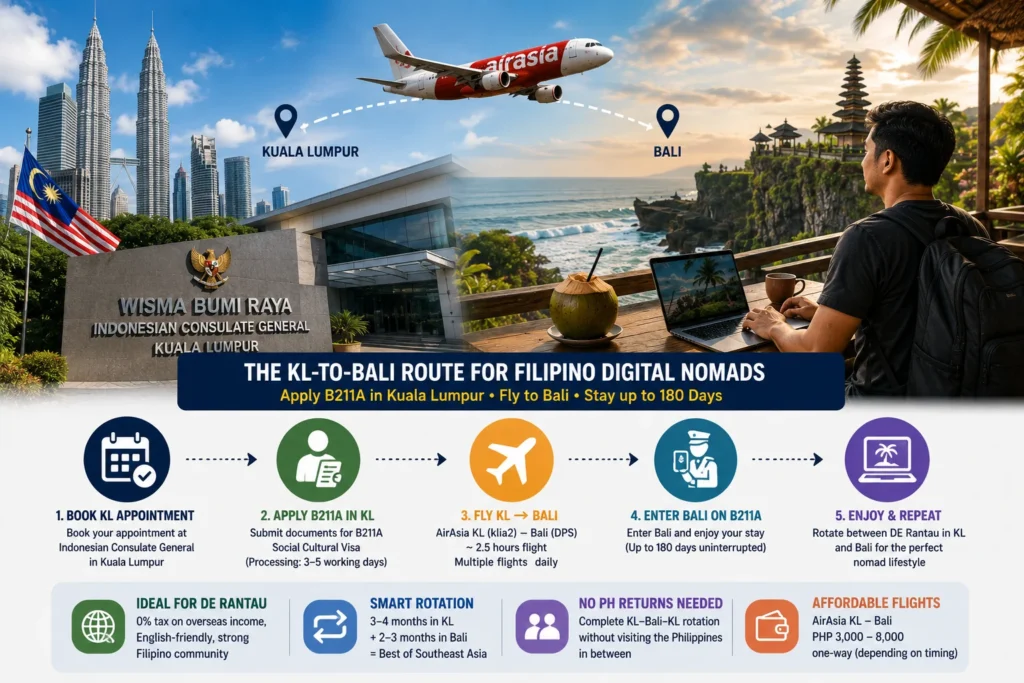
THE KL-TO-BALI ROUTE: BEST FOR DE RANTAU FILIPINOS For Filipino nomads already in Malaysia on DE Rantau: applying for B211A at the Indonesian Consulate General in Kuala Lumpur is dramatically more convenient than returning to Manila for the consulate visit. Indonesian Consulate General in Kuala Lumpur: Wisma Bumi Raya, 10 Jalan Raja Laut, Kuala Lumpur 50350. Process: Book KL appointment → Apply B211A in KL (3-5 working days processing) → Fly KL to Bali (approximately 2.5 hours, AirAsia KL-DPS multiple times daily) → Enter Bali on B211A. Why this works so well for Filipinos: DE Rantau is a natural primary base: Malaysia’s territorial tax (0% on overseas income), English-speaking environment, strong Filipino community, good flights to Philippines Bali as a secondary rotation: 3-4 months DE Rantau in KL + 2-3 months B211A in Bali = two exceptional Southeast Asian bases in one yearNo return to Philippines required: the entire KL-Bali-KL rotation can be done without visiting the Philippines in betweenFlight cost: AirAsia KL (klia2) to Bali: approximately PHP 3,000-8,000 one-way depending on booking timing
B211A Documents for Filipino Applicants
Valid Philippine passport: minimum 6 months validity from date of application, at least 2 blank visa pages
Two recent passport photographs: 3.5 × 4.5 cm, white background
Completed visa application form: from consulate website or available at the counter
Sponsor documents: (a) Surat Penjaminan (guarantee letter) from Indonesian citizen/company, and (b) copy of sponsor’s KTP. Bali visa agencies provide sponsor arrangement for a fee — USD 200-350 for full B211A package.
Visa fee: approximately USD 30-65 (consulate-specific)
If requested: Wise 12-month statement or Upwork/Fiverr earnings statement as income evidence. Not always required but have ready.
UPWORK/FIVERR INCOME DOCUMENTATION FOR B211A Some Indonesian consulates request proof of income or financial standing for B211A applicants. For Filipino Upwork or Fiverr freelancers: Upwork annual earnings statement (available in Upwork settings → Reports → Earnings Report)Wise 12-month PDF transaction history showing overseas income receiptsFiverr annual earnings report (available in Fiverr → Analytics → Earnings)Philippine bank statement (BDO, BPI, UnionBank) showing regular income deposits These documents are not universally required for B211A but having them ready prevents application delays if the consulate requests them. The goal is to demonstrate that you have sufficient funds to support yourself during the Bali stay without needing to work for Indonesian entities.
3. Cost of Living in Bali for Filipino Nomads — In Pesos
Monthly Expense
Canggu (PHP)
Ubud (PHP)
Notes
1BR Villa / Apartment
PHP 40,000–70,000
PHP 26,000–46,000
Always verify upload internet speed before committing
Food (warung + western mix)
PHP 11,500–20,000
PHP 8,700–14,500
Warung meals PHP 80–150; western PHP 500–1,100
Transport (scooter rental)
PHP 4,600–8,700
PHP 3,500–7,000
Scooter IDR 800,000–1.5M/month; Grab app available
International plan essential; SafetyWing popular for Bali
Internet + SIM (Telkomsel)
PHP 870–1,700
PHP 870–1,700
Data: IDR 100,000–200,000/month
TOTAL MONTHLY
PHP 66,270–117,800
PHP 47,670–85,400
Achievable on USD 1,200-1,500/month income
PHILIPPINES-BALI COST COMPARISON Canggu at PHP 66,000-85,000/month is comparable to mid-range Manila living (Makati, BGC area) — but with tropical Balinese lifestyle instead of Metro Manila traffic and density. Ubud at PHP 47,000-60,000/month is significantly cheaper than Manila for equivalent quality of life. For Filipino nomads earning USD 1,200-1,500/month, Ubud represents excellent value with exceptional cultural environment. Filipino food availability: traditional Filipino food (adobo, sinigang, Filipino-style pancit) is largely unavailable in Bali restaurants. However, rice-based culture overlap means the transition to Indonesian cuisine is smooth for most Filipinos. Indonesian nasi goreng (fried rice) and mie goreng (fried noodles) feel culturally familiar to Filipino palates.
4. Flights from Philippines to Bali: The Under-4-Hour Advantage
MANILA TO BALI: ONE OF THE CLOSEST NOMAD DESTINATIONS FROM THE PHILIPPINES Bali (DPS) is approximately 3.5–4 hours from Manila (MNL) by direct flight — making it closer than Bangkok by flight time and comparable to Kuala Lumpur. This geographic proximity is one of Bali’s most underappreciated advantages for Filipino nomads.
Route
Airline
Duration
Frequency
Typical Fare
Manila (MNL) → Bali (DPS)
Cebu Pacific
Approximately 3.5–4 hours
Multiple weekly (check current schedule)
PHP 3,000–8,000 one-way (advance booking)
Manila (MNL) → Bali (DPS)
Philippine Airlines
Approximately 3.5–4 hours (direct or 1-stop)
Seasonal / check schedule
PHP 5,000–12,000 one-way
Manila (MNL) → Kuala Lumpur → Bali (DPS)
AirAsia
Approximately 5.5–7 hours total
Daily (KL hub)
PHP 4,000–10,000 total
Cebu (CEB) → Bali (DPS)
Cebu Pacific / via Manila
Approximately 4.5–6 hours (with connection)
Check current routing
PHP 4,500–10,000
Best booking strategy: Cebu Pacific’s MNL-DPS route often has promotional fares under PHP 3,000 one-way. Book 4-8 weeks in advance for best prices.
Avoid July-August and December-January for both flights and Bali accommodation: peak season prices surge 50-100% above off-season.
October-November is an excellent Bali timing: shoulder season pricing, manageable rainy season (afternoon showers, not all-day), and significantly fewer tourists than peak season.
5. Filipino Community in Bali: What Actually Exists
The Established Filipino Presence
The Filipino community in Bali is one of the most significant in Southeast Asian expat circles, predating the digital nomad wave by many years. The majority of long-term Filipinos in Bali work in the island’s hospitality, wellness, and beauty industries:
Hotel and resort staff: Filipino hospitality workers are widely employed in Bali’s 4-5 star hotels and resorts; the warmth and English proficiency of Filipino staff is valued by international hotel operators
Spa therapists and wellness practitioners: Filipino-trained therapists are well-represented in Bali’s extensive spa and wellness industry
Entertainment and nightlife: Filipino musicians and performers have a long presence in Bali’s live entertainment venues
Growing digital nomad segment: in Canggu specifically, Filipino remote workers and freelancers have become a visible and growing part of the nomad community from approximately 2020 onwards
Finding the Filipino Community
Facebook groups: ‘Filipinos in Bali’ and ‘Philippine community Bali’ groups are active; ask for current invite links in r/Philippines or r/phdigitalnomad
Canggu area: highest concentration of Filipino digital nomads; many in the Berawa and Batu Bolong areas of Canggu
Filipino establishments: a handful of Filipino-style food options in Kuta (search ‘Filipino food Bali’) — smaller selection than KL’s Filipino restaurant scene but present
WhatsApp groups: ask at any Canggu co-working space for the current Filipino nomad group — these are more active than formal community organizations
Cultural Resonance: Why Bali Feels Familiar
Filipino nomads consistently report Bali feeling culturally accessible in a way that East Asian or European destinations do not. The shared Southeast Asian cultural DNA creates immediate comfort:
Tropical climate familiarity: both Philippines and Bali share a warm, humid tropical climate with similar seasonal rhythms. No temperature adjustment required.
Rice-based food culture: Indonesian food shares the foundational rice-and-ulam structure that Filipino cuisine shares. The transition from Filipino to Indonesian food is the smoothest of any cross-cultural food adjustment in the region.
Warmth of social interaction: Balinese hospitality culture and Filipino kapwa (shared humanity / warmth) create an immediately harmonious social environment.
Southeast Asian religious visual culture: though Bali is Hindu and the Philippines is primarily Catholic, the visual richness of ceremonial life, devotional offerings, and community-centered spirituality resonates across both traditions.
6. BIR Obligations for Filipino Nomads in Bali
BIR FILING: STILL REQUIRED IN BALI BIR Form 1701 (Annual Income Tax Return) must be filed by April 15 of the following year, regardless of whether you are living in Bali. Indonesian residency, Social Visa status, or even deportation from Indonesia does not eliminate Philippine BIR filing obligations. Indonesia and the Philippines tax framework for overseas remote workers: Indonesia (Bali): does not tax overseas income for tourists or Social Visa holders. Your Upwork or overseas employer income earned while in Bali is NOT Indonesian-taxable.Philippines (BIR): if you are a Philippine resident citizen (not yet non-resident citizen status), worldwide income is taxable. If you are a Philippine non-resident citizen (1+ year continuous absence established), only Philippine-sourced income is taxable.Result: for most Filipino nomads in early years abroad (resident citizen): BIR taxes worldwide income; Indonesia taxes zero; no double taxation, but BIR liability exists. For established non-resident citizens: BIR taxes only Philippine-sourced income (dividends from PSE, BDO/BPI bank interest); Bali overseas income not taxable. Optimal position. Indonesia-Philippines DTAA: there is a limited tax treaty between Indonesia and the Philippines. Its provisions are most relevant for passive income types (dividends from Indonesian companies, bank interest). For overseas remote workers earning from non-Indonesian clients while in Bali: the treaty’s relevance is limited since Indonesia doesn’t tax that income anyway. Practical: file BIR 1701 by April 15 via eBIR Forms or eFPS regardless of Bali location. Declare all income if resident citizen; declare only Philippine-sourced income if non-resident citizen. Consult a Philippine CPA with overseas Filipino expertise.
7. SSS, PhilHealth, and Pag-IBIG: Continue in Bali
SOCIAL CONTRIBUTIONS CONTINUE REGARDLESS OF BALI STAY Philippine social contribution obligations are not affected by your Indonesian visa status, length of Bali stay, or overseas residence. All three continue as voluntary overseas member contributions: SSS (Social Security System): Continue as Overseas Voluntary Member (OVM)Pay quarterly or annually via my.sss.gov.ph or remittance from Philippine bank Maintains pension entitlement, sickness benefits, and disability benefits for your return to the Philippines PhilHealth: Continue as Direct Contributor Pay via philhealth.gov.ph or accredited payment channels Maintains Philippine healthcare coverage; some international coverage options available Pag-IBIG (HDMF): Continue as Overseas Voluntary Member Pay via pagibigfund.gov.ph or accredited overseas channels Maintains housing loan eligibility for when you return to the Philippines All three contributions can be paid online from anywhere in the world. The Bali time zone (WITA, UTC+8) is the same as Philippine Standard Time (PST, UTC+8) — zero time zone adjustment for accessing Philippine online portals. Same time zone as Manila: Bali WITA = Philippine Standard Time. No jet lag between Philippines and Bali. Client calls, BIR portal access, and SSS portal hours are all on the same clock.
8. Filipino Payment Methods in Bali
PAYMENT SETUP FOR FILIPINO NOMADS IN BALI 1. Wise Card (Primary): Best tool for overseas income receipt and Bali daily expenses. Convert USD from Upwork/overseas clients to IDR at mid-market rates. Use at BCA ATMs for cash withdrawals. Use at Canggu and tourist area merchants (Mastercard acceptance is near-universal in the Canggu corridor). 2. Payoneer Card (Platform earners): If Upwork or Fiverr is your primary income platform, Payoneer’s ATM card works at BCA ATMs. Good alternative to Wise for platform-primary earners; slightly worse forex rates than Wise for non-USD currencies. 3. Philippine Credit Cards (BPI, BDO, Metrobank — Visa/Mastercard): Accepted at tourist-area restaurants, hotels, and Canggu establishments. Foreign transaction fee applies (1.5-3.5% depending on card). Premium cards (BPI Amore, BDO Visa Signature) have better rates. 4. GCash: GCash is a Philippine e-wallet and does NOT work at Indonesian merchants. GCash’s international feature allows some international transactions but is not a substitute for Wise or cash in Bali. 5. IDR Rupiah Cash: Essential for local warungs, small markets, scooter petrol, small temple donations, and anywhere outside the main tourist zone. Always carry IDR 100,000-200,000 cash (≈ PHP 300-600).
Payment Method
Works in Bali?
Best For
Wise card
Yes ✔
ATM cash + tourist merchants; best rates
Payoneer card
Yes ✔ (BCA ATMs)
Upwork/Fiverr platform earners
BPI/BDO Visa/MC credit card
Yes ✔ (tourist areas)
Restaurants, hotels; check forex markup
GCash
Very limited ⚠
Not a reliable payment tool in Bali
USD cash
Yes ✔
Money changer IDR exchange; good rates
IDR Rupiah cash
Yes ✔
Warungs, markets, local transport; essential
9. The Bali-Malaysia Rotation: A Strategy for Filipino Nomads
MAXIMIZING SOUTHEAST ASIA WITH BALI + MALAYSIA For Filipino nomads with income qualifying for Malaysia’s DE Rantau (USD 24,000+/year = PHP 1.3M+), the most financially and logistically optimal regional strategy is: Establish DE Rantau in Malaysia (KL or Penang): Malaysia’s 0% overseas income tax (territorial), English official language, strong Filipino community, USD 220 visa fee. 3-4 months KL base.Apply for B211A Social Visa at Indonesian Consulate in KL: while in KL, visit the Indonesian Consulate (Wisma Bumi Raya). Processing: 3-5 working days. Continue daily KL routine while processing.Fly KL to Bali (AirAsia klia2-DPS): approximately 2.5 hours, frequently available, PHP 2,500-6,000 one-way.Bali stay (2-3 months on B211A): Canggu co-working, Bali lifestyle, B211A up to 5 months if needed.Return to KL or Philippines: either extend DE Rantau in KL or return to Philippines for BIR filing (April 15 deadline) and SSS/PhilHealth/Pag-IBIG visits. Tax efficiency of this structure: Malaysia (DE Rantau): 0% overseas income tax (territorial)Bali (Social Visa): 0% overseas income tax (territorial, tourists/social visa)Philippines (non-resident citizen): 0% on overseas active incomeTotal tax on overseas remote work income: 0% throughout the rotation Both Malaysia and Bali charge zero tax on overseas remote work income. The BIR obligation continues, but as a non-resident citizen with overseas income, the BIR liability on overseas active income is also zero. Three destinations, zero double taxation on overseas income.
Frequently Asked Questions
Do Filipinos Need a Visa for Bali? A Guide to Bali for Filipino digital nomads?
Filipino citizens, as ASEAN passport holders, can enter Bali for 30 days under ASEAN reciprocal arrangements. Filipinos are not required to pay the USD 35 Visa on Arrival fee charged to non-ASEAN nationalities. Extend to 60 days at Bali Immigration for approximately IDR 500,000. For stays beyond 60 days: apply for B211A Social Cultural Visa at Indonesian Embassy Manila, Consulate Davao, or Indonesian Consulate in Kuala Lumpur.
Can I apply for Bali B211A Social Visa while in Malaysia on DE Rantau?
Yes. This is one of the most convenient B211A routes for Filipino nomads. Apply at the Indonesian Consulate General in Kuala Lumpur (Wisma Bumi Raya, Jalan Raja Laut). Processing: 3-5 working days. Then fly AirAsia KL-Bali (approximately 2.5 hours). This allows Filipinos to transition directly from their DE Rantau Malaysian base to a B211A Bali stay without returning to the Philippines.
What are the BIR obligations for Filipino nomads in Bali?
BIR Form 1701 must be filed by April 15 regardless of Bali stay. Indonesia does not tax overseas remote work income for tourists or social visa holders (territorial tax system). The Philippines taxes worldwide income for resident citizens; only Philippine-sourced income for non-resident citizens (1+ year continuous absence established). Consult a Philippine CPA to determine your BIR residency classification. SSS, PhilHealth, and Pag-IBIG voluntary overseas contributions continue unchanged and can be paid online from Bali (same time zone as Manila).
How does GCash work in Bali?
GCash is a Philippine e-wallet platform and does not function at Indonesian merchants in the same way it works in the Philippines. For payments in Bali, Filipinos should use Wise card (best for ATM withdrawals and merchant payments), Payoneer card (for Upwork/platform earners), or Philippine Visa/Mastercard credit cards at tourist-area establishments. Always carry some IDR Rupiah cash for local warungs, markets, and non-tourist-area spending.
Is the flight from Manila to Bali under 4 hours?
Yes. Direct flights from Manila (MNL) to Bali (DPS) with Cebu Pacific take approximately 3.5-4 hours. This makes Bali one of the closest quality digital nomad destinations from the Philippines by flight time — closer than Kuala Lumpur (approximately 3.5 hours) and comparable to Bangkok (approximately 4 hours). AirAsia operates via Kuala Lumpur (adding 1.5-2 hours connecting time). Bali’s geographic proximity is one of its most underappreciated advantages for Filipino nomads.
Final Verdict: Bali as a Filipino Nomad Base
Bali offers Filipino nomads a combination of advantages that no other Southeast Asian nomad hub matches simultaneously: the shortest flight from Manila of any quality nomad destination, ASEAN entry without advance consulate application or USD 35 fee, a large established Filipino community (particularly in Canggu), and a cost of living achievable on mid-range freelance income. The B211A Social Visa — most conveniently applied at the Indonesian Consulate in KL while on DE Rantau — gives Filipinos up to 180 days of uninterrupted Bali stay. The Bali-Malaysia rotation is the most financially efficient structure for Filipino nomads qualifying for both: 0% overseas income tax in both destinations, two high-quality Southeast Asian bases, and easy flight connectivity back to the Philippines for BIR filing season. Practical notes before departure: GCash does not work for Bali merchant payments; set up Wise card before you fly. Traditional Filipino food (sinigang, adobo) is largely unavailable; expect Indonesian and international cuisine with occasional Filipino food at community gatherings. BIR Form 1701 is due April 15 regardless of your Bali location — file via eBIR Forms online; Bali WITA and Philippine Standard Time are identical time zones. Read the Bali Digital Nomad Hub for the complete overview, or the Social Visa B211A guide for the application process in depth.