DISCLAIMER This guide provides general practical information about establishing a digital nomad base in Thailand. Policies, costs, and bank requirements change. Verify all current requirements with official sources before making decisions. This is not legal, immigration, or financial advice.
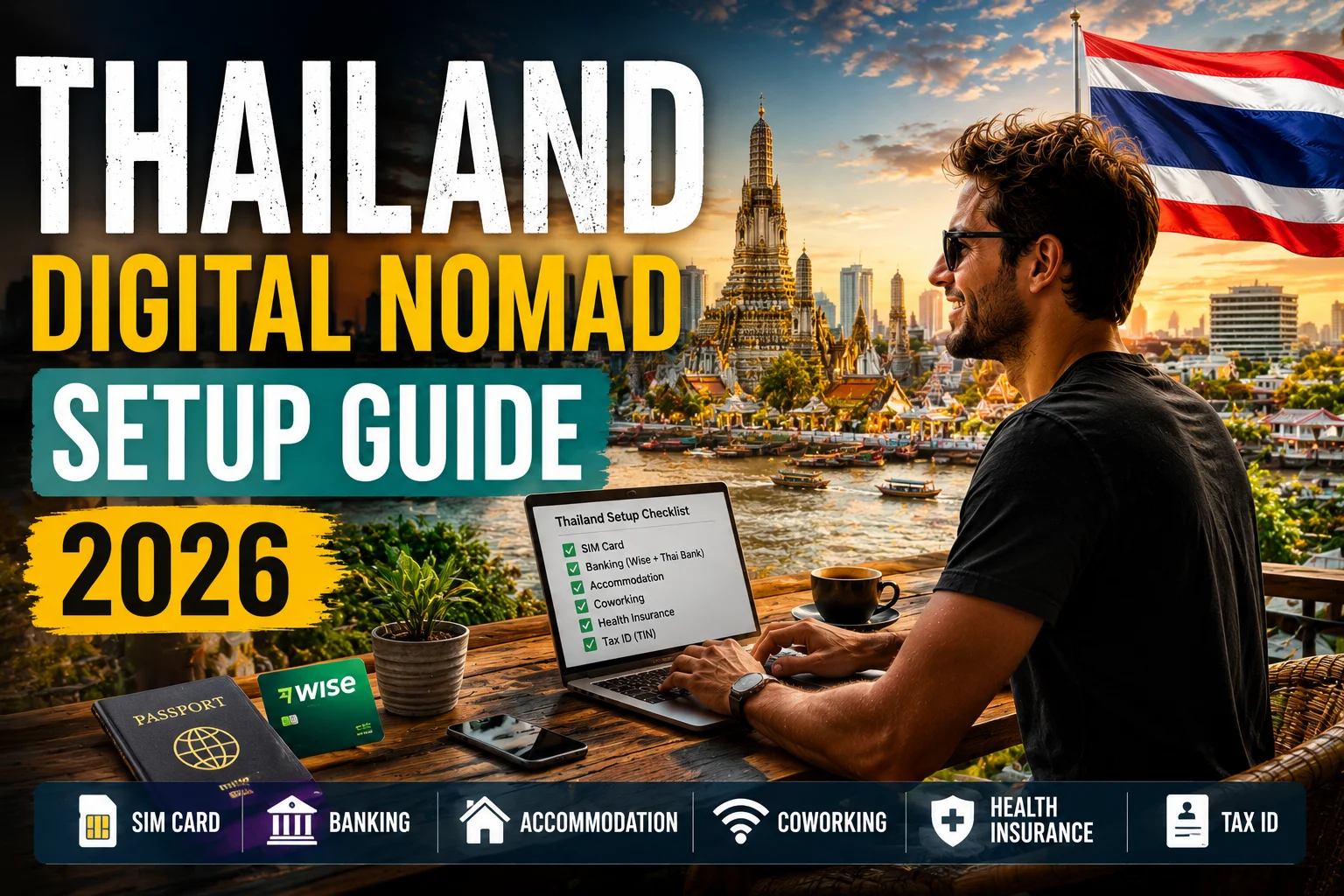
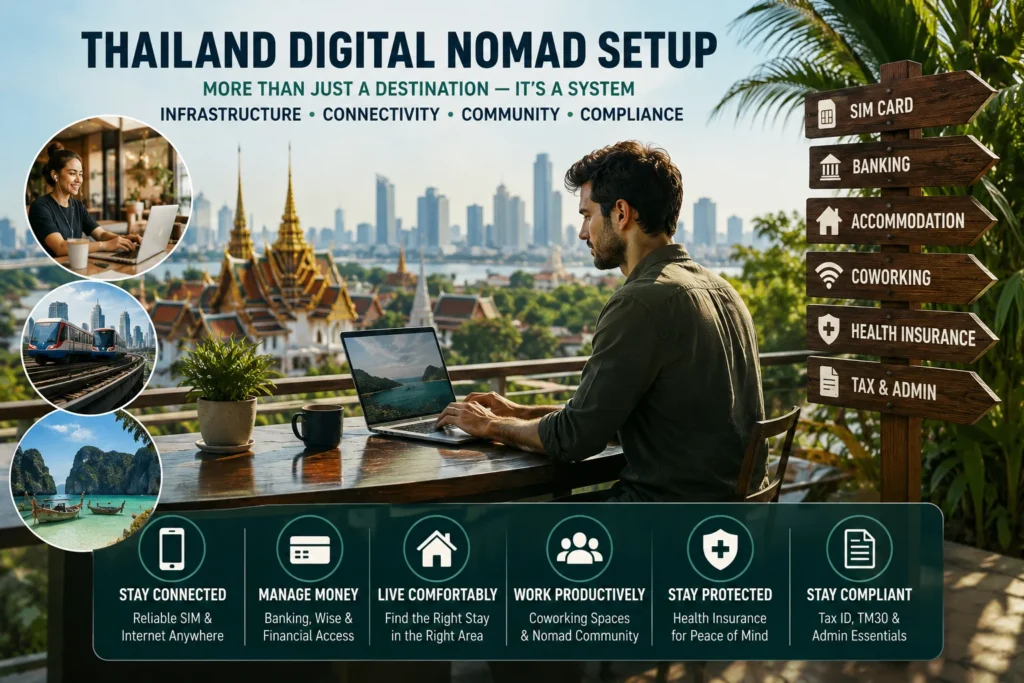
AI OVERVIEW SUMMARY Setting up a digital nomad base in Thailand requires establishing six core infrastructure components in roughly sequential order, as outlined in this Thailand digital nomad setup guide: (1) SIM card — AIS or True Move H for reliable data; eSIM available for arrival-day connectivity; (2) Banking — LTR/SMART visa holders can open KBank or Bangkok Bank with BOI letter; tourist visa holders rely on Wise card + PromptPay QR; (3) Wise + Thai bank architecture — Wise for overseas income receipt and forex; Thai bank for PromptPay, rent, utilities, and Thai tax payments; (4) Accommodation — service apartments for first month, then direct condo rental for 3-month+ stays; Bangkok’s Sukhumvit/Ari or Chiang Mai’s Nimmanhaemin as primary nomad zones; (5) Coworking — Hubba or The Hive in Bangkok; Yellow or Hub53 in Chiang Mai; (6) Health insurance — mandatory for LTR WFT (Cigna, AXA, Pacific Cross) and strongly recommended for all stays. Thai Tax ID (TIN) is needed if staying 180+ days. TM30 address registration is legally required and managed by the landlord. The total first-month Thailand setup cost runs approximately THB 25,000-55,000 (USD 700-1,600) beyond regular living expenses.
QUICK ANSWER: What do you need to set up as a digital nomad in Thailand? The six core components in setup sequence: SIM card: AIS or True Move H; long-stay SIM plan; eSIM for Day 1. (Day 1 at airport)Accommodation: service apartment month 1; direct condo rental month 2+. (Week 1)TM30 registration: landlord registers your address with immigration. (Week 1)Banking: LTR holders — KBank with BOI letter; tourist visa holders — Wise card primary. (Week 2-4)Coworking: Hubba/The Hive Bangkok; Yellow/Hub53 Chiang Mai. (Week 2)Health insurance: mandatory for LTR WFT; strongly recommended for all. (Before arrival)Thai Tax ID (TIN): from Revenue Dept. district office if staying 180+ days. (Month 2-3) Wise is the financial backbone for all Thailand nomads — LTR holder or tourist visa. Set up Wise before arriving. It handles overseas income receipt, forex, and covers banking gap before Thai account is established.
Introduction: The Thailand Setup Is More Layered Than Most Guides Admit
Thailand is one of the world’s most established digital nomad destinations. Bangkok and Chiang Mai between them have hosted hundreds of thousands of remote workers over the past decade. The infrastructure — coworking, cafes, internet, international food, expat healthcare — is world-class. But setting up properly for a 3-month or 12-month Thailand stay requires navigating several layers that most nomad guides skip or simplify: the banking reality for non-LTR holders, the SIM card selection for upload-intensive remote work, and the exact sequence of administrative steps that makes everything run smoothly.
This guide follows the actual setup sequence — from landing at Suvarnabhumi to having a fully functioning nomad base — and covers each component with the specificity that general guides never provide.
1. SIM Cards: Your First Thailand Infrastructure Decision
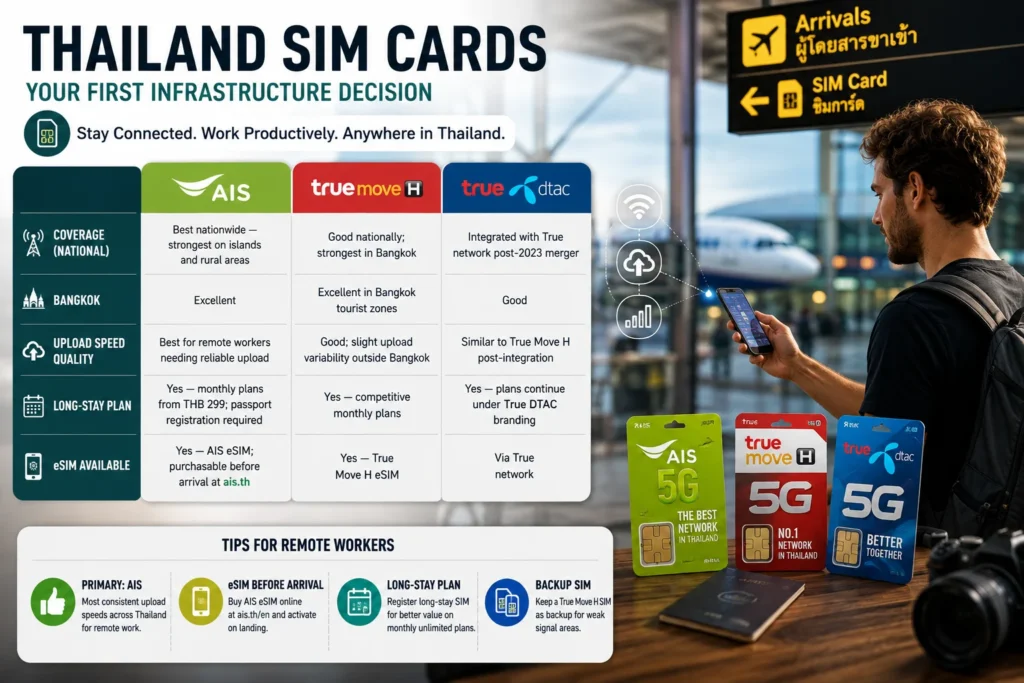
Your first setup task lands at the airport. Before you leave immigration, you need a working data SIM. Here is the decision that matters for remote workers:
The Three Operators
Operator
Coverage (National)
Bangkok
Upload Speed Quality
Long-Stay Plan
eSIM Available
AIS
Best nationwide — strongest on islands and rural areas
Excellent
Best for remote workers needing reliable upload (video calls, large file transfers)
Yes — monthly plans from THB 299; passport registration required
Yes — AIS eSIM; purchasable before arrival at ais.th
True Move H (post-merger)
Good nationally; strongest in Bangkok
Excellent in Bangkok tourist zones
Good; slight upload variability outside Bangkok
Yes — competitive monthly plans
Yes — True Move H eSIM
DTAC (True DTAC)
Integrated with True network post-2023 merger
Good
Similar to True Move H post-integration
Yes — plans continue under True DTAC branding
Via True network
SIM RECOMMENDATION FOR DIGITAL NOMAD REMOTE WORKERS Primary recommendation: AIS. For remote workers whose income depends on stable upload speeds for Zoom, Google Meet, Loom recordings, or large file uploads — AIS has the most consistent upload performance across Bangkok, Chiang Mai, Koh Samui, Phuket, and other popular nomad locations. eSIM before arrival: buy AIS eSIM online at ais.th/en (available internationally). Activate on landing. Immediate full connectivity without finding the airport SIM counter in an unfamiliar terminal. Long-stay plan: after first tourist SIM expires (7-30 days), register a long-stay SIM with your passport at any AIS retail counter. Monthly unlimited plans (with fair usage policy throttling after 30-50GB at full speed) from approximately THB 299-499/month. Better value than tourist SIM chains for stays over 45 days. Backup SIM: carry a second True Move H SIM for areas where AIS is weak (specific building basements, some mall interiors in Bangkok). Dual-SIM phone makes this seamless.
2. Banking in Thailand: The LTR vs Non-LTR Reality
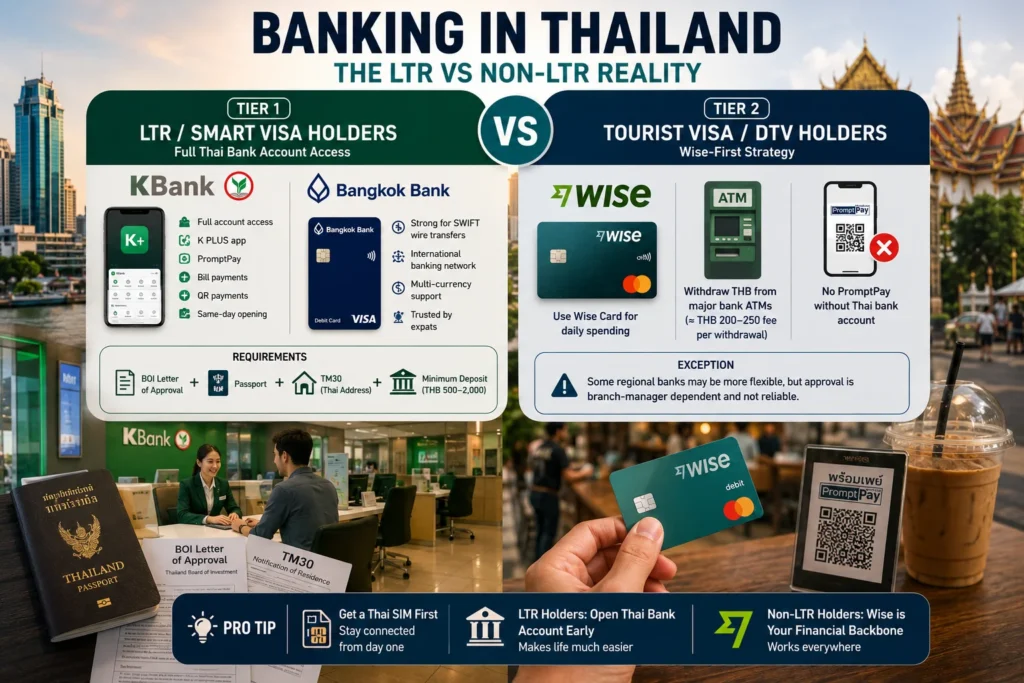
This is where most Thailand setup guides go wrong. Thai banking for foreigners in 2026 is significantly harder than it was in 2018-2020. The rules tightened substantially after COVID-era reviews of foreigner banking practices. Understanding which tier of banking access you can achieve based on your visa status saves enormous frustration.
Tier 1: LTR Visa or SMART Visa Holders (BOI Letter Access)
LTR / SMART VISA HOLDERS: STRAIGHTFORWARD BANKING If you hold an LTR visa or SMART visa: you receive a BOI Letter of Approval that confirms your immigration status with the Thailand Board of Investment. This letter is the master key to Thai banking. KBank (Kasikorn Bank): most recommended for LTR holders. Present your BOI letter + passport + TM30 (Thai address registration) at any KBank branch. Current account and savings account available. K PLUS app: excellent mobile banking with Prompt Pay, bill payment, QR merchant payments. Bangkok Bank: preferred by some LTR holders for overseas SWIFT wire receiving. Bangkok Bank has a well-established international banking division; their SWIFT infrastructure for receiving USD/EUR wires is marginally better than KBank. Some nomads maintain Bangkok Bank for overseas income receipt + KBank for daily Thailand spending. Process at KBank branch: bring original BOI letter, passport, TM30 (or rental contract with Thai address), minimum opening deposit (typically THB 500-2,000). Account opened same day in most cases. Takes 30-90 minutes depending on branch.
Tier 2: Tourist Visa, Social Visa, or DTV Holders (Wise-First Strategy)
TOURIST VISA / DTV HOLDERS: WISE CARD IS YOUR PRIMARY TOOL If you are on a tourist visa, visa exemption stamp, or DTV (Destination Thailand Visa): opening a full Thai bank account is now difficult to near-impossible at most major Thai banks. KBank, Bangkok Bank, and SCB (Siam Commercial Bank) have all tightened foreigner account opening requirements and typically require at minimum a Non-Immigrant visa (Non-B, Non-O) or work permit for foreigners without LTR/SMART. The practical solution: Wise card: accepts at virtually all merchant terminals in Bangkok and Chiang Mai (Mastercard acceptance is near-universal in tourist and expat areas). Use for daily spending, restaurants, accommodation, coworking day passes. BCA ATMs: in Thailand, use Wise card at ATMs of major Thai banks (KBank, Bangkok Bank, SCB) for cash THB withdrawals. Fee: approximately THB 200-250 per withdrawal. Withdraw larger amounts to minimize per-withdrawal fees. Prompt Pay limitation: without a Thai bank account, you cannot send Prompt Pay QR payments. Many Thai merchants use Prompt Pay QR. Workaround: Wise card at physical terminals where QR-only is not the only option. Exception: some smaller, regional Thai banks (Krungthai Bank branches in less-central areas, TMB Thanachart in some locations) have been more flexible for tourist visa foreigners willing to provide documentation packages. Success is branch-manager dependent. Not reliable enough to plan around.
3. The Wise + Thai Bank Architecture: The Definitive Framework
WISE + THAI BANK: AND NOT OR The most common misconception in Thailand nomad banking: choosing between Wise and a Thai bank account as if they are alternatives. They are not. They serve different functions in a complementary stack. What Wise does: Receives overseas income in USD, EUR, GBP, AUD from overseas clients/employerConverts at mid-market rates (significantly better than Thai bank TT rates)Wise card: accepted at merchant terminals; ATM cash withdrawals (Mastercard network)Holds multiple currencies simultaneouslyTransfers to Thai bank (SWIFT/local) when ready to fund Thailand expensesTransfers to NRE account in India (for Indian nomads building India savings) What Thai bank does (when available via LTR): PromptPay QR payments (standard at most Thai restaurants, shops, markets)Rent payment to Thai landlord (most landlords prefer Thai bank transfer)Thai income tax payment (PND 90 via online banking linked to RD portal)Local utility bills (electricity, water, internet)Receiving Thai-sourced income (if any Thai clients or Thai employer) The data flow: Overseas income → Wise (USD/EUR) → [Convert to THB at mid-market] → Thai bank (KBank) → daily Thailand spending Overseas income → Wise (USD) → [Transfer] → India NRE account → NRE FD investment Wise card → direct spending at Thai merchants (before Thai account established) Wise is essential regardless of LTR status. Even LTR holders with KBank accounts should receive overseas income in Wise first for the forex rate advantage before transferring to KBank.
4. Accommodation: Bangkok and Chiang Mai Zones
Accommodation Types and Best Value Sequencing
Type
Best For
Cost Range (Bangkok)
Cost Range (Chiang Mai)
Nomad Verdict
Service apartment (monthly)
First 1-2 months; all-inclusive utilities; housekeeping
THB 18,000–35,000/month 1BR
THB 8,000–18,000/month 1BR
Best for arrival period; no commitment; utilities included; often furnished with decent WiFi
Direct condo rental (owner)
3-month+ stays; best value
THB 12,000–25,000/month 1BR
THB 6,000–13,000/month 1BR
Best long-term value; cheaper than service apartment; find via FB groups, Hipflat, DDProperty; utilities separate
Airbnb (monthly rate)
Flexible 1-2 month stays
THB 22,000–45,000/month 1BR
THB 12,000–25,000/month 1BR
Convenient but premium; good for first Bangkok stay
Hotel
Arrival week only
THB 1,200–3,500/night
THB 600–1,800/night
Too expensive for long-term; use only for first 1-7 days
Bangkok Area Guide for Digital Nomads
Sukhumvit (BTS Nana to Ekkamai): maximum expat infrastructure; Indian restaurants, international pharmacies, international hospitals (Bumrungrad, Samitivej); most expensive; BTS direct. Ideal for first Bangkok stay.
Ari/Saphan Khwai: trendier, quieter, excellent cafes and independent restaurants; strong local Thai character mixed with expat presence; mid-range pricing; BTS accessible. Popular with experienced Bangkok nomads.
Silom/Sathorn: business district; good for Silom MRT access; international offices; less nightlife than Sukhumvit; good value service apartments.
Lat Phrao/Ratchada: more residential, lower cost; MRT access; excellent authentic Thai food; less expat infrastructure. Good for nomads who want cheaper accommodation and more local experience.
Chiang Mai Area Guide
Nimmanhaemin (Nimman): primary nomad area in Chiang Mai; highest density of cafes, coworking, international food, yoga studios; most expensive Chiang Mai area but significantly cheaper than Bangkok equivalents.
Old City: heritage area, temples; quieter; more budget options; slightly less nomad infrastructure than Nimman but growing.
Santitham: residential, quieter, slightly cheaper; community feel; some good coworking options (Hub53 is here).
Iconic Bangkok coworking; community events; good internet; meeting rooms; rooftop access
The Hive Thonglor
Thonglor, Bangkok
THB 300-400
THB 4,000-5,500
Professional; large space; strong internet; cafe on-site; popular with tech professionals
Mango (Ari)
Ari, Bangkok
THB 250-320
THB 3,000-3,800
Quiet professional environment; excellent for deep-focus work; neighborhood character
Common Ground (Asoke)
Asoke, Bangkok
THB 350-450
THB 4,500-6,000
Polished corporate feel; multiple floors; meeting rooms; BTS Asoke direct
Chiang Mai Top Coworking Options
Space
Location
Day Pass
Monthly
Character
Yellow
Nimmanhaemin, Chiang Mai
THB 250-350
THB 2,800-3,800
Best professional coworking in Chiang Mai; strong internet; quiet; reliable
Hub53 (Santitham)
Santitham, Chiang Mai
THB 200-280
THB 2,200-2,800
Community-focused; local nomad network; events; Santitham neighborhood character
CAMP (Maya Mall)
Nimmanhaemin, Chiang Mai
Free (with THB 60+ purchase)
N/A (not a formal membership)
Iconic cafe-coworking; cultural institution; great atmosphere; not for serious deadline-focused work
CHIANG MAI VS BANGKOK: WHICH COWORKING ENVIRONMENT? Bangkok: highest variety; more corporate and polished; stronger for networking with international tech professionals and startups; higher cost per day/month; BTS accessibility key. Chiang Mai: smaller but highly curated community; more focused on long-term nomads vs Bangkok’s higher tourist turnover; cheaper by 20-30%; slower pace generally better for deep work. Chiang Mai’s nomad community is arguably more ‘established’ in terms of shared norms and co-working culture than Bangkok’s larger but more transient scene.
6. Health Insurance: LTR Requirement and General Recommendations
Plan
Provider
Type
Monthly Cost (35 yrs)
LTR WFT Approved?
Thailand Coverage
CitizenShip (Premium tier)
Cigna Global
International
USD 100-200/month
Yes — widely accepted
Worldwide incl. Thailand
Premium / Premium PLUS
AXA International (BUPA International)
International
USD 120-220/month
Yes
Worldwide incl. Thailand
Classic / Superior
Pacific Cross
International
USD 75-150/month
Generally yes — verify BOI
Asia-Pacific primary
Care Plus
Allianz Care
International
USD 90-170/month
Yes
Worldwide incl. Thailand
Nomad Insurance
SafetyWing
Travel/Nomad
USD 49-65/month
NO — does not meet LTR minimum
Worldwide incl. Thailand
Local Thailand plan
AXA Thailand / BUPA Thailand
Local
THB 10,000-30,000/year
NO — Thailand-only coverage
Thailand only
HEALTH INSURANCE FOR LTR WFT APPLICANTS — MINIMUM REQUIREMENTS BOI LTR WFT Visa health insurance minimum: USD 40,000 coverage per illness/accident. The plan must be a genuine international health insurance plan with inpatient and outpatient coverage. SafetyWing and local Thailand plans do NOT meet this requirement. A Cigna Global, AXA International, or Pacific Cross plan is required for LTR WFT application. Age and premium: buy health insurance in your 30s if possible; premiums increase significantly in the 40s and 50s. A plan purchased at 35 locks in that age tier for annual renewal; some plans allow age-lock, others re-rate annually.
7. Thai Tax ID (TIN) and TM30: Administrative Foundations
Thai Tax Identification Number (TIN)
THAI TIN: WHO NEEDS IT AND HOW TO GET IT Required for: filing PND 90 (annual tax return), paying Thai income tax, e-filing at the RD portal. Also useful for some banking processes. When to get it: if you will stay 180+ days in Thailand in a calendar year, obtain your TIN between June and September. Don’t wait until January — Revenue Department offices are extremely busy January-March. Where to get it: Revenue Department district office in your area. Bangkok: multiple offices across the city. Chiang Mai: Chiang Mai Revenue Department. Documents: passport (original + copy), TM30 or Thai address proof, small passport photo (some offices request). Process: fill form at counter; TIN issued same day; 20-60 minutes depending on queue. After getting TIN: register at rd.go.th and activate your e-filing account at efiling.rd.go.th. Set up before the March 31 filing deadline.
TM30: Address Registration for Foreigners
TM30 is a legal requirement: landlords must notify immigration of foreign guests staying at their property within 24 hours of check-in.
How it’s done: landlord registers at tm30.immigration.go.th or in-person at immigration. Most service apartments handle this automatically.
Direct rental nomads: ensure your Thai landlord completes TM30 registration. If they refuse or are unaware, it creates complications if stopped at a police checkpoint or at airport immigration.
Your role: after landlord completes TM30, you receive a TM30 acknowledgement document. Keep it with your passport. Immigration officers may request to see it.
8. Transport in Bangkok and Chiang Mai
Bangkok
BTS Skytrain: primary transport for Sukhumvit (Nana-Ekkamai), Silom, Siam areas. Rabbit Card for regular use (reloadable). Fare: THB 17-59 depending on distance. 6:00 AM – midnight.
MRT: covers Lat Phrao, Huay Kwang, Silom (interchange with BTS), Chatuchak, Ratchada, Bang Sue. Similar pricing to BTS. MRT Gold Line serves Charoen Nakhon area.
Grab: dominant ride-hailing in Thailand; Grab Car and Grab Taxi options; install before arriving; GrabPay wallet links to Thai bank or credit card; most reliable for airport runs.
Airport transport: Airport Rail Link (ARL) from Suvarnabhumi Airport to Phaya Thai (interchange with BTS Sukhumvit line): THB 45, 30 minutes to central Bangkok. Grab from airport: approximately THB 300-500 to Sukhumvit depending on traffic.
Chiang Mai
Scooter rental: standard for most Chiang Mai nomads; THB 150-300/day or THB 1,500-3,000/month; international driving permit (IDP) technically required; driving in Chiang Mai is significantly safer than Bangkok for scooter beginners.
Grab: available in Chiang Mai but less frequent than Bangkok; useful for airport transfers and longer trips.
Songthaew (red trucks): shared taxi system unique to Chiang Mai; THB 30-50 per person for fixed routes; bargaining for custom trips.
9. First-Month Setup Cost Estimate
Setup Item
Bangkok (THB)
Chiang Mai (THB)
Notes
Accommodation (1 month, 1BR service apt)
THB 20,000-35,000
THB 8,000-15,000
Service apartment first month; includes utilities
SIM card (month 1, long-stay plan)
THB 299-499
THB 299-499
AIS long-stay unlimited plan
Coworking (1 month membership)
THB 3,500-5,500
THB 2,200-3,800
Full monthly membership
Health insurance (1 month, if not annual)
THB 3,500-8,000
THB 3,500-8,000
International plan pro-rated monthly
Transport (Grab + BTS/MRT card)
THB 2,000-4,000
THB 1,500-3,500
Depends on frequency and location
Thai Tax ID + TM30 admin time
THB 0-500
THB 0-500
Mostly free; minor transport and admin costs
TOTAL SETUP OVERHEAD
THB 29,000–53,000 (~USD 830–1,520)
THB 16,000–31,000 (~USD 460–890)
Beyond regular food and incidentals
10. Thailand Practical Setup Navigation Hub
Use the cluster articles below for deep-dive guidance on each setup component:
🏦
Thailand Banking Guide for Digital NomadsComplete guide to Thai banking: KBank vs Bangkok Bank, BOI letter process, overseas income receipt, and SWIFT architecture. /thailand-banking-guide-digital-nomads/
📞
Best SIM Cards in Thailand for Remote Workers 2026 AIS vs True Move H comparison specifically for upload-intensive remote work; tourist vs long-stay SIM plans; eSIM options. /best-sim-cards-thailand-remote-workers/
🖥️
Best Coworking Spaces in Bangkok 2026 Complete Bangkok coworking guide: Hubba, The Hive, Mango, Common Ground — pricing, internet speeds, community character. /best-coworking-spaces-bangkok/
🛡️
Health Insurance Requirements for Thailand LTR Visa LTR WFT minimum coverage requirement, qualifying plans (Cigna, AXA, Pacific Cross), age-tier pricing, and how to submit. /health-insurance-requirements-thailand-ltr-visa/
🔒
Best VPN for Thailand Digital Nomads 2026 Which VPNs work in Thailand without being blocked; speed comparison for video calls; protocol comparison for nomad remote work. /best-vpn-thailand-digital-nomads/
📊
Thailand Tax Residency GuideThe 180-day rule, the 2024 Revenue Department ruling on overseas income, how assessable income is calculated, and who must file PND 90. /thailand-tax-residency-guide/
💳
Wise for Digital Nomads — Complete Review Wise multi-currency account for Thailand: overseas income receipt, mid-market rates, Wise card for Thailand merchants, and the NRE account transfer flow. /wise-digital-nomads-complete-review/
🇹🇭
Thailand LTR Visa Complete Guide Full guide to the Long-Term Resident Visa: income categories, income proof requirements, BOI-authorized agents, processing timeline, and benefits. /thailand-ltr-visa-complete-guide/
Frequently Asked Questions
What do you need from a Thailand digital nomad setup guide?
Six core components in setup sequence: (1) SIM card — AIS or True Move H at airport; eSIM available before arrival; (2) Accommodation — service apartment first month, then direct condo rental; (3) TM30 — landlord must register your address with immigration; (4) Banking — LTR/SMART visa holders: KBank with BOI letter; tourist visa holders: Wise card primary until account access resolved; (5) Coworking membership; (6) Health insurance — mandatory for LTR WFT, recommended for all. Thai Tax ID from Revenue Dept. if staying 180+ days.
Can digital nomads open a bank account in Thailand?
It depends on visa status. LTR Visa and SMART Visa holders can open KBank or Bangkok Bank accounts using their BOI letter, passport, and TM30 address registration. Tourist visa and DTV holders face significant difficulty opening Thai bank accounts in 2026 — most major banks require at minimum a Non-Immigrant visa or work permit. The practical solution for tourist visa nomads: Wise card for merchant payments + Thai bank ATM withdrawals for cash.
Which SIM card is best for remote workers in Thailand?
AIS is the primary recommendation for digital nomads who depend on stable upload speeds for video calls, large file transfers, and remote collaboration. AIS has the strongest nationwide coverage and most consistent upload performance. True Move H is a strong alternative, particularly in central Bangkok. Purchase an AIS eSIM before arrival for immediate Day 1 connectivity. For stays over 45 days: switch to a long-stay monthly SIM plan (from approximately THB 299/month) at any AIS retail counter.
How much does it cost to set up a nomad base in Bangkok?
First-month setup overhead (accommodation + SIM + coworking + health insurance + transport) runs approximately THB 29,000-53,000 (USD 830-1,520) in Bangkok, beyond regular food and daily living costs. Chiang Mai setup is approximately THB 16,000-31,000 (USD 460-890) first month. This is the one-time setup cost; subsequent months are lower as accommodation deposits are not repeated.
Is Wise enough for Thailand or do I need a Thai bank account?
Wise is sufficient for most daily spending in Bangkok and Chiang Mai tourist/expat zones, where Mastercard acceptance is near-universal. However, Wise alone has limitations: PromptPay QR payment (very common in Thailand, including many markets and small restaurants) requires a Thai bank account; rent payment to Thai landlords is typically by Thai bank transfer; Thai income tax payment (PND 90) requires Thai bank linked to the RD e-filing portal. The optimal setup is Wise + Thai bank (KBank for LTR holders), not Wise OR Thai bank.
Final Verdict: The Sequence Matters More Than Any Individual Tool
Thailand’s nomad infrastructure is genuinely world-class — particularly in Bangkok and Chiang Mai. But arriving without a plan and trying to figure out banking, SIM, and accommodation simultaneously in an unfamiliar city leads to expensive shortcuts and delays. The sequence outlined in this guide — SIM Day 1, accommodation Week 1, banking Week 2-4, TIN Month 2-3 — is the order that makes the administrative overhead manageable without disrupting actual work. The Wise + Thai bank architecture is the financial foundation. LTR holders: set it up in both components simultaneously. Non-LTR holders: Wise is your primary tool; don’t let the Thai bank account question dominate your setup energy in the first month. Health insurance: sort this before arriving if applying for LTR WFT. The insurance documentation is part of the BOI application package, not something to handle after landing. Use the navigation hub above to go deep on any component. The cluster articles cover each topic with the specificity that a 4,000-word overview cannot.
SET UP YOUR THAILAND NOMAD BASE
Start with your visa status: it determines your banking access tier. Set up Wise before arriving. Read the banking guide and health insurance guide for your specific situation. [ Banking Guide → ] [ Health Insurance LTR → ] [ Best SIM Cards → ] [ Coworking Bangkok → ] [ Tax Residency → ]