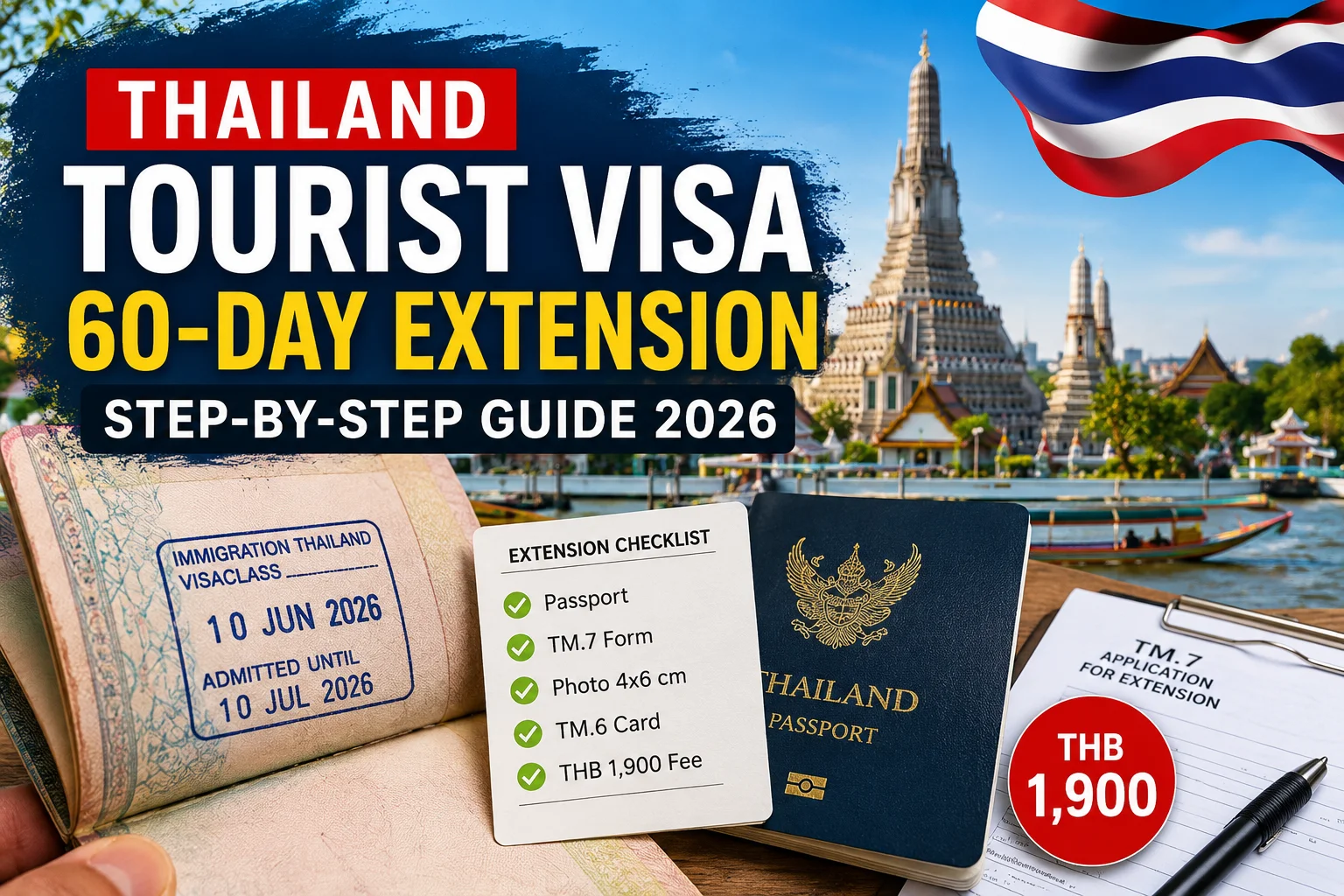
Thailand tourist visa extensions are processed in person at Thai Immigration offices. A Thailand tourist visa 60-day extension is available through this process, allowing eligible travelers to legally extend their stay. A 30-day visa-exempt entry can be extended once for 30 additional days (total 60 days in Thailand). A 60-day tourist visa (TR) can be extended once for 30 more days (total 90 days). The fee is THB 1,900, payable at the immigration office on the day of extension. Required documents include your original passport, one passport-size photograph (4×6 cm), the TM.7 application form (available at immigration offices), and the TM.6 departure card. Processing is usually completed the same day within 1 to 3 hours, depending on the office and queue. Indian and Filipino citizens on 30-day visa-exempt entries can extend to 60 days total using this process.
QUICK ANSWER: How do you extend a Thailand tourist visa for 60 days? To extend your Thailand tourist visa (or visa-exempt stay) for 60 days total: Go to a Thai Immigration office before your current visa or entry stamp expires Bring your original passport, one passport-size photograph (4×6 cm), and THB 1,900 in cash Collect the TM.7 extension application form at the immigration office Fill in the TM.7 form and submit it with your documents Pay the THB 1,900 fee at the payment counter Wait for your passport to be stamped with the new 30-day extension Result: Your permitted stay is extended by 30 days from the current expiry date (not from today). A 30-day visa-exempt entry becomes 60 days total. A 60-day tourist visa becomes 90 days total.
IMPORTANT DISCLAIMER Thai Immigration policies, fees, and procedures can change without notice. Always verify current requirements directly with Thai Immigration (immigration.go.th) or by calling the specific office before your visit. This guide reflects reported practices as of May 2026 and is for informational purposes only. This is not legal advice.
Introduction
Extending a Thailand tourist visa is one of the most commonly Googled questions in the digital nomad and long-stay traveler community — and one of the most poorly answered. Most guides cover the basics correctly but miss the practical details that make the difference between a smooth 90-minute process and a wasted afternoon at an immigration office.
This guide covers the full process with the specific information you actually need: the exact document list, the fee in Thai Baht, which immigration offices handle extensions most efficiently, what time to arrive, the dress code you cannot ignore, and the critical distinction between visa-exempt entries and tourist visas that most articles get wrong.
Visa-Exempt vs. Tourist Visa: The Critical Distinction
Before anything else, you need to know what type of entry you are extending. The extension outcome is different.
Entry Type
Standard Stay
Extension Granted
Total Maximum Stay
Best For
Visa-exempt entry (30-day stamp on arrival)
30 days
+30 days (one time)
60 days total
Most Indian and Filipino passport holders arriving without a prior visa
Tourist Visa (TR) 60-day
60 days
+30 days (one time)
90 days total
Anyone who applied for a tourist visa before traveling to Thailand
Tourist Visa (TR) 30-day
30 days
+30 days (one time)
60 days total
Shorter-validity tourist visa holders
MOST IMPORTANT RULE TO UNDERSTAND Extensions are granted only ONCE per entry. After using your extension, you must leave Thailand and re-enter to start a new permitted stay. You cannot extend a stay that has already been extended. The extension adds 30 days to your current EXPIRY DATE — not to today’s date. If your stamp expires on June 10 and you apply on June 5, your new expiry is July 10, not 30 days from June 5.
Who Can Apply for a Thailand Tourist Visa Extension
The extension is available to:
All nationalities who entered Thailand on a valid tourist visa (TR)
Most nationalities who entered on a visa-exempt basis (30-day stamp at airport or land border)
Holders of a valid Tourist Visa (TR) with at least some days remaining on the current permitted stay
You cannot extend:
An entry that has already been extended once (must leave and re-enter)
An expired entry stamp (overstay — must pay fine and depart)
A non-immigrant visa (Non-B, Non-O, etc.) through the tourist extension process — different visa, different procedure
Documents Required for Thailand Tourist Visa Extension
Document
Details
Where to Get It
Original passport
Must be valid with sufficient pages
Already with you
TM.7 application form
Extension application form
Available free at the immigration office counter
Passport-size photograph
4 cm x 6 cm (4×6 cm), white background, recent
Print before going; some offices have photo booths nearby
TM.6 departure card
The card in your passport — keep it safe from the day you entered
Given on arrival at airport or land border; keep with your passport
THB 1,900 in cash
Extension fee; cash only at most offices
Bring to the office; ATMs are near most immigration offices
Proof of accommodation (sometimes)
Hotel booking, rental contract, or host’s contact details
Not always required but bring something as backup
PASSPORT PHOTO TIP Print your 4×6 cm photo before leaving for the immigration office. Do not rely on a photo booth at the office — some offices have them, many do not. A pharmacy or photo shop near your accommodation can print the correct size for THB 100 to 200.
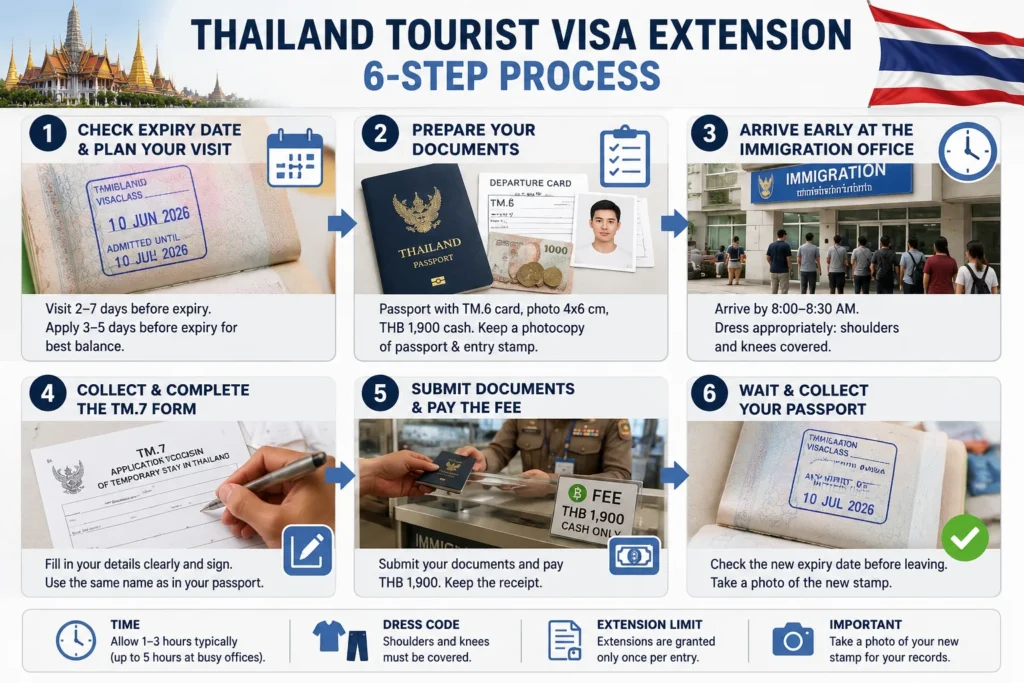
Thailand Tourist Visa Extension: 6-Step Process
The Thailand tourist visa 60-day extension process explained in six simple steps, from document preparation and TM.7 form submission to fee payment and passport collection.
STEP 1
Check Your Expiry Date and Plan Your Visit Find the entry stamp in your passport. The date shown is the date you must leave by (not the number of days from today). Plan your immigration office visit for 2 to 7 days before this date. Going too early is fine; going on the day of expiry is stressful and risky. ⚡ Tip: Apply 3 to 5 days before expiry for the best balance of safety and timing.
STEP 2
Prepare Your Documents Gather: original passport with TM.6 departure card inside, one passport-size photograph (4×6 cm, white background), and THB 1,900 in cash. Double-check that your TM.6 card is still in your passport — it is easy to lose. ⚡ Tip: Keep a photocopy of your passport bio-data page and entry stamp — some officers ask for a copy, some provide a copier on-site.
STEP 3
Arrive at the Immigration Office Early Arrive by 8:00 to 8:30 AM when the office opens. Queue numbers are issued from 8:30 AM at most offices. Getting there early means a number in the first batch and an extension completed by mid-morning. Arriving after 10 AM at a busy office (especially Chaeng Wattana in Bangkok) means significantly longer waits. ⚡ Tip: Dress appropriately before leaving: shoulders and knees covered. You may be turned away at the door if your clothing is not acceptable.
STEP 4
Collect and Complete the TM.7 Form Get the TM.7 application form at the immigration office counter or information desk (it is free). Fill in: your name exactly as on your passport, passport number, nationality, address in Thailand, reason for extension (typically ‘tourism’), and intended departure date (30 days from current expiry). Sign where indicated. ⚡ Tip: Write clearly and use the same name spelling as your passport. Discrepancies cause delays.
STEP 5
Submit Documents and Pay the Fee When your queue number is called, approach the counter and submit: your passport (with TM.6 inside), the completed TM.7 form, your photograph, and any supporting documents. The officer will direct you to the payment counter for the THB 1,900 fee. Keep your payment receipt until your passport is returned. ⚡ Tip: Be polite and patient at the counter. Have your documents organized before your number is called.
STEP 6
Wait and Collect Your Passport After paying, wait for your name or number to be called again. The officer will return your passport with a new entry stamp showing your updated permitted stay. Verify the new date before leaving the office. The total wait time, from arrival to collecting your passport, is typically 1 to 3 hours at well-managed offices and up to 5 hours at the busiest offices during peak season. ⚡ Tip: Take a photo of the new stamp as soon as your passport is returned. This gives you a digital record of your new expiry date.
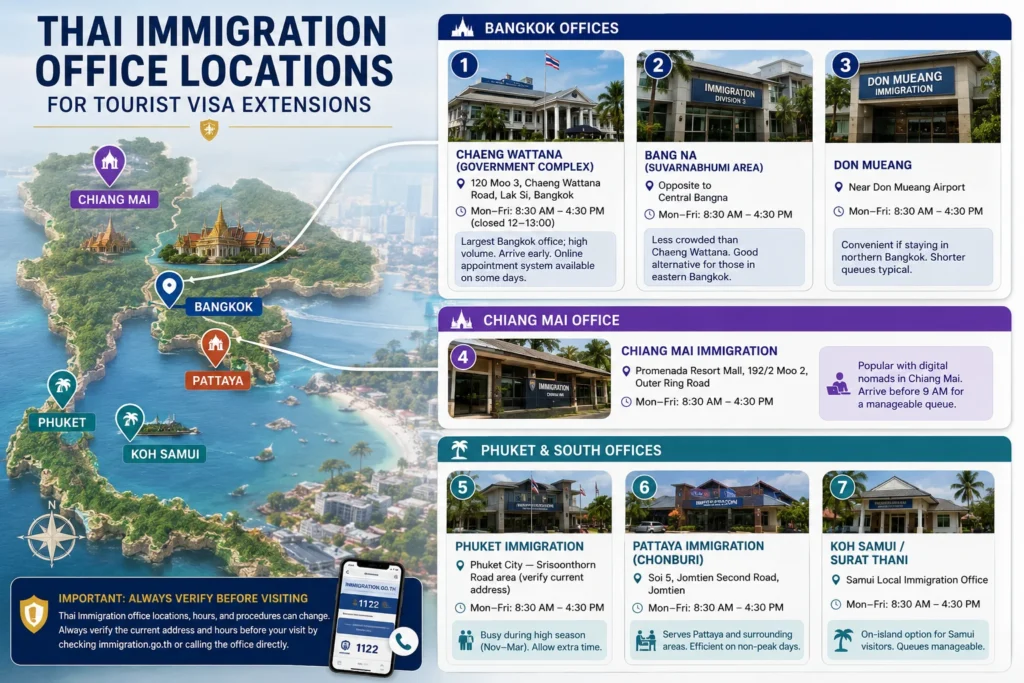
Thai Immigration Office Locations for Tourist Visa Extensions
Major Thai immigration offices where travelers can apply for a Thailand tourist visa 60-day extension, including Bangkok, Chiang Mai, Phuket, Pattaya, and Koh Samui.
Extensions can be processed at any Thai Immigration office nationwide. Here are the most commonly used offices for tourists and digital nomads:
Bangkok
Office
Address
Hours
Notes
Chaeng Wattana (Government Complex)
120 Moo 3, Chaeng Wattana Road, Lak Si, Bangkok
Mon–Fri: 8:30 AM – 4:30 PM (closed 12–13:00)
Largest Bangkok office; high volume. Arrive early. Online appointment system available on some days.
Bang Na (Suvarnabhumi area)
Opposite to Central Bangna
Mon–Fri: 8:30 AM – 4:30 PM
Less crowded than Chaeng Wattana. Good alternative for those in eastern Bangkok.
Don Mueang
Near Don Mueang Airport
Mon–Fri: 8:30 AM – 4:30 PM
Convenient if staying in northern Bangkok. Shorter queues typical.
Chiang Mai
Office
Address
Hours
Notes
Chiang Mai Immigration
Promenada Resort Mall, 192/2 Moo 2, Outer Ring Road
Mon–Fri: 8:30 AM – 4:30 PM
Popular with digital nomads in Chiang Mai. Arrive before 9 AM for a manageable queue.
Phuket and South
Office
Address
Hours
Notes
Phuket Immigration
Phuket City — Srisoonthorn Road area (verify current address)
Mon–Fri: 8:30 AM – 4:30 PM
Busy during high season (Nov–Mar). Allow extra time.
Pattaya Immigration (Chonburi)
Soi 5, Jomtien Second Road, Jomtien
Mon–Fri: 8:30 AM – 4:30 PM
Serves Pattaya and surrounding areas. Efficient on non-peak days.
Koh Samui / Surat Thani
Samui Local Immigration Office
Mon–Fri: 8:30 AM – 4:30 PM
On-island option for Samui visitors. Queues manageable.
IMPORTANT: ALWAYS VERIFY OFFICE DETAILS BEFORE VISITING Thai Immigration office locations, hours, and procedures can change. Always verify the current address and hours before your visit by checking immigration.go.th or calling the office directly. Do not rely solely on this guide for real-time office information.
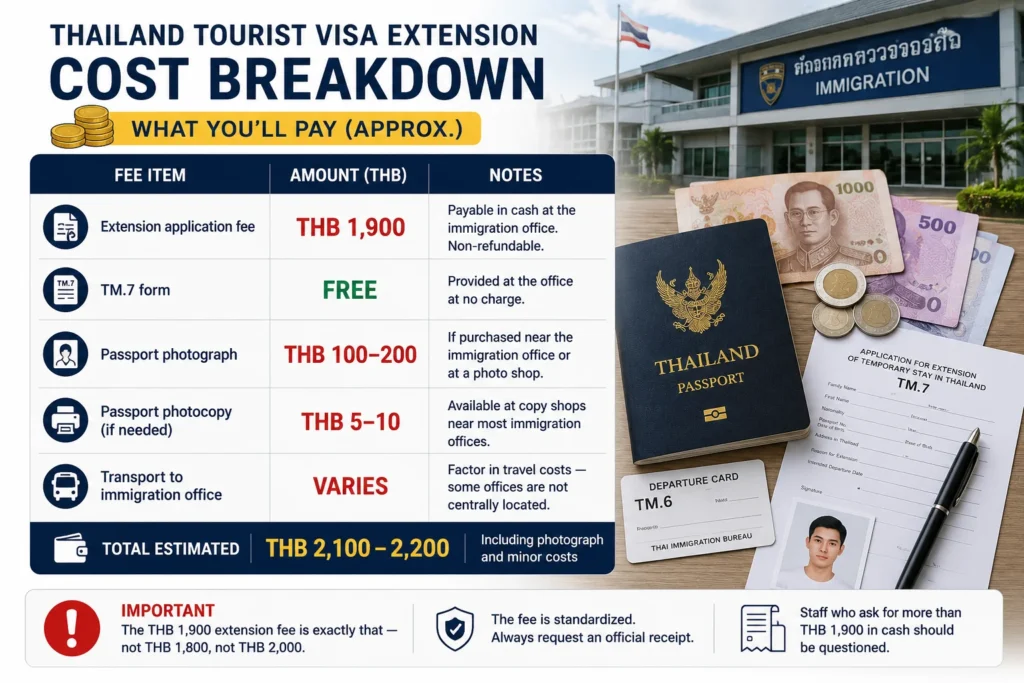
Cost Breakdown: Thailand Tourist Visa Extension Fee
A complete cost breakdown for a Thailand tourist visa 60-day extension, including the official THB 1,900 fee, document costs, and estimated total expenses.
Fee Item
Amount
Notes
Extension application fee
THB 1,900
Payable in cash at the immigration office. Non-refundable.
TM.7 form
Free
Provided at the office at no charge
Passport photograph
THB 100–200
If purchased near the immigration office or at a photo shop
Passport photocopy (if needed)
THB 5–10
Available at copy shops near most immigration offices
Transport to immigration office
Varies
Factor in travel costs — some offices are not centrally located
TOTAL estimated
THB 2,100–2,200
Including photograph and minor costs
Note: The THB 1,900 extension fee is exactly that — not THB 1,800, not THB 2,000. Staff who ask for more than THB 1,900 in cash for the official extension should be questioned. The fee is standardized. Always request an official receipt.
Timing and Queue Strategy: How to Avoid a 4-Hour Wait
Arrival Time
Expected Queue
Experience
7:30–8:00 AM (before opening)
First numbers available
Best. Completed by 10–11 AM in most cases.
8:00–8:30 AM (at opening)
Early queue; first batch
Very good. Expect 1.5–2 hour total time.
9:00–10:00 AM
Moderate queue
Manageable. 2–3 hours total.
10:00 AM – 12:00 PM
Long queue building
3–4 hours. Lunch hour (12–1 PM) pauses service at some offices.
1:00–2:00 PM (post-lunch)
Busy
Similar to morning arrival. 3–4 hours total.
After 3:00 PM
Risky
Some offices stop accepting new applications before 3:30 PM. Do not arrive late.
Dress Code at Thai Immigration Offices
DRESS CODE IS ENFORCED — DO NOT IGNORE THIS Thai government offices, including immigration offices, enforce a dress code. You will be turned away at the door or asked to put on a sarong or cover-up if you are not appropriately dressed. Required: Shoulders covered (no tank tops, sleeveless tops, or spaghetti straps)Knees covered (no shorts above the knee, no miniskirts)Closed-toe shoes are preferred at some offices but not universally enforced Acceptable: T-shirts, collared shirts, blouses with sleevesTrousers, jeans, long skirts, pants Pack a light cardigan or sarong in your bag if you are unsure. Many offices keep cover-ups available but this creates delay and inconvenience.
Nationality-Specific Guidance
Indian Citizens
INDIA-SPECIFIC NOTES Indian passport holders currently receive 30 days on arrival (visa-exempt) when entering Thailand by air at major airports. This can be extended by 30 days at any Thai Immigration office (total 60 days).Indian citizens arriving by land border may receive a different permitted stay duration. Check the stamp in your passport immediately upon entry. If you plan to stay in Thailand beyond 60 days, you must exit and re-enter, apply for a tourist visa in advance (at the Royal Thai Consulate in India), or consider a long-stay visa such as the LTR Visa (if you qualify).OCI card holders have no special immigration status in Thailand — an OCI card does not grant any additional stay permissions. You are treated as an Indian passport holder.
Filipino Citizens
PHILIPPINES-SPECIFIC NOTES Filipino passport holders receive 30 days on arrival (visa-exempt) when entering Thailand by air. This can be extended by 30 days (total 60 days) using this process. Filipino citizens arriving by land border should check the entry stamp carefully — permitted stay at land borders can differ from air entry. For stays beyond 60 days, Filipino citizens must exit Thailand and re-enter, or apply for a tourist visa at the Royal Thai Embassy in Manila before traveling. The Malaysia DE Rantau Digital Nomad Pass (USD 24,000/year income threshold) is an alternative long-stay option for Filipino remote workers who want a proper legal work visa in Southeast Asia.
Extension vs. Border Run: Which Is Better for You?
Factor
In-Country Extension
Border Run
Cost
THB 1,900 + transport to immigration office
Transport to nearest border + re-entry costs
Time
1 to 5 hours at immigration office
Half day to full day depending on border
Days gained
30 additional days from current expiry
Fresh 30-day entry stamp (from date of re-entry)
Stays same entry
Yes — same entry stamp, extended
No — new entry, new 30-day stamp
Risk of complications
Low if documents are ready
Border scrutiny if running multiple tourist entries
Best for
Those who want to complete their stay to the maximum permitted
Those who want a fresh 30-day entry and are concerned about extending
In practice, the in-country extension is simpler and less physically demanding than a border run for most travelers. However, if you have already used your extension and need more time, a border run is the only option for staying in Thailand legally.
Common Mistakes and How to Avoid Them
Mistake
Consequence
Prevention
Going on a Thai public holiday
Office is closed; wasted trip
Check the Thai public holiday calendar before your visit
Forgetting the TM.6 departure card
Cannot complete extension without it
Keep your TM.6 with your passport at all times from day of entry
No passport photograph
Turned away or significant delay
Print before going; 4×6 cm, white background
Wrong clothing (shorts/sleeveless)
Turned away at the door
Dress with shoulders and knees covered
Arriving after 3:00 PM
Application may not be accepted
Arrive by 9:00 AM maximum; 8:00 AM is ideal
Applying after passport expiry
Cannot extend; overstay situation
Check expiry date of PASSPORT (not just visa stamp) before traveling
Misreading extension date
Accidental overstay
Photograph the new stamp and note the exact date in your calendar
Expecting to extend again
Extensions are one-time per entry
Plan your exit date before you use the extension
What Happens If Your Tourist Visa Extension Is Denied?
Extensions are rarely denied for applicants with complete, correct documentation and a current, unextended entry stamp. The most common denial situations are:
Applying with an already-extended entry stamp (you cannot extend twice)
Applying with an expired entry stamp (this is overstay, not an extension)
Immigration officer’s discretion in cases of suspected visa abuse patterns
If your extension is denied:
Ask the officer politely for the reason and whether there is a resolution
If denied for a procedural reason (wrong form, missing document), correct the issue and try again at the same or different office the same day or next day
If denied due to your entry history, you must depart Thailand before your current permitted stay expires
You cannot appeal a Thai Immigration discretionary denial through a formal administrative process — departure is the only option
Overstay Fines: What Happens If You Miss the Extension Deadline
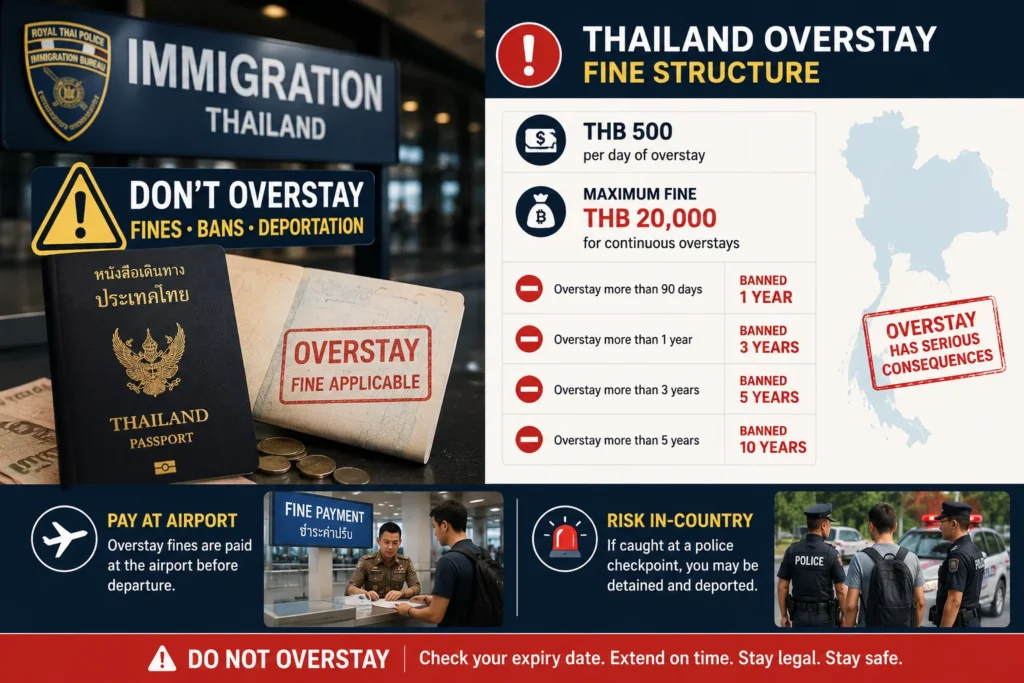
Understand Thailand tourist visa 60-day extension overstay penalties, including daily fines, immigration bans, and deportation risks.
THAILAND OVERSTAY FINE STRUCTURE If you remain in Thailand past your permitted stay (whether a visa-exempt entry or extended tourist visa), you are in overstay. Thai Immigration imposes the following fines: THB 500 per day of overstayMaximum fine: THB 20,000 for continuous overstaysOverstays of more than 90 days: banned from Thailand for 1 yearOverstays of more than 1 year: banned for 3 yearsOverstays of more than 3 years: banned for 5 yearsOverstays of more than 5 years: banned for 10 years Overstay fines are paid at the airport before departure. If caught at a police checkpoint in-country, you may be detained and deported. Do not overstay.
When 60 Days Is Not Enough: Legal Long-Stay Visa Options
If you need more than 60 days in Thailand regularly, the tourist visa extension is not a sustainable strategy. Legal alternatives with proper authorization:
How do you extend a Thailand tourist visa for 60 days?
You extend a Thailand tourist visa by visiting any Thai Immigration office before your current permitted stay expires, submitting a completed TM.7 application form with your original passport, one 4×6 cm passport photograph, and paying the THB 1,900 fee. A 30-day visa-exempt entry extended by 30 days gives you 60 days total. A 60-day tourist visa extended by 30 days gives you 90 days total.
Can I extend my Thailand tourist visa twice?
No. Extensions are granted only once per entry. After you have used your extension, you must exit Thailand and re-enter to start a new permitted stay period. Attempting to extend an already-extended entry will be denied.
How much does it cost to extend a Thailand tourist visa?
The official Thai Immigration extension fee is THB 1,900 per application, paid in cash at the immigration office. This is a fixed government fee. Budget an additional THB 200 to 300 for a passport photo and minor costs. The total is approximately THB 2,100 to 2,200.
How long does a Thailand tourist visa extension take?
Processing is typically completed the same day. If you arrive at 8:00 to 8:30 AM, most extensions are processed and returned within 1 to 2 hours. If you arrive later at a busy office, the same-day wait can be 3 to 5 hours. Extensions are not overnight — you collect your passport the same day.
Can Indian and Filipino citizens extend their Thailand stay?
Yes. Both Indian and Filipino passport holders receive 30 days on arrival (visa-exempt) when entering Thailand by air and can extend by 30 days at any Thai Immigration office (total 60 days). They follow the same process and pay the same THB 1,900 fee as all other nationalities.
Do I need to dress formally for the Thai Immigration office?
You do not need to dress formally, but you must dress appropriately by Thai government office standards: shoulders covered (no tank tops or sleeveless tops) and knees covered (no shorts above the knee or mini-skirts). Bring a light cardigan or scarf if your clothing is uncertain. Being turned away at the door wastes your trip.
Final Verdict
The Thailand tourist visa extension is one of the simpler immigration processes in Southeast Asia — provided you go with the right documents, at the right time, dressed appropriately. The most common problems (wasted trips, long waits, turned away) are all avoidable with proper preparation. For a 30-day visa-exempt entry, the extension gives you 60 days total — a reasonable duration for a visit or a test of life in Thailand before committing to a longer stay strategy. If you find yourself extending repeatedly to stay in Thailand long-term, the extension process is a sign that you need a proper long-stay visa. The Thailand LTR Visa (for those earning USD 40,000+ from overseas) or Malaysia DE Rantau (for those earning USD 24,000+) are the legal pathways that replace tourist visa runs and extensions with stable, authorized residency.