
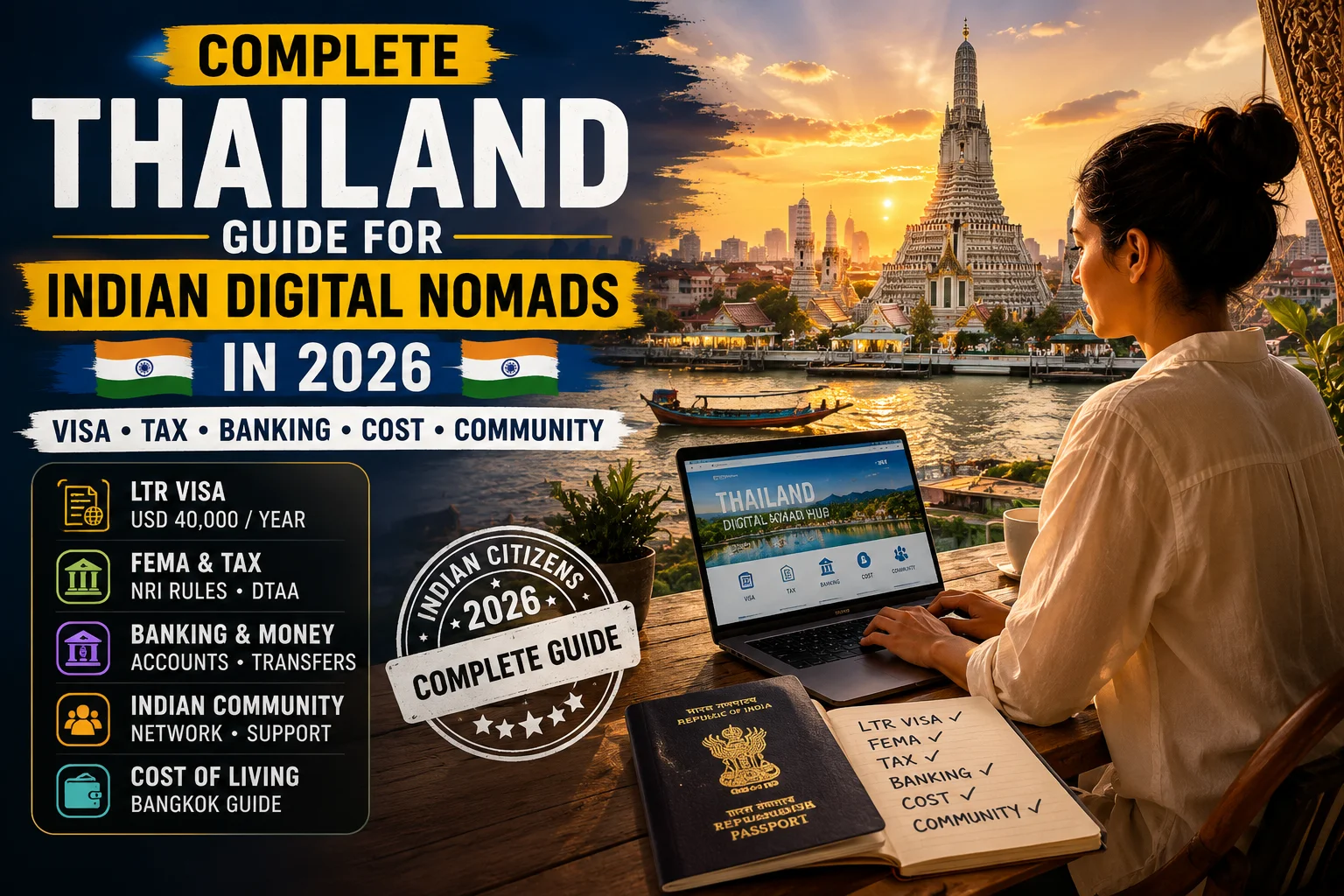
| Thailand is the most popular digital nomad destination in Southeast Asia and, increasingly, the first international base for Indian remote workers and freelancers. For anyone pursuing the India to Thailand digital nomad pathway, the key pathway is the Thailand LTR Visa (Long-Term Resident, Work-From-Thailand category) — requiring USD 40,000/year (approximately ₹34–35 lakh) from overseas sources and 5+ years of professional experience. Indian applicants need a CA certificate from an ICAI-registered Chartered Accountant as a critical income documentation requirement not needed by most other nationalities. Moving to Thailand for 180+ days per year has FEMA implications (potential NRI status), NRE/NRO account implications, and India-Thailand DTAA considerations. Bangkok has a substantial Indian community concentrated in Sukhumvit, Silom, and the Little India area near New Road. Monthly cost of living in Bangkok is approximately ₹70,000–120,000 for a comfortable remote worker lifestyle, making it comparable to or cheaper than Mumbai or Bangalore. |
| QUICK ANSWER: What do Indian digital nomads need to know about Thailand? Key essentials for Indian professionals considering Thailand as a digital nomad base: Visa: Thailand LTR Visa (WFT Professional) requires USD 40,000/year (₹34–35 lakh) from overseas. CA certificate (ICAI) required for income proof.FEMA: Spending 182+ days outside India per financial year may trigger NRI status. NRE/NRO accounts should be restructured accordingly.Tax: India-Thailand DTAA prevents double taxation. Thai 180-day residency rule applies to Thai tax.Banking: Bangkok Bank and KBank accessible with LTR Visa. Wise recommended for India-Thailand transfers.Entry: 30-day visa-exempt for Indians (air entry), extendable to 60 days. LTR Visa eliminates all restrictions. Thailand is the most accessible, affordable, and community-rich international base for Indian remote workers. The LTR Visa makes it legal, stable, and permanent. |
| DISCLAIMER This guide is for informational purposes only. FEMA regulations, RBI guidelines, Thai visa requirements, and tax treaties can change. Always consult a CA (for FEMA/ITR implications) and a licensed Thai immigration consultant (for visa guidance) before making relocation decisions. This is not legal, financial, or tax advice. |
Introduction: Why Thailand Makes Sense for Indian Remote Workers
Thailand and India have an intuitive fit that goes beyond geography. The cultural familiarity — the vegetarian food options, the Hindu temples, the tropical climate, the affordable cost of living — makes Thailand feel immediately accessible to Indian professionals in a way that many Western nomad destinations do not.
But for Indian remote workers specifically, Thailand has taken on a new dimension since 2022. The Thailand Board of Investment launched the LTR Visa — a 10-year, multiple-entry residence visa with an explicit work permit for overseas employment. For an Indian software developer earning ₹36 lakh per year, or an Indian freelance consultant with USD 45,000 in documented overseas income, this visa transforms Thailand from a tourist destination into a legitimate long-term home.
This hub page is the starting point for every Indian professional considering Thailand. It covers the visa pathway in Indian terms, the FEMA and banking implications, the practical daily life considerations, and links to every India-specific article on MeridianNomad that goes deeper on each topic.
Thailand for Indian Digital Nomads: At a Glance
| Factor | Thailand Details | India Equivalent / Context |
| LTR Visa income requirement | USD 40,000/year from overseas | Approx. ₹34–35 lakh/year at current rates |
| Monthly living cost (Bangkok) | THB 30,000–60,000 (₹70,000–140,000) | Similar to mid-range Mumbai / Bangalore |
| Visa-exempt entry for Indians | 30 days (extendable to 60) | No prior visa needed for short visits |
| LTR Visa total cost (first year) | THB 63,800 + health insurance | Approx. ₹1,50,000–2,00,000 total first year |
| Indian community | Large, well-established in Bangkok | Sukhumvit, Silom, New Road (Little India) |
| Flight time from India | 4–6 hours depending on city | Direct flights from Delhi, Mumbai, Bangalore, Chennai |
| Thai tax residency trigger | 180 days in Thailand per calendar year | Same year Indian FEMA NRI threshold: 182 days outside India |
| CA certificate required? | YES — ICAI CA certificate for income proof | Unique India-specific LTR requirement |
The Visa Question: Best Visa for Indian Remote Workers in Thailand
Indian professionals have three realistic visa options for Thailand:
| Visa Option | Income Requirement (INR) | Work Auth? | Stay Duration | Best For |
| LTR Visa (WFT) | ₹34–35 lakh/year from overseas | YES — overseas employers | 10 years | Long-term Thailand residents, senior IT professionals, consultants |
| Tourist Visa (TR) | None | NO (legal gray area) | 60–90 days/entry | Testing Thailand, short visits, pre-LTR exploration |
| Non-Immigrant B + WP | Employer-dependent | YES — specific employer | 1 year (renewable) | Indians employed by a Thai-registered company |
For the vast majority of Indian digital nomads and remote workers, the LTR Visa is the correct long-term answer and the tourist visa is the correct short-term starting point. The decision between them depends on whether you meet the USD 40,000/year income documentation requirement.
The LTR Visa in Indian Terms: What USD 40,000 Actually Means
One of the most significant barriers for Indian professionals considering the LTR Visa is that all published information is in USD. Translating to INR context makes the eligibility picture much clearer.
| LTR VISA INCOME REQUIREMENT IN INR CONTEXT USD 40,000/year at approximately ₹83.5/USD = ₹33.4 lakh/year gross from overseas sources Monthly equivalent: approximately ₹2.78 lakh/month gross from overseas clients or employers Who typically qualifies from India: Senior software engineers / tech leads at US/UK/EU companies earning USD 60,000–100,000+ (remote roles)Freelance developers on Upwork or direct contracts earning USD 40,000–80,000+ annuallyDigital marketing consultants, SEO specialists, content leads with overseas client incomeSaaS founders or product owners with overseas revenueManagement consultants, finance professionals, or legal professionals with international clients Who typically does NOT qualify yet: Junior developers or content writers earning ₹15–25 lakh domestically (India-sourced income does NOT count)Professionals with mixed Indian + overseas income where overseas portion is below thresholdThose who earn above the threshold but cannot document it (see income documentation guides) The income must be from NON-THAI, OVERSEAS sources. Indian client income does not qualify. Only foreign client income counts. |
LTR Visa Application for Indians: What’s Different
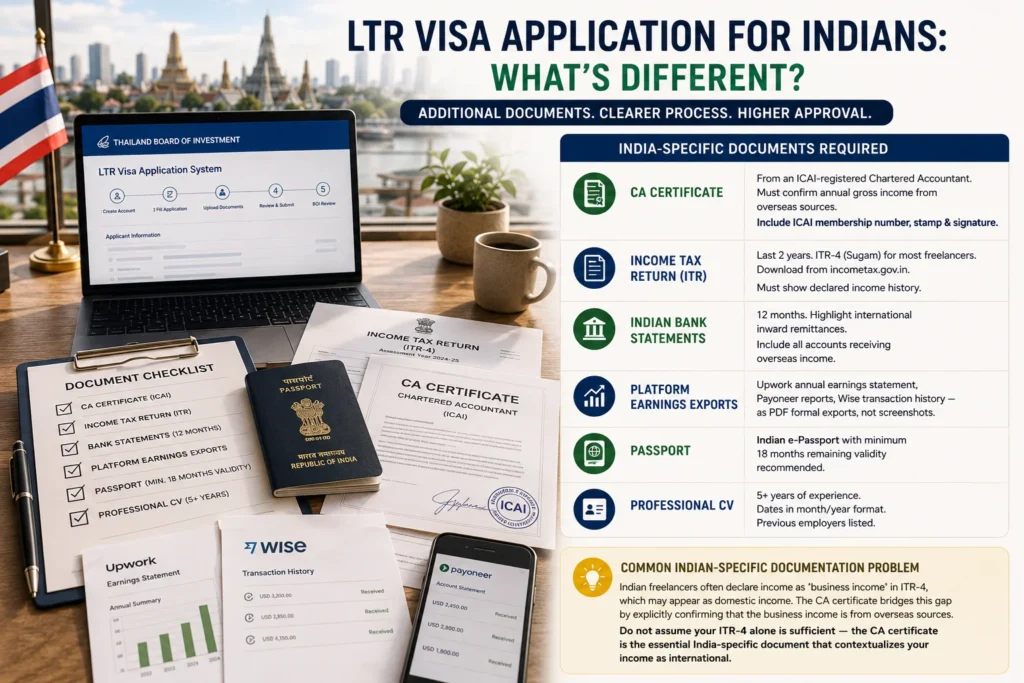
Indian applicants follow the same BOI online application process as all other nationalities, but have additional documentation requirements that most other nationalities do not face:
India-specific documents required
| Document | India-Specific Details |
| CA certificate | From an ICAI-registered Chartered Accountant. Must confirm annual gross income from overseas sources. Include ICAI membership number, stamp, and signature. This is the most critical India-specific document. |
| Income Tax Return (ITR) | Last 2 years. ITR-4 (Sugam) for most freelancers. Download from incometax.gov.in Must show declared income history. |
| Indian bank statements | 12 months. Highlight international inward remittances. Include all accounts receiving overseas income (HDFC, ICICI, SBI, Axis, Kotak). |
| Platform earnings exports | Upwork annual earnings statement, Payoneer reports, Wise transaction history — as PDF formal exports, not screenshots. |
| Passport | Indian e-Passport with minimum 18 months remaining validity recommended. |
| Professional CV | 5+ years of experience. Dates in month/year format. Previous employers listed. |
Common Indian-specific documentation problem
Indian freelancers often declare income as ‘business income’ in ITR-4, which may appear as domestic income. The CA certificate bridges this gap by explicitly confirming that the business income is from overseas sources. Do not assume your ITR-4 alone is sufficient — the CA certificate is the essential India-specific document that contextualizes your income as international.
FEMA and RBI Guidelines: What Indian Nationals Must Understand Before Moving to Thailand
This is the section that most guides for Indian nomads completely ignore — and it is one of the most practically important.
FEMA residency status
Under India’s Foreign Exchange Management Act (FEMA), an Indian citizen who spends fewer than 182 days in India in a financial year (April to March) may qualify as a Non-Resident Indian (NRI). Once NRI status is established, certain rules change:
- Existing Indian savings accounts must be converted to NRO (Non-Resident Ordinary) accounts for domestic Indian income
- New foreign income can be received in NRE (Non-Resident External) accounts, which are tax-free in India on principal and interest
- You are permitted to hold foreign bank accounts (including a Thai bank account) as an NRI — no RBI prior permission needed
- Certain investments and remittances that were restricted as a resident become more flexible as an NRI
- Your ITR filing status changes from Resident to Non-Resident, with different tax schedules
FEMA implications for India-Thailand digital nomads
If you plan to spend more than 182 days outside India in a financial year (which is likely if you are living in Thailand), you need to:
- Inform your Indian bank(s) of your change in residency status
- Convert your resident savings account to NRO account for India-sourced income
- Open or designate an NRE account for repatriating foreign earnings to India
- Update your ITR filing from resident to non-resident status
- Maintain documentation of days spent in India vs. outside India for the financial year
| FEMA COMPLIANCE IS NOT OPTIONAL Failure to update your FEMA residency status and bank accounts when you qualify as NRI is a legal non-compliance under FEMA, not merely an administrative oversight. The penalties can include fines of up to three times the amount involved in violations. Consult a CA or FEMA-qualified attorney before your Thailand stay crosses the 182-day threshold in any financial year. This is not tax advice. This information is provided for awareness only. |
India-Thailand DTAA: Tax Treaty Overview for Indian Remote Workers
India and Thailand have a Double Taxation Avoidance Agreement (DTAA) in force. For Indian remote workers in Thailand, the key provisions:
- The DTAA determines which country has the primary right to tax specific types of income
- Business profits: Generally taxed in the country where business activities occur. For remote workers performing services from Thailand for overseas clients, this becomes a nuanced determination
- Employment income: Typically taxed in the country where employment is exercised. If you work from Thailand for an Indian employer, Thailand may have tax rights under the DTAA
- The DTAA provides mechanisms to avoid paying tax on the same income in both countries through credits or exemptions
- Thailand’s 180-day tax residency rule and India’s own residency rules can result in a period where both countries claim tax rights — the DTAA provides the resolution framework
| INDIA-THAILAND DTAA DISCLAIMER The India-Thailand DTAA is complex. The tax implications of spending 180+ days in Thailand depend on your specific income type, sources, and declared residency status in both countries. This overview is for informational awareness only and is not a substitute for professional tax advice from a CA experienced in India-Thailand tax matters and international income. |
NRE and NRO Accounts: Managing Your Indian Banking from Thailand
For Indian digital nomads in Thailand, maintaining the right Indian bank accounts is as important as setting up Thai banking.
| Account Type | What It Is | Best For Indian Nomads in Thailand |
| NRE Account (Non-Resident External) | Rupee account for foreign earnings repatriated to India. Principal and interest tax-free in India. | Receiving foreign currency earnings (converted to INR). Full repatriation allowed. Best for overseas client payments repatriated. |
| NRO Account (Non-Resident Ordinary) | Rupee account for India-sourced income (rental income, dividends, etc.). Interest taxable. | Receiving India-sourced income (rent from Indian property, Indian stock dividends). Cannot be freely repatriated. |
| FCNR Account (Foreign Currency NR) | Fixed deposit in foreign currency (USD, GBP, EUR). Tax-free in India. | Parking foreign currency savings without converting to INR. Good for those keeping USD earnings. |
| Resident Savings Account (old) | Must be converted to NRO once you become NRI. Cannot be maintained as resident once FEMA NRI status applies. | Close or convert before your NRI status is established. |
Practical setup for Indian remote workers in Thailand: Maintain an NRE account at HDFC, ICICI, or SBI for repatriating overseas income. Keep an NRO account for India-sourced income. Send earnings from Thai clients (if any) or overseas clients via Wise to your NRE account for the best rates.
Sending Money Between India and Thailand
The India-Thailand financial corridor is well-served by multiple options. Here is the practical comparison:
| Method | Best For | Fees / Rate | Speed |
| Wise (recommended) | Regular transfers both directions | Near mid-market rate, flat 0.4–1.5% | 1–2 business days |
| SWIFT from Indian bank to Bangkok Bank | Large one-off transfers | INR 500–1,500 + exchange spread | 2–3 business days |
| Western Union / Remitly | Urgent smaller transfers | Fixed fee + margin; faster | Hours to 1 day |
| NEFT/RTGS to NRE account (from Thailand) | Repatriating overseas earnings to India | Conversion fee at NRE account level | 1–3 business days |
Most Indian digital nomads in Thailand use Wise as their primary transfer tool in both directions: receiving overseas client payments in USD/EUR via Wise, converting to THB for Thai living expenses, and converting to INR for India-side obligations. This eliminates the double-conversion cost of routing everything through Indian banks.
Opening a Thai Bank Account as an Indian National
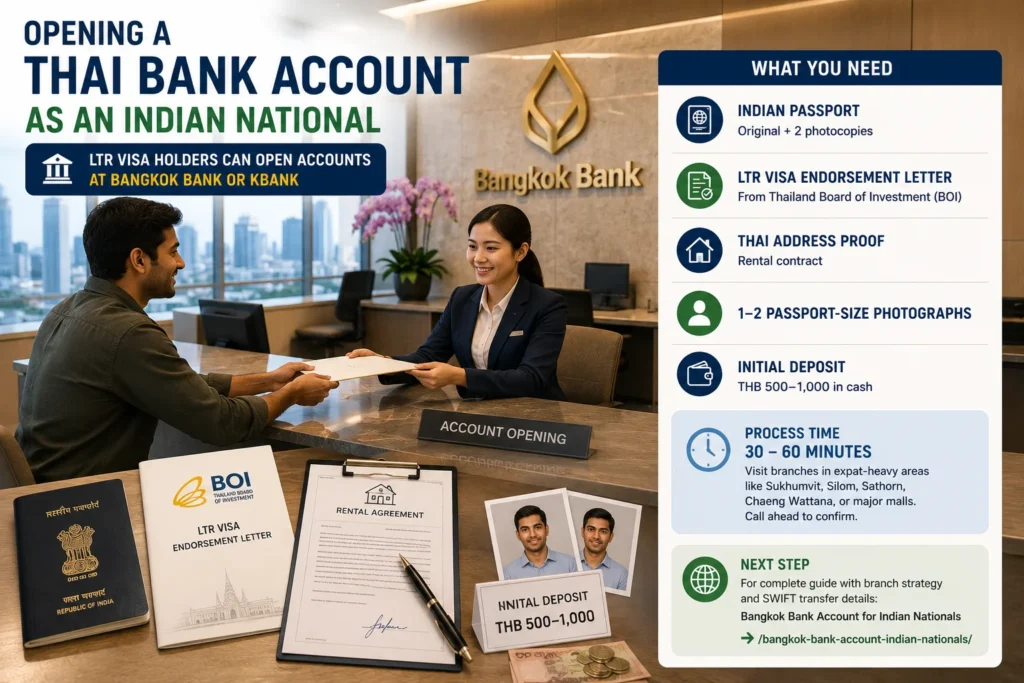
LTR Visa holders have the clearest pathway to Thai banking. With your BOI endorsement letter, you can open a savings account at Bangkok Bank or Kasikorn Bank (KBank). Here is what you need:
- Indian passport (original + 2 photocopies)
- LTR Visa endorsement letter from BOI
- Thai address proof (rental contract)
- 1–2 passport-size photographs
- Initial deposit: THB 500–1,000 in cash
Visit a branch in an expat-heavy area (Sukhumvit, Silom, Sathorn, Chaeng Wattana, or major shopping malls). Call ahead to confirm the branch accepts Indian passport holders with LTR Visa. The process takes 30 to 60 minutes.
For the complete step-by-step guide with branch selection strategy and SWIFT transfer details: Bangkok Bank Account for Indian Nationals → /bangkok-bank-account-indian-nationals/
Cost of Living: Thailand vs Indian Metro Cities (in ₹)
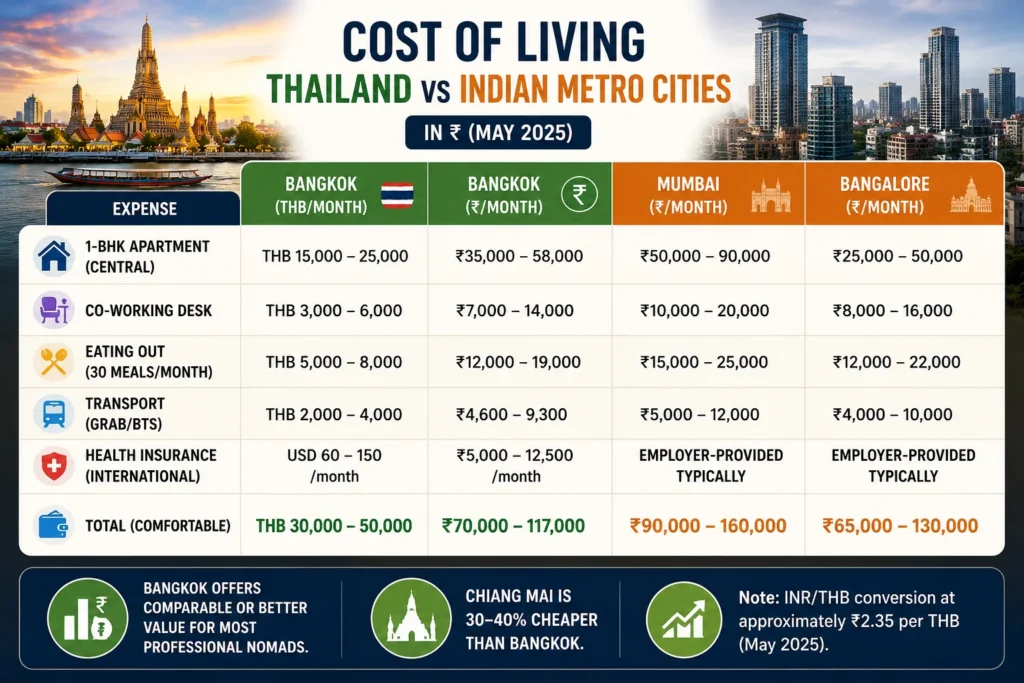
One of the most common questions from Indian professionals: is Thailand actually cheaper than living in Mumbai or Bangalore? The answer depends on lifestyle, but for most professional nomads, Bangkok offers comparable or better value.
| Expense | Bangkok (THB/month) | Bangkok (₹/month) | Mumbai (₹/month) | Bangalore (₹/month) |
| 1-BHK apartment (central) | THB 15,000–25,000 | ₹35,000–58,000 | ₹50,000–90,000 | ₹25,000–50,000 |
| Co-working desk | THB 3,000–6,000 | ₹7,000–14,000 | ₹10,000–20,000 | ₹8,000–16,000 |
| Eating out (30 meals/month) | THB 5,000–8,000 | ₹12,000–19,000 | ₹15,000–25,000 | ₹12,000–22,000 |
| Transport (Grab/BTS) | THB 2,000–4,000 | ₹4,600–9,300 | ₹5,000–12,000 | ₹4,000–10,000 |
| Health insurance (international) | USD 60–150/month | ₹5,000–12,500/month | Employer-provided typically | Employer-provided typically |
| TOTAL (comfortable) | THB 30,000–50,000 | ₹70,000–117,000 | ₹90,000–160,000 | ₹65,000–130,000 |
Note: INR/THB conversion at approximately ₹2.35 per THB (May 2026). Bangkok central areas are comparable to Bangalore mid-range and significantly more affordable than comparable Mumbai neighborhoods for the same quality of life. Chiang Mai is 30 to 40% cheaper than Bangkok.
Getting to Thailand from India: Flight Routes
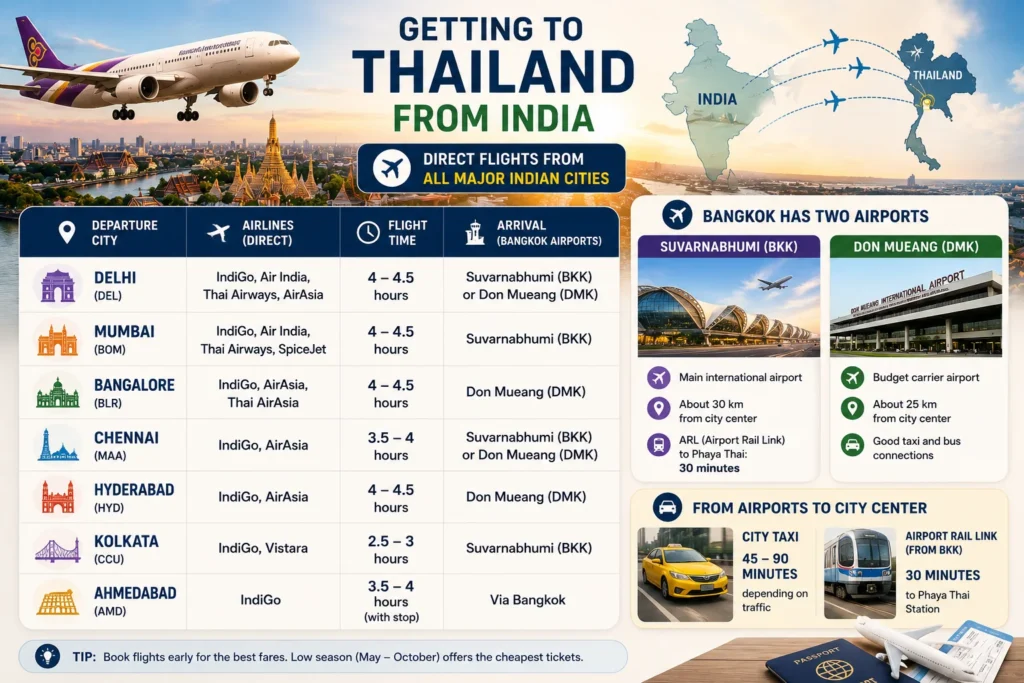
Thailand is one of India’s most well-connected international destinations with direct flights from all major Indian cities:
| Departure City | Airlines (Direct) | Flight Time | Arrival (Bangkok Airports) |
| Delhi (DEL) | IndiGo, Air India, Thai Airways, AirAsia | 4 to 4.5 hours | Suvarnabhumi (BKK) or Don Mueang (DMK) |
| Mumbai (BOM) | IndiGo, Air India, Thai Airways, SpiceJet | 4 to 4.5 hours | Suvarnabhumi (BKK) |
| Bangalore (BLR) | IndiGo, AirAsia, Thai AirAsia | 4 to 4.5 hours | Don Mueang (DMK) |
| Chennai (MAA) | IndiGo, AirAsia | 3.5 to 4 hours | Suvarnabhumi (BKK) or Don Mueang (DMK) |
| Hyderabad (HYD) | IndiGo, AirAsia | 4 to 4.5 hours | Don Mueang (DMK) |
| Kolkata (CCU) | IndiGo, Vistara | 2.5 to 3 hours | Suvarnabhumi (BKK) |
| Ahmedabad (AMD) | IndiGo | 3.5 to 4 hours (with stop) | Via Bangkok |
Bangkok has two airports: Suvarnabhumi (BKK) — the main international airport, about 30 km from the city center — and Don Mueang (DMK), a budget carrier airport about 25 km from the city. From both airports, city taxi takes 45 to 90 minutes depending on traffic. ARL (Airport Rail Link) from Suvarnabhumi takes 30 minutes to Phaya Thai.
Indian Community in Thailand: What to Expect
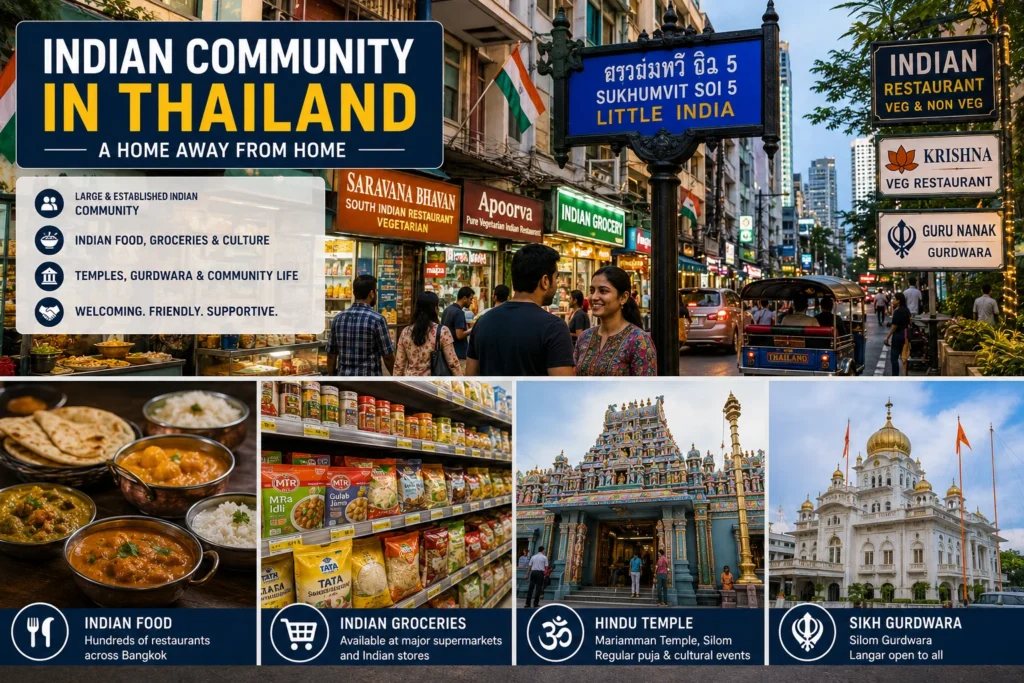
Thailand has one of Southeast Asia’s most established Indian communities, with a presence that goes back decades. For Indian digital nomads, this creates a surprisingly familiar social environment.
Bangkok’s Indian enclaves
- Sukhumvit Soi 3‑8 area: Significant concentration of Indian businesses, restaurants, and residents. Known informally as ‘Little India’ in Bangkok.
- Silom Road area: Mixed expat community with Indian professionals, particularly in finance and tech sectors
- New Road (Charoen Krung): Older Indian community; home to several Indian temples and textile businesses
- Sathorn: Professional Indian expat community; many IT professionals and consultants
Indian food
- Bangkok has hundreds of Indian restaurants serving North and South Indian cuisine, vegetarian options, and regional specialties
- Major supermarkets (Tops, Villa Market, Foodland) carry Indian grocery staples (dal, rice, spices, MTR products)
- Indian grocery stores on Sukhumvit Soi 11 and New Road stock most regional Indian ingredients
Religious and cultural infrastructure
- Mariamman Temple (Silom): Active Hindu temple; regular puja timings
- Sikh Gurdwara (Silom): Operates langar; open to all
- Indian cultural events organized by the Indian Embassy and Indian community associations
Practical Setup for Indian Digital Nomads in Thailand
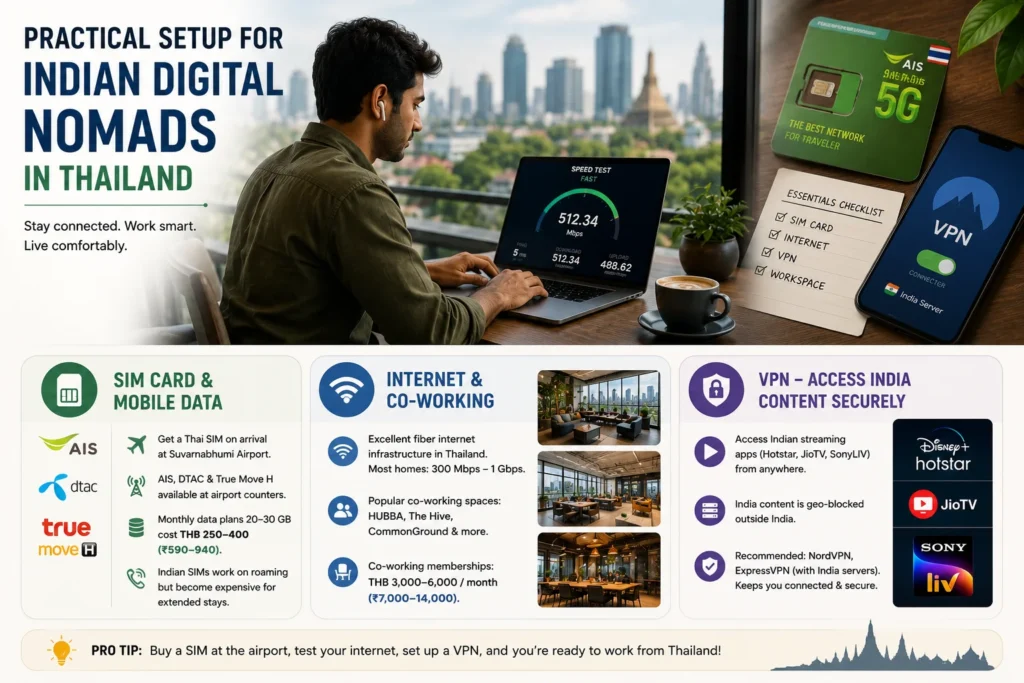
SIM card and mobile data
Get a Thai SIM on arrival at Suvarnabhumi Airport. AIS, DTAC, and True Move H all have airport counters. AIS is generally recommended for best coverage. Monthly data plans of 20–30 GB cost THB 250–400 (₹590–940). Indian SIMs work on roaming but become expensive for extended stays.
Internet and co-working
Thailand has excellent fiber internet infrastructure. Most serviced apartments and condos in Bangkok have 300 Mbps to 1 Gbps fiber. Co-working spaces are abundant: HUBBA, The Hive, and CommonGround are popular in Bangkok. Co-working memberships: THB 3,000–6,000/month (₹7,000–14,000).
VPN
A VPN is recommended for Thailand — not for work reasons but for accessing Indian streaming content (Hotstar, JioTV, SonyLIV are geo-blocked outside India). NordVPN and ExpressVPN both maintain India servers that unblock domestic content.
Common Mistakes Indian Professionals Make When Moving to Thailand
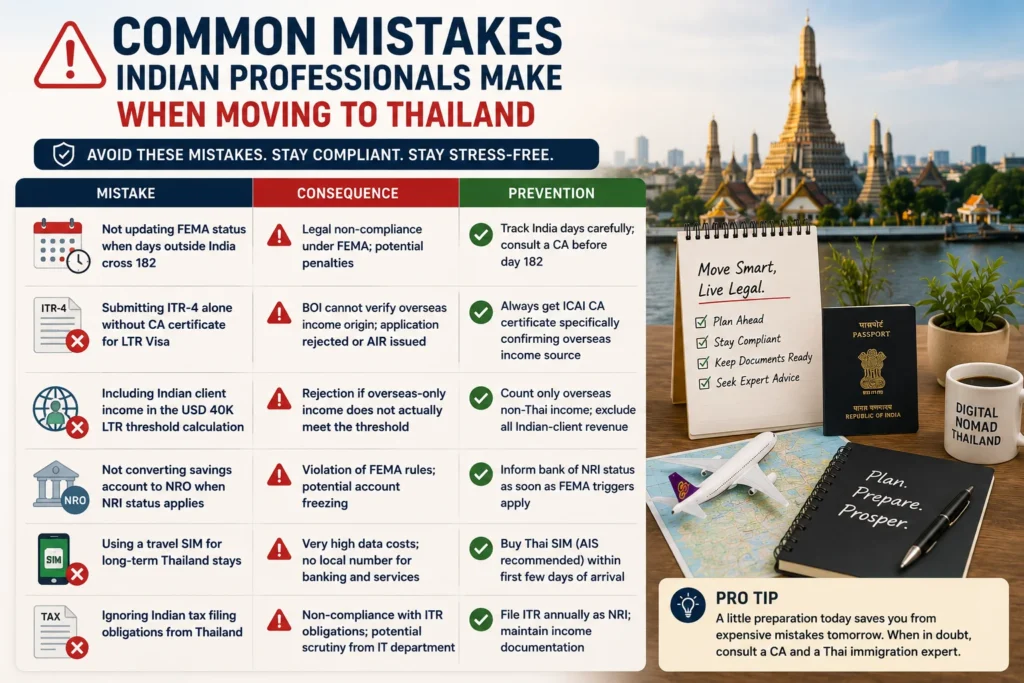
| Mistake | Consequence | Prevention |
| Not updating FEMA status when days outside India cross 182 | Legal non-compliance under FEMA; potential penalties | Track India days carefully; consult a CA before day 182 |
| Submitting ITR-4 alone without CA certificate for LTR Visa | BOI cannot verify overseas income origin; application rejected or AIR issued | Always get ICAI CA certificate specifically confirming overseas income source |
| Including Indian client income in the USD 40K LTR threshold calculation | Rejection if overseas-only income does not actually meet the threshold | Count only overseas non-Thai income; exclude all Indian-client revenue |
| Not converting savings account to NRO when NRI status applies | Violation of FEMA rules; potential account freezing | Inform bank of NRI status as soon as FEMA triggers apply |
| Using a travel SIM for long-term Thailand stays | Very high data costs; no local number for banking and services | Buy Thai SIM (AIS recommended) within first few days of arrival |
| Ignoring Indian tax filing obligations from Thailand | Non-compliance with ITR obligations; potential scrutiny from IT department | File ITR annually as NRI; maintain income documentation |
Your Complete India-Thailand Navigation Hub
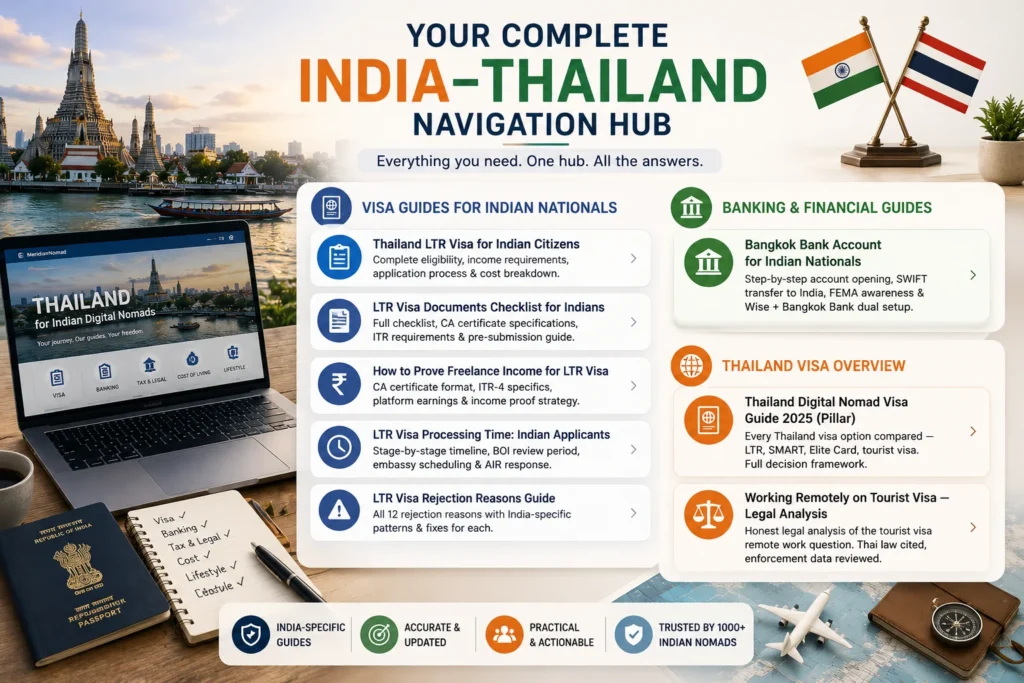
This hub page covers the overview. For complete, in-depth guidance on each topic, use the links below:
Visa guides for Indian nationals
| 📋 | Thailand LTR Visa for Indian Citizens Complete eligibility guide, income requirements, application process, and cost breakdown specifically for Indian passport holders. /thailand-ltr-visa-indian-citizens/ |
| 📝 | LTR Visa Documents Checklist for Indians Full checklist of required documents, CA certificate specifications, ITR requirements, and pre-submission verification guide. /ltr-visa-documents-checklist-indians/ |
| 💰 | How to Prove Freelance Income for LTR Visa Detailed guide on CA certificate format, ITR-4 specifics, platform earnings documentation, and income proof strategy for Indian freelancers. /prove-freelance-income-ltr-visa/ |
| ⏱ | LTR Visa Processing Time: Indian Applicants Stage-by-stage timeline, BOI review period, embassy scheduling, and AIR response strategy for Indian applicants. /ltr-visa-processing-time-indian-applicants/ |
| ⚠️ | LTR Visa Rejection Reasons Guide All 12 documented rejection reasons with India-specific risk patterns highlighted and fixes for each. /ltr-visa-rejection-reasons/ |
Banking and financial guides
| 🏦 | Bangkok Bank Account for Indian Nationals Step-by-step account opening guide, SWIFT transfer to India, FEMA awareness, and the Wise + Bangkok Bank dual setup. /bangkok-bank-account-indian-nationals/ |
Thailand visa overview
| 🌏 | Thailand Digital Nomad Visa Guide 2026 (Pillar) Every Thailand visa option compared — LTR, SMART, Elite Card, tourist visa. Full decision framework. /thailand-digital-nomad-visa-guide/ |
| ⚖️ | Working Remotely on Tourist Visa — Legal Analysis Honest legal analysis of the tourist visa remote work question. Thai law cited, enforcement data reviewed. /working-remotely-thailand-tourist-visa-legal/ |
Realistic Risks and Limitations for Indian Nomads in Thailand
- FEMA complexity: Moving between resident and NRI status is administratively demanding. Incorrect management creates genuine legal exposure. Many Indian nomads in Thailand underestimate this and face issues later.
- Health insurance ongoing cost: International health plans (₹50,000–1,00,000+/year) are required for the LTR Visa. If you previously had employer-provided health insurance in India, this is a new expense category.
- Indian tax obligations do not disappear: Filing ITR, reporting foreign assets (Schedule FA), and complying with Indian reporting requirements continues regardless of Thailand residence. Non-resident ITR filing is still required for Indian-sourced income.
- Thai tax residency after 180 days: Spending 180+ days in Thailand creates Thai tax residency. The 2024 Revenue Department ruling on foreign income brought into Thailand in the same year creates obligations that need active management.
- Currency risk: Your INR-denominated savings lose purchasing power when converted to THB if the INR weakens. Long-term Thailand residents should consider maintaining THB-denominated savings for Thailand expenses.
- Family visa for dependents: If you plan to bring family members to Thailand, they need separate visa applications. Dependents of LTR Visa holders can apply for a dependent LTR Visa.
Frequently Asked Questions from Indian Digital Nomads
What do Indian digital nomads need to know about Thailand?
Indian digital nomads in Thailand need to understand: the LTR Visa (Work-From-Thailand category) as the primary legal pathway (₹34–35 lakh/year from overseas required), FEMA implications of spending 182+ days outside India, the need for an ICAI CA certificate for income documentation, NRE/NRO account management, the India-Thailand DTAA for tax treaty benefits, and practical matters like flight connectivity, Indian community presence, and Bangkok banking.
Do I qualify for the Thailand LTR Visa as an Indian professional?
You qualify if you earn at least USD 40,000/year (approx. ₹34–35 lakh) gross from non-Indian, non-Thai overseas sources, have 5+ years of professional experience, and can obtain valid international health insurance. Indian IT professionals, freelancers, consultants, and online business owners regularly qualify. Income from Indian clients does not count toward the threshold.
Does moving to Thailand affect my Indian taxes?
Yes, potentially significantly. Spending fewer than 182 days in India in a financial year may trigger NRI status under FEMA and change your Indian tax residency. As an NRI, your Indian-sourced income remains taxable in India, but foreign-sourced income is generally not taxed in India. The India-Thailand DTAA prevents double taxation. Consult a CA before your Thailand stays cross the FEMA threshold.
Should I convert my Indian savings account to NRO/NRE when living in Thailand?
Yes, once your FEMA status qualifies as NRI (fewer than 182 days in India in a financial year), you are legally required to convert your resident savings account to NRO. You can open or designate an NRE account for repatriating foreign earnings. Maintaining a resident savings account after qualifying as NRI is a FEMA violation.
How do I send money from Thailand to India?
The most cost-effective method for regular India-Thailand transfers is Wise, which offers near mid-market rates and transfers to Indian NRE/NRO accounts (HDFC, ICICI, SBI, Axis). Traditional SWIFT transfers from Bangkok Bank to Indian banks are possible but carry higher fees (INR 500 to 1,500 per transfer plus exchange spread). Wise is recommended for amounts below USD 10,000; SWIFT may be competitive for very large transfers.
Is there an Indian community in Bangkok?
Yes. Bangkok has one of Southeast Asia’s most established Indian communities, concentrated in the Sukhumvit Soi 3-8 area, Silom, and along New Road (Charoen Krung). Indian restaurants, grocery stores, Hindu temples, and Sikh Gurdwara are all accessible. The Indian Embassy in Bangkok also hosts cultural events. Indian digital nomads in Thailand are far from isolated culturally.
Final Verdict: Is Thailand Right for Indian Digital Nomads?
| Thailand offers Indian remote workers something rare in international nomad destinations: cultural familiarity, affordable cost of living, an established Indian community, and — since 2022 — a formal legal pathway (the LTR Visa) that makes long-term residence legitimate and stable. The FEMA and tax dimensions add administrative complexity that many other nationalities do not face. But they are manageable with proper CA guidance and proactive account management. They are not a reason to avoid Thailand — they are a reason to plan properly. For Indian IT professionals, consultants, and freelancers earning above the LTR Visa threshold: Thailand in 2026 offers a legal, stable, culturally accessible home that was not available five years ago. Read each linked guide to understand your specific situation. Start with the LTR Visa for Indian Citizens guide if you are ready to explore the visa pathway. |