
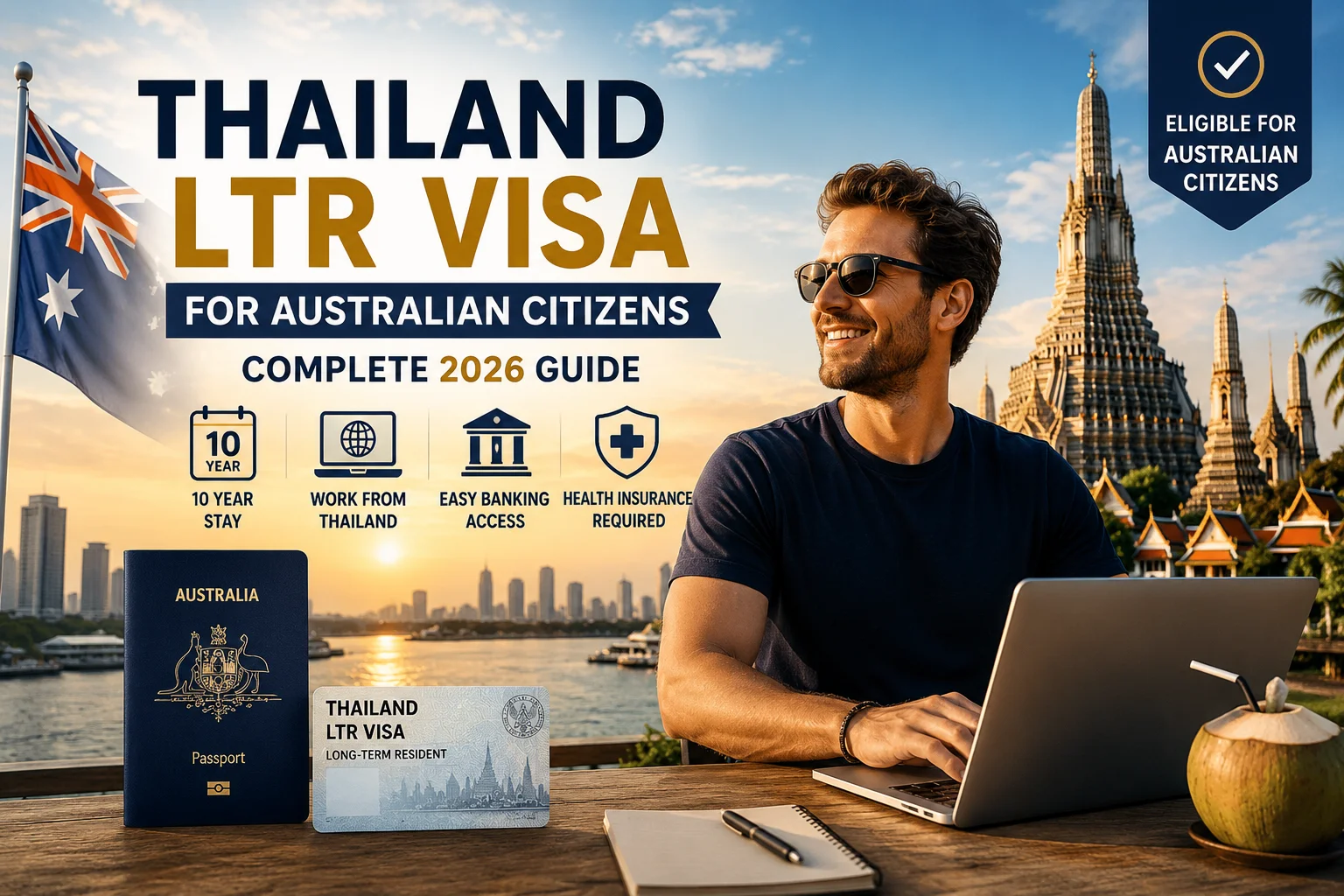
| Australian citizens are fully eligible for the Thailand LTR Visa (Long-Term Resident, Work-From-Thailand Professional category) with no nationality restrictions. The Thailand LTR Visa Australian Citizens pathway requires an income of USD 40,000/year (approximately AUD 61,000–63,000 at current exchange rates) from non-Thai overseas sources. ATO income documentation — Notice of Assessment (NOA), my Tax-filed Tax Return, Income Statement, and Australian bank statements — is accepted by BOI in place of a CA certificate. Australia uses a residence-based (not citizenship-based) tax system: Australian nationals who meet the ATO’s non-resident tests may not be liable for Australian income tax on overseas earnings, though the Australian residency test is stricter than the UK’s. Superannuation contributions typically continue only if working for an Australian employer; self-employed Australians in Thailand generally pause super contributions. Medicare ceases to cover Australians once they are non-residents, making the LTR Visa’s international health insurance requirement a natural replacement. Australia has a DTA with Thailand to prevent double taxation. |
| QUICK ANSWER: Can Australians apply for Thailand LTR Visa? Yes. Australian citizens are fully eligible for the Thailand LTR Visa. Key facts: Income: USD 40,000/year (approx. AUD 62,000) gross from non-Thai overseas sources Experience: 5+ years in your professional field Health insurance: International plan with USD 50,000+ coverage valid in Thailand Documentation: ATO Tax Return (2 years), Notice of Assessment (NOA), Australian bank statements. No CA certificate required. Medicare does NOT cover Thailand — the LTR Visa’s health insurance requirement effectively replaces it Thailand is already the most popular long-stay destination for Australian digital nomads in Southeast Asia. The LTR Visa makes it legally permanent, stable, and properly authorized. |
| DISCLAIMER This guide is for informational purposes only. ATO tax residency rules, Australian superannuation regulations, BOI requirements, and Thai immigration policies can change. Always consult a registered Australian tax agent or CPA for tax matters and a licensed Thai immigration consultant for visa guidance. This is not legal, financial, or tax advice. |
Introduction: Australians and the Thailand LTR Visa
Thailand has always been the natural long-stay destination for Australians in Southeast Asia — close enough by direct flight, affordable enough to live well on a professional income, warm enough year-round, and familiar enough culturally from years of holiday travel. For Australian remote workers and digital nomads, Thailand has been the default base for a generation.
What changed in 2022 was the legal framework. The Thailand LTR Visa gives Australian remote workers the formal structure that tourist visa runs never provided: 10 years of multiple-entry stay, explicit work authorization for overseas employers, and straightforward access to Thai banking. For an Australian software developer, consultant, or online business owner earning AUD 62,000+ in overseas income, the LTR Visa is the correct legal answer for long-term Thailand residence.
This guide covers what no other Thailand visa article for Australians addresses: ATO income documentation accepted by BOI, the Australian tax residency picture for expats, superannuation when you leave, Medicare cessation, and the AUD cost framing that makes the LTR Visa decision concrete.
LTR Visa in AUD Terms: What USD 40,000 Means for Australians
| INCOME THRESHOLD IN AUD CONTEXT USD 40,000/year at approximately AUD 1.54/USD = approximately AUD 61,600–63,000/year gross from overseas sources (rate as of May 2026). Monthly equivalent: approximately AUD 5,100–5,250/month gross from overseas clients or employers. Australian professionals who typically qualify: Senior software engineers and tech leads at US/UK/EU companies on remote contracts (AUD 120,000–250,000+)Australian freelance developers and designers with overseas client portfolios (AUD 80,000–150,000+)Digital marketing consultants, SEO specialists with international clientsRemote-first Australian business owners with overseas revenueProfessionals from Sydney or Melbourne firms with remote contracts paying overseas rates Note: Income must be NON-THAI, overseas sources. Australian client income qualifies. Thai client income does not. |
Eligibility Requirements for Australian Citizens
| Requirement | Standard | Australia-Specific Notes |
| Annual income | USD 40,000 (approx. AUD 62,000) from overseas non-Thai sources | Includes income from Australian employer (remote), Australian clients, and other overseas clients. Not Thai-client income. |
| Professional experience | 5 years in relevant professional field | Australian work history fully accepted. LinkedIn, CV, and Australian employer references standard. |
| Health insurance | USD 50,000+ international coverage valid in Thailand | Australian Medicare and Australian private health funds (Medibank, Bupa AU, HCF) do NOT cover Thailand. Need Cigna Global, AXA International, or Allianz Care. |
| Income documentation | Varies by nationality | ATO Tax Return (2 years), Notice of Assessment (NOA), Income Statement, Australian bank statements. No CA certificate required. |
| Passport validity | Valid national passport | Australian passport. Minimum 18 months remaining validity recommended. |
ATO Income Documentation: What BOI Accepts from Australian Applicants
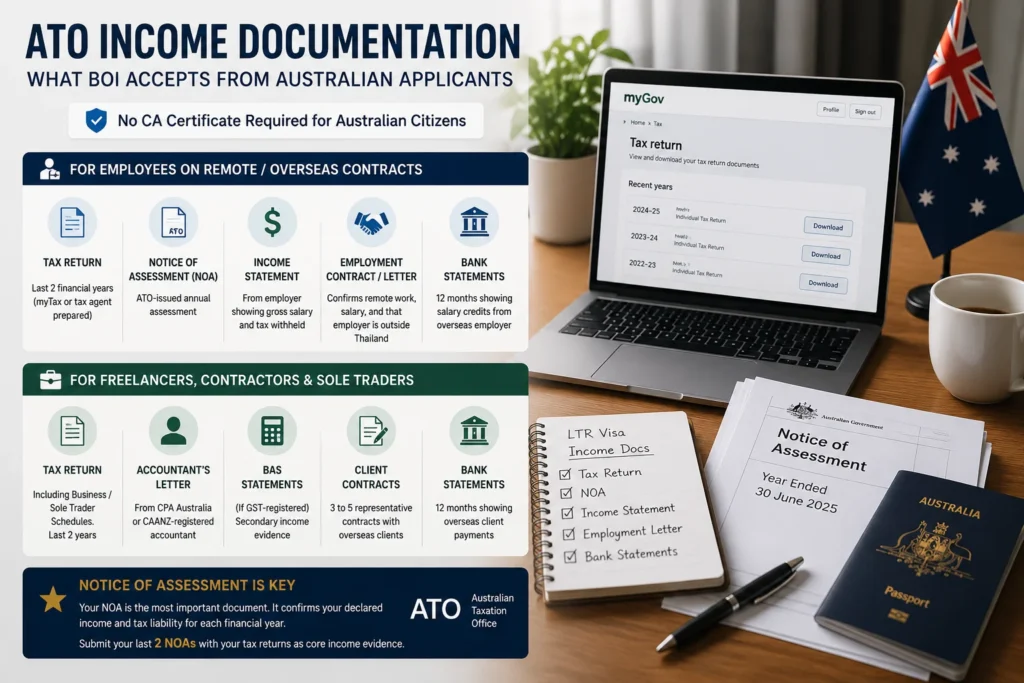
BOI requires evidence that your income reaches USD 40,000/year from overseas sources. For Australian nationals, ATO-issued documents serve this purpose. No CA certificate is required.
For Australian employees on remote or overseas contracts
| Document | ATO/Australian Name | Specification |
| Tax return | Individual Tax Return (myTax or tax agent prepared) | Last 2 financial years (July to June). Download from myGov or ask your tax agent. |
| Tax assessment | Notice of Assessment (NOA) | ATO-issued annual tax assessment. Confirms your taxable income and tax paid. Available via myGov. |
| Income summary | Income Statement (formerly PAYG Payment Summary / Group Certificate) | From employer showing gross salary, tax withheld. Available via myGov from July each year. |
| Employment contract | Letter from employer or employment contract | Confirming remote work arrangement, salary, and that the employer is based outside Thailand. |
| Bank statements | Australian bank statements (ANZ, CBA, Westpac, NAB, Macquarie) | 12 months showing salary credits from overseas employer. Highlight international credits. |
For Australian freelancers, contractors, and sole traders
| Document | ATO Equivalent | Specification |
| Tax return | Individual Tax Return including Business/Sole Trader schedules | Last 2 financial years. Shows gross business income. |
| Accountant’s letter | Letter from CPA Australia or CAANZ-registered accountant | Confirming annual gross income from overseas sources. Accountant’s registration details, stamp, and signature. Australian equivalent of the CA certificate. |
| BAS statements | Business Activity Statement (if GST-registered) | Shows GST turnover, useful as secondary income evidence. Not a primary document. |
| Client contracts | Service agreements with overseas clients | 3 to 5 representative contracts. Client country, scope, and fee. |
| Bank statements | Australian business or personal bank statements | 12 months. Highlight overseas client payments (typically SWIFT or Wise credits). |
| NOTICE OF ASSESSMENT: YOUR MOST IMPORTANT ATO DOCUMENT The ATO Notice of Assessment (NOA) is the single most useful document for LTR Visa applications. It is an ATO-issued official document confirming your declared income and tax liability for each financial year. Most Australian applicants submit their last 2 NOAs alongside their tax returns as the core income evidence. If your income is self-employment income: Your NOA will show your sole trader or partnership income. Supplement with an accountant’s letter from a CPA Australia or CAANZ member specifically confirming the overseas source of that income. |
Step-by-Step LTR Visa Application for Australian Citizens
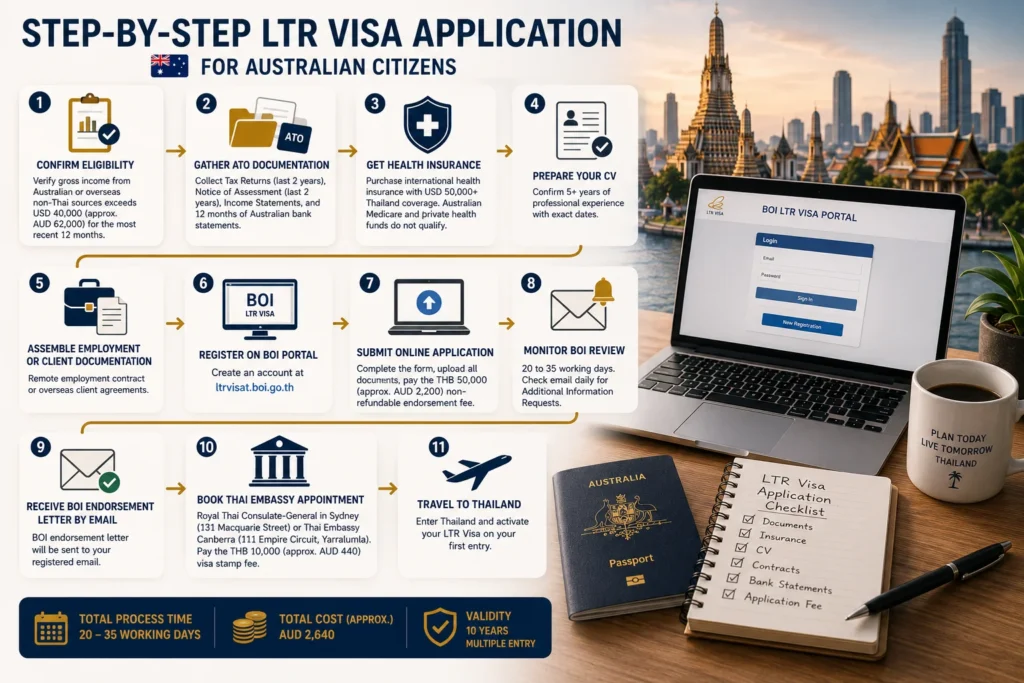
- Confirm eligibility: Verify gross income from Australian or overseas non-Thai sources exceeds USD 40,000 (approx. AUD 62,000) for the most recent 12 months
- Gather ATO documentation: Collect Tax Returns (last 2 financial years), Notice of Assessment (last 2 years), Income Statements, and 12 months of Australian bank statements
- Get international health insurance: Purchase Cigna Global, AXA International, Allianz Care, or Bupa Global with USD 50,000+ Thailand coverage. Australian Medicare and Australian private health funds do not qualify.
- Prepare your CV: Confirm 5+ years of professional experience with exact dates
- Assemble employment or client documentation: Remote employment contract or overseas client agreements
- Register on BOI portal: Create an account at ltrvisat.boi.go.th
- Submit online application: Complete the form, upload all documents, pay the THB 50,000 (approx. AUD 2,200) non-refundable endorsement fee
- Monitor BOI review: 20 to 35 working days. Check email daily for Additional Information Requests
- Receive BOI endorsement letter by email
- Book Thai Embassy appointment: Royal Thai Consulate-General in Sydney (131 Macquarie Street) or Thai Embassy Canberra (111 Empire Circuit, Yarralumla). Pay the THB 10,000 (approx. AUD 440) visa stamp fee
- Travel to Thailand and activate your LTR Visa on first entry
Cost Breakdown in AUD for Australian Applicants
| Cost Item | AUD (approx.) | Notes |
| BOI endorsement fee | AUD 2,200 (THB 50,000) | Non-refundable. Paid online via BOI portal. |
| Visa stamp fee (Thai Embassy/Consulate Australia) | AUD 440 (THB 10,000) | Sydney Consulate-General or Canberra Embassy. |
| International health insurance (annual) | AUD 1,100–2,750/year | Cigna Global, AXA International, or Allianz Care. |
| Accountant’s letter (self-employed only) | AUD 200–500 | CPA Australia or CAANZ member. One-time cost. |
| TOTAL first year (excluding insurance) | Approx. AUD 2,640–2,700 | Insurance adds AUD 1,100–2,750 annually. |
| Annual ongoing cost (health insurance only) | AUD 1,100–2,750/year | Only ongoing visa-related cost for 10 years. |
Australian Tax Residency When Living in Thailand
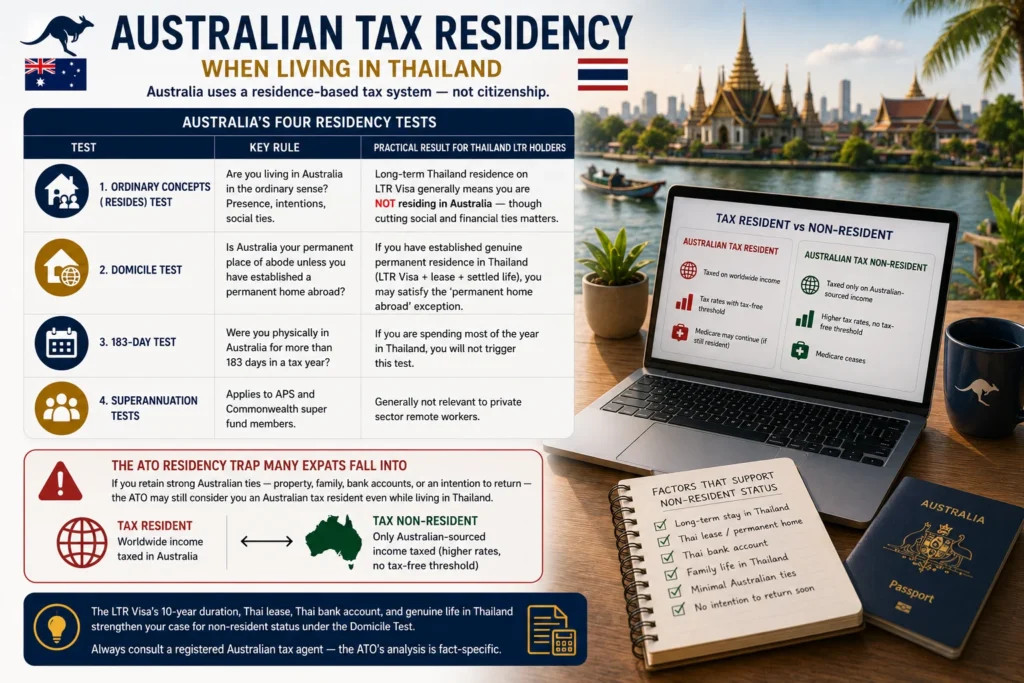
Australia’s tax residency rules for citizens living abroad are more complex than the UK’s Statutory Residence Test and operate differently from the US’s citizenship-based worldwide taxation. Understanding where you stand is essential before planning a long-term Thailand stay.
Australia’s four residency tests
| Test | Key Rule | Practical Result for Thailand LTR Holders |
| Ordinary Concepts (Resides) Test | Are you living in Australia in the ordinary sense? Presence, intentions, social ties. | Long-term Thailand residence on LTR Visa generally means you are NOT residing in Australia — though cutting social and financial ties matters. |
| Domicile Test | Is Australia your permanent place of abode unless you have established a permanent home abroad? | If you have established genuine permanent residence in Thailand (LTR Visa + lease + settled life), you may satisfy the ‘permanent home abroad’ exception. |
| 183-Day Test | Were you physically in Australia for more than 183 days in a tax year? | If you are spending most of the year in Thailand, you will not trigger this test. |
| Superannuation Tests | Applies to APS and Commonwealth super fund members. | Generally not relevant to private sector remote workers. |
| THE ATO RESIDENCY TRAP MANY AUSTRALIAN EXPATS FALL INTO The ATO’s residency tests are stricter than most Australians expect. Many people assume they become non-residents when they leave Australia. In practice, if you retain strong Australian ties — a property, family members, ongoing Australian bank accounts, or an intention to return — the ATO may still consider you an Australian tax resident even while living in Thailand. Australian tax residents pay Australian income tax on worldwide income. Australian non-residents pay Australian tax only on Australian-sourced income (at higher rates, with no tax-free threshold). The LTR Visa’s 10-year duration, combined with a Thai lease, Thai bank account, and establishment of genuine life in Thailand, strengthens the case for non-resident status under the Domicile Test. But the ATO’s analysis is fact-specific. Consult a registered Australian tax agent before assuming you are non-resident. |
Superannuation Considerations for Long-Term Thailand Stays
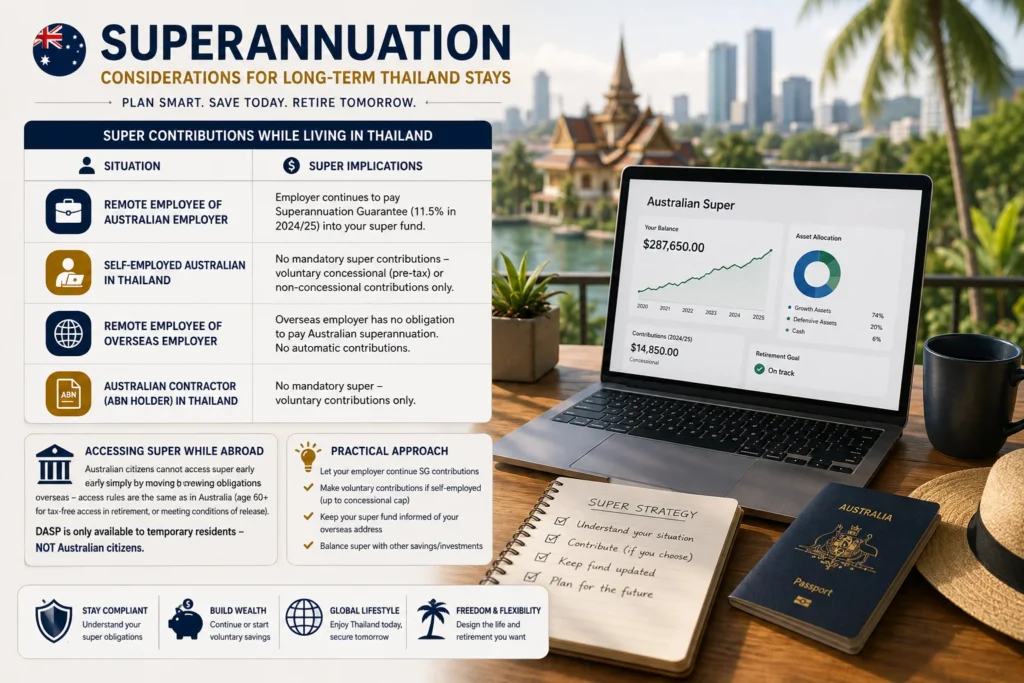
Superannuation is uniquely Australian and deserves specific attention that no other Thailand LTR Visa guide provides.
Super contributions while living in Thailand
| Situation | Super Implications |
| Remote employee of Australian employer | Employer continues to pay Superannuation Guarantee (11.5% in 2024/25) into your super fund. No action required. |
| Self-employed Australian in Thailand | No mandatory super contributions — you can make voluntary concessional (pre-tax) or non-concessional contributions but are not required to. |
| Remote employee of overseas employer | Overseas employer has no obligation to pay Australian superannuation. No automatic contributions. |
| Australian contractor (ABN holder) in Thailand | No mandatory super — voluntary contributions only. |
Accessing superannuation while abroad
Australian citizens cannot access their superannuation early simply by moving overseas — access rules are the same as in Australia (age 60+ for tax-free access in retirement, or meeting conditions of release). The ‘Departing Australia Superannuation Payment’ (DASP) is only available to temporary residents — NOT to Australian citizens.
| PRACTICAL SUPERANNUATION APPROACH FOR THAILAND LTR HOLDERS Most Australian professionals on the Thailand LTR Visa: If employed by an Australian employer: Let the employer continue making SG contributions normallyIf self-employed or contracting overseas: Make voluntary super contributions up to the concessional cap (£27,500/year in 2024/25) if they wish to maintain retirement savings — or pause contributions while building overseas savings in a Thai bank or global investment accountKeep super fund informed of overseas address for fund communications |
Medicare: What Happens to Your Health Cover in Thailand
Australian Medicare does not cover medical treatment in Thailand. This is a straightforward point that is relevant to the LTR Visa application because it makes the health insurance requirement less of an additional cost and more of a replacement cost.
- If you become a non-resident of Australia for tax purposes, Medicare entitlement is suspended. You should notify Medicare of your departure and non-residency.
- If you retain Australian tax residency while living in Thailand (which is possible under the ATO’s tests), you may technically retain Medicare entitlement, but Medicare will not pay for treatment in Thailand regardless of your residency status.
- Any Australian private health insurance (Medibank, Bupa AU, HCF, NIB) covers treatment in Australian hospitals, not Thailand. They do not satisfy the LTR Visa’s USD 50,000 international coverage requirement.
- The LTR Visa requires USD 50,000+ international health insurance valid in Thailand — Cigna Global, AXA International, Allianz Care, or Bupa Global are the practical options. These plans are comprehensive and genuinely replace Medicare and Australian private health for the Thailand context.
Australia-Thailand Double Taxation Agreement
Australia and Thailand have a Double Taxation Agreement (DTA) in force. Key provisions for Australian LTR Visa holders:
- The DTA establishes which country has primary taxing rights on different income types (employment income, business profits, dividends, interest, royalties, pensions)
- For Australian nationals who remain Australian tax residents living in Thailand: the DTA’s tiebreaker provisions determine the primary country of tax when both countries claim tax rights
- Australian franking credits from Australian share dividends: these are Australian domestic arrangements and generally not affected by the Thailand DTA
- Australian rental income for expats in Thailand: typically remains taxable in Australia as Australian-sourced income, at non-resident tax rates (no tax-free threshold)
| DTA DISCLAIMER The Australia-Thailand DTA is complex. Application depends on your income type, source, and residency status in both countries. This is general awareness information only. Consult a registered Australian tax agent with international experience before making decisions based on DTA provisions. |
Thailand vs Australia Cost of Living in AUD
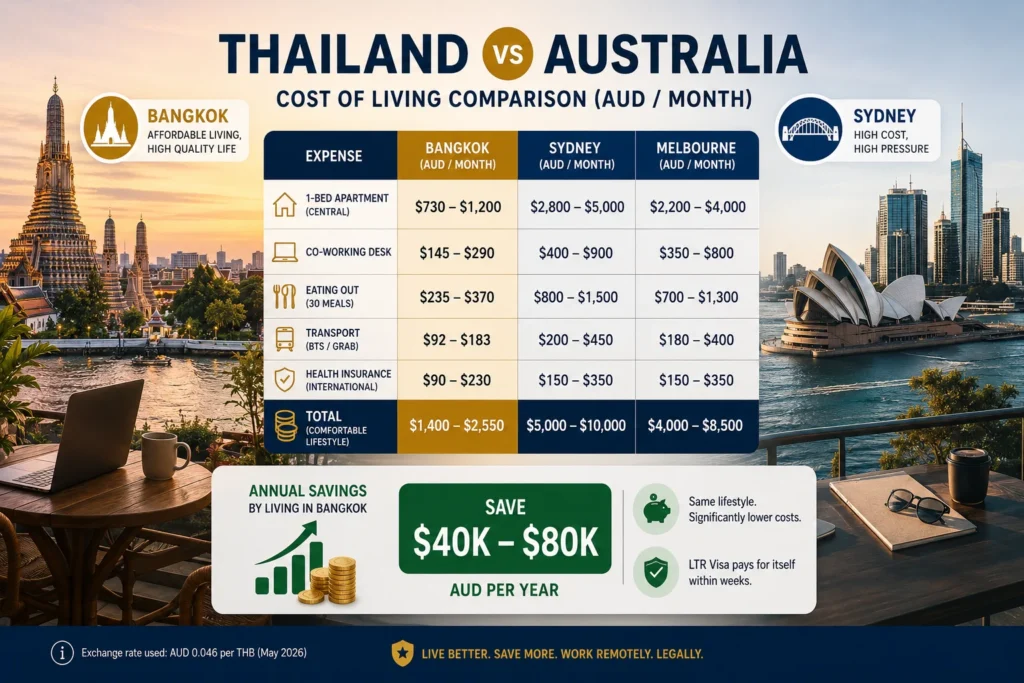
The cost comparison between Thailand and Australian cities — particularly Sydney and Melbourne — is one of the most compelling financial arguments for the LTR Visa among Australian applicants.
| Expense | Bangkok (AUD/month) | Sydney (AUD/month) | Melbourne (AUD/month) |
| 1-bed apartment (central) | AUD 730–1,200 | AUD 2,800–5,000 | AUD 2,200–4,000 |
| Co-working desk | AUD 145–290 | AUD 400–900 | AUD 350–800 |
| Eating out (30 meals) | AUD 235–370 | AUD 800–1,500 | AUD 700–1,300 |
| Transport (BTS/Grab) | AUD 92–183 | AUD 200–450 | AUD 180–400 |
| Health insurance (intl) | AUD 90–230/month | AUD 150–350/month (private) | AUD 150–350/month (private) |
| TOTAL (comfortable lifestyle) | AUD 1,400–2,550/month | AUD 5,000–10,000/month | AUD 4,000–8,500/month |
Note: AUD/THB conversion at approximately AUD 0.046 per THB (May 2026). An Australian professional earning AUD 80,000/year remotely saves approximately AUD 40,000 to 80,000/year by living in Bangkok vs Sydney on a like-for-like lifestyle comparison. The LTR Visa’s one-time cost (AUD 2,640) pays for itself within weeks of the lifestyle cost saving.
Flights: Australia to Thailand Direct Routes
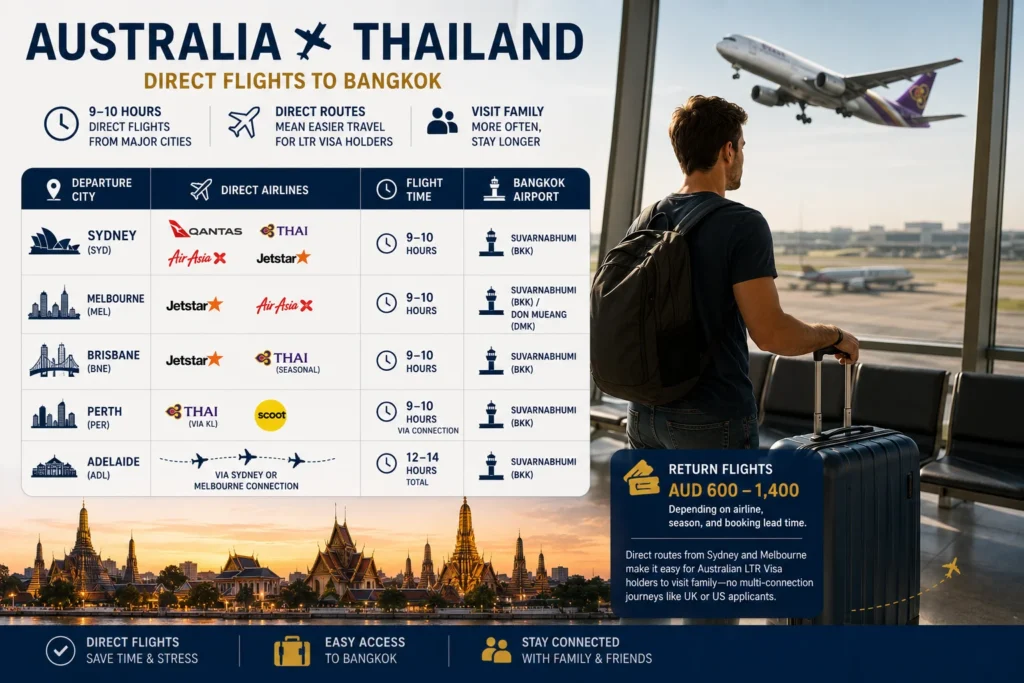
One of Australia’s practical advantages over UK applicants is direct flight access to Bangkok:
| Departure City | Direct Airlines | Flight Time | Bangkok Airport |
| Sydney (SYD) | Qantas, Thai Airways, AirAsia X, Jetstar | 9–10 hours | Suvarnabhumi (BKK) |
| Melbourne (MEL) | Jetstar, AirAsia X | 9–10 hours | Suvarnabhumi (BKK) / Don Mueang (DMK) |
| Brisbane (BNE) | Jetstar, Thai Airways (seasonal) | 9–10 hours | Suvarnabhumi (BKK) |
| Perth (PER) | Thai Airways (via KL), Scoot | 9–10 hours via connection | Suvarnabhumi (BKK) |
| Adelaide (ADL) | Via Sydney or Melbourne connection | 12–14 hours total | Suvarnabhumi (BKK) |
Return flights from major Australian cities to Bangkok typically cost AUD 600 to 1,400 depending on airline, season, and booking lead time. Direct routes from Sydney and Melbourne mean Australian LTR Visa holders can visit family easily without the multi-connection journey that UK or US applicants face.
Common Mistakes Australian Applicants Make
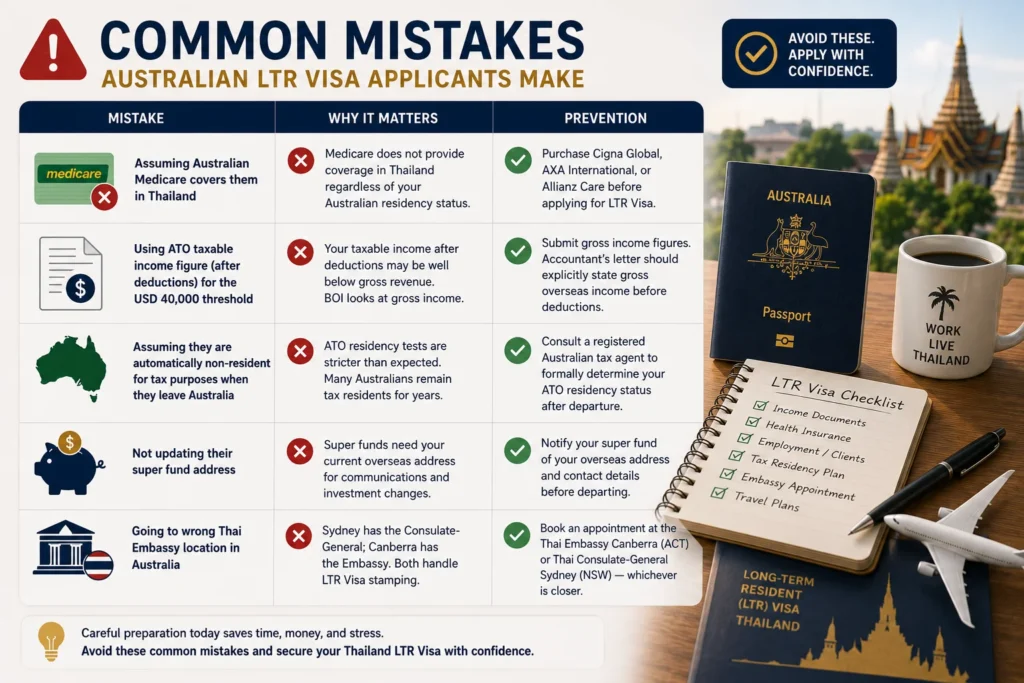
| Mistake | Why It Matters | Prevention |
| Assuming Australian Medicare covers them in Thailand | Medicare does not provide coverage in Thailand regardless of your Australian residency status | Purchase Cigna Global, AXA International, or Allianz Care before applying for LTR Visa |
| Using ATO taxable income figure (after deductions) for the USD 40,000 threshold | Your taxable income after deductions may be well below gross revenue. BOI looks at gross income. | Submit gross income figures. Accountant’s letter should explicitly state gross overseas income before deductions. |
| Assuming they are automatically non-resident for tax purposes when they leave Australia | ATO residency tests are stricter than expected. Many Australians remain tax residents for years. | Consult a registered Australian tax agent to formally determine your ATO residency status after departure. |
| Not updating their super fund address | Super funds need your current overseas address for communications and investment changes | Notify your super fund of your overseas address and contact details before departing |
| Going to wrong Thai Embassy location in Australia | Sydney has the Consulate-General; Canberra has the Embassy. Both handle LTR Visa stamping. | Book an appointment at the Thai Embassy Canberra (ACT) or Thai Consulate-General Sydney (NSW) — whichever is closer |
Risks and Limitations for Australian Citizens on LTR Visa
- ATO residency uncertainty: The ATO’s residency tests can produce unexpected results. Australians who retain strong Australian ties (property, family, accounts) may remain Australian tax residents even while living in Thailand, requiring Australian tax filing on worldwide income.
- Superannuation gap years: Self-employed Australians and those employed by overseas companies will have reduced or zero superannuation contributions during their Thailand stay. This creates a retirement savings gap that requires conscious planning.
- Medicare replacement cost: International health insurance (AUD 1,100 to 2,750/year) costs more than Australian Medicare Levy plus a basic private health fund for comparable coverage. However, it genuinely covers Thailand-based care, which neither Medicare nor Australian private funds do.
- Australian rental income stays taxable: Australians with Australian investment properties continue paying Australian income tax on rental income at non-resident rates (starting at 32.5% from the first dollar, no tax-free threshold).
- Thai 180-day tax residency: Spending 180+ days in Thailand can trigger Thai tax residency, creating potential dual taxation scenarios that require ATO-DTA analysis.
Frequently Asked Questions
Can Australian Citizens Qualify for the Thailand LTR Visa Australian Citizens Program?
Yes. Australian citizens are fully eligible for the Thailand LTR Visa Work-From-Thailand Professional category. The income requirement is USD 40,000/year (approximately AUD 61,000–63,000) from non-Thai overseas sources. Australians submit ATO Tax Returns, Notice of Assessment, Income Statement, and Australian bank statements — no CA certificate is required.
What ATO documents does Thailand’s BOI accept for the LTR Visa?
BOI accepts: Individual Tax Return (myTax, last 2 financial years), Notice of Assessment (NOA, last 2 years), Income Statement from employer, accountant’s letter from a CPA Australia or CAANZ-registered accountant (for self-employed), and 12 months of Australian bank statements. These replace the CA certificate required from Indian applicants.
What happens to my Australian superannuation when I move to Thailand?
If you work for an Australian employer, your employer continues paying the Superannuation Guarantee (SG) into your fund. If you are self-employed or working for an overseas employer, no mandatory super contributions are required. You can make voluntary contributions. Super cannot be accessed early by Australian citizens simply by moving overseas — the Departing Australia Superannuation Payment applies only to temporary visa holders, not Australian citizens.
Does Australian Medicare cover me in Thailand?
No. Australian Medicare does not cover medical treatment in Thailand, regardless of your Australian residency status. Australian private health funds also do not cover Thailand. The LTR Visa requires USD 50,000+ international health insurance valid in Thailand — Cigna Global, AXA International, or Allianz Care are the standard options. These effectively replace Medicare and Australian private cover for your Thailand stay.
Do I still pay Australian tax when living in Thailand?
It depends on your ATO tax residency status. Australian non-residents generally pay Australian tax only on Australian-sourced income (rental income, dividends) at non-resident rates — not on overseas earnings. However, Australian citizens often remain Australian tax residents for longer than expected under the ATO’s Domicile Test and Ordinary Concepts Test. Consult a registered Australian tax agent to formally determine your residency status.
Where do Australians apply for the Thailand LTR Visa stamp?
After receiving your BOI endorsement letter, book an appointment at either the Royal Thai Embassy in Canberra (111 Empire Circuit, Yarralumla, ACT 2600) or the Royal Thai Consulate-General in Sydney (131 Macquarie Street, Sydney NSW 2000). Both process LTR Visa stamps. The Sydney Consulate-General is more convenient for NSW and QLD applicants; the Canberra Embassy for ACT and VIC applicants.
Final Verdict: Thailand LTR Visa for Australian Citizens
| Australian citizens are among the best-positioned LTR Visa applicants: direct flights to Bangkok, strong professional income profiles (particularly from Sydney and Melbourne’s tech and professional sectors), and a cost of living differential that makes Bangkok genuinely transformative for Australian purchasing power. The ATO documentation path is clear: Notice of Assessment + Tax Return + bank statements, with an accountant’s letter for self-employed Australians. The health insurance requirement fills the Medicare gap. The superannuation situation is manageable with employer-maintained contributions or voluntary planning. The tax residency question requires attention — Australians should consult a registered tax agent before assuming they are non-resident — but it does not prevent the LTR Visa application or long-term Thailand residence. For Australian remote workers earning AUD 60,000+ from overseas clients: the LTR Visa delivers 10 years of legal, stable, work-authorized Thailand residence at a first-year cost of approximately AUD 2,640 in visa fees. At Sydney rental prices, that pays for itself in the first fortnight. |