
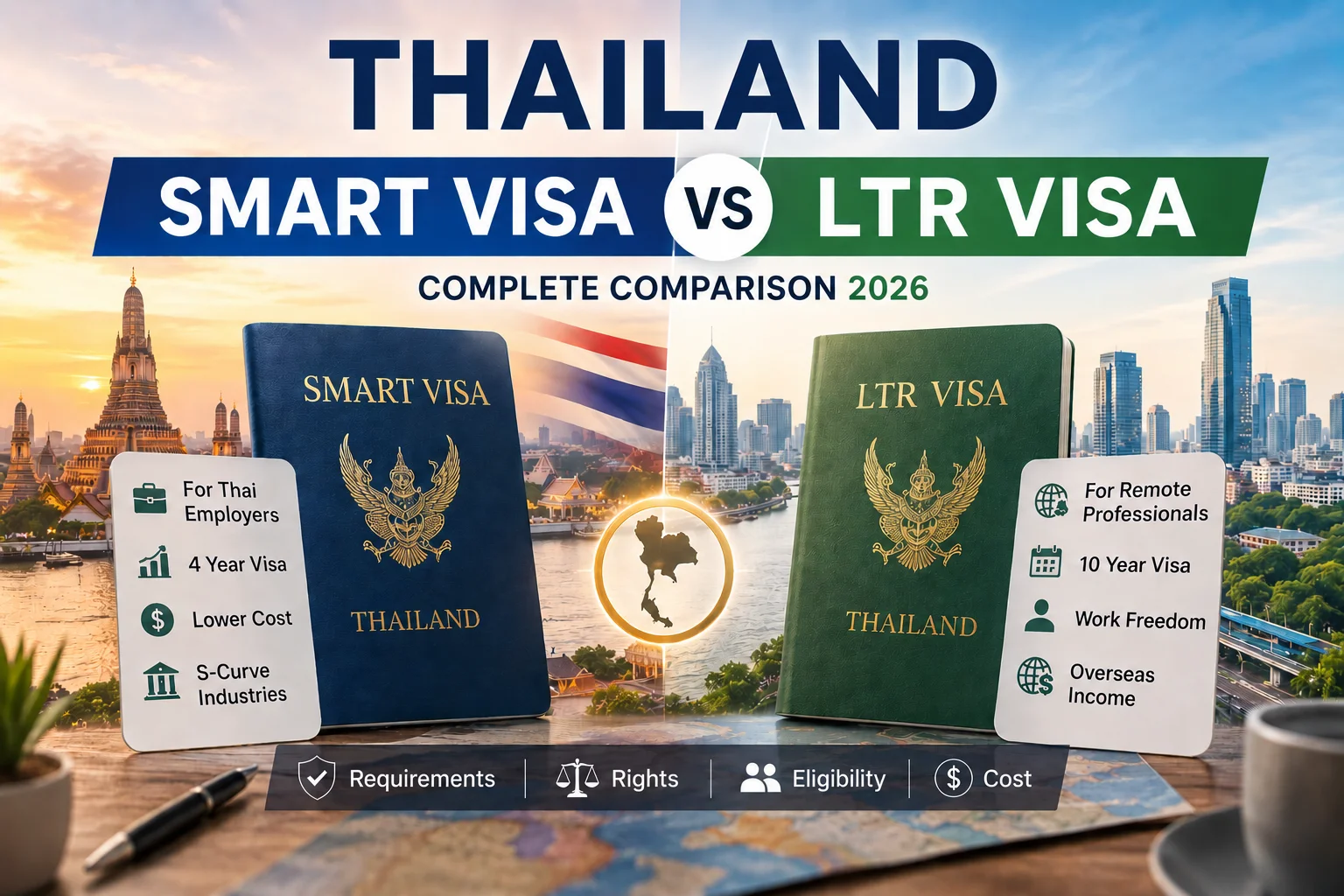
| Thailand SMART Visa vs LTR Visa is one of the most common comparisons for professionals considering long-term residency in Thailand. Thailand’s SMART Visa and LTR Visa are commonly compared but serve fundamentally different audiences. The SMART Visa (4 years, requires Thai employer endorsement via NIA/depa/NSTDA) is for senior specialists working for Thai-registered entities in BOI S-curve industries. The LTR WFT Professional (10 years, direct BOI application) is for remote workers earning from overseas employers or clients. The LTR HSP (10 years) is for specialists at Thai entities — overlapping with SMART Visa but with a longer duration and higher upfront cost. SMART Visa costs approximately THB 3,500 per application; LTR Visa costs THB 63,800. Over 10 years, SMART Visa requires 2 to 3 reapplications (total THB 7,000–10,500) vs LTR’s single application (THB 63,800) — making their 10-year total cost comparable but with very different administrative experiences. The core decision rule: working FOR a Thai company = SMART Visa or LTR HSP; working FROM Thailand for overseas = LTR WFT. |
| QUICK ANSWER: What is the difference between Thailand SMART Visa and LTR Visa? The core difference between SMART Visa and LTR Visa is who they are for: SMART Visa: For senior specialists working for Thai-registered entities in BOI S-curve sectors. Requires endorsement from NIA, depa, or NSTDA. Duration: 4 years. LTR WFT Professional: For remote workers earning from overseas employers or clients. Direct BOI application, no sector agency endorsement. Duration: 10 years. LTR HSP: For senior specialists at Thai entities in S-curve sectors. Same audience as SMART Visa but 10-year duration and higher upfront cost. They are not competing alternatives for the same person. Most professionals choose between SMART Visa and LTR HSP (if at a Thai company) or simply apply for LTR WFT (if working for overseas clients). |
| DISCLAIMER Visa fees, requirements, and policies change. Verify current requirements at boi.go.th before applying. This is not legal advice. Consult a licensed Thai immigration attorney for your specific situation. |
Introduction: Why This Comparison Is More Complex Than It Appears
The question “SMART Visa or LTR Visa?” seems like a simple binary choice. In reality, it is a three-way decision — and the most important thing to establish first is which two options are actually relevant for your situation.
Most professionals asking this question are either working at a Thai company in a tech sector (where SMART Visa and LTR HSP are the relevant comparison) or working remotely for overseas employers or clients (where LTR WFT Professional is the clear answer and SMART Visa is not even applicable).
This article covers the complete three-way comparison with a 15-factor master table, the 10-year cost analysis that no other guide provides, the endorsement complexity cost that makes SMART Visa less straightforward than its low fee suggests, and the decision framework that tells you which visa applies to your specific professional situation.
The Correct Framework: SMART Visa vs LTR WFT vs LTR HSP
| UNDERSTAND THIS BEFORE COMPARING The two most common comparison mistakes: Mistake 1: Comparing SMART Visa with LTR WFT as if they are alternatives. They serve different employment models. SMART Visa requires a Thai employer. LTR WFT requires an overseas employer. If you work for a Thai company, WFT is not your category. If you work for an overseas company remotely, SMART Visa is not your category.Mistake 2: Not including LTR HSP in the comparison when assessing SMART Visa. For professionals at Thai companies in S-curve sectors, LTR HSP is the direct 10-year alternative to SMART Visa’s 4-year term. This is the most important comparison for senior Thai-employed specialists. The correct comparisons: Thai employer, S-curve sector: SMART Visa T vs LTR HSPOverseas remote work, USD 40K+ income: LTR WFT Professional (SMART Visa not applicable)Transitioning from Thai employer to remote work later: SMART Visa now, LTR WFT when situation changes |
Master Comparison Table: 15 Key Factors
| Factor | 🟢 SMART Visa (T cat.) | ⭐ LTR WFT Professional | 🔵 LTR HSP | Best for |
| Visa duration | 4 years | 10 years | 10 years | LTR |
| Annual renewal | Not required in 4 yrs | Not required in 10 yrs | Not required in 10 yrs | LTR |
| Application fee (one-time) | THB 3,500 (∼USD 98) | THB 63,800 (∼USD 1,775) | THB 63,800 (∼USD 1,775) | SMART |
| 10-year total visa cost | THB 7,000–10,500 (2–3 apps) | THB 63,800 (one-time) | THB 63,800 (one-time) | SMART |
| Thai employer required | YES — qualifying Thai entity | NO — overseas employer | YES — qualifying Thai entity | WFT |
| Sector restriction | YES — S-curve only | NO — any profession | YES — S-curve only | WFT |
| Pre-BOI endorsement | YES — NIA/depa/NSTDA (4–8 wks) | NO — direct BOI | NO — direct BOI | LTR |
| Income threshold (standard) | USD 80,000/year | USD 40,000/year | USD 80,000/year | WFT |
| Credential-based threshold | USD 40,000 + Master’s | N/A (USD 40K is standard) | USD 40,000 + Master’s | WFT |
| Work permit (Thai employer) | YES — specific employer | NO — work endorsement for overseas | YES — specific employer | Equal |
| Freelancers eligible | NO — Thai employer required | YES — overseas clients | NO — Thai employer required | WFT |
| Banking access | Good (visa documentation) | Good (BOI letter) | Good (BOI letter) | Equal |
| Application complexity | High (2-stage: agency + BOI) | Medium (BOI only) | Medium (BOI only) | LTR |
| Career flexibility | Tied to Thai employer + sector | Free to change overseas clients | Tied to Thai employer + sector | WFT |
| Best overall for | Thai-employed sector specialists, lower upfront cost | Remote workers, freelancers, overseas income | Thai-employed sector specialists, 10-year stability | Depends on situation |
Deep Dive: Duration and Renewal — 4 Years vs 10 Years
The duration difference between SMART Visa (4 years) and LTR Visa (10 years) has practical implications that go beyond the number itself.
SMART Visa 4-year cycle
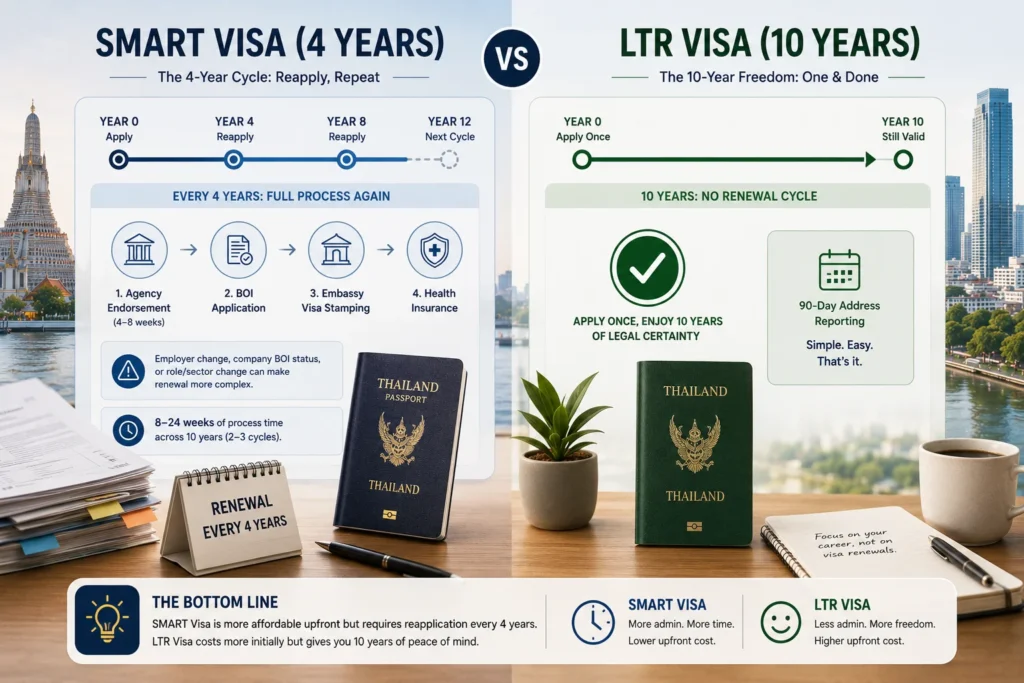
Every 4 years, SMART Visa holders must reapply. Each reapplication requires: new endorsement from the agency (another 4 to 8 weeks of endorsing body process), new BOI application, new Embassy visa stamping, and new health insurance certificate. This is not a minor administrative burden — it is essentially re-running the full SMART Visa application process every 4 years.
If your employer changes, or the company’s BOI status changes, or you transition to a different sector role between renewal cycles, the renewal may become more complex or may need to be approached as a new application rather than a straightforward renewal.
LTR Visa 10-year structure
The LTR Visa’s 10-year validity eliminates this renewal cycle entirely. After the initial application, you receive 10 years of legal certainty with only the 90-day address report as an ongoing administrative obligation. No endorsement renewal, no reapplication, no Embassy appointment for a decade.
For professionals planning a long Bangkok career, this 10-year freedom from visa administration is a significant quality-of-life difference — and it is a difference that the SMART Visa’s lower upfront cost does not fully capture.
Deep Dive: The Endorsement Requirement — SMART Visa’s Hidden Complexity
The SMART Visa’s lower application fee (THB 3,500 vs THB 63,800) is genuine. But it does not reflect the total cost of the SMART Visa process because it excludes the endorsement stage.
| Cost Component | SMART Visa (per application cycle) | LTR Visa (one-time) |
| BOI application fee | THB 3,500 | THB 63,800 |
| Visa stamp fee (Embassy) | THB 3,500 | THB 10,000 |
| Time: endorsement process | 4 to 8 weeks (employer + agency coordination) | Zero (no sector agency step) |
| Employer HR coordination cost | Real cost in staff time and admin | Minimal (BOI-direct) |
| Professional consultation (if needed) | Per renewal cycle | One-time only |
| Endorsement renewal risk | Every 4 years | None for 10 years |
Deep Dive: The 10-Year Total Cost Analysis
The number most people cite — SMART Visa THB 3,500 vs LTR Visa THB 63,800 — is a first-year comparison only. Over a 10-year horizon, the picture is different:
| Scenario | SMART Visa (10 years) | LTR Visa (10 years) |
| Number of visa applications | 2 to 3 (reapply at years 4 and 8) | 1 (one-time, valid 10 years) |
| Total BOI fees | THB 7,000–10,500 | THB 63,800 |
| Total Embassy stamp fees | THB 7,000–10,500 | THB 10,000 |
| Endorsement process time per cycle | 4–8 weeks × 2–3 cycles = 8–24 weeks of process time | Zero after initial application |
| Total 10-year visa fee cost | THB 14,000–21,000 | THB 73,800 |
| Administrative burden per decade | High (2–3 full application cycles) | Low (90-day reporting only) |
At face value over 10 years, the SMART Visa (THB 14,000 to 21,000 total) is still significantly cheaper than the LTR Visa (THB 73,800). The premium for LTR is the administrative simplicity and the certainty of not having to reapply in years 4 and 8. For senior professionals who value their time highly, the difference in administrative burden may justify the LTR premium. For professionals who are comfortable with the renewal process, SMART Visa remains genuinely more affordable over a decade.
Deep Dive: Work Authorization and Employment Flexibility
| Employment Scenario | SMART Visa | LTR WFT | LTR HSP |
| Working at current Thai employer in S-curve sector | ✅ Authorized | ❌ Not applicable | ✅ Authorized |
| Working for overseas employer remotely from Thailand | ❌ Not authorized | ✅ Authorized | ❌ Not authorized |
| Serving multiple overseas clients as freelancer | ❌ Not authorized | ✅ Authorized | ❌ Not authorized |
| Changing Thai employers (same sector) | Requires visa reassessment / new process | Not applicable | Requires visa reassessment / new process |
| Starting own Thai-registered company | Separate work permit needed | Not applicable | Separate work permit needed |
| Taking overseas remote consulting work alongside Thai employment | ❌ Gray area / not covered | ✅ Covered (overseas clients) | ❌ Gray area / not covered |
The LTR WFT category offers the most flexible work authorization for those whose income model involves overseas clients. SMART Visa and LTR HSP are both restricted to the specific Thai employer relationship that anchors the visa.
Decision Framework: Which Visa Is Right for Your Situation?
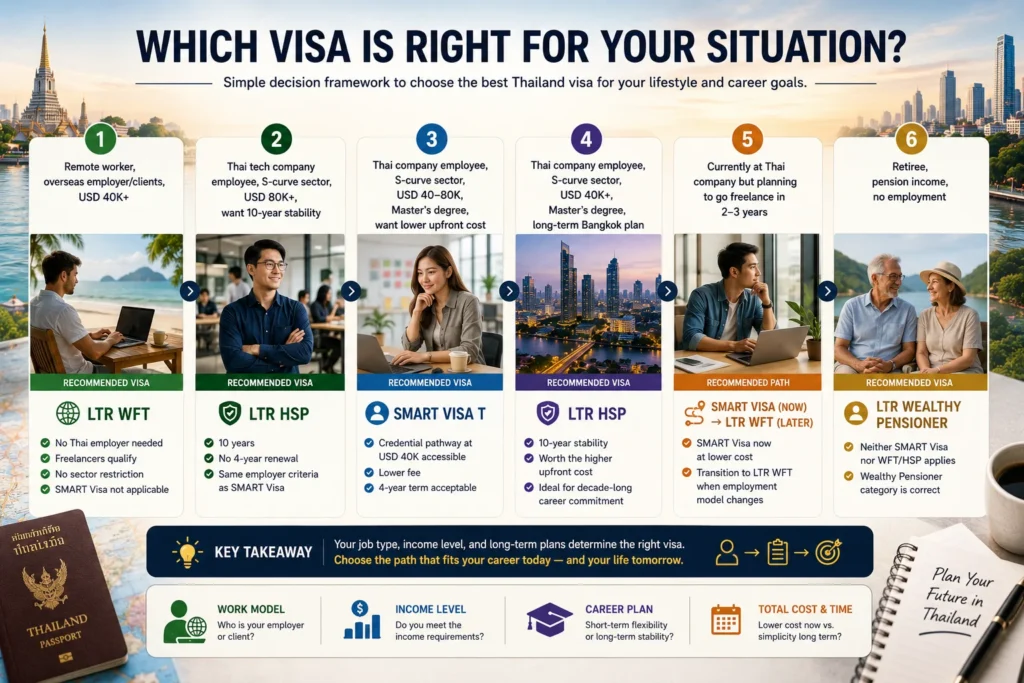
| Your Situation | Recommended Visa | Reason |
| Remote worker, overseas employer/clients, USD 40K+ | LTR WFT | No Thai employer needed. Freelancers qualify. No sector restriction. SMART Visa not applicable. |
| Thai tech company employee, S-curve sector, USD 80K+, want 10-year stability | LTR HSP | 10 years, no 4-year renewal, same employer criteria as SMART Visa. |
| Thai company employee, S-curve sector, USD 40–80K, Master’s degree, want lower upfront cost | SMART Visa T | Credential pathway at USD 40K accessible. Lower fee. 4-year term acceptable. |
| Thai company employee, S-curve sector, USD 40K+, Master’s degree, long-term Bangkok plan | LTR HSP | 10-year stability worth the higher upfront cost for decade-long career commitment. |
| Currently at Thai company but planning to go freelance in 2–3 years | SMART Visa (now), LTR WFT (later) | SMART Visa now at lower cost; transition to LTR WFT when employment model changes. |
| Retiree, pension income, no employment | LTR Wealthy Pensioner | Neither SMART Visa nor WFT/HSP applies. Wealthy Pensioner category is correct. |
Career Transition Scenarios: What Happens When Your Situation Changes
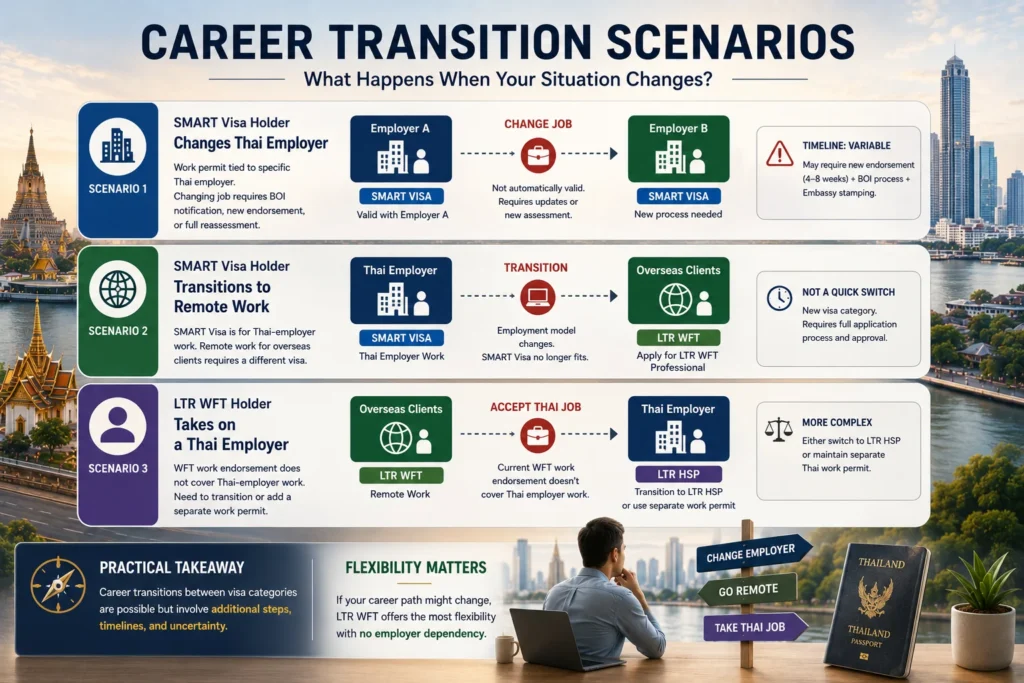
One of the most under-discussed aspects of SMART Visa vs LTR Visa is what happens when your career situation changes mid-visa.
Scenario 1: SMART Visa holder changes Thai employer
Your SMART Visa work permit is tied to your specific Thai employer. If you leave that employer for a different Thai company (even in the same sector), your SMART Visa work permit for the previous employer is no longer valid. You must either change employer on the existing visa (requires BOI notification and potentially new endorsement) or go through a full reassessment. This process has variable timelines.
Scenario 2: SMART Visa holder transitions to remote work
If you leave your Thai employer to work remotely for overseas clients — a common career transition — your SMART Visa category no longer matches your employment model. You would need to apply for LTR WFT Professional to legalize your new remote work status. This is not a quick switch.
Scenario 3: LTR WFT holder takes on a Thai employer
If you are on LTR WFT and accept an offer from a Thai company in a BOI sector, your WFT work endorsement does not cover Thai-employer work. You would need to either transition to LTR HSP or use a separate Thai work permit alongside your LTR status — a more complex arrangement.
| PRACTICAL TAKEAWAY ON TRANSITIONS Career transitions between visa categories are possible but involve additional administrative steps and timelines. If you anticipate a career model change (Thai employment to remote, or vice versa) within the next 4 to 10 years, factor this into your initial visa choice. The flexibility of LTR WFT (no employer dependency) is an underappreciated advantage for professionals whose career direction is not yet settled. |
Nationality-Specific Guidance: Indian and Filipino Professionals
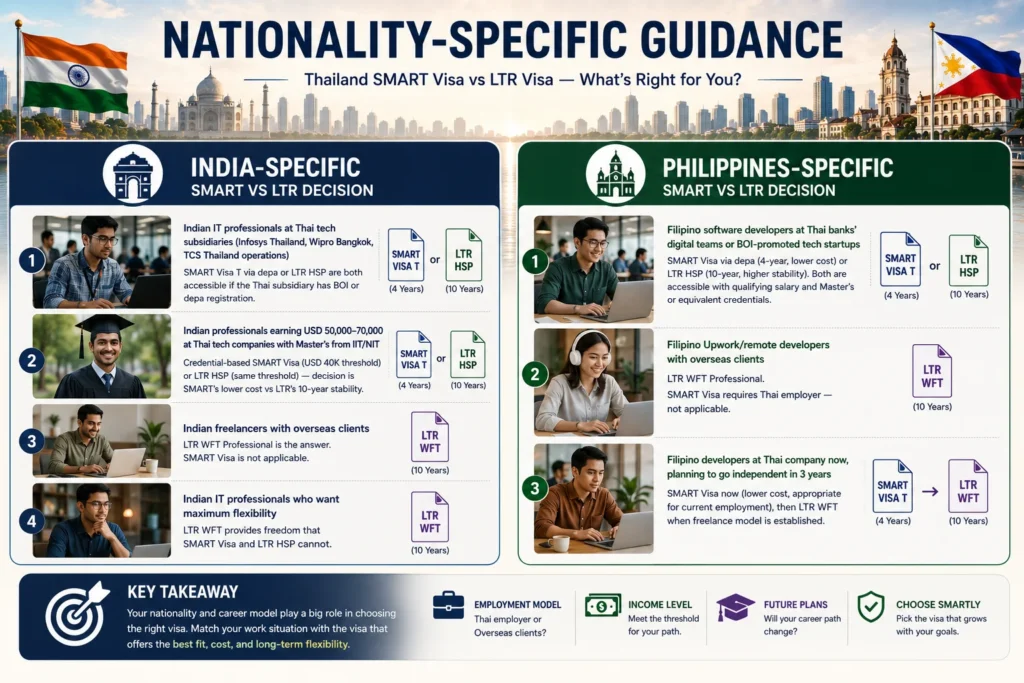
| INDIA-SPECIFIC SMART VS LTR DECISION Indian IT professionals at Thai tech subsidiaries (Infosys Thailand, Wipro Bangkok, TCS Thailand operations): SMART Visa T via depa or LTR HSP are both accessible if the Thai subsidiary has BOI or depa registration. Indian professionals earning USD 50,000–70,000 at Thai tech companies with Master’s from IIT/NIT: credential-based SMART Visa (USD 40K threshold) or LTR HSP (same threshold) — decision is SMART’s lower cost vs LTR’s 10-year stability. Indian freelancers with overseas clients: LTR WFT Professional is the answer. SMART Visa is not applicable. Indian IT professionals who want maximum flexibility (may go freelance, may change sectors): LTR WFT provides freedom that SMART Visa and LTR HSP cannot. |
| PHILIPPINES-SPECIFIC SMART VS LTR DECISION Filipino software developers at Thai banks’ digital teams or BOI-promoted tech startups: SMART Visa via depa (4-year, lower cost) or LTR HSP (10-year, higher stability). Both are accessible with qualifying salary and Master’s or equivalent credentials.Filipino Upwork/remote developers with overseas clients: LTR WFT Professional. SMART Visa requires Thai employer — not applicable.Filipino developers at Thai company now, planning to go independent in 3 years: SMART Visa now (lower cost, appropriate for current employment), then LTR WFT when freelance model is established. |
Common Mistakes When Choosing Between SMART and LTR
| Mistake | Consequence | Correct Approach |
| Comparing SMART Visa to LTR WFT as if they are alternatives for the same person | Applying for the wrong category entirely | Identify your employment model first: Thai employer = SMART/HSP; overseas clients = WFT |
| Not including LTR HSP in the SMART Visa comparison for Thai-employer professionals | Missing the 10-year LTR HSP option that serves the same audience as SMART Visa | Compare SMART T vs LTR HSP when you work for a Thai company in S-curve sector |
| Using only upfront fee to compare total cost | Underestimating SMART Visa’s 10-year renewal cost or LTR’s 10-year administrative simplicity | Run the 10-year total cost analysis including renewals and endorsement cycles |
| Choosing SMART Visa without accounting for Thai employer dependency risk | Career changes mid-visa create complex transition situations | If career direction is uncertain, LTR WFT (if income qualifies) offers more flexibility |
Risks and Limitations
SMART Visa risks
- 4-year renewal cycle: Every renewal requires the full endorsement process again. If your employer changes, sector changes, or endorsing agency process becomes more complex, renewal is not guaranteed to be smooth.
- Thai employer dependency: SMART Visa is tied to your specific employer. Losing the job or changing employer creates immediate visa status uncertainty.
- Sector restriction: Moving to a role outside the BOI S-curve sectors requires a new visa category.
LTR WFT risks
- USD 40,000 income requirement: Income must remain above threshold throughout the 10-year period. Significant income drops could theoretically affect visa status at inspection.
- Overseas employer only: Cannot work for Thai companies without additional work permit arrangements.
- THB 63,800 non-refundable: High upfront cost is lost if circumstances change.
LTR HSP risks
- Same Thai employer dependency as SMART Visa.
- High upfront cost (same as WFT at THB 63,800).
- Sector and employer restrictions create same career flexibility limitations as SMART Visa.
Frequently Asked Questions
What is the difference between Thailand SMART Visa and LTR Visa?
The core difference is the employment model they serve. SMART Visa (T category) is for senior specialists working for Thai-registered entities in BOI S-curve sectors — it requires endorsement from NIA, depa, or NSTDA and is valid for 4 years. LTR WFT Professional is for remote workers earning from overseas employers or clients — it requires no sector agency endorsement and is valid for 10 years. LTR HSP (a third option) serves the same audience as SMART Visa but with 10-year duration and higher upfront cost.
Is SMART Visa or LTR Visa cheaper?
SMART Visa is cheaper per application (THB 3,500 vs THB 63,800). Over 10 years, SMART Visa requires 2 to 3 reapplications (THB 14,000 to 21,000 total) vs LTR’s one-time cost (THB 73,800 including both fees). SMART Visa is more affordable over a decade, but LTR Visa’s administrative simplicity (no renewal cycle for 10 years) has real value for senior professionals.
Can I switch from SMART Visa to LTR Visa?
Yes. If your employment situation changes — for example, you leave your Thai employer to work remotely for overseas clients — you can apply for LTR WFT Professional from Thailand on your existing valid SMART Visa. The LTR application is independent of your SMART Visa status. You would apply for LTR WFT, wait for approval, and then transition to the new visa category.
For Indian and Filipino professionals at Thai tech companies, is SMART Visa or LTR HSP better?
It depends on the income level and career horizon. At USD 40,000–80,000/year with a Master’s degree: SMART Visa is more affordable (lower fee) and appropriate for a 4-year commitment. LTR HSP is better for those earning USD 40,000+ who want 10-year stability without the 4-year reapplication cycle. At USD 80,000+/year, both options are accessible at standard thresholds; LTR HSP’s 10-year advantage becomes more compelling.
Final Verdict: SMART Visa vs LTR Visa
| The choice between SMART Visa and LTR Visa is not a simple ‘which is better’ question. It depends entirely on your employment model and career stage. If you work remotely for overseas employers or clients: LTR WFT Professional is your answer. SMART Visa does not serve your employment model. If you work for a Thai company in an S-curve sector: compare SMART T vs LTR HSP based on your career horizon. Short-to-medium term or lower upfront cost priority = SMART Visa. Long-term Bangkok career with administrative simplicity = LTR HSP. The SMART Visa’s genuinely lower fee and the LTR’s genuine 10-year stability are both real benefits — the question is which matters more for your specific situation. Use the decision framework above to identify your category. Then read the specific guide for that visa to understand the full application process. |