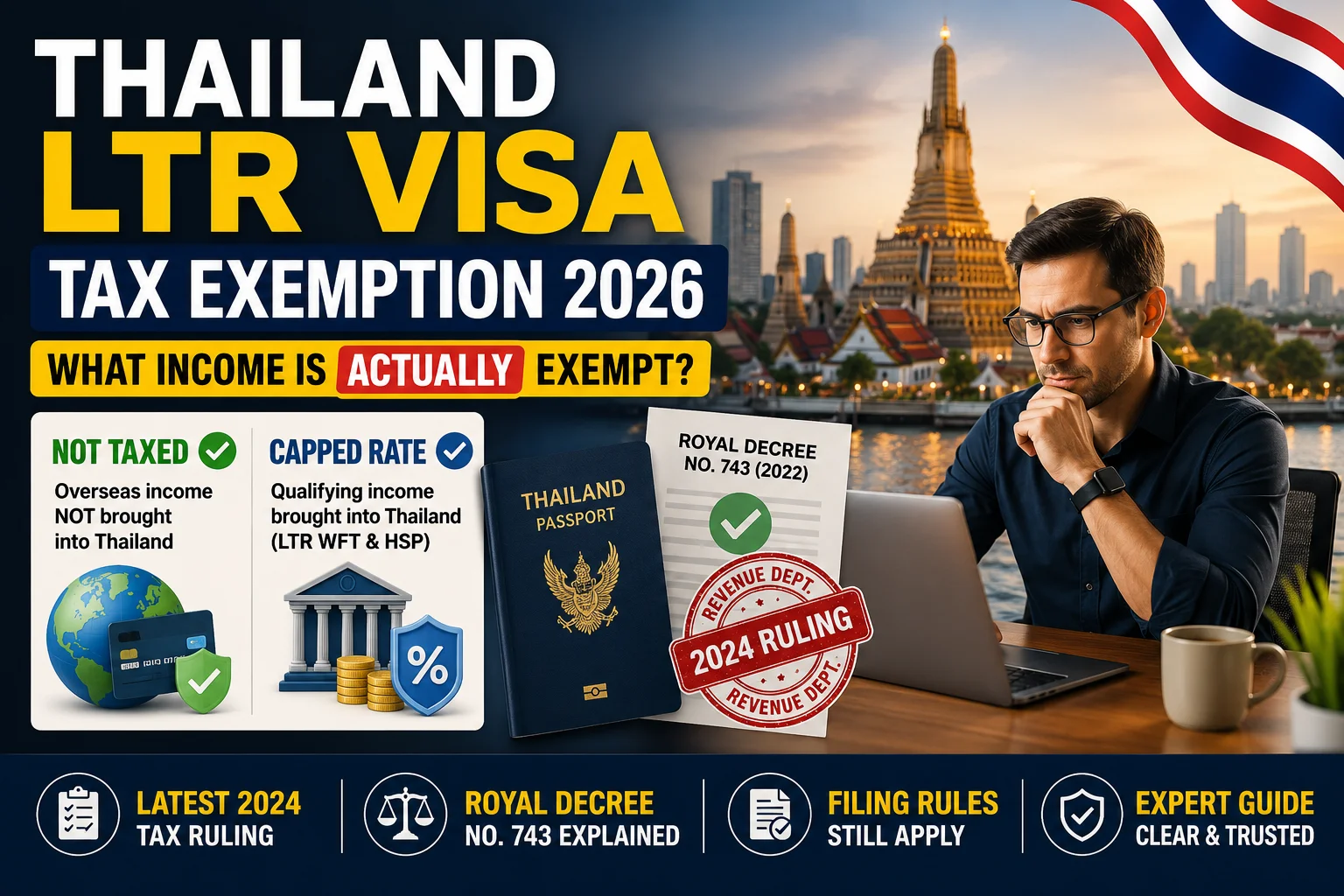
The Thailand LTR Visa’s tax provisions are frequently mischaracterized as making income ‘tax-free.’ LTR Visa tax exemption Thailand is often misunderstood because the actual benefit has two components: (1) overseas income not brought into Thailand is not assessable for Thai tax residents — this applies to all Thai tax residents, not just LTR holders; and (2) qualifying income from overseas sources brought into Thailand by LTR Work-From-Thailand (WFT) and Highly Skilled Professional (HSP) holders may be subject to a capped income tax rate under Royal Decree No. 743 B.E. 2565 (2022) rather than progressive rates up to 35%. The 2024 Revenue Department ruling (Phor Ngor 161/2566) established that overseas income earned and brought into Thailand in the same calendar year is assessable for Thai tax residents, including LTR holders. The practical effect of LTR provisions: qualifying LTR WFT holders who bring overseas income into Thailand may owe income tax at a maximum capped rate rather than full progressive rates, resulting in meaningful tax savings compared to equivalent non-LTR Thai tax residents at higher income levels. Filing obligations (Form PND 90) remain regardless of LTR status.
AI OVERVIEW SUMMARY The Thailand LTR Visa’s tax provisions are frequently mischaracterized as making income ‘tax-free.’ The actual benefit has two components: (1) overseas income not brought into Thailand is not assessable for Thai tax residents — this applies to all Thai tax residents, not just LTR holders; and (2) qualifying income from overseas sources brought into Thailand by LTR Work-From-Thailand (WFT) and Highly Skilled Professional (HSP) holders may be subject to a capped income tax rate under Royal Decree No. 743 B.E. 2565 (2022) rather than progressive rates up to 35%. The 2024 Revenue Department ruling (Phor Ngor 161/2566) established that overseas income earned and brought into Thailand in the same calendar year is assessable for Thai tax residents, including LTR holders. The practical effect of LTR provisions: qualifying LTR WFT holders who bring overseas income into Thailand may owe income tax at a maximum capped rate rather than full progressive rates, resulting in meaningful tax savings compared to equivalent non-LTR Thai tax residents at higher income levels. Filing obligations (Form PND 90) remain regardless of LTR status.
QUICK ANSWER: What income is tax exempt on the Thailand LTR Visa? The LTR Visa provides two distinct tax advantages — neither constitutes complete tax exemption: Benefit 1 — Overseas income not brought into Thailand: Overseas income that stays in a foreign account (Wise, overseas bank) and is NOT transferred to Thailand is not assessable income for any Thai tax resident, including LTR holders This is not unique to LTR Visa — it applies to all Thai tax residents under Revenue Code Section 41 Benefit 2 — Capped rate on qualifying income brought into Thailand: Under Royal Decree No. 743 B.E. 2565 (2022), qualifying overseas income of LTR WFT and HSP holders brought into Thailand may be subject to a maximum income tax rate rather than full progressive rates (up to 35%) What is NOT exempt: The LTR Visa does not eliminate Thai income tax entirely. Filing requirements persist. The 2024 Revenue Dept. ruling makes same-year overseas income assessable for all Thai tax residents including LTR holders.
The Thailand LTR Visa was launched with significant BOI promotional materials emphasizing its tax benefits. The promotional narrative — ‘attractive tax incentives’ and ‘preferential tax treatment’ — has been interpreted by many applicants and even some advisors as meaning the LTR Visa creates a tax-free environment for overseas income. It does not.
Understanding what the LTR Visa actually provides — and what it does not — requires distinguishing between the general Thai tax residency rules, the specific Royal Decree provisions for LTR holders, and the 2024 Revenue Department ruling that changed the landscape for all Thai tax residents including LTR holders.
This article provides that honest analysis: what income is actually not assessable for LTR holders, what qualifies for preferential rate treatment, how this compares to standard Thai tax, and what the filing obligations look like regardless of LTR status.
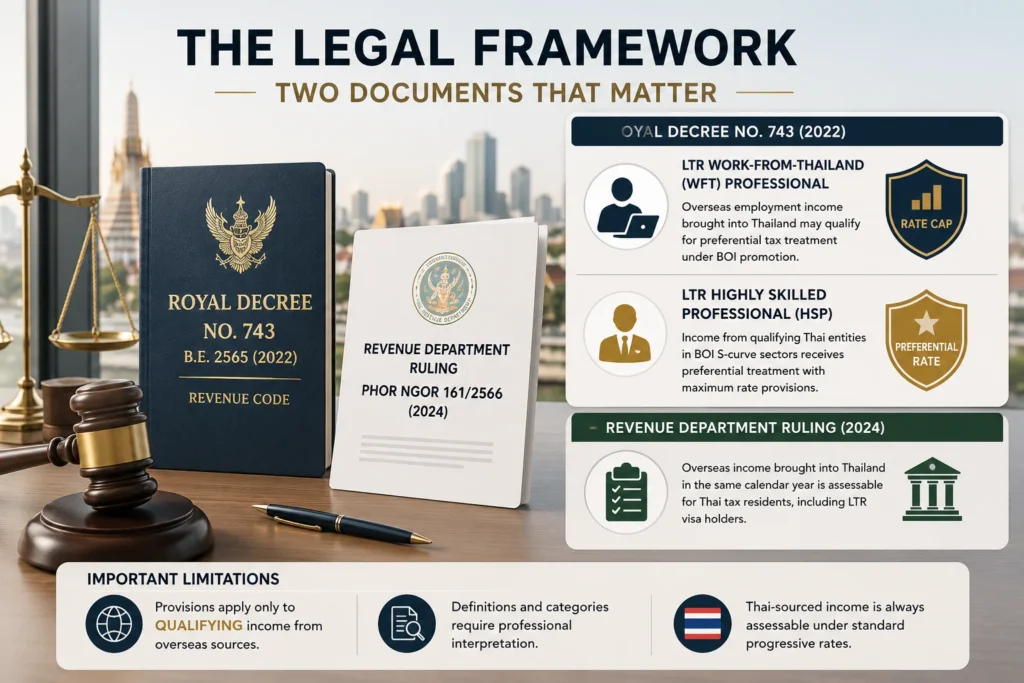
The Legal Framework: Two Documents That Matter
1. Royal Decree No. 743 B.E. 2565 (2022)
Royal Decree No. 743 was issued under the Revenue Code to provide specific tax provisions for qualifying BOI-promoted visa holders, including LTR Visa categories. The key provision for LTR WFT and HSP holders:
ROYAL DECREE NO. 743 — KEY PROVISIONS For LTR Work-From-Thailand (WFT) Professional holders: Income from overseas employment with foreign employers or from overseas clients brought into Thailand may qualify for preferential personal income tax treatment under BOI promotionThe preferential treatment is framed as a rate cap — income tax not to exceed the BOI-promoted specialist rate — rather than complete exemption For LTR Highly Skilled Professional (HSP) holders: Income from employment with qualifying Thai entities in BOI S-curve sectors receives similar preferential treatmentIncome from the qualifying Thai employer: maximum rate provisions under BOI specialist provisions Important limitation of Royal Decree No. 743: The provisions apply to QUALIFYING income from overseas sources. Specific income categories and definitions of qualifying income under the Royal Decree require careful professional interpretation.The provisions do not exempt all income. Thai-sourced income is always assessable under standard progressive rates.
2. Revenue Department Ruling Phor Ngor 161/2566 (2024)
The 2024 Revenue Department ruling established that overseas income brought into Thailand in the same calendar year it is earned is assessable income for Thai tax residents. This ruling applies to all Thai tax residents, including LTR Visa holders.
HOW ROYAL DECREE 743 AND THE 2024 RULING INTERACT The 2024 ruling establishes that same-year overseas income brought into Thailand IS assessable — this applies to LTR holders as it does to everyone. Royal Decree No. 743 then provides that for qualifying LTR WFT/HSP income that IS assessable (per the 2024 ruling), the applicable rate may be capped at the BOI specialist rate rather than standard progressive rates. Net effect: LTR WFT holders who bring overseas income into Thailand same year do owe Thai income tax on that income. BUT: the effective rate may be significantly lower than for equivalent non-LTR Thai tax residents at the same income level. The interaction between these two instruments is actively being interpreted by Thai tax advisors. Professional consultation is essential for any significant income planning.
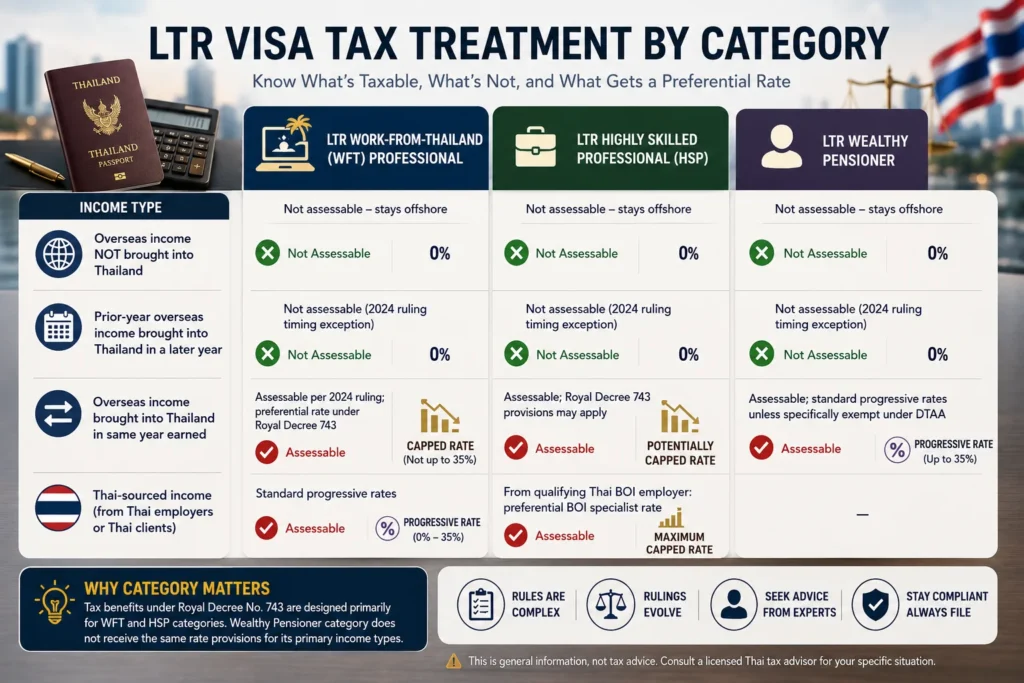
LTR Visa Tax Treatment by Category
LTR Work-From-Thailand (WFT) Professional
Income Type
Tax Treatment
Assessable?
Rate
Overseas income NOT brought into Thailand
Not assessable — stays offshore
❌ No
0% (not in Thai tax base)
Prior-year overseas income brought into Thailand in a later year
Not assessable (2024 ruling timing exception)
❌ No
0%
Overseas income brought into Thailand in same year earned
Assessable per 2024 ruling; preferential rate under Royal Decree 743
✅ Yes
Capped rate rather than progressive up to 35%
Thai-sourced income (from Thai employers or Thai clients)
Standard progressive rates
✅ Yes
0%–35% progressive
LTR Highly Skilled Professional (HSP)
Income Type
Tax Treatment
Assessable?
Rate
Employment income from qualifying Thai BOI employer
Preferential BOI specialist rate under Royal Decree 743
✅ Yes
Maximum capped rate (BOI specialist provision)
Overseas income NOT brought into Thailand
Not assessable
❌ No
0%
Overseas income brought into Thailand same year earned
Assessable; Royal Decree 743 provisions may apply
✅ Yes
Potentially capped rate
LTR Wealthy Pensioner
Income Type
Tax Treatment
Assessable?
Notes
Pension income NOT brought into Thailand
Not assessable
❌ No
Stays offshore; no Thai tax
Pension/investment income brought into Thailand same year earned
Standard progressive rates unless specifically exempt under DTAA
✅ Yes
No specific Royal Decree 743 rate cap for Pensioner category; seek advisor
Prior-year passive income brought into Thailand later
Not assessable (2024 ruling timing)
❌ No
Prior-year income timing exception
WHY CATEGORY MATTERS FOR LTR TAX TREATMENT The tax benefits under Royal Decree No. 743 are designed primarily for WFT and HSP categories, reflecting their active professional and employment relationships. The Wealthy Pensioner and Wealthy Global Citizen categories do not receive the same rate provisions under the Royal Decree for their primary income types. Each category’s tax position requires separate analysis.
The Rate Cap Benefit: How It Compares to Standard Thai Tax
To understand the actual financial value of LTR Visa tax provisions for WFT holders, here is a comparison at different income levels:
Annual Income (USD)
Annual Income (THB approx.)
Standard Thai Tax (progressive, after basic deductions)
With LTR WFT Provisions (max capped rate, after deductions)
Annual Saving (approx.)
USD 40,000
THB 1,400,000
Approximately THB 175,000 (12.5% effective)
Lower than standard — exact amount requires professional calculation
Meaningful but requires calculation
USD 80,000
THB 2,800,000
Approximately THB 525,000 (18.75% effective)
Lower under capped rate provisions
Potentially THB 50,000–150,000 per year
USD 120,000
THB 4,200,000
Approximately THB 925,000 (22% effective)
Significantly lower under cap vs progressive
Most material benefit at higher incomes
WHY EXACT NUMBERS ARE NOT GIVEN HERE The exact effective rate under Royal Decree No. 743 provisions for LTR WFT holders requires professional interpretation of: The specific income types that qualify under the Royal DecreeHow deductions interact with the rate cap provisionsThe interaction with the 2024 Revenue Dept. ruling on assessable incomeIndividual DTAA treaty credits that may further reduce liability The worked example table above shows directional comparisons. For precise calculations: consult a Thai tax advisor who handles LTR Visa tax matters specifically. This is a specialized area.
What Is Definitely NOT Exempt Under LTR Visa
To prevent the common misconception that LTR Visa eliminates all Thai tax obligations, here is a clear list of what the LTR Visa does NOT do:
WHAT LTR VISA DOES NOT DO — IMPORTANT CLARIFICATIONS Does NOT eliminate the 180-day Thai tax residency test. LTR holders who spend 180+ days in Thailand are Thai tax residents subject to Thai tax law.Does NOT make Thai-sourced income tax-free. Any income from Thai employers, Thai clients, or Thai-based business activities is subject to standard progressive rates.Does NOT eliminate the Thai personal income tax filing obligation. LTR Visa holders who are Thai tax residents must file Form PND 90 by March 31 of the following year.Does NOT make all overseas income non-assessable. Overseas income brought into Thailand in the same year it is earned is assessable per the 2024 Revenue Department ruling.Does NOT provide absolute clarity on the exact rate cap. The precise provisions under Royal Decree No. 743 and their interaction with the 2024 ruling are subject to professional interpretation.
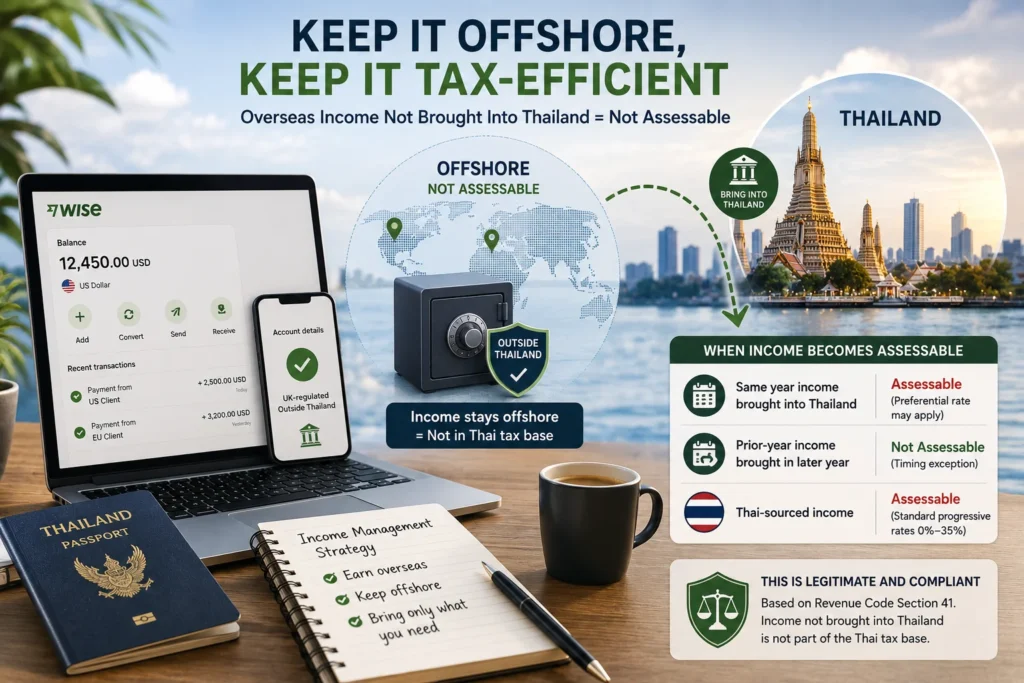
Income Not Brought Into Thailand: The Most Reliable ‘Exemption’
The most straightforward and universally applicable ‘exemption’ for LTR holders — and indeed for all Thai tax residents — is keeping overseas income outside Thailand:
THE OFFSHORE INCOME STRATEGY Overseas income that is NOT brought into Thailand is not assessable for Thai tax residents, per Revenue Code Section 41. How this works in practice for LTR WFT holders: USD income from overseas clients received into Wise (UK-regulated, outside Thailand) and NOT converted/transferred to a Thai bank in the same year it was earned: Not assessable in Thailand for that tax year USD income from 2025, held in Wise or overseas bank through December 31, 2025, then transferred to Thailand in 2026: Assessable in 2025 (when earned)? No, per the timing exception. This is prior-year income in 2026.The practical implication: LTR WFT holders who receive USD income in Wise but only transfer what they need for Thai expenses (while leaving the remainder offshore) can manage the assessable income amount Important: This is not tax avoidance — it is the application of Revenue Code Section 41 as it exists. Income kept offshore is not brought into Thailand and is therefore not in the Thai tax base. Note: For income management strategy specific to your situation, consult a Thai tax advisor. The offshore income approach has legitimate tax basis but individual application varies.
LTR Visa Filing Requirements: What You Must Do
Regardless of LTR Visa provisions or income exemptions, the following filing obligations apply to LTR holders who are Thai tax residents (180+ days):
Obligation
Detail
Deadline
Consequence of Missing
Obtain Thai Tax Identification Number (TIN)
From Revenue Department district office near your Thai address. Bring passport + TM30.
Before filing
Cannot file without TIN; administrative issues
File Form PND 90
Personal Income Tax Return for all income types (overseas, investment, etc.). Online: efiling.rd.go.th
March 31 following year
Penalty: 1.5%/month on unpaid tax (up to 20%)
Declare all assessable income
Include all Thai-sourced income and overseas income brought into Thailand in same year
As part of PND 90
Non-declaration can be treated as tax evasion
Claim Royal Decree 743 provisions
Work with qualified Thai tax advisor to claim LTR WFT preferential rate provisions correctly
At time of PND 90 filing
May overpay tax without claiming available provisions
Document DTAA credits
Keep proof of foreign taxes paid on same income for DTAA credit claims
INDIA-SPECIFIC LTR TAX GUIDE For Indian nationals on LTR Visa in Thailand: Tax residency status assessment: If spending 180+ days in Thailand AND fewer than 182 days in India per financial year (April–March): Thai tax resident AND Indian NRIAs Indian NRI: Indian tax obligation limited to India-sourced income (dividends from Indian companies, rental income from Indian property, etc.)As Thai tax resident: Thai tax obligation on assessable income including same-year overseas income brought into Thailand India-Thailand DTAA application for LTR holders: DTAA prevents double taxation. Indian NRI status + Thai tax resident = primarily Thai tax jurisdiction on overseas active income Indian advance tax or TDS on the same income: DTAA credit mechanism allows credit against Thai tax Practical filing for Indian LTR WFT holders: India: File ITR as NRI. Report NRE account. India-sourced income taxable in India. DTAA protection for Thailand-taxed income. Thailand: File PND 90. Report same-year overseas income brought into Thailand. Claim Royal Decree 743 LTR WFT provisions. Claim DTAA credit for any Indian taxes paid on same income. Recommended: Engage both an Indian CA with international tax experience AND a Thai tax advisor with LTR Visa expertise for coordinated cross-border filing.
PHILIPPINES-SPECIFIC LTR TAX GUIDEFor Filipino nationals on LTR Visa in Thailand: BIR obligations continue regardless of Thailand residence: Filipino nationals generally maintain Philippine BIR filing obligations regardless of tax residence location BIR Form 1701 should reflect all income from all sources Philippine non-resident alien status may apply if you have established clear non-Philippine residence — seek CPA advice Philippines-Thailand tax treaty for LTR holders: Treaty prevents double taxation. Thai income tax paid on Thai-assessable income can be credited against Philippine tax liability on the same income Ensures you do not pay full rates in both countries on the same overseas income Practical filing for Filipino LTR WFT holders: Philippines: File ITR 1701. Credit Thai taxes paid on same income under treaty credit mechanism. Consult Philippine CPA on non-resident filing implications. Thailand: File PND 90. Claim LTR WFT Royal Decree 743 provisions. Claim Philippines-Thailand treaty credits. LTR Visa benefit for Filipinos: The rate cap provisions under Royal Decree 743 reduce Thai tax on qualifying overseas income brought into Thailand. Combined with the Philippines-Thailand treaty, this can make Thailand a tax-efficient base for high-earning Filipino remote workers.
Common LTR Visa Tax Misconceptions
Misconception
Reality
‘LTR Visa makes all income tax-free in Thailand’
Incorrect. LTR Visa provides preferential rate treatment on qualifying overseas income under Royal Decree 743, not complete tax exemption. Thai-sourced income is taxed at standard rates. Filing obligations persist.
‘I don’t need to file taxes in Thailand with LTR Visa’
Incorrect. Thai tax residents (180+ days) must file Form PND 90 by March 31 regardless of LTR Visa status or whether they owe tax.
‘The LTR Visa tax benefit means I pay 17% flat on all my income’
Partially incorrect. The rate cap applies to qualifying overseas income categories under Royal Decree 743. Exact application requires professional interpretation and depends on income composition.
‘Keeping money in Wise is a tax avoidance scheme’
Incorrect. Overseas income not brought into Thailand is simply not in the Thai tax base — this applies to all Thai tax residents, not just LTR holders. It is the application of Revenue Code Section 41 as written.
Incorrect. The 2024 ruling applies to all Thai tax residents including LTR Visa holders. Royal Decree 743 provides rate benefits on assessable income; it does not override the assessability rules.
Frequently Asked Questions
What income is tax exempt on the Thailand LTR Visa?
The LTR Visa does not create a blanket tax exemption. Two types of income are effectively non-assessable: (1) overseas income NOT brought into Thailand (this applies to all Thai tax residents, not just LTR holders), and (2) prior-year overseas income transferred to Thailand in a later year. For qualifying overseas income that IS brought into Thailand in the same year it was earned, LTR WFT and HSP holders may benefit from a capped income tax rate under Royal Decree No. 743 B.E. 2565, rather than standard progressive rates up to 35%.
Does the LTR Visa eliminate Thai income tax?
No. The LTR Visa provides preferential tax treatment on qualifying overseas income under Royal Decree No. 743, but does not eliminate Thai income tax. Thai-sourced income is subject to standard progressive rates. LTR holders who are Thai tax residents (180+ days) must file Form PND 90 annually. The benefit is a potential rate cap on qualifying overseas income brought into Thailand, not complete exemption.
How does the 2024 Revenue Department ruling affect LTR Visa holders?
The 2024 ruling (Phor Ngor 161/2566) applies to LTR Visa holders the same as all Thai tax residents: overseas income earned and brought into Thailand in the same calendar year is assessable. Royal Decree No. 743 provides that for qualifying LTR WFT income that is assessable, a preferential rate cap may apply rather than full progressive rates. The two instruments work together: the 2024 ruling determines assessability; Royal Decree 743 determines the applicable rate for qualifying LTR income.
Do LTR Visa holders still need to file Thai tax returns?
Yes. LTR Visa holders who spend 180 or more days in Thailand in a calendar year are Thai tax residents and must file Form PND 90 (Personal Income Tax Return) by March 31 of the following year. This filing obligation exists regardless of whether you owe tax. Failure to file when required can result in penalties.
How do India-Thailand DTAA provisions interact with LTR Visa tax treatment for Indian nationals?
For Indian LTR WFT holders who are also Indian NRIs: Thai tax applies to qualifying overseas income brought into Thailand (with preferential rate cap under Royal Decree 743). India taxes only India-sourced income for NRIs. The India-Thailand DTAA prevents double taxation by providing credit for taxes paid in one country against liability in the other. Thai and Indian filing obligations coexist but do not create double taxation.
Final Verdict: The Honest Assessment of LTR Visa Tax Benefits
The Thailand LTR Visa tax provisions provide genuine, meaningful financial benefits — but not in the form of complete tax exemption. The honest assessment: What works: Overseas income not brought into Thailand is not in the Thai tax base (applies to all Thai residents). For income that is brought into Thailand, qualifying LTR WFT holders may benefit from a capped rate rather than standard progressive rates up to 35%. At higher income levels, this rate cap benefit becomes increasingly significant. What requires professional guidance: The exact application of Royal Decree No. 743 to specific income types, the interaction with the 2024 Revenue Department ruling, and the integration with home-country tax treaty provisions are all areas requiring specialized professional advice. The provisions are real; their precise application is complex. The bottom line: The LTR Visa offers a more favorable tax position than equivalent non-LTR Thai tax residency for qualifying overseas income, but it is not a zero-tax solution. Budget for Thai income tax as a real cost. Engage a specialized Thai tax advisor before making income transfer or timing decisions. See the Thailand 180-Day Rule guide for residency determination and the Thailand Tax Residency Guide for the complete tax framework.