DISCLAIMER This article provides general educational guidance on Thai income tax reporting for digital nomads. It is NOT tax advice. Thai tax law is complex and individual circumstances vary. Always engage a licensed Thai tax advisor before filing. Filing requirements and procedures are subject to change.
AI OVERVIEW SUMMARY Thai tax residents (180+ days in Thailand per calendar year) must understand how to report foreign income Thailand digital nomads and report overseas income that is assessable under Thai law — specifically overseas income brought into Thailand in the same calendar year it is earned, per the 2024 Revenue Department ruling (Phor Ngor 161/2566). The reporting process has seven practical stages: (1) confirm Thai tax residency, (2) identify assessable vs non-assessable income, (3) classify income under the correct Thai Revenue Code Section (40(1)–40(8)), (4) calculate allowable deductions for each income type, (5) choose the correct form (PND 90 for most nomads; PND 91 only for salary-only Thai employees), (6) apply DTAA treaty credits if applicable, and (7) file online at efiling.rd.go.th by March 31. Key document: the Wise 12-month PDF export is the most important income record for freelancers and platform earners. Late filing penalty: 1.5% per month on unpaid tax, up to 20%. Non-filing penalty: up to 100–200% of unpaid tax.
QUICK ANSWER: How do digital nomads report overseas income in Thailand? The 8-step process for Thai tax residents reporting overseas income: Step 1: Confirm 180+ days in Thailand (triggers filing obligation)Step 2: Identify assessable income (overseas income transferred to Thailand in same year earned)Step 3: Classify income type (Section 40(1) employment vs 40(8) freelance/other)Step 4: Calculate deductions (personal allowance + income-type-specific deduction)Step 5: Choose form: PND 90 (most nomads) vs PND 91 (salary only, no other income)Step 6: Apply DTAA credits if home country taxes paid on same income Step 7: File online at efiling.rd.go.th by March 31Step 8: Pay any tax due via online banking or Revenue Dept. office
Introduction: From Understanding to Filing
Most Thailand tax guides explain the framework — the 180-day rule, the 2024 ruling, the progressive rates. This article is different: it is the operational guide for what to actually do when you sit down to file your Thai income tax return. The sequence matters, the income classifications have real financial consequences, and the form choice is not obvious for nomads with mixed income types.
This guide follows the eight-step filing process, explains the income classification system that determines your deduction amounts, shows you which form to use and why, and covers the documentation you need at your side when filing. Read this alongside the Thailand Tax Residency Guide and the Thailand RD e-Filing Guide for the complete filing system.
Step 1: Confirm Thai Tax Residency (The Filing Trigger)
STEP 1
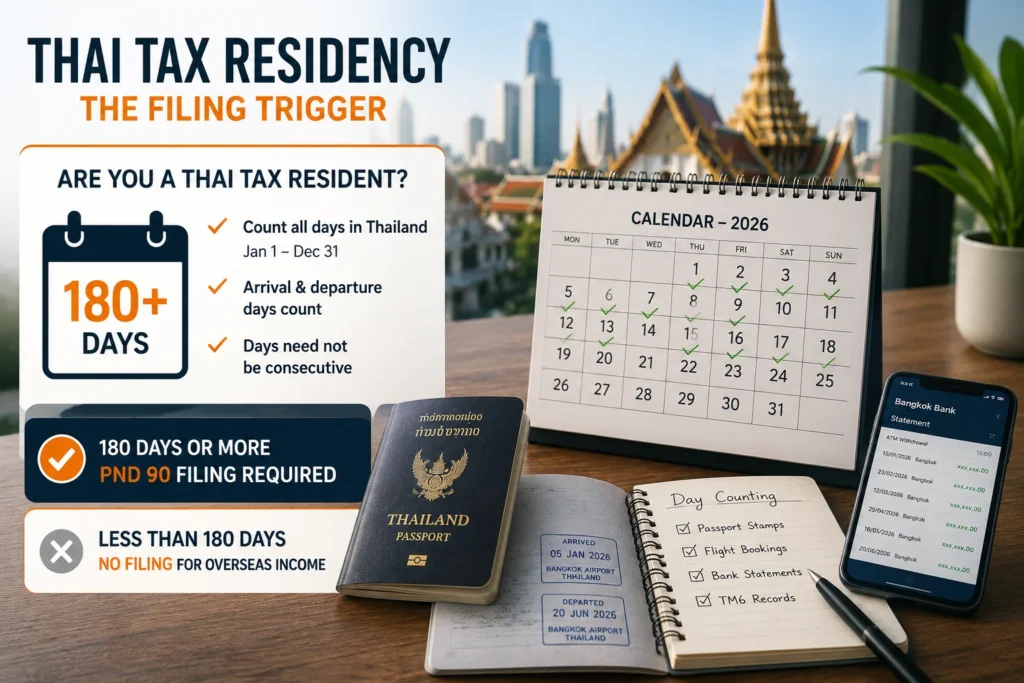
Confirm whether you are a Thai tax resident for this calendar year Count all days you were physically present in Thailand during January 1 to December 31 of the tax year. Day of arrival and day of departure both count. Days need not be consecutive. If total = 180 or more: you are a Thai tax resident. Filing PND 90 is required. ⚡ If you spent fewer than 180 days in Thailand: you are not a Thai tax resident. No Thai filing obligation for overseas income. Only Thai-sourced income (e.g., from a Thai employer) requires reporting.
DAY-COUNTING REFERENCE Use your passport stamps as the primary record. Supplement with flight bookings, Thai bank statement entry dates, and TM6 (departure card) records. If you have a Thai bank account, your statement will show ATM withdrawals at Bangkok ATMs confirming physical presence dates. If your day count is 179 or fewer: stop here. No PND 90 filing required for overseas income. If your day count is 180 or more: proceed to Step 2.
Step 2: Identify Your Assessable vs Non-Assessable Income
STEP 2
Separate assessable income from non-assessable income Go through your full-year Wise transaction history, Bangkok Bank and KBank statements, and Upwork/Fiverr earnings statements. For each income receipt, apply the 2024 ruling test. ⚡ The most common mistake: nomads include ALL overseas income in their Thai return when only income transferred to Thailand in the same year it was earned is assessable. Income kept in Wise offshore and not transferred is not assessable.
Income Type
Assessable?
Test
Example
Thai-sourced income (Thai employer, Thai clients)
YES — always
Was the work performed in Thailand for a Thai entity? Yes = assessable
Freelance work for a Bangkok startup paid in THB
Overseas income brought into Thailand in same year earned
Was it earned in 2026 AND transferred to your Thai bank/converted to THB in 2026?
USD 3,000 earned from US client in March 2026, transferred to KBank in June 2026
Overseas income kept in Wise/offshore and NOT transferred to Thailand
NOT assessable
Did it stay in Wise or overseas bank through December 31?
USD 15,000 accumulated in Wise, never sent to Thai bank in 2026
Prior-year overseas income transferred in current year
Generally NOT assessable
Was it earned in 2025 or earlier, held offshore, then brought into Thailand in 2026?
USD saved in 2025, transferred to KBank in February 2026
Overseas income brought to Thailand in same year via Wise card spending
Interpretation unclear
Using Wise card to pay Thai merchants: is this ‘bringing into Thailand’?
Paying Grab taxi from Wise USD balance — seek professional advice
THE WISE CARD QUESTION — SEEK PROFESSIONAL GUIDANCE A commonly asked question: If I use my Wise card to pay for Thai groceries, is that ‘bringing overseas income into Thailand’ under the 2024 ruling? The answer is not definitively settled in Thai regulatory guidance. Most Thai tax professionals interpret ‘brought into Thailand’ as requiring a bank transfer or cash exchange into THB — not mere spending from an overseas card. However, until the Revenue Department issues explicit guidance on Wise card spending, nomads who rely heavily on Wise card for Thai daily expenses should seek a Thai tax advisor’s opinion on how to treat these amounts. The safest documentation approach: maintain a clear record distinguishing Wise amounts spent in Thailand vs Wise amounts transferred to Thai bank accounts.
Step 3: Classify Your Income Under the Thai Revenue Code
STEP 3
Classify each income stream under Revenue Code Section 40(1)–40(8) The income Section determines your allowable deduction rate. Misclassifying income means either under-deducting (paying more tax than required) or over-deducting (a filing error). Match each income stream to the correct section. ⚡ For most digital nomads: overseas salary from an employer = Section 40(1). Freelance consulting or platform income = Section 40(8). Getting this right directly affects your deductible amount.
Revenue Code Section
Income Type
Standard Deduction
Common Digital Nomad Examples
Section 40(1)
Employment income from employer (salary, wages, bonuses)
Startup advisors; board member fees from overseas company
Section 40(3)
Goodwill, copyright, and other rights (royalties)
50% of income, maximum THB 100,000
Software licensing fees; IP royalties; creative rights income
Section 40(4)
Dividends, shares of profits, partnership distributions
None (fixed 0% or 10% withholding credit depending on type)
Dividends from overseas investments brought into Thailand same year
Section 40(5)
Rental income from property
30% fixed or actual expenses
Thai property rental; overseas property rental brought into Thailand
Section 40(6)
Professional services income (doctors, lawyers, architects, engineers, accountants)
30% fixed or actual expenses
Independent professional consultants in licensed professions
Section 40(7)
Contracting income (construction, engineering, other contracting work)
60% fixed or actual expenses
Civil engineers, contractors, site managers doing overseas project work
Section 40(8)
All other income (residual category)
60% fixed, or actual documented expenses
Freelance developers, digital marketers, Upwork/Fiverr income, content creators, SEO consultants, VAs
THE 40(1) vs 40(8) DECISION FOR NOMADS — WHICH APPLIES TO YOU? If you receive a monthly salary from an overseas company that you are employed by (W-2, payslip, employment contract with clear employment relationship): Section 40(1). Deduction: 50%, max THB 100,000. If you are a freelancer, independent contractor, or platform worker (Upwork, Fiverr, Toptal) who invoices clients or earns project-based fees: Section 40(8). Deduction: 60% fixed OR actual documented business expenses. Mixed income: If you have both overseas salary (40(1)) AND freelance income (40(8)): report both sections in PND 90. Apply each section’s deduction independently. This is common for nomads who do client work alongside an employer engagement.
Step 4: Calculate Allowable Deductions
STEP 4
Apply all allowable deductions to reduce net assessable income After determining income by Section, apply: (a) the Section-specific standard deduction, (b) personal allowances, (c) any additional eligible deductions. This is where many nomads leave money on the table by only claiming the personal allowance and forgetting other eligible deductions. ⚡ 60% standard deduction on Section 40(8) income is often larger than most nomads realize. At THB 1,200,000 freelance income: 60% = THB 720,000 deducted. Only THB 480,000 is assessable before other allowances.
Deduction
Amount (THB)
Notes
Personal allowance
60,000
All Thai tax filers
Spouse allowance
60,000
If legally married, spouse has no/low income
Child allowance
30,000 per child
Children under 20 or in full-time education
Section 40(1) standard deduction
50% of income, max 100,000
Employment/salary income only
Section 40(8) standard deduction
60% of income (no cap) OR actual expenses
Freelance/other income; choose whichever is higher
Life insurance premiums
Up to 100,000
Thai-qualifying policies
Health insurance premiums
Up to 25,000
Personal premiums + additional for parents
SSF (Super Savings Fund) contributions
Up to 30% of income, max 200,000
Thai investment vehicle; reduces assessable income
Charitable donations
Up to 10% of net income after other deductions
BOT-approved charities in Thailand
Step 5: Choose the Correct Form — PND 90 vs PND 91
STEP 5
Select PND 90 or PND 91 based on your income composition Most digital nomads file PND 90. PND 91 is only for people with EXCLUSIVELY Section 40(1) employment income (Thai employer salary) and no other income types. If you have any overseas income, any freelance income, or any combination of income types: use PND 90. ⚡ When in doubt, use PND 90. It covers all income types. PND 91 is a simpler form for straightforward Thai employment-only situations — it is not designed for nomads with overseas or mixed income.
Form
Who Should Use It
Income Types Covered
Filing Method
PND 90
All Thai tax residents with overseas income, freelance income, investment income, or multiple income types
All Section 40(1–8) income types; DTAA credits; all deductions
Online: efiling.rd.go.th; or in-person at Revenue Dept. district office
PND 91
ONLY Thai-employed individuals with exclusively Section 40(1) salary from Thai employer, no other income sources
Section 40(1) only; standard Thai payroll deductions
Online: efiling.rd.go.th; or in-person
NOMADS WITH ONLY OVERSEAS EMPLOYER INCOME: USE PND 90 A common mistake: a nomad employed by an overseas company (not a Thai employer) receiving only overseas salary thinks they can use PND 91. This is incorrect. PND 91 is designed for Thai employees on Thai payroll. Nomads with overseas employment income — even if it is their only income type — must use PND 90, as their income situation involves overseas sources that require full disclosure in the more comprehensive form.
Step 6: Apply DTAA Tax Credits (If Applicable)
STEP 6
Claim treaty credits for taxes paid in your home country on the same income If you have paid income tax in India, Philippines, UK, or another treaty country on income that is also taxable in Thailand, you may be able to claim a credit in Thailand for those foreign taxes paid. This prevents double full taxation on the same income. ⚡ For Indian NRIs: India does not tax overseas active income. DTAA credit in Thailand for Indian taxes is unlikely to apply. For Philippine resident citizens: Philippine income tax on the same income that Thailand has taxed can be used as a credit in Thailand (or vice versa on the Philippine return).
DTAA CREDIT DOCUMENTATION REQUIRED Proof of foreign tax paid: Tax payment acknowledgement from home country (e.g., Indian ITR acknowledgement, Philippine BIR 1701 acknowledgement)Amount of foreign tax paid in THB equivalent at RBI / BIR reference rate on payment dateApplicable DTAA article: Specify which treaty article allocates taxing rights for this income typeIncome documentation: Show the same income appears on both the Thai return and the home-country return
Step 7 & 8: File PND 90 Online and Pay
STEP 7
File PND 90 at efiling.rd.go.th by March 31 Log in to the Thailand Revenue Dept. e-filing portal. Enter income by Section (40(1), 40(8), etc.), apply deductions, enter DTAA credits, and submit. Deadline: March 31 of the year FOLLOWING the tax year (e.g., March 31, 2027 for tax year 2026). ⚡ Use the RD portal in desktop browser — the mobile version can be inconsistent. Have all documentation ready before starting the online form: Wise PDF, bank statements, deduction receipts. The portal saves progress, but sessions time out after inactivity.
STEP 8
Pay any tax due After submitting PND 90, pay any tax balance via: (1) Online banking (Krungthai, KBank, Bangkok Bank linked directly in the RD portal); (2) Counter payment at any major Thai bank; (3) In-person at Revenue Dept. office. If overpaid (withholding tax exceeds liability), a refund can be claimed on the same PND 90 form. ⚡ If the calculated tax is higher than expected: the filing is still the correct action. Unpaid tax with a filed return carries only the late payment surcharge (1.5%/month). Unfiled returns with unpaid tax carry both the surcharge AND the non-filing penalty.
Complete Documentation Checklist
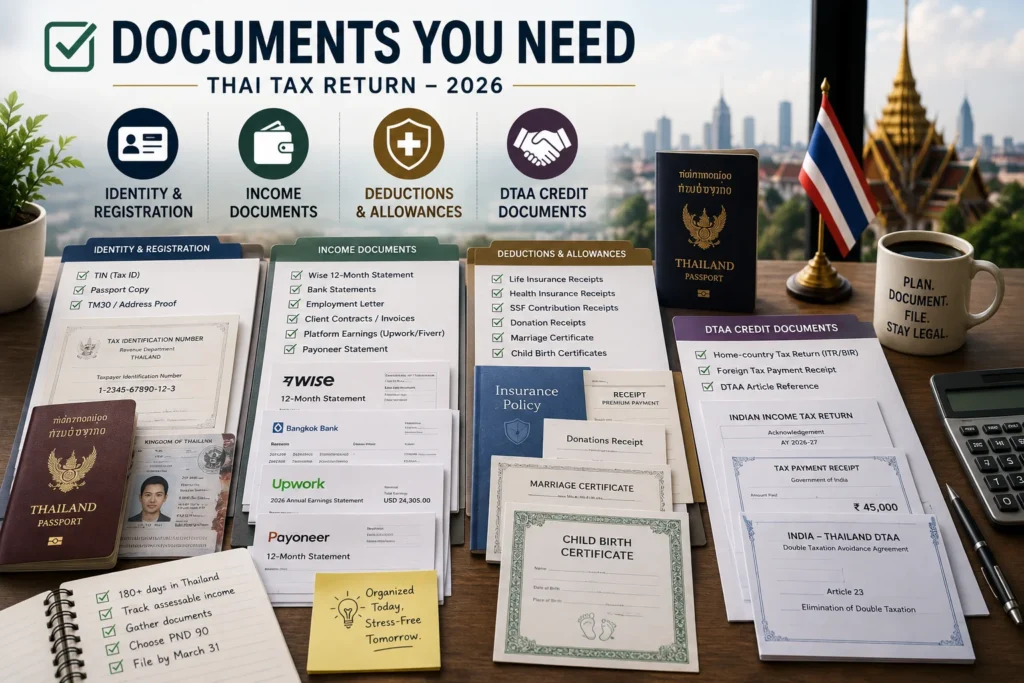
DOCUMENTS NEEDED AT FILING Identity and Thai tax registration: Thai Tax Identification Number (TIN) — obtain from Revenue Dept. district office if not yet registeredPassport copyTM30 (residence notification) or Thai address evidence Income documentation: Wise 12-month PDF transaction history — primary income record for most nomadsBangkok Bank / KBank statements (6–12 months) showing overseas income receiptsEmployment letter from overseas employer (for Section 40(1) income)Client contracts and/or invoices (for Section 40(8) freelance income)Upwork/Fiverr annual earnings statement (for platform income)Payoneer 12-month statement if income routed through Payoneer Deduction documentation: Life insurance policy + premium payment receipts (for insurance deduction)Health insurance policy + premium receiptsSSF contribution receiptsCharitable donation receipts from approved organizationsMarriage certificate (for spouse allowance)Child birth certificates (for child allowance) DTAA credit documentation (if applicable): Home-country tax return acknowledgement (Indian ITR, Philippine BIR 1701)Foreign tax payment receipt / Form 16A equivalentDTAA article reference for the applicable income type
How to Get Your Thai Tax Identification Number (TIN)
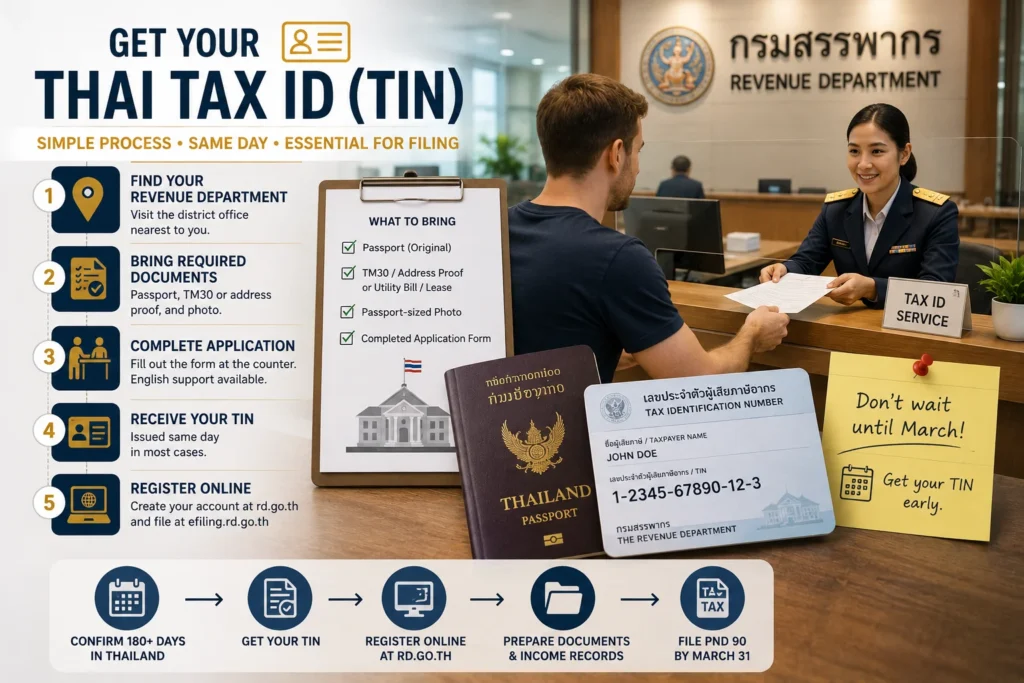
If you are a Thai tax resident who has not yet obtained a Thai TIN, you must do this before filing. The process:
Identify your nearest Revenue Department district office. In Bangkok: multiple offices (Huay Kwang, Ratchathewi, Silom area). In Chiang Mai: Revenue Department Chiang Mai. In Pattaya: Revenue Department Chonburi.
Bring: original passport, TM30 (residence notification from your landlord/hotel) or utility bill/lease showing your Thai address, and passport-sized photograph.
Complete the TIN application form at the counter. Staff who speak English are available at most major offices.
Receive your TIN: issued same day in most cases. This is your Tax ID for all future Thai filings.
Register for online tax account at rd.go.th using your TIN. This enables e-filing at efiling.rd.go.th.
WHEN TO GET YOUR TIN Do not wait until March to obtain your TIN. If you are approaching 180 days in Thailand mid-year, obtain your TIN at that point. Some nomads obtain it in July or August after confirming they will exceed 180 days by year-end. Early registration avoids the late-January to mid-March rush at Revenue Dept. offices.
Penalties for Late Filing or Non-Filing
PENALTY STRUCTURE — WHAT NON-COMPLIANCE COSTS Late payment of tax due (filed return, tax paid late): Surcharge: 1.5% per month on the unpaid tax amountMaximum surcharge: 20% of unpaid tax (approximately 13 months of delay) Non-filing (did not file PND 90 when required): Penalty: 100% to 200% of the tax that should have been paidAdditional late payment surcharge: 1.5% per month on unpaid taxPotential criminal prosecution for willful non-compliance (rare; reserved for fraud cases) Incorrect filing (underdeclared income): If discovered on audit: 100% penalty on underpaid tax + 1.5% per month surcharge Enforcement reality: Active enforcement against individual digital nomads has been historically limited in Thailand. However, Thailand’s Revenue Department is developing more sophisticated data-matching capabilities. Bank transfers, visa records, and SWIFT reports can be cross-referenced. Filing correctly is the only risk-free path. The safe path: File PND 90 by March 31. Pay any tax due. Late filing with payment costs 1.5%/month on unpaid tax — far less than the penalties for not filing at all.
Frequently Asked Questions
How to report foreign income Thailand digital nomads?
Thai tax residents (180+ days in Thailand) report overseas assessable income on Form PND 90, filed online at efiling.rd.go.th by March 31. Assessable overseas income: overseas income earned and transferred to Thailand in the same calendar year. Classify income under the correct Revenue Code Section (40(1) for employment, 40(8) for freelance/platform). Apply Section-specific deductions + personal allowances. Apply DTAA credits if applicable. Pay any tax due.
Should I use PND 90 or PND 91 as a digital nomad?
PND 90 for virtually all digital nomads. PND 91 is only for people with exclusively Thai employer salary income and no other income types. If you have overseas income, freelance income, platform income, or any combination of income types: use PND 90. Even if you only have overseas salary from a foreign employer with no Thai sources: use PND 90, not PND 91.
What counts as assessable overseas income in Thailand?
Under the 2024 Revenue Department ruling (Phor Ngor 161/2566): overseas income earned and brought into Thailand in the same calendar year it was earned. ‘Brought into Thailand’ means transferred to a Thai bank account or converted to THB. Income kept in Wise or overseas bank without being transferred to Thailand: not assessable. Prior-year income transferred to Thailand in a later year: generally not assessable in the year of transfer.
What is the Thai tax filing deadline?
March 31 of the year following the tax year. For tax year 2026: file by March 31, 2027. Online via efiling.rd.go.th. In-person at Revenue Department district office. Late filing: 1.5% per month surcharge on unpaid tax, up to 20% maximum.
What documents do I need to file Thai taxes as a digital nomad?
Essential: Thai Tax ID (TIN), Wise 12-month PDF transaction history, bank statements (6–12 months) showing overseas income receipts, employment letter or client contracts. For deductions: insurance premium receipts, SSF contribution records. For DTAA credits: home-country tax return acknowledgement and payment receipts. Organize these before March to avoid filing deadline pressure.
Final Verdict: The Filing Process Is Manageable
Reporting overseas income in Thailand follows a clear eight-step process. The most important preparation steps — identifying assessable income, classifying it correctly under Section 40(1) or 40(8), and maximizing legitimate deductions — are worth doing carefully because they directly affect your tax amount. The Wise 12-month PDF export is the anchor document. The Revenue Code Section classification determines your deduction rate. PND 90 is the correct form for virtually all nomads. March 31 is the non-negotiable deadline. For a first-year filer: engage a Thai tax advisor who works with expats for the first year. The investment — typically THB 5,000–15,000 for a straightforward nomad return — pays for itself in correct deduction optimization and peace of mind. For second-year and beyond: many nomads file independently using the e-filing portal with their previous year’s return as a template. Read the Thailand RD e-Filing Guide for the complete portal walkthrough, or the Thailand Tax Residency Guide for the legal framework behind what you are reporting.