DISCLAIMER This guide provides general informational analysis of Bali and Indonesia’s visa and regulatory framework for digital nomads as of June 2026. It is NOT legal or immigration advice. Indonesian immigration law is subject to change and enforcement patterns vary. Always verify current requirements with official Indonesian immigration authorities (imi.imigrasi.go.id) and consult an immigration specialist before making decisions.
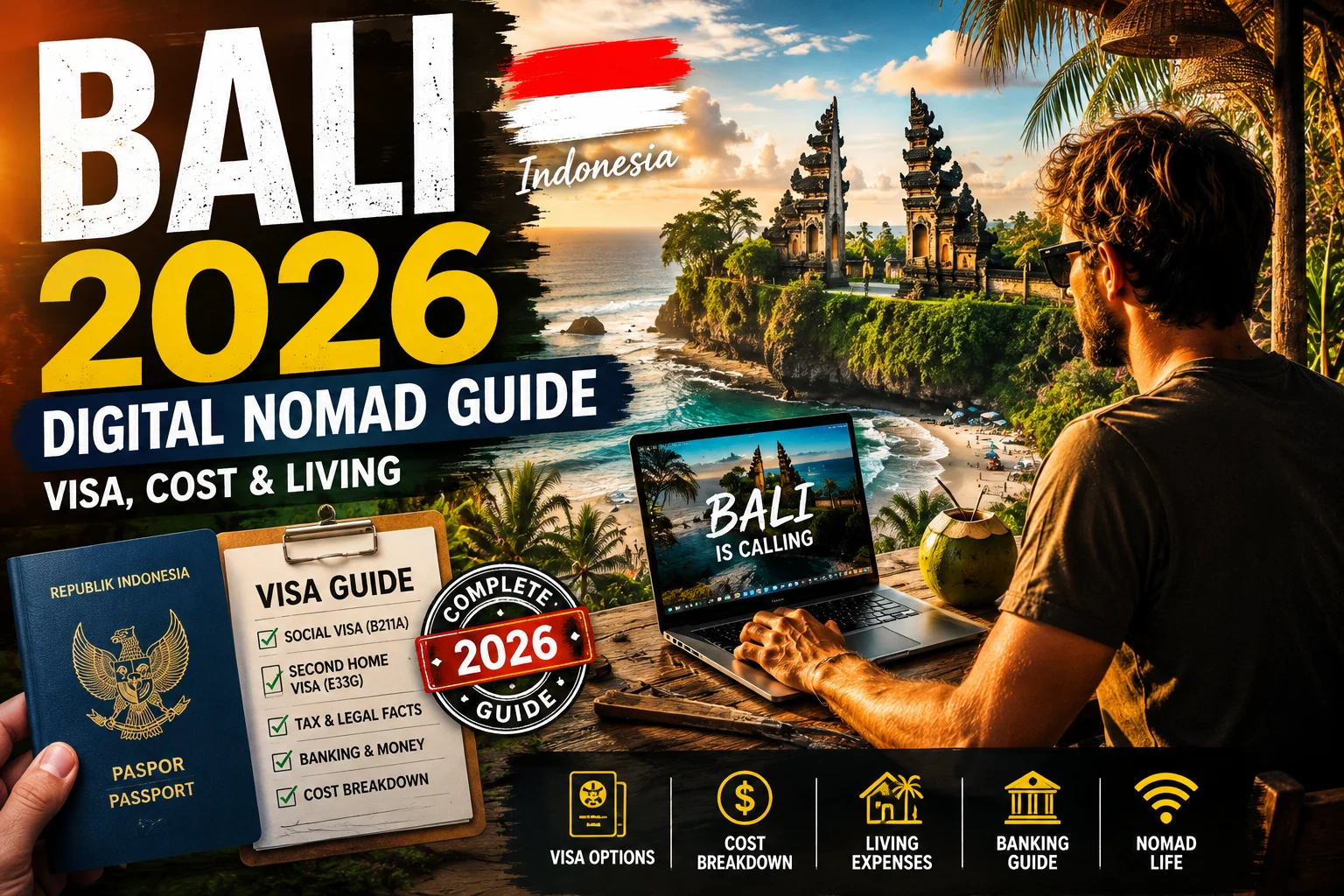
Bali is the world’s most recognized digital nomad destination, combining affordable living, world-class co-working infrastructure in Canggu, exceptional culture, and a warm nomad community. This Bali digital nomad guide explains that, however, it has a significant regulatory gap: there is no formal digital nomad visa equivalent to Thailand’s LTR or Malaysia’s DE Rantau. The Social Cultural Visa (B211A) provides the most accessible path to stays up to 180 days, though it requires an Indonesian sponsor. The E33G Second Home Visa (5-10 years) requires approximately USD 130,000 in accessible funds — beyond most nomads. Working for overseas clients while on a tourist or social visa is a legal grey area that carries meaningful (if historically inconsistent) enforcement risk. Cost: comfortable Canggu living runs USD 900-1,500/month (approximately ₹75,000-1,25,000/month or PHP 52,000-87,000/month). Indonesian banking for tourists is limited: Wise card + BCA ATM withdrawals is the practical setup. Unique advantage for Indian nomads: Bali is the only Hindu-majority province in Indonesia, creating deep cultural resonance through temples, ceremonies, and spiritual life that is directly familiar to Hindu Indian nomads.
QUICK ANSWER: Is Bali Good for Digital Nomads in 2026? Yes — with important caveats. Bali remains one of the world’s best digital nomad destinations on lifestyle grounds. But it is also the major nomad hub with the least formal legal framework for remote workers. Here is the honest picture: Visa: No formal digital nomad visa. Social Visa (B211A) = most practical path (sponsor required, up to 180 days). E33G = long-term but requires USD 130,000+ funds.Tax: No Indonesian income tax on overseas income for tourists/social visa holders. Overseas active income is outside Indonesian tax base.Banking: Indonesian bank accounts require a work permit (KITAS). Wise card + BCA ATMs = practical workaround.Cost: USD 900-1,500/month Canggu; USD 600-900/month Ubud. ₹75,000-1,25,000 or PHP 52,000-87,000/month.Community: Extraordinary. Canggu is among the world’s top-3 digital nomad communities by any measure. Bottom line: Go for the lifestyle, community, and culture. Manage the legal grey area with a Social Visa. Set realistic expectations on banking and enforcement risk.
Introduction: The World’s Most Iconic Nomad Destination
Bali became the world’s most talked-about digital nomad destination somewhere around 2015. It was not the first nomad hub — Chiang Mai and Berlin predated it — but nothing since has matched Bali for the specific combination it offers: affordable tropical living, a co-working scene that practically defined the concept of ‘working from paradise,’ a rich Hindu spiritual culture that feels unlike anywhere else in Southeast Asia, and a community of nomads so large and self-sustaining that arriving alone means you will not stay alone for long.
In 2026, Bali is different from the Bali of 2017. Canggu has gentrified. Prices have risen significantly from their pandemic-era lows. The Social Visa process requires more effort. The Indonesian government has introduced the E33G Second Home Visa but priced it beyond most nomads’ reach. And enforcement against foreigners working illegally has been more visible, if still inconsistent.
None of this has fundamentally changed Bali’s appeal. It has changed its character — from ‘cheap paradise for broke freelancers’ to ‘premium lifestyle destination for serious remote professionals.’ The community is more established, the infrastructure more mature, and the cultural draw as powerful as ever. This guide gives you the honest, complete picture of Bali in 2026: the visa reality, the cost reality, the banking reality, and why it remains on the shortlist of every nomad planning Southeast Asia.
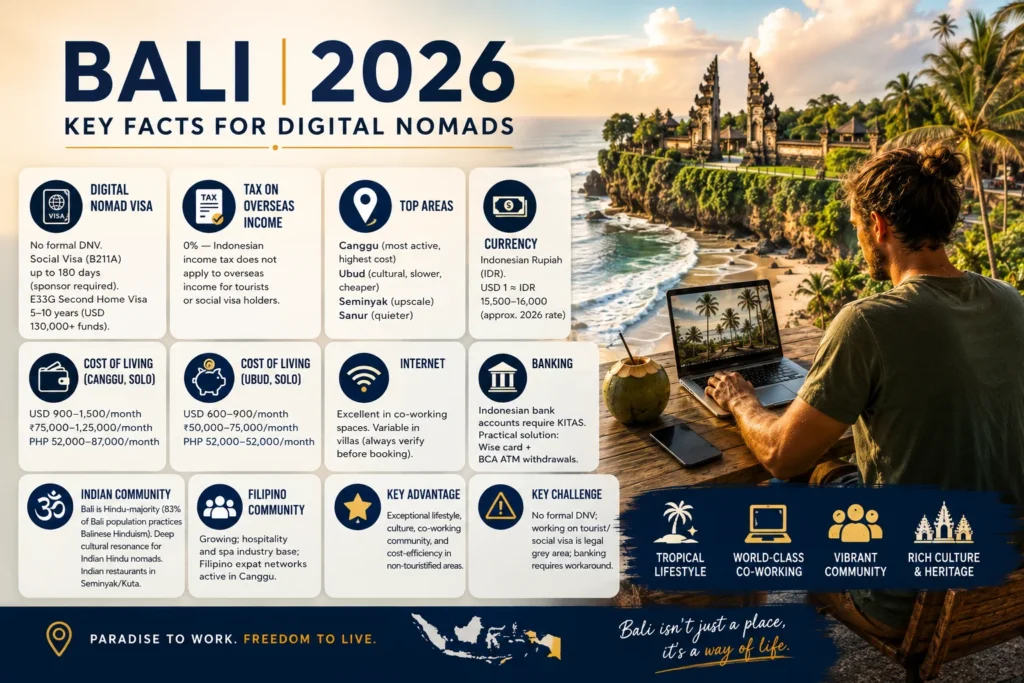
Bali at a Glance: Key Facts for Digital Nomads
Category
Bali 2026
Digital nomad visa
None formally. Social Cultural Visa (B211A) for up to 180 days (sponsor required). E33G Second Home Visa for 5-10 years (USD 130,000+ funds required).
Tax on overseas income
0% — Indonesian income tax does not apply to overseas income for tourists or social visa holders
Excellent in co-working spaces. Variable in villas (always verify before booking).
Banking
Indonesian bank accounts require KITAS. Practical solution: Wise card + BCA ATM withdrawals.
Indian community
Bali is Hindu-majority (83% of Bali population practices Balinese Hinduism). Deep cultural resonance for Indian Hindu nomads. Indian restaurants in Seminyak/Kuta.
Filipino community
Growing; hospitality and spa industry base; Filipino expat networks active in Canggu.
Key advantage
Exceptional lifestyle, culture, co-working community, and cost-efficiency in non-touristified areas
Key challenge
No formal DNV; working on tourist/social visa is legal grey area; banking requires workaround
The Visa Reality: Bali’s Regulatory Gap
This is the section most Bali nomad guides get wrong — usually by being either too dismissive (‘nobody cares, just work from a café’) or too alarming (‘you will be deported immediately’). The truth is more nuanced and more important to understand clearly.
Option 1: Visa on Arrival (VOA) / Tourist Visa (B213)
Factor
Details
Duration
30 days, extendable once to 60 days total
Fee
USD 35 at point of entry (paid in foreign currency)
Extension
Apply at Bali immigration office (Kantor Imigrasi) for 30-day extension: approximately IDR 500,000-600,000
Work authorization
None. Tourist visa is for tourism purposes only.
Who it works for
Short stays; initial exploration; nomads who rotate in and out of Bali every 60 days
Enforcement risk
Low to medium for overseas remote workers. Higher risk if visibly working for or with Indonesian entities.
Option 2: Social Cultural Visa (B211A) — The Practical Long-Stay Path
Factor
Details
Duration
60 days initial + 4 extensions of 30 days each = maximum 180 days
Sponsor required
Yes: an Indonesian citizen, company, or organization must act as sponsor
How to find a sponsor
Visa agencies in Bali facilitate sponsor arrangements (fee-based service): approximately USD 250-500 for full visa facilitation
Application
At Indonesian consulate/embassy in home country OR in-country conversion (check current policy)
Work authorization
No formal work authorization. Legal status for working remotely for overseas clients: grey area.
Fee
Consulate fee + visa agency fee: approximately USD 250-500 total
Best for
Nomads planning 2-6 month Bali stays who want a more legitimate status than repeated VOA extensions
Option 3: E33G Second Home Visa — Long-Term but Expensive
Factor
Details
Duration
5 years or 10 years
Financial requirement
Must demonstrate IDR 2 billion (approximately USD 130,000) accessible funds — either in an Indonesian bank account or through qualified investment
Work authorization
More established long-term status; does not automatically confer work permit
Who qualifies
High-net-worth nomads, retirees with substantial savings, property investors in Indonesia
Fee
Significant processing fees + financial requirement makes this inaccessible to most nomads
Verdict for most nomads
Not the primary solution. Accessible to fewer than 10% of the typical digital nomad demographic.
THE HONEST LEGAL ASSESSMENT Working for overseas clients via laptop while on a tourist or social visa in Bali is technically not authorized under Indonesian immigration law. However: Enforcement has been inconsistent and primarily targeted at people visibly operating Indonesian businesses or working for Indonesian companies without proper authorizationDocumented enforcement specifically targeting overseas remote workers serving only non-Indonesian clients via laptop has been rare, though not zeroThe Indonesian government has repeatedly signaled intention to create a formal digital nomad visa framework but has not implemented one at scale as of June 2026The 2023 enforcement actions in Canggu targeted specific patterns of behavior (operating commercial activities, instructing Indonesian employees, appearing to manage Indonesian businesses) — not the typical ‘laptop at a café serving US clients’ profile MeridianNomad’s position: understand the legal grey area clearly. Use the Social Visa (B211A) for stays beyond 60 days — it does not eliminate the legal ambiguity entirely but provides better immigration status than repeated tourist visa extensions. Do not work for or visibly manage Indonesian businesses without proper authorization.
Tax Position: Indonesia’s Overseas Income Framework
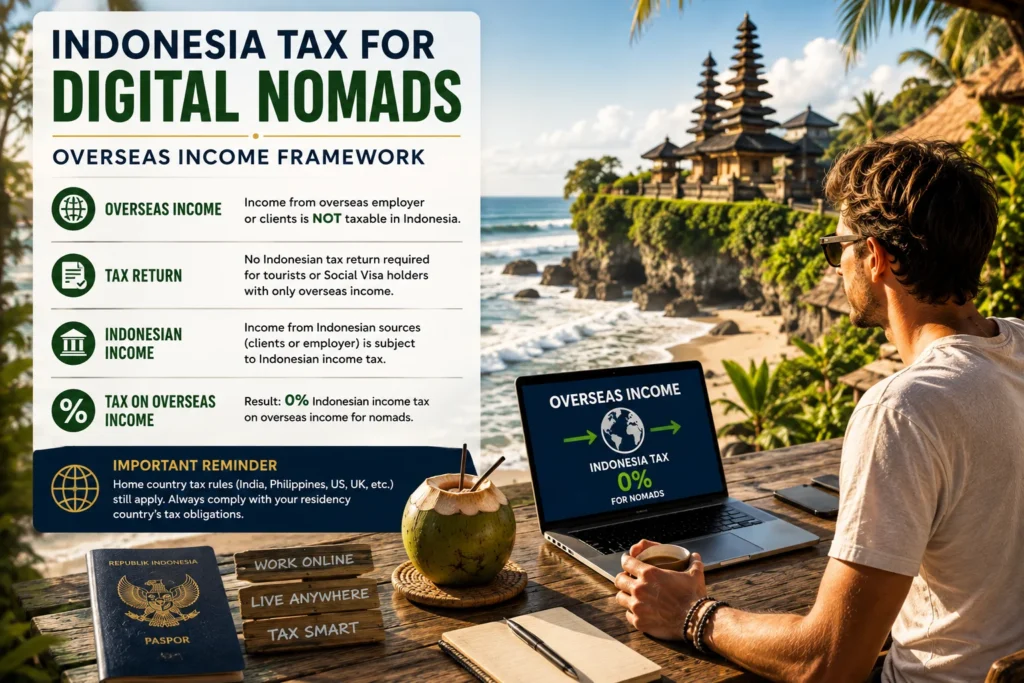
INDONESIA TAX ON OVERSEAS INCOME — NOT APPLICABLE Indonesian income tax (PPh — Pajak Penghasilan) taxes individuals on Indonesian-sourced income. For tourists and Social Visa holders: Overseas income from overseas employer or overseas clients: NOT taxable in IndonesiaNo Indonesian income tax return required for tourists or social visa holders with only overseas incomeIndonesian-sourced income (working for an Indonesian company, providing services to Indonesian clients): subject to Indonesian income tax Practical result: A digital nomad in Canggu earning from a US startup or via Upwork from overseas clients: zero Indonesian income tax liability on that overseas income. This is the same territorial principle as Malaysia, though Malaysia’s framework is codified explicitly while Indonesia’s application to nomads is an absence of taxing authority rather than a positive exemption. Home country obligations: Indian NRI, Philippine BIR, UK resident rules, US worldwide taxation — all continue regardless of Indonesia stay. Indonesia’s zero tax on your overseas income does not affect home country obligations.
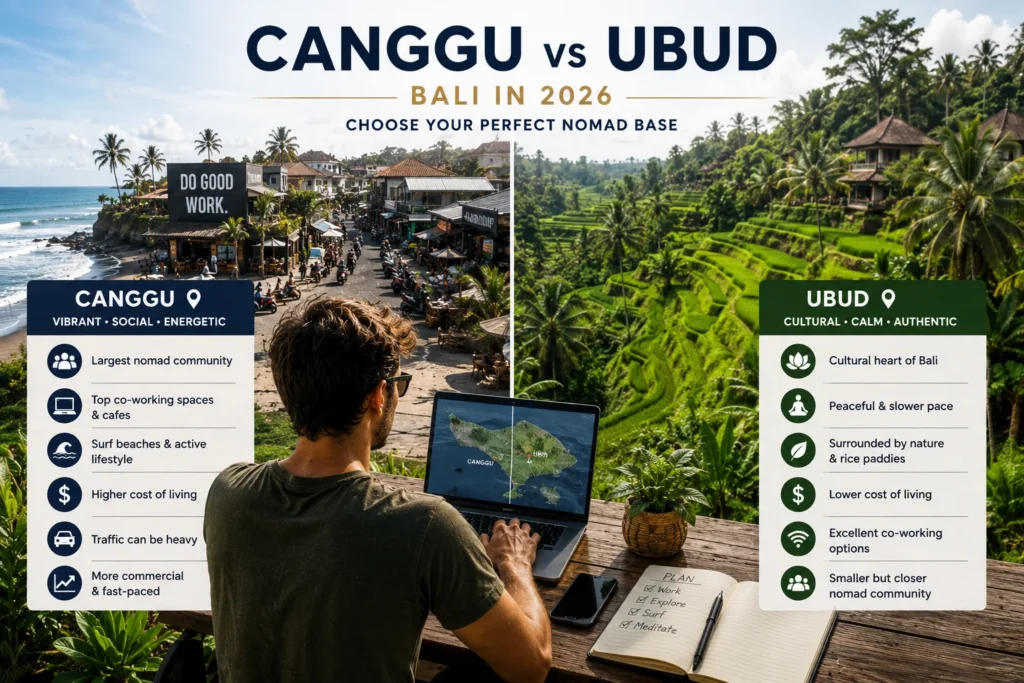
Canggu in 2026: The Honest Assessment
Canggu became a shorthand for ‘digital nomad Bali’ so completely that the name now carries expectations the neighborhood itself may no longer fully meet — or may meet in ways people didn’t expect. Here is the honest, current picture.
What Canggu still is in 2026
One of the world’s highest concentrations of digital nomads, co-working spaces, and nomad-friendly cafes in a single geographic area
An exceptional community: the density of interesting, globally mobile professionals in Canggu creates a social environment that is genuinely hard to replicate anywhere else
Great surf access (Batu Bolong, Echo Beach), yoga studios, gyms, health food infrastructure
Walking-distance access to multiple quality co-working spaces, international restaurants, and daily necessities
The Bali lifestyle experience: ceremonies, offerings, rice paddy walks, temple visits — all accessible from a Canggu base
What Canggu has become that surprises some nomads
Significantly more expensive than 5 years ago. A basic Canggu villa that cost USD 400/month in 2019 is USD 700-900+ in 2026. Co-working day passes that were USD 8 are now USD 15-25.
More commercial and saturated: the growth in wellness businesses, restaurants, and co-working spaces has created a Canggu that feels more like a built-out expat destination than a frontier nomad hub
Traffic: Canggu’s narrow roads were not built for the volume of scooters and cars that now fill them. Getting around by scooter (which most nomads do) is fine; by car is frustrating.
Seasonal pricing spikes: July-August and December-January prices surge significantly. High-season Canggu 1BR villas can reach USD 1,500-2,000/month.
Ubud as the alternative
For nomads who want the Bali lifestyle with significantly lower cost and a more community-depth experience: Ubud is the answer. The cultural heart of Bali, surrounded by rice paddies and artistic tradition, Ubud’s nomad community is smaller but more intentional. Accommodation is 30-40% cheaper than Canggu. Co-working options (Outpost Ubud, Hubud, several boutique spaces) are excellent. The pace is slower. The experience is more classically ‘Bali.
Long-stay; families; those wanting quieter environment
Moderate
Uluwatu
Cliffs; temples; surf; dramatic scenery; more isolated
USD 600–1,000/month
Surfers; those wanting nature; shorter stays
Growing but limited
Cost of Living in Bali: Canggu vs Ubud
Monthly Expense
Canggu (USD)
Canggu (INR)
Ubud (USD)
Ubud (INR)
1BR accommodation (private villa or apartment)
USD 700–1,200
₹58,000–1,00,000
USD 450–800
₹37,000–66,000
Food (mix of warung + western restaurant)
USD 200–350
₹16,500–29,000
USD 150–250
₹12,500–20,700
Transport (scooter rental + fuel)
USD 80–150
₹6,600–12,400
USD 60–120
₹5,000–10,000
Co-working space (full month)
USD 80–150
₹6,600–12,400
USD 70–130
₹5,800–10,800
Health insurance (international plan)
USD 80–150
₹6,600–12,400
USD 80–150
₹6,600–12,400
Internet + mobile SIM
USD 15–30
₹1,200–2,500
USD 15–30
₹1,200–2,500
TOTAL ESTIMATE
USD 1,155–2,030
₹95,500–1,68,000
USD 825–1,480
₹68,000–1,22,000
COST CONTEXT FOR INDIAN AND FILIPINO NOMADS In PHP terms: Canggu runs approximately PHP 67,000-1,17,000/month; Ubud approximately PHP 48,000-85,000/month. These are comparable to mid-range Bangkok costs for similar lifestyle quality, with the Ubud option being materially cheaper. Key cost advantage: food at warungs (local Indonesian eateries) is genuinely cheap. A warung meal with rice, protein, and vegetables costs IDR 25,000-50,000 (approximately ₹125-250 or PHP 80-150). Staying predominantly warung-diet cuts food costs dramatically. Key cost trap: villa internet quality varies wildly. Confirm actual internet speeds (both download AND upload) before committing to a villa rental. A USD 700/month villa with 5 Mbps upload is functionally useless for video calls.
Banking in Bali: The Practical Reality
Banking is Bali’s most consistent practical frustration for nomads. Indonesian banks require a KITAS (limited stay permit, i.e., work permit) or KITAP (permanent stay permit) for standard personal account opening. Tourist visa and social visa holders cannot open Indonesian bank accounts.
THE BALI BANKING WORKAROUND Primary setup: Wise card + BCA ATMs Wise multi-currency account: Receive overseas income in USD/EUR. Convert to IDR for daily Bali spending. Wise card accepted at most merchants in Canggu and tourist areas (Mastercard acceptance is near-universal in Canggu).BCA ATMs: Bank Central Asia is Indonesia’s most reliable bank for international card withdrawals. BCA ATMs accept Visa, Mastercard, and Cirrus/Maestro. Withdrawal fee: IDR 25,000-35,000 per transaction (approximately USD 1.50-2.20). Daily limit: IDR 3,000,000-5,000,000 per card per day (check your card’s limit).Currency exchange: Authorized money changers in Canggu/Seminyak offer competitive USD-to-IDR rates — often better than ATM forex rates. Look for ‘Authorized Money Changer’ signage. The PTT exchange rate (mid-market reference) vs physical exchange rate gap in Bali is smaller than most tourist destinations.GoPay / DANA / ShopeePay: Indonesian mobile wallets. Foreigners can register with passport but functionality is limited. GoPay via Gojek app works for many daily transactions in Canggu. Fund via international card. The standard nomad setup: Wise card for merchant payments and restaurant bills. International ATM card (Wise card or your home bank card) for cash IDR from BCA ATMs. Currency exchange for larger IDR needs.
Internet, Co-Working and Digital Infrastructure
Internet in Bali
Co-working spaces: consistently fast (20-200 Mbps; co-working operators in Canggu know their audience). Speeds for video calls: excellent at established co-workings.
Villa internet: completely variable. Some villas have dedicated fibre (excellent). Most have shared building WiFi (often 5-15 Mbps shared across multiple units — insufficient for full-time remote work). ALWAYS ask for a Speedtest.net test result before booking a villa for work.
Mobile data: Telkomsel (best coverage including rural Bali), XL Axiata (good for data-heavy users, competitive pricing), Indosat (budget option, adequate in urban Bali). Tourist SIM: available at Ngurah Rai airport arrivals. Register with passport.
Original Ubud co-working; community-focused; garden setting
The Loft
Seminyak area
USD 15-20
USD 110-150
Creative environment; good for design/creative professionals
India × Bali: The Hindu Cultural Connection
FOR INDIAN NOMADS: BALI’S UNIQUE RESONANCE Bali is unlike anywhere else in Southeast Asia for Indian Hindu nomads. Here is why: Balinese Hinduism: Approximately 83% of Bali’s 4.5 million population practices Balinese Hinduism — a unique syncretic form combining Hindu, Buddhist, and animist traditions. The result is a landscape saturated with temples (there are an estimated 20,000 temples on the island), daily offering rituals (canang sari — the small flower and incense offerings you see on doorsteps and sidewalks), and ceremonial life integrated into daily routine. For Indian Hindus: The visual iconography is deeply familiar — Ganesh, Saraswati, and Shiva statues in temples; the sound of gamelan music accompanying puja; priests in white; the smell of incense in every street. Arriving in Bali as an Indian Hindu is an experience of recognition, not foreignness. Major temples Indian nomads should visit: Tanah Lot: iconic sea temple, 20 minutes from Canggu. Sunset views. Most photographed temple in Bali.Uluwatu Temple: dramatic cliff-top temple with Kecak fire dance at sunset. Uluwatu area (45 min from Canggu).Pura Besakih (Mother Temple): Bali’s most sacred temple, on the slopes of Mount Agung. 2 hours from Canggu.Pura Tirta Empul: holy spring temple in Tampaksiring (near Ubud); ritual bathing in sacred spring. Indian food in Bali: primarily in Seminyak, Legian, and Kuta (20-30 min from Canggu). Bollywood Bali Restaurant and several curry houses. Not as accessible as Bangkok or KL. South Indian food especially limited. Flights from India: Bali (DPS) connects from Delhi (DXB or SIN stop), Mumbai (direct or 1-stop), Chennai, Bengaluru via Singapore or Kuala Lumpur. Flight time: approximately 6-9 hours depending on routing.
Philippines × Bali: The Growing Filipino Nomad Scene
FOR FILIPINO NOMADS: BALI’S FAMILIAR FEEL Southeast Asian cultural overlap: Filipino nomads consistently report Bali feeling culturally familiar in a way that European or East Asian destinations do not. Shared tropical climate, similar fruit availability, rice-based food culture, and Southeast Asian warmth in social interactions create a smooth adjustment. Filipino community in Bali: significant Filipino presence in hospitality and wellness industries (hotel staff, spa therapists). Growing Filipino digital nomad community centered in Canggu. Filipino expat Facebook groups (search ‘Filipinos in Bali’) are active and helpful for practical questions. ASEAN visa advantage: Filipino passport holders receive Visa on Arrival in Bali (30 days, USD 35) with no advance application required — same as other ASEAN nationals. Extension to 60 days at Bali immigration is straightforward. Connectivity: AirAsia flies Manila-Bali via Kuala Lumpur (total travel 5-8 hours). Cebu Pacific operates Manila-Bali routes periodically. Philippine Airlines seasonal service. Check current schedules; Bali connectivity from Philippines improves regularly. BIR obligations: continue regardless of Bali stay. BIR Form 1701 filing is mandatory. Philippines-Indonesia DTAA: limited in scope; overseas income earned while in Bali is not Indonesian-taxable; BIR implications remain.
Healthcare and Safety in Bali
Private healthcare: BIMC Hospital (Kuta, international standards, expensive), Kasih Ibu Hospital (Denpasar, good quality, more affordable), Prima Medika Hospital (Denpasar). Costs are significantly lower than Western countries but not free.
Travel and health insurance: Essential and non-negotiable for Bali. At minimum, ensure your international plan covers medical evacuation. Bali roads and the prevalence of scooter riding create meaningful accident risk.
Bali Belly: the colloquial name for traveler’s diarrhea from water or uncooked food. Drink only bottled or filtered water. Most international restaurants and established warungs are safe. Street food: exercise judgment.
Water: never drink tap water. All villas have water dispensers (isi ulang). Bring a reusable bottle with filter for environmental and economic savings.
Safety: Bali is generally very safe for tourists and nomads. Petty theft (primarily bag-snatching from scooters) is the primary crime concern in tourist areas. Use a secure bag; keep laptops in backpacks not open baskets.
Bali Seasons: When to Go
Season
Months
Character
Nomad Recommendation
Dry season
April – October
Blue skies; low humidity; beautiful weather; peak tourist season (July-August very crowded and expensive)
Best overall for most nomads. Avoid July-August if possible (crowds, prices). April-June and September-October are sweet spots.
Rainy season
November – March
Daily rain (usually afternoon showers, not all-day); still warm (26-30°C); lower prices; fewer tourists
Excellent value for nomads comfortable with rain. November-December and February-March are particularly good value. January can be heavy rainfall.
Bali Digital Nomad Navigation Hub
Use the cluster articles below for complete depth on each specific Bali topic:
📋
Indonesia Social Visa for Remote Workers — Complete Guide B211A Social Cultural Visa: sponsor requirements, application process, extensions, and how to obtain one as a digital nomad. /indonesia-social-visa-remote-workers/
⚖️
Can You Work Remotely in Bali on Tourist Visa? — Legal Analysis Honest legal analysis of working remotely in Bali on tourist or social visa: what Indonesian law says, what enforcement looks like, and what the risks are. /remote-work-bali-tourist-visa-legal/
🇮🇳
Indonesia / Bali for Indian Citizens India-specific Bali guide: VOA process, income documentation, FEMA implications, Indian community, temple access, and flight connections from India. /indonesia-bali-indian-citizens/
🇵🇭
Indonesia / Bali for Filipino Citizens Philippines-specific Bali guide: ASEAN VOA advantage, BIR obligations, Filipino community in Bali, Upwork income documentation, and flight connections. /indonesia-bali-filipino-citizens/
💰
Cost of Living Bali for Digital Nomads 2026 Complete monthly cost breakdown: Canggu vs Ubud, accommodation reality, food costs at warungs vs restaurants, transport, and seasonal price variation. /cost-of-living-bali-digital-nomads/
🏦
Bali Banking for Digital Nomads — Account Opening Guide Banking reality for nomads: why you can’t open an Indonesian bank account on tourist visa, Wise + BCA ATM setup, GoPay for daily use, and currency exchange strategy. /bali-banking-digital-nomads/
🖥
Best Coworking Spaces in Bali 2026 Top co-working spaces in Canggu and Ubud: Dojo, Outpost, Hubud, Bali Bustle — internet speeds, pricing, community character, and which is best for your work style. /best-coworking-spaces-bali/
Frequently Asked Questions
Is Bali good for digital nomads in 2026?
Yes, with important context. Bali remains one of the world’s top digital nomad destinations for lifestyle, community, and culture. Canggu’s co-working scene is exceptional. Cost is moderate — USD 900-1,500/month in Canggu, USD 600-900/month in Ubud. The main challenge: no formal digital nomad visa exists. The Social Visa (B211A) provides the most practical path for stays up to 180 days. Banking requires a Wise card + BCA ATM workaround as Indonesian bank accounts require a work permit.
What visa do digital nomads use in Bali?
Most use either the Visa on Arrival / Tourist Visa (30 days, extendable to 60) or the Social Cultural Visa (B211A, up to 180 days, requires Indonesian sponsor). The E33G Second Home Visa (5-10 years) exists but requires approximately USD 130,000 in accessible funds — beyond most nomads. There is no formal ‘digital nomad visa’ equivalent to Thailand’s LTR or Malaysia’s DE Rantau as of June 2026.
Is it legal to work remotely in Bali on a tourist visa?
This is a legal grey area. Indonesian immigration law does not explicitly authorize remote work for overseas clients on tourist or social visas. Enforcement has historically been inconsistent and primarily targeted visible local business operations. However, enforcement actions in Canggu in recent years show the risk is not zero. The safest approach: use a Social Visa for longer stays, do not work for or manage Indonesian businesses, and maintain professional discretion. Full analysis in the Remote Work Bali Tourist Visa Legal article.
How much does it cost to live in Bali as a digital nomad?
Canggu: USD 900-1,500/month total (approximately ₹75,000-1,25,000 or PHP 52,000-87,000). Ubud: USD 600-900/month (approximately ₹50,000-75,000 or PHP 35,000-52,000). Accommodation is typically the largest cost (USD 450-1,200/month for 1BR villa depending on area and season). Food ranges from very cheap (warung meals USD 2-4) to moderate (Western restaurant USD 10-20).
Can I open a bank account in Bali as a digital nomad?
Not on a tourist or social visa. Indonesian banks require a KITAS (work permit / limited stay permit) for personal account opening. The practical banking solution: Wise card for merchant payments + international ATM card for BCA ATM withdrawals. Wise card is accepted at most Canggu merchants. BCA ATMs: most widely available for international cards; IDR 25,000-35,000 withdrawal fee per transaction.
Yes, with unique advantages. Bali is Indonesia’s only Hindu-majority province — approximately 83% of Bali’s population practices Balinese Hinduism. For Indian Hindu nomads, the cultural resonance is immediate: temples everywhere, daily offerings, familiar iconography. Indian restaurants are available in Seminyak/Kuta. FEMA implications (NRE/NRO accounts, overseas income reporting) continue unchanged regardless of Bali stay. Read the Indonesia/Bali for Indian Citizens guide for the complete framework.
Final Verdict: Should You Base Yourself in Bali?
Bali in 2026 is not the cheap paradise of 2017, but it is still a genuinely extraordinary place to live and work. The combination of Hindu culture, co-working community, tropical lifestyle, and the social infrastructure that has grown around the nomad scene creates an experience that is simply unavailable anywhere else at any price. The financial reality is honest: Canggu is now mid-range in global nomad terms, not cheap. USD 1,200-1,500/month for a comfortable Canggu life is comparable to Bangkok or Kuala Lumpur. Ubud at USD 700-900/month is meaningfully cheaper and arguably more authentically Balinese. The legal reality is also honest: no formal digital nomad visa exists. The Social Visa is the most practical option for stays beyond 60 days. The overseas remote worker legal grey area has lower enforcement risk than some other destinations but is not zero. Who Bali is perfect for: nomads who prioritize community, culture, and lifestyle over legal clarity; those who plan 1-6 month stays using Social Visa; Indian Hindu nomads seeking cultural resonance; anyone who has ‘always wanted to go to Bali’ and now has the remote work freedom to do it properly. Who should consider alternatives: nomads who need long-term (1+ year) legal certainty; those who want straightforward banking; anyone whose income level makes Malaysia DE Rantau or Thailand LTR accessible and preferred. Use the navigation hub to explore the Bali cluster articles in depth. Start with the Social Visa guide if you are planning a stay, and the cost of living guide for budget planning.