DISCLAIMER This ranking reflects the analysis of MeridianNomad.com as of June 2026. Visa policies, tax laws, and community infrastructure change. Verify all visa requirements at official sources before planning. This is not immigration, tax, or legal advice.
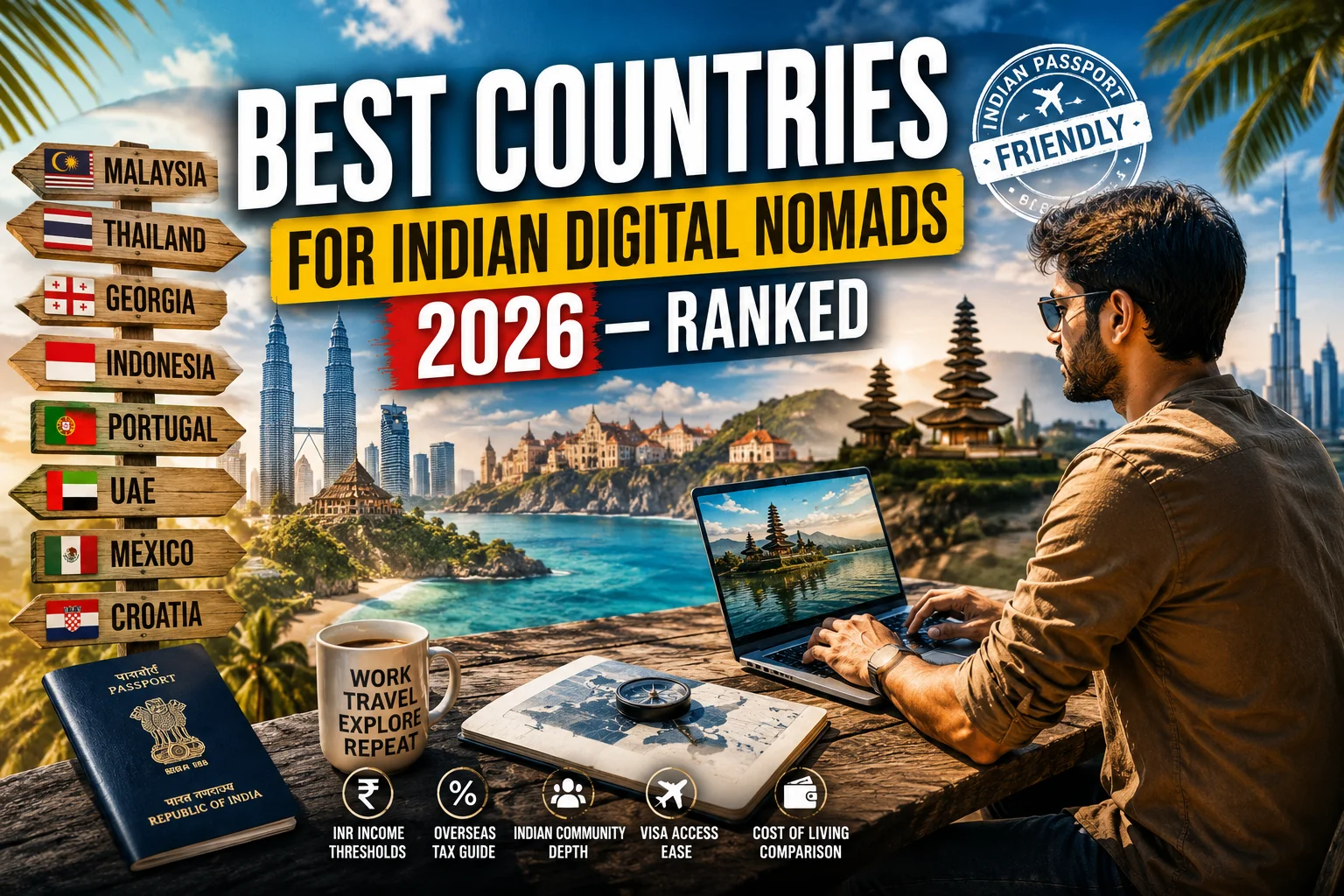
AI OVERVIEW SUMMARY This ranking evaluates the top 8 countries for Indian digital nomads using a methodology built specifically for the Indian passport and Indian income context: Indian passport visa access (how difficult to enter), income threshold in INR (what annual rupee income qualifies for a formal digital nomad visa), Indian community depth (established community, Indian food, cultural familiarity), overseas income tax (0% territorial to 18%+ progressive), English use, cost of living in INR, and India flight connectivity. Malaysia ranks #1 — the only country to score high on all seven factors simultaneously: eVisa entry, ₹19-20 lakh DE Rantau threshold, the world’s largest overseas Indian community, 0% overseas income tax, English official, competitive cost, and excellent flight links from all major Indian cities. Georgia ranks #3 — the most underappreciated option: 365-day visa-free for Indian passport, 1% Individual Entrepreneur flat tax, Tbilisi at ₹50,000-75,000/month. Indonesia/Bali ranks #4 — VOA since 2023, 0% overseas income tax, Hindu cultural resonance, at ₹75,000-1,25,000/month Canggu. The Indian nomad sweet spot: Malaysia (primary base, 3-4 months) + Thailand (2-3 months) + India visits (1-2 months), maintaining NRI status throughout.
QUICK ANSWER: Best countries for Indian digital nomads? Top 3 by income tier: Under ₹19 lakh/year: Georgia (365-day visa-free, 1% IE tax) or Bali (VOA, 0% tax) — no income threshold₹19-33 lakh/year: Malaysia DE Rantau (#1) — best overall for most Indian nomads at this income₹33 lakh+/year: Thailand LTR WFT — Bangkok base, formal 10-year visa, Royal Decree 743 tax provisions Overall: Malaysia is the most well-rounded choice for Indian nomads across visa access, community, tax, and cost. Georgia is the most underrated. Thailand is the highest quality city lifestyle but with income tax.
The Ranking Methodology: Built Specifically for Indian Passport Holders
Generic digital nomad rankings use criteria designed for EU or US passport holders: visa ease, internet speed, cost, climate. These rankings are largely irrelevant to Indian nomads because they do not account for the specific variables that shape the Indian nomad decision.
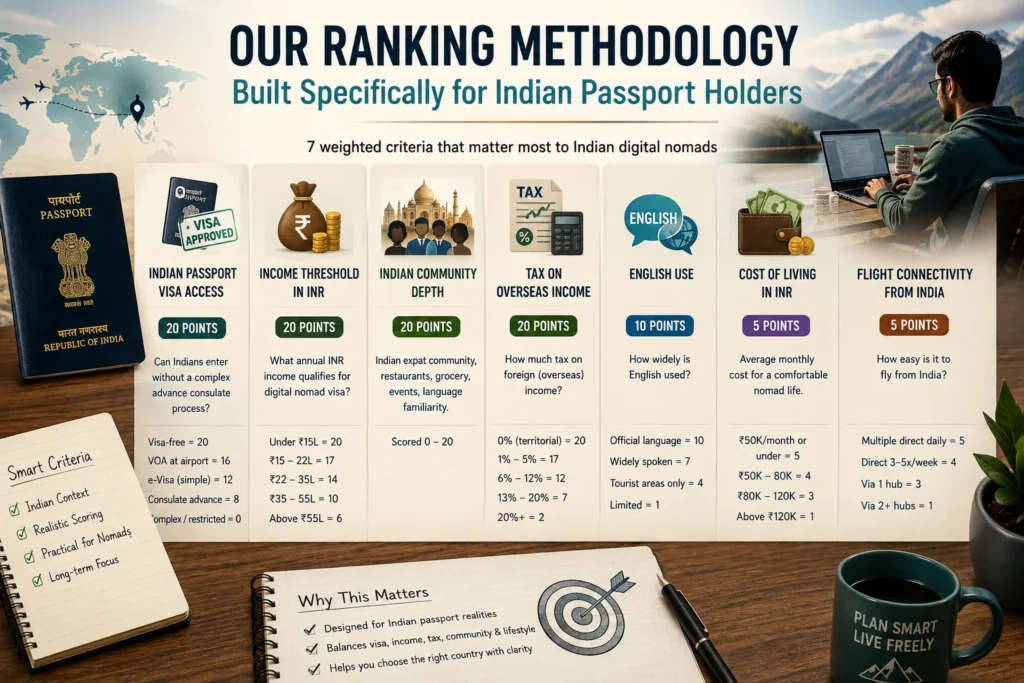
This ranking uses seven criteria specifically selected for their relevance to Indian citizens planning international nomad life:
Can Indians enter without a complex advance consulate process? Visa-free = 20; VOA at airport = 16; simple e-Visa = 12; consulate advance = 8; complex or restricted = 0
Income threshold in INR
20 points
What annual INR income qualifies for the country’s formal digital nomad status? Under ₹15L = 20; ₹15-22L = 17; ₹22-35L = 14; ₹35-55L = 10; above ₹55L = 6
Indian community depth
20 points
Established Indian expat community, Indian restaurants, Indian grocery, cultural events, Hindi or regional language speakers. Scored 0-20.
Official language = 10; widely spoken = 7; tourist areas only = 4; limited = 1
Cost of living in INR
5 points
₹50K/month or under = 5; ₹50-80K = 4; ₹80-120K = 3; above ₹120K = 1
Flight connectivity from India
5 points
Multiple direct daily = 5; direct 3-5x/week = 4; via 1 hub = 3; via 2+ hubs = 1
The Indian Passport Premium: Why Some Rankings Shift for Indians
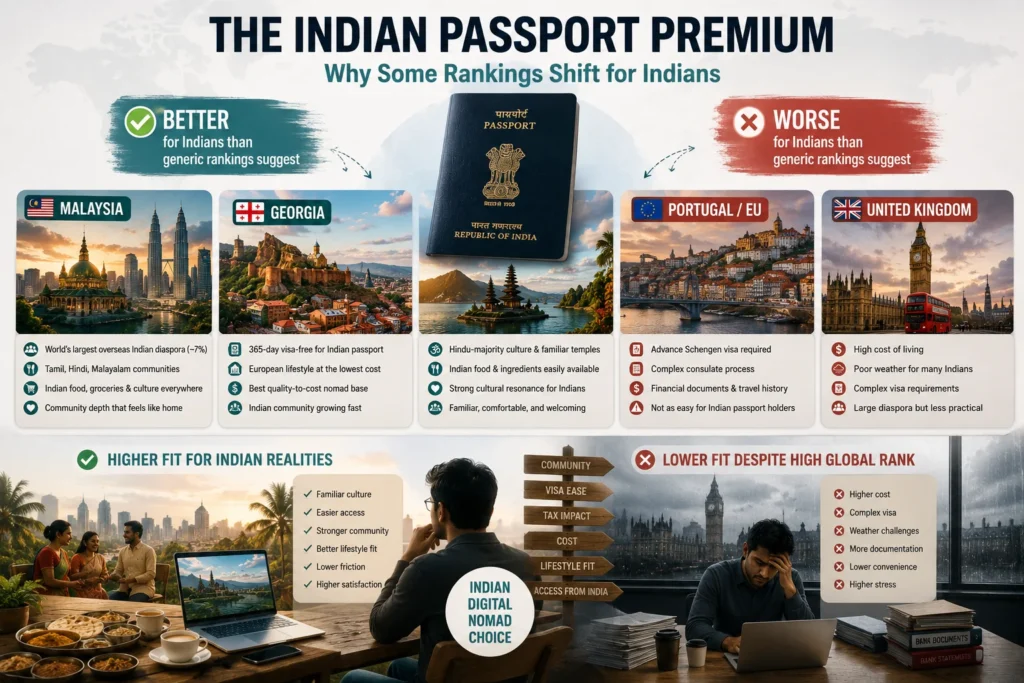
THE INDIAN PASSPORT PREMIUM CONCEPTIndian passport holders experience a different ranking reality than EU or US passport holders: Destinations that are BETTER for Indians than generic rankings suggest: Malaysia: Generic rankings rate Malaysia as ‘medium.’ For Indians: Malaysia has the world’s largest overseas Indian diaspora (approximately 7% of Malaysia’s population is Indian); Tamil, Hindi, Malayalam communities are deeply established; Indian restaurants are ubiquitous; vegetarian food is readily available. This community depth is irrelevant to a German nomad but transformative for an Indian one. Georgia: Generic rankings rarely feature Georgia. For Indians: 365-day visa-free (extraordinary for Indian passport); European lifestyle; cheapest quality nomad base globally; Indian community growing.Bali: Generic rankings rate Bali high for lifestyle. For Indians: Bali’s Hindu-majority culture creates an unmistakable cultural familiarity that is irrelevant to non-Hindu nomads but deeply meaningful to Indian Hindus. Destinations that are WORSE for Indians than generic rankings suggest: Portugal/EU: Rates highly for EU passport holders (Schengen freedom). For Indians: advance Schengen visa required (complex consulate process, financial documentation, travel history reviewed).UK: Large Indian diaspora but high cost, poor weather, complex visa. Generic rankings ignore the visa barrier for Indians.
The Rankings: Top 8 Countries for Indian Digital Nomads
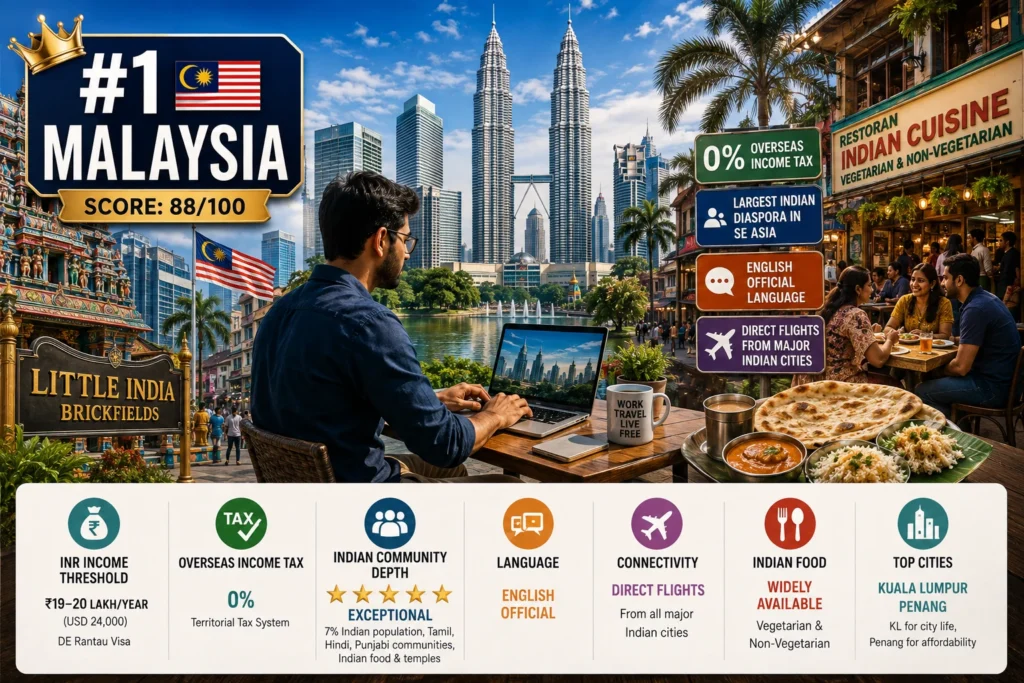
#1 🇲🇾 Malaysia — Score: 88/100 Best overall for most Indian nomads: community, tax, language, threshold 💰 INR Income Threshold: ₹19-20 lakh/year (USD 24,000) for DE Rantau; no formal threshold for tourist eVisa 📊 Overseas Income Tax: 0% (territorial tax system — overseas income not taxable regardless of stay duration) 🇮🇳 Indian Community Depth: ★★★★★ Exceptional (7% of Malaysian population is Indian; Tamil, Hindi, Punjabi communities; Indian grocery, restaurants, temples) ✅ Pros: 0% overseas income tax (territorial), largest Indian overseas community in SE Asia, English official language, DE Rantau at ₹19-20L/year threshold, Indian food ubiquitous (Tamil, North Indian), direct flights from all major Indian cities, Brickfields Little India in KL, Penang cheaper alternative ❌ Key limitation: eVisa required in advance (no visa-free); Indian passport does not get ASEAN visa-free access
Malaysia is the unanimous #1 for most Indian digital nomads. The combination of factors is simply unmatched: DE Rantau’s accessible income threshold (₹19-20 lakh/year), zero overseas income tax, the world’s deepest Indian diaspora outside India itself, English as an official language of commerce, and excellent flight connections. For an Indian nomad arriving in Kuala Lumpur: finding familiar food, hearing Tamil and Hindi, navigating in English, and paying zero income tax on overseas earnings — all simultaneously — is a combination no other destination matches. Penang as an alternative to KL offers a smaller-city environment with a particularly strong Penang Tamil and Chettinad community.
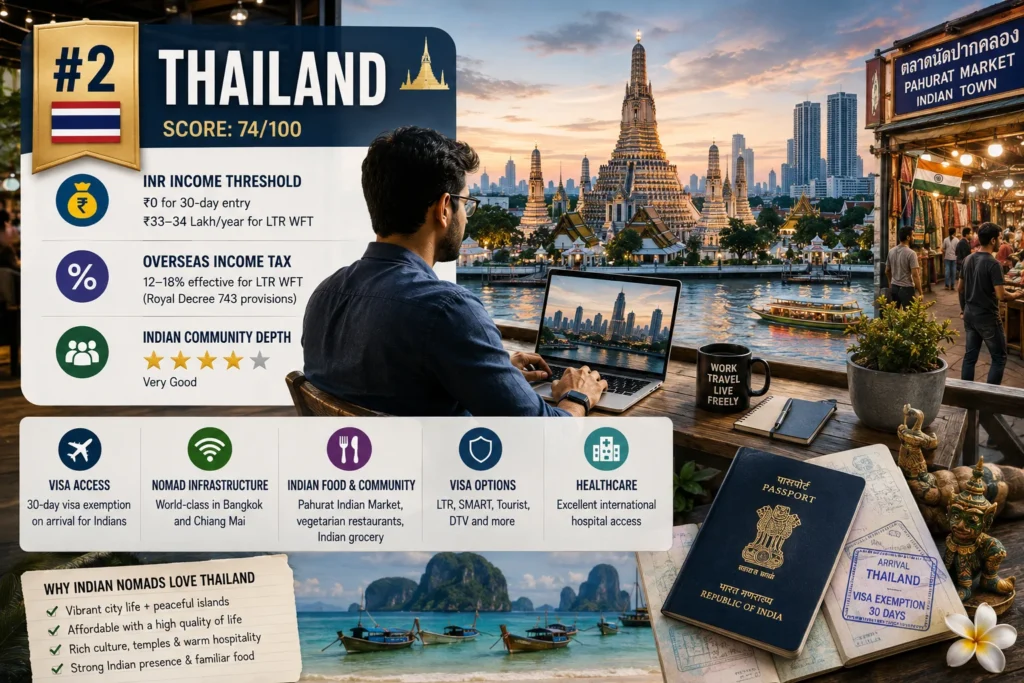
#2 🇹🇭 Thailand — Score: 74/100 Best city lifestyle; 30-day visa-free entry; highest nomad infrastructure quality 💰 INR Income Threshold: ₹0 for tourist 30-day entry; ₹33-34 lakh/year (USD 40,000) for LTR WFT formal visa 📊 Overseas Income Tax: 12-18% effective for LTR WFT (Royal Decree 743 provisions); full Thai progressive rates on tourist visa (up to 35%) 🇮🇳 Indian Community Depth: ★★★★ Very Good (Pahurat Indian market Bangkok; vegetarian restaurants; Bollywood nights; strong Indian IT expat community) ✅ Pros: 30-day visa exemption on arrival (no advance visa for initial stay), world’s best digital nomad infrastructure in Bangkok and Chiang Mai, strong Indian community in Bangkok (Sukhumvit area), Indian restaurants and grocery in Pahurat and upper Sukhumvit, multiple visa pathways (LTR, SMART, tourist, DTV), excellent international hospital access ❌ Key limitation: Thai income tax applies on assessable overseas income (12-18% effective for LTR WFT; potentially higher on tourist visa); LTR WFT income threshold (₹33 lakh) excludes many mid-income nomads
Thailand’s rank reflects the tension in its offering: the lifestyle and infrastructure quality is exceptional (Bangkok arguably offers the world’s best nomad city infrastructure), but the income tax position is the most complex of the top 5. The 2024 Revenue Department ruling means that overseas income transferred to Thailand in the same year it is earned becomes assessable for Thai tax — producing a 12-18% effective rate for LTR WFT holders even with Royal Decree 743 provisions. For Indian NRIs (who pay 0% Indian tax on overseas income), this is still net-positive: 12-18% Thailand tax + 0% India tax = 12-18% total. Manageable, but materially higher than Malaysia’s 0%.
#3 🇬🇪 Georgia — Score: 71/100 Most underrated: 365-day visa-free, 1% IE tax, cheapest quality base globally 💰 INR Income Threshold: ₹0 formal income threshold for visa-free entry; Remotely From programme: accessible at low income levels 📊 Overseas Income Tax: 1% Individual Entrepreneur flat tax on overseas business income under GEL 500,000/year (≈ USD 185,000) 🇮🇳 Indian Community Depth: ★★ Small but growing (Indian grocery limited; a few Indian restaurants in Rustaveli area; Indian expat WhatsApp groups) ✅ Pros: 365-day visa-free for Indian passport (extraordinary and rarely highlighted), 1% Individual Entrepreneur flat tax on overseas income under GEL 500,000/year, Tbilisi at ₹50,000-75,000/month total (among the cheapest quality nomad bases globally), same-day TBC Bank account opening with just passport, Remotely From Georgia programme for formal status, European cultural experience ❌ Key limitation: Small Indian community (growing but limited); limited Indian food; no India-Georgia DTAA; smaller nomad community than Bangkok or Canggu
Georgia is the most underrated destination for Indian digital nomads and deserves significantly more attention in Indian nomad discourse. The 365-day visa-free access for Indian passport holders is extraordinary — there are very few quality nomad destinations where Indian passports receive this length of visa-free stay. Combined with Individual Entrepreneur registration (same day, approximately ₹1,600 fee) that reduces effective income tax to 1% on overseas active income, and Tbilisi’s cost at approximately ₹60,000-75,000/month, Georgia produces the best tax-adjusted cost-of-living for Indian nomads of any destination in this ranking. The main limitation: Indian community infrastructure is significantly less developed than Malaysia or Thailand. For Indian nomads who are comfortable with European food culture and limited access to Indian cuisine, Georgia’s financial case is compelling.
#4 🇮🇩 Indonesia / Bali — Score: 68/100 Hindu cultural home for Indian nomads; VOA since 2023; 0% overseas income tax 💰 INR Income Threshold: ₹0 formal threshold (VOA or B211A Social Visa; no income requirement) 📊 Overseas Income Tax: 0% (overseas income not taxable for tourists/social visa holders; territorial system) 🇮🇳 Indian Community Depth: ★★★ Good (Hindu cultural connection; Indian restaurants in Seminyak; growing Indian nomad community in Canggu; limited South Indian food) ✅ Pros: VOA at airport for Indians since 2023 (USD 35, no advance visa), 0% overseas income tax (territorial for tourists/social visa holders), Bali’s Hindu-majority culture creates profound cultural familiarity for Indian Hindus, temples and ceremony directly resonant with Indian Hindu tradition, strong international nomad community (Canggu), Bali Social Visa B211A for up to 180 days ❌ Key limitation: No formal digital nomad visa; legal grey area for overseas remote work on tourist/social visa; banking requires workaround (Wise card + BCA ATMs); limited Indian food outside Seminyak/Kuta
Bali occupies a unique position for Indian Hindu nomads that goes beyond a standard cost-of-living or tax analysis. Arriving in a Hindu-majority province — where Ganesh statues are at every doorstep, where daily puja offerings line every street, where temples and ceremony are the fabric of daily life — produces a cultural recognition that is unavailable in Bangkok, Kuala Lumpur, or Tbilisi. This is unmeasurable in a ranking but deeply felt in practice. The practical case is also strong: VOA accessibility since 2023 removed the advance consulate requirement; zero overseas income tax; Ubud at ₹50,000-70,000/month is genuinely affordable. The main limitation remains the absence of a formal digital nomad visa framework.
#5 🇦🇪 UAE (Dubai) — Score: 62/100 Best for high-income Indians wanting Gulf connectivity and 0% tax 💰 INR Income Threshold: ₹35 lakh+/year (USD 3,500/month) for UAE Remote Work Visa; VOA accessible for initial stays 📊 Overseas Income Tax: 0% (UAE has no personal income tax) 🇮🇳 Indian Community Depth: ★★★★ Very Good for Indian diaspora (large Indian community; Indian restaurants everywhere; Hindi and Malayalam widely spoken; Indian grocery; Bollywood events) ✅ Pros: 0% personal income tax, VOA on Indian passport, large Indian diaspora in Dubai (approximately 25% of Dubai’s population is Indian), professional networking in Gulf region, world-class infrastructure, UAE Remote Work Visa for formal status, direct flights from all major Indian cities ❌ Key limitation: High cost of living (₹1,50,000-2,50,000+/month Dubai); income threshold for Remote Work Visa (USD 3,500/month = ₹35 lakh/year) excludes mid-income nomads; extreme summer heat (June-September); lifestyle not suited to all nomad styles
UAE makes sense for a specific Indian nomad profile: high-income IT professionals (USD 3,500+/month), those who work with Gulf-region clients, or those who want the Indian community depth of Malaysia with the professional prestige of Dubai. The zero income tax is attractive, and the Indian community is enormous. However, Dubai’s cost is significantly higher than Malaysia, Thailand, or Bali — and the summer heat (June-September) makes outdoor life extremely uncomfortable. UAE works best as a component of a multi-country rotation rather than a year-round base.
#6 🇵🇹 Portugal — Score: 48/100 Best for Indian nomads targeting EU clients and European lifestyle 💰 INR Income Threshold: ₹33+ lakh/year for D8 Visa (€3,040/month employment income requirement) 📊 Overseas Income Tax: Complex: NHR regime provides flat 20% rate on Portuguese-sourced income; foreign income may be exempt under NHR (professional advice essential) 🇮🇳 Indian Community Depth: ★ Limited (Indian community present in Lisbon but small; Indian restaurants limited; Hindi not widely spoken) ✅ Pros: D8 Digital Nomad Visa provides EU-based residency, NHR (Non-Habitual Residency) tax regime on certain foreign income (complex; evolving), growing nomad infrastructure in Lisbon and Porto, English widely used in tech sector, gateway to EU travel ❌ Key limitation: Schengen visa required in advance for Indian passport (consulate application, documentation, processing time); significantly higher cost (€1,500-2,500/month = ₹1,35,000-2,25,000/month); limited Indian community; language barrier outside tech hubs
#7 🇨🇴 Colombia (Medellín) — Score: 41/100 Lowest cost globally; best for Indian nomads targeting LATAM time zones 💰 INR Income Threshold: No formal income threshold for DNV (accessible at low income levels) 📊 Overseas Income Tax: 0% (Colombia does not tax overseas income for non-residents/visa holders on tourist/DNV in most cases) 🇮🇳 Indian Community Depth: ★ Very Limited (negligible Indian community; no Indian food; no cultural infrastructure) ✅ Pros: Very low cost (USD 700-1,000/month Medellín = ₹58,000-83,000/month), Colombia DNV available, growing nomad community (Medellín is top-5 global nomad city), good internet infrastructure in nomad areas, pleasant year-round climate in Medellín (City of Eternal Spring) ❌ Key limitation: Indian passport requires advance visa; extreme distance from India (20+ hour journey with multiple connections); negligible Indian community; personal safety requires area-specific awareness; significant time zone gap from India clients
#8 🇻🇳 Vietnam — Score: 39/100 Lowest cost Southeast Asia with decent infrastructure; no formal DNV 💰 INR Income Threshold: No formal DNV income threshold; e-Visa accessible at any income 📊 Overseas Income Tax: 0% (overseas income not taxable for e-Visa/tourist holders; territorial system) 🇮🇳 Indian Community Depth: ★ Very Limited (small Indian expat community; Indian restaurants available in District 1 HCMC but limited; Hindi not spoken) ✅ Pros: Very low cost (₹40,000-60,000/month Ho Chi Minh City), 0% overseas income tax, good nomad community in HCMC, decent co-working infrastructure, close flight connections to India ❌ Key limitation: No formal digital nomad visa; advance e-Visa required for Indian passport; limited Indian community; language barrier significant; enforcement risk for remote workers (similar to Bali grey area); South and North Vietnam require separate planning
Complete Comparison: Top 8 Countries at a Glance
Rank
Country
Indian Entry
INR Threshold (DNV)
Overseas Tax
Indian Community
Monthly COL (INR)
Overall
#1
Malaysia 🇲🇾
eVisa advance
₹19-20L (DE Rantau)
0%
★★★★★ Exceptional
₹65-85K
88/100
#2
Thailand 🇹🇭
30-day on arrival
₹33-34L (LTR WFT)
12-18% (LTR)
★★★★ Very Good
₹75-1,00,000K
74/100
#3
Georgia 🇬🇪
365-day visa-free
Very low (IE)
1% (IE flat)
★★ Small
₹50-75K
71/100
#4
Bali 🇮🇩
VOA (USD 35)
None (B211A)
0%
★★★ Good
₹75-1,25,000K
68/100
#5
UAE 🇦🇪
VOA on arrival
₹35L+ (Remote Work)
0%
★★★★ Very Good
₹1,50,000-2,50,000K
62/100
#6
Portugal 🇵🇹
Schengen visa
₹33L+ (D8 Visa)
Complex NHR
★ Limited
₹1,35,000-2,25,000K
48/100
#7
Colombia 🇨🇴
Advance visa
Low (DNV)
0%
★ Very Limited
₹58-83K
41/100
#8
Vietnam 🇻🇳
e-Visa advance
None (no DNV)
0%
★ Very Limited
₹40-60K
39/100
The Indian Nomad Sweet Spot: Malaysia + Thailand + India Rotation
THE OPTIMAL ROTATION FOR MOST INDIAN DIGITAL NOMADS For Indian nomads with income between ₹19-40 lakh/year, the most financially and logistically optimal structure: Malaysia (3-4 months): Primary tax base. DE Rantau. 0% overseas income tax. Indian community for practical comfort. English. KL or Penang.Thailand (2-3 months): Secondary base. 30-day visa exemption (no advance application). Bangkok lifestyle. Co-working infrastructure. India community. Rotate with Malaysia without visa hassle.India (2-3 months): Family, CA consultation, NRE/NRO management, medical check-ups. Critical: stay under 182 India days total for the financial year to maintain NRI status. Tax math on this rotation (for NRI): Malaysia period: 0% overseas income tax (territorial). 0% Indian tax (NRI). Total: 0%.Thailand period: Thai income tax on assessable overseas income brought into Thailand same year. 12-18% for LTR WFT holders; higher without LTR. Indian tax (NRI): 0%. Total: Thai rate.India period: No host country tax. Indian tax (NRI): 0% on overseas active income. Total: 0%. Optimization: maximize Malaysia and India months; minimize Thailand months where Thai tax applies (unless LTR WFT holder with Royal Decree 743 provisions already in place). This is the ‘Indian nomad sweet spot’ — maximum lifestyle variety (Bangkok + KL/Penang + India visits), NRI status maintained, tax position optimized through country allocation.
By Income Tier: Which Country Is Right for You?
Annual Income (INR)
Annual Income (USD)
Recommended Primary Base
Why
Below ₹10 lakh
Below USD 12,000
Not yet viable for sustained nomad life
Minimum viable nomad income: ₹10-12L/year for budget destinations; build income first
₹10-18 lakh
USD 12,000-22,000
Georgia or Bali (budget)
No income threshold; cheapest quality options; build savings while traveling
LTR WFT threshold crossed; Bangkok base viable; Malaysia remains most tax-efficient
₹50+ lakh
USD 60,000+
All options open; UAE becomes attractive
Full flexibility; optimize rotation for lifestyle preference and tax efficiency
Frequently Asked Questions
Which is the best country among the best countries for Indian digital nomads?
Malaysia is the overall best for most Indian nomads with income above ₹19-20 lakh/year: 0% overseas income tax (territorial), the world’s largest overseas Indian diaspora, English as an official language, and DE Rantau income threshold accessible at ₹19-20 lakh/year. Georgia is the best for Indian nomads at any income level wanting maximum tax efficiency (1% IE flat tax) with European lifestyle. Bali is the best for Hindu Indian nomads wanting cultural resonance and tropical lifestyle with no income threshold.
Which countries are visa-free for Indian passport holders for digital nomads?
Georgia: 365-day visa-free for Indian passport (one of the best globally for Indians). Indonesia/Bali: Visa on Arrival (USD 35, since 2023, no advance application) for 30 days extendable to 60 days. Thailand: 30-day visa exemption on arrival (no advance application). UAE: Visa on Arrival. Vietnam: advance e-Visa required. Malaysia: advance eVisa or eNTRI required. Portugal: advance Schengen visa required.
Is Georgia a good destination for Indian digital nomads?
Yes, and significantly underrated. Georgia offers 365-day visa-free access for Indian passport holders (one of the world’s most generous visa-free policies for Indians), Individual Entrepreneur registration producing a 1% flat tax on overseas income, and Tbilisi’s total cost of ₹50,000-75,000/month. The limitation: small Indian community and limited Indian food. For Indian nomads comfortable with European food culture, Georgia’s combination of visa-free access, 1% tax, and low cost is exceptional.
What income do I need to be a digital nomad in Malaysia as an Indian?
Malaysia DE Rantau requires USD 24,000/year (approximately ₹19-20 lakh/year at current rates). This corresponds to approximately USD 2,000/month overseas income. For Indian IT professionals: a mid-level developer (3-5 years experience), senior designer, or established freelance consultant earning from overseas clients. The DE Rantau fee is MYR 1,000 (approximately ₹18,000) per year.
How does being an Indian NRI affect taxes when living abroad?
Indian NRI status (under 182 days in India per financial year, April-March) means overseas active income is NOT taxable in India under the Income Tax Act. Combined with a territorial-tax country like Malaysia or Bali (0% overseas income tax), Indian NRIs achieve an effective 0% total income tax position on overseas remote work income. NRE account interest is completely tax-free in India (Section 10(4)(ii)). FEMA compliance required: resident savings account must be converted to NRO; NRE account opened for overseas income.
Final Verdict: The Indian Nomad Decision Framework
The best country for an Indian digital nomad is not a single answer — it is a function of your income level, lifestyle preference, and how much administrative complexity you are prepared to manage for tax optimization. For most Indian nomads: start with Malaysia. The combination of accessible income threshold, zero overseas income tax, the largest Indian community in Southeast Asia, English language, and excellent India flight connections makes it the lowest-friction, highest-community-value starting point. Add Thailand as a rotation destination for lifestyle variety. Maintain Indian visits under 182 days for NRI status. For those who value maximum tax efficiency at lower income levels: Georgia’s 365-day visa-free access + 1% IE tax is the underdiscovered option. The main trade-off is Indian community infrastructure. The Indian nomad passport situation: it requires planning, not resignation. Every destination worth living in has an accessible pathway for an Indian professional with a legitimate overseas income. The planning requirement is the price of admission to a zero-tax or low-tax overseas lifestyle — and the financial payoff makes it one of the best investments of planning time available to Indian professionals. Read the Digital Nomad Guide for Indian Passport Holders for the complete hub framework, or the Thailand vs Malaysia for Indians comparison for the two most popular Indian nomad bases.