
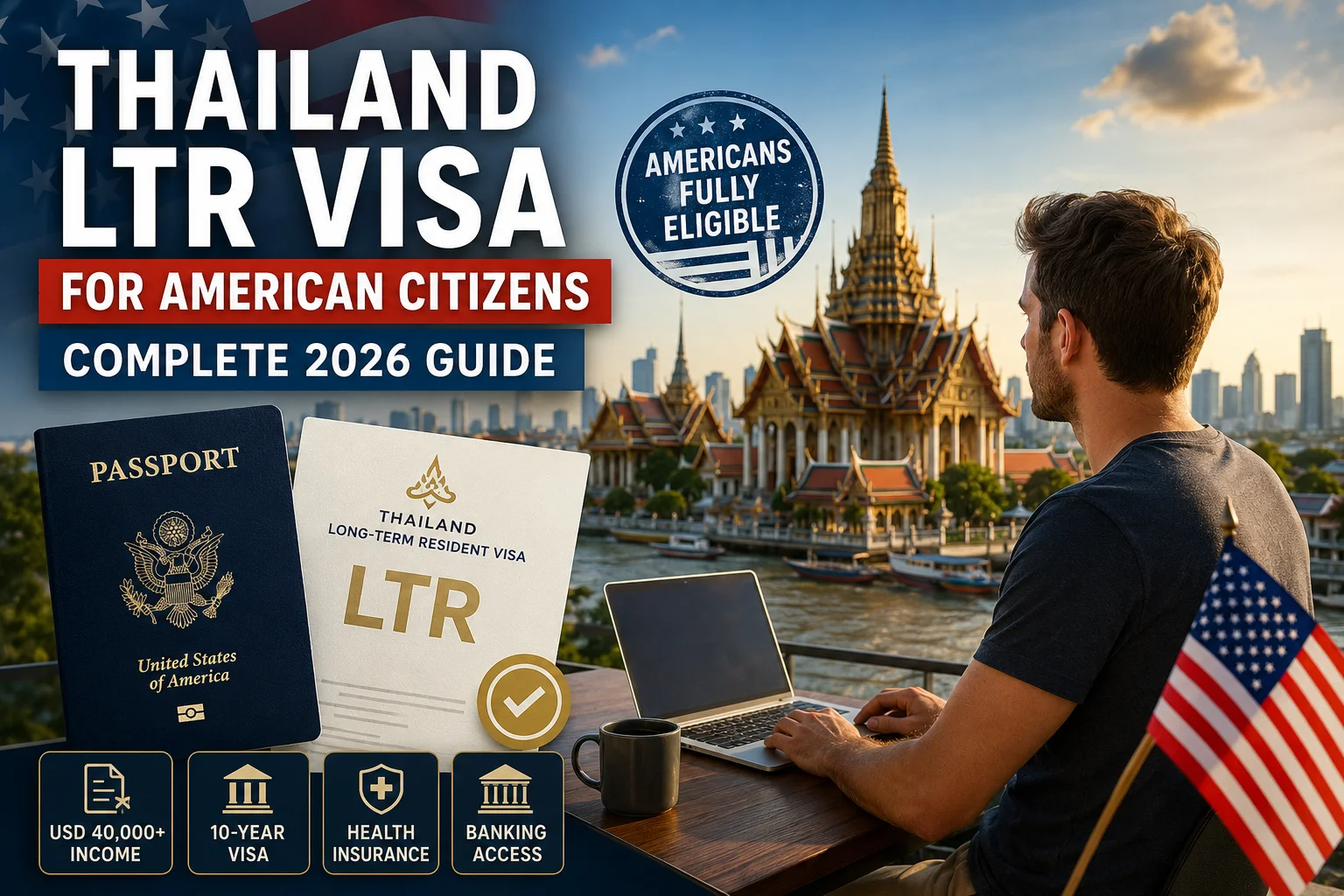
| American citizens are fully eligible for the Thailand LTR Visa (Long-Term Resident, Work-From-Thailand Professional category). The income requirement is USD 40,000/year gross from non-Thai overseas sources — the same as for all nationalities. For US citizens, the income documentation differs: BOI accepts IRS Form 1040, W-2 forms, 1099-NEC forms, Schedule C, and US bank statements in place of the CA certificate required from Indian applicants. Americans living in Thailand face unique tax obligations: US citizens are taxed on worldwide income regardless of residence, but the Foreign Earned Income Exclusion (FEIE) can exclude up to approximately USD 126,500 (2024 limit) from US taxation. Americans with Thai bank accounts must file FBAR (FinCEN Form 114) annually if the account balance exceeds USD 10,000. Thai banks are FATCA-compliant and will report US person accounts to the IRS. Thailand’s 180-day tax residency rule creates potential dual tax obligations that require active management. This guide explains everything about the Thailand LTR Visa American Citizens need to know before applying. |
| QUICK ANSWER: Can Americans apply for Thailand LTR Visa? Yes. US citizens are fully eligible for the Thailand LTR Visa (Work-From-Thailand Professional category). Key requirements: Income: USD 40,000/year gross from non-Thai overseas sourcesExperience: 5+ years of professional experienceHealth insurance: International plan with USD 50,000+ coverage valid in ThailandDocumentation: Form 1040 (2 years), W-2 or 1099 forms, US bank statements (12 months), professional CVNo CA certificate needed — IRS tax documentation is accepted by BOI Americans are among the largest applicant groups for the Thailand LTR Visa. The US passport’s 30-day visa-exempt access to Thailand is a useful starting point, but the LTR Visa is the correct legal solution for long-term remote workers. |
| DISCLAIMER This guide is for informational purposes only. It does not constitute legal, immigration, or tax advice. US tax law, BOI requirements, and Thailand immigration policies can change. Always consult a licensed Thai immigration attorney for visa guidance and a US CPA or tax attorney specializing in expat taxation for US tax matters. Do not rely on this guide as a substitute for professional advice. |
Introduction: Americans and the Thailand LTR Visa
Americans have been living in Thailand on tourist visas for decades. The combination of 30-day visa-exempt entry, easy extensions, and historically low enforcement against remote workers made Thailand the default base for American digital nomads long before the LTR Visa existed.
But the legal landscape has changed. The Thailand LTR Visa — launched in 2022 by the Thailand Board of Investment — gives American remote workers something the tourist visa never could: explicit legal authorization to work for overseas employers, 10 years of multiple-entry stay, and full banking access. For an American earning USD 50,000+ per year from overseas clients or a remote US employer, the LTR Visa is the correct long-term answer.
What this guide covers that no other guide does: the specific IRS documentation BOI accepts, the FEIE implications of living in Thailand, the FBAR requirement for Thai bank accounts, and the FATCA landscape for Americans opening accounts at Bangkok Bank or KBank.
Eligibility Requirements for American Citizens
| Requirement | Standard | US-Specific Notes |
| Annual income | USD 40,000 gross from overseas non-Thai sources | Must be from non-Thai sources. US employer income (remote) qualifies. US client income qualifies. |
| Professional experience | 5 years in professional field | US work history and LinkedIn profile generally sufficient. US employer reference letters strengthen application. |
| Health insurance | USD 50,000+ international coverage valid in Thailand | US domestic plans (Aetna, BCBS, Kaiser) do NOT cover Thailand adequately. Need Cigna Global, Allianz Care, or similar. |
| Income documentation | Varies by nationality | IRS Form 1040 (2 years), W-2 or 1099-NEC, Schedule C, US bank statements. No CA certificate required. |
| Passport validity | Valid national passport | US passport. Recommend minimum 18 months remaining validity. |
| Background check | BOI conducts background review | Any US criminal record may affect eligibility. Minor offenses may not disqualify. |
US Income Documentation: What BOI Accepts from American Applicants
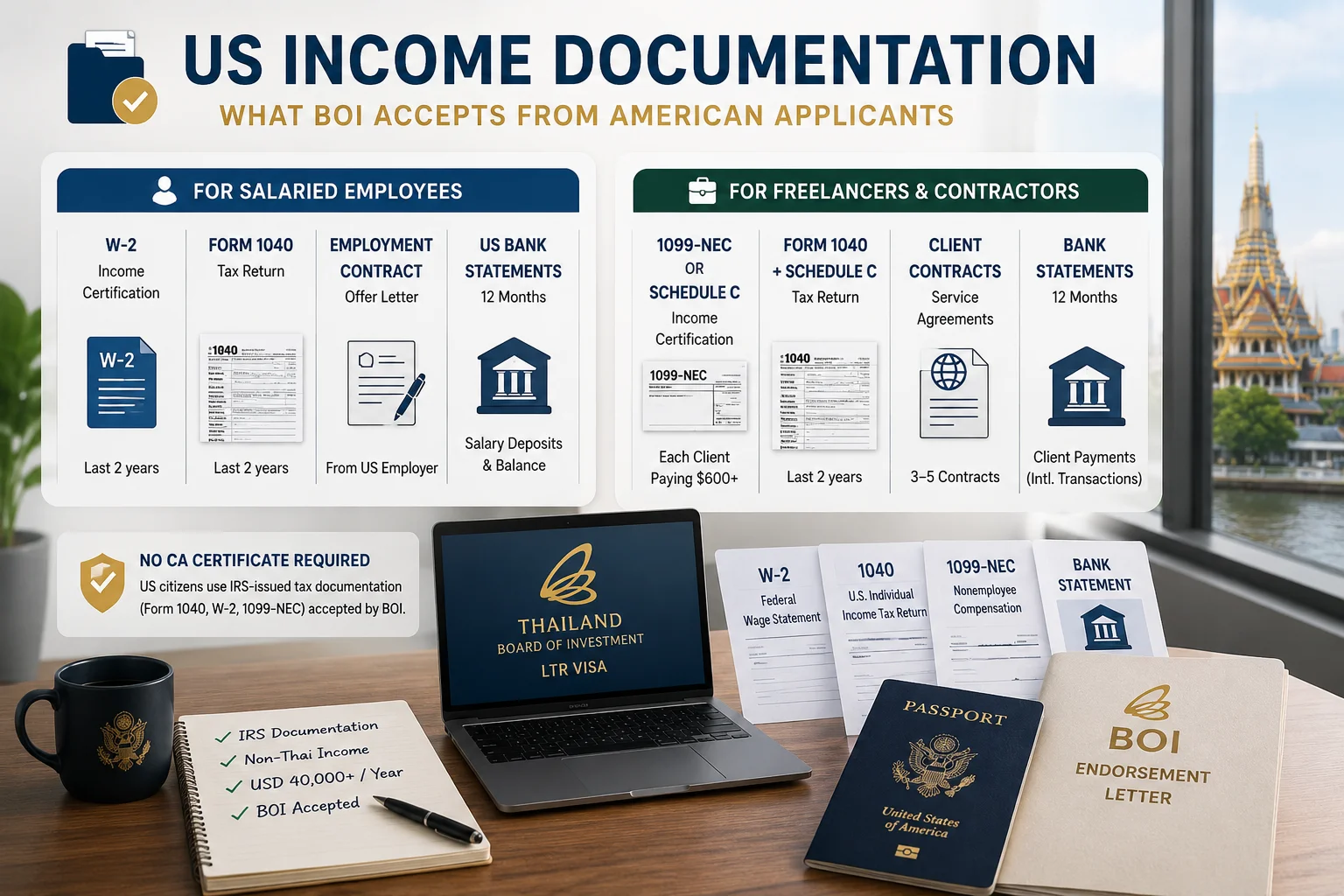
This is the most practically important section for American applicants. Unlike Indian nationals (who need an ICAI CA certificate) or Filipino nationals (who need BIR documentation), Americans use standard IRS-issued tax documentation that BOI recognizes and accepts.
Core documents for salaried American employees
| Document | US Equivalent | Specification |
| Income certification | W-2 (Wage and Tax Statement) | Last 2 years. Shows employer name, wages, and federal tax withheld. |
| Tax return | Form 1040 (US Individual Income Tax Return) | Last 2 years. Download from IRS.gov transcript section or your CPA. |
| Employment contract | Offer letter or employment contract | From US employer confirming remote work arrangement, salary, and role. |
| Bank statements | US bank statements (Chase, Wells Fargo, BOA, etc.) | 12 months showing salary deposits and balance. USD amounts. |
Core documents for American freelancers and contractors
| Document | US Equivalent | Specification |
| Income certification | 1099-NEC from clients OR Schedule C | 1099-NEC: from each client paying USD 600+/year. Schedule C: from Form 1040 showing business income. |
| Tax return | Form 1040 + Schedule C | Last 2 years. Schedule C shows gross receipts from self-employment. |
| Client contracts | Service agreements with US/overseas clients | 3 to 5 representative contracts. Show client country, scope, and fee. |
| Bank statements | US business or personal bank statements | 12 months showing client payments. Highlight international transactions. |
| WHAT AMERICANS DO NOT NEED THAT OTHER NATIONALITIES DO US citizens do not need a ‘CA certificate’ (the ICAI-issued document required from Indian applicants). The IRS tax documentation system — Form 1040, W-2, and 1099-NEC — is recognized by BOI as equivalent income proof. However: if you have been living abroad and filing using the FEIE (Foreign Earned Income Exclusion), your Form 1040 may show reduced or zero US taxable income. In this case, you should attach a cover letter explaining that gross income (before FEIE deduction) is the figure relevant to the LTR Visa threshold, and provide Schedule C or 1099 forms that show gross income before the exclusion. |
Step-by-Step Application Process for American Citizens
- Confirm income threshold: Verify that your gross income from US or overseas non-Thai sources totals USD 40,000+ for the most recent 12 months
- Gather IRS documentation: Collect Form 1040 (last 2 years), W-2 or 1099-NEC forms, and 12 months of US bank statements
- Arrange qualifying health insurance: Purchase an international plan (Cigna Global, Allianz Care, Aetna International) with USD 50,000+ Thailand coverage. US domestic health plans do not qualify.
- Prepare employment documentation: Gather employment contract or client agreements confirming your remote work arrangement with non-Thai entities
- Build your CV: Confirm 5+ years of professional experience with dates and role descriptions
- Create BOI portal account: Register at ltrvisat.boi.go.th
- Complete and submit the application: Upload all documents, pay the THB 50,000 non-refundable endorsement fee
- Monitor BOI review: 20 to 35 working days. Watch email for Additional Information Requests (AIR)
- Receive BOI endorsement letter and schedule Royal Thai Consulate appointment in the US
- Attend Thai Consulate appointment: Major US cities have Royal Thai Consulates (Los Angeles, New York, Chicago, Houston, Miami). Pay THB 10,000 visa stamp fee (approximately USD 280)
- Travel to Thailand: Activate your LTR Visa on first entry
Cost Breakdown in USD for American Applicants
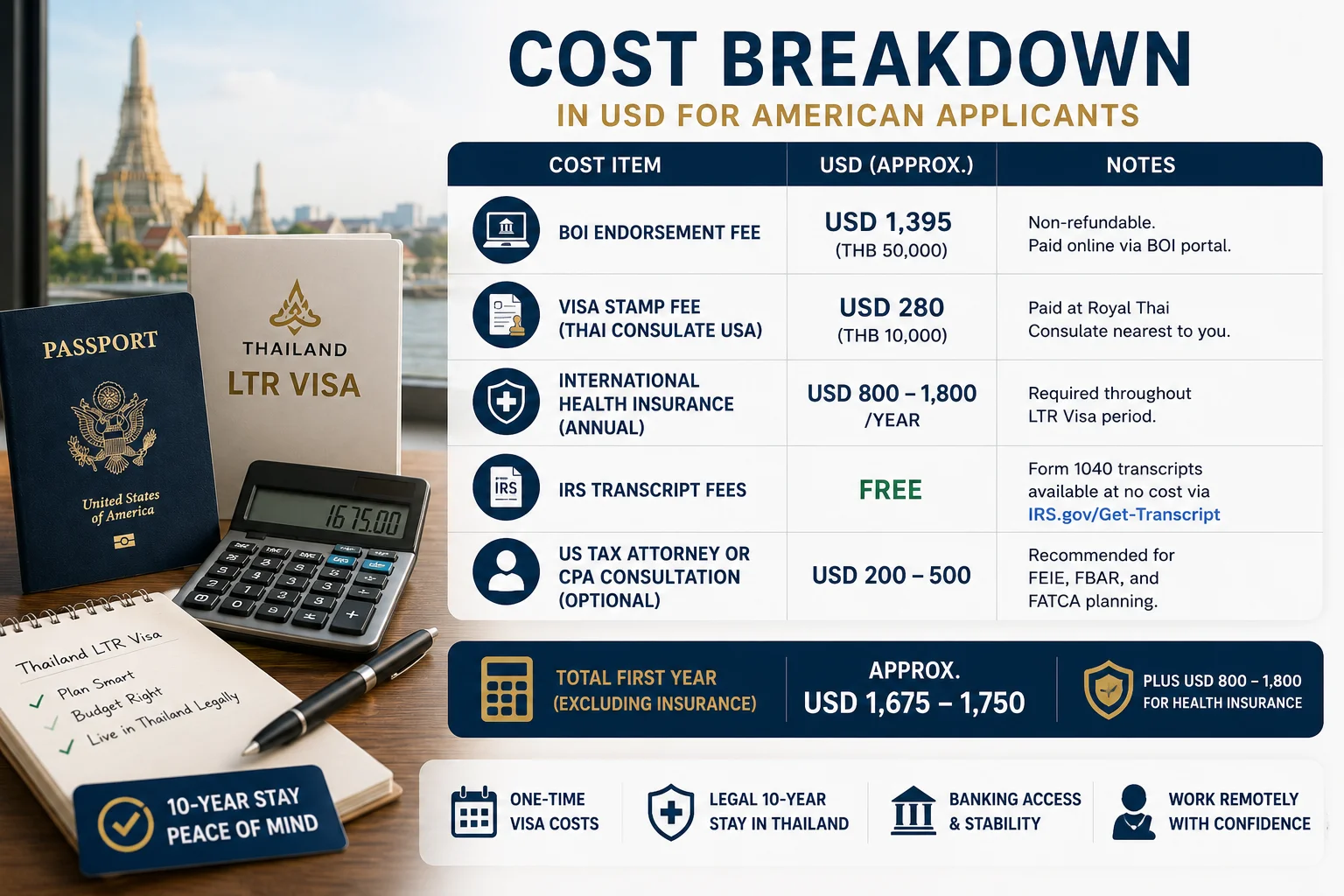
| Cost Item | USD (approx.) | Notes |
| BOI endorsement fee | USD 1,395 (THB 50,000) | Non-refundable. Paid online via BOI portal. |
| Visa stamp fee (Thai Consulate USA) | USD 280 (THB 10,000) | Paid at Royal Thai Consulate nearest to you |
| International health insurance (annual) | USD 800–1,800/year | Required throughout LTR Visa period |
| IRS transcript fees | Free | Form 1040 transcripts available at no cost via IRS.gov/Get-Transcript |
| US tax attorney or CPA consultation (optional) | USD 200–500 | Recommended for FEIE, FBAR, and FATCA planning |
| TOTAL first year (excluding insurance) | Approx. USD 1,675–1,750 | Plus USD 800–1,800 for health insurance |
US Tax Implications of Living in Thailand on the LTR Visa
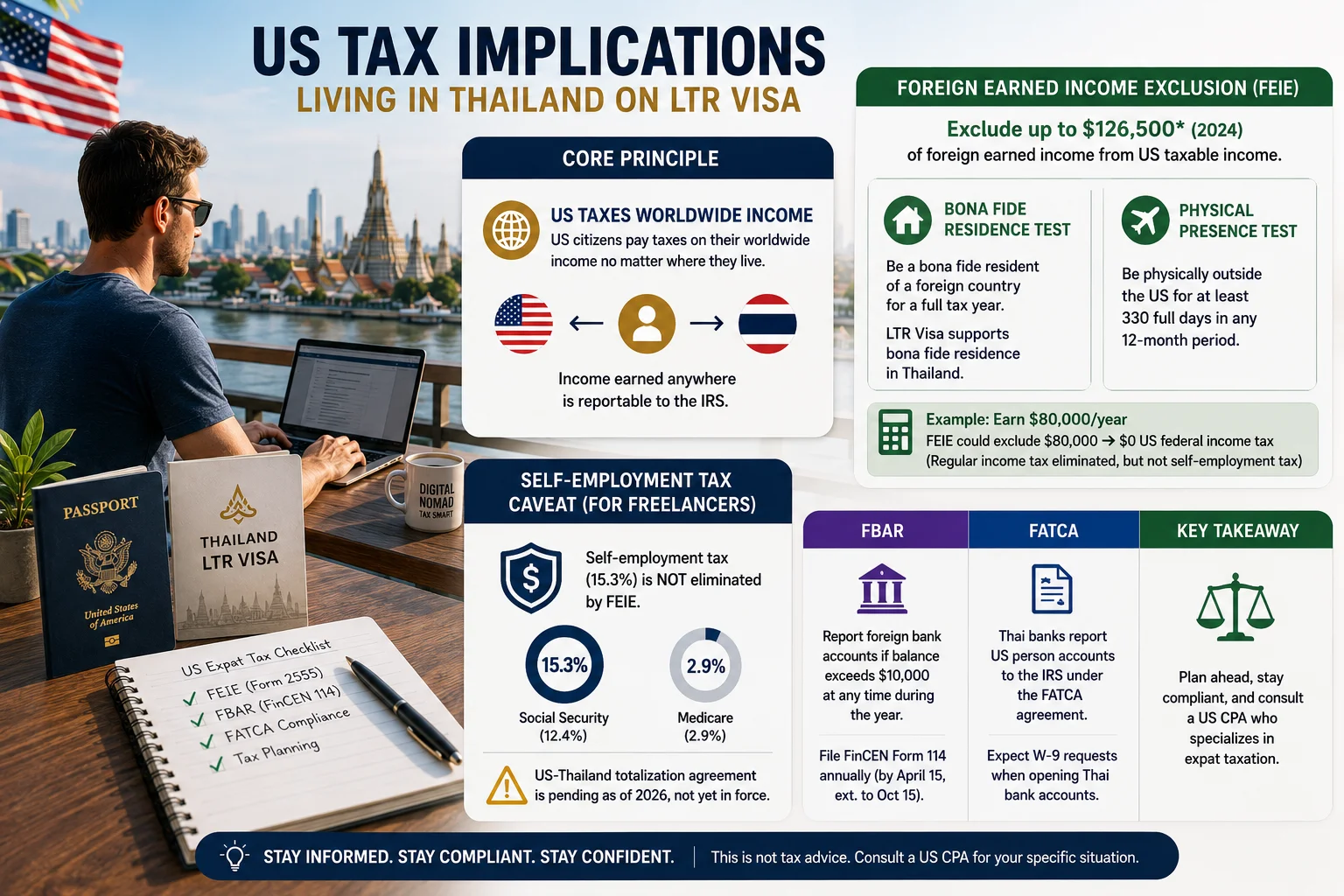
This section does not exist in any other Thailand LTR Visa guide. It is the most important section for American applicants because US citizens face tax obligations that no other nationality on the LTR Visa faces.
US worldwide taxation: the core principle
The United States taxes its citizens on worldwide income, regardless of where they live. An American living in Bangkok on an LTR Visa continues to owe US income taxes on their income, just as they would if living in New York. This is the fundamental principle that creates the FEIE, FBAR, and FATCA issues discussed below.
The Foreign Earned Income Exclusion (FEIE)
The FEIE (IRS Form 2555) allows qualifying American citizens to exclude up to approximately USD 126,500 (2024 indexed limit) of foreign earned income from US taxation. To qualify, you must meet either:
- Bona Fide Residence Test: You are a bona fide resident of a foreign country for a full tax year. An LTR Visa is strong evidence of bona fide residence status in Thailand.
- Physical Presence Test: You are physically outside the United States for at least 330 full days in any 12-month period.
For an American earning USD 80,000/year from a US tech company while living in Thailand on an LTR Visa, the FEIE could reduce US taxable income by USD 80,000 — eliminating US federal income tax on that income entirely. However, self-employment tax (Social Security + Medicare, 15.3%) is NOT eliminated by the FEIE.
| SELF-EMPLOYMENT TAX CAVEAT FOR AMERICAN FREELANCERS American freelancers and contractors in Thailand face a tax that employees do not: self-employment tax (15.3% on net self-employment income up to the Social Security wage base, 2.9% above it). The FEIE excludes this income from regular income tax but does NOT eliminate self-employment tax liability. A US-Thailand totalization agreement (which would allow Americans in Thailand to opt out of US Social Security/Medicare in favor of Thai contributions) is pending as of 2026 but not yet in force. This is not tax advice. Consult a US CPA specializing in expat taxation for your specific situation. |
FBAR: Required Reporting for Americans with Thai Bank Accounts
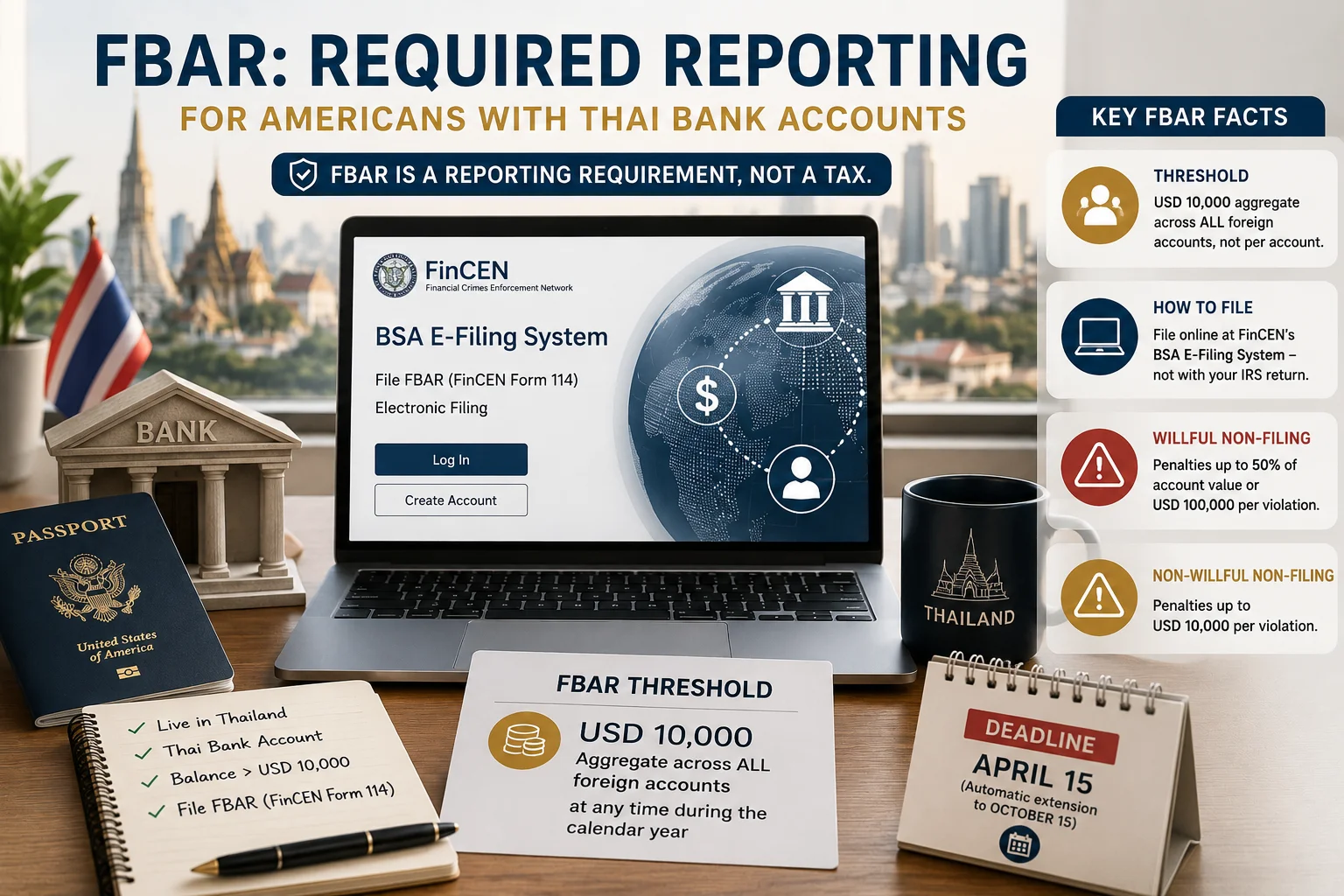
FBAR stands for Foreign Bank Account Report. It is administered by the Financial Crimes Enforcement Network (FinCEN), not the IRS, but is often handled by US tax professionals alongside the annual tax filing.
| FBAR REQUIREMENT FOR AMERICANS IN THAILAND Any US citizen, resident, or entity that has a financial interest in or signature authority over foreign financial accounts exceeding USD 10,000 in aggregate at any point during the calendar year must file FinCEN Form 114 (FBAR) annually. If you open a Bangkok Bank savings account and the balance exceeds USD 10,000 (approximately THB 350,000) at any time during the year, you are required to file FBAR by April 15 (with automatic extension to October 15). Key FBAR facts for Thailand LTR Visa holders: The threshold is USD 10,000 aggregate across ALL foreign accounts, not per account Filing is done online at FinCEN’s BSA E-Filing System — not with your IRS tax return Penalties for willful non-filing: up to 50% of account value or USD 100,000 per violation Penalties for non-willful non-filing: up to USD 10,000 per violation FBAR is a filing requirement, not a tax. It does not create additional tax liability on your Thai bank account. But the penalties for non-compliance are severe. |
FATCA and Thai Banking for US Persons
FATCA (Foreign Account Tax Compliance Act) requires foreign financial institutions to report information about accounts held by US persons to the IRS. Thailand’s major banks — including Bangkok Bank and Kasikorn Bank — are FATCA-compliant.
- What this means for American LTR Visa holders: Bangkok Bank and KBank will report your account details (account number, balance, and identity) to the Thai Revenue Department, which shares data with the IRS under the intergovernmental FATCA agreement
- You will need to complete IRS Form W-9 (US persons) when opening a Thai bank account. Some American applicants report that Bangkok Bank requires additional documentation for US persons due to FATCA compliance
- FATCA compliance does not make Thai banking unavailable to Americans — but it creates more paperwork and some banks may be slower to open accounts for US persons due to the compliance burden
- Wise (formerly TransferWise) is a useful alternative: Wise is not a bank and FATCA reporting rules apply differently. Many American LTR Visa holders use Wise for international income and a Thai bank for local expenses
American LTR Visa vs. Tourist Visa: The Practical Comparison
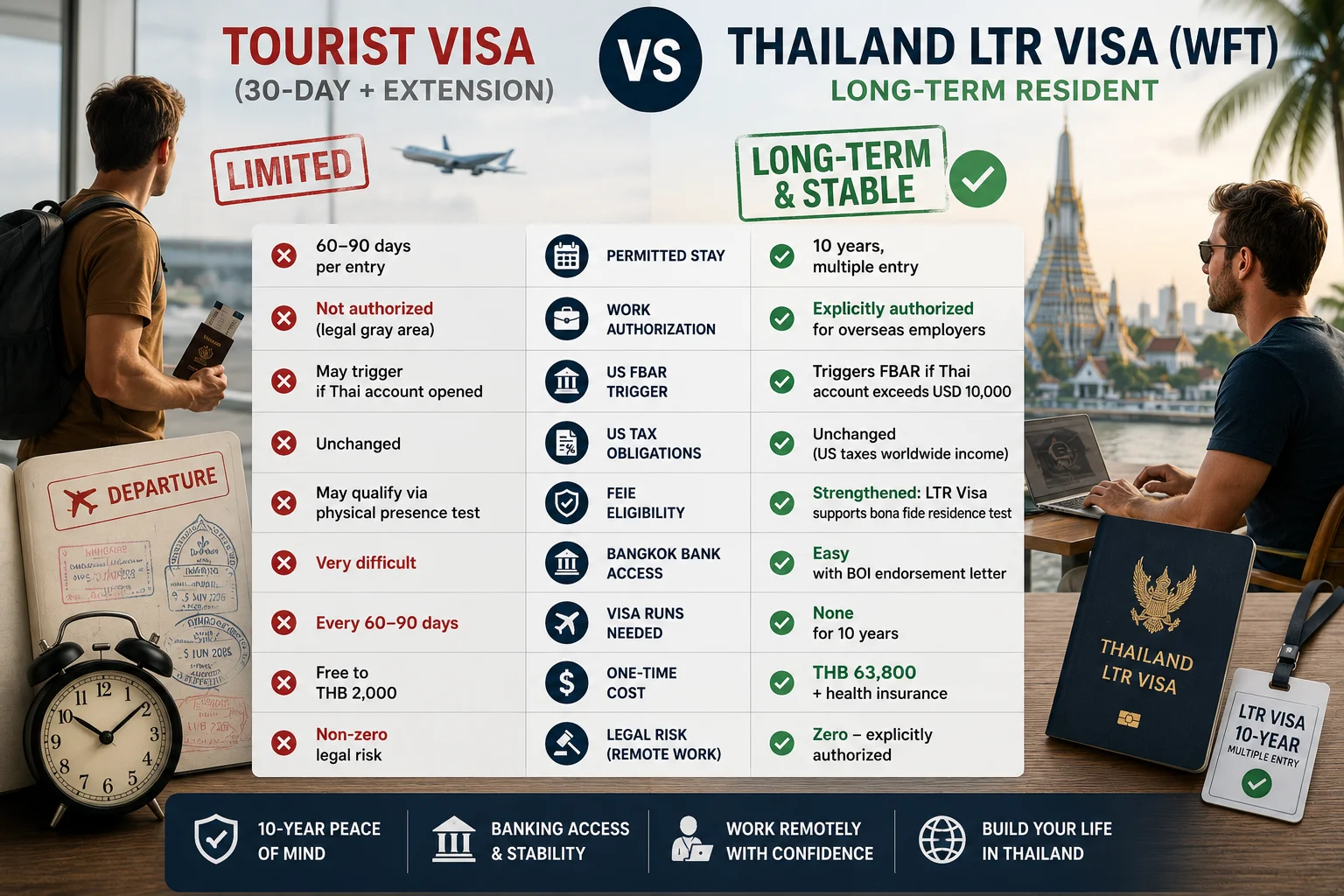
| Factor | Tourist Visa (30-day + extension) | Thailand LTR Visa (WFT) |
| Permitted stay | 60–90 days per entry | 10 years, multiple entry |
| Work authorization | Not authorized (legal gray area) | Explicitly authorized for overseas employers |
| US FBAR trigger | May trigger if Thai account opened | Triggers FBAR if Thai account exceeds USD 10,000 |
| US tax obligations | Unchanged | Unchanged (US taxes worldwide income regardless) |
| FEIE eligibility | May qualify via physical presence test | Strengthened: LTR Visa supports bona fide residence test |
| Bangkok Bank access | Very difficult | Easy with BOI endorsement letter |
| Visa runs needed | Every 60–90 days | None for 10 years |
| One-time cost | Free to THB 2,000 | THB 63,800 + health insurance |
| Legal risk (remote work) | Non-zero legal risk | Zero — explicitly authorized |
Common Mistakes American Applicants Make
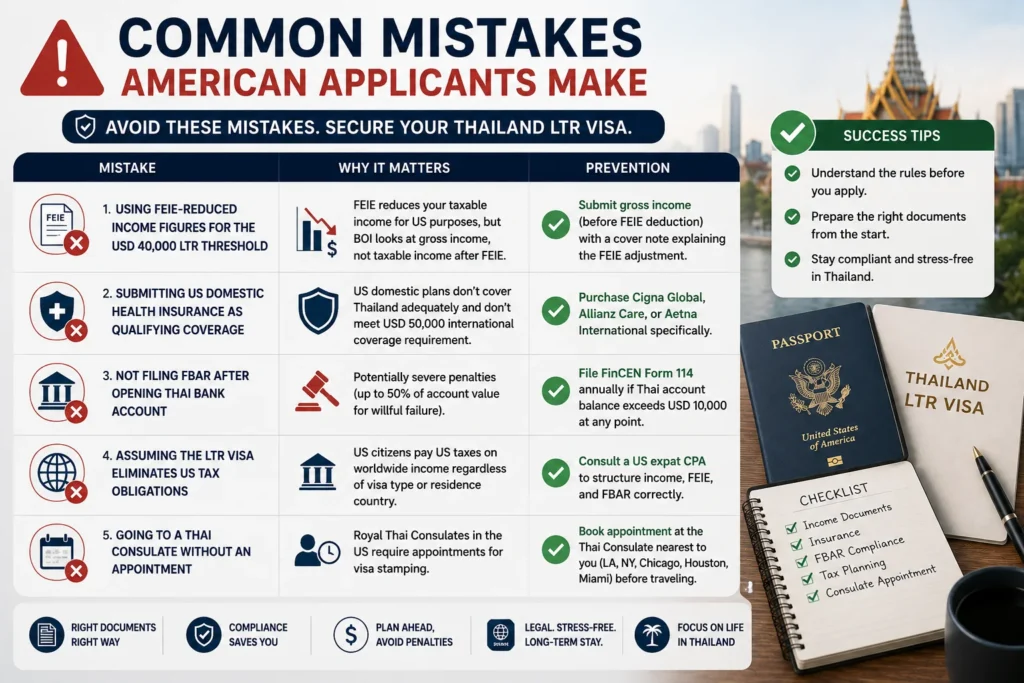
| Mistake | Why It Matters | Prevention |
| Using FEIE-reduced income figures for the USD 40,000 LTR threshold | FEIE reduces your taxable income for US purposes, but BOI looks at gross income, not taxable income after FEIE | Submit gross income (before FEIE deduction) with a cover note explaining the FEIE adjustment |
| Submitting US domestic health insurance as qualifying coverage | Blue Cross, Aetna US domestic plans don’t cover Thailand adequately and don’t meet USD 50,000 international coverage requirement | Purchase Cigna Global, Allianz Care, or Aetna International specifically |
| Not filing FBAR after opening Thai bank account | Potentially severe penalties (up to 50% of account value for willful failure) | File FinCEN Form 114 annually if Thai account balance exceeds USD 10,000 at any point |
| Assuming the LTR Visa eliminates US tax obligations | US citizens pay US taxes on worldwide income regardless of visa type or residence country | Consult a US expat CPA to structure income, FEIE, and FBAR correctly |
| Going to a Thai Consulate without an appointment | Royal Thai Consulates in the US require appointments for visa stamping | Book appointment at the Thai Consulate nearest to you (Los Angeles, New York, Chicago, Houston, Miami) before traveling |
Risks and Limitations for American Citizens on LTR Visa
- US worldwide taxation persists: Living in Thailand on an LTR Visa does not reduce or eliminate US tax obligations. Americans must file Form 1040 annually, report foreign accounts via FBAR, and comply with FATCA — regardless of how long they have been in Thailand.
- Thai 180-day tax residency creates dual tax exposure: Americans who spend 180+ days in Thailand may become Thai tax residents AND remain US taxpayers. The US-Thailand tax treaty provides some relief but does not fully eliminate dual obligations. The treaty is less comprehensive than US tax treaties with major European countries.
- FEIE has limits and conditions: FEIE excludes up to USD 126,500 (2024) but does not eliminate self-employment tax, does not cover passive income (dividends, capital gains), and requires meeting the bona fide residence or physical presence test each year.
- Thai banking complexity for US persons: FATCA compliance requirements make Thai bank account opening slightly more complex for Americans than for other nationalities. Some branches may request additional paperwork. Plan for a longer branch visit.
- Health insurance ongoing cost: Required international health insurance (typically USD 800 to 1,800/year) is an ongoing expense that replaces any prior employer-provided insurance for Americans who were previously covered by US employer plans.
Frequently Asked Questions
Can Americans apply for the Thailand LTR Visa?
Yes. US citizens are fully eligible for the Thailand LTR Visa under the Work-From-Thailand (WFT) Professional category. The income requirement is USD 40,000/year from non-Thai overseas sources. American applicants submit IRS Form 1040, W-2 or 1099-NEC forms, and US bank statements — no CA certificate is required. Americans are among the largest applicant groups for the LTR Visa.
What IRS documents do I need for the Thailand LTR Visa?
BOI accepts: Form 1040 (US Individual Income Tax Return) for the last 2 years, W-2 forms (if employed) or 1099-NEC forms (if freelancing/contracting), Schedule C from Form 1040 for self-employed applicants, and 12 months of US bank statements showing income deposits. No CA certificate is required from US applicants.
Do I still pay US taxes if I live in Thailand on LTR Visa?
Yes. US citizens pay US federal income taxes on worldwide income regardless of where they live. However, the Foreign Earned Income Exclusion (FEIE, IRS Form 2555) allows qualifying Americans to exclude up to approximately USD 126,500 (2024 limit) from US taxation. The LTR Visa supports the bona fide residence test for FEIE qualification. Self-employment tax (Social Security + Medicare) applies even with FEIE.
Do I need to file FBAR if I open a Thai bank account?
Yes, if your Thai bank account balance exceeds USD 10,000 (aggregate across all foreign accounts) at any point during the calendar year. File FinCEN Form 114 online at the BSA E-Filing System by April 15 (auto-extension to October 15). FBAR is a reporting requirement, not a tax. Non-compliance penalties can be severe.
Will Bangkok Bank know I am American and report to the IRS?
Yes. Bangkok Bank and other major Thai banks are FATCA-compliant and required to report US person accounts to the Thai Revenue Department, which shares data with the IRS under the US-Thailand intergovernmental FATCA agreement. You will be asked to complete IRS Form W-9 when opening a Thai bank account as a US person. This is standard and expected — it does not create additional tax liability beyond your existing obligations.
Where are the Royal Thai Consulates in the United States for LTR Visa stamping?
The United States has five Royal Thai Consulates: Los Angeles (covers the western US), New York (covers the northeastern US), Chicago (covers the midwest), Miami (covers the southeastern US and Caribbean), and Honolulu (covers Hawaii and Pacific US territories). After receiving your BOI endorsement letter, book an appointment at the consulate nearest to you for visa stamping.
Final Verdict: Thailand LTR Visa for American Citizens
| American citizens are well-positioned to qualify for the Thailand LTR Visa. The US passport’s 30-day visa-exempt access to Thailand is convenient for testing the country, but the LTR Visa is the correct legal solution for Americans who want to make Thailand a long-term base. The US-specific complexity lies not in the visa application itself — which is straightforward with IRS documentation — but in the ongoing US tax obligations: FEIE planning, FBAR filing, and FATCA awareness. These are manageable with proper US expat CPA guidance but should not be ignored. For American remote workers earning USD 40,000+ from US companies or overseas clients, the LTR Visa delivers what the tourist visa never could: 10 years of legal certainty, banking access, and no border runs. Check the Thailand LTR Visa Complete Guide for the full application process, or the Thailand Digital Nomad Visa Guide for a comparison of all Thailand visa options. |