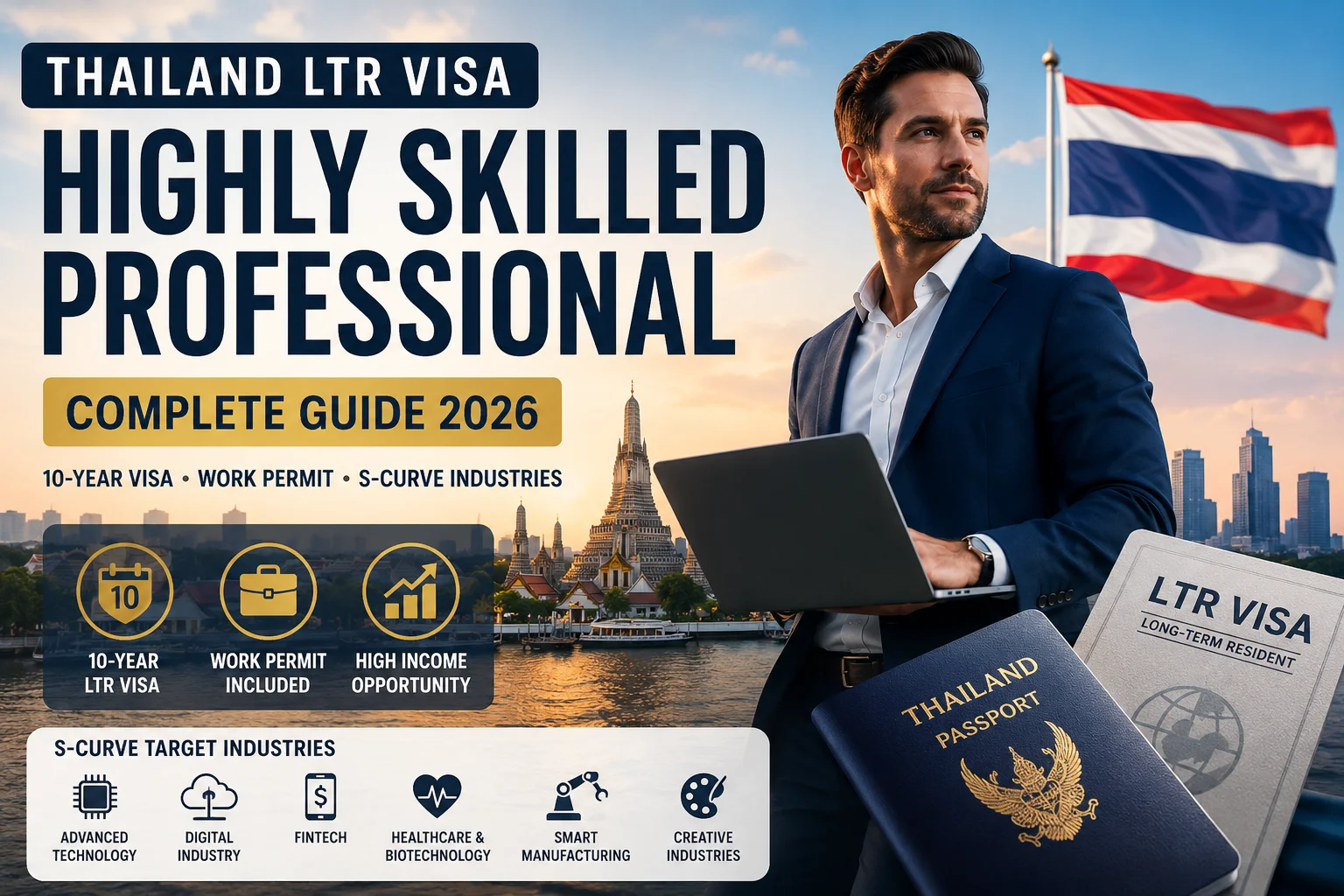
The Thailand LTR Visa Highly Skilled Professional (HSP) category is designed for senior specialists working in Thailand’s BOI-targeted S-curve industries. It differs from the Work-From-Thailand (WFT) Professional category in a fundamental way: HSP applicants must be employed by or contracted with a Thai-registered company, government organization, or BOI-promoted entity — not working remotely for purely overseas employers. The category has two income thresholds: USD 80,000/year for standard applicants, and USD 40,000/year for those holding a Master’s degree or higher in a relevant field or possessing specific government-recognized certifications in target sectors. Qualifying sectors include advanced technology, digital industry, fintech, healthcare, biotechnology, smart manufacturing, and creative industries. HSP holders receive a 10-year, multiple-entry LTR Visa with a work permit for their specific Thai employer. The category is distinct from the SMART Visa, which serves a similar audience with a 4-year duration and different endorsement structure.
QUICK ANSWER: What is the Thailand LTR Visa Highly Skilled Professional category? The LTR Visa Highly Skilled Professional (HSP) category provides a 10-year Thailand residence visa with work permit for senior specialists in BOI-targeted industries. Key requirements: Employment: Must work for a Thai-registered entity, government organization, or BOI-promoted companyIncome Threshold A: USD 80,000+/year for most applicantsIncome Threshold B: USD 40,000+/year for holders of Master’s degree or higher in a target sector, or those with specific certificationsSector: Must work in one of BOI’s S-curve target industries (technology, fintech, healthcare, biotechnology, smart manufacturing, creative industry)Health insurance: USD 50,000+ international coverage valid in Thailand Unlike the WFT Professional category (which is for remote workers with overseas employers), HSP requires physical presence working with a Thai-connected entity.
DISCLAIMER This guide reflects BOI’s HSP requirements as of May 2026. BOI can update target sector definitions, income thresholds, and endorsement requirements. Always verify current requirements at boi.go.th. This is not legal or immigration advice. Consult a licensed Thai immigration attorney for your specific situation.
Introduction
Most Thailand LTR Visa guides focus on the Work-From-Thailand (WFT) Professional category — understandably, since it serves the largest audience of remote workers and freelancers. But there is a second professional category that serves a distinct and arguably more economically impactful audience: the Highly Skilled Professional (HSP) category.
The HSP category is designed for senior specialists whose expertise Thailand actively wants: engineers in advanced manufacturing, biotech researchers, fintech architects, healthcare specialists, digital technology leaders, and creative industry professionals. These are professionals working in or with Thai-based organizations — not purely remote workers — whose skills align with Thailand’s national S-curve industry strategy.
This guide clarifies every aspect of the HSP category that its audience actually needs to know: the dual income thresholds, which Thai employer types qualify, what ‘S-curve industry’ means in practice, and the critical comparison with both the WFT Professional and SMART Visa that no other guide provides.
What Is the LTR Visa Highly Skilled Professional Category?
HSP CATEGORY AT A GLANCE Full name: Highly Skilled Professional (HSP) category — Thailand LTR Visa Administered by: Thailand Board of Investment (BOI) Visa duration: 10 years, multiple entry Work authorization: YES — work permit for specific Thai employer included Sector restriction: YES — must work in BOI S-curve target industries Thai employer requirement: YES — must work for Thai-registered entity, BOI-promoted company, or government organization Annual renewal: Not required 90-day address report: Required
The HSP category is specifically designed to attract and retain senior talent in Thailand’s nationally prioritized industries — not as remote workers for overseas employers, but as on-the-ground specialists contributing to Thai industry development. This is the fundamental distinction from the WFT Professional category.
The Two Income Thresholds for LTR HSP
This is the section that most articles get wrong by omission. The HSP category has two distinct income thresholds depending on the applicant’s academic credentials:
Threshold
Annual Income Required
Who Qualifies
Standard HSP Threshold
USD 80,000+/year
All qualified applicants regardless of academic credentials
Credential-Based HSP Threshold
USD 40,000+/year
Applicants with: (a) Master’s degree or higher in a field relevant to target sectors, OR (b) specific government-recognized professional certifications in BOI target industries
THE USD 40,000 THRESHOLD: WHO IT ACTUALLY HELPS The USD 40,000 credential-based threshold is significantly more accessible and is designed to attract mid-career specialists with strong academic backgrounds. A Thai hospital employing an Indian specialist physician with an MBBS + MD degree at USD 45,000/year qualifies under this pathway. A Filipino fintech engineer at a Bangkok digital bank with a Master’s degree in Computer Science at USD 42,000/year qualifies. However: the credentials must be in a field relevant to BOI target sectors. A Master’s in History or Literature does NOT qualify for the reduced threshold. The degree must align with the sector in which you are working.
BOI Target S-Curve Industries: Which Sectors Qualify
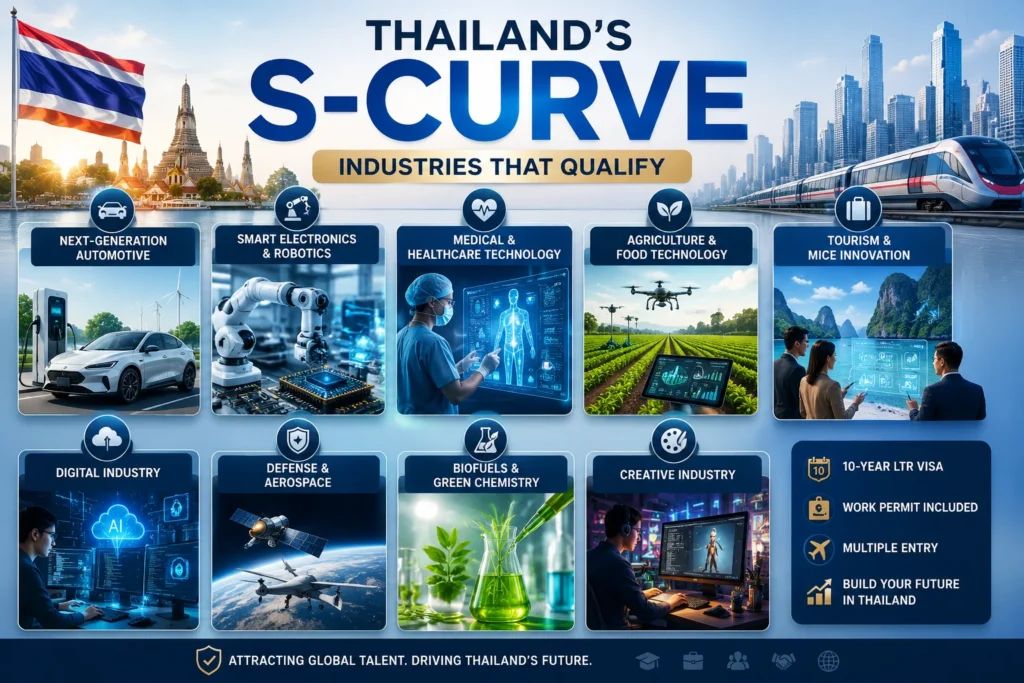
The HSP category is limited to Thailand’s S-curve (strategic) industries. Here is what each sector covers in practice, so professionals can determine if their specialty qualifies:
S-Curve Industry
What It Covers in Practice
Example Roles That Qualify
Next-Generation Automotive
Electric vehicles, EV charging infrastructure, autonomous vehicles, automotive technology
EV systems engineer, battery technology specialist, autonomous driving software engineer
Content production, game development, animation, digital media
Senior game developer, animation director, VFX specialist, digital content architect
Most practically: digital technology (software, fintech, cybersecurity, AI) and healthcare are the two sectors with the highest volume of HSP-qualifying roles in Thailand’s current economy. Bangkok’s growing tech ecosystem and its world-class private hospital network both actively employ specialists at HSP-qualifying levels.
The Thai Employer Requirement: Who Endorses Your HSP Application
This is the requirement that most distinguishes the HSP category from the WFT Professional. HSP applicants must be employed by or have a formal engagement with one of the following Thai entity types:
Entity Type
Examples
Notes
Thai government organization
Ministry of Science and Technology, NSTDA (National Science and Technology Development Agency), Thai Revenue Department
Direct employment by Thai government. BOI does not need to separately endorse.
Manufacturing company with BOI promotion certificate, EEC (Eastern Economic Corridor) registered entity, tech company with BOI status
Company must have active BOI promotion for the relevant sector. Check company’s BOI certificate.
Government-accredited private organization
Universities accredited by Thai Ministry of Education, research institutes recognized by government agencies, hospitals accredited by the Medical Council of Thailand
Accreditation from relevant Thai government authority required.
Thai-registered company operating in S-curve sectors
Tech startups, fintech companies, biotech firms registered in Thailand
Company operates in BOI S-curve sector. May not need BOI promotion status — verify with BOI.
PRACTICAL EMPLOYER VERIFICATION Not every Thai company qualifies as an HSP endorsing employer. Before applying, verify with the company’s HR or legal team whether the company holds BOI promotion status or is otherwise recognized by BOI as a qualifying entity. The BOI’s contact center (investmentpromotiondivision@boi.go.th) can confirm whether a specific employer qualifies. A senior software engineer at a large Thai commercial bank (KASIKORN Bank, SCB, Bangkok Bank) working in digital transformation qualifies — these are major Thai entities in the digital sector. A senior developer at a small Thai startup without BOI registration may not qualify under HSP, and would be better served by the WFT Professional category if their employer is not Thai-registered.
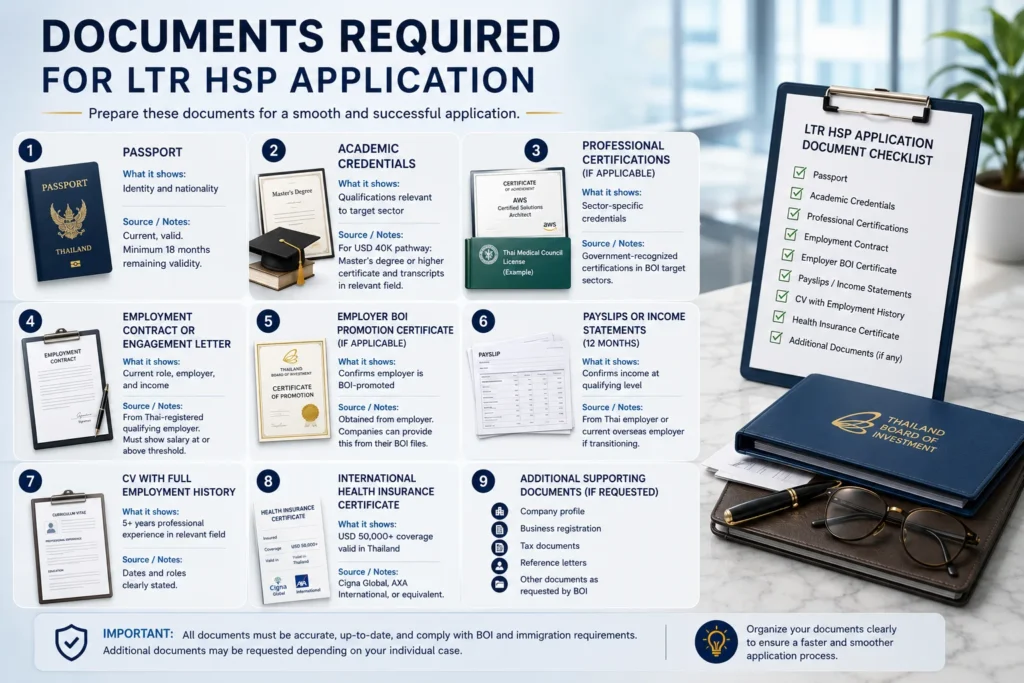
Obtained from employer. Companies can provide this from their BOI files.
Payslips or income statements (12 months)
Confirms income at qualifying level
From Thai employer or current overseas employer if transitioning.
CV with full employment history
5+ years professional experience in relevant field
Dates and roles clearly stated.
International health insurance certificate
USD 50,000+ coverage valid in Thailand
Cigna Global, AXA International, or equivalent.
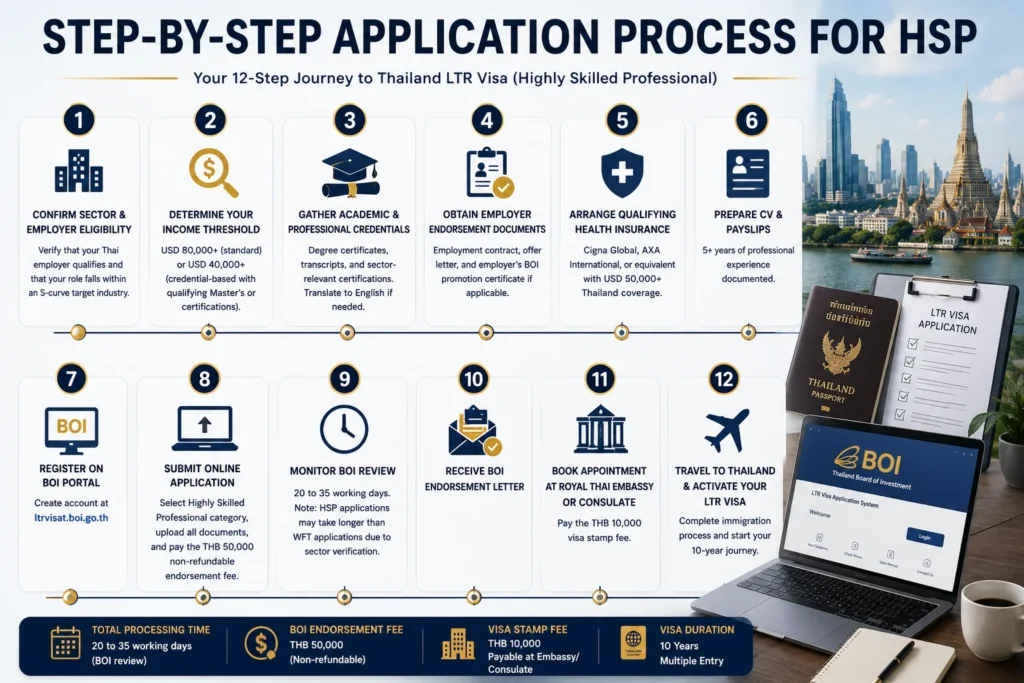
Step-by-Step Application Process for HSP
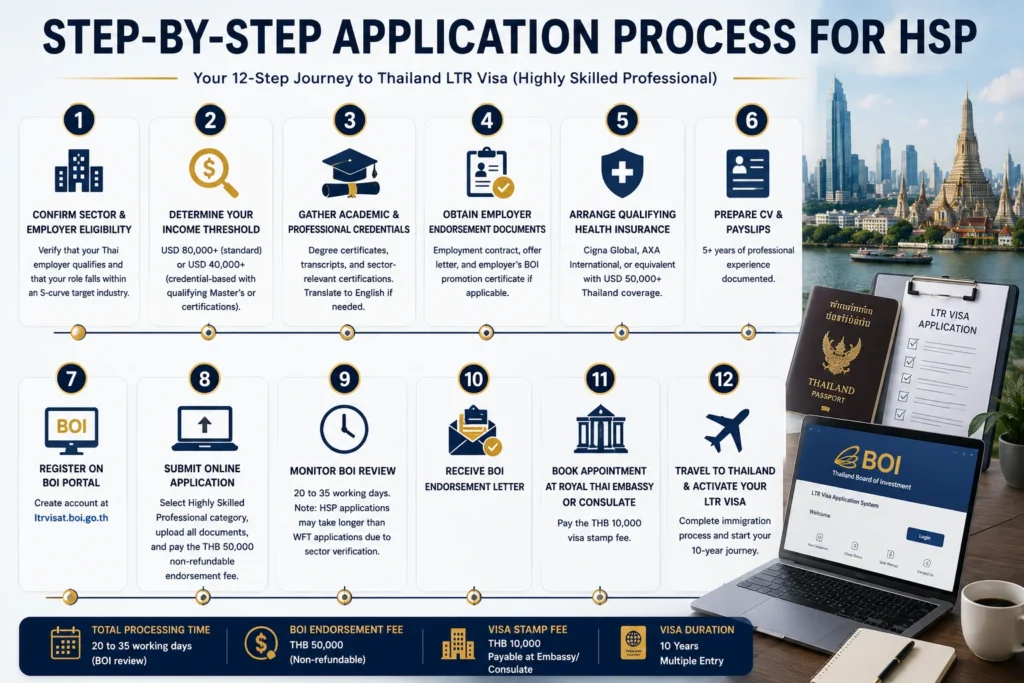
Confirm sector and employer eligibility: Verify that your Thai employer qualifies and that your role falls within an S-curve target industry
Determine your income threshold: USD 80,000+ (standard) or USD 40,000+ (credential-based with qualifying Master’s or certifications)
Gather academic and professional credentials: Degree certificates, transcripts, and sector-relevant certifications. Have documents translated to English if in another language.
Obtain employer endorsement documentation: Employment contract, offer letter, and employer’s BOI promotion certificate if applicable
Arrange qualifying health insurance: Cigna Global, AXA International, or equivalent with USD 50,000+ Thailand coverage
Prepare complete CV and payslips: 5+ years of professional experience documented
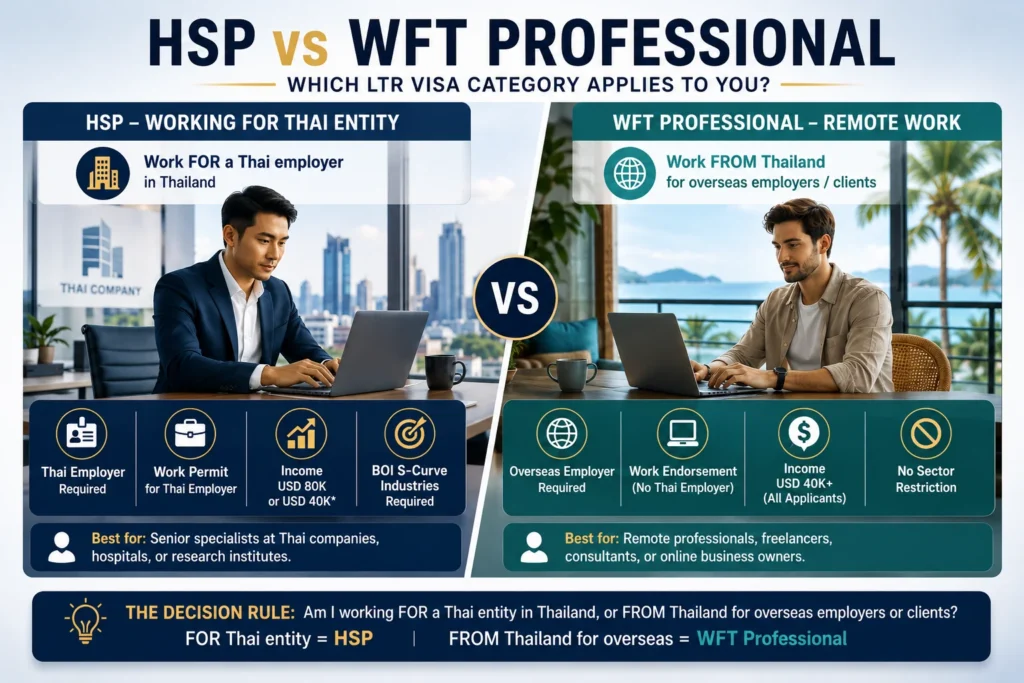
Senior specialist at Thai tech company, hospital, or research institute
Remote developer, consultant, or online business owner with overseas income
THE CRITICAL DECISION RULE Ask yourself one question: Am I working FOR a Thai employer/entity in Thailand, or working FROM Thailand for overseas employers/clients? • Working FOR a Thai entity in Thailand = HSP category • Working FROM Thailand for overseas employers or clients = WFT Professional category A senior software engineer at Kasikorn Bank’s digital team = HSP. A remote software engineer working for a UK company from Bangkok = WFT Professional. These are distinct legal and employment situations requiring different categories.
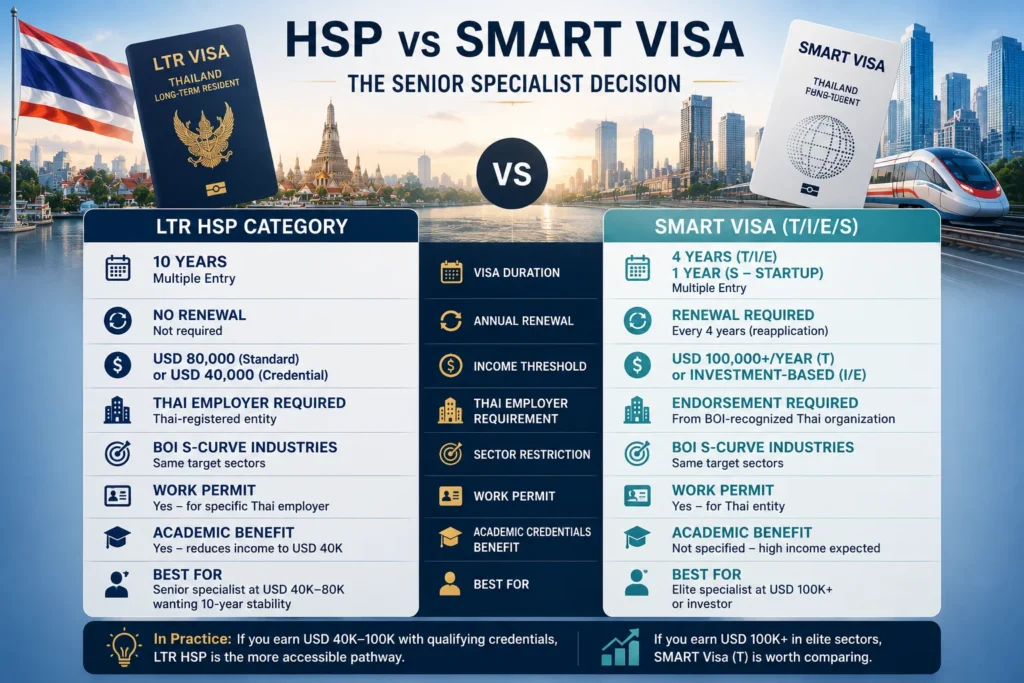
Both the HSP LTR category and the Thailand SMART Visa serve senior specialists in BOI target industries. The comparison is not straightforward because they serve overlapping but distinct audiences:
4 years (T/I/E categories) or 1 year (S — startup)
Annual renewal
Not required
Required every 4 years (reapplication)
Income threshold
USD 80,000 (standard) or USD 40,000 (credential)
USD 100,000/year (T category) or investment-based (I/E)
Thai employer requirement
Required (Thai-registered entity)
Endorsement from BOI-recognized Thai organization required
Sector restriction
BOI S-curve industries
Same BOI S-curve industries
Work permit
YES — for specific Thai employer
YES — for Thai entity
Academic credentials benefit
YES — reduces income to USD 40K
Not specified in same way; high income expected
Best for
Senior specialist at USD 40–80K wanting 10-year stability
Elite specialist at USD 100K+ or investor
In practice: the LTR HSP category at the USD 40,000 credential-based threshold is more accessible than the SMART Visa (T category at USD 100,000+). For specialists earning between USD 40,000 and USD 100,000/year with qualifying credentials, the HSP LTR category is the correct pathway. For those earning USD 100,000+ in elite sectors, the SMART Visa T category offers a comparable pathway worth comparing.
Nationality-Specific Guidance: Indian Professionals
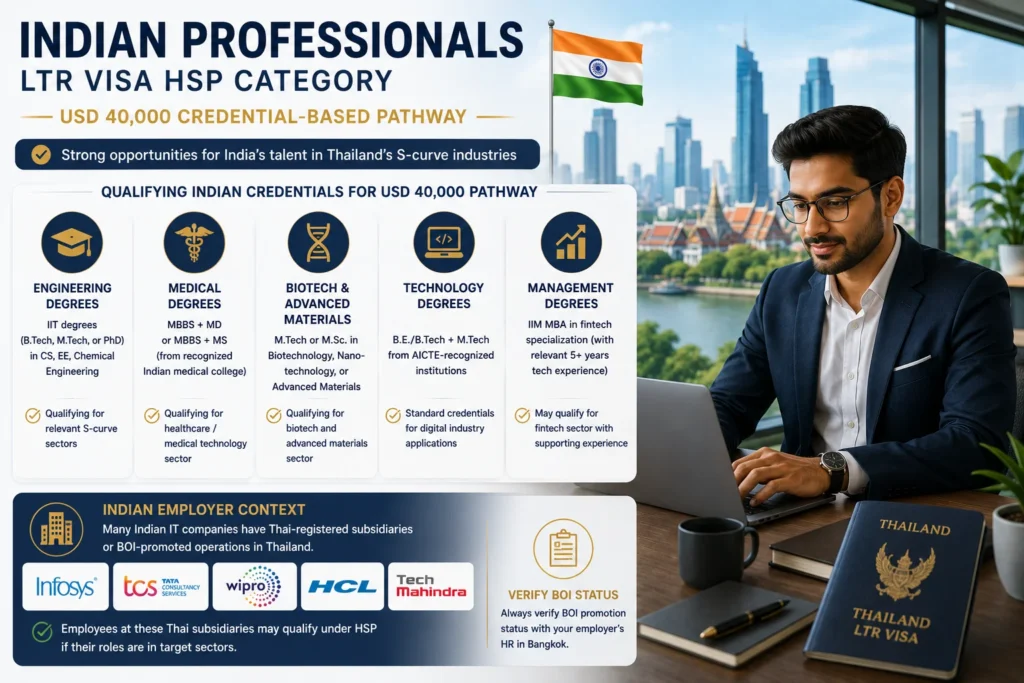
INDIA-SPECIFIC HSP GUIDANCE Indian professionals are among the strongest candidates for the HSP credential-based USD 40,000 threshold, given India’s deep talent pools in technology, medicine, and engineering. Qualifying Indian credentials for the USD 40,000 pathway: IIT degrees (B.Tech, M.Tech, or PhD) in Computer Science, Electrical Engineering, Chemical Engineering: recognized globally; likely qualifying for relevant S-curve sectors MBBS + MD or MBBS + MS (from recognized Indian medical college): qualifying for healthcare/medical technology sector M.Tech or M.Sc. in Biotechnology, Nanotechnology, or Advanced Materials: qualifying for biotech and advanced materials sectorB.E./B.Tech + M.Tech from AICTE-recognized institutions: standard credentials for digital industry applications IIM MBA in fintech specialization (with relevant 5+ years tech experience): may qualify for fintech sector with supporting experience documentation Indian employer context: Many Indian IT companies (Infosys, Wipro, TCS, HCL) have Thai-registered subsidiaries or BOI-promoted operations in Thailand. Employees at these Thai subsidiaries may qualify under HSP if their roles are in target sectors. Verify BOI promotion status with your employer’s HR in Bangkok.
PHILIPPINES-SPECIFIC HSP GUIDANCEFilipino professionals in IT, healthcare, and engineering are well-positioned for the HSP category given the Philippines’ strong technical and medical professional pipeline. Qualifying Filipino credentials for the USD 40,000 pathway: BS Computer Science + Master’s in Computer Science or Information Technology from UP, DLSU, or Ateneo: likely qualifying for digital industry sector MD + specialty board certification in medical fields: qualifying for healthcare sector. PRC board certification in Medicine is recognized.BS Electronics Engineering + M.Eng (relevant field): qualifying for smart electronics and robotics sector BS Computer Engineering + relevant Master’s or BSCS + cloud/AI certifications (AWS, Azure, Google Cloud): qualifying for digital industry with strong supporting certification Filipino employer context: Major Philippine IT companies (Ayala Group’s tech entities, Globe Fintech Innovations) may have Thai operations. Filipino healthcare professionals at Thai hospitals (JCI-accredited Thai private hospitals) qualify under healthcare sector HSP.
Common Mistakes HSP Applicants Make
Mistake
Consequence
Prevention
Applying for WFT Professional when they should apply for HSP (or vice versa)
Wrong category = rejection. A Thai-based specialist applying under WFT will be rejected for not having overseas-only income.
Use the decision rule: Thai employer = HSP. Overseas employer = WFT.
Claiming the USD 40,000 credential threshold with a degree not in a target sector
BOI will reject the credential claim; standard USD 80,000 applies instead
Ensure degree field explicitly aligns with the S-curve sector you are applying in. Generic MBA or arts degrees do not qualify.
Not verifying Thai employer’s BOI or government status before applying
BOI may reject application if employer is not a qualifying entity
Ask employer HR for BOI promotion certificate or government accreditation documentation before starting application
Submitting credentials in a language other than English without certified translation
BOI cannot assess non-English credentials and will issue an AIR or reject
Obtain certified English translations of all academic documents not in English
Assuming any Thai company qualifies as an HSP employer
Small Thai companies without BOI promotion may not qualify; application may be rejected
Confirm employer’s qualifying status with BOI before paying the THB 50,000 endorsement fee
Risks and Limitations
Thai employer dependency: Your HSP Visa is tied to your Thai employer relationship. If you lose your job, switch employers, or your employer loses BOI status, your visa situation requires review. Consult a Thai immigration attorney in these scenarios.
Sector restriction: HSP visa holders can only work in their qualifying sector. A move to a different industry (e.g., from digital technology to retail management) would need a separate visa assessment.
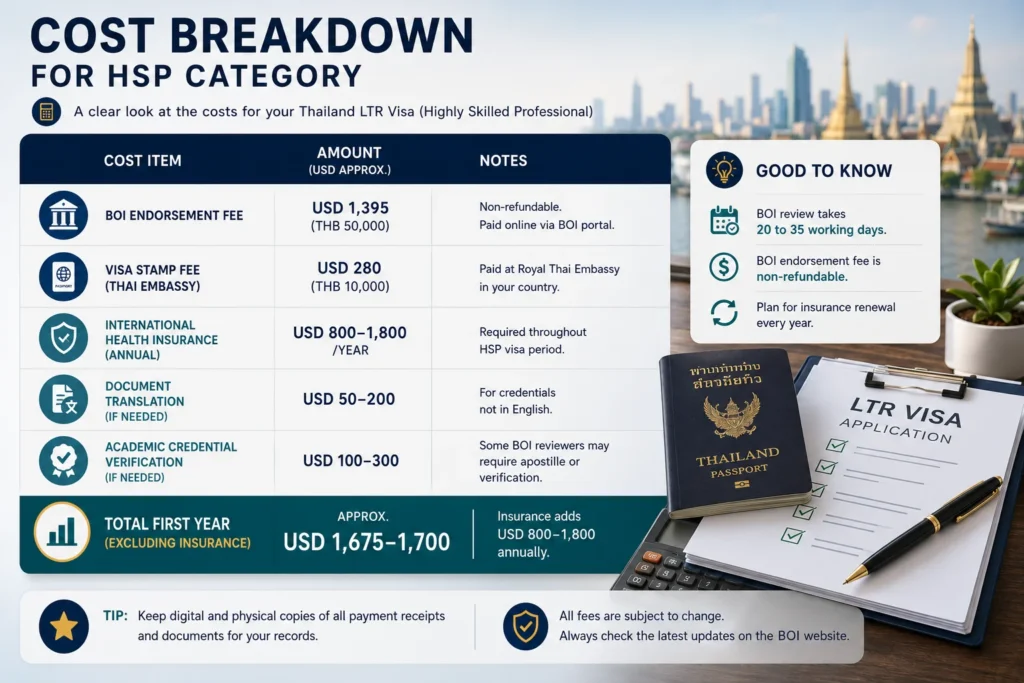
BOI fee is non-refundable: The THB 50,000 endorsement fee is lost if rejected. Confirming employer and sector eligibility before applying is essential.
Higher income threshold than WFT: The standard USD 80,000 threshold is more demanding than WFT’s USD 40,000. Specialists earning USD 40,000 to 80,000 need qualifying credentials to access HSP.
Documentation complexity: Academic credential verification, employer BOI status confirmation, and potentially certified translation all add administrative load relative to WFT Professional applications.
Frequently Asked Questions
What is the Thailand LTR Visa Highly Skilled Professional category?
The LTR Visa Highly Skilled Professional (HSP) category is a 10-year Thailand residence visa for senior specialists in BOI S-curve target industries (digital technology, healthcare, fintech, biotech, advanced manufacturing, creative industry). Applicants must work for a Thai-registered entity, BOI-promoted company, or government organization. Income thresholds: USD 80,000/year (standard) or USD 40,000/year for Master’s degree holders in relevant fields.
What industries qualify for Thailand LTR HSP?
BOI’s qualifying industries include: digital industry (software, AI, fintech, cybersecurity), smart electronics and robotics, automotive technology (EV), medical and healthcare technology, biotechnology, agriculture technology, creative industry (games, animation, digital content), and aerospace/defense. These are Thailand’s national S-curve strategic sectors.
How is LTR HSP different from LTR WFT Professional?
HSP requires working for a Thai-registered entity or government organization and has higher income thresholds (USD 80K or USD 40K with credentials). WFT Professional requires working for overseas employers/clients (remote work) and has a USD 40,000 income threshold with no sector restriction and no Thai employer requirement. If you are working for a Thai company in Thailand, you need HSP. If you are working remotely for overseas clients from Thailand, you need WFT Professional.
Does a Master’s degree reduce the income requirement for LTR HSP?
Yes. Applicants with a Master’s degree or higher in a field relevant to BOI’s S-curve target sectors qualify under the credential-based threshold of USD 40,000/year — compared to the standard USD 80,000/year. The degree must be in a discipline relevant to the sector in which you are working. An unrelated Master’s degree does not reduce the threshold.
Can Indian or Filipino professionals qualify for LTR HSP?
Yes. Indian and Filipino professionals with qualifying credentials and income, working for Thai-registered entities in S-curve sectors, are fully eligible. Indian IIT degrees and Philippine state university degrees in technology and healthcare fields are strong credential-based pathway qualifiers. Verify that your specific employer in Thailand holds BOI promotion status or qualifies as a government-accredited entity.
Final Verdict: Is the LTR HSP Category Right for You?
The LTR Visa Highly Skilled Professional category serves a specific, high-value audience: senior specialists who are working in Thailand for Thai-connected organizations in BOI-targeted industries. If that description fits you, HSP is the correct pathway and its 10-year stability is a significant improvement over the SMART Visa’s 4-year structure. The dual income thresholds are the most important feature most applicants miss. At the standard USD 80,000 threshold, HSP serves a relatively narrow group. At the credential-based USD 40,000 threshold for Master’s degree holders, HSP becomes accessible to a much larger pool of mid-to-senior specialists in Thailand’s tech, health, and innovation economy. The decision rule is simple: if you are working for a Thai entity, use HSP. If you are working remotely for overseas clients, use WFT Professional. Getting this right before paying the THB 50,000 endorsement fee is the most important step. Read the Thailand LTR Visa Complete Guide for a full comparison of all LTR categories, or the SMART Visa guide if your income is above USD 100,000/year in a BOI target sector.