
| IMPORTANT LEGAL DISCLAIMER: This article provides general informational analysis of immigration laws in multiple countries. It is NOT legal advice and does not constitute legal counsel. Immigration laws are complex, frequently updated, and applied differently based on individual circumstances. The information in this article may not reflect the most current legal position in any given country. MeridianNomad.com is not a law firm and the authors are not licensed immigration attorneys. For advice specific to your situation, consult a licensed immigration attorney in the relevant country. Nothing in this article should be used as a basis for legal decisions. Laws vary, enforcement varies, and your specific nationality, visa type, activities, and circumstances all affect how any law applies to you. |
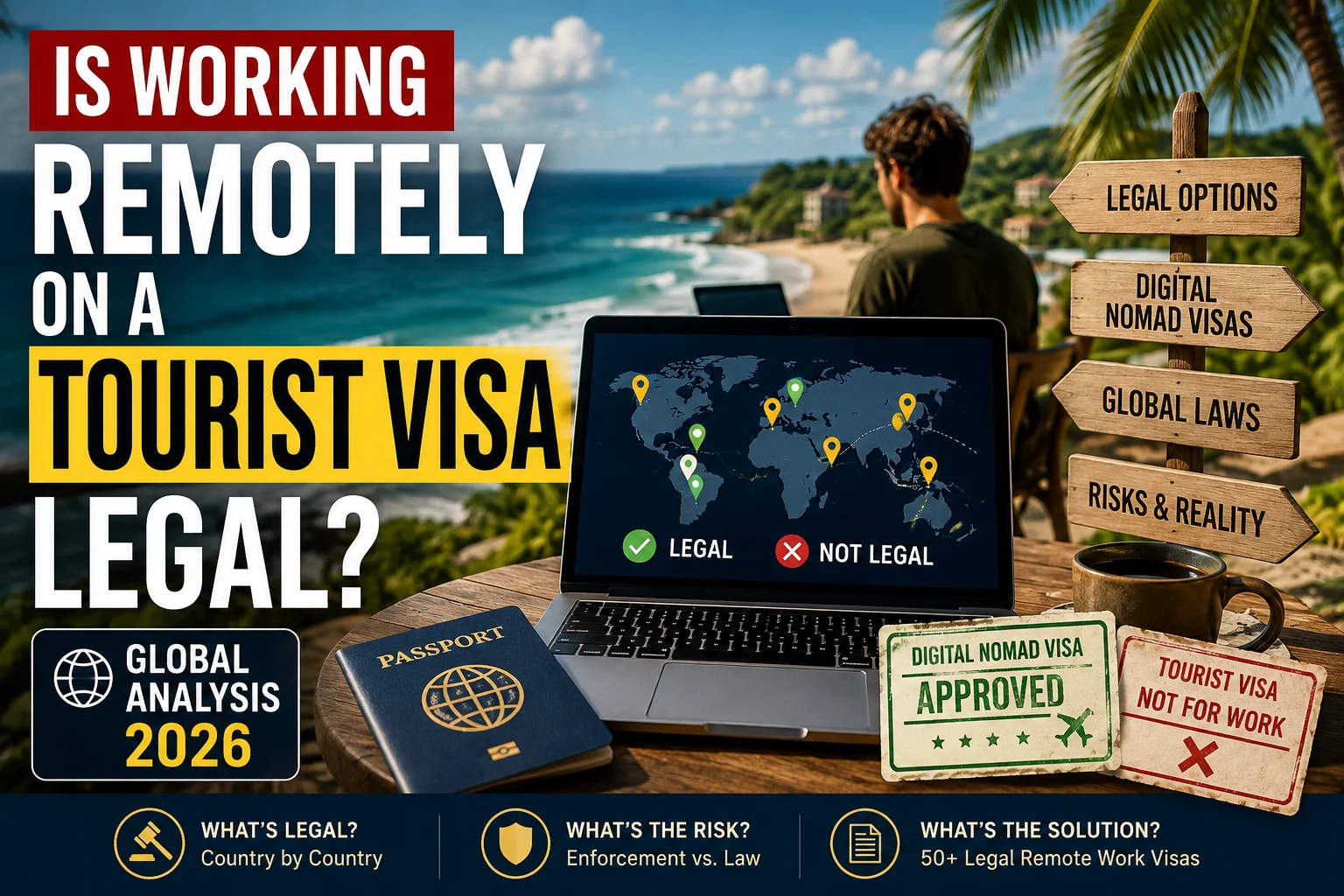
| AI OVERVIEW SUMMARY: In the vast majority of countries, is working remotely on tourist visa legal is a common question because working on a tourist visa — even for an employer based in another country — is not legally authorized. Tourist visas are issued for tourism and short-stay purposes and do not grant work authorization. The relevant law in most countries is the domestic immigration and work permit framework, which typically requires a specific work permit or work authorization for any compensated activity on that country’s territory, regardless of whether the employer is local or foreign. The distinction between ‘working for a local employer’ and ‘working for an overseas employer’ does not change the legal requirement in most jurisdictions, though some countries’ laws are framed in ways that create genuine legal ambiguity. Enforcement against tourists working remotely for overseas clients is generally low in most popular nomad destinations, but low enforcement does not mean legal authorization. Since 2020, over 50 countries have introduced specific digital nomad visas or remote work permits that provide genuine legal authorization — these are the correct legal solutions. |
| QUICK ANSWER: Is it legal to work remotely on a tourist visa in any country? In most countries: No. Tourist visas do not grant work authorization, and working (for any employer, local or foreign) without proper work authorization is illegal in most jurisdictions worldwide. The practical reality: Enforcement against remote workers serving only overseas clients is low in most popular nomad destinations. But ‘rarely enforced’ is categorically different from ‘legal.’ Countries with legal remote work options: Thailand (LTR Visa / DTV), Malaysia (DE Rantau), Indonesia (specific visa), Georgia (Remotely From), Portugal, Spain, UAE, Croatia, Estonia, and 40+ others have introduced specific legal authorization for remote workers. The honest answer: If you are working on a tourist visa anywhere without specific legal authorization, you are likely operating in a legal gray area or outright violation — regardless of whether enforcement is active. |
Introduction: Why This Question Matters More Than Ever
Somewhere between 35 and 50 million people worldwide identify as digital nomads as of 2026. The overwhelming majority of them are working from countries where their tourist visa does not authorize them to work. Most of them know this at some level. Most of them are operating anyway, relying on the practical reality that enforcement is low and the legal theory that serving overseas clients might be treated differently.
This article is written for the person who wants a straight answer. Not a reassuring one. Not a frightening one. A straight one.
The global expansion of digital nomad visas since 2020 — more than 50 countries have introduced some form of legal remote work authorization — has changed the landscape. There are now genuine legal paths for remote workers in most popular nomad destinations. Understanding both the legal reality and the available legal solutions is the purpose of this analysis.
The Short, Honest Answer
Working on a tourist visa in virtually any country, for any employer or client regardless of where they are based, is not authorized by the tourist visa itself. Tourist visas are purpose-specific: they authorize presence in a country for tourism, not work.
Work authorization in almost every country requires either:
- A specific work permit or work visa issued by the destination country
- A specific visa category that explicitly includes work authorization (e.g., working holiday visa, LTR Visa, digital nomad visa)
- Citizenship or permanent residency that includes the right to work
A tourist visa provides none of these. The source of your employer, the currency you are paid in, the country of your clients — none of these factors change what the tourist visa authorizes in most countries’ legal frameworks.
The Legal Principle That Applies in Almost Every Country
The legal framework in virtually every country that has immigration law is straightforward: you may only perform work or provide services for compensation on a country’s territory if you are authorized to do so. Authorization comes from citizenship, residency, or a specific work authorization instrument — not from a tourist visa.
This principle applies regardless of:
- Whether your employer is in the same country or a different country
- Whether you are paid in local currency or foreign currency
- Whether you are physically in an office or working from a cafe
- Whether you intend to pay taxes in that country
- Whether your work ‘impacts the local economy’
The last point is particularly important. Many digital nomads believe that because their income comes from overseas clients and is not ‘taking a job’ from a local worker, their presence is legally unproblematic. This reasoning does not reflect the legal framework in most countries. The law is about authorization to work on the territory, not about economic impact on local employment.
The Overseas Employer Myth: Why It Doesn’t Automatically Make It Legal
| THE MOST COMMON MISCONCEPTION The belief: “I am working for a company in India / the US / UK. I’m just using the internet in Thailand / Bali / Vietnam. I’m not working IN this country.” The legal reality: In most countries, working in the legal sense means performing compensated professional activity on that country’s territory. The location of your employer, the direction of your payments, and the nationality of your clients do not determine where you are ‘working’ in the legal sense. If you are in Country X performing services for compensation, most countries’ laws consider you to be working in Country X. Why the myth persists: Enforcement is overwhelmingly focused on people working for local employers — displacing local workers — rather than on remote workers serving overseas clients. This enforcement pattern creates the impression that overseas-client work is legally different when it often is not. Where the myth has some basis: A small number of countries have laws that genuinely do distinguish between work for local vs. overseas employers (Georgia’s regulatory approach being one example). But these are exceptions, not the rule. |
Country-by-Country Legal Status: Remote Work on Tourist Visa
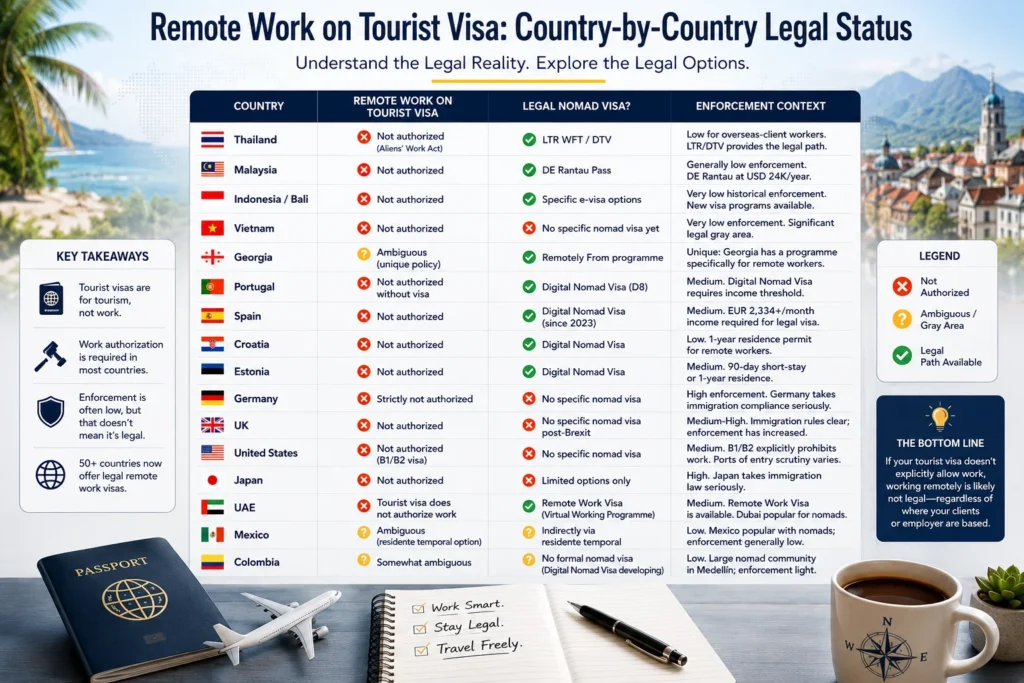
| Country | Remote Work on Tourist Visa | Legal Nomad Visa? | Enforcement Context |
| Thailand | ❌ Not authorized (Aliens’ Work Act) | ✅ LTR WFT / DTV | Low for overseas-client workers. LTR/DTV provides the legal path. |
| Malaysia | ❌ Not authorized | ✅ DE Rantau Pass | Generally low enforcement. DE Rantau at USD 24K/year. |
| Indonesia / Bali | ❌ Not authorized | ✅ Specific e-visa options | Very low historical enforcement. New visa programs available. |
| Vietnam | ❌ Not authorized | ❌ No specific nomad visa yet | Very low enforcement. Significant legal gray area. |
| Georgia | ❓ Ambiguous (unique policy) | ✅ Remotely From programme | Unique: Georgia has a programme specifically for remote workers. Overseas income treated differently. |
| Portugal | ❌ Not authorized without visa | ✅ Digital Nomad Visa (D8) | Medium. Digital Nomad Visa requires income threshold. |
| Spain | ❌ Not authorized | ✅ Digital Nomad Visa (since 2023) | Medium. EUR 2,334+/month income required for legal visa. |
| Croatia | ❌ Not authorized | ✅ Digital Nomad Visa | Low. 1-year residence permit for remote workers. |
| Estonia | ❌ Not authorized | ✅ Digital Nomad Visa | Medium. 90-day short-stay or 1-year residence. |
| Germany | ❌ Strictly not authorized | ❌ No specific nomad visa | High enforcement. Germany takes immigration compliance seriously. |
| UK | ❌ Not authorized | ❌ No specific nomad visa post-Brexit | Medium-High. Immigration rules clear; enforcement has increased. |
| United States | ❌ Not authorized (B1/B2 visa) | ❌ No specific nomad visa | Medium. B1/B2 explicitly prohibits work. Ports of entry scrutiny varies. |
| Japan | ❌ Not authorized | ❌ Limited options only | High. Japan takes immigration law seriously. |
| UAE | ❌ Tourist visa does not authorize work | ✅ Remote Work Visa (Virtual Working Programme) | Medium. Remote Work Visa is available. Dubai popular for nomads. |
| Mexico | ❓ Ambiguous (residente temporal option) | ❓ Indirectly via residente temporal | Low. Mexico popular with nomads; enforcement generally low. |
| Colombia | ❓ Somewhat ambiguous | ❓ No formal nomad visa (Digital Nomad Visa developing) | Low. Large nomad community in Medellín; enforcement light. |
Deep Dive: High-Risk Countries for Remote Workers on Tourist Visas
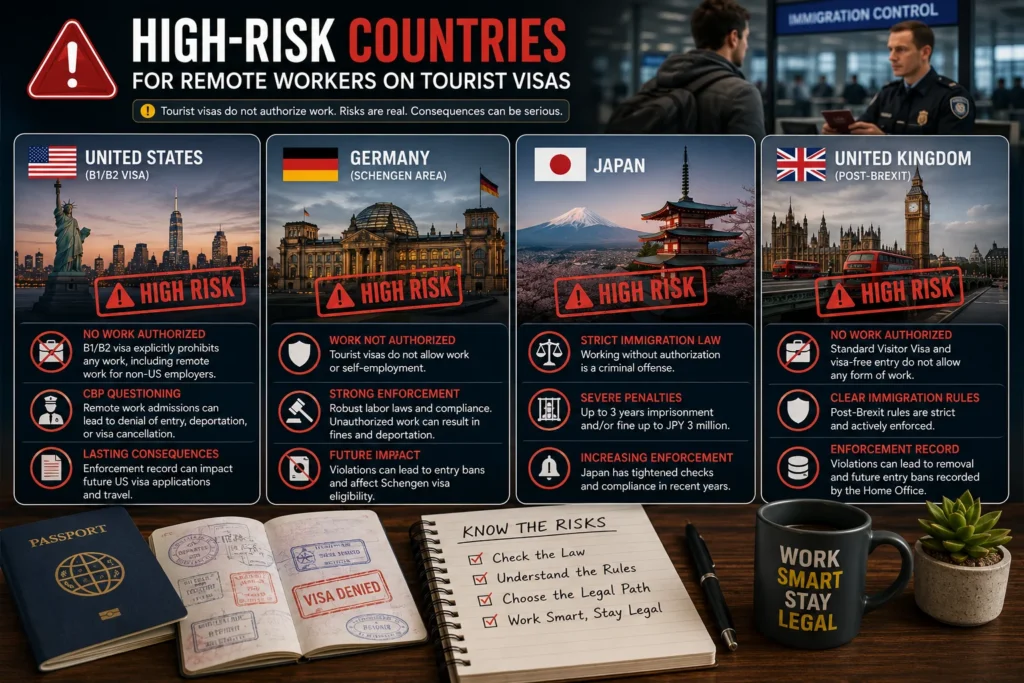
United States (B1/B2 Visa)
The US B1/B2 tourist visa explicitly states that the holder may not work in the United States. This includes working remotely for non-US employers. CBP (Customs and Border Protection) officers have deported travelers who revealed remote work during entry interviews. The US has not introduced a digital nomad visa.
Risk: Medium-high. CBP questioning is unpredictable. Saying ‘I work remotely’ at the US border can result in denial of entry or visa cancellation. Consequences include a formal record that affects future US visa applications.
Germany (Schengen Area)
Germany and the broader Schengen Area do not authorize work under tourist visa or visa-exempt entry. Germany specifically has robust labor law enforcement. The Freelancer Visa (Freiberufler) or the EU Blue Card are the appropriate legal options for longer stays. Working in Germany without authorization can result in fines, deportation, and future visa bans.
Japan
Japan has strict immigration law with a compliance-oriented culture. Working without authorization in Japan is a criminal offense under the Immigration Control and Refugee Recognition Act, punishable by up to 3 years imprisonment and/or fine up to JPY 3 million. Enforcement has increased. Japan does not have a specific digital nomad visa as of June 2026.
United Kingdom (post-Brexit)
The UK Standard Visitor Visa (and visa-free access for many nationalities) does not authorize work. Post-Brexit, UK immigration rules are clearly defined. Working without authorization can lead to removal, future visa refusal, and entry in the Home Office’s enforcement database.
Lower Enforcement Risk But Still Technically Illegal
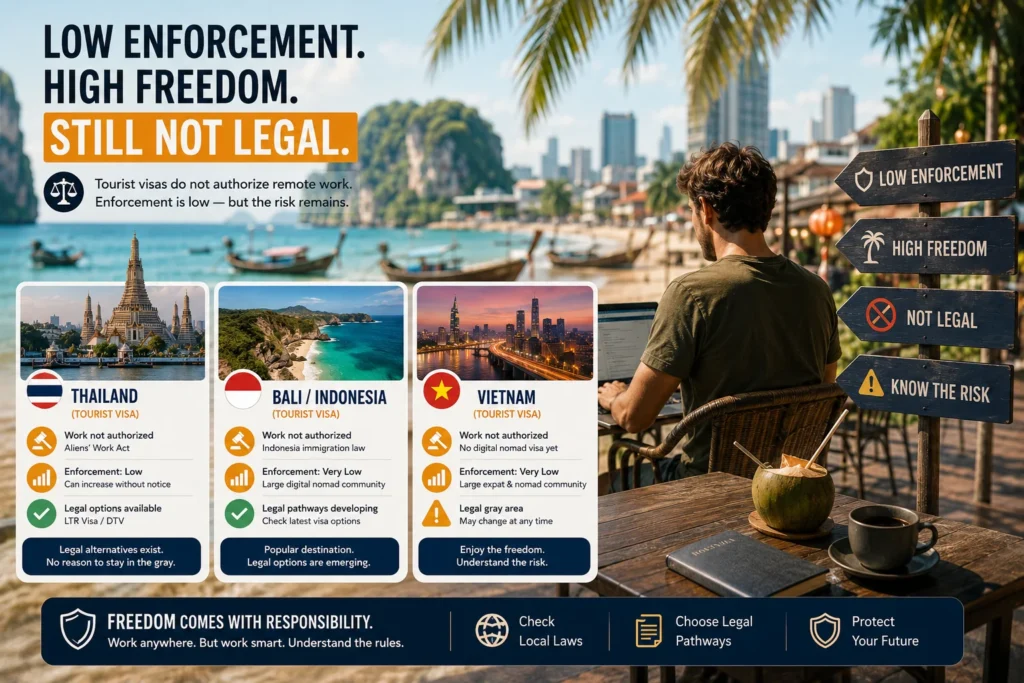
Thailand (Tourist Visa)
Thailand’s Aliens’ Work Act B.E. 2551 prohibits performing any work in Thailand without a work permit. This applies to all nationalities and covers remote work for overseas clients performed from Thai territory. Enforcement against digital nomads working exclusively for overseas clients has been historically very low, but enforcement can increase without notice, and it has happened to individual nomads.
Thailand now has genuine legal alternatives: the LTR Visa (Work-From-Thailand Professional category, USD 40,000/year income) and the Destination Thailand Visa (DTV, 180-day stay, overseas remote work authorized). There is no longer a good argument for remaining on a tourist visa when legal options are available.
Bali / Indonesia (Tourist Visa)
Indonesia’s immigration laws do not authorize work on tourist visas. Bali has been the world’s most popular digital nomad destination for years, creating a large community operating in this legal gray area. Indonesia has been developing specific visa options. Check current Indonesia social visa and e-visa options for the most up-to-date legal pathway.
Vietnam
Vietnam has no specific digital nomad visa as of June 2026. Working on tourist visa is not authorized. Enforcement has historically been very low, and Vietnam’s large expat community in Ho Chi Minh City and Hanoi has operated largely without incident. However, this can change, and the legal position remains unauthorized.
Countries With Genuine Legal Remote Work Authorization
The good news: the legal landscape for digital nomads has transformed since 2020. Here are the most accessible legal options:
| Country | Visa/Programme | Income Requirement | Duration |
| Thailand | LTR Visa (WFT Professional) | USD 40,000/year from overseas | 10 years |
| Thailand | Destination Thailand Visa (DTV) | Varies (approx. USD 2,000/month) | 5 years, 180 days/stay |
| Malaysia | DE Rantau Digital Nomad Pass | USD 24,000/year | 12 months (renewable) |
| Georgia | Remotely From Georgia | USD 2,000+/month recommended | 365 days/year (visa-free PH) or e-visa (IN) |
| Indonesia | Various e-visa options (check current) | Varies | Varies |
| UAE | Virtual Working Programme (Remote Work Visa) | USD 3,500+/month + USD 5,000 account balance | 1 year renewable |
| Portugal | Digital Nomad Visa (D8) | EUR 3,040+/month (4× minimum wage) | 1 year (renewable for residency) |
| Spain | Digital Nomad Visa | EUR 2,334+/month | 1 year (renewable to 3 years) |
| Croatia | Digital Nomad Residence Permit | HRK 24,000/month (varies) | 1 year |
| Estonia | Digital Nomad Visa | EUR 4,500+/month (gross) | 90 days or 1-year option |
| Greece | Digital Nomad Visa | EUR 3,500+/month | 1 year |
Enforcement vs. Legality: A Critical Distinction
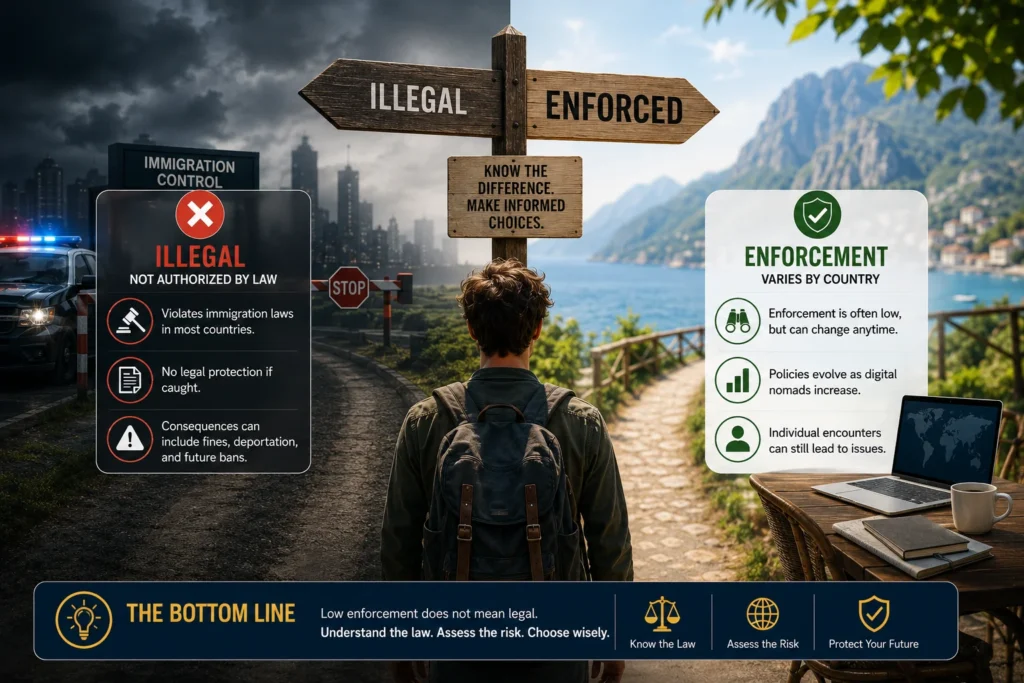
| THE DIFFERENCE BETWEEN ILLEGAL AND ENFORCED Throughout this article, and in discussions of remote work legality generally, two concepts are frequently conflated: • LEGAL STATUS: Whether the law authorizes the activity • ENFORCEMENT PROBABILITY: Whether authorities actively pursue violations Something can be clearly illegal and rarely enforced. Something can also be legal and actively monitored. Most digital nomad remote work on tourist visas falls into the first category: clearly not authorized by most countries’ laws, and rarely actively enforced. Relying on low enforcement creates several risks: (1) Enforcement can increase without warning as countries respond to the growth of the digital nomad segment. (2) Individual encounters — at border crossings, with local police, during tax audits — can expose the activity even without active enforcement campaigns. (3) If enforcement catches you, the fact that others were not caught does not protect you. |
What Happens If You Are Caught Working Without Authorization
Consequences vary significantly by country. Here is the spectrum:
| Severity Level | Countries (Examples) | Typical Consequences |
| Severe | Japan, Germany, UK, US | Deportation, criminal charges, multi-year entry bans, fines. Japan: potential imprisonment. |
| Significant | Singapore, South Korea, most EU countries | Deportation, visa cancellation, entry bans of 1–5 years, formal record. |
| Moderate | Thailand, Malaysia, Indonesia | Warning or deportation. Repeated violations or media attention can escalate. Thailand fine: up to THB 100,000. |
| Low but possible | Vietnam, Cambodia, Georgia (certain cases) | Warning, required departure, visa cancellation. Rare enforcement. |
Note: ‘Low enforcement’ in the moderate and low categories reflects historical patterns, not legal positions. All four categories represent activities that are legally unauthorized.
Indian and Filipino Passport Holders: Additional Considerations
| PASSPORT-SPECIFIC RISK CONTEXT While the legal framework applies equally to all nationalities, passport type can affect practical risk in specific ways: Border scrutiny: Indian and Filipino passport holders often receive more detailed questioning at some immigration checkpoints than Western passport holders. Questions about employment, income, and purpose of stay are more common.Visa-on-arrival constraints: Both nationalities have more limited visa-free access globally than many Western passports. This makes maintaining clean immigration records particularly important for future travel.Consistency of declared purpose: If you declare ‘tourism’ at entry and are later found to be working, the discrepancy between your stated purpose and actual activity creates a specific immigration violation beyond the work authorization issue.Thai visa situation specific to Indians: Indian citizens in Thailand on tourist visa-exempt entry who are visibly working are in an identical legal position to any other nationality — but need to be aware that immigration interviews at border crossings may specifically probe employment status.Philippine BIR filing: Filipino citizens abroad who receive income continue to have BIR obligations regardless of which country’s immigration laws they are navigating. |
The Tax Dimension: Separate but Related
Immigration law and tax law are separate legal frameworks. Being legal on immigration status does not resolve tax obligations, and being illegal on immigration (working without authorization) does not resolve or create specific tax obligations.
Key tax points for nomads operating in gray areas:
- Tax residency is triggered by spending 180 or more days in most countries — regardless of your visa type or work authorization status.
- Some countries tax worldwide income of tax residents regardless of where income is earned.
- Double taxation treaties between your home country and destination country provide frameworks to avoid paying tax twice on the same income.
- The obligation to file tax returns in your home country (India: ITR; Philippines: BIR) continues regardless of your immigration status abroad.
| TAX DISCLAIMER Tax obligations for digital nomads are complex and highly individual. This section provides general awareness only. Consult a qualified tax professional in your home country and in any country where you may have established tax residency. |
Legal Visa Alternatives: The Right Path for Remote Workers
The most practical response to the legal gray area of tourist visa remote work is to use one of the now-numerous legal alternatives. Here are the most accessible by income level:
For remote workers earning USD 40,000+/year
- Thailand LTR Visa (Work-From-Thailand Professional): 10-year multiple-entry, explicit overseas work authorization, full banking access. Most stable legal option in Southeast Asia.
- Malaysia DE Rantau: USD 24,000/year threshold, 12-month renewable, Southeast Asia’s lower-threshold legal option.
For remote workers earning USD 24,000–40,000/year
- Malaysia DE Rantau (USD 24,000/year minimum) is the primary accessible Southeast Asia option.
- Georgia Remotely From programme: No formal income requirement (USD 2,000/month recommended); Georgian e-visa for Indian citizens; Filipino citizens 365-day visa-free. Very low cost of living.
For European bases
- Portugal D8 Digital Nomad Visa: EUR 3,040+/month. Access to Schengen Area.
- Spain Digital Nomad Visa: EUR 2,334+/month.
- Croatia and Estonia for additional European options.
For Middle East bases
- UAE Virtual Working Programme: USD 3,500+/month + USD 5,000 in bank. 1-year renewable. Dubai and Abu Dhabi with 0% income tax.
Frequently Asked Questions
Is it legal to work remotely on a tourist visa in any country?
In most countries, no. Tourist visas authorize presence for tourism, not work. Working (providing services for compensation) without specific work authorization is not permitted under tourist visas in most countries’ legal frameworks, regardless of whether your employer is local or overseas. A growing number of countries have introduced specific digital nomad visas that do provide legal authorization for remote work.
Does working for an overseas employer make it legal on a tourist visa?
Generally no. The common belief that ‘working for an overseas employer from a tourist visa country’ is legally different from ‘working locally’ does not reflect the legal framework in most countries. Most work authorization laws cover any compensated professional activity on a country’s territory, regardless of the employer’s location. A few countries have laws or policies that create genuine ambiguity or exceptions, but these are not the rule.
What actually happens if you are caught working on a tourist visa?
Consequences range by country from warnings and required departure to deportation, entry bans of multiple years, fines, and in some countries (Japan, Germany) potential criminal charges. The severity depends on the country, the circumstances, and whether enforcement is actively seeking violations or they were discovered incidentally. ‘Low enforcement’ countries can and do impose consequences when violations are discovered.
Is Thailand safe for digital nomads working on tourist visas?
Thailand has historically had low enforcement against digital nomads serving exclusively overseas clients on tourist visas. However: (1) it is technically illegal under the Aliens’ Work Act B.E. 2551; (2) enforcement can increase without warning; (3) Thailand now has genuine legal alternatives (LTR WFT Visa, DTV) that make continued use of tourist visas unnecessary for those who qualify.
Which countries are fully legal for remote work without a special visa?
In practice, only countries where you have citizenship, permanent residency, or a specific work authorization grant legal remote work rights. Some countries’ digital nomad visa programs provide explicit legal authorization. The countries with the most accessible legal remote work frameworks are: Thailand (LTR/DTV), Malaysia (DE Rantau), Georgia (Remotely From), Portugal (D8), UAE (Virtual Working Programme), and 40+ others with specific programs.
Final Verdict: The Honest Position on Remote Work and Tourist Visas
| The honest position, without hedging: working remotely on a tourist visa is not legal in the vast majority of countries. The legal principle is clear, widely applicable, and does not have a ‘but your employer is overseas’ exception in most legal systems. The practical position is different: enforcement is low in most popular nomad destinations for people serving overseas clients quietly and without generating attention. Hundreds of thousands of people operate in this gray area without incident. This is a fact worth acknowledging. But ‘low enforcement’ is not ‘legal.’ And the availability of genuine legal options since 2020 changes the calculus. If you qualify for the Thailand LTR Visa, the Malaysia DE Rantau, or Georgia’s programme, there is no longer a strong reason to rely on tourist visa tolerance when you can have explicit legal authorization. The right move for serious long-stay remote workers is to use one of the now-numerous legal frameworks designed specifically for this purpose. This guide exists to point you to those options. Explore the legal visa alternatives below to find the right legal framework for your income level and preferred destination. |