
| IMPORTANT LEGAL DISCLAIMER This article provides general informational analysis of Thai tax residency law as of June 2026. It is NOT tax advice, legal advice, or financial counsel. Thai tax law is complex and actively evolving. The 2024 Revenue Department ruling is being interpreted and applied in real time. Always consult a licensed Thai tax advisor for guidance specific to your individual circumstances. Tax obligations vary by individual income level, treaty eligibility, visa type, and actual day count in Thailand. Do not make tax decisions based solely on this article. |
| Under Thailand’s Revenue Code Section 41, a person who resides in Thailand for 180 or more days in a tax year (January 1 to December 31) is a Thailand 180-day rule tax resident. As a Thai tax resident, they become potentially liable for Thai personal income tax on assessable income. The critical distinction post-2024: the 2024 Revenue Department ruling (Phor Ngor 161/2566) establishes that overseas income brought into Thailand in the same calendar year it was earned is assessable income for Thai tax residents. Prior-year earned income transferred in a later year is generally not assessable. Thai progressive income tax rates apply to net income after deductions: 0% (up to THB 150,000), 5% (up to THB 300,000), 10% (up to THB 500,000), up to 35% (above THB 5,000,000). LTR Visa (Work-From-Thailand) holders have specific BOI-promoted tax provisions that may affect their assessable income and applicable rates. India-Thailand DTAA and Philippines-Thailand tax treaty prevent double taxation for holders of those nationalities. |
| QUICK ANSWER: When do you become a tax resident in Thailand? You become a Thai tax resident when you spend 180 or more days in Thailand in any calendar year (January 1 to December 31). Key facts about the 180-day rule: Days do not need to be consecutive — total accumulated days in the calendar year count Short trips outside Thailand do NOT reset the counter — days outside simply don’t add to the total Legal basis: Thailand Revenue Code Section 41, paragraph 3As a Thai tax resident: you may be liable for Thai income tax on Thai-sourced income AND overseas income brought into Thailand in the same year it was earned (per 2024 ruling)Filing requirement: Thai Personal Income Tax Return (Form PND 90), filed by March 31 of the following year Important: The 180-day threshold determines tax residency. Whether your specific overseas income is assessable depends on additional factors including timing of transfer, tax treaties, and visa type. |
Introduction
The Thailand 180-day tax residency rule is one of the most consequential facts for any professional considering a long-stay Thailand life — yet it is also one of the most misunderstood. Many nomads and expats know the number. Far fewer understand precisely what it triggers, how to count it correctly, what ‘assessable income’ means in 2026, or what the specific implications are for their nationality.
This guide covers the Thailand 180-day tax residency rule from first principles: the legal basis, the day-counting methodology, what changes when you cross the 180-day threshold, the 2024 Revenue Department ruling that materially changed the overseas income picture, the Thai personal income tax rate structure with worked examples, the LTR Visa’s specific provisions, and the double taxation treaty frameworks for Indian and Filipino nationals.
The Legal Basis: Thailand Revenue Code Section 41
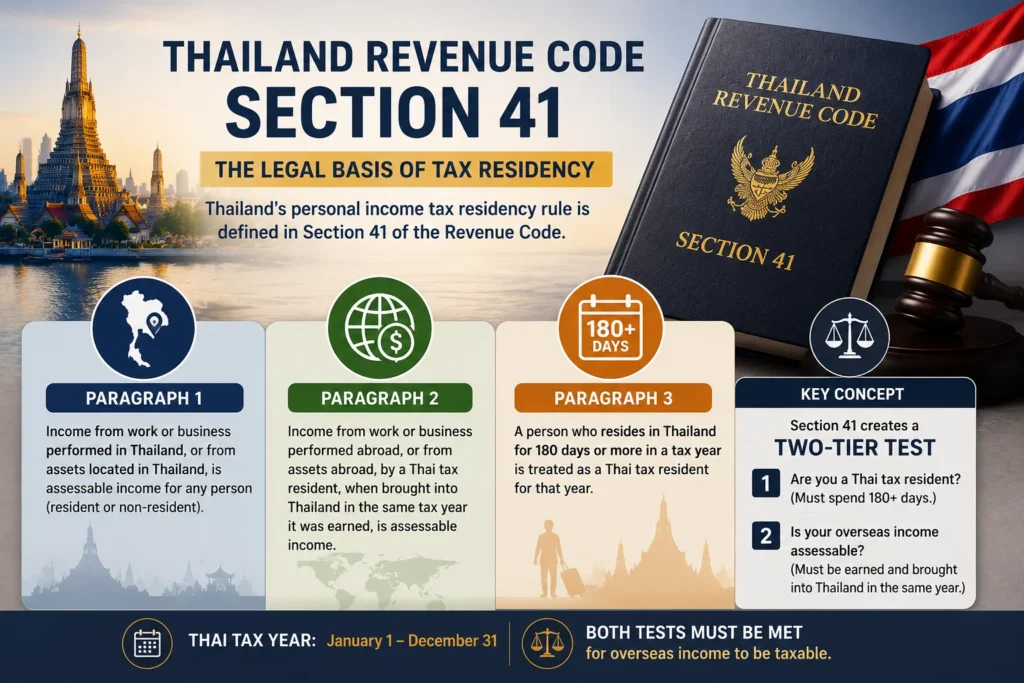
| THAILAND REVENUE CODE — SECTION 41 Section 41 of Thailand’s Revenue Code (Prapheni Eng.) establishes the personal income tax residency rule: Paragraph 1: Income derived from work or business performed in Thailand, or from assets located in Thailand, is assessable income for any person (resident or non-resident). Paragraph 2: Income derived from work or business performed abroad, or from assets abroad, by a Thai tax resident, when brought into Thailand in the same tax year it was earned, is assessable income. Paragraph 3 (the 180-day rule): A person who resides in Thailand for 180 days or more in a tax year is treated as a Thai tax resident for that year. The Thai tax year: January 1 to December 31. Implication: Section 41 creates a two-tier test. (1) Are you a Thai tax resident? (Must spend 180+ days.) (2) Is your overseas income assessable? (Must be earned and brought into Thailand in the same year.) Both tests must be met for overseas income to be taxable. |
How to Count the 180 Days: Practical Methodology
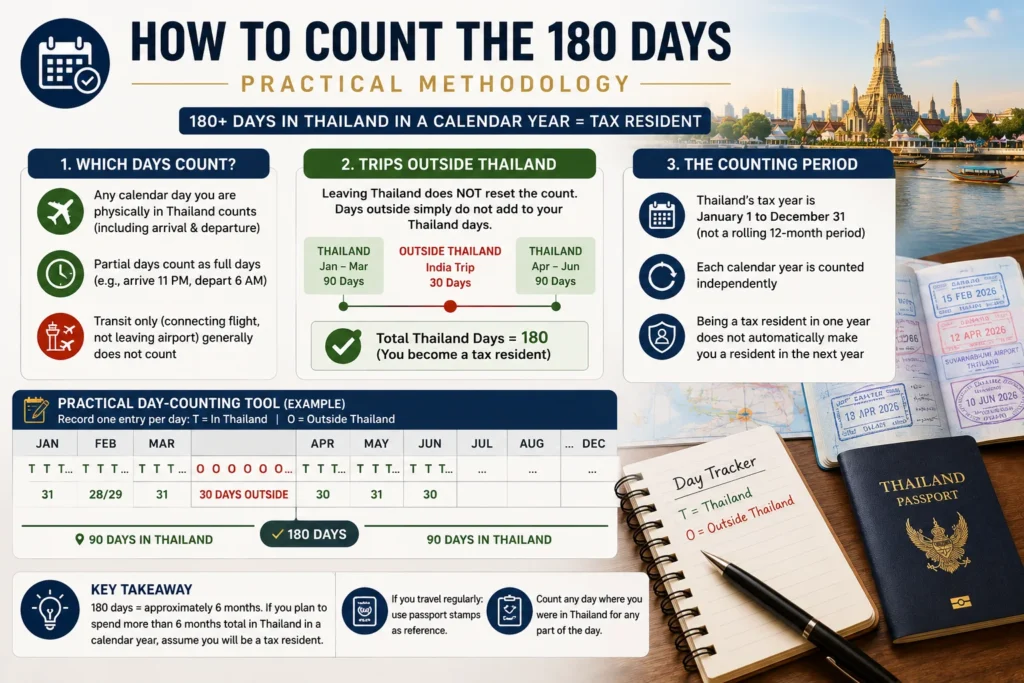
The day-counting methodology for Thailand’s 180-day rule has important practical nuances:
Which days count as days in Thailand
- Any calendar day during which you are physically present in Thailand counts, including the day of arrival and the day of departure
- A partial day (arriving at 11 PM, departing at 6 AM) generally counts as a full day — for each of arrival and departure
- Days when you are in Thailand for transit only (connecting flight, not leaving the airport) are generally not counted as days of presence
How trips outside Thailand affect the count
- Leaving Thailand for a day trip, a weekend, or a week does NOT reset the 180-day count
- Days spent outside Thailand simply do not add to your total Thailand days
- Example: If you spend January to March in Thailand (90 days), leave for India for 30 days, then return for April through June (90 days), your total Thailand days for the year are 180 — the 30 days in India neither add to nor reset the Thailand count
The counting period
- Thailand’s tax year is January 1 to December 31 — not a rolling 12-month period
- Each calendar year is counted independently
- Being a Thai tax resident in one year does not automatically make you a resident in the next year
| PRACTICAL DAY-COUNTING TOOL Keep a simple record: one entry per day noting whether you were in Thailand (T) or outside Thailand (O). After 6 months of Thailand presence, you cross the threshold. If you travel regularly: use passport stamps as reference. Count any day where you were in Thailand for any part of the day. 180 days = approximately 6 months. If you plan to spend more than 6 months total in Thailand in a calendar year, assume you will be a Thai tax resident for that year. |
What Changes When You Cross the 180-Day Threshold
Crossing the 180-day threshold has two main implications:
1. Filing obligation
As a Thai tax resident, you are required to file a Thai Personal Income Tax Return (Form PND 90 for most income types, PND 91 for employment income only) by March 31 of the following year. This obligation exists regardless of whether you owe any tax.
2. Potential income tax liability on assessable income
Thai tax residents are potentially liable for personal income tax on:
- Thai-sourced income: Any income from employment, services, or business performed in Thailand is always assessable (this applies to all persons in Thailand, resident and non-resident)
- Overseas income brought into Thailand in the same year it was earned: Per the 2024 Revenue Department ruling, this is now explicitly assessable for Thai tax residents
The 2024 Revenue Department Ruling: What Changed
| PHOR NGOR 161/2566 — THE 2024 RULING In 2024, Thailand’s Revenue Department issued Ruling Phor Ngor 161/2566, which clarified the interpretation of Revenue Code Section 41 Paragraph 2: Before 2024 (common understanding): Many Thai tax advisors and nomads interpreted the pre-ruling position as: only overseas income brought into Thailand IN THE SAME YEAR it was earned was assessable. Income from previous years could be brought in tax-free. The 2024 Ruling: Confirmed and formalized the interpretation that overseas income earned AND brought into Thailand in the same tax year is assessable for Thai tax residents. Prior-year income held offshore and brought into Thailand in a later year remains generally non-assessable. Practical impact: Income you earned in 2026 and transferred to your Thai bank in 2026: Potentially assessable if you are a 2026 Thai tax resident Income you earned in 2025 and kept offshore in Wise or a foreign bank, then transferred to Thailand in 2026: Generally not assessable for 2026 Thai tax purposes Assessable does not mean taxed: After deductions, allowances, and DTAA credits, many nomads owe little or no Thai tax even as Thai tax residents |
Thai Personal Income Tax Rates and Worked Examples
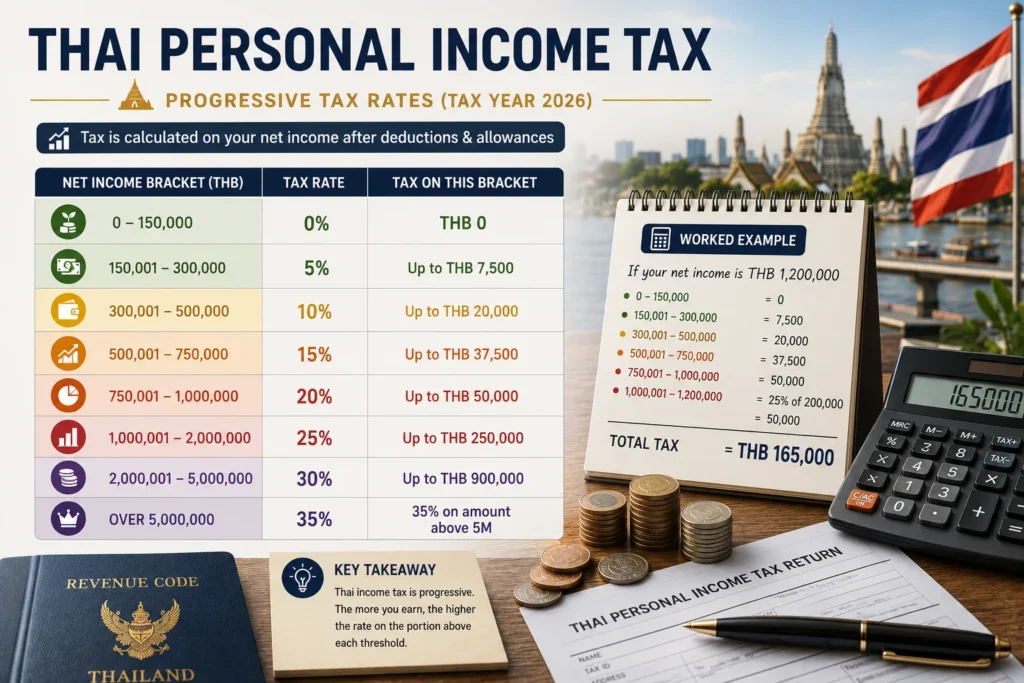
Thai personal income tax applies at progressive rates after deductions and allowances:
Progressive tax rate schedule (tax year 2026)
| Net Income Bracket (THB) | Tax Rate | Tax on This Bracket |
| 0 – 150,000 | 0% | THB 0 |
| 150,001 – 300,000 | 5% | Up to THB 7,500 |
| 300,001 – 500,000 | 10% | Up to THB 20,000 |
| 500,001 – 750,000 | 15% | Up to THB 37,500 |
| 750,001 – 1,000,000 | 20% | Up to THB 50,000 |
| 1,000,001 – 2,000,000 | 25% | Up to THB 250,000 |
| 2,000,001 – 5,000,000 | 30% | Up to THB 900,000 |
| Over 5,000,000 | 35% | 35% on amount above 5M |
Key deductions and allowances that reduce taxable income
| Deduction / Allowance | Amount (THB) | Notes |
| Personal allowance | 60,000 | Available to all Thai tax residents |
| Spouse allowance (if dependent) | 60,000 | If spouse has no income or income under threshold |
| Child allowance | 30,000 per child | Natural and legally adopted children |
| Standard income deduction (employment income) | 50% of income, up to 100,000 | For employment-type income |
| Life insurance premiums | Up to 100,000 | Thai or approved international life insurance |
| Long-Term Equity Fund (LTF/SSF) | Up to 30% of income | Tax-saving Thai investment |
| Provident Fund / Social Security contributions | Actual amount paid | If enrolled in Thai social security |
| Charitable donations | Up to 10% of net income after other deductions | To approved Thai charities |
Worked example: Thai tax for a USD 40,000/year nomad
Scenario: Indian digital nomad, LTR WFT Visa, 200 days in Thailand in 2026, USD 40,000 overseas income (approx. THB 1,400,000 at USD 1 = THB 35), all brought into Thailand in 2026.
| WORKED EXAMPLE — USD 40,000 INCOME (THB 1,400,000) Gross overseas income: THB 1,400,000 Less: 50% standard deduction (up to THB 100,000): THB 100,000 Less: Personal allowance: THB 60,000 Net assessable income: THB 1,240,000 Tax calculation: 0 to THB 150,000 at 0%: THB 0THB 150,001 to 300,000 at 5%: THB 7,500THB 300,001 to 500,000 at 10%: THB 20,000THB 500,001 to 750,000 at 15%: THB 37,500THB 750,001 to 1,000,000 at 20%: THB 50,000THB 1,000,001 to 1,240,000 at 25%: THB 60,000 TOTAL Thai tax before DTAA credits: THB 175,000 (approx. 12.5% effective rate) DTAA credit: If this income was also taxed in India (e.g., Indian advance tax or TDS), the DTAA credit reduces Thai tax by the amount paid in India on the same income. Note: This is a simplified illustrative example. Actual calculations depend on income composition, deductions claimed, and treaty application. Consult a Thai tax advisor. |
LTR Visa Tax Provisions: What WFT Holders Need to Know
| LTR VISA TAX TREATMENT Thailand’s LTR Visa was promoted with specific tax provisions for qualifying holders. Understanding these requires distinguishing the general 180-day rule from the LTR-specific provisions: For LTR Work-From-Thailand (WFT) and Highly Skilled Professional (HSP) holders: Under Royal Decree No. 743 (2022) and associated Revenue Department guidance, income from overseas sources of LTR WFT holders receives specific tax treatmentThe provisions are designed to make the LTR Visa attractive by providing favorable tax treatment on qualifying overseas incomeIn practice: the specific application of LTR tax provisions is an active area of interpretation. The key provisions relate to which overseas income is assessable and whether flat or progressive rates apply What LTR WFT holders should do: Do NOT assume LTR Visa eliminates Thai tax obligations. The 180-day rule still determines residency.DO consult a Thai tax advisor who specifically handles LTR Visa holders — this is a specialized area Keep records of all income sources, amounts, and dates of transfer to Thailand File a Thai tax return (PND 90) if you are a Thai tax resident, even if you believe no tax is owed For a complete analysis of LTR Visa tax treatment: see the LTR Visa tax exemption guide in our internal links. |
India-Thailand DTAA: How It Works for Indian Nomads
| INDIA–THAILAND DOUBLE TAXATION AVOIDANCE AGREEMENT India and Thailand have a Double Taxation Avoidance Agreement (DTAA) that prevents the same income from being taxed twice — once in each country. How DTAA works in practice for Indian nomads in Thailand: If you are a Thai tax resident (180+ days in Thailand) AND an NRI / non-resident of India: your primary tax obligation is in Thailand on most income. India taxes only India-sourced income (dividends, rental income, etc.) for NRIs. If you are a Thai tax resident AND still an Indian resident (less common; requires careful analysis): Both countries may claim taxing rights. DTAA provides tie-breaker rules based on habitual abode, centre of vital interests, and citizenship. Key DTAA provisions: Business profits (Article 7): Taxed only in the country of residence unless a permanent establishment exists in the other country Independent personal services (Article 14): Taxed in the country where services are performed OR where the person is resident Dependent personal services / employment income (Article 15): Taxed in the country where employment is exercised Dividends (Article 10), Interest (Article 11), Royalties (Article 12): Specific rates apply Practical outcome: Most Indian digital nomads who are Thai tax residents and Indian NRIs will owe Thai tax on Thai-assessable overseas income, with limited Indian tax liability (India-sourced income only). DTAA prevents paying full rates in both countries. For the complete India-Thailand DTAA analysis: see the India-Thailand DTAA guide (internal link). Always consult a qualified CA / tax advisor with India-Thailand cross-border expertise for your specific situation. |
Philippines-Thailand Tax Treaty: For Filipino Nomads
| PHILIPPINES–THAILAND TAX TREATY Philippines and Thailand have a tax treaty preventing double taxation: Key provisions relevant to Filipino nomads in Thailand: Business profits (Article 7): Taxed in country of residence unless permanent establishment exists Independent personal services (Article 14): Tax rights split between Thailand (where services performed) and Philippines (country of residence) depending on circumstances Employment income (Article 15): Taxed in Thailand if work is performed there Philippine BIR obligations for Thai tax residents: Filipino nationals generally maintain Philippine BIR filing obligations regardless of where they live If Thai tax is paid on income that is also taxable in Philippines: credit for Thai tax paid can be claimed on Philippine ITR under the treatyNon-resident alien status in Philippines may reduce Philippine tax to Philippines-sourced income only Practical planning: Filipino nomads spending 180+ days in Thailand should consult both a Thai tax advisor (for Thai obligation) and a Philippine CPA (for Philippine obligation) to ensure coordinated filing that uses the treaty credit correctly. |
How to File as a Thai Tax Resident: Practical Steps
If you have crossed the 180-day threshold and have assessable income, here is the filing process:
- Determine assessable income: Identify all Thai-sourced income and all overseas income brought into Thailand in the same year it was earned.
- Calculate allowable deductions: Personal allowance (THB 60,000), standard income deduction (50%, up to THB 100,000), insurance premiums, and other applicable deductions.
- Calculate gross tax: Apply the progressive rate schedule to net income.
- Apply DTAA credits: If you have paid tax on the same income in India or Philippines, credit the foreign tax against Thai tax due (DTAA mechanism). Ensure you have documentation of foreign tax paid.
- Obtain Tax ID: If you do not have a Thai Tax Identification Number (TIN), obtain one from the Revenue Department district office near your Thai address. Bring passport and TM30 (address proof).
- File Form PND 90 (or PND 91 for employment income only): File online at efiling.rd.go.th or in person at the Revenue Department district office. Deadline: March 31 of the year following the tax year.
- Pay tax due (if any): Online via the Revenue Department portal, at designated banks, or in person.
| Filing Form | Used For | Deadline | Online Available? |
| PND 90 | All income types including overseas, business, investment income | March 31 of following year | ✅ efiling.rd.go.th |
| PND 91 | Employment income only (salary from Thai employer) | March 31 of following year | ✅ efiling.rd.go.th |
| Half-year filing (some cases) | For certain income types | September 30 of tax year | Check with advisor |
How to Stay Under the 180-Day Threshold: Planning Considerations
For nomads who prefer to avoid Thai tax residency, the simplest approach is to spend fewer than 180 days in Thailand per calendar year. Practical considerations:
- Count from January 1 each year. If you are already in Thailand at the start of the year, your clock starts from day 1.
- 180 days = approximately 6 months. Spending 5 months in Thailand and 7 months elsewhere keeps you under the threshold.
- Consider neighboring countries for the off-months: Malaysia (Penang, KL), Bali (Indonesia), Vietnam, Georgia are common nomad bases that pair well with Thailand as a second base.
- Track days precisely. Do not rely on memory. Use a travel tracking app or simple spreadsheet.
- Consider whether the tax obligations of Thai residency are actually more burdensome than the cost of maintaining a split-country lifestyle. For many nomads with moderate income and applicable DTAA treaties, the Thai tax liability as a resident may be lower than expected after deductions.
Common Thai Tax Residency Mistakes
| Mistake | Consequence | Prevention |
| Assuming tourist visa / LTR Visa provides tax exemption | Tax residency is determined by days present, not visa type. LTR Visa has specific provisions but does not eliminate the 180-day rule. | Count days. Understand that residency and visa type are separate concepts. |
| Not tracking days carefully | Unexpected tax residency for a year you thought you were non-resident | Maintain a day-count log from January 1 each year. Use passport stamps as verification. |
| Transferring all year’s overseas income to Thailand in the same year | All transferred amounts may be assessable if you are a Thai tax resident | Understand the 2024 ruling timing. Consider whether prior-year accumulated funds can be used for Thailand expenses. |
| Not filing PND 90 when required | Penalty for late filing (1.5% per month of unpaid tax, up to 20%); administrative issues | File by March 31 even if no tax is owed. Get a Tax ID early in the year if approaching 180-day residency. |
| Applying DTAA credits incorrectly | Overpaying Thai tax; double taxation not fully relieved | Consult a Thai tax advisor with DTAA expertise. Keep documentation of all foreign taxes paid on Thailand-assessable income. |
Frequently Asked Questions
When do you become a tax resident in Thailand?
You become a Thai tax resident when you spend 180 days or more in Thailand in a calendar year (January 1 to December 31). Days do not need to be consecutive — total accumulated days in the year count. Legal basis: Thailand Revenue Code Section 41.
Does the 180-day count reset when you leave Thailand?
No. Leaving Thailand for any period does not reset the day count. Days spent outside Thailand simply do not contribute to the 180-day total. If you have spent 120 days in Thailand, left for 3 weeks, and return, you had 120 days before departure and continue accumulating from where you left off after return.
What income is taxable when you are a Thai tax resident?
As a Thai tax resident: (1) Thai-sourced income is always assessable. (2) Overseas income brought into Thailand in the same calendar year it was earned is assessable per the 2024 Revenue Department ruling (Phor Ngor 161/2566). Overseas income earned in a prior year and brought into Thailand in a later year is generally not assessable.
Does the LTR Visa protect you from Thai taxes?
No. The LTR Visa does not eliminate Thai tax residency based on the 180-day rule. LTR WFT and HSP holders have specific BOI-promoted tax provisions (Royal Decree No. 743) that may provide favorable treatment of qualifying income, but the 180-day rule for residency still applies. LTR holders who spend 180+ days in Thailand are still Thai tax residents and should file a Thai tax return. Consult a Thai tax advisor specializing in LTR Visa holders.
Do Indian digital nomads in Thailand need to pay tax in both India and Thailand?
Not typically on the same income. The India-Thailand DTAA prevents double taxation. Most Indian digital nomads who are Thai tax residents and Indian NRIs (fewer than 182 days in India per financial year) owe Thai tax on Thailand-assessable overseas income, with limited Indian tax liability on India-sourced income only. DTAA credit mechanisms eliminate or reduce the risk of paying full rates in both countries. Consult a CA with India-Thailand cross-border expertise.
What is the Thai tax filing deadline?
The Thai personal income tax return (Form PND 90 or PND 91) must be filed by March 31 of the year following the tax year. If your 2026 tax year creates a filing obligation, you file by March 31, 2027. Online filing is available at efiling.rd.go.th.
Final Verdict: Understanding Your Thailand Tax Residency Position
| The Thailand 180-day rule is straightforward as a counting exercise: any calendar year in which you spend 180 or more days in Thailand makes you a Thai tax resident. That calculation is simple. What the residency triggers is more complex: the 2024 Revenue Department ruling, the progressive rate schedule, deductions and allowances, LTR Visa-specific provisions, and double taxation treaty credits all interact to determine what you actually owe, if anything. For many nomads with moderate overseas income (USD 30,000–50,000/year) and applicable DTAA treaties, the Thai tax liability after deductions and treaty credits is significantly lower than a surface reading of the progressive rates suggests. The worked example above illustrates this. The most important action: if you will spend or have spent 180+ days in Thailand in any calendar year, get a Thai Tax ID and consult a Thai tax advisor by Q3 of that year — not after March 31 of the following year. Early planning provides options; late awareness limits them. See the Thailand Tax Residency Guide for the complete tax framework, and the LTR Visa Tax Exemption guide for LTR-specific provisions. |