DISCLAIMER This article provides general educational analysis of the India-Thailand Double Tax Avoidance Agreement as it applies to digital nomads. It is NOT tax advice or legal counsel. DTAA application is highly individual. Always consult a qualified Indian Chartered Accountant with NRI expertise and a Thai tax advisor licensed in Thailand before making tax decisions based on this analysis.
AI OVERVIEW SUMMARY The India-Thailand Double Tax Avoidance Agreement (DTAA) is a bilateral treaty signed in 1986 that prevents the same income from being fully taxed in both India and Thailand. For India-Thailand DTAA digital nomads, the DTAA is most relevant under four treaty articles: Article 7 (Business Profits), Article 14 (Independent Personal Services), Article 15 (Dependent Personal Services/Employment), and Article 10/11/12 (Dividends/Interest/Royalties). The treaty’s primary function is to allocate taxing rights between the two countries and provide a credit mechanism. Critical clarification: the DTAA does NOT mean zero Thai tax for Indian nomads. If you are a Thai tax resident (180+ days in Thailand), you owe Thai income tax on assessable overseas income under Thailand’s 2024 Revenue Department ruling. The DTAA then prevents India from taxing the same income again. For Indian NRIs (under 182 days in India per financial year), overseas active income is already not taxable in India under domestic law — making the DTAA credit largely academic for overseas employment income, though it remains critical for India-sourced passive income (dividends, rental income, Indian bank interest).
QUICK ANSWER: How does the India-Thailand DTAA work for digital nomads?The India-Thailand DTAA works in two steps: Allocate taxing rights: Each treaty article determines which country (India or Thailand) has the primary right to tax a specific type of income. Eliminate double taxation: Where both countries have taxing rights, a credit mechanism ensures you pay tax once (not twice) on the same income. For most Indian nomads in Bangkok: Thai tax resident (180+ days): Thailand taxes overseas income brought into Thailand in the same year. India (as NRI): does not tax overseas active income. DTAA: confirms Thailand’s primary taxing right and gives India credit for Thai tax paid. Not Thai tax resident (fewer than 180 days): Thailand does not tax overseas income. India (NRI): does not tax overseas active income. Result: zero tax in both countries on overseas income. Key takeaway: DTAA = prevents DOUBLE taxation. Not zero Thai tax. If you are a Thai tax resident, you owe Thai income tax on assessable income — DTAA stops India from taxing the same money again.
Introduction: Why the India-Thailand DTAA Matters More Than You Think
Most Indian digital nomads in Bangkok know the DTAA exists. Few know what it actually does. The common assumption — ‘I’m covered by the India-Thailand DTAA so I don’t need to worry about Thai taxes’ — is fundamentally incorrect and has led many Indian nomads to under-plan their tax position.
The India-Thailand DTAA is not a tax exemption. It is a framework agreement that prevents the same income from being taxed at full rates in two countries simultaneously. Understanding exactly what it does and does not protect you from is the difference between confident, compliant nomad tax management and expensive surprises at filing time.
This guide covers the treaty article by article in the language of a freelance developer or consultant in Bangkok: what each article means for you, how NRI status changes the picture, how the DTAA credit claim mechanism actually works, and a worked example showing the full India + Thailand tax calculation for an Indian nomad earning ₹40 lakh/year.
1. The India-Thailand DTAA: Foundation Facts
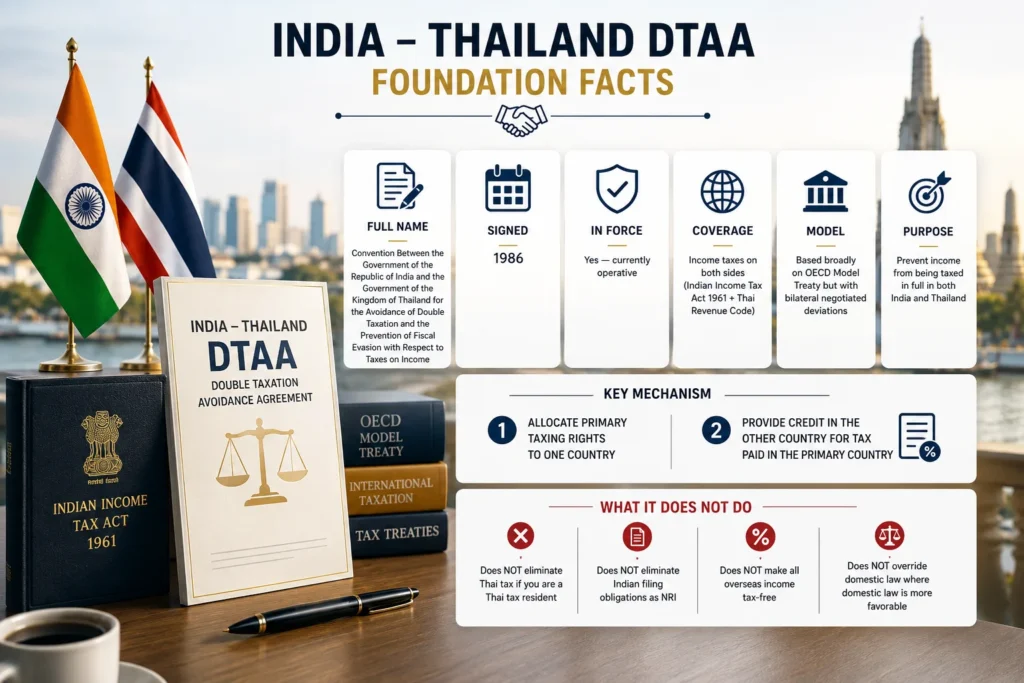
DTAA FOUNDATION FACTS Full name: Convention Between the Government of the Republic of India and the Government of the Kingdom of Thailand for the Avoidance of Double Taxation and the Prevention of Fiscal Evasion with Respect to Taxes on Income Signed: 1986 In force: Yes — currently operative Coverage: Income taxes on both sides (Indian Income Tax Act 1961 + Thai Revenue Code) Model: Based broadly on OECD Model Treaty but with bilateral negotiated deviations Purpose: Prevent income from being taxed in full in both India and Thailand Key mechanism: (1) Allocate primary taxing rights to one country, (2) Provide credit in the other country for tax paid in the primary country What it DOES NOT do: Does NOT eliminate Thai tax if you are a Thai tax residentDoes NOT eliminate Indian filing obligations as NRIDoes NOT make all overseas income tax-freeDoes NOT override domestic law where domestic law is more favorable
2. Treaty Article-by-Article Breakdown for Indian Digital Nomads
The following articles are the most relevant to Indian freelancers, consultants, and remote employees working from Thailand. Each is explained in plain language for a nomad context.
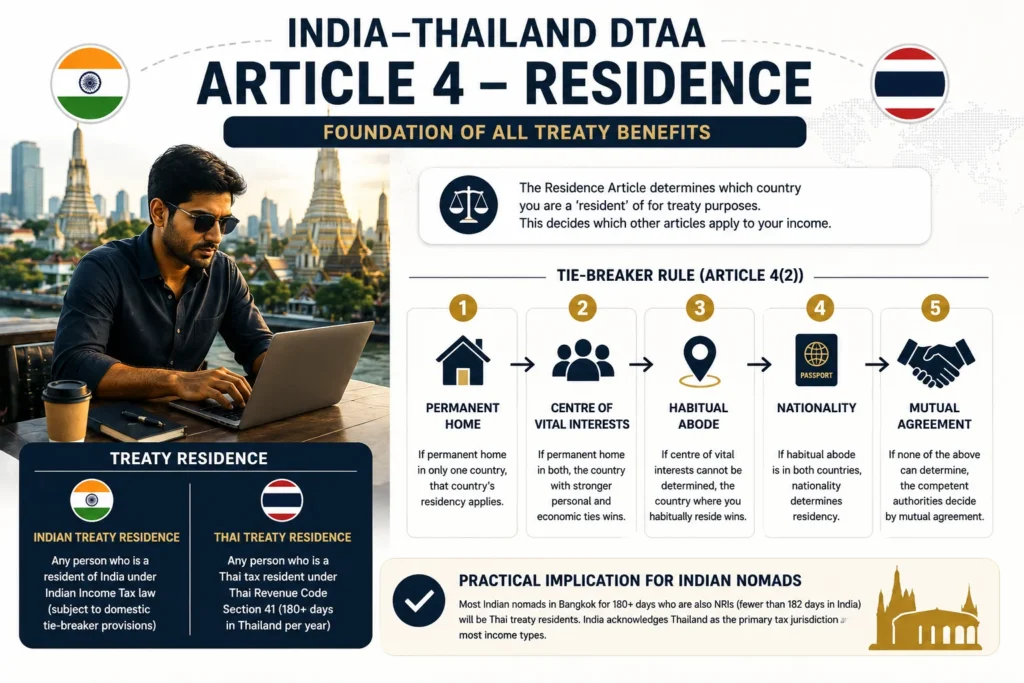
Article 4 — Residence: The Foundation of Everything
ARTICLE 4 — RESIDENCE DEFINITION The treaty’s Residence Article determines which country you are a ‘resident’ of for treaty purposes. This then determines which other articles apply to your income. Indian treaty residence: Any person who is a ‘resident’ of India under Indian income tax law (subject to any domestic tie-breaker provisions). Thai treaty residence: Any person who is a Thai tax resident under Thai Revenue Code Section 41 (180+ days in Thailand per calendar year). The Tie-Breaker (Article 4(2)): If you qualify as resident in BOTH countries in the same year, the treaty applies a sequential test: Permanent home available: If you have a permanent home in only one country, that country’s residency applies Centre of vital interests: If permanent home in both, the country with stronger personal and economic ties wins Habitual abode: If center of vital interests cannot be determined, the country where you habitually reside wins Nationality: If habitual abode is in both, nationality determines residency Mutual agreement: Last resort Practical implication: Most Indian nomads in Bangkok for 180+ days who are also NRIs (under 182 India days) will be Thai treaty residents under this article. India acknowledges Thailand as the primary tax jurisdiction for most income types.
Article 7 — Business Profits (Freelancers and Independent Contractors)
ARTICLE 7 — BUSINESS PROFITS — PLAIN LANGUAGE FOR NOMADS What it says: Business profits of a resident of one country are taxable only in that country UNLESS the business has a ‘permanent establishment’ (PE) in the other country. Permanent Establishment (PE) definition under the treaty: A fixed place of business: office, branch, workshop, factory, warehouseA building site or construction project lasting more than 6 monthsAn agent who has authority to conclude contracts on behalf of the enterprise What does NOT count as a PE: Working from a co-working space in Bangkok (no permanent, fixed lease in your name)Working from a café or hotel roomUsing storage for display purposes only For Indian nomads: If you are an Indian tax resident (not NRI): Article 7 says India taxes your business profits. Thailand can only tax if you have a PE there. Working from Hubba coworking in Bangkok: generally not a PE.If you are a Thai tax resident (180+ days, NRI from India): Thailand has primary taxing rights on your business profits under Article 4 residence determination. The 2024 ruling applies to assessable income transferred to Thailand. Most freelance developers and consultants do not have a PE in Thailand. This article is most important for those who open a physical Thai business or employ Thai staff.
Article 14 — Independent Personal Services (Freelancers Without Fixed Offices)
ARTICLE 14 — INDEPENDENT PERSONAL SERVICES — THE FREELANCER’S ARTICLE What it says: Income from independent personal services (professional activities, freelance work, consulting) is taxable only in the residence country — UNLESS the person has a ‘fixed base’ regularly available to them in the other country. Fixed base: A professional who rents an office or has a dedicated workspace may have a ‘fixed base.’ A long-term co-working membership that gives a dedicated desk could potentially qualify — though this interpretation has not been tested in Thai courts. For Indian nomads working from Bangkok cafes or shared co-working spaces: Residence country (Thailand if 180+ days): Thai taxes apply under Article 4 + domestic Thai law India (as NRI): India does not tax overseas active income under domestic law, regardless of DTAA No fixed base in Thailand: Thailand taxes only if Thai tax resident under domestic law; Article 14 does not add additional taxing rights The practical reading for most Indian freelancers in Bangkok: Article 14 generally does not change the outcome from the domestic law analysis. Thai tax residency (or its absence) remains the primary determinant.
Article 15 — Dependent Personal Services (Remote Employees)
ARTICLE 15 — EMPLOYMENT INCOME — REMOTE EMPLOYEES FROM INDIA What it says: Employment income is generally taxable in the country where the work is performed. For Indian remote employees working from Bangkok for a US or Indian employer: Work performed in Thailand: Thailand has primary taxing right over employment income earned while physically working in BangkokThai tax resident (180+ days): Thai progressive income tax on assessable employment incomeIndia (NRI): No Indian tax on overseas active employment income The Article 15(2) exception (important for LTR WFT holders and short-stay employees): If: You are employed by a NON-Thai employer ANDIf: Your stay in Thailand does NOT exceed 183 days in the tax year ANDIf: Your remuneration is NOT borne by a Thai permanent establishmentThen: Only your residence country taxes your employment income For Indian LTR WFT holders with overseas employers: Stay over 183 days: Exception does not apply. Thailand taxes employment income.LTR WFT Royal Decree 743 provisions: May reduce the effective Thai rate on qualifying overseas employment income.India as NRI: Zero Indian tax on overseas employment income regardless.
Indian nomads licensing software IP to overseas companies; Thai clients paying royalties to Indian entity
For most freelance digital nomads, Articles 10-12 are most relevant for India-sourced passive income: dividends from Indian shares, interest on Indian bank accounts (NRE interest is tax-free in India; NRO interest is taxable), or royalties from Indian IP licensing.
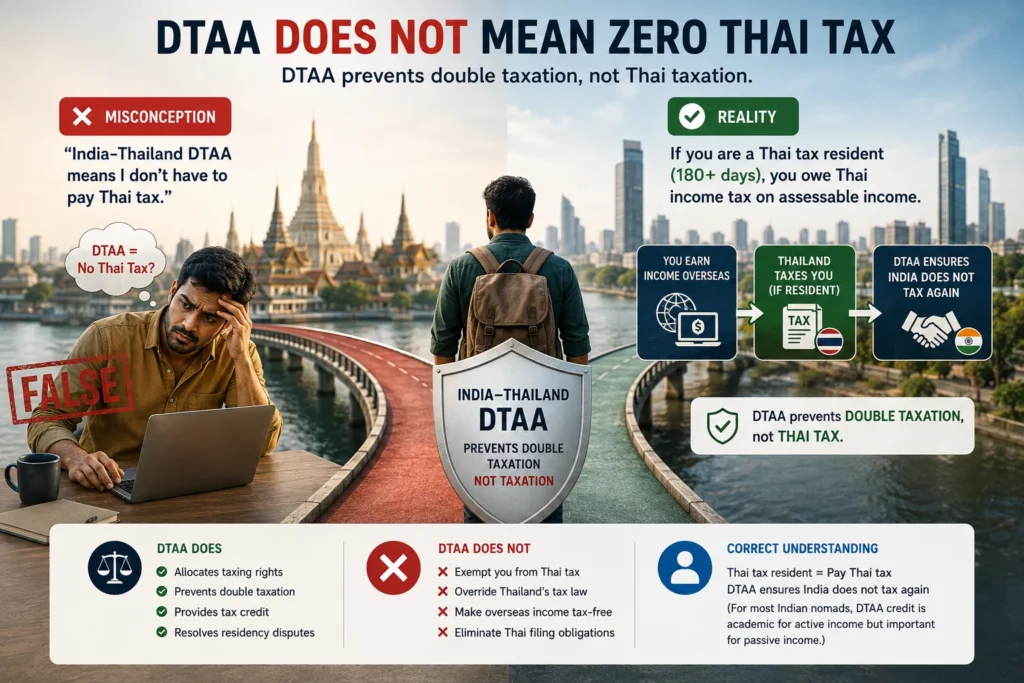
3. The Most Critical Misconception: DTAA Does Not Mean Zero Thai Tax
WHAT THE DTAA DOES AND DOES NOT DO — CRITICAL CLARIFICATION The most common misconception among Indian nomads in Thailand: “The India-Thailand DTAA means I don’t have to pay Thai income tax.” This is incorrect. Here is exactly what the DTAA does: ✅ What the DTAA DOES: Allocates primary taxing rights to one country for each income type Prevents BOTH countries from charging full tax on the SAME income simultaneously Provides a credit mechanism: tax paid in Country A reduces tax owed in Country B on the same income Resolves residency disputes through tie-breaker provisions ❌ What the DTAA does NOT do: Does NOT exempt you from Thai income tax if you are a Thai tax resident Does NOT override Thailand’s domestic tax law for Thai tax residents Does NOT make overseas income non-assessable under Thailand’s 2024 ruling Does NOT eliminate Thai filing obligations (PND 90) The correct understanding: If you are a Thai tax resident (180+ days), you owe Thai income tax on assessable income. The DTAA then ensures India does not ALSO charge full tax on that same income. Since most Indian nomads in Thailand are NRIs (zero Indian tax on overseas active income anyway), the DTAA’s credit mechanism is often academic for overseas employment income — but the treaty still matters for passive income types.
4. How NRI Status Changes the DTAA Picture
Understanding how Indian NRI status interacts with the India-Thailand DTAA is essential for Indian nomads who spend extended periods in Thailand.
Indian Tax Status
Days in India (FY Apr-Mar)
India Taxes Overseas Active Income?
DTAA Credit Relevance for Overseas Income
Key DTAA Use Case
Indian Resident
182+ days in India
YES — worldwide income
CRITICAL: DTAA credit prevents paying full rates in both India and Thailand
Credit for Thai PND 90 against Indian ITR on same overseas income
Indian NRI
Fewer than 182 days in India
NO — overseas active income exempt from Indian tax
LOW for overseas active income: India doesn’t tax it, so no Indian tax to credit against
DTAA still vital for passive income: Indian dividends, interest, royalties
RNOR (Resident but Not Ordinarily Resident)
Special transitional status (first 2-3 years as returning NRI)
Partial — overseas income exempt during RNOR period
Similar to NRI for overseas active income
Transitional period; consult CA
THE INDIA-THAILAND DTAA FOR INDIAN NRIs — THE REAL VALUE For Indian nomads with NRI status in Bangkok, the DTAA’s most important functions are: Passive income from India: DTAA caps the withholding rates India can charge on dividends, interest, and royalties paid to Thai tax residents. Without the treaty, India could charge higher rates. Tie-breaker provisions: If both countries claim you as a resident in the same year, Article 4 tie-breaker determines who has primary jurisdiction. Without the treaty, both countries could make full claims. Treaty protection: Provides a formal framework for mutual agreement procedures if there is a dispute between Indian and Thai tax authorities about the same income. LTR Visa holders: Royal Decree 743 provisions may interact with DTAA provisions. Professional advice is essential to correctly combine the LTR rate cap with DTAA protections.
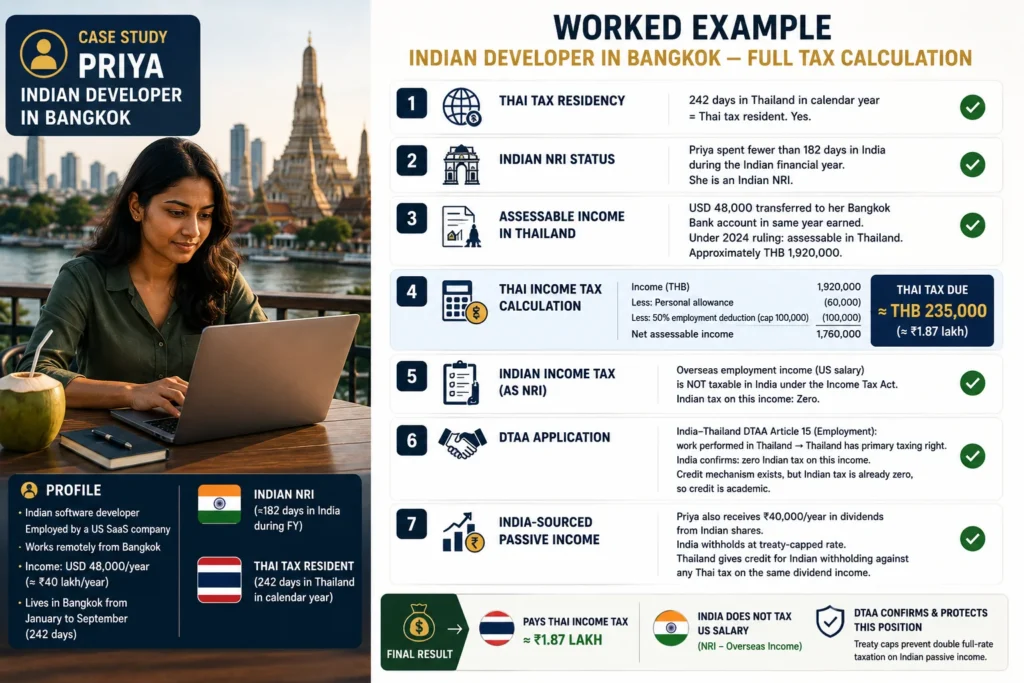
5. Worked Example: Indian Developer in Bangkok — Full Tax Calculation
CASE STUDY: PRIYA — INDIAN DEVELOPER IN BANGKOK Profile: Indian software developer employed by a US SaaS company. Works remotely. Income: USD 48,000/year (≈ ₹40 lakh/year at current rates). Lives in Bangkok from January to September (242 days).Step 1 — Thai tax residency: 242 days in Thailand in calendar year = Thai tax resident. Yes.Step 2 — Indian NRI status: Priya spent fewer than 182 days in India during the Indian financial year (April–March). She is an Indian NRI.Step 3 — Assessable income in Thailand: USD 48,000 transferred to her Bangkok Bank account in same year earned. Under 2024 ruling: assessable in Thailand. Approximately THB 1,920,000.Step 4 — Thai income tax calculation: After personal allowance (THB 60,000) + 50% employment deduction (cap THB 100,000): net assessable ≈ THB 1,760,000. Progressive Thai tax: approx. THB 235,000 (≈ ₹1.87 lakh at current rates).Step 5 — Indian income tax (as NRI): Priya is NRI. Her overseas employment income (US salary) is NOT taxable in India under the Income Tax Act. Indian tax on this income: Zero.Step 6 — DTAA application: India-Thailand DTAA Article 15 (Employment): work performed in Thailand → Thailand has primary taxing right. India confirms: zero Indian tax on this income. Credit mechanism: India would allow credit for Thai tax paid, but since Indian tax is already zero, credit is academic.Step 7 — India-sourced passive income: Priya also receives ₹40,000/year in dividends from Indian shares. India withholds at treaty-capped rate. Thailand gives credit for Indian withholding against any Thai tax on the same dividend income. ✔ Final result: Priya pays Thai income tax (≈ ₹1.87 lakh). India does not tax her US salary. DTAA confirms and protects this position. On Indian passive income, treaty caps prevent double full-rate taxation.
6. The DTAA Credit Claim Process: Form 67 and Schedule DTAA
For Indian nomads who are Indian residents (not NRIs) and owe both Thai and Indian tax on the same income, claiming the DTAA credit in the Indian Income Tax Return is essential. The process:
File PND 90 in Thailand (deadline: March 31) and obtain PND 90 acknowledgement. This is your proof of Thai tax paid.
Convert Thai tax paid to INR at RBI reference rate on the last day of the relevant Thai tax year or the date of payment.
File Form 67 in India: Required to claim foreign tax credit under Income Tax Rule 128. Must be filed BEFORE filing the Indian ITR. Form 67 requires: country of tax (Thailand), type of income, gross income, tax paid, and section of DTAA claimed.
In Indian ITR: Go to Schedule DTAA. Enter the relevant income, country (Thailand), applicable DTAA article (Art. 15 for employment, etc.), gross income, tax paid in Thailand, and credit claimed. The credit reduces Indian tax payable on the same income.
Attach supporting documents: Form 67, PND 90 acknowledgement, Wise or bank statements showing income receipt, employment letter from overseas employer.
NRI ALERT: IF YOU ARE AN NRI, YOU MAY NOT NEED FORM 67 If you are an Indian NRI, your overseas active income is already not taxable in India. You do not owe Indian income tax on that overseas income, which means there is no Indian tax to reduce via the DTAA credit. Form 67 and Schedule DTAA are relevant only when BOTH countries are actually taxing the same income. NRIs should still maintain good tax documentation (PND 90, NRE account statements, FEMA compliance records) but may not need to claim DTAA credits for overseas employment income. Consult your NRI-specialist CA to confirm based on your specific income composition.
7. India-Thailand DTAA vs India-Malaysia DTAA: Key Difference for Indian Nomads
Factor
India-Thailand DTAA
India-Malaysia DTAA
Overseas income tax in host country
Thailand taxes same-year overseas income transfers for Thai tax residents (2024 ruling)
Malaysia does NOT tax overseas income (territorial tax system). No Malaysian tax regardless of stay duration.
DTAA credit relevance
Highly relevant: Thai tax is real; DTAA prevents India from also taxing same income
Largely academic for overseas active income: no Malaysian tax to create double taxation scenario
India (as NRI)
Zero Indian tax on overseas active income; DTAA confirms Thailand’s primary taxing right
Zero Indian tax on overseas active income; Malaysia’s territorial tax = zero double taxation risk
Best financial outcome for Indian nomads
After DTAA: approximately 12–18% effective Thai tax on assessable overseas income at mid income levels
After DTAA: 0% total tax on overseas income (as NRI in Malaysia)
DTAA practical value for nomad
Caps rates on passive India-sourced income; resolves dual-residency disputes
Caps rates on passive India-sourced income; primarily relevant for India-sourced income only
Planning recommendation
Count Thailand days carefully; LTR WFT provisions may reduce effective rate
Consider Malaysia as primary long-stay base for zero overseas income tax
THE PRACTICAL TAKEAWAY FROM THIS COMPARISON For Indian nomads who qualify for both Thailand and Malaysia (income above USD 40,000/year), the India-Malaysia DTAA position is structurally more favorable: Malaysia’s territorial tax eliminates Malaysian tax on overseas income, making the DTAA credit mechanism irrelevant for overseas active income. The India-Thailand DTAA, while comprehensive and protective, cannot change the fact that Thailand taxes assessable overseas income at rates up to 35%. For income below USD 40,000/year (below Thailand LTR WFT threshold): Malaysia DE Rantau is the only qualifying option, making this comparison academic.
8. Practical Planning Framework for Indian Nomads in Thailand
Scenario A: Indian nomad, fewer than 180 days in Thailand per calendar year
Thai tax residency: Not triggered. No Thai income tax on overseas income. India (NRI): Zero Indian tax on overseas active income. DTAA relevance: Passive income only (Indian dividends, interest).Action required: No Thai PND 90 filing needed for overseas income. File Indian ITR as NRI. Report NRE account and foreign assets in Schedule FA.
Scenario B: Indian nomad, 180+ days in Thailand, NRI status
Thai tax residency: Yes. Thai income tax on overseas income brought into Thailand same year earned. India (NRI): Zero Indian tax on overseas active income. DTAA relevance: Treaty confirms Thailand’s primary taxing right. Credit mechanism academic for active income. Treaty relevant for India-sourced passive income. Action required: Obtain Thai Tax ID. File PND 90 by March 31. File Indian ITR as NRI. Report PND 90 in Indian ITR (Schedule FA — foreign tax paid). No Form 67 needed unless Indian income tax liability exists on the same income.
Scenario C: Indian nomad, 180+ days in Thailand, Indian resident (over 182 India days)
Thai tax residency: Yes. Thai income tax on overseas assessable income. India: Indian resident. India taxes worldwide income. This is the double-taxation scenario. DTAA: CRITICAL. File Form 67 before ITR. Claim Schedule DTAA credit in ITR. Thai tax paid (PND 90) reduces Indian tax on same income. Action required: Obtain Thai Tax ID. File PND 90 in Thailand. File Form 67 in India (before ITR). File Indian ITR with Schedule DTAA credit claim. Engage BOTH a Thai tax advisor AND an Indian NRI-specialist CA.
Frequently Asked Questions
How does the India-Thailand DTAA work for digital nomads?
The India-Thailand DTAA allocates taxing rights between India and Thailand for different income types, and provides a credit mechanism to prevent double taxation. For Indian digital nomads: if you are a Thai tax resident (180+ days in Thailand), Thailand taxes your overseas assessable income under the 2024 ruling. The DTAA then prevents India from also taxing the same income. As an Indian NRI, India does not tax your overseas active income anyway, making the credit largely academic for overseas employment or freelance income.
Does the India-Thailand DTAA mean I pay zero tax in Thailand?
No. The DTAA does not exempt you from Thai income tax. If you are a Thai tax resident (180+ days), you owe Thai income tax on assessable overseas income at progressive rates 0–35%. The DTAA prevents India from ALSO taxing that same income. Zero Thai tax is not available through the DTAA — the only way to avoid Thai income tax on overseas income is to spend fewer than 180 days in Thailand per calendar year.
Which DTAA article applies to Indian freelancers in Bangkok?
For independent freelancers and consultants: Article 14 (Independent Personal Services) applies. It allocates taxing rights to the residence country unless you have a fixed base in the other country. For most Bangkok-based freelancers working from co-working spaces: no fixed base = Article 14 does not add additional taxing rights beyond what Thai tax residency already creates under domestic law. For remote employees (employed by an overseas company): Article 15 (Dependent Personal Services) applies.
Do I need to file Form 67 to claim the India-Thailand DTAA credit?
Form 67 is required to claim foreign tax credit in an Indian Income Tax Return. If you are an Indian NRI, your overseas active income is not taxable in India, so you typically have no Indian tax to credit against — Form 67 may not be required. If you are an Indian resident (over 182 India days) and owe both Thai and Indian tax on the same income, Form 67 must be filed BEFORE the Indian ITR. Attach PND 90 acknowledgement and complete Schedule DTAA in the ITR.
How is Indian NRI status relevant to the India-Thailand DTAA?
Indian NRI status (under 182 India days per financial year) means India does not tax overseas active income under domestic Indian law. This makes the DTAA credit mechanism largely academic for overseas employment or freelance income: since India doesn’t tax that income, there’s no Indian tax to reduce via DTAA credit. However, the DTAA remains important for NRIs in two ways: (1) it caps India’s withholding on passive income (dividends, interest from Indian accounts), and (2) it provides tie-breaker rules if both countries claim you as a resident.
How does the India-Thailand DTAA compare to the India-Malaysia DTAA for nomads?
India-Malaysia DTAA is structurally more favorable for Indian nomads on overseas active income: Malaysia’s territorial tax means overseas income is not taxable in Malaysia at all, making the DTAA credit rarely needed. India-Thailand DTAA: Thailand taxes assessable overseas income at progressive rates for Thai tax residents, making the DTAA’s credit mechanism necessary to prevent double taxation for Indian residents. For Indian NRIs comparing both countries, Malaysia’s territorial system produces zero overseas income tax, while Thailand produces approximately 12–18% effective tax at mid-income levels after deductions.
Final Verdict: The India-Thailand DTAA in Your Planning Framework
The India-Thailand DTAA is a well-structured bilateral agreement that effectively prevents double taxation. For most Indian digital nomads in Bangkok, its most important functions are: protecting India-sourced passive income from double taxation through treaty caps, resolving dual-residency questions through Article 4 tie-breaker rules, and confirming Thailand’s primary taxing right for the types of income most nomads earn. What it is not: a ticket to zero Thai tax. If you spend 180+ days in Bangkok, Thai income tax applies on your assessable overseas income. The DTAA ensures India does not also charge full rates on the same income. As an Indian NRI, India wasn’t taxing that overseas income anyway — so the DTAA primarily protects you on passive income and provides treaty framework certainty. The planning implication: the only way to legally avoid Thai income tax on overseas income entirely is to stay under 180 days in Thailand per calendar year. For those who stay longer: engage a Thai tax advisor and a FEMA-qualified Indian CA before October of the tax year to plan your assessable income, deductions, and LTR Visa provisions correctly. See the Thailand Tax Residency Guide for the complete framework, and the Thailand vs Malaysia for Indian Nomads comparison for how the DTAA picture changes when Malaysia is the base.