
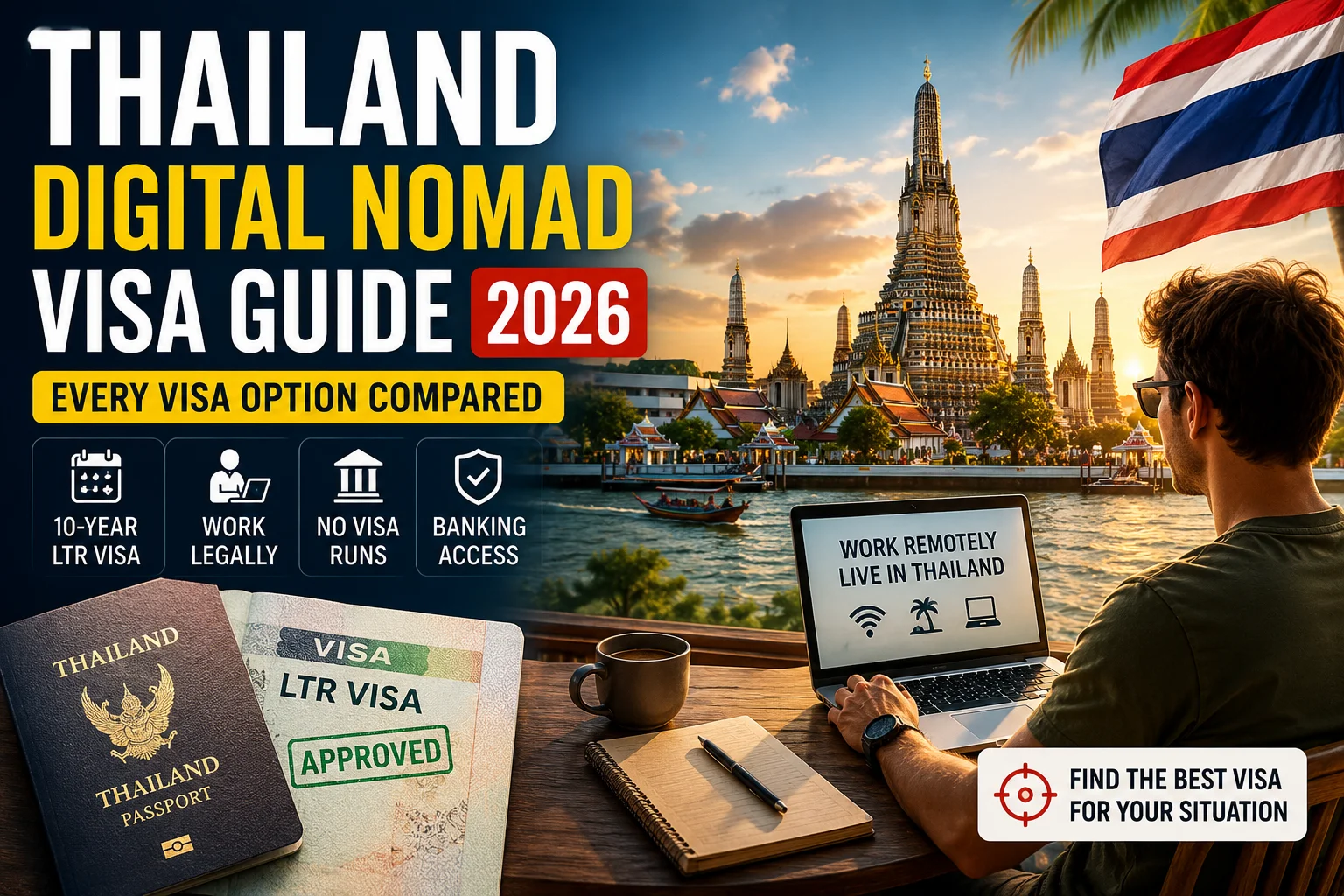
| Thailand offers five main visa options for digital nomads and remote workers in 2026: the LTR Visa (Long-Term Resident, Work-From-Thailand category), the SMART Visa, the Elite / Privilege Card, the tourist visa route, and the Non-Immigrant B with work permit. The Thailand digital nomad visa landscape is centered around the LTR Visa, which is the definitive legal solution for remote workers earning USD 40,000+ per year from overseas sources — it provides a 10-year, multiple-entry stay with an explicit work permit for overseas employment. The SMART Visa targets senior specialists in BOI-priority sectors at higher income thresholds. The Elite / Privilege Card offers long stays but no work authorization. The tourist visa is not designed for long-term remote work and carries legal uncertainty. The Thailand BOI manages the LTR Visa programme through its online portal (ltrvisat.boi.go.th). Indian and Filipino citizens are the most active applicants, with nationality-specific documentation requirements. Thailand’s 180-day tax residency rule applies to all visa types. |
| QUICK ANSWER: What is the best digital nomad visa for Thailand in 2026? The best Thailand visa for digital nomads in 2026 depends on your income and employment situation: Earning USD 40,000+/year from overseas: Thailand LTR Visa (WFT Professional category) — 10-year stay, explicit work permit, best overall Senior specialist in BOI target sector, USD 80,000+/year: Thailand SMART Visa — 4-year stay with work authorization High-net-worth individual wanting long stay without work needs: Thailand Elite / Privilege Card — 5 to 20 years, no work permit Under USD 40,000/year income or testing Thailand: Tourist visa (60 to 90 days) — no work authorization, not a long-term solution For most remote workers and digital nomads who meet the income threshold, the Thailand LTR Visa is the correct answer. It provides everything a long-term remote resident needs: legal work authorization, banking access, no visa runs, and 10 years of stability. |
| LEGAL DISCLAIMER This guide is for informational purposes only and does not constitute legal, immigration, or tax advice. Thailand’s BOI and immigration policies can change. All visa fees, requirements, and procedures should be verified at boi.go.th, immigration.go.th, and rd.go.th before applying. Individual circumstances vary — consult a licensed Thai immigration attorney for advice on your specific situation. |
Introduction: Thailand’s Visa Landscape for Remote Workers
Thailand has been the world’s most popular digital nomad destination for over a decade. The combination of low cost of living, excellent infrastructure, a vibrant international community, and Southeast Asia’s most developed tourist ecosystem made Thailand the default choice for remote workers long before ‘digital nomad visa’ was a mainstream concept.
But for years, Thailand had a critical gap: no visa actually authorized remote work. Remote workers stayed on tourist visas, did endless border runs, and lived in a legal gray area where working for overseas clients was technically unauthorized but rarely enforced.
That changed in 2022 when the Thailand Board of Investment launched the Long-Term Resident (LTR) Visa, including the Work-From-Thailand (WFT) Professional category. For the first time, Thailand had a visa specifically designed for remote workers — one that explicitly authorized working for overseas employers, eliminated visa runs, and provided 10 years of stable legal residence.
This guide is the complete reference for 2026: every Thailand visa option for remote workers and digital nomads, compared side by side, with a clear decision framework, nationality-specific guidance for Indian and Filipino applicants, and direct links to every detailed cluster guide you need.
Thailand’s Digital Nomad Visa Landscape: The 2026 Overview
Thailand’s visa system for remote workers involves five main pathways. Understanding which serves which need is the essential first step:
| Visa / Route | Introduced | Best For | Work Authorization | Stay Duration |
| LTR Visa — WFT Professional | 2022 (BOI) | Remote workers, freelancers earning USD 40K+/yr | YES — overseas employers | 10 years, multiple entry |
| Thailand SMART Visa | 2018 (BOI) | Senior specialists in BOI target sectors | YES — sector-specific | 4 years, multiple entry |
| Thailand Elite / Privilege Card | 2003 (Thailand Elite) | Long-stay without work needs | NO work permit | 5–20 years, multiple entry |
| Tourist Visa (TR) / Visa-exempt | Standard immigration | Genuine tourists, testing Thailand | NOT authorized | 30–90 days per entry |
| Non-Immigrant B + Work Permit | Standard immigration | Those employed by a Thai company | YES — specific employer only | 1 year (renewable) |
Master Visa Comparison Table: 12 Key Factors
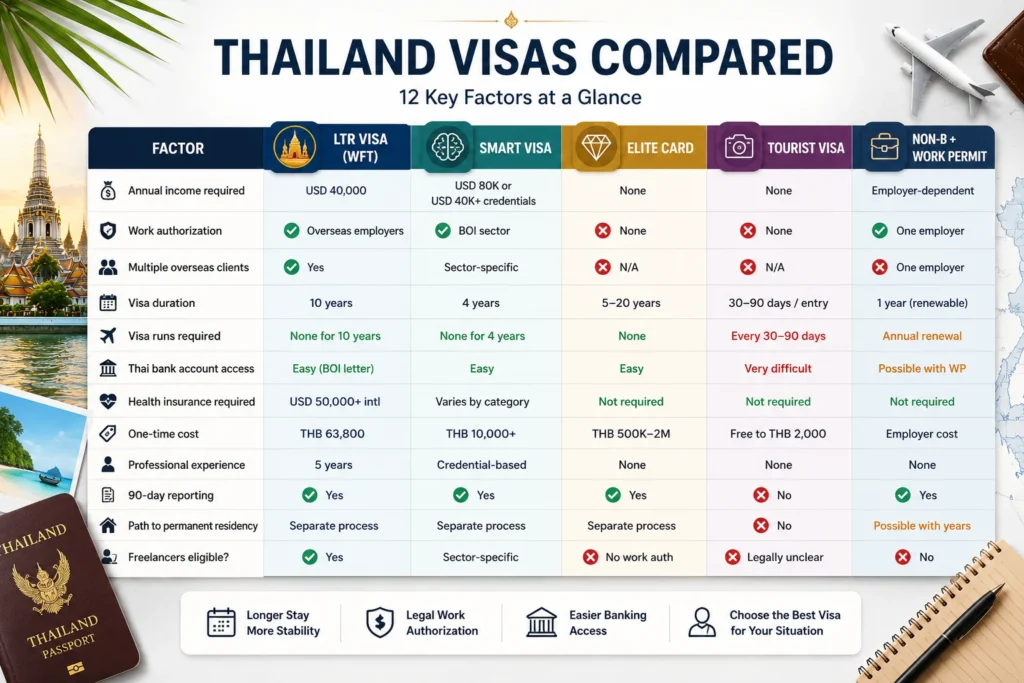
| Factor | LTR Visa (WFT) | SMART Visa | Elite Card | Tourist Visa | Non-B + WP |
| Annual income required | USD 40,000 | USD 80K or USD 40K+credentials | None | None | Employer-dependent |
| Work authorization | ✅ Overseas employers | ✅ BOI sector | ❌ None | ❌ None | ✅ One employer |
| Multiple overseas clients | ✅ Yes | Sector-specific | ❌ N/A | ❌ N/A | ❌ One employer |
| Visa duration | 10 years | 4 years | 5–20 years | 30–90 days/entry | 1 year (renewable) |
| Visa runs required | None for 10 years | None for 4 years | None | Every 30–90 days | Annual renewal |
| Thai bank account access | Easy (BOI letter) | Easy | Easy | Very difficult | Possible with WP |
| Health insurance required | USD 50,000+ intl | Varies by category | Not required | Not required | Not required |
| One-time cost | THB 63,800 | THB 10,000+ | THB 500K–2M | Free to THB 2,000 | Employer cost |
| Professional experience | 5 years | Credential-based | None | None | None |
| 90-day reporting | Yes | Yes | Yes | No | Yes |
| Path to permanent residency | Separate process | Separate process | Separate process | No | Possible with years |
| Freelancers eligible? | ✅ Yes | Sector-specific | ❌ No work auth | ❌ Legally unclear | ❌ No |
Option 1: Thailand LTR Visa — Work-From-Thailand (WFT) Professional
The Thailand Long-Term Resident Visa, specifically the Work-From-Thailand (WFT) Professional category, is the primary digital nomad visa for Thailand in 2026. It is administered by the Thailand Board of Investment and represents the government’s formal answer to the decade-long question of how remote workers could live legally in Thailand.
Who the LTR Visa (WFT) is designed for
- Remote employees working for overseas companies from Thailand
- Freelancers serving multiple overseas clients from Thailand
- Online business owners whose revenue comes from overseas customers
- Independent contractors with overseas retainer agreements
Core eligibility requirements
| Requirement | WFT Professional Standard |
| Annual income | Minimum USD 40,000 gross per year from non-Thai overseas sources |
| Professional experience | Minimum 5 years in relevant professional field |
| Health insurance | International health plan with minimum USD 50,000 coverage valid in Thailand |
| Employment type | Remote worker for overseas employer OR freelancer for overseas clients |
| Income source | Must be non-Thai overseas sources (not Thai companies or Thai clients) |
| Criminal background | Background check conducted by BOI during review |
LTR Visa cost breakdown
| Cost Item | Amount |
| BOI endorsement fee | THB 50,000 (non-refundable, paid online via BOI portal) |
| Visa stamp fee (at Thai Embassy) | THB 10,000 |
| Re-entry permit (if needed before check-in) | THB 3,800 |
| CA certificate / income certification | INR 2,000–5,000 (India) / PHP 1,500–3,000 (Philippines) |
| International health insurance (ongoing) | USD 600–1,800/year |
| TOTAL (first year, including health insurance) | Approx. USD 2,400–3,200 |
LTR Visa application process summary
- Confirm eligibility: gross USD 40,000+/year from overseas sources, 5+ years experience
- Gather documentation: bank statements (12 months), CA certificate or income certification, client contracts, health insurance certificate, CV
- Create account on BOI portal: ltrvisat.boi.go.th
- Submit online application and pay THB 50,000 endorsement fee
- Wait for BOI review: 20 to 35 working days
- Receive BOI endorsement letter via email
- Book appointment at Royal Thai Embassy in your country and pay THB 10,000 visa stamp fee
- Receive LTR Visa stamp in passport; travel to Thailand and activate
| LTR VISA WORK PERMIT COVERAGE The LTR Visa includes a special endorsement that functions as a work permit for remote work with overseas employers. It covers: Remote work for one overseas employerFreelancing for multiple overseas clients simultaneouslyOnline business serving overseas customers It does NOT cover working for Thai companies or Thai clients (requires separate work permit). |
Option 2: Thailand SMART Visa
The Thailand SMART Visa is a BOI-administered long-stay visa targeting senior professionals in specific high-value sectors. It predates the LTR Visa (launched 2018) and serves a different, more specialized audience.
SMART Visa categories
| Category | Targets | Income Requirement | Duration |
| SMART T (Talented) | Highly skilled professionals in target sectors | USD 100,000+/year or specific credentials | 4 years |
| SMART I (Investor) | Investors in target sectors | THB 20M+ investment | 4 years |
| SMART E (Executive) | Senior executives at BOI-registered firms | USD 200,000+/year | 4 years |
| SMART S (Startup) | Startups operating in target sectors | BOI-approved startup status | 1 year (extendable) |
Who SMART Visa is better than LTR Visa for
The SMART Visa is more relevant than the LTR Visa in one scenario: a highly specialized professional (senior software engineer, fintech specialist, biotech researcher) who earns above the SMART threshold and is employed by or working with a BOI-recognized Thai entity. In most remote worker scenarios, the LTR Visa is simpler and more accessible.
| SMART VISA VS LTR VISA: THE KEY DIFFERENCE LTR Visa (WFT): No Thai company involvement needed. You work for overseas employers or clients. No sector restriction. Income threshold USD 40,000/year. SMART Visa (T): Requires endorsement from a BOI-recognized Thai organization. Higher income threshold. Sector-specific. More suitable for senior professionals with formal Thai connections. For most Indian and Filipino digital nomads working remotely for overseas clients: LTR Visa is the better pathway. SMART Visa requires a Thai organizational endorsement that most independent remote workers do not have. |
Option 3: Thailand Elite / Privilege Card
The Thailand Elite Card (officially rebranded as Thailand Privilege Card in 2022) is a long-stay membership programme that offers 5 to 20 years of multiple-entry stays in Thailand for a one-time fee. It is issued by Thailand Privilege Card Co., Ltd., a government-affiliated entity.
| Tier | Duration | Fee (approx.) | Key Features |
| Elite Easy Access | 5 years | THB 500,000 (approx. USD 14,000) | Basic long stay; no work permit |
| Elite Family Alternative | 5 years (family) | THB 800,000 | Covers 2 applicants |
| Elite Superiority Extension | 20 years | THB 2,000,000 (approx. USD 56,000) | Longest stay option; premium services |
| CRITICAL LIMITATION: NO WORK AUTHORIZATION The Thailand Privilege Card does NOT include a work permit. Holders of this card who work remotely for overseas clients are in the same legal gray area as tourist visa holders. The card provides long-stay immigration benefits only — not legal authorization for any form of work on Thai territory. The Privilege Card makes most sense for high-net-worth individuals, retirees, or long-stay travelers who do not need work authorization. For remote workers, the LTR Visa is the legally superior option despite the lower upfront cost. |
Option 4: Tourist Visa Route
The Thailand tourist visa (TR) and visa-exempt entry have been the default approach for most digital nomads in Thailand for years — not because they are the right solution, but because they were the only widely accessible option before the LTR Visa.
What the tourist visa permits
- Genuine tourism: sightseeing, leisure, visiting friends/family
- Permitted stay: 30 days (visa-exempt) to 60 days (TR), extendable once for 30 more days
- No income requirement or documentation needed
What the tourist visa does NOT permit
- Remote work for any employer or client — legally speaking
- Providing services to any party (Thai or overseas) from Thai territory without a work permit
- Establishing a stable long-term residence in Thailand
| TOURIST VISA REALITY CHECK Most digital nomads who have been in Thailand on tourist visas understand that enforcement against remote workers serving exclusively overseas clients is rare. But ‘rarely enforced’ does not mean ‘legally permitted.’ The Aliens’ Work Act B.E. 2551 requires a work permit for any work on Thai territory. The LTR Visa exists precisely to give remote workers a legal alternative. Read the complete legal analysis: Working Remotely in Thailand on Tourist Visa — Legal Analysis |
Option 5: Non-Immigrant B Visa + Thai Work Permit
The Non-Immigrant B (Business) Visa with a Thai work permit is the traditional path for those employed by Thai-based companies. It is not a digital nomad visa but is included here for completeness.
- Issued to: Foreign nationals employed by a Thai-registered company with a valid work permit
- Duration: 1 year, renewable annually with employer support
- Work authorization: Yes, but for the specific employer named in the work permit
- Freelancers: Not eligible (requires formal Thai employer)
- Relevant for: Those who have been hired by a Thai company or establish their own Thai company
For independent remote workers and freelancers, the Non-Immigrant B + work permit route is not practical. The LTR Visa is the correct pathway.
Decision Framework: Which Thailand Visa Is Right for You?
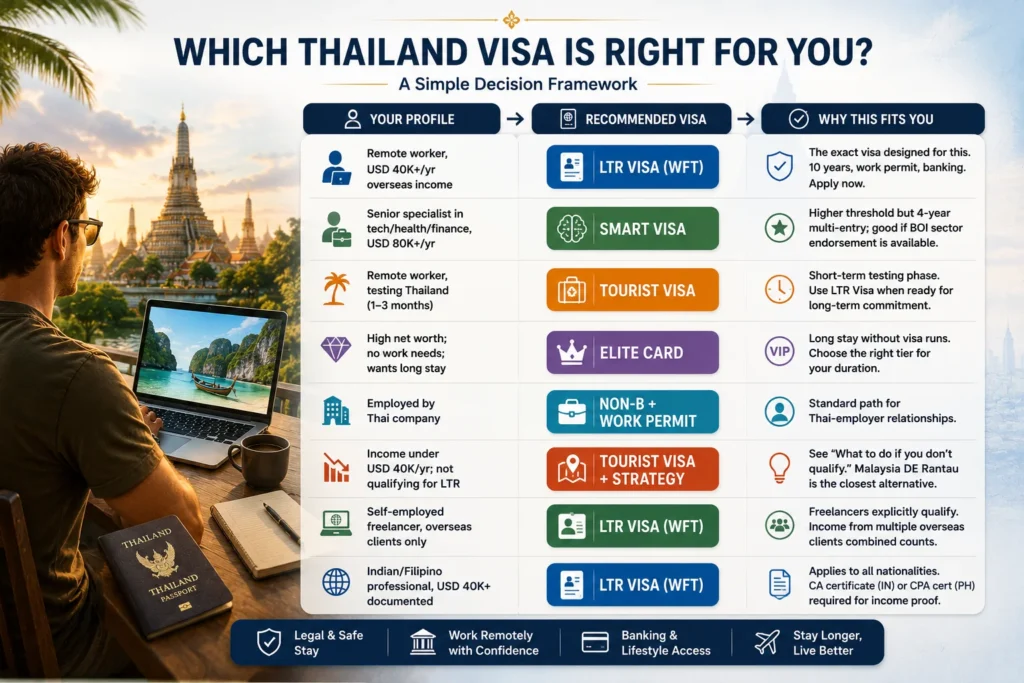
| Your Profile | Recommended Visa | Reason |
| Remote worker, USD 40K+/yr overseas income | LTR Visa (WFT) | The exact visa designed for this. 10 years, work permit, banking. Apply now. |
| Senior specialist in tech/health/finance, USD 80K+/yr | SMART Visa | Higher threshold but 4-year multi-entry; good if BOI sector endorsement is available. |
| Remote worker, testing Thailand (1–3 months) | Tourist Visa | Short-term testing phase. Use LTR Visa when ready for long-term commitment. |
| High net worth; no work needs; wants long stay | Elite Card | Long stay without visa runs. Choose the right tier for your duration. |
| Employed by Thai company | Non-B + Work Permit | Standard path for Thai-employer relationships. |
| Income under USD 40K/yr; not qualifying for LTR | Tourist Visa + strategy | See ‘What to do if you don’t qualify.’ Malaysia DE Rantau is the closest alternative. |
| Self-employed freelancer, overseas clients only | LTR Visa (WFT) | Freelancers explicitly qualify. Income from multiple overseas clients combined counts. |
| Indian/Filipino professional, USD 40K+ documented | LTR Visa (WFT) | Applies to all nationalities. CA certificate (IN) or CPA cert (PH) required for income proof. |
Nationality-Specific Guidance: Indian Citizens
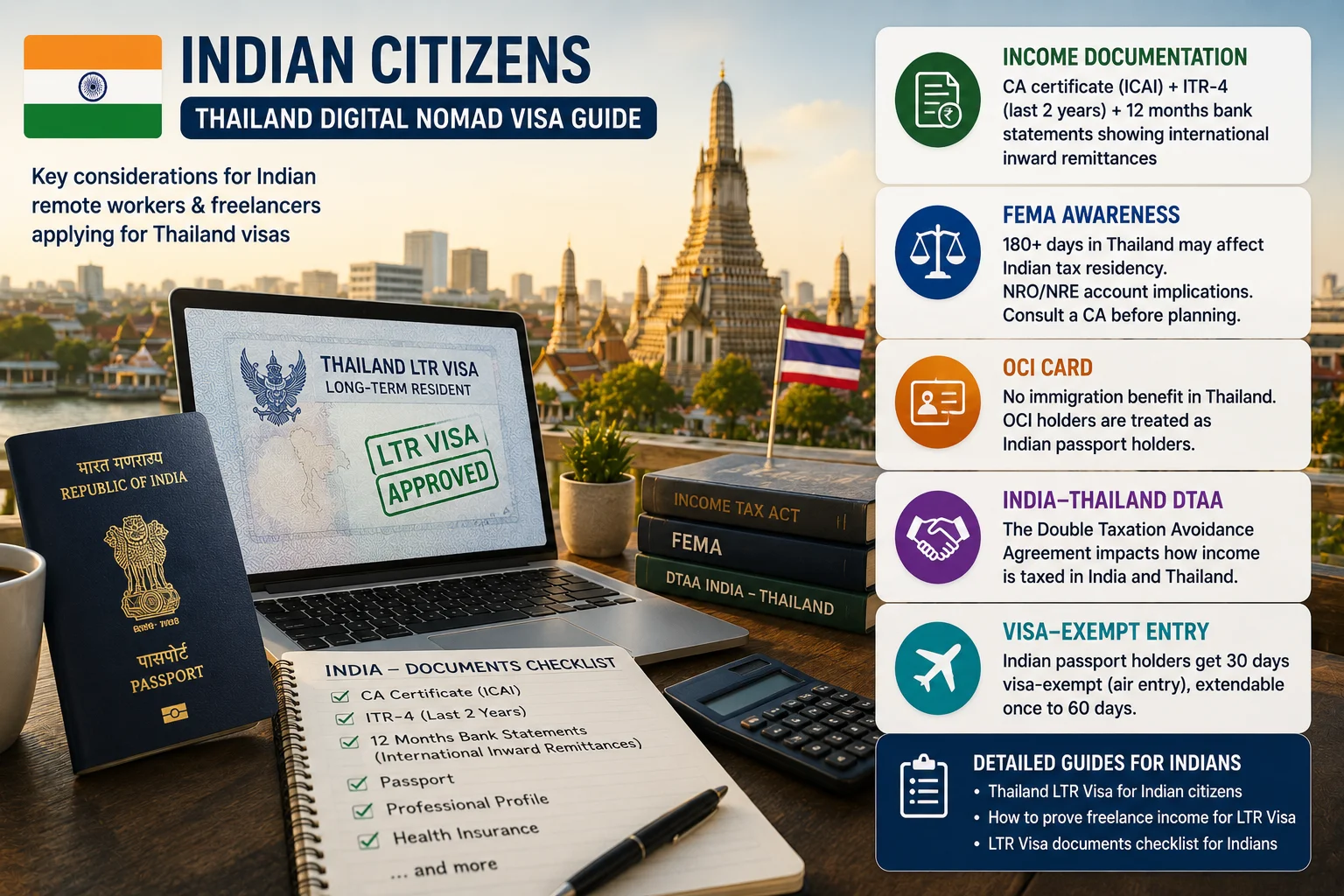
| INDIA-SPECIFIC THAILAND DIGITAL NOMAD VISA GUIDE Indian citizens are among the most active applicants for the Thailand LTR Visa. Key India-specific points: Income documentation: Indian freelancers and self-employed professionals need a CA certificate from an ICAI-registered Chartered Accountant confirming overseas income, plus ITR-4 (last 2 years), and 12 months of bank statements showing international inward remittancesFEMA awareness: Extended stays in Thailand (180+ days per year) can affect Indian tax residency status. NRO/NRE account implications arise for Indians qualifying as NRI under FEMA. Consult a CA before planning a 180+ day stay.OCI card: No immigration benefit in Thailand. OCI holders are treated as Indian passport holders.India-Thailand DTAA: The India-Thailand Double Taxation Avoidance Agreement affects how income earned in Thailand is taxed in India and vice versaVisa-exempt entry: Indian passport holders get 30 days visa-exempt in Thailand (air entry), extendable once to 60 days Detailed India-specific guides: Thailand LTR Visa for Indian citizens → /thailand-ltr-visa-indian-citizens/How to prove freelance income for LTR Visa → /prove-freelance-income-ltr-visa/LTR Visa documents checklist for Indians → /ltr-visa-documents-checklist-indians/ |
Nationality-Specific Guidance: Filipino Citizens
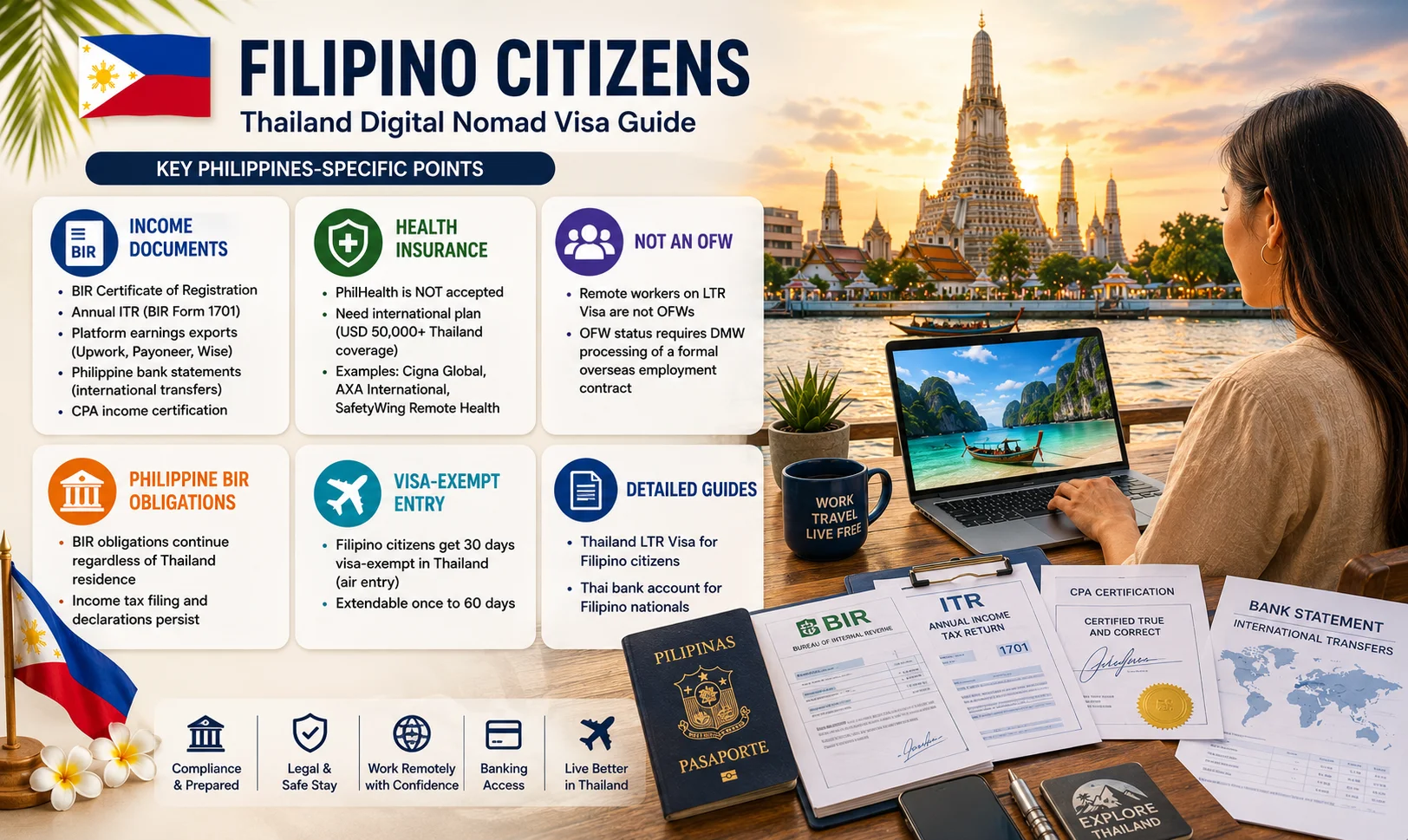
| PHILIPPINES-SPECIFIC THAILAND DIGITAL NOMAD VISA GUIDE Filipino remote workers form a significant segment of Thailand LTR Visa applicants. Key Philippines-specific points: Income documentation: Filipino freelancers need BIR Certificate of Registration, Annual ITR (BIR Form 1701), official platform earnings exports (Upwork, Payoneer, Wise), Philippine bank statements showing international transfers, and a CPA income certification Health insurance: PhilHealth is NOT accepted as qualifying international health insurance. Filipinos need an international plan (Cigna Global, AXA International, Safety Wing Remote Health) with USD 50,000+ Thailand coverage OFW distinction: Remote workers on LTR Visa are not OFWs. OFW status requires DMW processing of a formal overseas employment contract — not relevant to digital nomads Philippine BIR obligations continue regardless of Thailand residence — income tax filing and declarations persistVisa-exempt entry: Filipino citizens get 30 days visa-exempt in Thailand (air entry), extendable once to 60 days Detailed Philippines-specific guides: Thailand LTR Visa for Filipino citizens → /thailand-ltr-visa-filipino-citizens/Thai bank account for Filipino nationals → /thai-bank-account-filipino-nationals/ |
Other Nationalities: Quick Reference
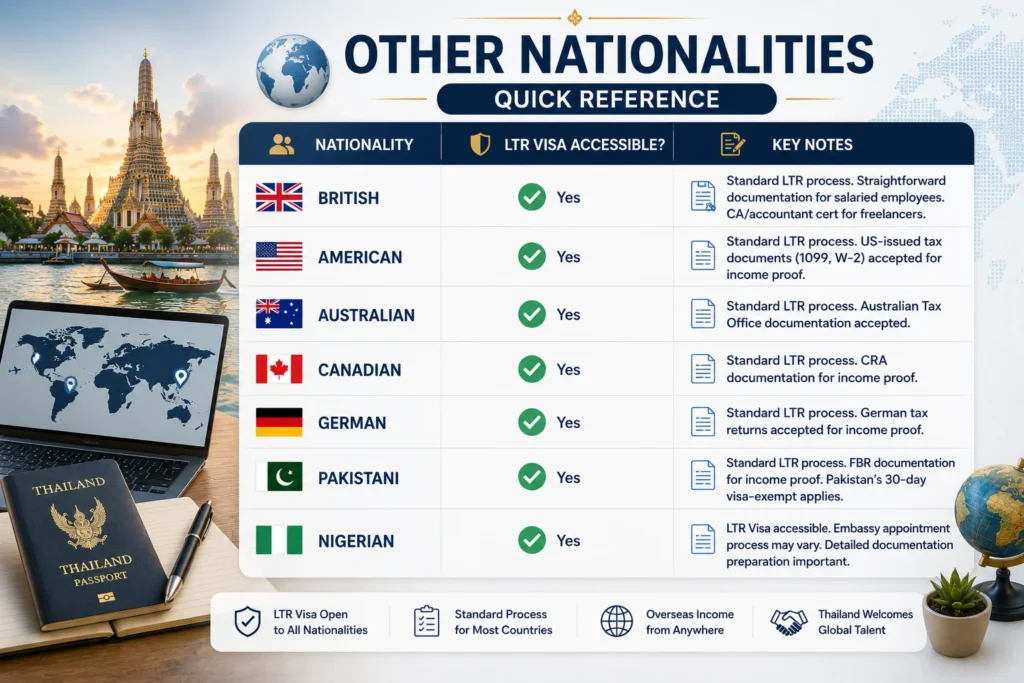
| Nationality | LTR Visa Accessible? | Key Notes |
| British | Yes | Standard LTR process. Straightforward documentation for salaried employees. CA/accountant cert for freelancers. |
| American | Yes | Standard LTR process. US-issued tax documents (1099, W-2) accepted for income proof. |
| Australian | Yes | Standard LTR process. Australian Tax Office documentation accepted. |
| Canadian | Yes | Standard LTR process. CRA documentation for income proof. |
| German | Yes | Standard LTR process. German tax returns accepted for income proof. |
| Pakistani | Yes | Standard LTR process. FBR documentation for income proof. Pakistan’s 30-day visa-exempt applies. |
| Nigerian | Yes | LTR Visa accessible. Embassy appointment process may vary. Detailed documentation preparation important. |
Thailand Tax Implications for Digital Nomads
Tax is one of the most misunderstood aspects of long-term Thailand stays. Here is what every digital nomad needs to know:
The 180-day Thai tax residency rule
Thailand’s Revenue Code triggers tax residency when you spend 180 or more days in Thailand in a calendar year. Once tax resident, your ‘assessable income’ is subject to Thai income tax at progressive rates (0% to 35%).
The 2024 Revenue Department ruling (Phor Ngor 161/2566)
In 2024, the Thai Revenue Department issued a ruling clarifying that foreign-sourced income brought into Thailand in the same tax year as it is earned is subject to Thai income tax for Thai tax residents. Income earned in prior years is not affected. This ruling affects digital nomads who are Thai tax residents and regularly repatriate their overseas earnings into Thailand.
Practical implications by visa type
- LTR Visa holders: The LTR Visa does not exempt you from Thai tax residency. If you spend 180+ days in Thailand, the same tax rules apply as for tourist visa holders.
- LTR Visa tax benefit: The LTR Visa was initially marketed with a tax exemption on foreign income, but this was revised. Current LTR Visa holders should verify their specific tax position with a Thai tax advisor.
- Both visa types: Active tax planning is required if spending 180+ days in Thailand. The India-Thailand DTAA and Philippines-Thailand tax treaty provide frameworks for avoiding double taxation.
| TAX DISCLAIMER Thai tax law for digital nomads is complex, actively evolving, and highly dependent on individual circumstances including nationality, income source, and home country tax treaties. This is not tax advice. Consult a qualified Thai tax advisor and a home-country tax professional before making long-term Thailand residency plans based on tax considerations. Do not rely on generic online forums for tax guidance. |
Thailand Banking for Remote Workers
Banking access is one of the most practical differences between Thailand visa types. It directly affects daily quality of life in Thailand.
LTR Visa holders
The LTR Visa endorsement letter from BOI is accepted by Bangkok Bank and Kasikorn Bank (KBank) as proof of long-stay resident status for account opening. LTR Visa holders can open savings accounts, set up Prompt Pay (QR payment), receive international SWIFT transfers, and access full Thai banking functionality. The endorsement letter eliminates the visa-type barrier that prevents tourist visa holders from accessing banking.
Tourist visa holders
Opening a Thai bank account on a tourist visa is notoriously difficult. Most branches require a Non-Immigrant visa or long-stay status proof. Tourist visa holders are regularly turned away at Bangkok Bank and KBank. Workarounds (Wise, Payoneer, international transfers) work for receiving income but create friction for local expenses.
Recommended banking setup for LTR Visa holders
- Bangkok Bank or KBank: Primary Thai account for local expenses, rent, utilities, PromptPay QR payments
- Wise: International income reception (USD, EUR, GBP accounts), conversion to THB at near mid-market rates
- Indian nationals: NRO/NRE accounts in India for ongoing India-linked financial obligations
- Filipino nationals: Philippine bank account (BDO, BPI) maintained for Philippine obligations
What to Do If You Don’t Yet Qualify for the LTR Visa
If your income is below USD 40,000 per year or you cannot fully document it for the LTR Visa application, you have these options:
- Tourist visa + Thailand base: Continue on tourist visa extensions and border runs. Legally imperfect, practically manageable. Track your income and apply for LTR Visa when you have 12 clear months above USD 40,000.
- Malaysia DE Rantau Digital Nomad Pass: USD 24,000/year threshold, up to 12 months, legal remote work authorization. Best legal remote work visa in Southeast Asia below the LTR threshold. [Read: Malaysia DE Rantau guide]
- Georgia Remotely From programme: USD 2,000/month recommendation, 365-day visa-free for Filipinos, easy e-visa for Indians. Very low cost of living. [Read: Remotely from Georgia guide]
- Build income documentation: If your income is near the threshold but poorly documented, invest in getting a CA certificate (India) or CPA income certification (Philippines) that clearly states your annual overseas income. Once documentation is solid, apply for LTR Visa.
Navigate to Your Specific Guide — Internal Hub
This pillar page covers every Thailand visa option at overview level. Use the links below to go deeper on the topic most relevant to your situation:
LTR Visa — Nationality-Specific Guides
- Thailand LTR Visa for Indian citizens → /thailand-ltr-visa-indian-citizens/
- Thailand LTR Visa for Filipino citizens → /thailand-ltr-visa-filipino-citizens/
- LTR Visa for self-employed freelancers → /thailand-ltr-visa-self-employed-freelancers/
- How to prove freelance income for LTR Visa → /prove-freelance-income-ltr-visa/
- LTR Visa documents checklist for Indians → /ltr-visa-documents-checklist-indians/
- LTR Visa processing time: Indian applicants → /ltr-visa-processing-time-indian-applicants/
- LTR Visa rejection reasons guide → /ltr-visa-rejection-reasons/
Thailand Tourist Visa Guides
- Working remotely in Thailand on tourist visa — legal analysis → /working-remotely-thailand-tourist-visa-legal/
- Thailand tourist visa 60-day extension process → /thailand-tourist-visa-60-day-extension/
- Thailand tourist visa vs LTR Visa comparison → /thailand-tourist-visa-vs-ltr-visa/
Thailand Banking Guides
- Bangkok Bank account for Indian nationals → /bangkok-bank-account-indian-nationals/
- Thai bank account for Filipino nationals → /thai-bank-account-filipino-nationals/
Risks, Limitations, and Reality Check
- LTR Visa income threshold: USD 40,000/year is an accessible threshold for many professionals but excludes lower-income freelancers and early-career remote workers. There is no lower-threshold Thai visa for remote workers.
- Thai tax residency: Spending 180+ days per year in Thailand creates genuine tax obligations. The 2024 Revenue Department ruling specifically clarifies that current-year foreign income brought into Thailand is assessable. Tax planning is not optional for long-term Thailand residents.
- LTR Visa fee is non-refundable: The THB 50,000 BOI endorsement fee is lost on rejection. Preparing a complete, compliant application on the first submission is essential.
- SMART Visa complexity: The SMART Visa requires BOI sector endorsement from a Thai organization — this is not available to most independent remote workers.
- Elite Card work authorization gap: The Elite/Privilege Card is marketed heavily but does not include work authorization, creating an unaddressed gap for remote workers who choose it.
- Tourist visa legal uncertainty: Working on a tourist visa is technically illegal under the Aliens’ Work Act. Low enforcement probability does not mean low legal risk.
- Documentation burden: LTR Visa applications have a high documentation standard, particularly for Indian and Filipino freelancers with complex income structures.
Frequently Asked Questions
What is the best digital nomad visa for Thailand in 2026?
The best Thailand digital nomad visa for 2026 is the Long-Term Resident (LTR) Visa under the Work-From-Thailand (WFT) Professional category, administered by the Thailand Board of Investment. It provides 10 years of multiple-entry stay, explicit work authorization for overseas employers, and full Thai banking access. Minimum income requirement: USD 40,000 per year from overseas sources.
Does Thailand have a digital nomad visa?
Yes. Thailand launched the LTR Visa (Long-Term Resident) in 2022, which includes the Work-From-Thailand (WFT) Professional category. This is Thailand’s formal digital nomad visa. It replaced years of digital nomads using tourist visas without legal work authorization.
How much do you need to earn to get the Thailand LTR Visa?
The minimum income requirement for the LTR Visa Work-From-Thailand (WFT) Professional category is USD 40,000 gross per year from non-Thai overseas sources. This is calculated as annual total from all overseas sources combined. The Highly Skilled Professional category requires USD 80,000/year or USD 40,000+ with qualifying credentials.
Can Indian and Filipino citizens apply for the Thailand LTR Visa?
Yes. Both Indian and Filipino citizens can apply for the Thailand LTR Visa under the WFT Professional category. There is no nationality restriction. Indian applicants need a CA certificate from an ICAI-registered CA for income proof. Filipino applicants need BIR documentation, platform earnings exports, and a CPA income certification. See the nationality-specific guides linked above.
Can I work remotely in Thailand on a tourist visa?
Legally, no. Under Thailand’s Aliens’ Work Act B.E. 2551, working without a work permit on Thai territory is not authorized, and tourist visas do not include work permits. In practice, enforcement against remote workers serving exclusively overseas clients is rare but documented. The LTR Visa is the legal solution. See our complete legal analysis: Working Remotely in Thailand on Tourist Visa.
How long does the Thailand LTR Visa application take?
The LTR Visa application involves two stages: BOI review (20 to 35 working days from submission) and Thai Embassy visa stamping (3 to 5 working days after BOI approval). Total time from application to visa stamp: typically 6 to 10 weeks. Additional time may be needed to prepare documentation before submitting.
What is the Thailand SMART Visa and how is it different from the LTR Visa?
The Thailand SMART Visa is a BOI visa targeting senior professionals in specific BOI-priority sectors (technology, fintech, biotech, etc.). It requires either USD 80,000/year income or USD 40,000+/year with specific credentials, plus endorsement from a BOI-recognized Thai organization. Unlike the LTR Visa, the SMART Visa requires a Thai organizational connection. For most independent remote workers with overseas clients, the LTR Visa is more accessible.
Does the Thailand Elite Card allow remote work?
No. The Thailand Elite / Privilege Card is a long-stay membership programme that provides multiple-entry stays of 5 to 20 years but does NOT include a work permit. Elite Card holders who work remotely for overseas clients are in the same legal position as tourist visa holders — technically unauthorized under the Aliens’ Work Act. For legal remote work authorization in Thailand, the LTR Visa is the correct choice.
What are the tax implications of living in Thailand on a digital nomad visa?
Thai tax residency is triggered by spending 180 or more days in Thailand in a calendar year. Once tax resident, you may be subject to Thai income tax on foreign-sourced income brought into Thailand in the same year (per the 2024 Revenue Department ruling). This applies regardless of visa type — LTR Visa, tourist visa, and Elite Card holders all face the same 180-day rule. Consult a Thai tax advisor and a home-country tax professional for your specific situation.
What if I earn below USD 40,000 and cannot qualify for the LTR Visa?
If you are below the LTR Visa income threshold, Malaysia’s DE Rantau Digital Nomad Pass (USD 24,000/year) and Georgia’s Remotely From programme (USD 2,000/month recommendation) are the closest Southeast/Central Asian alternatives with legal remote work authorization. Continue building your income and documentation toward the LTR threshold and apply when ready.
Final Verdict: Thailand’s Digital Nomad Visa Landscape in 2026
| Thailand’s digital nomad visa landscape is more developed than most readers realize — and more nuanced than most articles acknowledge. The LTR Visa represents a genuine, well-designed solution for remote workers who meet the income threshold: 10 years, multiple entry, explicit work authorization, banking access, and no visa runs. It is the best long-stay option available in Southeast Asia for remote workers earning USD 40,000+ from overseas. The gaps in the landscape are real. No equivalent option exists below USD 40,000 income. The tourist visa legal ambiguity persists. The Elite Card’s work authorization gap is never acknowledged in its marketing. Tax planning is non-optional for anyone staying 180+ days. But for the growing number of Indian, Filipino, Pakistani, and global remote workers who qualify for the LTR Visa, Thailand in 2026 offers something it could not offer five years ago: a legitimate, stable, legally authorized home. If you meet the income threshold, the LTR Visa is not a complicated decision. It is the correct one. |