IMPORTANT TAX DISCLAIMER This article provides general informational analysis of Thailand’s tax residency framework as of June 2026. It is NOT tax advice, legal advice, or financial counsel. Thai tax law is complex, actively evolving, and highly individual in its application. Always consult a licensed Thai tax advisor and home-country tax professional for guidance specific to your individual income situation, nationality, and DTAA treaty eligibility. Do not make tax decisions based solely on this article.
Thailand’s tax residency system for Thailand tax residency digital nomads involves three intersecting legal frameworks: (1) Revenue Code Section 41 — the 180-day rule that determines when you become a Thai tax resident; (2) Revenue Department Ruling Phor Ngor 161/2566 (2024) — which established that overseas income brought into Thailand in the same calendar year it is earned is assessable income for Thai tax residents; and (3) bilateral double taxation treaties with India, Philippines, UK, US, and 60+ other countries that prevent double taxation. As a Thai tax resident, progressive personal income tax rates from 0% to 35% apply to net assessable income after deductions. LTR Visa WFT and HSP holders benefit from preferential provisions under Royal Decree No. 743 (2022). Filing: Form PND 90 by March 31 of the following year. Non-assessable: overseas income not brought into Thailand, and prior-year overseas income transferred later. The most common misconception is that Thai tax residency is catastrophic — in reality, after deductions and treaty credits, most nomads at USD 30,000–60,000 income face effective Thai tax rates of 5–15%.
QUICK ANSWER: How does Thailand tax residency work for digital nomads? Thailand determines your tax obligation in two steps: Are you a Thai tax resident? YES if you spend 180 or more days in Thailand in a calendar year (Jan 1–Dec 31). Days need not be consecutive. Leaving Thailand does not reset the count.Is your income assessable? YES for: Thai-sourced income (always), and overseas income brought into Thailand in the same year you earned it (per 2024 ruling). NO for: overseas income kept offshore, and prior-year overseas income transferred later. Rates: Progressive 0–35% on net income after deductions. Key deductions: personal allowance (THB 60,000) + standard 50% deduction (max THB 100,000) + others. DTAA treaties with India, Philippines, UK, US, and 60+ countries prevent double taxation. Bottom line: Many nomads at USD 40,000/year face an effective Thai tax rate of ~12% after deductions — significantly lower than the top 35% headline rate suggests. The obligation requires engagement, not panic.
Introduction: Thailand Tax Is Manageable — When You Understand It
Thailand became one of the world’s most popular digital nomad destinations before it had any formal framework to address long-stay remote workers. For years, nomads lived in Bangkok on tourist visas, banked in Thai accounts, received USD from overseas clients, and largely gave Thailand’s tax system little thought.
That era is ending. The 2022 LTR Visa created formal legal status for long-stay professionals. The 2024 Revenue Department ruling resolved longstanding ambiguity about overseas income. Thailand’s government has signaled increasing intention to capture tax revenue from its growing community of high-income foreign residents.
For professionals planning Thailand as a serious long-term base, tax literacy is no longer optional. The good news: the system, once understood, is manageable. After applicable deductions and treaty credits, many Thailand-based nomads at moderate income levels owe significantly less than a surface reading of the progressive rates suggests. Anxiety about Thai tax is often disproportionate to the actual liability.
This guide is the complete reference: the 180-day residency rule, the 2024 ruling and what it changed, the progressive tax rate structure with worked examples, LTR Visa provisions, double taxation treaties for India, Philippines, UK, US, and other key nationalities, the filing mechanics, and practical planning strategies — with a navigation hub linking to depth articles on each topic.
1. The 180-Day Rule: When You Become a Thai Tax Resident
LEGAL BASIS: REVENUE CODE SECTION 41 Section 41, Paragraph 3 of Thailand’s Revenue Code: A person who resides in Thailand for 180 days or more in a tax year (January 1 to December 31) is treated as a Thai tax resident for that year. Five critical features of the 180-day rule: Days do NOT need to be consecutive — total accumulated days in the calendar year count Leaving Thailand for any period does NOT reset the day count. Days outside Thailand simply don’t add to the total. Any calendar day you are physically in Thailand counts — including the day of arrival and the day of departure The threshold is 180 days, not 183 (as in some countries)Each calendar year is assessed independently — being a Thai tax resident in 2026 does not automatically make you one in 2027
Practical day-counting example
A nomad spends January to March in Bangkok (90 days), leaves for 3 weeks to India, returns for April to July in Bangkok (120 days), then leaves again in August. Total Thailand days: 90 + 120 = 210 days. Result: Thai tax resident for that calendar year, even though they were absent for 3 weeks in the middle and left in August.
What 180 days means practically
180 days is approximately 6 months. If you plan to spend more than 6 months total in Thailand in any calendar year, plan for Thai tax residency in your financial projections. The threshold is a planning trigger, not a crisis.
For the complete day-counting methodology, how partial days are treated, and how to track accurately: see the Thailand 180-Day Rule guide in the navigation hub below.
2. Assessable Income: What Thailand Can Tax
Tax residency (the 180-day question) and assessable income (the what-can-be-taxed question) are legally distinct. Understanding both is required.
Income Type
Assessable?
Legal Basis
Practical Implication
Thai-sourced income (employment, services, business conducted in Thailand)
Even short-stay visitors pay Thai withholding tax on Thai-sourced income. Not unique to Thai tax residents.
Overseas income brought into Thailand in same calendar year earned
✅ Yes — for Thai tax residents
Section 41, Para 2 + 2024 ruling Phor Ngor 161/2566
The key assessment for digital nomads: overseas client income converted to THB and spent in Thailand same year = assessable.
Overseas income kept offshore (not transferred to Thailand)
❌ No
Section 41 negative implication
Income in Wise, overseas bank, or any non-Thai account that is not transferred to Thailand = outside Thai tax base.
Prior-year overseas income transferred to Thailand in a later year
❌ Generally No
2024 ruling timing interpretation
Income earned in 2025, held offshore through Dec 31, transferred to Thailand in 2026 = generally not assessable in 2026.
3. The 2024 Revenue Department Ruling: What Changed and What Stayed the Same
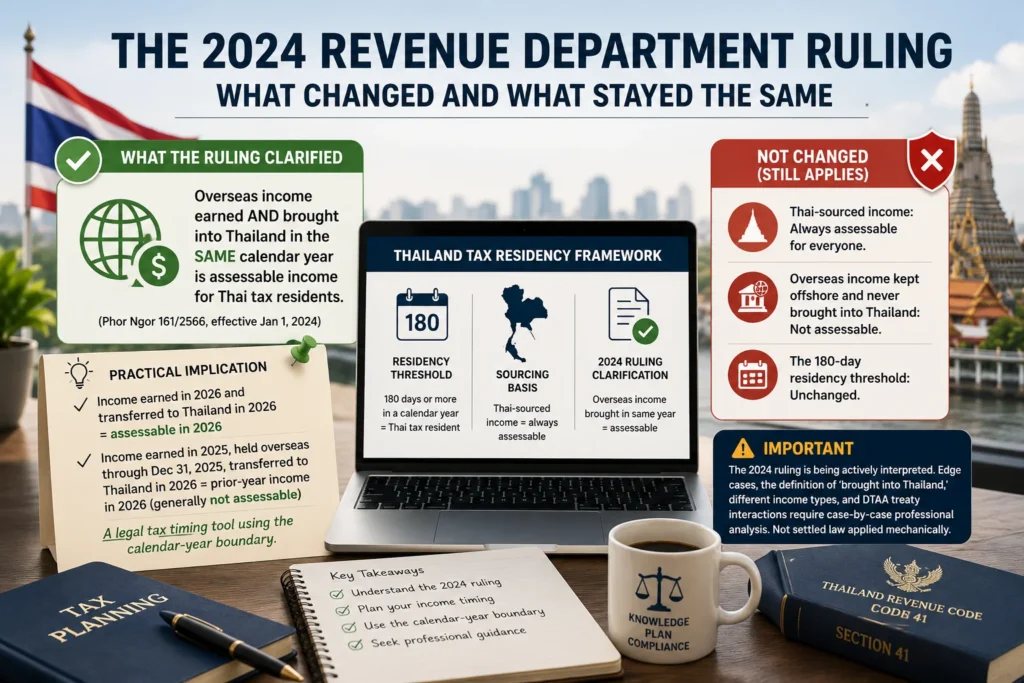
Revenue Department Ruling Phor Ngor 161/2566, effective January 1, 2024, is the most significant Thailand tax development for digital nomads in recent years. It resolved a long-standing interpretive gap in Revenue Code Section 41.
What the ruling clarified
PHOR NGOR 161/2566 — KEY PROVISIONS Confirmed: Overseas income earned AND brought into Thailand in the SAME calendar year is assessable income for Thai tax residents. This formalized an interpretation of Section 41 Paragraph 2. Not changed (still applies as before): Thai-sourced income: Always assessable for everyone. No change.Overseas income kept offshore and never brought into Thailand: Not assessable. No change.The 180-day residency threshold: Unchanged. The practical planning implication the ruling created: Income earned in 2026 and transferred to Thailand in 2026 = assessable in 2026 (if Thai tax resident)Income earned in 2025, held in Wise or overseas bank through December 31, 2025, transferred to Thailand in 2026 = prior-year income in 2026. Generally not assessable in 2026. This creates a meaningful and legal tax timing tool for Thai tax residents who can manage the calendar-year boundary of their income transfers.
THE 2024 RULING IS BEING ACTIVELY INTERPRETED The broad strokes described above represent the current mainstream professional interpretation. Specific edge cases, the definition of ‘brought into Thailand,’ how different income types are treated, and the interaction with DTAA treaty scenarios are all areas where active professional guidance is essential. This is not settled law applied mechanically — it is a ruling requiring case-by-case professional analysis.
4. Thai Personal Income Tax: Rates, Deductions, and Real Costs
Progressive tax rate schedule (2026)
Net Income Bracket (THB)
Rate
Max Tax on Bracket
Cumulative Max Tax
0 – 150,000
0%
THB 0
THB 0
150,001 – 300,000
5%
THB 7,500
THB 7,500
300,001 – 500,000
10%
THB 20,000
THB 27,500
500,001 – 750,000
15%
THB 37,500
THB 65,000
750,001 – 1,000,000
20%
THB 50,000
THB 115,000
1,000,001 – 2,000,000
25%
THB 250,000
THB 365,000
2,000,001 – 5,000,000
30%
THB 900,000
THB 1,265,000
Over 5,000,000
35%
35% on excess
—
Key deductions and allowances
Deduction / Allowance
Amount (THB)
Notes
Personal allowance
60,000
All Thai tax filers
Spouse allowance
60,000
Dependent spouse with no/low income
Child allowance
30,000 per child
Under 20 or in full-time education
Standard income deduction
50% of income, max 100,000
For employment-type income
Life insurance premiums
Up to 100,000
Thai-qualifying policies
Health insurance premiums
Up to 25,000
Own + additional for parents
SSF (Super Savings Fund) investments
Up to 30% of income, max 200,000
Thai investment scheme; reduces taxable income
Charitable donations
Up to 10% of net income
BOT-approved charities
Effective tax rates at key income levels (illustrative, after basic deductions only)
Income (USD/year)
Gross Income (THB)
Net After Basic Deductions
Estimated Thai Tax
Effective Rate
USD 20,000
THB 700,000
THB 540,000
Approx. THB 41,000
~5.9%
USD 40,000
THB 1,400,000
THB 1,240,000
Approx. THB 175,000
~12.5%
USD 60,000
THB 2,100,000
THB 1,940,000
Approx. THB 310,000
~14.8%
USD 80,000
THB 2,800,000
THB 2,640,000
Approx. THB 502,000
~17.9%
USD 120,000
THB 4,200,000
THB 4,040,000
Approx. THB 887,000
~21.1%
NOTE ON ILLUSTRATIVE RATES These estimates use only personal allowance (THB 60,000) + standard 50% employment deduction (THB 100,000 max). Additional deductions (insurance, children, SSF investments) reduce tax further. DTAA treaty credits are not included and can significantly reduce total Thai tax owed. These are illustrations only — consult a Thai tax advisor for precise calculations.
5. LTR Visa Tax Provisions: The Honest Picture
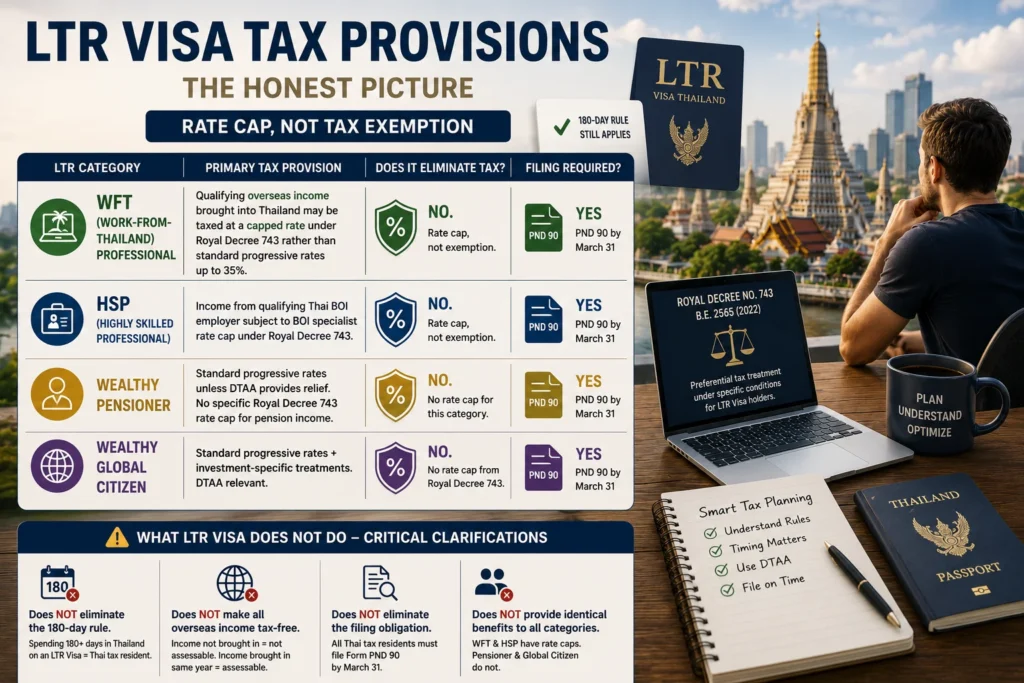
The LTR Visa (2022) was promoted with specific tax incentives under Royal Decree No. 743 B.E. 2565. The most important thing to understand: LTR Visa provisions reduce the tax rate on qualifying income — they do not eliminate Thai income tax entirely.
LTR Category
Primary Tax Provision
Does It Eliminate Tax?
Filing Required?
WFT (Work-From-Thailand) Professional
Qualifying overseas income brought into Thailand may be taxed at a capped rate under Royal Decree 743 rather than standard progressive rates up to 35%
No. Rate cap, not exemption.
Yes — PND 90 by March 31
HSP (Highly Skilled Professional)
Income from qualifying Thai BOI employer subject to BOI specialist rate cap under Royal Decree 743
No. Rate cap, not exemption.
Yes — PND 90 by March 31
Wealthy Pensioner
Standard progressive rates unless DTAA provides relief. No specific Royal Decree 743 rate cap for pension income.
No rate cap for this category.
Yes — PND 90 by March 31
Wealthy Global Citizen
Standard progressive rates + investment-specific treatments. DTAA relevant.
No rate cap from Royal Decree 743.
Yes — PND 90 by March 31
WHAT LTR VISA DOES NOT DO — CRITICAL CLARIFICATIONS Does NOT eliminate the 180-day Thai tax residency rule. Spending 180+ days in Thailand on an LTR Visa = Thai tax resident.Does NOT make all overseas income tax-free. Overseas income not brought into Thailand is not assessable (same as for any Thai tax resident). Overseas income brought into Thailand same year earned is assessable.Does NOT eliminate the filing obligation. All Thai tax residents must file Form PND 90 by March 31.Does NOT provide identical benefits to all categories. WFT and HSP categories have rate cap provisions; Pensioner and Wealthy Global Citizen do not receive the same Royal Decree 743 benefit for their primary income types.
For the complete LTR Visa tax analysis including worked rate-cap examples and interaction with the 2024 ruling: see the LTR Visa Tax Exemption guide in the navigation hub.
Thailand has bilateral double taxation avoidance agreements (DTAAs / DTAs) with over 60 countries. These treaties prevent the same income from being taxed at full rates in both Thailand and your home country. They are among the most important tools for nomads managing cross-border tax obligations.
INDIA – THAILAND DTAA (MOST IMPORTANT FOR MN READERS)The India-Thailand DTAA is the most critical treaty for Meridian Nomad’s primary audience. Key articles for Indian digital nomads: Article 7 — Business Profits: Taxed in country of residence (Thailand, if Thai tax resident) unless a permanent establishment exists in the other country. For nomads without Indian PE: Thailand has primary taxing rights. Article 14 — Independent Personal Services: Taxed where services are performed. Services performed in Thailand by Thai tax residents: Thailand taxes. Article 15 — Dependent Personal Services (employment): Taxed in country where work is performed. Work performed in Thailand: Thailand taxes. Articles 10, 11, 12 — Dividends, Interest, Royalties: India-sourced dividends/interest continue to be taxable in India; treaty caps apply on source-country withholding. Practical outcome for most Indian nomads: Indian NRI status (fewer than 182 days in India per financial year): India taxes only India-sourced income (dividends on Indian shares, Indian rental income, Indian bank interest).Thai tax resident: Thailand taxes overseas active income brought into Thailand same year earned. DTAA credit: Any Indian tax paid on the same income (advance tax, TDS) can be credited against Thai tax due, preventing double taxation. For the complete India-Thailand DTAA analysis: see the India-Thailand DTAA guide in the navigation hub.
PHILIPPINES – THAILAND TAX TREATY Key provisions for Filipino digital nomads in Thailand: Article 7 — Business Profits: Thailand taxes as country where services are performed if Thai tax resident Article 14 — Independent Personal Services: Thailand taxes income from services performed there Article 15 — Employment Income: Taxed where work is performed (Thailand) Philippine BIR obligations persist regardless of Thailand tax residence: BIR Form 1701 must reflect all income from all sources. Philippines-Thailand treaty credit mechanism allows crediting Thai tax paid against Philippine tax on the same income. Result: Thai tax + Philippines-Thailand treaty credit = no double full taxation. Two filing obligations (PND 90 in Thailand + BIR 1701 in Philippines) but not two complete tax bills.
UK – THAILAND DOUBLE TAXATION AGREEMENT For UK nationals in Thailand: UK’s Statutory Residence Test (SRT): Spending fewer than 183 days in UK + meeting SRT conditions = UK non-resident. Non-UK residents: Thai tax jurisdiction primary on overseas income.UK personal pension income: Generally taxed in UK only under treaty provisions UK property rental income: Continues to be taxable in UK Practical outcome: UK nomads who are Thai tax residents AND UK non-residents face Thai tax on Thai-assessable overseas income, with UK taxes limited to UK-sourced income. DTAA prevents double full taxation.
US – THAILAND: THE COMPLEX CASE US citizens and green card holders face the most complex tax position of any nationality: US citizenship-based taxation: US citizens pay US federal income tax on worldwide income regardless of where they live or workUS-Thailand tax treaty: More limited than US’s European treaties. Provides some but not comprehensive double taxation relief.Foreign Earned Income Exclusion (FEIE, Form 2555): US citizens may exclude up to USD 126,500 (2024 amount, adjusted annually) from US tax if meeting Physical Presence or Bona Fide Residence testsForeign Tax Credit (Form 1116): Thai income taxes paid can be credited against US federal tax on the same incomeFBAR and FATCA: US citizens with Thai bank accounts above threshold must file FinCEN 114 (FBAR) and Form 8938 annually Practical implication: US nomads in Thailand face both Thai income tax (as Thai tax residents) and US federal tax (always). FEIE + FTC typically prevents most double taxation but requires complex cross-filing. Engage a US-licensed CPA with international tax expertise.
Other major treaty partners for nomads
Country
Treaty Status
Key Note for Nomads
Australia
Yes — AUS-Thailand DTA
Australian residents taxed on worldwide income. Clear Australian non-residency required before assuming Thai-only jurisdiction. Consult Australian tax advisor.
Germany
Yes — Germany-Thailand DTA
Germany has strict residency exit rules. German non-residency must be formally established. German nomads need German tax advisor alongside Thai advisor.
Canada
Yes — Canada-Thailand DTA
Similar complexity to Australia. Canadian tax residency must be clearly addressed before relying on Thai jurisdiction only.
Singapore
Yes
Singapore uses territorial taxation. Thai residents with Singapore-sourced income: specific treaty articles apply. Generally favorable.
No treaty country
N/A
Citizens of countries without Thailand DTA face potential double taxation without formal treaty relief. Unilateral tax credits may still apply. Seek specialist advice.
7. How to File Thai Personal Income Tax: Step-by-Step
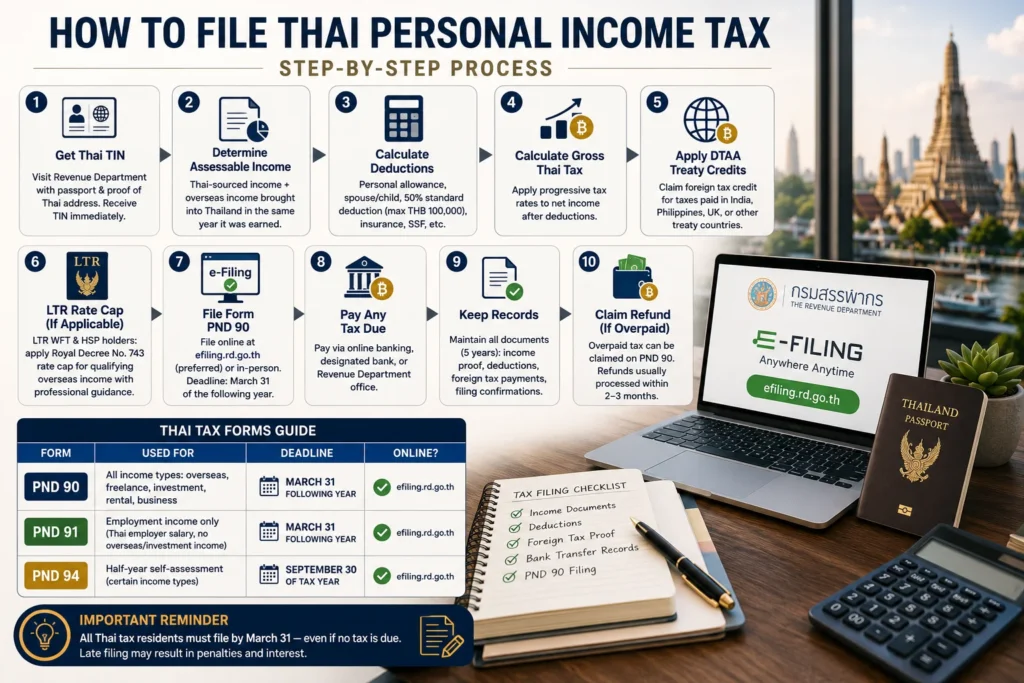
Obtain a Thai Tax Identification Number (TIN): Visit the Revenue Department district office near your Thai address. Bring: passport (original), TM30 or rental agreement (proof of Thai address). TIN is issued immediately in most cases. This should be done during the tax year, not after.
Determine your assessable income: All Thai-sourced income + all overseas income brought into Thailand in the same calendar year it was earned. Review: bank transfer records, Wise transaction history, payroll from any Thai employers.
Calculate allowable deductions: Personal allowance (THB 60,000), spouse/child allowances, standard 50% employment deduction (max THB 100,000), qualifying insurance premiums, SSF investments. Document all deductions.
Calculate gross Thai tax: Apply the progressive rate schedule to net income after deductions.
Apply DTAA treaty credits: If income taxed in India, Philippines, UK, or other treaty country: apply foreign tax credit against Thai tax. Ensure documentary proof of foreign taxes paid.
For LTR WFT holders: Work with a Thai tax advisor to correctly apply Royal Decree No. 743 provisions for qualifying overseas income. The rate cap application requires professional structuring.
File Form PND 90: Online at efiling.rd.go.th (preferred) or in-person at Revenue Department district office. Deadline: March 31 of the year following the tax year.
Pay any tax due: Via online banking, designated bank counters, or Revenue Department office. If overpaid, a refund can be claimed on the same form.
Form
Used For
Deadline
Online?
PND 90
All income types: overseas, freelance, investment, rental, business
March 31 following year
✅ efiling.rd.go.th
PND 91
Employment income only (Thai employer salary, no overseas/investment income)
March 31 following year
✅ efiling.rd.go.th
PND 94
Half-year self-assessment (certain income types)
September 30 of tax year
✅ efiling.rd.go.th
8. Nationality-Specific Tax Planning Frameworks
India: the three-account tax coordination system
INDIA-SPECIFIC TAX COORDINATION For Indian nationals spending 180+ days in Thailand, a three-step framework applies: Establish Indian NRI status: Fewer than 182 days in India per financial year (April–March) = NRI under FEMA. NRIs pay Indian tax only on India-sourced income (dividends from Indian companies, Indian rental income, Indian bank interest). Overseas active income: not taxed in India for NRIs.Determine Thai tax base: Overseas income from foreign clients/employers brought into Thailand in same year earned = assessable in Thailand. Apply progressive rates (or LTR WFT rate cap if applicable). Apply standard deductions.Apply India-Thailand DTAA credits: Any Indian advance tax or TDS on the same income can be credited against Thai tax liability, preventing double taxation. Key documentation priorities: FIRC (Foreign Inward Remittance Certificate) from Indian bank for all NRE/NRO inward remittancesWise transaction history PDF (monthly exports): Complete record of overseas income received and when transferred to ThailandIndian ITR as NRI: Report as Non-Resident; NRE account balance in Schedule FA (Foreign Assets)Thai PND 90: Claim applicable LTR WFT provisions + India-Thailand DTAA credits Three-account structure: Wise (overseas income receipt) + KBank or Bangkok Bank Thailand (daily THB spending) + NRE account India (savings and India obligations). See Thailand Banking Guide for complete setup.
Philippines: coordinating BIR and Thai filing
PHILIPPINES-SPECIFIC TAX COORDINATION For Filipino nationals spending 180+ days in Thailand: Maintain Philippine BIR obligations: Filipino nationals generally have BIR filing obligations regardless of where they live. BIR Form 1701 must reflect all worldwide income. File Thai PND 90: Report all Thai-assessable income. Claim Philippines-Thailand treaty credits for any Philippine taxes paid on same income. Use Philippines-Thailand treaty credit on Philippine return: Thai income tax paid on Thai-assessable income can be credited against Philippine tax on the same income. This prevents full double taxation. Key points: Wisely transfer timing: Same-year earned income kept offshore and transferred to Thailand in a later year = generally not assessable in Thailand. Manage transfer timing thoughtfully. BIR 1701 deadline: April 15 of the following year (Philippine calendar). Coordinate with Thai PND 90 (March 31).Non-resident alien status in Philippines: If clearly established, may limit Philippines tax to Philippines-sourced income. Consult Philippine CPA for status determination. Three-account structure: Wise (overseas income) + KBank Thailand (Thai spending) + BDO/BPI Philippines (Philippine obligations and family remittances). See Thailand Banking Guide.
9. Tax Planning Strategies: Five Approaches
Strategy 1: Stay under the 180-day threshold
The cleanest approach: spend fewer than 180 total days in Thailand per calendar year. Thai tax residency does not arise. No Thai filing obligation for overseas income. Many nomads use a Thailand + Malaysia, Indonesia, Georgia or Vietnam rotation. Thailand 4–5 months + secondary base 7–8 months = under 180 days in Thailand. Primary location flexibility is the key enabler.
Strategy 2: Prior-year income transfer timing
For Thai tax residents: earn income in Year N, hold it in Wise or overseas bank through December 31, Year N. Transfer to Thailand only in Year N+1. Under the 2024 ruling interpretation, this income is prior-year income in Year N+1 and is generally not assessable. This requires: disciplined year-end financial discipline, documentation of when income was earned (invoice dates, payment receipts), and professional advice to confirm application to your specific income types.
This is not a tax avoidance scheme — it is the application of Revenue Code Section 41 and the 2024 ruling as currently interpreted. Income genuinely earned and held in a prior year is simply outside the scope of current-year assessability.
Strategy 3: Maximize legitimate deductions
The standard deductions described above can significantly reduce net assessable income. At THB 1,400,000 gross (USD 40,000): maximizing personal allowance, insurance premiums, SSF investment, and child allowances can reduce assessable income by THB 200,000–300,000, reducing tax by THB 30,000–75,000. Deductions are one of the most underutilized tools by first-time Thai tax filers.
Strategy 4: LTR Visa for high-income professionals
For nomads earning USD 40,000–120,000+ annually from overseas sources who plan Thailand as a long-term base: the LTR WFT Visa’s Royal Decree 743 rate cap provisions provide meaningful tax reduction on qualifying overseas income brought into Thailand. The benefit is most material at incomes above USD 80,000 where the difference between progressive rates (approaching 25–30%) and the capped rate becomes significant. At USD 40,000, the benefit is smaller. Quantify the actual saving for your income level before optimizing the visa choice around the tax benefit.
Strategy 5: DTAA treaty credit discipline
For nomads from treaty countries (India, Philippines, UK, US, etc.): claim every available DTAA credit you are entitled to. First-time Thai filers frequently overlook home-country tax credits that would reduce their net Thai liability. This requires documenting foreign taxes paid on the same income and correctly applying them on PND 90 in the same tax year. Treaty credit discipline — claiming what you are entitled to rather than simply paying twice out of uncertainty — is one of the most impactful planning steps.
10. The Most Common Thailand Tax Misconceptions
Misconception
Reality
‘I’m on a tourist visa so I don’t pay Thai tax’
Thai tax residency is determined by days present in Thailand, not by visa type. 180+ days on any visa type — tourist, LTR, Non-B — makes you a Thai tax resident.
‘My income is paid by an overseas company so Thailand can’t tax it’
Thailand taxes overseas income brought into Thailand in the same year it was earned by Thai tax residents. The overseas source does not exempt the income.
‘The LTR Visa makes my income completely tax-free’
LTR WFT and HSP holders may benefit from a rate cap on qualifying overseas income (not full exemption). Filing obligations persist. Thai-sourced income: standard rates.
‘I don’t need to file a Thai tax return if I owe zero tax’
Filing obligation exists for all Thai tax residents regardless of whether tax is owed. Penalties for non-filing apply even when the tax due is zero.
‘Keeping money in Wise in Thailand avoids Thai tax’
Wise is a UK-regulated e-money institution. Funds in Wise that have not been transferred to a Thai bank are offshore income not brought into Thailand. But once converted and transferred to KBank, those funds enter the Thai tax base if earned in the same year.
‘My home country handles my taxes; Thailand won’t chase me’
Thailand has its own tax jurisdiction for Thai tax residents. DTAAs prevent double taxation but do not eliminate Thai filing obligations. Enforcement is increasing as Thailand’s tax administration becomes more sophisticated.
Complete Thailand Tax Article Navigation Hub
This pillar covers all Thailand tax topics at framework level. Use the cluster articles below for complete depth on each specific sub-topic:
📅
Thailand 180-Day Rule — When You Become Tax Resident Complete day-counting methodology, what the threshold triggers, short-trip impact, partial-day rules, and how to track accurately. /thailand-180-day-rule-tax-resident/
🏢
Thailand LTR Visa Tax Exemption — What Income Is Exempt? Honest analysis of Royal Decree No. 743: what is and is not exempt, rate cap vs full exemption distinction, 2024 ruling interaction, worked examples. /ltr-visa-tax-exemption-thailand/
🇮🇳
India–Thailand DTAA Guide for Digital Nomads Complete India-Thailand treaty analysis: which DTAA articles apply to nomads, NRI status interaction, FIRC documentation, and coordinated dual-filing approach. /india-thailand-dtaa-guide/
🇵🇭
Filipino Nomads: Philippines–Thailand Tax Treaty Philippines-Thailand treaty for Filipino nomads: BIR obligations, treaty credit mechanics, dual-filing coordination, and non-resident alien status analysis. /philippines-thailand-tax-treaty-nomads/
🏦
Thailand Banking Guide for Digital Nomads Banking setup (Wise + Thai bank), income receipt methods, and how banking decisions interact with the 2024 tax ruling — the operational finance counterpart to this tax guide. /thailand-banking-guide-digital-nomads/
💲
Receiving USD and EUR Income in Thailand Legally BOT regulations, Wise vs SWIFT vs Payoneer method comparison, and how income receipt timing affects tax assessability. /receiving-usd-eur-income-thailand-legally/
🇺🇸
LTR Visa Complete Guide 2026 All four LTR Visa categories, eligibility, application process, and how LTR Visa changes your Thailand legal and tax position. /thailand-ltr-visa-complete-guide/
Frequently Asked Questions
How does Thailand tax residency work for digital nomads?
You become a Thai tax resident when you spend 180 or more days in Thailand in a calendar year. As a Thai tax resident, Thai-sourced income is always assessable. Overseas income brought into Thailand in the same year you earned it is also assessable per the 2024 Revenue Department ruling. Progressive tax rates from 0% to 35% apply after deductions. Double taxation treaties with India, Philippines, UK, US, and 60+ countries prevent paying full rates in two countries on the same income.
Do digital nomads have to pay tax in Thailand?
Only if they spend 180+ days in Thailand (making them Thai tax residents) AND have assessable income. Nomads who spend fewer than 180 days per calendar year, or who keep overseas income offshore and never transfer it to Thailand in the same year it was earned, face no Thai income tax liability on overseas income. Nomads who are Thai tax residents owe Thai tax on assessable income, but effective rates after deductions and treaty credits are often 5–15%, not 35%.
What exactly did the 2024 Revenue Department ruling change?
The 2024 ruling (Phor Ngor 161/2566) formally confirmed that overseas income earned and brought into Thailand in the same calendar year is assessable for Thai tax residents. Prior-year overseas income transferred to Thailand in a later year remains generally non-assessable. It did not change the 180-day residency threshold, did not make Thai-sourced income more or less assessable, and did not eliminate the offshore-income exemption for income not brought into Thailand.
Does keeping money in Wise avoid Thai income tax?
Income held in Wise (a UK-regulated e-money institution) that has not been transferred to Thailand is offshore income outside the Thai tax base. It is not assessable for Thai purposes. Once you convert that income to THB and transfer it to your Thai bank in the same year you earned it, it becomes assessable. This is the lawful application of Revenue Code Section 41, not a tax avoidance arrangement.
What Thai income tax rate do digital nomads pay?
Progressive rates from 0% to 35%. On USD 40,000 income (approx. THB 1,400,000): after standard personal allowance and 50% employment deduction, net assessable income is approximately THB 1,240,000. Estimated Thai tax: approximately THB 175,000 (12.5% effective rate). Additional deductions (insurance, investments, children) can reduce this further. DTAA credits may reduce it further still.
Does the LTR Visa eliminate Thai taxes?
No. The LTR Visa (WFT and HSP categories) provides a rate cap on qualifying overseas income under Royal Decree No. 743 B.E. 2565, not full tax exemption. Thai tax residents on LTR Visa must still file Form PND 90 by March 31. Thai-sourced income is taxed at standard progressive rates. The benefit is meaningful at higher income levels (USD 80,000+) but does not create a zero-tax environment.
Is there an India-Thailand tax treaty?
Yes. The India-Thailand DTAA (Double Taxation Avoidance Agreement) prevents double taxation for Indian nationals in Thailand. Indian NRIs who are Thai tax residents pay Thai tax on Thai-assessable overseas income, with DTAA credit mechanisms preventing Indian taxation of the same income. India taxes NRIs only on India-sourced income (dividends, rental income, interest on Indian accounts).
Do I need to file a Thai tax return?
Yes, if you are a Thai tax resident (180+ days in Thailand). File Form PND 90 by March 31 of the following year. This obligation exists even if the tax owed is zero after deductions and credits. Failure to file when required can result in penalties of 1.5% per month on any unpaid tax, up to 20%, plus potential surcharges.
How do I get started with Thai tax compliance?
Step 1: Count your days for the current calendar year. If approaching 180, get a Thai Tax Identification Number (TIN) from the Revenue Department district office near your Thai address. Step 2: Engage a Thai tax advisor who works with expats and digital nomads before October of the tax year. Step 3: Organize your income documentation (bank statements, Wise history, invoices). Step 4: File PND 90 by March 31 of the following year. Early engagement costs far less than late compliance.
Final Verdict: Thailand Tax — Your Action Framework
Thailand’s tax system for digital nomads is more manageable than its reputation suggests — but it requires active engagement rather than passive hope. The framework is clear: 180 days creates tax residency; the 2024 ruling makes same-year overseas income brought into Thailand assessable; deductions and treaty credits reduce real liability significantly; LTR Visa WFT provisions add a further reduction for qualifying holders. The headline 35% rate is the ceiling on very high incomes, not the reality for most nomads. For most nomads at USD 30,000–60,000 income levels: the actual Thai tax liability after deductions and DTAA treaty credits is in the 5–15% effective range. The anxiety about Thai tax is frequently out of proportion to the actual obligation. What matters is not avoiding the system but engaging it correctly: track your days, understand your income categories, claim your deductions and treaty credits, file on time, and use the professional advice you are entitled to. Early planning creates options; late awareness limits them. Use the navigation hub to find the depth article most relevant to your situation. Start with the 180-Day Rule guide to understand your residency position, then move to the India-Thailand DTAA guide (for Indian readers) or the Philippines-Thailand treaty guide (for Filipino readers) for the nationality-specific framework.