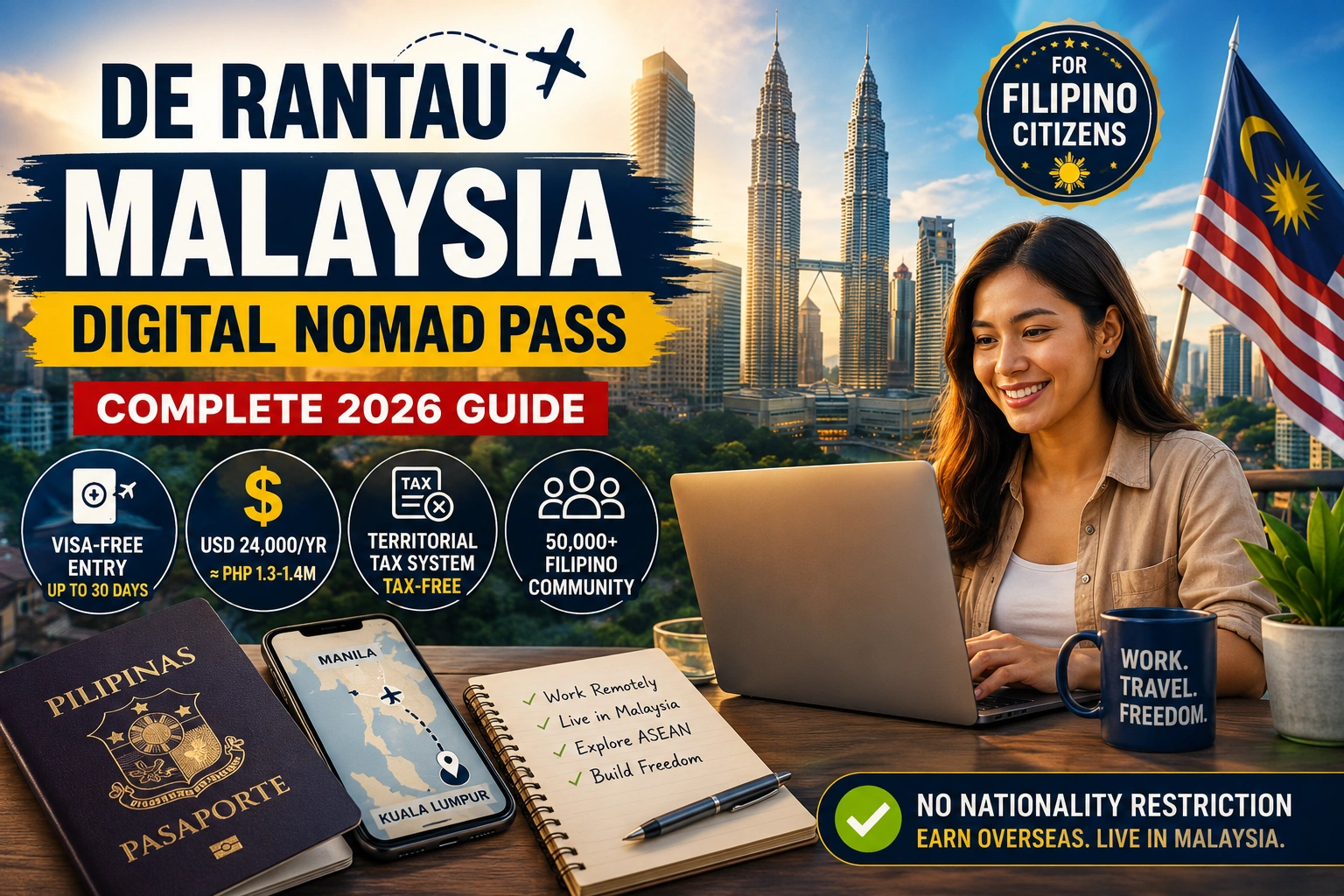
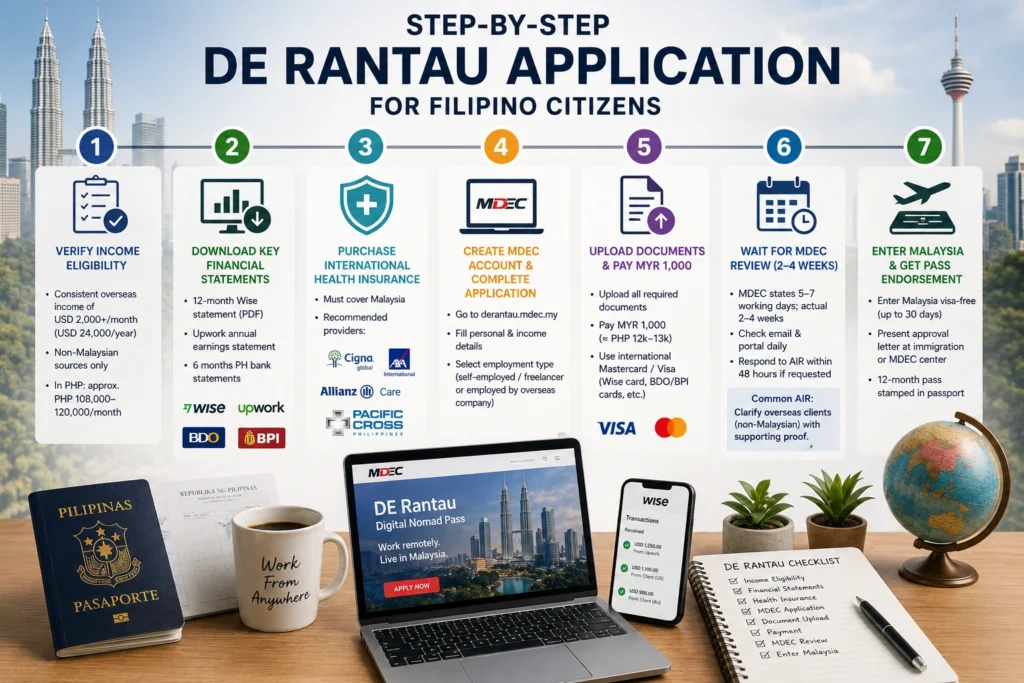
DE Rantau Filipino citizens: Filipino nationals can apply for Malaysia’s DE Rantau Digital Nomad Pass with no nationality restriction. A significant practical advantage: Filipino passport holders can enter Malaysia visa-free for up to 30 days under ASEAN reciprocal arrangements, simplifying the entry process compared to nationalities that need to arrange separate Malaysian visas. Income threshold: USD 24,000/year = approximately PHP 1.3–1.4 million/year from overseas clients or foreign employer. Application fee: MYR 1,000 (≈ USD 220 / approximately PHP 12,000–13,000). DE Rantau is NOT the same as OFW (Overseas Filipino Worker) status — holders do not receive OWWA benefits, OFW remittance incentives, or POEA registration benefits. SSS, PhilHealth, and Pag-IBIG contributions can continue voluntarily as overseas members. BIR filing obligations (Form 1701) continue regardless of Malaysia stay. Malaysia’s territorial tax system means overseas income is NOT taxable in Malaysia. Filipino community in Kuala Lumpur is large (approximately 50,000+), English is an official Malaysian language, and KL–Manila flight time is under 3 hours via AirAsia and other carriers from approximately MYR 100–300 one-way.
QUICK ANSWER: Can Filipino citizens apply for DE Rantau? Yes. Filipino passport holders can apply with no nationality restriction. Key Filipino-specific advantages: Visa-free entry: Filipinos can enter Malaysia without a visa (up to 30 days) — simplest entry process of any major nomad nationality Income threshold in PHP: USD 24,000/year = approximately PHP 1.3–1.4 million/year from overseas clients Tax advantage: Malaysia’s territorial tax system means zero Malaysian income tax on overseas earnings English: Official Malaysian language — no adjustment needed Community: 50,000+ Filipinos in Kuala Lumpur area OFW vs nomad: DE Rantau is NOT OFW status. BIR obligations continue. SSS/PhilHealth/Pag-IBIG: can continue as voluntary overseas members.
DISCLAIMER Requirements can change. Always verify at derantau.mdec.my. This guide reflects requirements as of June 2026. This is not legal, tax, or immigration advice. Consult a Philippine CPA for BIR and SSS guidance specific to your situation.
Introduction: Why Malaysia Is a Natural Fit for Filipino Digital Professionals
For Filipino digital professionals earning USD 2,000+/month from overseas clients, Malaysia presents a uniquely natural transition. English is an official working language. The culture, food, and ASEAN context is familiar. The flight from Manila to Kuala Lumpur takes under three hours and costs under PHP 7,000 one-way on AirAsia on most travel dates. And the Filipino community in KL — estimated at over 50,000 — means arriving without a ready-made network is unlikely.
Beyond the lifestyle fit, the financial case is compelling. The DE Rantau income threshold — USD 24,000/year, approximately PHP 1.3–1.4 million/year — is accessible to mid-senior Filipino developers, digital marketers, full-time Upwork professionals, and consultants with consistent overseas income at this level. Malaysia’s territorial tax system means that overseas income is not taxable in Malaysia regardless of how long you stay. The application cost is MYR 1,000 (approximately PHP 12,000–13,000).
This guide covers everything the Filipino applicant needs to know: the income threshold in PHP, the exact documentation for Upwork and direct client income, the visa-free entry advantage, the OFW vs digital nomad distinction that every Filipino must understand, BIR obligations, and the Filipino community life you can expect in KL and Penang.
DE Rantau Eligibility for Filipino Nationals
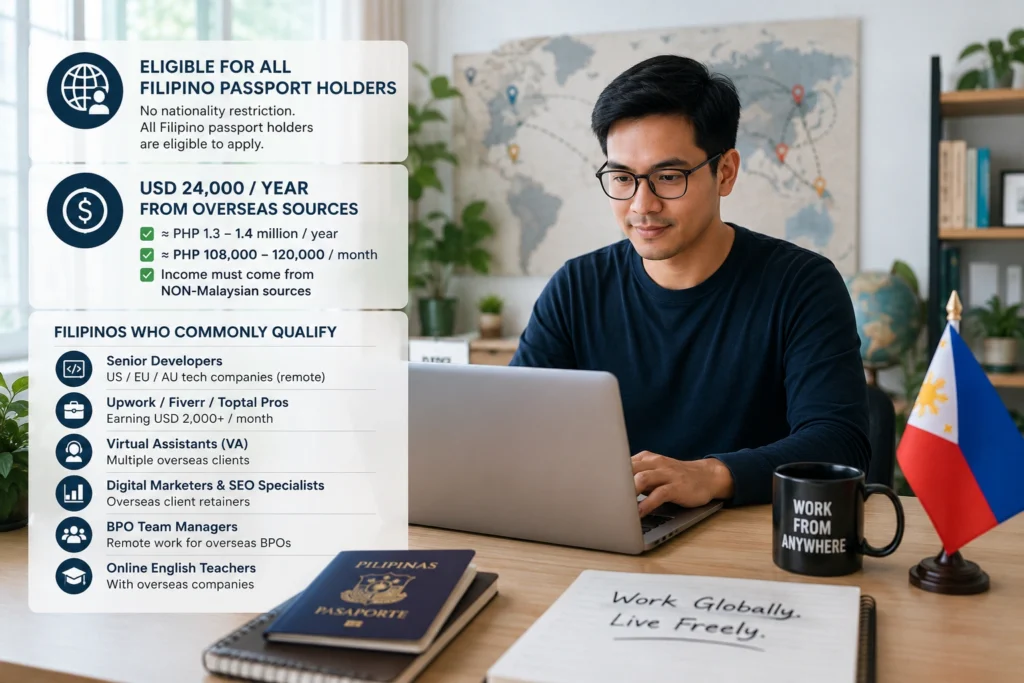
ELIGIBILITY SUMMARY FOR FILIPINO PASSPORT HOLDERS No nationality restriction. All Filipino passport holders are eligible to apply. The core requirement: USD 24,000/year from overseas non-Malaysian sources In PHP terms: approximately PHP 1.3–1.4 million/year at current exchange ratesMonthly equivalent: approximately PHP 108,000–120,000/month from overseas clientsIncome must come from NON-Malaysian sources. Philippine clients, US clients, EU clients — all qualify as ‘overseas.’ Malaysian company income does NOT qualify. Filipinos who commonly qualify: Senior software developers at US/EU/Australian tech companies (remote): typically USD 3,000–8,000/monthUpwork/Fiverr/Toptal professionals earning USD 2,000+/month: consistent platform income qualifiesVirtual assistants (VA) with multiple overseas clients earning USD 2,000+/month total: qualifiesDigital marketers and SEO specialists with overseas client retainers: qualifies if USD 2,000+/monthBPO team managers working remotely for overseas BPO companies: qualifiesOnline English teachers (overseas company): qualifies if monthly income meets threshold
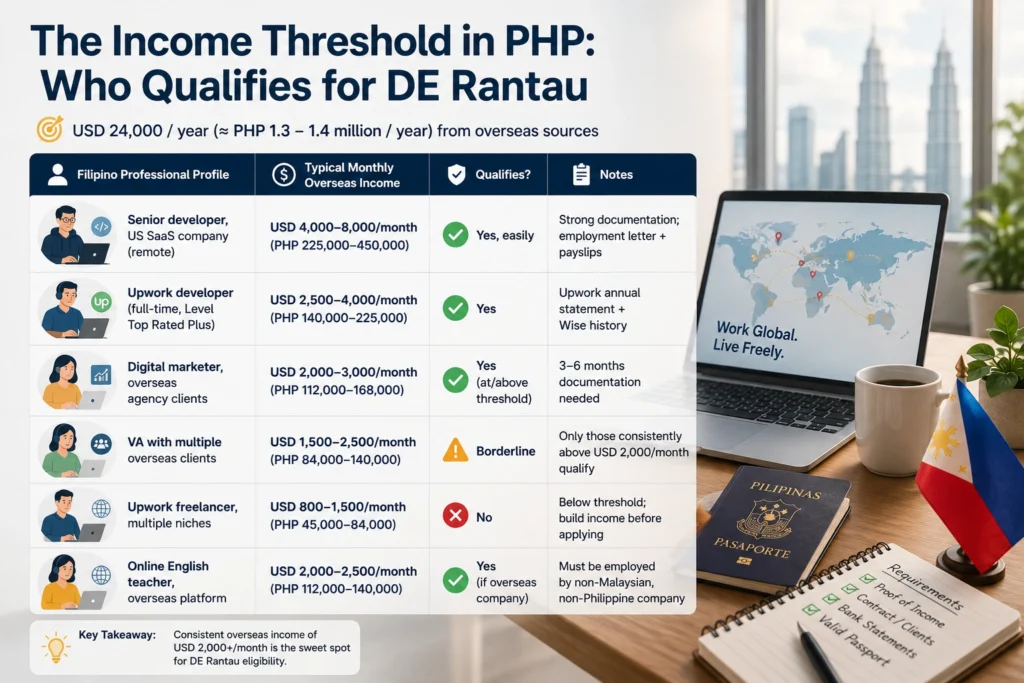
The Income Threshold in PHP: Who Qualifies
Filipino Professional Profile
Typical Monthly Overseas Income
Qualifies?
Notes
Senior developer, US SaaS company (remote)
USD 4,000–8,000/month (PHP 225,000–450,000)
Yes, easily
Strong documentation; employment letter + payslips
Upwork developer (full-time, Level Top Rated Plus)
USD 2,500–4,000/month (PHP 140,000–225,000)
Yes
Upwork annual statement + Wise history
Digital marketer, overseas agency clients
USD 2,000–3,000/month (PHP 112,000–168,000)
Yes (at/above threshold)
3–6 months documentation needed
VA with multiple overseas clients
USD 1,500–2,500/month (PHP 84,000–140,000)
Borderline
Only those consistently above USD 2,000/month qualify
Upwork freelancer, multiple niches
USD 800–1,500/month from overseas
No
Below threshold; build income before applying
Online English teacher, overseas platform
USD 2,000–2,500/month (PHP 112,000–140,000)
Yes (if overseas company)
Must be employed by non-Malaysian, non-Philippine company
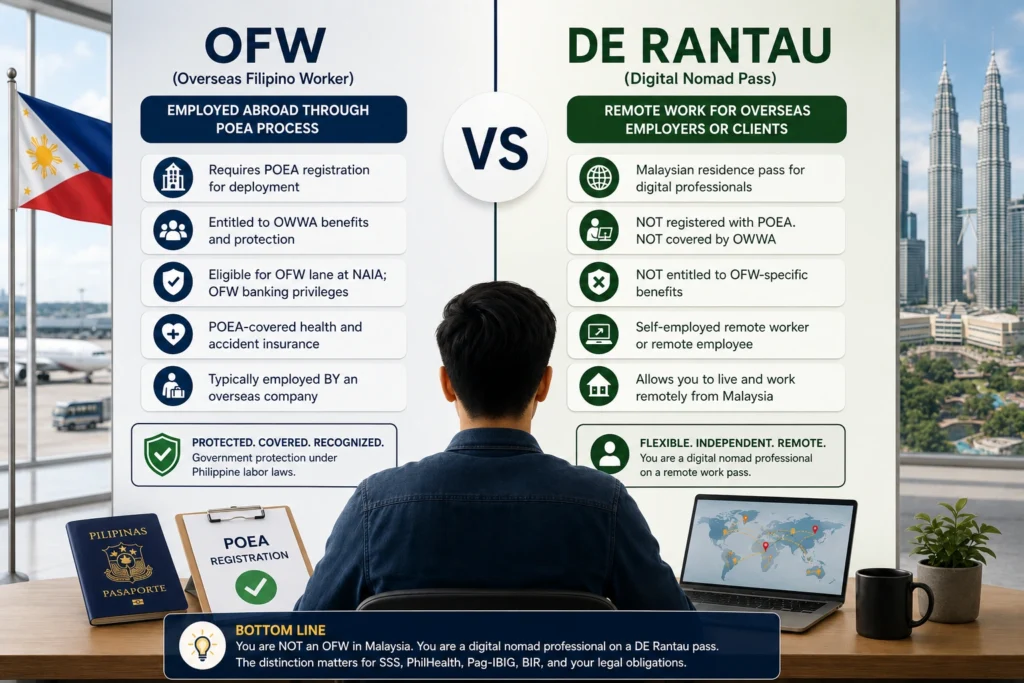
OFW vs Digital Nomad: A Critical Distinction for Filipino Applicants
THIS IS NOT OFW STATUS — UNDERSTAND THE DIFFERENCE Many Filipino applicants assume that working in Malaysia on a DE Rantau pass makes them an Overseas Filipino Worker (OFW). This assumption has real financial consequences if acted on incorrectly. OFW (Overseas Filipino Worker) — what it is: Requires POEA (Philippine Overseas Employment Administration) registration for deployment Entitles holder to OWWA (Overseas Workers Welfare Administration) benefits and protection Eligible for OFW lane at NAIA; OFW banking privileges; POEA-covered health and accident insurance Typically for workers employed BY an overseas company that recruits through POEA processes DE Rantau Digital Nomad Pass — what it is: A Malaysian residence pass for digital professionals working REMOTELY for overseas employers or clients NOT registered with POEA. NOT covered by OWWA. NOT entitled to OFW-specific benefits. You are a self-employed remote worker or remote employee — the Malaysian visa allows you to live and work remotely from Malaysia Bottom line: If you apply for DE Rantau and tell people or government agencies you are an ‘OFW in Malaysia,’ this is technically inaccurate. You are a digital nomad professional on a remote work pass. The difference matters for how you interact with SSS, PhilHealth, Pag-IBIG, and BIR.
SSS, PhilHealth, and Pag-IBIG for DE Rantau Holders
DE Rantau holders in Malaysia can continue Philippine social contribution memberships on a voluntary basis. Here is the practical guidance:
Online: pagibigfund.gov.ph. Overseas voluntary member contributions available.
Recommended — maintains housing loan eligibility when returning to Philippines
BIR (Tax)
BIR filing obligations CONTINUE
File ITR 1701 annually in Philippines. Declare all income from all sources.
MANDATORY — not continuing BIR filing has legal consequences
BIR OBLIGATIONS FOR DE RANTAU HOLDERS — IMPORTANT Your BIR (Bureau of Internal Revenue) filing obligations do NOT stop when you live in Malaysia on DE Rantau. File BIR Form 1701 (Annual Income Tax Return) on or before April 15 each year in the PhilippinesDeclare all income from all sources, including overseas income received while in MalaysiaPhilippines-Malaysia DTAA: If you have paid Malaysian income tax on any income, this can be claimed as credit on your Philippine return. In practice, since Malaysia’s territorial tax means zero Malaysian tax on your overseas income, there is no Malaysian tax credit to claim.Non-resident alien status: If you are clearly non-resident in the Philippines, your Philippine tax obligation may be limited to Philippine-sourced income only. Consult a Philippine CPA to determine your BIR residency status. Key reminder: Malaysia’s zero tax on overseas income is a Malaysian advantage. It does not reduce your Philippine BIR obligations.
The Filipino Visa-Free Advantage: Entering Malaysia
FILIPINO PASSPORT — VISA-FREE MALAYSIA ENTRY Filipino citizens can enter Malaysia visa-free for up to 30 days for social, tourism, and transit purposes under ASEAN reciprocal arrangements. This is a significant practical advantage for DE Rantau applicants. Entry sequence for Filipino DE Rantau applicants: Apply for DE Rantau online from the Philippines. Wait for MDEC approval letter. Book flights to Kuala Lumpur International Airport (KLIA or KLIA2).Enter Malaysia using Philippine passport — no visa required. You receive a 30-day visit entry stamp at immigration. Within your 30-day stay: visit MDEC or complete the DE Rantau pass endorsement process at Malaysian immigration. Upon endorsement: your passport receives the DE Rantau pass for up to 12 months. This process is significantly simpler than for Indian passport holders who must arrange a separate Malaysian visa before entry. Always confirm current entry requirements at Malaysian Immigration (imi.gov.my) before travelling. Entry policies can change.
Income Documentation Guide for Filipino Applicants
Type 1: Upwork / Fiverr / Platform income (most common for Filipinos)
DOCUMENTATION: UPWORK / FIVERR / PLATFORM EARNER Upwork annual earnings statement or monthly payment history (12 months): official PDF from Upwork showing total earnings. Download from Upwork’s Reports section.Wise or Payoneer annual statement (12 months): if earnings are routed through Wise or Payoneer before reaching your Philippine bank.BDO/BPI/UnionBank bank statements (6 months): showing regular USD inward transfers from Upwork, Payoneer, or Wise.Philippine bank FCDU (Foreign Currency Deposit Unit) account statements if you hold USD in a Philippine bank before converting. Tip: Wise 12-month PDF transaction history is the single most accepted document for Filipino freelancers. Export it from Wise account settings and include it alongside your Upwork statement for the strongest documentation package.
Type 2: Salaried by overseas company (remote employee)
DOCUMENTATION: REMOTE EMPLOYEE (OVERSEAS COMPANY) Employment letter from overseas company (on company letterhead): role, monthly salary in USD, and confirmation that the company is NOT Malaysian-registered Last 6 months payslips from overseas employer showing USD salary Bank statements (6 months) showing salary receipt: overseas bank, Wise, or Philippine bank showing regular USD salary deposits Employment contract if payslips alone don’t clearly state the salary amount Tip: The overseas company’s letter should explicitly state the company registration country (e.g., ‘XYZ Inc., registered in Delaware, USA’). This confirms non-Malaysian income source.
Type 3: Direct overseas clients (no platform)
DOCUMENTATION: DIRECT OVERSEAS CLIENT FREELANCER Client service agreements or contracts (2–3 minimum): signed contracts showing scope of services and compensation in USD from overseas clientsInvoices and payment confirmations (6–12 months): matching invoices with payment receipts confirming USD payments receivedWise transaction history (12 months): showing regular USD receipts from client namesPhilippine bank statements: showing inward remittances if income routed to Philippine bank
Complete Document Checklist for Filipino Applicants
Document
Specification
Required?
Valid Philippine passport
Minimum 6 months validity remaining. Copy of bio page and all stamps.
Essential
Passport photograph
Recent digital passport photo per MDEC specification
Essential
Proof of overseas income
Upwork annual earnings + Wise statement / Employment letter + payslips / Direct client contracts — based on income type
Essential
Health insurance
International plan with Malaysia coverage (Cigna, AXA, Allianz, Pacific Cross). Not PhilHealth only.
Essential
Bank statements
6 months of relevant bank statements showing regular overseas income receipt
Essential
Client contracts or employment letter
Confirming overseas (non-Malaysian) income source
Essential
Philippine bank account statements
BDO, BPI, UnionBank, Metrobank showing USD inward transfers (if income routed through PH bank)
Strongly recommended
BIR TIN (Tax Identification Number)
Not required to upload, but have TIN ready for your records and future BIR filings
For your records
Payoneer statement
If Upwork/Fiverr income routed through Payoneer: 12-month Payoneer transaction statement
Helpful for platform earners
Step-by-Step DE Rantau Application for Filipino Citizens
STEP 1
Verify Your Income Eligibility Calculate your consistent monthly overseas income from non-Malaysian clients or overseas employer. Must reach USD 2,000+/month (USD 24,000/year). Only overseas income counts — not income from Philippine clients or Philippine companies. ⚡ In PHP terms: you need to consistently earn PHP 108,000–120,000/month from overseas sources. If your income varies, take your 6-month average and confirm it exceeds USD 2,000/month.
STEP 2
Download Key Financial Statements Export 12-month Wise transaction history (PDF from Wise account → Statements). Download Upwork annual earnings statement from Reports section. Print/save 6 months of Philippine bank statements showing USD inward transfers. ⚡ All documents should be in English. Wise and Upwork statements are already in English. Philippine bank statements from BDO and BPI are in English by default.
STEP 3
Purchase International Health Insurance Buy an international health insurance plan explicitly covering Malaysia. Options: Cigna Global, AXA International, Allianz Care, Pacific Cross (strong Asia coverage). PhilHealth alone does NOT qualify. ⚡ Pacific Cross is popular among Filipino expats in Asia and often more affordable than Cigna/AXA for the same minimum coverage. Compare plans that explicitly list Malaysia in the coverage area.
STEP 4
Create MDEC Account and Complete Application Go to derantau.mdec.my. Create account. Fill in personal details and income information. In the income section: enter USD 2,000+/month and select your employment type (self-employed / freelancer OR employed by overseas company). ⚡ For Upwork earners: select ‘self-employed’ or ‘freelancer.’ Upload your Upwork earnings statement and Wise history as the primary income documentation.
STEP 5
Upload Documents and Pay MYR 1,000 Upload all required documents in the MDEC portal. Pay MYR 1,000 (≈ PHP 12,000–13,000) using international Mastercard or Visa. Wise card, BDO/BPI international debit cards, or Philippine credit cards (Mastercard/Visa) typically work. ⚡ If your Philippine card declines (some Philippine cards have international transaction restrictions): use a Wise card, Revolut, or ask a contact with an international card to assist.
STEP 6
Wait for MDEC Review (2–4 Weeks) MDEC states 5–7 working days; actual experience is often 2–4 weeks. Check email and portal daily. If you receive an Additional Information Request (AIR): respond within 48 hours with the requested clarification. ⚡ Common AIR for Filipino applicants: MDEC may ask you to clarify that your clients are overseas (non-Malaysian). Provide a simple cover letter: ‘My services are provided to [Client Name], registered in [US/EU/AUS], and all payments are received in USD via Wise/Upwork.’
STEP 7
Enter Malaysia Visa-Free and Get Pass Endorsement Book flights to KL (KLIA or KLIA2). Enter Malaysia on Philippine passport — no visa required, up to 30 days visa-free. Present DE Rantau approval letter at immigration or MDEC processing centre. Your 12-month pass is stamped in your passport. ⚡ KL-Manila: AirAsia, Cebu Pacific, and Philippine Airlines operate daily. AirAsia KLIA2 → NAIA 3 is often cheapest. Book 2–3 weeks ahead for best fares. Flight time: approximately 2 hours 45 minutes.
Tax Position for Filipino Nomads on DE Rantau
MALAYSIA + PHILIPPINES TAX FRAMEWORK Malaysian side (good news): Malaysia’s territorial tax system: overseas income (from overseas employer or overseas clients) is NOT taxable in Malaysia regardless of how long you stayDE Rantau holders who earn exclusively from overseas sources pay zero Malaysian income tax Philippine side (obligations continue): BIR Form 1701 (Annual ITR) must be filed by April 15 each year regardless of Malaysia residenceAll income from all sources must be declaredIf you qualify as a Philippines non-resident alien: Philippine tax obligation may be limited to Philippines-sourced income only Philippines-Malaysia DTAA: The Philippines-Malaysia Double Taxation Agreement prevents formal double taxationSince Malaysia’s territorial tax means zero Malaysian tax on your overseas income, the DTAA’s main practical relevance is for any Malaysia-sourced income (if any)Philippine tax credit for Malaysian taxes paid: in practice, since you pay zero Malaysian tax on overseas income, there is no Malaysian tax to credit Practical outcome: Zero Malaysian income tax on overseas income + Philippine BIR filing obligation on worldwide income (with non-resident provisions if applicable). Consult a Philippine CPA for your specific BIR residency status and filing requirements.
Banking in Malaysia as a Filipino DE Rantau Holder
Primary recommended setup: Wise account as main income tool. Receive USD from overseas clients into Wise. Convert to MYR for daily Malaysian spending.
GrabPay Malaysia: Link international Mastercard (Wise card, BDO international card) to GrabPay wallet. Works for Grab rides, GrabFood, most KL merchants.
Touch ‘n Go eWallet: Malaysia’s most widely used e-wallet. Fund via international card. Used for LRT/MRT transit, toll payments, and many merchants.
CIMB Malaysia: Best chance among local Malaysian banks for DE Rantau holders. Visit a CIMB branch with your DE Rantau pass, MDEC letter, income documentation.
Philippine bank access: BDO, BPI, and UnionBank international debit cards work at Malaysian ATMs (MYR 12–20 fee per withdrawal). Wise card for 2 free monthly withdrawals.
Filipino Community in Malaysia: What to Expect
FILIPINO COMMUNITY IN KUALA LUMPUR AND MALAYSIA Kuala Lumpur Filipino community (approximately 50,000+): Active Facebook groups: ‘Filipinos in Kuala Lumpur,’ ‘Filipino Digital Nomads Malaysia’ — useful for housing, co-working, and community connection Filipino restaurants: Several in the KL Sentral and Chow Kit areas; Filipino grocery items available at selected supermarkets (Fili Stop, some Jaya Grocer branches)Filipino Catholic masses: Several churches in KL area offer Tagalog-language masses. Church of the Holy Rosary (KL), St. Francis Xavier Church Filipino expat professional network: Growing community of Filipino tech professionals, marketers, and consultants in Bangsar South and Mont Kiara areas Penang Filipino community: Smaller but present; some Filipino restaurants in George Town area; AirAsia connects Penang to Manila via KL. English language environment: English is widely used in Malaysian professional and daily life. Filipinos experience the easiest language transition of any Southeast Asian country after leaving the Philippines. Cultural familiarity: Both Malaysia and Philippines share Southeast Asian cultural elements — rice-based cuisine, similar fruit availability (durian, rambutan, mangosteen), tropical climate, and ASEAN regional identity. Adaptation is typically smooth. Flight connectivity: AirAsia (KLIA2 → NAIA 3) and Cebu Pacific (KLIA → NAIA/Clark) fly KL–Manila daily. Philippine Airlines and Malaysia Airlines also serve the route. One-way tickets frequently available for under PHP 5,000 with advance booking.
Frequently Asked Questions
Can Filipino citizens apply for Malaysia DE Rantau?
Yes. Filipino passport holders can apply with no nationality restriction. Additional advantage: Filipinos can enter Malaysia visa-free for up to 30 days, simplifying the initial entry process. Income threshold: USD 24,000/year = approximately PHP 1.3–1.4 million/year. Application fee: MYR 1,000 (≈ USD 220 / approximately PHP 12,000–13,000).
What is the DE Rantau income requirement for Filipinos in pesos?
USD 24,000/year = approximately PHP 1.3–1.4 million/year at current exchange rates, or PHP 108,000–120,000/month. Only income from overseas (non-Malaysian, non-Philippine) clients or employers counts toward this threshold.
Is DE Rantau the same as OFW status?
No. DE Rantau is a Malaysian remote work residence pass, not an OFW (Overseas Filipino Worker) designation. DE Rantau holders are not registered with POEA, not covered by OWWA, and are not entitled to OFW-specific benefits. You are a remote working professional living in Malaysia, not an OFW in the legal sense.
Do DE Rantau holders still pay BIR in the Philippines?
Yes. BIR filing obligations continue regardless of Malaysia stay. File BIR Form 1701 by April 15 annually. Declare all income. Malaysia’s zero tax on overseas income is a Malaysian advantage and does not affect Philippine BIR obligations. Consult a Philippine CPA for your specific BIR residency status and potential non-resident tax treatment.
Can I continue my SSS, PhilHealth, and Pag-IBIG while on DE Rantau?
Yes. SSS, PhilHealth, and Pag-IBIG voluntary overseas contributions can continue while you are on DE Rantau in Malaysia. Manage these online via my.sss.gov.ph, philhealth.gov.ph, and pagibigfund.gov.ph respectively. Continuing these contributions maintains your benefit entitlements and Pag-IBIG housing loan eligibility when you return to the Philippines.
Do Filipinos need a visa to enter Malaysia for DE Rantau?
No. Filipino passport holders can enter Malaysia visa-free for up to 30 days under ASEAN arrangements. Enter on your Philippine passport with your DE Rantau approval letter. At Malaysian immigration, you receive a visit entry stamp. The DE Rantau pass endorsement (up to 12 months) is then processed at MDEC or immigration.
How do I document Upwork income for DE Rantau?
Primary documentation for Upwork earners: (1) Upwork annual earnings statement — download from Upwork Reports as PDF; (2) Wise or Payoneer 12-month transaction history PDF showing USD receipts; (3) Philippine bank statements (BDO/BPI) confirming USD inward transfers. This combination is the strongest documentation package for Filipino Upwork professionals applying to DE Rantau.
Final Verdict: DE Rantau for Filipino Digital Professionals
For Filipino digital professionals earning USD 2,000+/month from overseas Upwork clients, overseas employers, or direct international clients, DE Rantau combines the easiest entry process (visa-free), the most familiar language environment (English official), the closest regional community (50,000+ Filipinos in KL), and zero Malaysian income tax on overseas earnings. The BIR and social contribution picture requires understanding, not avoidance: BIR filing continues, OFW status does not apply, but SSS/PhilHealth/Pag-IBIG voluntary contributions can be maintained. A Philippine CPA familiar with overseas Filipino professional income is the right advisor to coordinate your Filipino and Malaysian compliance. The application process is streamlined for Filipinos: visa-free entry removes the Malaysian visa step that complicates applications for other nationalities. Once approved, the endorsement process at immigration is straightforward. Total Year 1 cost: approximately PHP 12,000–13,000 (DE Rantau fee) + PHP 45,000–90,000 (annual health insurance) = approximately PHP 60,000–105,000 — for year-round legal remote work authorization in Malaysia. Practical recommendation: If you earn USD 2,000–3,500/month from Upwork, direct overseas clients, or an overseas employer, and prefer an English-speaking, ASEAN-connected base with zero overseas income tax — apply for DE Rantau. See the DE Rantau complete guide for the full application process, or the Malaysia Digital Nomad Hub for the complete Malaysia overview.