
| CRITICAL LEGAL DISCLAIMER — READ BEFORE CONTINUING This article provides an analysis of ENFORCEMENT RISK, not legal advice. Working remotely for overseas clients while on a tourist visa may violate immigration law in most countries, regardless of where your clients or employer are located. The risk levels described here are based on observed enforcement patterns and legal ambiguity in each country’s immigration framework — they are NOT an indication that such activity is legal or endorsed. MeridianNomad’s position: the correct long-term approach is to obtain a legal visa or permit that explicitly authorizes remote work. This article exists to help nomads understand the risk landscape while they work toward legal compliance, not to encourage tourist visa violations. This analysis does not constitute legal advice. Consult an immigration attorney in the relevant country for guidance specific to your situation. |
| AI OVERVIEW SUMMARY The risk of working remotely on a tourist visa varies significantly by country across five dimensions: legal prohibition strength, enforcement intensity, detection likelihood, consequence severity, and legal ambiguity about what ‘work’ means in that country’s immigration law. For anyone researching remote work tourist visa lowest risk countries, the lowest-risk countries are those with high legal ambiguity (immigration law doesn’t clearly address overseas remote work), low enforcement intensity, and relatively mild consequences. Georgia, Colombia, and Mexico represent the global lowest-risk tier. Thailand and Malaysia have low-medium enforcement risk specifically for digital nomads, though both now have formal legal alternatives (LTR/DTV and DE Rantau respectively). Vietnam is medium risk with some documented enforcement actions. UAE, UK, and USA represent the highest-risk tier: active enforcement, severe consequences (deportation, multi-year bans), and no legal ambiguity — remote work on tourist visa is clearly prohibited. The central argument of this article: with most popular nomad destinations now offering formal digital nomad visas, the practical case for tourist visa remote work is diminishing. The legal visa is almost always worth the cost over the risk. |
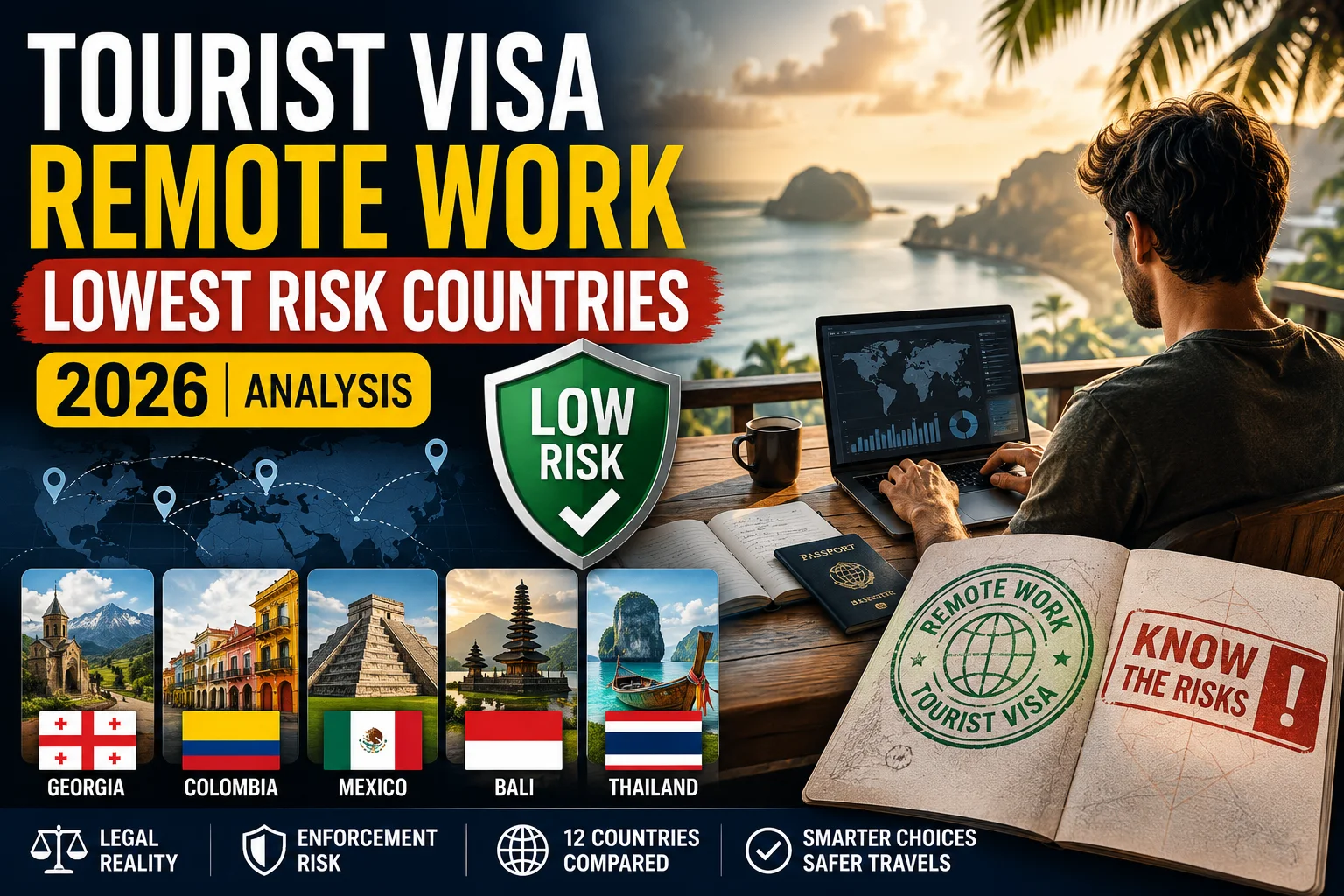
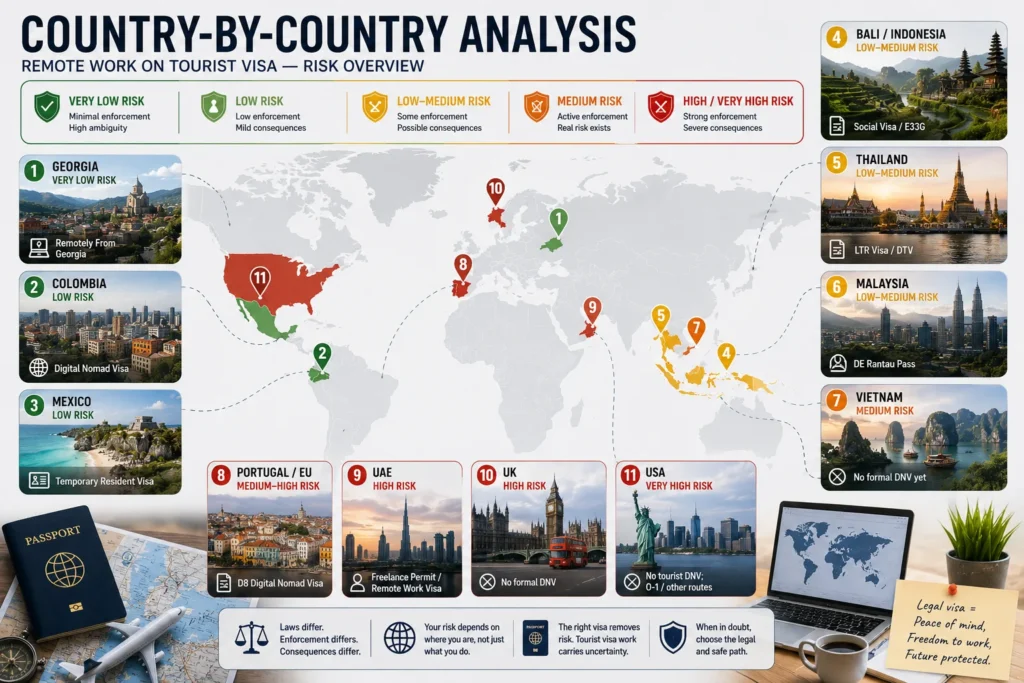
| QUICK ANSWER: Which countries have the lowest risk for tourist visa remote work? Lowest risk (legal ambiguity + low enforcement): Georgia, Colombia, Mexico Low-medium risk (tolerated but legally uncertain): Bali/Indonesia, Thailand, Malaysia Medium risk (some documented enforcement): Vietnam, Portugal before D8 High-to-very-high risk (clear prohibition + active enforcement): UAE, UK, USA Important: ‘Lowest risk’ does not mean ‘legal.’ All countries listed have immigration laws that technically prohibit or do not explicitly permit tourist visa work. Lowest risk means enforcement is least likely — not that the activity is authorized. The correct path: Obtain a digital nomad visa or remote work authorization. Most major nomad destinations now offer them. |
Introduction: Why This Question Matters — and Its Limits
Millions of digital nomads work remotely while traveling on tourist visas. Many do so without incident for months or years. Others have experienced enforcement actions, detentions, fines, deportations, and multi-year entry bans. The difference between these outcomes is often not what they did — it’s where they did it.
Immigration law regarding remote work for overseas clients is one of the most legally ambiguous areas in international travel. Most tourist visa laws were written decades before remote work existed. The question of whether serving a US client from a Thai cafe constitutes ‘working in Thailand’ in the legal sense has no clear universal answer — it depends on how each country’s immigration law defines work, how actively the government enforces those definitions, and how difficult it is for authorities to detect the activity.
This article maps the risk landscape across 12 countries using a five-dimension framework. It is written to inform nomads who are currently working on tourist visas about the risk levels they face, and to make a clear case for why obtaining a formal digital nomad visa or remote work authorization — where available — is the correct long-term approach.
1. The Legal Framework: What ‘Work’ Means in Immigration Law
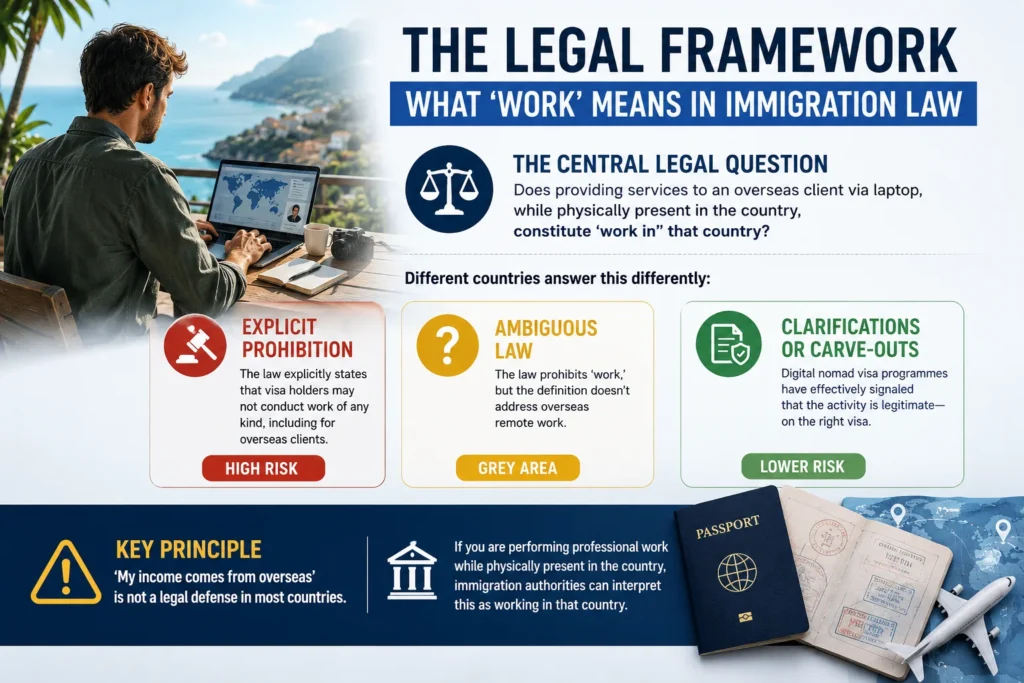
| THE CENTRAL LEGAL QUESTION Most countries’ immigration laws define a tourist visa as permission to visit for non-work purposes. Work is typically defined as: providing services, performing employment duties, or engaging in professional or commercial activities within the country. The ambiguity for remote workers: does providing services to an overseas client via laptop, while physically present in the country, constitute ‘work in’ that country? Different countries answer this differently: Countries with explicit prohibition: The law explicitly states that visa holders may not conduct work of any kind, including for overseas clients. High risk.Countries with ambiguous law: The law prohibits ‘work,’ but the definition doesn’t address overseas remote work. Grey area.Countries that have introduced clarifications or carve-outs: Digital nomad visa programmes (Georgia’s Remotely From, Estonia’s Digital Nomad Visa, Portugal’s D8) have effectively signaled that the activity is legitimate — on the right visa. Key principle: ‘My income comes from overseas’ is not a legal defense in most countries. If you are performing professional work while physically present in the country, most countries’ immigration authorities can interpret this as working in that country. |
2. The Risk Matrix: 12 Countries Compared
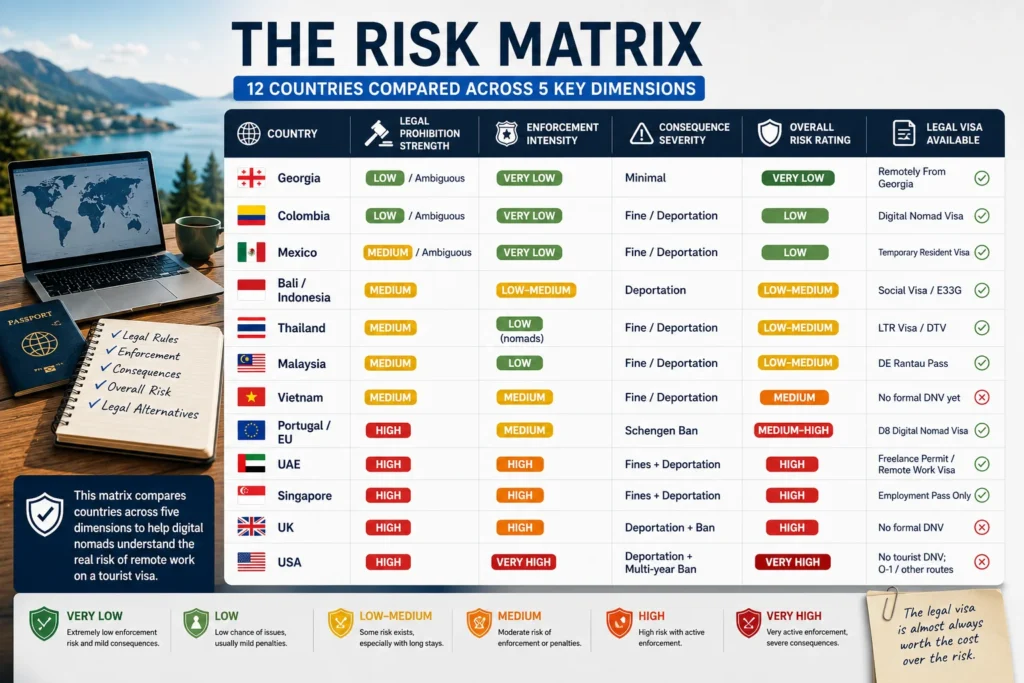
Risk assessment across five dimensions: legal prohibition strength (Low/Medium/High), enforcement intensity (Very Low to Very High), consequence severity, overall risk rating, and available legal alternatives.
| Country | Legal Prohibition | Enforcement | Consequences | Overall Risk | Legal Visa Available |
| Georgia | Low / Ambiguous | Very Low | Minimal | Very Low | Remotely From Georgia |
| Colombia | Low / Ambiguous | Very Low | Fine / Deportation | Low | Digital Nomad Visa |
| Mexico | Medium / Ambiguous | Very Low | Fine / Deportation | Low | Temporary Resident Visa |
| Bali / Indonesia | Medium | Low–Medium | Deportation | Low–Medium | Social Visa / E33G |
| Thailand | Medium | Low (nomads) | Fine / Deportation | Low–Medium | LTR Visa / DTV |
| Malaysia | Medium | Low | Fine / Deportation | Low–Medium | DE Rantau Pass |
| Vietnam | Medium | Medium | Fine / Deportation | Medium | No formal DNV yet |
| Portugal / EU | High | Medium | Schengen ban | Medium–High | D8 Digital Nomad Visa |
| UAE | High | High | Fines + Deportation | High | Freelance Permit / Remote Work Visa |
| Singapore | High | High | Fines + Deportation | High | Employment Pass only |
| UK | High | High | Deportation + Ban | High | No formal DNV |
| USA | High | Very High | Deportation + Multi-year Ban | Very High | No tourist DNV; O-1 / other routes |
3. Country-by-Country Analysis
🟢 Georgia — Very Low Risk
Georgia is consistently regarded as the global lowest-risk destination for tourist visa remote work. The Georgian government has not only tolerated remote workers but actively welcomed them through the ‘Remotely From Georgia’ programme. Georgian immigration law does not clearly prohibit overseas remote work, enforcement against nomads is effectively zero, and the government’s public communication has signalled openness to this population.
The ‘Remotely From Georgia’ programme provides a legitimate framework for stays up to one year. Indian and Pakistani passport holders benefit from Georgian visa-free access (or simplified visa on arrival), making entry straightforward.
| LEGAL ALTERNATIVE — GEORGIA Remotely From Georgia programme: Available to remote workers from approved countries. Provides legal framework for stays. Apply at remotelyfromgeorgia.com. Tax benefit: Georgian territorial tax means overseas income may not be taxable in Georgia. |
🟢 Colombia — Low Risk
Colombia’s immigration authorities have not historically targeted digital nomads working for overseas clients. Medellín in particular has developed into a major global nomad hub precisely because of low enforcement and high quality of life. Colombia’s immigration law does not clearly address overseas remote work, creating the same ambiguity as Georgia.
Colombia introduced a Digital Nomad Visa in 2022, providing a formal legal route. Duration: up to 2 years. Income requirement: approximately USD 30,000/year. The legal route is now available and removes all ambiguity.
🟢 Mexico — Low Risk
Mexico has one of the world’s largest remote worker populations and very limited enforcement against tourist visa nomads. Popular nomad areas (Playa del Carmen, Mexico City’s Roma Norte and Condesa, Oaxaca, Puerto Vallarta) host tens of thousands of working nomads without meaningful enforcement action being regularly reported. Detection risk is low: no immigration officer can tell a laptop worker from a tourist.
Mexico’s Temporary Resident Visa provides a legal option for stays beyond 180 days. Indian and Pakistani passport holders require a Mexican tourist visa, which is standard but adds a step.
🟡 Bali / Indonesia — Low-Medium Risk
Bali has been the world’s most iconic digital nomad destination for over a decade. Canggu’s co-working scene operates openly and enforcement against individual laptop workers has been historically inconsistent. However, Indonesia has conducted periodic enforcement operations — most notably targeted at foreigners working for or at Indonesian companies rather than overseas-only remote workers — and the risk level is higher than Georgia or Colombia.
Indonesia’s Social Cultural Visa (B211A) provides up to 180 days with extensions. The newer E33G visa category is explicitly designed for digital nomads and provides a proper legal framework. The Canggu co-working scene has adapted to reference digital nomad visa holders openly.
| BALI-SPECIFIC RISK NOTE Bali has experienced specific enforcement actions targeting foreigners working — including operations at co-working spaces. Most actions have focused on people working for Indonesian entities or those clearly operating Indonesian businesses. Overseas-only remote work has lower risk, but Bali is not Georgia. The risk level is meaningfully above zero. |
🟡 Thailand — Low-Medium Risk
Thailand is the most discussed country in digital nomad legal conversations. The Thai Remuneration from Work Act prohibits foreigners from working without a work permit, and Thai immigration authorities have periodically signalled enforcement intent. However, targeted enforcement against individual laptop workers earning from overseas clients has been rare. The enforcement risk is primarily for those working visibly for Thai companies or operating Thai businesses without proper authorization.
The 2022 LTR Visa and 2023 Destination Thailand Visa (DTV) have created clear legal paths. With these options available, the practical case for tourist visa remote work in Thailand has weakened considerably. The DTV in particular — targeted at remote workers — is accessible at relatively low income thresholds.
| LEGAL ALTERNATIVES — THAILAND Thailand LTR WFT Visa: USD 40,000/year income. 10-year pass. BOI tax provisions. Thailand DTV (Destination Thailand Visa): For remote workers and nomads. Shorter duration. Check current income requirements at thai embassy or consulate. Thailand SMART T Visa: For specialists in target sectors. USD 40,000+ or sector-specific criteria. |
🟡 Malaysia — Low-Medium Risk
Malaysia’s DE Rantau programme has removed most of the risk question for qualifying remote workers. Before DE Rantau, Malaysia had low historical enforcement against tourist visa nomads. With DE Rantau now available at USD 24,000/year (≈ MYR 1,000 fee), the legal option is accessible and affordable. There is no practical reason to work on tourist visa in Malaysia when DE Rantau is this accessible.
🟠 Vietnam — Medium Risk
Vietnam is one of the most popular Southeast Asian nomad destinations without a formal digital nomad visa framework. Ho Chi Minh City (Saigon) and Hanoi both host significant nomad communities. Enforcement has historically been limited but Vietnam has conducted documented enforcement actions against foreigners working without authorization, making it a step above the lowest-risk tier.
The e-visa system provides 90-day stays. Without a formal digital nomad visa, legal remote work authorization in Vietnam requires a work permit through a Vietnamese employer, which is not practical for independent remote workers. Vietnam remains a legal grey area with medium enforcement risk.
🔴 Portugal / EU — Medium-High Risk
Working on a Schengen tourist visa in the EU is medium-to-high risk. EU countries have considerably stronger immigration enforcement infrastructure than most Southeast Asian countries. Portugal introduced the D8 Digital Nomad Visa, providing a clear legal route. Working on a Schengen visa is a Schengen Area violation that can result in a Schengen-wide entry ban — affecting travel to 27 EU countries simultaneously. This consequence severity makes EU tourist visa work substantially riskier than equivalent activity in Southeast Asia.
🔴 UAE — High Risk
The UAE takes work authorization very seriously. Working without a proper permit (Employment Visa, Freelance License, or Remote Work Visa) is a serious violation. The UAE Remote Work Visa and the various Freelance Permits (Dubai, Abu Dhabi) provide legal options. Enforcement in the UAE is active, and consequences include fines and deportation. No ambiguity exists in UAE immigration law regarding work authorization.
🔴 UK — High Risk
The UK Visitor Visa explicitly prohibits work, including remote work for overseas clients. UK Border Force has sophisticated screening for people who may be working on tourist visas. Consequence: deportation, potential entry ban, and impact on future UK visa applications. The UK has not introduced a formal digital nomad visa. Working remotely in the UK on a tourist visa is genuinely high risk.
🔴 USA — Very High Risk
The USA has the strictest tourist visa enforcement globally for work-related violations. CBP (Customs and Border Protection) officers can deny entry at the port of entry to anyone they suspect of working on a B-1/B-2 visa. Consequences: deportation, ESTA cancellation, J1/B visa revocation, and multi-year entry bars. The US also has ‘visa fraud’ provisions that can affect future visa applications. Working remotely on a US tourist visa is very high risk regardless of whether clients are American or overseas. The USA has no digital nomad tourist visa.
| USA WARNING US CBP has broad authority to deny entry based on suspicion alone. Having a laptop, co-working day passes, or documentation of remote work income in your bags can trigger questioning. A prior US entry denial affects applications for US visas in the future. The risk asymmetry here is extreme: one enforcement encounter can affect US travel for years. |
4. The Five Risk Dimensions Explained
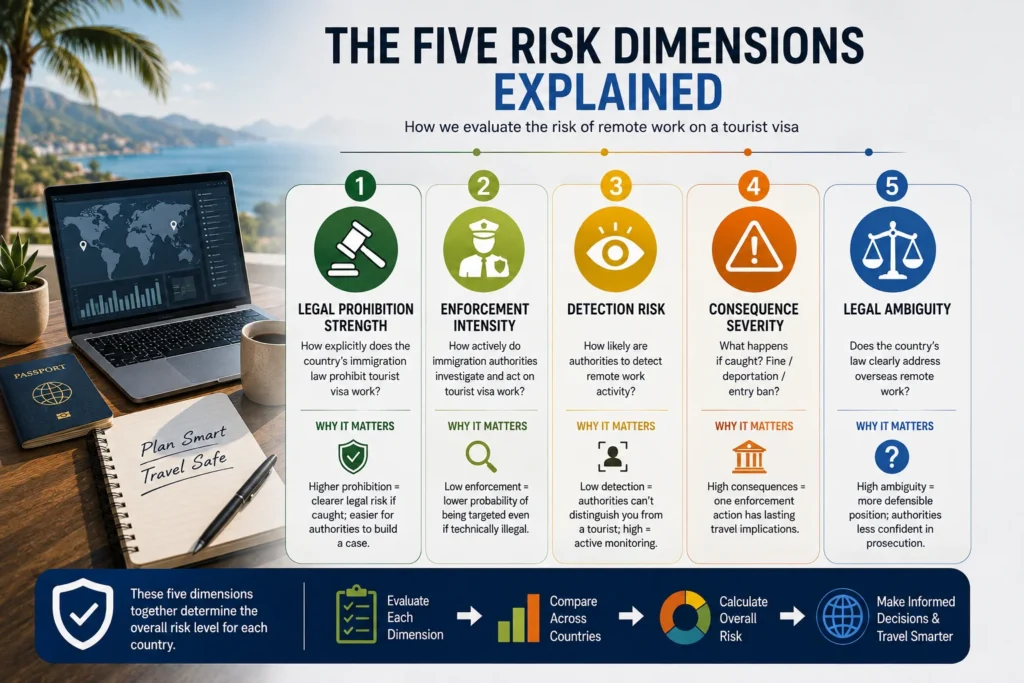
| Dimension | What It Means | Why It Matters |
| Legal prohibition strength | How explicitly does the country’s immigration law prohibit tourist visa work? Low = ambiguous; High = explicit prohibition | Higher prohibition = clearer legal risk if caught; easier for authorities to build a case |
| Enforcement intensity | How actively do immigration authorities investigate and act on tourist visa work? | Low enforcement = lower probability of being targeted even if technically illegal |
| Detection risk | How likely are authorities to detect remote work activity? | Low detection = authorities can’t distinguish you from a tourist; High = active monitoring |
| Consequence severity | What happens if caught? Fine / deportation / entry ban? | High consequences = one enforcement action has lasting travel implications |
| Legal ambiguity | Does the country’s law clearly address overseas remote work? | High ambiguity = more defensible position; authorities less confident in prosecution |
5. Additional Risk Considerations for Indian and Filipino Nationals
| INDIA-SPECIFIC RISK FACTORS Indian passport holders face compounded risk factors when working on tourist visas: Visa application record: Unlike EU or US passport holders who may enter many countries without a visa application, Indian passport holders apply for tourist visas for most destinations. This creates a documented record of intended stay purpose. Any enforcement action creates a discrepancy with the stated tourist purpose on that application.Visa overstay risk: Indian nationals are subject to more scrutiny at immigration for overstays and purpose-of-stay violations in some countries. An enforcement action can affect future visa applications to that country and potentially others.Practical recommendation: For Indian nationals, the case for obtaining a proper digital nomad visa is stronger than for those with visa-free access. DE Rantau (Malaysia), LTR/DTV (Thailand), and Remotely From Georgia are all accessible to Indian passport holders and remove all legal risk at costs ranging from MYR 1,000 to USD 63,800. |
| PHILIPPINES-SPECIFIC RISK FACTORS Filipino passport holders have some advantages in this context: ASEAN visa-free access: Filipinos enter Malaysia visa-free (30 days), Thailand visa-free (30 days), and several other ASEAN countries without visa applications. This reduces the ‘documented tourist intent’ risk factor slightly. Malaysia DE Rantau is the obvious upgrade: Filipino professionals can enter Malaysia visa-free and obtain DE Rantau endorsement from MDEC. The cost (MYR 1,000/year) is minimal. There is no practical reason to work on Malaysian tourist visa when DE Rantau is this accessible. BIR obligations continue: Philippines-specific: BIR filing obligations continue regardless of which country you are in or what visa you are on. Tourist visa work does not affect (positively or negatively) Philippine tax obligations. |
6. Legal Alternatives: The Correct Long-Term Path
For every major nomad destination discussed in this article, a formal legal alternative now exists or is accessible. The following table maps the risk level to the available legal visa:
| Country | Legal Visa / Permit | Approximate Income Requirement | Approximate Annual Cost |
| Georgia | Remotely From Georgia programme | USD 2,000/month equivalent | Very low (programme free; nominal costs) |
| Colombia | Digital Nomad Visa | ~USD 30,000/year | ~USD 200–300 application |
| Mexico | Temporary Resident Visa | Approximately MXN 26,000/month income | ~USD 300–500 |
| Bali / Indonesia | Social Visa (B211A) or E33G Nomad Visa | No income minimum stated for E33G | ~USD 200–400 per stay |
| Thailand | LTR WFT Visa or DTV | USD 40,000/year (LTR) or lower (DTV) | USD 63,800 (LTR 10yr) or lower (DTV) |
| Malaysia | DE Rantau Digital Nomad Pass | USD 24,000/year | MYR 1,000 (≈ USD 220/year) |
| Vietnam | No formal DNV currently | — | E-visa: 90 days; no remote work authorization |
| Portugal / EU | D8 Digital Nomad Visa (Portugal) | ~USD 3,200/month | ~EUR 200–500 application + NHR tax regime |
| UAE | Remote Work Visa or Freelance Permit | Varies by emirate and permit type | ~USD 1,500–3,000/year total |
| UK | No digital nomad tourist visa available | — | Consult UK immigration solicitor |
Frequently Asked Questions
Which countries have the lowest risk for working remotely on tourist visa?
Georgia, Colombia, and Mexico have the lowest enforcement risk based on legal ambiguity and historically minimal enforcement against overseas remote workers. Thailand and Malaysia are low-medium risk for digital nomads specifically. However, both now have formal digital nomad visa options (Thailand LTR/DTV; Malaysia DE Rantau) that eliminate legal risk entirely.
Is it legal to work remotely on a tourist visa?
In most countries, working remotely on a tourist visa is technically not permitted under immigration law, even if the work is for overseas clients. The law in most countries prohibits ‘work’ on a tourist visa, and most immigration law defines work broadly enough to include professional services for overseas clients. Low enforcement risk does not mean the activity is legal.
What happens if you get caught working on a tourist visa?
Consequences vary by country and severity: fine and warning (lower risk countries), deportation with re-entry ban (common outcome in medium-risk countries), multi-year entry ban (USA, UK, Schengen if serious), and potential impact on future visa applications to other countries. In high-risk countries (UAE, UK, USA), a single enforcement action can affect travel for years.
Can Indian citizens work remotely in Thailand or Malaysia on tourist visa?
Technically, no — both countries’ immigration laws require work authorization for professional work conducted on their soil. Enforcement against overseas remote workers is low in both countries. However, both countries now offer legal digital nomad visa options: Malaysia’s DE Rantau (USD 24,000/year, MYR 1,000/year fee) and Thailand’s LTR Visa (USD 40,000/year) and DTV. For Indian nationals, the legal route is the correct approach.
What is the safest way to work remotely internationally?
Obtain a digital nomad visa or remote work authorization in the country where you plan to stay. Most major nomad destinations now offer these: Georgia (Remotely From Georgia), Malaysia (DE Rantau), Thailand (LTR/DTV), Indonesia (Social Visa/E33G), Colombia (Digital Nomad Visa), Portugal (D8). The cost of legal compliance is almost always lower than the consequences of an enforcement action.
Final Verdict: The Risk Landscape Is Shifting Toward Legal Compliance
| The risk analysis in this article has a clear conclusion: the countries with the lowest risk for tourist visa remote work are also, increasingly, the countries with accessible formal digital nomad visa programmes. Georgia, Malaysia, Thailand, Colombia, Indonesia — the lowest-risk destinations for tourist visa work are precisely the destinations where legal alternatives exist at reasonable costs. The practical case for tourist visa remote work is weakening. Malaysia’s DE Rantau costs MYR 1,000/year and provides full legal authorization. Georgia’s Remotely From programme is effectively free. Thailand’s DTV provides a legal remote work option. The legal visa was historically more expensive and harder to access; the gap has narrowed dramatically. The correct sequence: understand the risk landscape (this article), identify the legal visa option for your preferred destination (use the links below), and obtain that visa as soon as you qualify. Tourist visa remote work as a long-term strategy is increasingly unnecessary and avoidable. MeridianNomad covers the legal visa options for every major destination in this article. Start with your preferred country’s guide using the navigation links below. |